Images of Old Hawaiʻi

  • Home
  • About
  • Categories
    • Ali’i / Chiefs / Governance
    • American Protestant Mission
    • Buildings
    • Collections
    • Economy
    • Missionaries / Churches / Religious Buildings
    • General
    • Hawaiian Traditions
    • Other Summaries
    • Mayflower Summaries
    • Mayflower Full Summaries
    • Military
    • Place Names
    • Prominent People
    • Schools
    • Sailing, Shipping & Shipwrecks
    • Voyage of the Thaddeus
  • Collections
  • Contact
  • Follow

February 3, 2022 by Peter T Young 1 Comment

Georges Phillipe Trousseau

Georges Trousseau was born in Paris on May 1, 1833 to a prominent Parisian family. His father, Armand Trousseau, a distinguished physician and surgeon, was also the author of medical books used throughout the world.  (Greenwell)

He received the usual education of a wealthy Frenchman and entered the ecole de medicine in Paris at the early age of 15.  (Hawaiʻi Holomua, May 5, 1894)

From the days in 1848 and 1852, when he as a student fought in the streets of Paris, he has unswervingly believed in the rights of the people – and early or late was he found ready to serve them as a physician as a friend or simply as a fellow-man.  (Hawaiʻi Holomua, May 5, 1894)

Trousseau married Edna Vaunois, who was also from Paris; they had two children, Armond and Rene in 1856 and 1857.  In 1865, the couple was legally separated (but never divorced.)

He followed his father’s footsteps and graduated from the Paris School of Medicine as a physician in 1858.  He became an army surgeon, seeing service in Algiers early in the fifties. He also served at Solferino and Magenta, Italy.  (Greenwell)

For personal reasons, he left France and went to Australia and New Zealand.  In part, he was at the Australian gold mines, but did not strike it rich; in fact, his estranged wife loaned him money while he was there.  (Greenwell, Hawaiʻi Holomua, May 5, 1894)

He left there and arrived in Hawaiʻi in 1872.  Almost immediately upon his arrival, he was appointed by the Board of Health to serve as Port Physician for Honolulu (there was no salary attached to the office; fees for services were worked out between the Port Physician and the ship/agent the usual charge was $25.)  (Greenwell)

He soon gained great fame as a doctor.  He served on the Board of Health for 20-years, serving as a Board member and as President.   He took an interest in Leprosy and supervised the leper treatment center in Kalihi.

In 1865, the legislature of the Hawaiian Islands had passed “An Act to Prevent the Spread of Leprosy.” This law called for a place to be set aside for the isolation of those found to have leprosy in order to curb the spread of the disease.  It was not until 1873, however, on Doctor Trousseau’s recommendation, that a vigorous effort was made to segregate lepers.  (Greenwell)

“Trousseau strongly urging that the only method, at all likely to be successful, was the immediate, energetic, and to a certain extent, unsympathetic isolation of all who were afflicted with the disease, and even that would require a generation in all probability to prove successful.”  (Board of Health, March 1, 1873)

He diagnosed Father (now Saint) Damien’s leprosy.  “… In January, 1885 Damien visited Honolulu … (and accidentally) scalded his left foot. Father Leonore, the provincial of the mission, phoned for Dr George Trousseau, whose examination of the priest’s foot and leg proved they were devoid of feeling … this discovery indicated that the peroneal nerve and its branches were dead due to leprosy.”  (Mouritz; Bushnell)

Though not an official title, Trousseau served as royal physician.  He was called on as a consultant by Doctor Ferdinand W Hutchison, Minister of the Interior, during Kamehameha V’s last illness and was at the King’s bedside when he died.

In August 1873, when it was apparent that King Lunalilo was ill, Trousseau accompanied the King and stayed with Lunalilo at Huliheʻe Palace in Kailua- Kona, from mid-November to the middle of January 1874.  After it became apparent that Lunalilo was not going to recover, and the royal party returned to Honolulu where Lunalilo died on February 3.  (Greenwell)

The rulers of Hawaiʻi honored him.   Lunalilo made him a major in his staff and his personal physician. Kalākaua befriended him and appointed him the executor of his will and the administrator of his estate.  (Hawaiʻi Holomua, May 5, 1894)

“(H)e was always ready to promote any now industry that might prove a source of benefit to his adopted country.”  This got him involved in sheep, sugar and ostriches.  (Hawaiʻi Holomua, May 5, 1894)

In 1875, he gave up his Honolulu medical practice and moved to Kona, Hawaiʻi, where he purchased a sheep and cattle ranch at Kanahaha high on the slopes of Mauna Loa.  Wool was baled at Kanahaha and transported by cart to Kainaliu Beach, from where it was shipped. (Greenwell)

A road was constructed which ran from Kanahaha on Mauna Loa, to the beach at Kainaliu (where he also had a home.) (This old cart road is used by jeeps today and is known as the Trousseau Trail.)  Early in 1879, Trousseau sold all of his holdings in Kona to Henry N Greenwell.

After selling the sheep ranch, Trousseau bought out two sugar planters at Kukuihaele on the Hāmākua coast. He became partners in the Pacific Sugar Mill with the Purvis family. Trousseau had an excellent relationship with John Purvis and his son Herbert.  (Greenwell)

The plantation thrived for a time.  However, defects in the furnace caused difficulties.  In 1881, Trousseau suddenly and unexpectedly sold his half in the plantation to his partners.  He moved back to Honolulu and resumed his medical practice.

He tried one last agricultural venture there.  “The doctor started a new industry for these islands a few years ago (1890) by establishing an ostrich farm at Kapiʻolani Park. Many young birds have been bred from the original stock, and some of the feathers have gone into domestic exports. The farm was under the management of Captain John Morriseau (Trousseau’s nephew.)”  (Daily Bulletin, May 5, 1894)

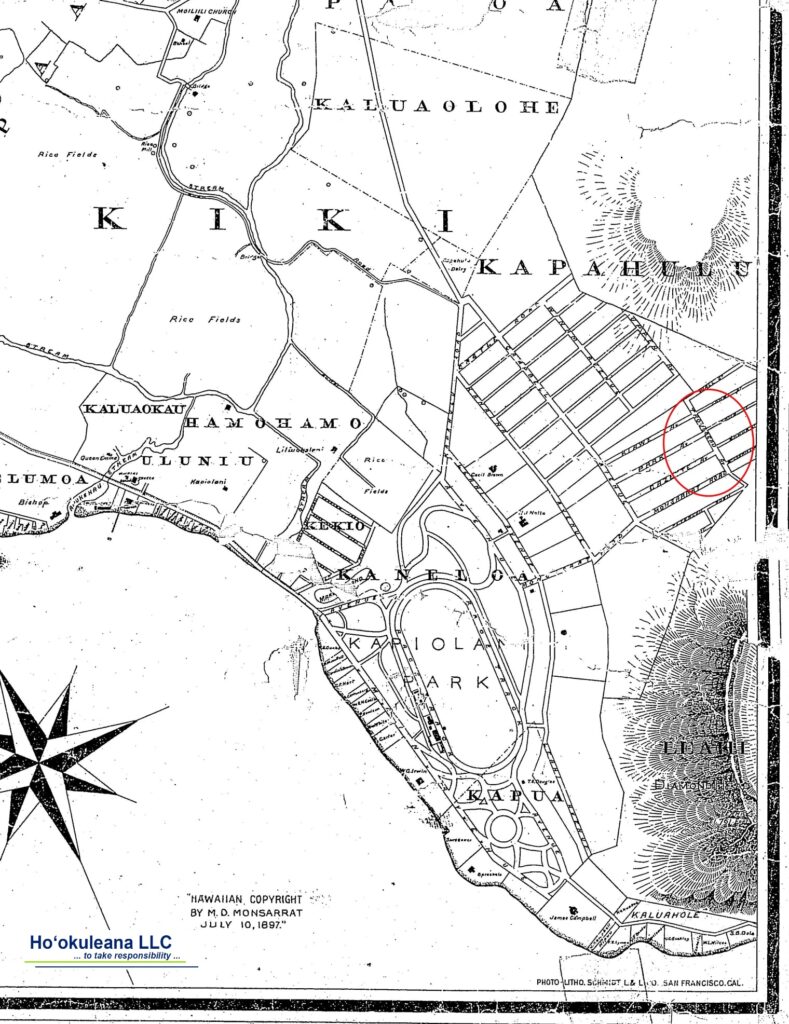
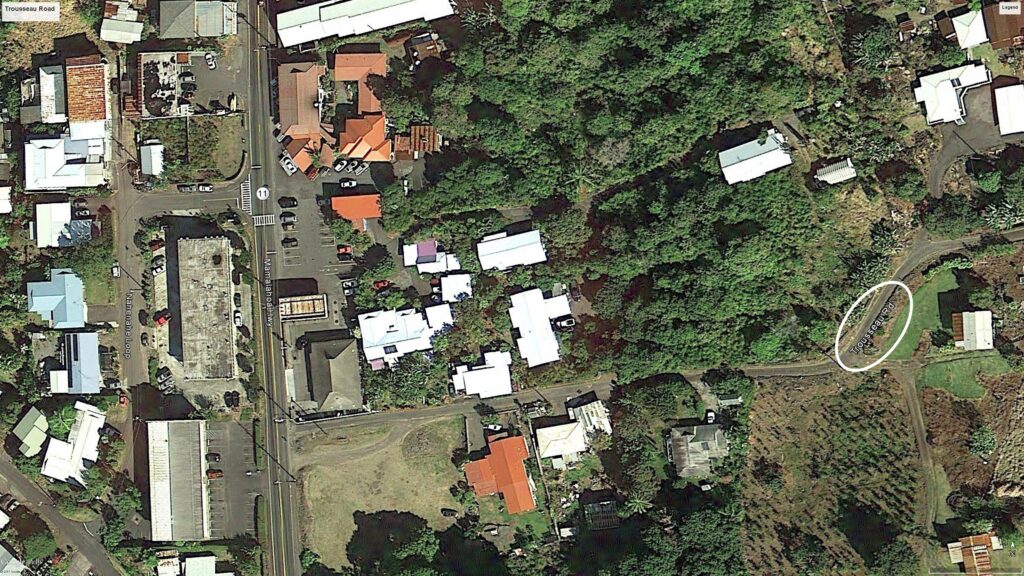
The 1,000-acre farm (purchased from the Lunalilo Estate) was located in the Kapahulu area near the present zoo; Paul Isenberg, who owned a nearby cattle ranch, later purchased the farm (Trousseau Street notes the general location.)

Though Trousseau never divorced, he did have a mistress, Makanoe; Makanoe was also married (to Kaʻaepa.)  (This relationship is referred to as ‘punalua;’ an association in which, typically, two women, often sisters, share one husband, or, as in Makanoeʻs case, two men share the affection of one woman.)  (Greenwell)

Trousseau died May 4, 1894, shortly after Kaʻaepa’s death.  Makanoe buried her husband and Trousseau side by side in a wrought iron fenced plot at Makiki Cemetery on Oʻahu.  Trousseau left all of his estate to Makanoe (she eventually moved to Salt Lake City, Utah.)

Trousseau faithfully supported the Hawaiian Monarchy and stood up for the royalists which caused bitter feelings among many of his associates who backed the annexationists.

In spite of this, his obituary noted, “It is seldom that people of all classes, opposed to each other socially and politically can gather around the bier of a fellow-citizen and unite in saying, ‘we have lost a friend.’”  (Hawaiʻi Holomua, May 5, 1894)

“Dr. Trousseau was a strong nationalist of Hawaiʻi, who believed that none but born or naturalized subjects should have a determining voice in national affairs. The Hawaiian people, who revered and confided in him, will take his death as a sort bereavement.”  (Daily Bulletin, May 5, 1894)  (Lots of information here from Jean Greenwell.)

© 2022 Hoʻokuleana LLC


Filed Under: Prominent People Tagged With: Oahu, King Kalakaua, Lunalilo, Molokai, Saint Damien, Hansen's Disease, Georges Trousseau, Hawaii, Hawaii Island

January 5, 2020 by Peter T Young 1 Comment

Hawaiʻi National Anthem

The history of Hawaiʻi’s National Anthems generally starts in 1861. Before then, the kingdom of Hawaiʻi did not have its own anthem, but used the British royal anthem “God Save the King”.

E Ola ka Mō‘ī i ke Akua (“God Save the King”) (Lunalilo)

The Hawaiian language newspaper, Ka Nūpepa Kū‘oko‘a, wishing to promote a Hawaiian national song sponsored an anthem writing contest in 1861. The rules specified four stanzas in the Hawaiian language, but still set to the tune of God Save the King.

Fifteen anonymous entries were submitted. In January of 1862, the judges chose an entry titled “E Ola ka Mō‘ī i ke Akua” as the winner. The composer was Prince William Lunalilo, age 27; his prize was $10.00.

His song was a faithful translation of “God Save The King” into Hawaiian, yet it fits the music of the British tune. Lunalilo’s new song was sung first on the birthday of Kamehameha IV.

E Ola ka Mō‘ī i ke Akua
http://www.youtube.com/watch?v=xqRB83I3X24

He Mele Lahui Hawaiʻi (“The Song of the Hawaiian Nation”) (Liliʻuokalani)

King Kamehameha V wanted to replace the translated British anthem by a song with a truly Hawaiian background. At the request of King Kamehameha V, the new song “He Mele Lāhui Hawaiʻi” (“The Song of the Hawaiian Nation”) was composed in 1868 by Mrs. John Dominis (later known as Queen Liliʻuokalani.)

Liliʻuokalani’s memoir, Hawaiʻi’s Story by Hawaiʻi’s Queen, stated: “In the early years of the reign of Kamehameha V, he brought to my notice the fact that the Hawaiian people had no national air. Each nation, he said, but ours had its statement of patriotism and love of country in its own music; but we were using for that purpose on state occasions the time-honored British anthem, ‘God save the Queen.'” (Liliʻuokalani)

“This he desired me to supplant by one of my own composition. In one week’s time I notified the king that I had completed my task. The Princess Victoria had been the leader of the choir of the Kawaiahaʻo church; but upon her death, May 29, 1866 I assumed the leadership. It was in this building and by that choir that I first introduced the ‘Hawaiian National Anthem.’” (Liliʻuokalani)

“The king was present for the purpose of criticising my new composition of both words and music, and was liberal in his commendations to me on my success. He admired not only the beauty of the music, but spoke enthusiastically of the appropriate words, so well adapted to the air and to the purpose for which they were written.” (Liliʻuokalani)

The lyrics of this song praise the Hawaiian Islands. It asks the lord for blessing for the land, its people, chiefs and king. Liliʻuokalani was then the leader of the Kawaiahaʻo church choir, which introduced the new anthem in a public service.

He Mele Lahui Hawaiʻi
http://www.youtube.com/watch?v=oIDoJUpa7cE

Hawaiʻi Ponoʻī (“Hawaiʻi’s own”) (Kalākaua)

King David Kalākaua (brother of Liliʻuokalani) wrote the words to “Hymn to Kamehameha I” (Hawaiʻi Ponoʻī) in 1874 and the music was composed by Captain Henri Berger, then the king’s royal bandmaster.

Hawaiʻi Ponoʻī was one of the national anthems of the Republic of Hawaiʻi and the Kingdom of Hawaiʻi, having replaced Liliʻuokalani’s composition He Mele Lahui Hawaiʻi.

Hawaiʻi Ponoʻī was the adopted song of the Territory of Hawaiʻi; and later became the State song for the State of Hawaiʻi, by an act of the Hawaiʻi State Legislature in 1967:

“HRS-§5-10 State song. The song “Hawai‘i Pono‘i” is adopted, established, and designated as the official song of the State, to be effective for as long as the legislature of the State does not otherwise provide.”

Hawaiʻi Ponoʻī
http://www.youtube.com/watch?v=ymLBxhHteh4

Follow Peter T Young on Facebook 

Follow Peter T Young on Google+ 

Follow Peter T Young on LinkedIn  

Follow Peter T Young on Blogger

© 2020 Hoʻokuleana LLC

Filed Under: General Tagged With: Lunalilo, Berger, Hawaii Ponoi, Hawaii, Liliuokalani, Kalakaua

June 27, 2019 by Peter T Young Leave a Comment

Hale Ali‘i

When the seat of government was being established in Lāhainā in the 1830s, Hale Piula (iron roofed house,) a large two-story stone building, was built for Kamehameha III to serve as his royal palace.

But, by 1843, the decision was made to permanently place a palace in Honolulu; Hale Piula was then used as a courthouse, until it was destroyed by wind in 1858 – its stones were used to rebuild a courthouse on Wharf Street.

In Honolulu, Kekūanāo‘a (father of two kings, Kamehameha IV and V) was building a house for his daughter (Princess Victoria Kamāmalu.)

The original one story coral block and wooden building called Hanailoia was built in July 1844 on the grounds of the present ‘Iolani Palace.

But, in 1845 Kamehameha III took possession of it as his Palace; from then on, Honolulu remained the official seat of government in Hawai‘i.

At the time when Kekūanāo‘a erected the old Palace, the grounds were not so spacious as they are at present.  On the western corner was Kekūanaō‘a’s house, which he had named Hali‘imaile.

Kekauluohi, a premier, erected her house in the vicinity.  When John Young was premier, he built and lived in Kīna‘u Hale.  Also, on the premises was Pohukaina.

The site of the Palace was once a section of the important heiau (temple,) Ka‘ahaimauli; other heiau were also in the vicinity of the Palace, including Kanela‘au and Mana.

The Palace was used mainly of official events and the structure had mainly offices and reception areas, since smaller buildings on the grounds served as residences for the rulers and their court; it was only one-third the floor area of the present Palace.

Kamehameha III built a home next door (on the western side of the present grounds, near the Kīna‘u gate, opening onto Richards Street;) he called the house “Hoihoikea,” (two authors spell it this way – it may have been spelled Hoihoiea) in honor of his restoration after the Paulet Affair of 1843. (Taylor and Judd)

(In 1843, Paulet had raised the British flag and issued a proclamation annexing Hawai‘i to the British Crown.  This event became known as the Paulet Affair.  Queen Victoria sent Rear Admiral Richard Thomas to restore the Hawaiian Kingdom.  That day is now referred to as Ka La Hoʻihoʻi Ea, Sovereignty Restoration Day.)

“Hoihoikea” was a large, old-fashioned, livable cottage erected on the grounds a little to the west and mauka side of the old Palace.  This served as home to Kamehameha III, Kamehameha IV and Kamehameha V: the Palace being used principally for state purposes. (Taylor)

The palace building was named Hale Ali‘i meaning (House of the Chiefs.)

During the reign of Kamehameha V, cabinet councils were frequently held there.  This was where the council called the Constitutional Convention, the result of which was the abolition of the constitution of 1852 and the creation of a new one.

Hale Ali‘i was renamed ‘Iolani in 1863, at the request of King Kamehameha V (Lot Kapuāiwa.)  The name “‘Iolani” was chosen by King Kamehameha V to honor his deceased brother, the former king, Kamehameha IV (Alexander Liholiho ‘Iolani.)

“‘Io” is the Hawaiian hawk, a bird that flies higher than all the rest, and “lani” denotes heavenly, royal or exalted.

The Palace served as the official state structure for five Kings: Kamehameha III, Kamehameha IV, Kamehameha V, Lunalilo and the first part of Kalākaua’s reign.

Theodore Heuck, who had earlier designed the new Mausoleum, designed a building called ‘Iolani Barracks, completed in 1871, to house the royal guards. Over time the various other houses on the grounds were removed and replaced with grass lawns.

Although the old palace was demolished in 1874, the name ʻIolani Palace was retained for the building that stands today.

The construction of the present ‘Iolani Palace began in 1879 and in 1882 ‘Iolani Palace was completed and furnished.

Follow Peter T Young on Facebook 

Follow Peter T Young on Google+ 

Follow Peter T Young on LinkedIn  

Follow Peter T Young on Blogger

© 2019 Hoʻokuleana LLC

Pohukaina-in_front_of_Hale_Alii-original_Iolani_Palace-1850s
White building in the front is old royal Mausoleum-Pohukaina. Wooden building behind it is original ʻIolani Palace
Former_Iolani_Palace-before-1879
Hale_Alii_illustration
Hale_Aliʻi_in_1857
Hale_Aliʻi_with_Royal_Guards_(before 1879
Old_Iolani_Palace_and_adjacent_premises,_ca._1850s
Palace_of_King_Kamehameha_III,_from_the_harbor_(c._1853)
The old palace, which was built in 1845 and was replaced by Iolani Palace in 1882
Hale_Alii-front_and_Floor_Plan-(Judd-Palaces_and_Forts)
No._2._View_of_Honolulu-Emmert-c._1854)-(portion-Hale_Alii_is to the right - flag in front-Kawaiahao Church behind)
'Io, the Endemic Hawaiian Hawk

Filed Under: Ali'i / Chiefs / Governance, Buildings Tagged With: Kauikeaouli, Kamehameha III, Hale Alii, Kekuanaoa, Hawaii, Kalakaua, Iolani Palace, Lunalilo, Kamehameha V, Kamehameha IV

April 30, 2019 by Peter T Young 2 Comments

Hawaiian Dynasties

The Kamehameha Dynasty ruled for nearly a century from the late-1700s to the late-1800s, while the Kalākaua Dynasty ruled from 1874 to 1893.

Kamehameha Dynasty

Kamehameha I, Paiʻea, Kamehameha the Great (1758-1819)
Born in North Kohala on the Big Island, Kamehameha united all the major islands under one rule in 1810.

The king traded with foreign ships arriving in the islands and enlisted some of the foreigners into his service. During his reign, the export of sandalwood to the Orient brought about the ability for island chiefs to purchase merchandise from abroad.

Kamehameha II, Liholiho – (1796-1824)
The son of Kamehameha and his sacred wife Keōpūolani, Liholiho overthrew the ancient kapu system by allowing men and women of the court to eat at the same table. At the same time, he announced that the heiau (temples) should be destroyed with all the old idols.

Believing like his father that the islands were under the protection of Great Britain, Liholiho and his favorite wife Kamamalu traveled to England in May of 1824, where they were received by the government of King George IV. However, measles afflicted the royal party and Kamāmalu died on July 8 followed by Liholiho on July 14, 1824.

Kamehameha III, Kauikeaouli (1813-1854)
The younger brother of Liholiho had the longest reign in Hawaiian history. He was 10 years old when he was proclaimed king in 1825 under a regency with Ka‘ahumanu, his father’s favorite queen, as joint ruler.

Realizing the need for written laws to control growing problems brought about by increasing numbers of foreigners settling in the kingdom, the declaration of rights, called the Hawaiian Magna Charta, was issued on June 7, 1839. The rights of residents were repeated in the Constitution of 1840.

The Great Mahele (division), the first legal basis for land ownership in the kingdom, was enacted and divided the land between the king, his chiefs and others.

Kamehameha IV, Alexander Liholiho (1834-1863)
The nephew of Kauikeaouli, Alexander Liholiho was the son of Kekūanāoʻa and his wife Kīna‘u, the grandson of Kamehameha I, younger brother of Lot Kapuāiwa and elder brother of Victoria Kamāmalu.

He ascended to the throne after the death of his uncle in December of 1854. On June 19, 1856, he married Emma Rooke.

Concerned about the toll that foreign diseases were taking on his subjects, the king signed a law on April 20, 1859 that established a hospital in Honolulu for sick and destitute Hawaiians. He and Emma personally solicited funds to erect Queen’s Hospital, named in honor of Emma.

Kamehameha V, Lot Kapuāiwa (1830-1872)
Four years older than his brother Kamehameha IV, Lot would also rule for just nine years. In 1864, when it appeared that a new constitution could not be agreed upon, he declared that the Constitution of 1852 be replaced by one he had written himself.

Known as “the bachelor king,” Lot Kamehameha did not name a successor, which led to the invoking of the constitutional provision for electing kings of Hawai`i.

William Charles Lunalilo (1835-1874)
The grandson of a half-brother of Kamehameha I, Lunalilo was the son of Charles Kanaina and Kekauluohi, a sister of Kīnaʻu.

He defeated David Kalākaua in 1873 to become the first king to be elected (therefore, technically, not a part of the Kamehameha Dynasty, although he was related.) He offered many amendments to the Constitution of 1864, such as abolishing the property qualifications for voting.

Lunalilo died of tuberculosis on February 3, 1874, a little more than a year after his election. He became the first Hawaiian to leave his property to a work of charity, creating the Lunalilo Home, which accommodates elderly Hawaiians who are poor, destitute and infirm.

Kalākaua Dynasty

David Kalākaua (1836-1891)
After the death of Lunalilo, Kalākaua (married to Kapiʻolani) ran against and defeated the queen dowager, Emma. Kalākaua was the first king in history to visit the United States.

“The Merry Monarch” was fond of old Hawaiian customs, and he attempted to restore the people’s lost heritage – such actions gave rise to anti-monarchy movements, such as the Reform Party.

In 1887, Kalākaua signed the “Bayonet Constitution,” (signed under threat of an armed uprising) that stripped the king of most of his power and gave foreigners the right to vote. Kalākaua died while on a trip to San Francisco on January 20, 1891, leaving his younger sister Liliuokalani to ascend the throne.

Queen Lili‘uokalani, Lydia Kamakaʻeha Pākī (1839-1917)
Liliʻuokalani (married to John Owen Dominis and living at his mother’s home, Washington Place) inherited the throne from her brother, King Kalākaua, on January 29, 1891.

Two years later, a group composed of Hawaiian Nationals, Americans and Europeans formed a Committee of Safety seeking to overthrow the Hawaiian Kingdom, depose the Queen and seek annexation to the United States; the Queen was deposed on January 17, 1893.

Queen Lili‘uokalani flew the US flag over her personal residence, Washington Place, in 1917 to mourn and honor Hawaiians killed in World War I.

Follow Peter T Young on Facebook 

Follow Peter T Young on Google+ 

Follow Peter T Young on LinkedIn  

Follow Peter T Young on Blogger

© 2019 Hoʻokuleana LLC

Kamehameha-Kalakaua_Dynasties
Collage of Kamehameha and Kalakaua dynasties-HSA
Collage of images of Kamehameha and Kalakaua dynasties-HSA

Filed Under: Ali'i / Chiefs / Governance Tagged With: Kamehameha IV, Kamehameha V, Queen Emma, Kaahumanu, Kauikeaouli, Kamehameha III, Keopuolani, Hawaii, Kamamalu, Queen Liliuokalani, Kalama, Kalakaua, Liholiho, Kapiolani, Kamehameha II, Lunalilo, Kamehameha

March 1, 2018 by Peter T Young Leave a Comment

Grandmother of Three Kings

Kalākua (also Kaheiheimālie) was daughter of Keʻeaumoku, a chief from Hawaiʻi Island and Namahana, from the royal family on Maui.

Kalākua’s siblings included Queen Kaʻahumanu, Hawaiʻi Island Governor John Adams Kuakini, Maui Governor George Cox Kahekili Keʻeaumoku II and Lydia Nāmāhāna Piʻia. She was described as physically being ‘tall and gigantic,’ like her siblings. (Bingham)

“(Kalākua) was never a woman to indulge in flirtations, and her name was never coupled with gossip. She may have had her longings, but she remained true to her husband; and her children were never rumored to have been born of a double paternity like so many of the chiefs.”

“Double paternity was considered an honor because it gave a double or triple line of chiefly descent, thick and intermingled, and formed an honorable ancestry doubly blessed in such riches and knowledge as chiefs desire.”

“Not so (Kalākua,) who considered herself sufficiently honored with the root already established. Kamehameha was her uncle, and both he and Keʻeaumoku were directly descended from Haʻae.” (Kamakau)

She first married Kalaʻimamahu, the brother of Kamehameha I. They had a daughter, Kekāuluohi; Kekāuluohi became Kamehameha’s youngest wife.

Liholiho (Kamehameha II) later took her as one of his wives and around 1821 Kamehameha II gave Kekāuluohi to his friend Charles Kanaʻina. By Kanaʻina, Kekāuluohi had a son William Charles Lunalilo (the first grandson of Kalākua to become king.)

Kekāuluohi succeeded her half-sister Kīnaʻu as Kuhina Nui. Initially, she was considered something of a “place-holder” for Kīnaʻu’s infant daughter Victoria Kamāmalu, who would later assume the office. (Archives)

Kalākua was also married to Kamehameha I; she had four children. Their two sons died as infants; the oldest daughter, Kamāmalu, became wife of Liholiho (Kamehameha II,) and the youngest daughter, Kīnaʻu, later became Kuhina Nui.

Kīnaʻu later married Mataio Kekūanāoʻa; they had several children, including Alexander Liholiho (the second grandson of Kalākua to become king, known as Kamehameha IV), Lot Kapuāiwa (the third grandson of Kalākua to become king, as Kamehameha V,) and Victoria. (Liliʻuokalani) That made Kalākua grandmother of three future Kings.

“The death of Kamehameha made the first separation from the man she had lived with for twenty years. There was no woman of his household whom Kamehameha loved so much as (Kalākua.)

“Kamehameha is never known to have deserted (Kalākua,) but it has often been said that she did not love him so much as her first husband Kalaʻimamahu from whom Kamehameha took her away.” (Kamakau)

“In September, 1823, she heard in Hawaii of Keōpūolani’s death and sailed at once for Lāhainā to attend the burial ceremonies. The chiefs had all assembled at Lāhainā, the body of the chiefess had been concealed, and (Hoapili) was in mourning.”

“After the days of mourning were ended (Kalākua) became the wife of (Hoapili) (October 19, 1823,) they became converted, were married under Christian vows, and took the names of Hoapili-kāne and Mary Hoapili-wahine [the Hawaiian form of Mr. and Mrs.]”

“At this time she had not thought much about religion. The chiefs took to drinking and sensual indulgence after the death of the chiefess [Keōpūolani], but (Kalākua) listened to the word of God as taught by the missionaries although in her heart she still enjoyed life and fun.”

“Hoapili had accepted the word of God because of Keōpūolani. (Kalākua) turned to Christianity first, and Kaʻahumanu followed.” (Kamakau)

Follow Peter T Young on Facebook 

Follow Peter T Young on Google+ 

Follow Peter T Young on LinkedIn  

Follow Peter T Young on Blogger

© 2018 Hoʻokuleana LLC

Hoapiliwahine_by_C._C._Armstrong
Kamehameha_IV_(PP-97-8-006)
Queen_Emma_and_Kamehameha_IV-between 1856 and 1863
Prince_Lot_Kapuaiwa_(PP-97-9-007)
Kamehameha_V-PPWD-15-6-016-1865
The young Prince William Charles Lunalilo in his teens
King_Lunalilo
King_Lunalilo

Filed Under: Ali'i / Chiefs / Governance Tagged With: Hoapiliwahine, Kalaimamahu, Hawaii, Lunalilo, Alexander Liholiho, Hoapili, Kalakua, Liholiho, Kamehameha, Lot Kapuaiwa, Kanaina

  • « Previous Page
  • 1
  • 2
  • 3
  • 4
  • 5
  • Next Page »

Images of Old Hawaiʻi

People, places, and events in Hawaiʻi’s past come alive through text and media in “Images of Old Hawaiʻi.” These posts are informal historic summaries presented for personal, non-commercial, and educational purposes.

Info@Hookuleana.com

Connect with Us

  • Email
  • Facebook
  • LinkedIn
  • Twitter
  • YouTube

Recent Posts

  • Homeless
  • 250 Years Ago … Signing the Declaration of Independence
  • Nanaue
  • Nationality
  • About 250 Years Ago … Lafayette Comes to America
  • ʻŌhiʻa
  • Waiʻalae Shopping Center

Categories

  • Prominent People
  • Schools
  • Sailing, Shipping & Shipwrecks
  • Economy
  • Voyage of the Thaddeus
  • Mayflower Summaries
  • American Revolution
  • General
  • Ali'i / Chiefs / Governance
  • Buildings
  • Missionaries / Churches / Religious Buildings
  • Hawaiian Traditions
  • Military
  • Place Names

Tags

Albatross Al Capone Ane Keohokalole Archibald Campbell Bernice Pauahi Bishop Charles Reed Bishop Downtown Honolulu Eruption Founder's Day George Patton Great Wall of Kuakini Green Sea Turtle Hawaii Hawaii Island Hermes Hilo Holoikauaua Honolulu Isaac Davis James Robinson Kamae Kamaeokalani Kameeiamoku Kamehameha Schools Lalani Village Lava Flow Lelia Byrd Liberty Ship Liliuokalani Mao Math Mauna Loa Midway Monk Seal Northwestern Hawaiian Islands Oahu Papahanaumokuakea Marine National Monument Pearl Pualani Mossman Quartette Thomas Jaggar Volcano Waikiki Wake Wisdom

Hoʻokuleana LLC

Hoʻokuleana LLC is a Planning and Consulting firm assisting property owners with Land Use Planning efforts, including Environmental Review, Entitlement Process, Permitting, Community Outreach, etc. We are uniquely positioned to assist you in a variety of needs.

Info@Hookuleana.com

Copyright © 2012-2024 Peter T Young, Hoʻokuleana LLC

Loading Comments...