Images of Old Hawaiʻi

  • Home
  • About
  • Categories
    • Ali’i / Chiefs / Governance
    • American Protestant Mission
    • Buildings
    • Collections
    • Economy
    • Missionaries / Churches / Religious Buildings
    • General
    • Hawaiian Traditions
    • Other Summaries
    • Mayflower Summaries
    • Mayflower Full Summaries
    • Military
    • Place Names
    • Prominent People
    • Schools
    • Sailing, Shipping & Shipwrecks
    • Voyage of the Thaddeus
  • Collections
  • Contact
  • Follow

November 30, 2022 by Peter T Young Leave a Comment

Queen For A Day

The aliʻi attained high social rank in several ways: by heredity, by appointment to political office, by marriage or by right of conquest. The first was determined at birth, the others by the outcomes of war and political processes.

King Kamehameha I conquered most of the islands by late-1795 and negotiated a peaceful unification of the islands under single rule in 1810.  Before this, the Hawaiian Islands were ruled by a network of independent island kings (High Chiefs called Aliʻi Nui) through most of its history.

Queen Kaʻahumanu was Kamehameha’s favorite wife; but her role in leadership became more than that.  She was, at one time, arguably, the most powerful figure in the Hawaiian Islands, helping usher in a new era for the Hawaiian kingdom.

When Kamehameha died on May 8, 1819, the leadership was passed to his son, Liholiho, who would rule as Kamehameha II.  At that time, Kaʻahumanu created the office of Kuhina Nui and would rule as an equal with Liholiho.

Ka‘ahumanu assumed control of the business of government, including authority over land matters, the single most important issue for the Hawaiian nation for many generations to come.

The Kuhina Nui was a unique position in the administration of Hawaiian government and had no specific equivalent in western governments of the day. It has been described in general terms as “Prime Minister,” “Premier” and “Regent.”

The Kuhina Nui held equal authority to the king in all matters of government, including the distribution of land, negotiating treaties and other agreements, and dispensing justice.

Kamehameha III established Hawai‘i’s first constitution in 1840, where the office of Kuhina Nui was first codified.  The Kuhina Nui’s primary judicial responsibility over “life and death, condemnation and acquittal” became institutionalized in that constitution (1840.)  The Kuhina Nui was also given the duty of presiding, with the King, over the Supreme Court.

Article 45 of the 1852 Constitution of Hawaiian Kingdom stated: “Art. 45. All important business of the kingdom which the King chooses to transact in person, he may do, but not without the approbation of the Kuhina Nui. The King and Kuhina Nui shall have a negative on each other’s public acts.”

The Constitution of 1852 further clarified some of the office’s responsibilities, including its authority in the event of the King’s death or minority of the heir to the throne.  The office of Kuhina Nui functioned from 1819 to 1864, through the reigns of Kamehameha II, III, IV and V.

Kaʻahumanu was such a powerful person and Kuhina Nui that subsequent female Kuhina Nui adopted her name, Kīna‘u (Kaʻahumanu II) (1832-1839,) Kekāuluohi (Kaʻahumanu III) (1839-1845) and Victoria Kamāmalu (Kaʻahumanu IV) (1855-1863.)  (Keoni Ana (1845-1855) and Mataio Kekūanāo‘a (1863-1864) were the male Kuhina Nui.)

The Constitution (1852 – Article 47) further stated that the Kuhina Nui (Premier), in absence of a Monarch, would fill the vacant office.  “Whenever the throne shall become vacant by reason of the King’s death, or otherwise, and during the minority of any heir to the throne, the Kuhina Nui, for the time being, shall, during such vacancy or minority, perform all the duties incumbent on the King, and shall have and exercise all the powers, which by this Constitution are vested in the King.”

This situation occurred once, when Kuhina Nui Victoria Kamāmalu (Kaʻahumanu IV) assumed the powers of the monarchy – and, was conceptually “Queen” for a day – the first sole-ruling female of the Kingdom of Hawaiʻi.   Here’s how it happened.

On April 6, 1853, Alexander Liholiho was named successor to the office of the Constitutional Monarch by King Kamehameha III, in accordance with Article 25 of the Constitution of 1852. Article 25 provided that the “…successor (of the Throne) shall be the person whom the King and the House of Nobles shall appoint and publicly proclaim as such, during the King’s life…”

Alexander Liholiho succeeded Kamehameha III on December 15, 1854 (at the death of Kamehameha III) and served as Kamehameha IV.

Victoria Kamāmalu became Kuhina Nui in 1855 by appointment by her brother, Alexander Liholiho (Kamehameha IV.)  Kamehameha IV ruled for nine years; he died unexpectedly on November 30, 1863, without naming a successor.

Following the provisions of the Constitution, on November 30, 1863, Kuhina Nui Victoria Kamāmalu became the first female Head of State in Hawaiʻi (149-years ago, today.)

After consulting with the Privy Councilors, Kuhina Nui Victoria Kamāmalu proclaimed in front the Legislature:

“It having pleased Almighty God to close the earthly career of King Kamehameha IV, at a quarter past 9 o’clock this morning, I, as Kuhina Nui, by and with the advice of the Privy Council of State hereby proclaim Prince Lot Kamehameha, King of the Hawaiian Islands, under the style and title of Kamehameha V. God preserve the King!”

Kamehameha V had not named a successor to the throne before he died on December 11, 1872. Lunalilo, heir apparent to the throne, wanted his people to choose their next ruler in a democratic manner and requested a vote be held on New Year’s Day following the death of Kamehameha V.

He therefore noted, “Whereas, it is desirable that the wishes of the Hawaiian people be consulted as to a successor to the Throne, therefore, notwithstanding that according to the law of inheritance, I am the rightful heir to the Throne, in order to preserve peace, harmony and good order, I desire to submit the decision of my claim to the voice of the people.” (Lunalilo, December 16, 1872)

Prince David Kalākaua and others not in the Kamehameha lineage, chose to run against Prince Lunalilo.  The people on every island unanimously chose William Charles Lunalilo as King. (lunalilo-org)

At noon on January 8, 1873, the Legislature met, as required by law, in the Courthouse to cast their ballots of election of the next King.  Lunalilo won – the first elected King of Hawaiʻi (officially elected by the Legislative Assembly.)

© 2022 Hoʻokuleana LLC

Victoria Kamāmalu (Kaʻahumanu IV) (1855-1863)
Victoria_Kamamalu_the_year_she_was_appointed_Kuhina_Nui-1855
Ka‘ahumanu (1819-1832)
Kalakaua,_ca._1860
Kamehameha_III-Kauikeaouli
Kamehameha_IV-1861
Kamehameha_V
Lunalilo_by_J._J._Williams-1873
Kalakaua_1882
Victoria_K_Kaahumanu_signature-1855
Kuhina_Nui_flag
Kamehameha_Dynasty

Filed Under: Ali'i / Chiefs / Governance Tagged With: Victoria Kamamalu, Lot Kapuaiwa, Kamehameha V, Kamehameha IV, Alexander Liholiho, Kaahumanu, Kauikeaouli, Kamehameha III, Hawaii, Kuhina Nui, Kalakaua, Lunalilo

September 7, 2022 by Peter T Young Leave a Comment

Mutiny At ʻIolani Barracks

In the 1860s, the Hawaiian military was made up by the Royal Guard, a unit assigned to guard the sovereign.  They were also known as the Household Guard, Household Troops, Queen’s Guard, King’s Own and Queen’s Own – they guarded the king and queen and the treasury, and participated in state occasions.

Later, the Guard was quartered in ʻIolani Barracks (Halekoa.) (Built in 1871 (before ‘Iolani Palace,) the Barracks was located on a site now occupied by the State Capitol behind ʻIolani Palace across Hotel Street, formerly Palace Walk.  In 1965, the coral block building was dismantled piece-by-piece and reassembled on the Palace grounds.)

The Guard was an elite group of 60-men from which the King’s body guards were drawn, with a heritage which extended far back into Hawaiʻi’s history.

In 1873, King Lunalilo became ill. The Guard mutinied – not against the King, but rather, unanimously against their drill master Captain Joseph Jajczay, a Hungarian.

While Lunalilo was convalescing and regaining temporarily part of his lost strength, he stayed at his marine residence at Waikiki. To that seaside resort went his ministers to consult with him on matters of public business; his physicians to watch the state of his health; friends, real and pretended, on simple visits of courtesy or personal advantage.

The mutiny started on Sunday, September 7. The simple origin of it is to be found in the bitter dislike of the Household Troops for their martinet drill-master, Captain Joseph Jajczay, a Hungarian, and resentment over some acts of the adjutant general, Charles H. Judd.

An attempt by the captain to enforce some disciplinary measure was resisted; he was knocked down and otherwise mishandled. The governor of O‘ahu, John O Dominis, and the adjutant general having been called, the latter was attacked and the governor was defied or was simply disregarded.

The other soldiers joined the mutineers and they united in demanding the removal of Jajczay and Judd.  (Kuykendall)

While some reports suggest the mutiny was triggered because the drill-master was very strict and planned to punish some of the men for a breach of duty, other reports suggest otherwise.

No particular action was taken until Tuesday, when a court of inquiry was held, without much result, and a message from the king was read to the mutineers ordering them to return to duty at once; otherwise, to be dismissed from the service, lay down their arms, and vacate the barracks.

Some of them obeyed the order, but thirty-four remained insubordinate, saying the message was only a trick of the officers. Two companies of volunteers, the Honolulu Rifles and the Hawaiian Cavalry, some forty men in all, were called out but were given nothing to do beyond serving as a rather ineffectual guard for parts of two days.

A warrant for the arrest of the mutineers was read to them by Marshal Parke; their response was to slam the door of the barracks in his face.

Shortly after, at the request of the king, a delegation of three of the mutineers went out to see him at Waikīkī; he told them they must submit to orders and trust to his clemency.

The mutineers obeyed his order to stack arms, but they stayed in the barracks, instead of going to their homes as they were expected to do.

Major William Luther Moehonua was placed temporarily in charge of the barracks; late in the day a second delegation visited the king, who said he would put his message to them in writing.

Accordingly, on Friday morning, the King’s letter, addressed “to my subjects now assembled at the Barracks in Honolulu,” was read to the mutineers, who were referred to in the body of the letter as “my loving people”; they were ordered to relinquish possession of all government property and to depart, each by himself, to their homes.

“If you shall implicitly obey this my command, then I will be on your side, as a Father to his children, and I will protect you from injury.” After a little further dickering, the mutineers obeyed the king’s order.  (Kuykendall)

One report noted, “During the reign of Lunalilo a mutiny occurred among the Household Guard which was then occupying the old stone barracks now used by the United States Army Quarter Masters Department.”

“The men mutinied over the kind of poi being issued to them as rations and defied the authority of the king to make them obey orders until new poi was given them.”   (The Independent, March 13, 1902)

“Two companies of volunteers, the Honolulu Rifles and the Hawaiian Calvary, some forty men in all, were called out but were given nothing to do beyond serving as a rather ineffectual guard for parts of two days.”  (Kuykendall)

Lunalilo then issued a decree disbanding the Household Troops, except the band, and the kingdom was thus left without any regular organized military force. (Kuykendall)

But Lunalilo died a year later, and the newly-elected king, Kalākaua, restored the army, and named it the Household Guard.  (It was reported Kalākaua sympathized and sided with the mutineers and advised and instigated them.)

In 1893, the Provisional government disbanded the guards and used the Barracks for munitions storage.  It is unclear how many soldiers made up the Hawaiian army.  Some suggest the 60 Household Guards was the total strength.

Kuykendall put the Hawaiian army at 272; this is consistent with the Blount report that noted an affidavit by Nowlein, commander of the palace troops that put its strength at 272 (with an additional local police force of 224.)

The memory and legacy of the Royal Guard lives on through two venues.  In 1916, the US Army’s 32nd Regiment was first organized on Oʻahu.  At its activation, it was known as “The Queen’s Own” Regiment, a title bestowed by the last queen of Hawaiʻi, Liliʻuokalani.

In addition, the Royal Guard of the Hawaiʻi National Guard is an Air National Guard ceremonial unit which re-enacts the royal bodyguards of the Kingdom of Hawaiʻi.

The unit is structured in the same way as the original organization. The governing body, or “Na Koa Hoomalu Kini O Ka Moi” (King’s Body Guards), is composed of five men elected by the general membership. The five men, in turn, select the “Kapena Moku” (Commander of Troops).

The impact of the re-creation of the Royal Guard on the community was best described by Hawaiʻi’s Governor, John A. Burns when he said, “The traditions of the past are, to me, means by which we gain strength to meet the trials of the present and the future.”  (ngef-org)

© 2022 Ho‘okuleana LLC

Filed Under: Ali'i / Chiefs / Governance, Military Tagged With: Iolani Barracks, Royal Guard, Hawaii, Lunalilo

August 29, 2022 by Peter T Young 1 Comment

Kaluaokau

Kaluaokau, an ʻili in Waikīkī, has been interpreted with several possible meanings.  Henry Kekahuna, a Hawaiian ethnologist, pronounced Kaluaokau as ka-lu‘a-o-ka‘u, which translates as “the grave of Ka‘u” (lu‘a means “heap, pile or grave.”)

The term Kaluaokau can also be divided as ka-lua-o-Kau, which literally translates as ka (the) lua (pit) o (of) Kau (a personal name), or “the pit of Kau.”  There are others.

Whatever the purpose of the prior naming and its meaning, this portion of Waikīkī (including Helumoa, Kaluaokau and adjacent ‘ili) was important in the lives of the Hawaiian Ali’i.

The ‘ili of Kaluaokau was eventually granted to William Lunalilo (the first democratically elected King, who defeated Kalākaua in 1873.)

The first structure on the property was a simple grass hut; Lunalilo later built and referred to his Waikīkī home as the “Marine Residence;” it consisted of a residence, a detached cottage and outbuildings, surrounded by a fence. The estate included a small section that extended makai to the sea and included several small outbuildings and a canoe shed.

Following Lunalilo’s death in 1874, his Kaluaokau home and land were bequeathed to Queen Emma, the widow of Kamehameha IV (Alexander Liholiho – who had died in 1863.)

Queen Emma had Papaʻenaʻena Heiau on the slopes of Diamond Head dismantled, and she used the rocks to build a fence to surround her Waikīkī estate.

Later litigation confirmed that the Queen Emma parcel included access to the water (ʻĀpuakēhau Stream) and the taro growing on the ‘Marine Residence” property.  Queen Emma is known to have resided occasionally on the Waikīkī property before her death.

Her will stated that her lands be put in trust with the proceeds to benefit the Queen’s Hospital in Honolulu, which Queen Emma, along with her husband, Kamehameha IV, had helped to found.

Records indicate Henry Macfarlane, an entrepreneur from New Zealand who had settled on O‘ahu owned and/or leased property within the Kaluaokau ʻili.

Reportedly, it was Macfarlane and his wife who planted the banyan tree currently growing in the center of the property. They lived on this property for a while, eventually raising six children, some of who became financiers for sugar plantations and for the early tourist industry in Waikīkī.

The site was also used by immigrant Japanese workers.  During the construction of hotels (Moana Hotel, Royal Hawaiian Hotel) in the early twentieth century (and later the Surfrider in 1952) by the Matson Navigation Company, cottages were built for housing the mostly Japanese immigrant workers and their families, and called “Japanese Camps.”  More buildings were built.

By the mid-1950s, there were more than fifty hotels and apartments from the Kālia area to the Diamond Head end of Kapiʻolani Park. The Waikīkī population by the mid-1950s was not limited to transient tourists; it included 11,000 permanent residents, living in 4,000 single dwellings and apartment buildings.

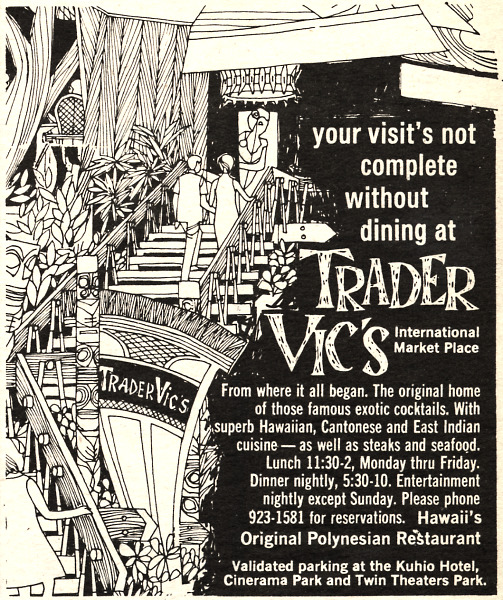
On January 16, 1955, entrepreneur Donn Beach (Don the Beachcomber) announced plans for a “Waikīkī Village” that was to be called “The International Market Place.”

The International Market Place first opened in 1957. Envisioned as a commercial center with the Dagger Bar and Bazaar Buildings, and featuring the arts, crafts, entertainment and foods of Hawaiʻi’s multicultural people, it may have been one of the earliest cultural tourist attractions in the Islands.

Designed originally to encompass 14-acres between the Waikīkī Theater and the Princess Kaʻiulani Hotel, extending from Kalākaua Avenue halfway to Kūhiō Avenue, the International Market Place was to be a “casual, tropical village with arts, crafts, entertainment, and foods of Hawai‘i’s truly diverse people … including Hawaiian, South Sea islander, Japanese, Chinese, Indian, and Filipino…” (Queen Emma Foundation)

By the late-1950s, a row of retail shops had been constructed along Kalākaua Avenue.  Other elements of the International Market Place included the Hawaiian Halau, Japanese Tea House and Esplanade buildings. The banyan tree, which still remains to this day, was also once home to Don’s tree house.

Matson sold all of its Waikīkī hotel properties to the Sheraton Company in 1959 and no longer required housing for its hotel staff. Additionally, properties were likely cleared in anticipation of the extensive development that occurred throughout Waikīkī in the 1960s and 1970s.

In 1964, Waikīkī’s entertainment hub was International Market Place; and it’s where the first Crazy Shirts shop was born (initially known as Ricky’s Crazy Shirts.) T-shirts with a message sold. Some were silly (“Suck ’em Up!”), some were logos (“Surfboards Hawaii”), and some were political (“Draft Beer Not Students”). (Crazy Shirts)

The famous Duke Kahanamoku’s (Duke’s,) where Don Ho gained fame, was once housed there. Don the Beachcomber, one of Waikīkī’s long-gone landmark restaurants, as well as Trader Vic’s also called it home.

Hawaiʻi radio icon, Hal Lewis (the self-named “J Akuhead Pupule,” best known to Island radio listeners as “Aku,”) once broadcast his popular morning talk show from the tree house in the Banyan tree.

However, over the last half-century, as the rest of Waikīkī evolved, the Market Place kept its 1960s look, as visitors wind through the carts and kiosks, hawking T-shirts, plastic hula skirts, volcano-shaped candles, and other tiki and tacky souvenirs.

Landowner Queen Emma Foundation changed that. Working with the Taubman Company, the International Market Place, Waikīkī Town Center and Miramar Hotel were demolished, and new structures took their place.

Aiming to restore “a sense of Hawaiianness,” the new International Market Place features low-rise structures, open-air shops and restaurants, paths, gardens, a storytelling hearth, a performance amphitheater and, yes, parking. And the banyan tree stays.

Today, as successor to The Queen’s Hospital, The Queen’s Medical Center is the largest private nonprofit hospital in Hawaiʻi, licensed to operate with 505 acute care beds and 28 sub-acute beds. As the leading medical referral center in the Pacific Basin, Queen’s has more than 3,500 employees and over 1,100 physicians on staff.

The royal mission and vision of The Queen’s Health Systems is directly supported through revenues generated by the lands bequeathed by Queen Emma when she passed away in 1885, including the International Market Place.

© 2022 Hoʻokuleana LLC

Filed Under: Place Names, Prominent People, Economy Tagged With: Queen Emma, Duke Kahanamoku, Don Ho, Trader Vic's, Kaluaokau, Hawaii, Don the Beachcomber, Waikiki, Oahu, Lunalilo, Kamehameha IV, Matson

August 25, 2022 by Peter T Young Leave a Comment

Lunalilo’s Crown

William Charles Lunalilo was born on January 31, 1835 in an area known as Pohukaina to High Chiefess Miriam ‘Auhea Kekauluohi (Kuhina Nui, or Premier of the Hawaiian Kingdom and niece of Kamehameha I) and High Chief Charles Kanaʻina.

Lunalilo’s grandparents were Kalaʻimamahu (half-brother of Kamehameha I) and Kalākua (sister to Kaʻahumanu). His great grandfather was Keouakupupailaninui (father of Kamehameha I).

He was declared eligible to succeed by the royal decree of King Kamehameha III and was educated at the Chief’s Children’s School, and at age four became one of its first students.

He was known as a scholar, a poet and a student with amazing memory for detail. From a very young age, he loved to write, with favorite subjects in school being literature and music.

Kamehameha V had not named a successor to the throne before he died on December 11, 1872. Lunalilo wanted his people to choose their next ruler in a democratic manner and requested a plebiscite to be held on New Year’s Day following the death of Kamehameha V.

He therefore noted, “Whereas, it is desirable that the wishes of the Hawaiian people be consulted as to a successor to the Throne, therefore, notwithstanding that according to the law of inheritance, I am the rightful heir to the Throne, in order to preserve peace, harmony and good order, I desire to submit the decision of my claim to the voice of the people.” (Lunalilo, December 16, 1872)

Kalākaua chose to run against Lunalilo.  The majority of people on every island chose William Charles Lunalilo as King.  At noon on January 8, 1873, the Legislature met, as required by law, in the Courthouse to cast their official ballots of election of the next King.  Lunalilo received all thirty-seven votes.

The coronation of Lunalilo took place at Kawaiahaʻo Church in a simple ceremony on January 9, 1873. Unfortunately, he was to reign for just over a year, succumbing to pulmonary tuberculosis on February 3, 1874.

Upon his passing, the Royal Mausoleum was the temporary resting place for Lunalilo.  By birthright, his remains could have remained there with the other Aliʻi, however, his desire was to be among his people, and in 1875 his remains were moved to their permanent resting place in a tomb built for him and his father, Kanaʻina, on the grounds of Kawaiahaʻo Church.

Then, terrible news hit the papers, “Advices from Key West, Fla., today told of the arrest at the naval station there of two bluejackets, Albert Gerbode and Paul Payne, charged with having broken into the Lunalilo mausoleum and stolen the skull of a Hawaiian king, a silver shield and a silver crown.”  (The Evening Leader, Tartonn Springs, Florida, April 22, 1918)

In follow-up reporting, we learn that, “All that remains intact of the historic crown of King Lunalilo, which was stolen last autumn from the tomb in the Kawaiahao churchyard, is a silver leaf, part of the name plate and the silver ornament which rested on the top of the crown. The rest has been melted down into a single bar of silver.”

“Deputy Sheriff JW Asch returned this morning from Key West, Florida, where he went to recover the crown. His story of the chase, which finally ended in the arrest of Albert Gerbode and Paul Payne, electricians in the submarine flotilla which was stationed at Pearl Harbor, and the recovery of the stolen property, throws much new light on the robbery.”

“Sheriff Asch says that both Gerbode anil Payne absolutely deny taking any of the skulls and bones from the tomb, as was reported at the time of the robbery.”

“He says that both the naval authorities and himself are inclined to believe the two men in this respect, which would make it appear that others entered the tomb and stole the bones.”

“The skull which the two men had was made by themselves of plaster of Paris.”

“According to the confession of Gerbode and Payne, Sheriff Asch says plain robbery was the motive for the theft. They had heard that Hawaiian chiefs were buried with all their jewelry and expected to make a big haul.”

“In the confession the men said that they did not use instruments to enter the tomb, but simply yanked off the padlock, which they said, was so old and worn that it took but little effort to break.”

“The crown was kept intact until the submarine had reached Key West where it was melted down.”

“Another strange feature of the theft was that the two electricians made no attempt to hide the crown and a large number of the crew knew of its existence on board. For this reason, when charged with the robbery, neither Gerbode nor Payne attempted to deny anything but made a full confession.”

“Gerbode and Payne are to be tried by the naval authorities at Key West. They will not be returned to Honolulu as was first reported.”

“It will be possible to some extent to reproduce the original crown from the silver, as the naval authorities made Gerbode and Payne draw pictures and diagrams of the crown with a full description of its appearance. That Sheriff Asch brought back with him.”

“The silver has been sent by registered mail and will probably arrive on the next steamer from San Francisco. – Star-Bulletin.” (Maui News, May 31, 1918)

© 2022 Ho‘okuleana LLC

Filed Under: Missionaries / Churches / Religious Buildings, Ali'i / Chiefs / Governance Tagged With: Lunalilo, Kawaiahao Church, Kawaiahao, Crown, Albert Gerbode, Paul Payne

July 2, 2022 by Peter T Young 1 Comment

Honuʻapo

Honuʻapo is literally translated as “caught turtle” (Pukui,) but others suggest Honuʻapo was originally Honua‘apo, meaning “embraced land”, or land embraced by a kapu. “Honua‘apo” has its origin with a cave that was a place of refuge and was therefore kapu.  (Haun)

When Captain James Cook traveled this part of the Island in January 1799, King, who accompanied Cook on the voyage, wrote:
“It is not only the worst part of the Island but as barren waste looking a country as can be conceived to exist…”

“… we could discern black streaks coming from the Mountain even down to the seaside… horrid and dismal as this part of the Island appears, yet there are many villages interspersed, and it struck as being more populous than the part of Opoona (Puna) which joins Koa (Kaʻū.) There are houses built even on the ruins (lava flows) we have described.”

In July 1823, Protestant missionary Reverend William Ellis visited Kaʻū and said this of Honuʻapo:  “From the manner in which we were received at Honuʻapo, we should not think this village had been often visited by foreigners…”

“… for on our descending from the high land to the lava on which the town stands, the natives came running out to meet us from all quarters, and soon gathered so thickly around us, that we found it difficult to proceed…”

“We passed through the town to the residence of the head man, situated on the farthest point towards the sea. He invited us to his house, procured us water to wash our feet with, and immediately sent to an adjacent pond for some fish for our supper.”

“While that was preparing, the people assembled in crowds around the house, and a little before sun-set Mr. Thurston preached to them in the front yard. Upwards of 200 were present…”

Soon after Ellis’s visit to Honuʻapo there was an influx of Westerners. The ever-growing population of Westerners throughout Hawai‘i forced socioeconomic and demographic changes.  (Rechtman)

At the time of the Māhele (1848,) Honuʻapo ahupuaʻa (totaling 2,200 acres) was awarded as Konohiki Land to William Charles Lunalilo.

In 1868, a series of earthquakes were felt and lava began flowing on the slopes of Mauna Loa. These initial eruptions “destroyed a large stone church at Kahuku, and also all the stone dwelling houses in that place, including the houses….at the foot of the mountain”.

Then on April 4th an even larger eruption occurred. Fredrick S Lyman, who witnessed the eruption first hand, wrote: “Soon after four o’clock p.m. on Thursday we experienced a most fearful earthquake. First the earth swayed to and fro from north to south, then from east to west, then round and round, up and down, and finally in every imaginable direction, for several minutes, everything crashing around, and the trees thrashing as if torn by a hurricane, and there was a sound as of a mighty rushing wind.”

“It was impossible to stand: we had to sit on the ground, bracing with hands and feet to keep from being rolled over…we saw…an immense torrent of molten lava, which rushed across the plain below…swallowing everything in its way;–trees, houses, cattle, horses, goats, and men, all overwhelmed in an instant. This devouring current passed over a distance of about three miles in as many minutes, and then ceased.”

Within minutes of the initial quake, the ocean rose up and a tsunami pounded the coast, washing inland in some locations as far as 150 yards. It was recorded that the wave destroyed 108 houses in Ka‘ū and drowned forty-six people.

The tsunami devastated coastal villages and forced people to move inland to towns such as Nāʻālehu and Pāhala. Lyman wrote:  “The villages on the shore were swept away by the great wave that rushed upon the land immediately after the earthquake. The eruption of earth destroyed thirty-one lives, but the waves swallowed a great number.”  (Lyman; Journal of Science, 1868)

The coastal trail (alaloa) that Ellis walked was later modified to accommodate horse and cart as foreign population into the area increased. The trail maintained its original alignment at least through Nīnole and Punaluʻu. The 1868 earthquake and tsunami devastated the Kaʻū coastline and washed out much of the trail.

The trail was then straightened, realigned and widened, and took a mauka course and eventually became the Government Road and was the most direct means to reach villages and commerce.

With the treaty of Reciprocity and growing demand for Hawaiʻi sugar, there was a rise of sugar plantations throughout Kaʻū, including Honuʻapo; mills were built in Pāhala (1868,) Hīlea (1878) and Honuʻapo (1881.)

The sugar industry quickly set down roots in Honuʻapo and erected a sugar mill, a large sugar warehouse and various out buildings. All of these developed areas were connected with a small gauge railroad network.

Sugar from the Pāhala sugar mill was originally transported to Punaluʻu wharf for shipping. After the dredging of Honuʻapo Bay in the 1870s and construction of the landing at Honuʻapo by 1883, most of the sugar in Kaʻū was shipped out of Honuʻapo.

Honuʻapo wharf served the communities of Waiʻōhinu, Nāʻālehu, Hīlea and Honuʻapo. Punaluʻu harbor served the sugar plantation at Pāhala, as well as the communities of Nīnole and Punaluʻu.

First, government ships then private interests provided inter and intra-island transportation.  Competitors Wilder Steamship Co (1872) and Inter-Island Steam Navigation Co (1883) ran different routes, rather than engage in head to head competition.

On Hawaiʻi Island, Mahukona, Kawaihae and Hilo were the Island’s major ports; Inter-Island served Kona ports.  From Kailua, the steamer went south stopping at the Kona ports of Nāpoʻopoʻo, Hoʻokena, Hoʻopuloa, rounding South Point, touching at Honuʻapo and finally arriving at Punaluʻu, the terminus of the route.  (From Punaluʻu, a 5-mile railroad took passengers to Pāhala, then coaches hauled the visitors to the volcano to site see.)

By 1890, Honuʻapo and Hīlea plantations became the property of Hutchinson Sugar Company, while Pāhala was owned by Hawaiian Agriculture.   The mill at Hīlea was gone by 1907.

The concrete pier still visible at Honuʻapo Bay was constructed in 1910. The harbor at Honuʻapo continued operations until 1942. After that, sugar was trucked to Hilo for off-island shipment.

In 1928, the plantation camps of the Hutchinson Sugar Plantation were torn down and the residents were moved to Nā‘ālehu.)  The Honuʻapo mill was shut down in 1973 and sugar plantation activities in Kaʻū were then centered at the Pāhala plantation; in 1996, the Pāhala plantation ceased operation marking the end of the sugar plantation era in Kaʻū.  (Lots of information here from Rechtman and Haun.)

When I was at DLNR, we partnered with the community, County, NOAA (CELCP) and Trust for Public Land to purchase and preserve the historic and scenic Honuʻapo Estuary and coastal area along the Kaʻū coast adjoining Whittington Beach Park.

© 2022 Hoʻokuleana LLC

Filed Under: Place Names Tagged With: Hutchinson Sugar, Pahala, Honuapo, Hawaii, Hawaii Island, Lunalilo, Sugar, Punaluu, Treaty of Reciprocity, Waiohinu, Naalehu

  • « Previous Page
  • 1
  • 2
  • 3
  • 4
  • 5
  • Next Page »

Images of Old Hawaiʻi

People, places, and events in Hawaiʻi’s past come alive through text and media in “Images of Old Hawaiʻi.” These posts are informal historic summaries presented for personal, non-commercial, and educational purposes.

Info@Hookuleana.com

Connect with Us

  • Email
  • Facebook
  • LinkedIn
  • Twitter
  • YouTube

Recent Posts

  • Homeless
  • 250 Years Ago … Signing the Declaration of Independence
  • Nanaue
  • Nationality
  • About 250 Years Ago … Lafayette Comes to America
  • ʻŌhiʻa
  • Waiʻalae Shopping Center

Categories

  • Prominent People
  • Schools
  • Sailing, Shipping & Shipwrecks
  • Economy
  • Voyage of the Thaddeus
  • Mayflower Summaries
  • American Revolution
  • General
  • Ali'i / Chiefs / Governance
  • Buildings
  • Missionaries / Churches / Religious Buildings
  • Hawaiian Traditions
  • Military
  • Place Names

Tags

Albatross Al Capone Ane Keohokalole Archibald Campbell Bernice Pauahi Bishop Charles Reed Bishop Downtown Honolulu Eruption Founder's Day George Patton Great Wall of Kuakini Green Sea Turtle Hawaii Hawaii Island Hermes Hilo Holoikauaua Honolulu Isaac Davis James Robinson Kamae Kamaeokalani Kameeiamoku Kamehameha Schools Lalani Village Lava Flow Lelia Byrd Liberty Ship Liliuokalani Mao Math Mauna Loa Midway Monk Seal Northwestern Hawaiian Islands Oahu Papahanaumokuakea Marine National Monument Pearl Pualani Mossman Quartette Thomas Jaggar Volcano Waikiki Wake Wisdom

Hoʻokuleana LLC

Hoʻokuleana LLC is a Planning and Consulting firm assisting property owners with Land Use Planning efforts, including Environmental Review, Entitlement Process, Permitting, Community Outreach, etc. We are uniquely positioned to assist you in a variety of needs.

Info@Hookuleana.com

Copyright © 2012-2024 Peter T Young, Hoʻokuleana LLC

Loading Comments...