Images of Old Hawaiʻi

  • Home
  • About
  • Categories
    • Ali’i / Chiefs / Governance
    • American Protestant Mission
    • Buildings
    • Collections
    • Economy
    • Missionaries / Churches / Religious Buildings
    • General
    • Hawaiian Traditions
    • Other Summaries
    • Mayflower Summaries
    • Mayflower Full Summaries
    • Military
    • Place Names
    • Prominent People
    • Schools
    • Sailing, Shipping & Shipwrecks
    • Voyage of the Thaddeus
  • Collections
  • Contact
  • Follow

February 10, 2022 by Peter T Young Leave a Comment

Kamakahelei

Captain James Cook’s crew first sighted the Hawaiian Islands in the dawn hours of January 18, 1778.  His two ships, the HMS Resolution and the HMS Discovery, were kept at bay by the weather until the next day when they approached Kauai’s southeast coast.

Cook sailed along the coast searching for a suitable anchorage.  His two ships remained offshore, but a few Hawaiians were allowed to come on board on the morning of January 20, before Cook continued on in search of a safe harbor.  On the afternoon of January 20, 1778, Cook anchored his ships near the mouth of the Waimea River on Kauai’s southwestern shore.

At the time of Cook’s arrival, the Hawaiian Islands were divided into four kingdoms: (1) the island of Hawaiʻi under the rule of Kalaniʻōpuʻu, who also had possession of the Hāna district of east Maui; (2) Maui (except the Hāna district,) Molokai, Lānaʻi and Kahoʻolawe, ruled by Kahekili; (3) Oʻahu, under the rule of Kahahana; and at (4) Kauai and Niʻihau, Kamakahelei was ruler.

Of the four, Kamakahelei was the only woman.

Kamakahelei was the “queen of Kauai and Niʻihau, and her husband was a younger brother to Kahekili, while she was related to the royal family of Hawaiʻi. Thus, it will be seen, the reigning families of the several islands of the group were all related to each other, as well by marriage as by blood. So had it been for many generations. But their wars with each other were none the less vindictive because of their kinship, or attended with less of barbarity in their hours of triumph.”  (Kalākaua)

“At that time Kahekili was plotting for the downfall of Kahahana and the seizure of Oʻahu and Molokai, and the queen of Kauai was disposed to assist him in these enterprises.”  (Kalākaua)”

The occupation of the Hana district of Maui by the kings of Hawaii had been the cause of many stubborn conflicts between the chivalry of the two islands, and when Captain Cook first landed on Hawaii he found the king of that island absent on another warlike expedition to Maui, intent upon avenging his defeat of two years before, when his famous brigade of eight hundred nobles was hewn in pieces.”  (Kalākaua)

“The native historians all say that on the night that Cook’s ships anchored at Waimea, a grand council was held at the house of Kamakahelei, the highest chiefess on the island, and the actual hereditary sovereign of that part of Kauai, when some proposed to seize the ships by force and run them ashore for the sake of the plunder that would be obtained …”

“… while others of a more pacific or more timid mind proposed to propitiate the newcomers – whom, or rather whose captain, they in some confused manner connected with the old and distorted legend of Lono – with presents and with the charms of their women.”  (Fornander)

“The latter advice was acted on, and hogs, vegetables, kapa, and women were sent on board, and among the latter was Kamakahelei’s own daughter, Lelemahaalani; and during the last generation of Hawaiians it was openly said, and never contradicted, that that night Lelemahoalani slept with Lono (Cook.)”  (Fornander)

Surgeon Ellis, who was part of Cook’s crew, stated in 1779 that Kamakahelei “was short and lusty, about 40 years of age, and very plain with respect to person.”  That would make Kamakahelei’s birth around 1739.

Kamakahelei was the only daughter of High Chief Kaumeheiwa (the son of High Chief Lonoikahaupu and High Chiefess Kamuokaumeheiwa) and his wife, High Chief Kaʻapuwai (possibly the daughter of Peleioholani, 22nd Alii ʻAimoku of Oahu and 21st Alii ʻAimoku of Kauai.)

Kamakahelei succeeded Peleioholani as the Aliʻi of Kauai.

Kamakahelei was believed to possess a secret, most powerful and sacred prayer, greatly feared throughout Hawai‘i, called the “Aneekapuahi,” which could cause an enemy’s immediate incineration – it was feared throughout the Islands.

Kamakahelei’s first husband was Kaneoneo (Peleʻioholani’s grandson.)  With Kaneoneo, Kamakahelei had two daughters, one of whom, Kapuaʻamohu, became one of the wives of Kaumualiʻi and grandmother of Queen Kapiʻolani.

Her husband’s father, Kūmahana, was desposed by the ʻEwa chiefs who replaced him with Kahahana, who would become the last king of Oʻahu.  Kaneoneo died during the rebellion on Oʻahu against Kahekili about 1785-6.

At the time of Cook’s visit, Kamakahelei had another husband, the celebrated Kāʻeokūlani ((Kāʻeo) younger brother of Kahekili, Mōʻi of Maui.)

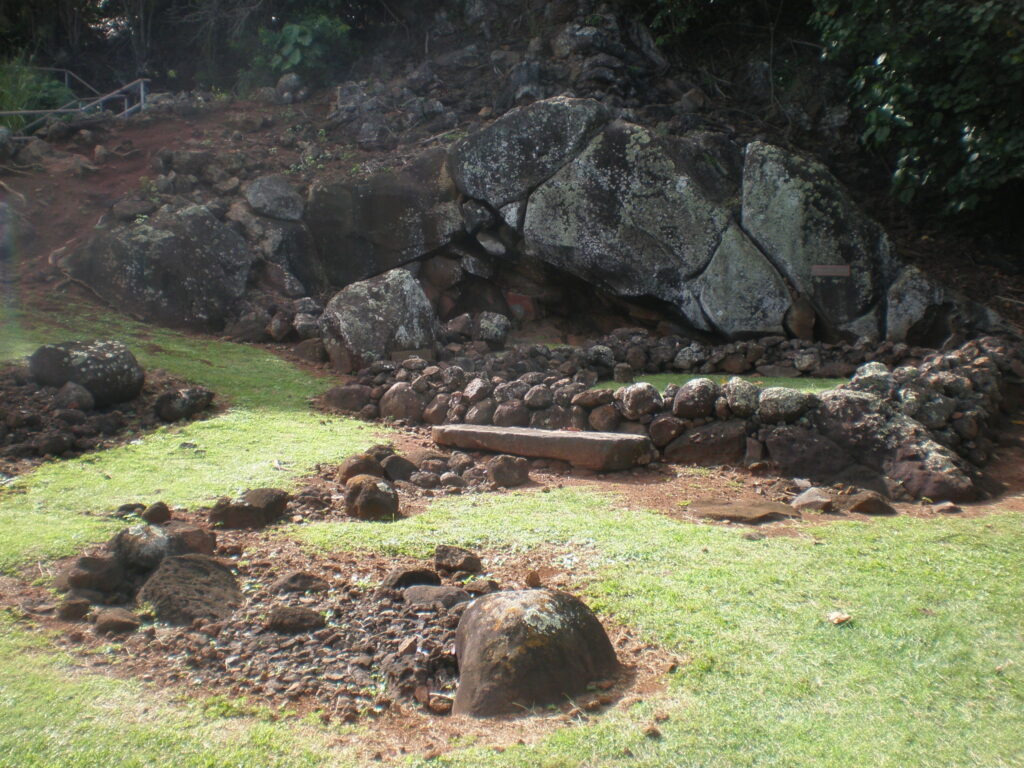
With Kāʻeokūlani, Kamakahelei had a son Kaumualiʻi.  Kaumualiʻi was born at Holoholokū Heiau in Wailua.  (Like its counterpart Kūkaniloko heiau in Wahiawa, Oʻahu, these royal birthing sites maintained the antiquity and purity of the chiefly lineages on O‘ahu and Kauai.  It is said that chiefs from Hawai‘i Island and Maui often sought greater prestige by marrying those with these strong ancestral lineages.)

Her second husband, Kāʻeokūlani, died on Oʻahu in 1794, but the time of her own death has not been remembered, but it probably occurred shortly after that of Kāʻeo.  (Fornander)

At his mother’s death, Kaumualiʻi became the sovereign of Kauai, and, though young in years, appears from all descriptions to have been a prince of remarkable talents and a most amiable temper.  (Fornander)

In the face of the threat of a further invasion, in 1810, at Pākākā on Oʻahu, negotiations between King Kaumuali‘i and Kamehameha I took place and Kaumualiʻi yielded to Kamehameha.  The agreement marked the end of war and thoughts of war across the islands.

© 2022 Hoʻokuleana LLC


Filed Under: Ali'i / Chiefs / Governance Tagged With: Kahekili, Kalaniopuu, Kamakahelei, Kaeo, Kaumualii, Hawaii, Captain Cook, Holoholoku, Kukaniloko, Kauai, Kahahana

January 6, 2022 by Peter T Young 3 Comments

Owyhee

Some suggest the spelling was the way Captain James Cook spelled the Island chain he “discovered” in 1778, and the name of the island where he eventually died.

However, we need to remember that Cook first sighted Oʻahu on January 18, 1778. On February 2, 1778 his journal entry named the island group after his patron: “Of what number this newly-discovered Archipelago consists, must be left for future investigation. … I named the whole group the Sandwich Islands, in honour of the Earl of Sandwich.”  (Cook’s Journal)  (That name stuck for about 60-years, when the Hawaiian Islands replaced the Sandwich moniker.)

Likewise, in the dedication of his journals, the memorial (and in numerous references throughout) noted: “He raised himself, solely by his merit, from a very obscure birth, to the rank of Post-Captain in the royal navy, and was unfortunately killed by the savages of the of the island Owhyhee on the 14th of February, 1779; which island he had not long before discovered, when prosecuting his third voyage round the globe.”

When Captain Cook first visited the Hawaiian Islands, Hawaiian was a spoken language but not a written language.  Historical accounts were passed down orally, through chants and songs.  After western contact and attempts to write about Hawaiʻi, early writers tried to spell words based on the sound of the words they heard.  People heard words differently, so it was not uncommon for words to be spelled differently, depending on what the writer heard.

So the origin of the specific spelling of this place(s) is not clear.

The discussion of this place relates to a river on the continent (and some places it passes that are similarly named.)  There are many stories about other “Owyhee” continental place names; those are subjects of future stories – this one is about the Owyhee River.   The word Owyhee is the older spelling of Hawaiʻi.

The USGS Geological Names Information Systems note an 1838 map of Oregon Territory prepared by Samuel Parker (not Hawaiʻi’s Samuel Parker) as the citation for the river’s name (by Board action of the Board of Geographic Names, the river received that “Official” name in 1959.)

The Owyhee River (a 280-mile tributary of the Snake River) has its source in northern Elko County, Nevada, flowing northward into southwestern Idaho through Owyhee County, and continuing into extreme southeastern Oregon in southern Malheur County.

So how did Hawaiʻi (Owyhee) make it to the Oregon Territory?  And, why did a river receive that name?

To get there, we need to go back a bit … to 1811.

That year, the first two-dozen Kanakas (Hawaiians) were recruited to work the Pacific Northwest to support the expanding fur trading business (twelve as seamen and the remaining half to work at a proposed fur post.)

Thick, luxurious and water-repellent furs of sea mammals (from beavers, sea otters and fur seals) were highly valued in China as well as in Europe, where they were sewn into coats, hats and bed covers.  Furs were mostly traded in China in exchange for tea, silks, porcelain and other Chinese goods, which were then sold in Europe and the US.

Trading ships plying between the Northwest, China and Europe would stop in Hawaiʻi to replenish their stores.  Hawaiians had worked on many of the merchant ships.  Most served as seamen or contract workers; others manned their outposts and built structures or farmed food for the ships’ crews and others.

As the fur trade expanded, nearly every post had had a contingent of Kanakas, who were noted for their reliability, cheerful dispositions and hard work.

This leads us to Donald Mackenzie, a brigade leader for the Canadian North West Company, who led yearlong trapping expeditions on the Snake and Columbia Rivers in the Oregon Territory.

About one-third of Mackenzie’s men on his 1818-1820 Snake River expedition were Kanakas.  Mackenzie and his party wintered among the Snake Indians in 1819-1820.

Three of his Kanakas had been sent to another area to hunt beaver.  When they did not return, Mackenzie sent out a search party which “found the place where they had been hunting, and where they had been murdered (believed to be by a band of Bannock Indians;) the skeleton of one of them was found, but nothing else.”  (Duncan)

The river in the area was thereafter known as the Owyhee (in honor of the three Hawaiians.)  (Some early references also note the name as “Sandwich Island River.”)

The earliest surviving record of the name is found on a map dating to 1825, drawn by William Kittson (who was previously with Donald Mackenzie in 1819-1820.)

Then, Peter Skene Ogden, who led subsequent Snake River expeditions for the Hudson’s Bay Company in 1825-1826, noted in his journal, “Saturday, (February) 18th (1826.) Severe cold. …  when we reached Sandwich Island River, so called, owing to 2 of them murdered by Snake Indians in 1819. This is a fine large river…”

Ogden later notes, “Thursday, June 15th (1826.) All along our route this day the plains were covered with women digging roots; at least 10 bushels were traded by our party; the men (Indians) all gone to join the Fort Nez Perces Indians. Reached a fork of Owyhee River.”

The Owyhee begins at its headwaters in Nevada, flows through Idaho, and crosses into southeastern Oregon, where it eventually flows into the Snake River. From the Oregon/Idaho border to the Owyhee Reservoir (formed by the Owyhee Dam), the river flows through deeply incised canyons in a remote, arid and almost unpopulated area.

Other places near or on the river received the same “Owyhee” name.

Owyhee Dam, the tallest in the world when completed in 1932, is significant as a proving ground for engineering techniques used later in construction of Hoover Dam. As construction of the Owyhee began in 1928, plans were being laid for the much larger Hoover Dam on the Colorado River; it was Hoover’s testing ground.  (NPS)

The Bureau of Reclamation’s Owyhee irrigation project is the largest in Oregon, with surrounding farmland used for a combination of livestock grazing and specialty crops such as potatoes, sugar beets, onions, and alfalfa seed. (In 1984, a hydroelectric powerhouse was built just downstream from the dam.)

The first known recreation use of the river occurred in 1951, when commercial outfitter Prince Helfrich floated from Three Forks to Rome utilizing surplus World War II rubber assault rafts. Boating use remained extremely light through the 1950s and 60s.

The Bureau of Land Management (BLM) began recording recreation use in 1974, when 482 persons floated the river. By 1980, 2,000 boaters were utilizing the Owyhee and popular campsites were beginning to show the effect of recreational use.  (Meyer)

In 1970 the state of Oregon designated the Owyhee River as a State Scenic Waterway.  On October 19, 1984, President Reagan signed Public Law 98-494, designating 120 miles of the Owyhee River from the Oregon-Idaho boundary to the Owyhee Reservoir, excluding the Rome Valley from China Gulch to Crooked Creek, as a “Wild River” to be included in the National Wild and Scenic Rivers System.

Oh, back to the fur trappers … they didn’t last long. It was the discovery of gold that brought many more people to the Owyhee.  As prospectors fanned out throughout the state they eventually found their way into the Owyhee Mountain; a group discovered gold there in 1863.

© 2022 Hoʻokuleana LLC


Filed Under: General, Sailing, Shipping & Shipwrecks Tagged With: Oregon, Sandwich Islands, Owhyhee, Hawaii, Captain Cook

November 14, 2021 by Peter T Young Leave a Comment

James Hay Wodehouse

James Hay Wodehouse was born on April 23, 1824. He was the second son of Charles Nourse Wodehouse (Archdeacon of Norwich) and Lady Dulcibella Jane Hay. He married Annette Fanny Massey, daughter of William Massey, on January 19, 1861.

Wodehouse was private secretary to George Grey (Governor of New Zealand) in 1851; on November 5, 1860, it was announced, “The Queen has been graciously pleased to appoint Major James Hay Wodehouse to be her Majesty’s consul in the Society or Leeward Islands in the Pacific Ocean.”  (London Daily News, November 24, 1860)

On June 21, 1866, “The Queen has been graciously pleased to appoint James Hay Wodehouse, Esq … to be Her Majesty’s Commissioner and Consul-General in the Sandwich Islands.”  (British Bulletins, 1866)

A retired British Army Major, Wodehouse took up his duties and thereafter worked diligently to protect British interests during a long career.  (Andrade)  “Minister Wodehouse represented the British Governmental the Hawaiian court for over twenty-five years with great credit.”   (San Francisco Call, August 11, 1895)

These were tumultuous times in the Islands.  Through several monarchs, the issue of independence / annexation and takeover by others were part of the ongoing discussions.

“About the end of 1867, Queen Emma, in a conversation with British Commissioner JH Wodehouse, assured him ‘that with a few exceptions, all the natives were opposed to annexation.’”  (Daws)

“Many times, Kamehameha V stated his firm resolve to maintain the independence of his kingdom, and there is no good reason to doubt the sincerity of these declarations. British Commissioner Wodehouse reported a conversation with the king in which the latter expressed ‘his determination to resist any project for the annexation of his Islands to the United States.’”  (Daws)

On January 17, 1893, Queen Lili`uokalani yielded her authority to the US government.  In 1895, an abortive attempt by Hawaiian royalists to restore Queen Liliʻuokalani to power resulted in the Queen’s arrest.

Convicted of having knowledge of a royalist plot, “at two o’clock on the afternoon of the 27th of February I was again called into court, and sentence passed upon me … a fine of $5,000, and imprisonment at hard labor for five years.” (Queen Liliʻuokalani)  The sentence was commuted to imprisonment in an upstairs apartment in ʻIolani Palace.

“(Wodehouse) was strongly opposed to the revolution, and made himself obnoxious to the Provisional Government, who came to regard the British legation as the chief center of royalist intrigue.”    (San Francisco Call, August 11, 1895)

The British Government, having recognized the Hawaiian Republic, recalled Wodehouse and appointed Mr Hawes British commissioner and consul general.  Major Wodehouse, on his departure, neglected to pay an official farewell to the Dole Government, and proposed to take leave of the ex-Queen, imprisoned in the palace.  (Appletons’, 1895)

“Previous to Mr Wodehouse’s departure from Honolulu he requested a parting interview with ex-Queen Liliʻuokalani, but the request received a positive refusal. The reason assigned was that Mr Wodehouse still held an official character of which he could not divest himself, so as to render his visit to the former Queen one merely of friendship.”  (San Francisco Call, August 11, 1895)

“(A)n open letter of Mrs Wodehouse to the ex-Queen had been returned to the writer because it was addressed to ‘Her Majesty.’ The denial of intercourse in the case of the British Minister is an exception to a very considerable degree of the freedom usually allowed to Mrs Dominis in seeing her friends.  (San Francisco Call, August 11, 1895)

Wodehouse had other reasons for desiring to be relieved of his duties at this time. He had been in Hawaiʻi for 15-years without any leave, was not in good health and wished to return to England to spend his last years.  The British government accordingly granted him leave to return to England.  (Andrade)  Wodehouse died in England on July 13, 1911.

Here’s a little Wodehouse side note:  A malfunctioning chronometer put the British sailing ship Dunnottar Castle off course and onto the reef at Kure atoll.  Seven of the crew members, including its Chief Officer, took one of the surviving boats and sailed, for 52 days, to Kauaʻi. Upon being informed of the tragedy, the British Commissioner in Honolulu organized a rescue mission. (HawaiianAtolls)

Wodehouse decided to send a ship for the remaining crew.  Suspecting that the British might use the occasion to annex the island, the Hawaiian Government shared the expedition expenses and instructed Commissioner James Boyd to take formal possession of Kure.  On September 20, 1886 Boyd took possession of the island, then-called Mokupāpapa, for the Hawaiian government.  (PMNM)

The rescue mission came back to Honolulu with the same amount of people it had sailed out with. No survivors were found on the atoll, except for two fox terriers and a retriever. All of the survivors had been picked up earlier by a passing vessel and were on route to Chile.  (HawaiianAtolls)

Here’s another side note, relating to one of Wodehouse’s sons, ‘Hay.’  On July 30, 1889, Robert William Wilcox led a rebellion to restore the rights of the monarchy, two years after the Bayonet Constitution of 1887 left King Kalākaua a mere figurehead.

“The day was won, they say, by a base ball (catcher,) who threw dynamite bombs into the bungalow that formed the headquarters of the insurgents and brought them to terms quicker than rifle or cannon shot.”

“Bombs were made, but it was found that there were no guns to fire them. It was a long throw, and in their dilemma the King’s guards secured the services of Haywood (Wodehouse,) (catcher) of the Honolulu Base Ball Club.”

“(Wodehouse) took up his position in the Coney Island building, just across a narrow lane, and overlooking the bungalow. No attack was expected from that quarter, and there was nothing to disturb the bomb thrower. (Wodehouse) stood for a moment with a bomb in his hand as though he were in the box waiting for a batsman. He had to throw over a house to reach the bungalow, which he could not see.”

“The first bomb went sailing over the wall, made a down curve and struck the side of the bungalow about a foot from the roof … The bomb had reached them and hurt a number of the insurgents.  (Wodehouse) coolly picked out another bomb. Then he took a step back, made a half turn and sent it whizzing. It landed on the roof … He threw one more bomb and Wilcox came out and surrendered.”    (The Sporting Life, October 16, 1889)

Here’s one more … The unveiling of the Captain Cook monument in Kealakekua Bay took place on November 14, 1874.  Credit for it is given to Princess Likelike (sister of King Kalākaua and Queen Liliʻuokalani, and mother of Princess Kaʻiulani (who sold the land for $1 on January 26, 1877 to be held in trust for the monument in memory of Captain Cook)) and British Commissioner Wodehouse.

“The erection of a suitable and durable monument to the memory of Captain James Cook has been often proposed and more than once attempted, but has now been happily accomplished under the direction of Mr Wodehouse, the British Commissioner, with the cooperation of Captain Cator of HMS ship Scout, who kindly conveyed the architect and his men and materials to the spot in Kealakekua Bay, where the circumnavigator fell, and where now, nearly a century later, a fitting monument is at last dedicated to his memory.”

“It is a plain obelisk, standing on a square base, the whole being twenty-seven feet in height, and constructed throughout of a concrete composed of carefully screened pebbles and cement, similar to tie material of which the fine public buildings in this city are built. It stands on an artificially leveled platform of lava only a few feet distant from and above the highwater mark, and fifteen or twenty yards from the shore or lava slab on which the great seaman stood when struck down.”

“The site is thus the most suitable that could have been chosen, and is the gift of Princess Likelike, wife of Hon. AS Cleghorn. The expense of the erection is partly borne by subscribers in England…”  (Hawaiian Gazette, November 25, 1874)

© 2021 Hoʻokuleana LLC

Filed Under: Prominent People Tagged With: Dunnottar Castle, Kure, James Hay Wodehouse, Hawaii, Queen Liliuokalani, King Kalakaua, Iolani Palace, Captain Cook, Robert Wilcox, Mokupapapa, Kealakekua

November 10, 2021 by Peter T Young Leave a Comment

Early Brew Crew

Beer is produced by the saccharification (breaking into sugars) of starch and fermentation of the resulting sugar.  There are eight basic steps to the standard commercial brewing process: milling, mashing, wort separation, boiling, chilling, fermenting, conditioning and packaging.  (Barth)

Journal entries show Captain James Cook was the first to make beer in the Islands.  On December 7, 1778 he notes, “Having procured a quantity of sugar cane; and having, upon a trial, made but a few days before, found that a strong decoction of it produced a very palatable beer, I ordered some more to be brewed, for our general use.”

“A few hops, of which we had some on board, improved it much. It has the taste of new malt beer; and I believe no one will doubt of its being very wholesome. And yet my inconsiderate crew alleged that it was injurious to their health.”  (Cook)

While the crew “would (not) even so much as taste it”, Cook “gave orders that no grog should be served … (he) and the officers, continued to make use of this sugarcane beer, whenever (they) could get materials for brewing it.”  (Cook)

I realize some purists might suggest beer needs cereal grain to be brewed, and sugar is not a grain.  However, beer, ultimately, is the fermentation of sugar.  (BTW, starch is a primary product of photosynthesis, and is found in sugarcane stalks.  (Figueira))

Other early beer references show experiences with the brew.  On June 29, 1807, Iselin notes, “Went on shore with some Englishmen, etc., who took us to their houses, where they displayed beer and a kind of gin, a spirituous liquor distilled of the tea root (ʻōkolehao,) said to be drank freely in the Isles.”  (Isaac Iselin)

For early indications of new plants and production from those plants in the Islands, most attention turn to Don Francisco de Paula Marin.  Marin was a Spaniard who arrived in the Hawaiian Islands in 1793 or 1794 (at about the age of 20.)

His knowledge of Western military weapons brought him to the attention of Kamehameha, who was engaged in the conquest of O‘ahu.  Marin almost immediately became a trusted advisor to Kamehameha I.

Marin was responsible for introducing and cultivating many of the plants commonly associated with the Islands.  And, he is reportedly the first Island resident to brew beer. His journal entry for February 2, 1812 recorded the making of “a barrel of beer.”  On December 7, 1815, he wrote, “This day I made a little oil and a barrel of beer for Captain Tela (Tyler.)”  (Schmitt)

We even see some references to beer (brewing and drinking) in missionary journals.  On November 19-20, 1824, missionary Elisha Loomis notes, “Yesterday and today I have been engaged in making beer and vinegar from a root called tee, which grows plentifully in these islands. It is the most sweet of any vegetable I ever tasted. The juice is nearly as sweet as molasses.”

On October 31, 1832, Clarissa Armstrong (wife of Reverend Richard Armstrong) noted, “Capt. Brayton has given me a little beer cask – it holds 6 quarts – Nothing could have been more acceptable.  I wanted to ask you for one, but did not like to. O how kind providence has been & is to us, in supplying our wants. The board have sent out hops – & I have some beer now a working. I should like to give you a drink.”

On July 24, 1836, Clarissa Armstrong notes (during an illness:) “We had a bottle of wine of which I drank … All the nourishment I took after leaving Honolulu til we reached Wailuku was two biscuit about the size of small crackers, & a bit of dried beef. Drinks were my nourishment. Limes grow at Oahu & I obtained some for the voyage, which furnished me pleasant drink. Also a little beer which I had made.”

Hawaiʻi’s first full-scale brewery appeared in 1854. From April 15 to October 21, 1854, The Polynesian carried a weekly one-column advertisement headed “Honolulu Brewery.-Genuine Beer.”  (Schmitt)

The copy continued: “Brewry in Honolulu, Fort street, opposite the French Hotel, are now prepared to supply families, hotels, boarding houses and bar rooms, in bottles or in kegs.  This Beer is made of barley and hops only, contains no alcohol, nor any ingredient whatever injurious to health, can be recommended to the public as the best and most wholesome beverage ever made on these islands, and we hope, therefore, to obtain the favor of public patronage. All orders will be punctually attended to. Captains and passengers will be accommodated at the shortest notice. JJ Bischoff L Co (Polynesian, September 30, 1854)

They later changed the ad, and dropped the “no alcohol” reference, “Honolulu Brewery Malt Beer. The undersigned having established a Brewery in Honolulu, Fort St., opposite the French Hotel, are now prepared to supply families, hotels, boarding houses and bar rooms, in kegs or in bottles. All orders will be punctually attended to. Captains and passengers will be accommodated at the shortest notice.  JJ Bischoff & Co. (Polynesian, August 4, 1855)

Willard Francis and Thos. Warren started Hawaiian Brewery in March 1865; apparently the partnership didn’t last long.  On February 10, 1866, Francis was advertising the brewery for sale, noting that he intended to leave the Islands.  At the same time, Warren was advertising for “a No. 1 Brewer” for the Oʻahu Brewery.  (PCA, Feb. 10, 1866)

Other breweries followed this initial effort. Gilbert Waller National Brewery Co. in Kalihi produced steam beer from January 1888 until 1893 or thereabouts.  (Schmitt)

Then came one of Hawaiʻi’s notable beers, Primo, that started production on February 13, 1901.  “The Honolulu Brewing and Malting Co Ltd will deliver their Primo lager either in kegs or bottled by July 1st. Orders received will be promptly filled.”  (Hawaiian Star, June 27, 1901)

Another paper that day noted an early ‘Buy Local’ marketing theme, “The building up of home industries made the United States what it is today. The Honolulu Brewing and Malting Co have a home production ‘Primo Lager Beer’ why not order some when it is the equal of any beer brewed?”  (Honolulu Republican, June 27, 1901)

Primo also touted the apparent health benefits of drinking beer, “Every doctor knows how beer benefits. If you need more strength or vitality, he will prescribe it. For run-down, nervous people, there is no better tonic and nutrient than a glass of good Primo Beer with meals. Primo Beer, the best tonic.”  The brewery was later renamed Hawaiʻi Brewing Co.

The first American beer to be marketed in an aluminum can was Primo, in October 1958. The 11-ounce “Shiny Steiny,” developed by the Hawaiʻi Brewing Corp with the help of Kaiser, was heavily promoted but failed to achieve popularity, and it was eventually withdrawn.  (Schmitt)

A lasting legacy of the early brew crew is the Royal Brewery on Queen Street.  It was built in 1899 to the specifications of the Honolulu Brewing and Malting Company.  It was constructed from materials shipped in from San Francisco and New York in 1899-1900 and was the original home of Primo.  (They stopped brewing beer there in 1960.)

© 2021 Hoʻokuleana LLC


Filed Under: General, Economy, Prominent People Tagged With: Don Francisco de Paula Marin, Elisha Loomis, Royal Brewery, Primo, Hawaii, Beer, Captain Cook, Missionaries, Richard Armstrong

November 6, 2021 by Peter T Young 1 Comment

Portlock

Recent work that I have been involved with in the Portlock area on O‘ahu, reminded me of the namesake for the place, explorer and fur trader Nathaniel Portlock.

Nathaniel Portlock was born in about 1748 in Norfolk, Virginia, where his grandfather had emigrated, probably from the English south-west, around 1685. Nathaniel’s father died in 1752, leaving his wife Rebecca (formerly Ballard, who had previously been a widow with a daughter from a previous marriage).

Nathaniel’s father’s will left his property, and stay and board, to “my Daughter in Law Nancey Ballard a Negro … said children [Paul and Nathaniel] [and] their mother”.

After Portlock’s father’s death, his mother Rebecca quickly remarried a third time to a Richard Scott, who became guardian to her three surviving Portlock children and had others with her.

At about the age of 24, Nathaniel Portlock entered the British Royal Navy and was one of the loyal colonists of America, known as the “American Loyalists;” he later left that country on the close of the War of Independence.

(It is not clear what relationship a certain John Portlock had with Nathaniel; but John was born in 1765 in Shenandoah Co., Virginia and in 1781 volunteered to serve in the Virginia Regiment and fought and was “slightly wounded’ in the American Revolutionary War. It is an interesting situation if they are related.)

On March 30, 1776, he served as master’s mate on Captain James Cook’s third Pacific voyage aboard the Discovery. Portlock was transferred to the Resolution, also on the expedition, in August 1779.

Cook’s third and final voyage (1776-1779) of discovery was an attempt to locate a North-West Passage, an ice-free sea route which linked the Atlantic to the Pacific Ocean. Cook commanded the Resolution while Charles Clerke commanded Discovery. (State Library, New South Wales)

“Cook had chosen his subordinates well or had been lucky. The officers of the third voyage were a remarkably intelligent group of men.” (Captain Cook Society)

“All the great remaining voyages of the eighteenth century drew on Cook’s officers. Bligh, Portlock, Vancouver, Colnett, Riou, and Hergest all got their commands and served with great distinction. These men then passed on their skills to a second generation of men such as Flinders and Broughton.” (Mackay, Captain Cook Society)

Nathaniel Portlock and George Dixon, observed the commercial benefits that the development of the fur trade in the region could bring. In 1785, a group of London merchants formed the “King George’s Sound Co” (also known as Richard Cadman Etches and Company).

They proposed to carrying on the fur trade from the western coast of America to China, bringing home cargoes of tea from Canton for the East India Company. They bought two boats; Portlock and Dixon were selected to sail them (Dixon also previously sailed with Cook to Hawai‘i) and they set off on an expedition to North America to establish a foothold for fur trappers.

Portlock commanded the 1785-1788 expedition from the ship King George, while Dixon captained the Queen Charlotte. The purpose of the expedition was to investigate the potential of the Alaskan fur trade and to resume Cook’s search for a Northwest Passage through the continent.

The pair left England on August 29, 1785, and took nearly a year to reach Alaska, rounding Cape Horn and touching at Hawaiʻi on the way, first arriving off the coast of Kaʻū, May 24, 1786.

These were the first English ships to reach Hawai‘i following Captain Cook’s first arrival there in 1778. During the course of their 3-year expedition, they made three trips to Hawaiʻi.

A favorite anchorage on Oʻahu for Portlock was at Maunalua Bay (which Portlock named King George’s Bay). He named the Waikiki area (Diamond Head to Honolulu) Queen Charlotte’s Bay.

The East point of the Maunalua Bay (Koko Head) Portlock named Point Dick, “in honour of Sir John Dick, the first patron of this voyage,”) and the West point (Diamond Head) that Portlock named “Point Rose, after George Rose Esq. secretary of the treasury, the second worthy patron of our undertaking.” (Portlock)

Portlock also mentioned what is probably Kuapā Pond that he described as, “a little salt water river that has a communication with King George’s Bay.”

Portlock wrote about the early challenges of getting fresh drinking water in the region as they “found that we could not water at this place without an infinite deal of trouble …”

“… besides the danger of losing our casks, getting the boats dashed to pieces against the rocks, and the inconvenience of carrying our casks so far amongst a multitude of Indians, which would make it necessary to have an armed force on shore.”

“Towards evening the surgeon returned on board with the convalescents, and informed me, that the inhabitants had behaved in a very quiet inoffensive manner, though they were rather incommoded by the multitudes which curiosity brought about them.”

“By this time all our water from the ground tier was got to hand, and the cables coiled down. The inhabitants now brought us water in such plenty, that by noon on the 4th all our empty casks were filled”.

He noted, “As good water in any quantity may be procured at this island with the greatest facility for small nails and buttons, it undoubtedly must be the safest and most expeditious method any person can adopt who may chance to touch here, to barter for their water in the manner we did.” (Portlock)

“No chiefs of consequence paid us a visit as yet: the inferior chiefs indeed came on board without any scruple, and some of them slept with us every night. Amongst rest I had a daily visit from an old priest, who always brought by way of present, a small pig, and a branch of the cocoa-nut·tree.” (Portlock)

Maunalua was thought to be well-populated in ancient times. Maunalua was known for its offshore fishing resources, a large fishpond, and sweet potato cultivation. Taro was farmed in wet areas, sweet potato was grown in the drier regions and a series of fishing villages lined the coast. (McElroy) Part of that area now carries the Portlock name.

© 2021 Hoʻokuleana LLC

Filed Under: Prominent People, Sailing, Shipping & Shipwrecks, Economy Tagged With: Leahi, Diamond Head, Maunalua Bay, Portlock, Nathaniel Portlock, Maunalua, Hawaii, Kamehameha Schools, Oahu, Captain Cook

  • « Previous Page
  • 1
  • …
  • 5
  • 6
  • 7
  • 8
  • 9
  • …
  • 12
  • Next Page »

Images of Old Hawaiʻi

People, places, and events in Hawaiʻi’s past come alive through text and media in “Images of Old Hawaiʻi.” These posts are informal historic summaries presented for personal, non-commercial, and educational purposes.

Info@Hookuleana.com

Connect with Us

  • Email
  • Facebook
  • LinkedIn
  • Twitter
  • YouTube

Recent Posts

  • Hawaiian Colonization
  • Winne Units
  • ʻAwa
  • Mother Road – Route 66
  • Kalapueo
  • Hawaii 50th Staters
  • Glory! Glory! Hallelujah!

Categories

  • Buildings
  • Missionaries / Churches / Religious Buildings
  • Hawaiian Traditions
  • Military
  • Place Names
  • Prominent People
  • Schools
  • Sailing, Shipping & Shipwrecks
  • Economy
  • Voyage of the Thaddeus
  • Mayflower Summaries
  • American Revolution
  • General
  • Ali'i / Chiefs / Governance

Tags

Albatross Al Capone Ane Keohokalole Archibald Campbell Bernice Pauahi Bishop Charles Reed Bishop Downtown Honolulu Eruption Founder's Day George Patton Great Wall of Kuakini Green Sea Turtle Hawaii Hawaii Island Hermes Hilo Holoikauaua Honolulu Isaac Davis James Robinson Kamae Kamaeokalani Kameeiamoku Kamehameha Schools Lalani Village Lava Flow Lelia Byrd Liberty Ship Liliuokalani Mao Math Mauna Loa Midway Monk Seal Northwestern Hawaiian Islands Oahu Papahanaumokuakea Marine National Monument Pearl Pualani Mossman Quartette Thomas Jaggar Volcano Waikiki Wake Wisdom

Hoʻokuleana LLC

Hoʻokuleana LLC is a Planning and Consulting firm assisting property owners with Land Use Planning efforts, including Environmental Review, Entitlement Process, Permitting, Community Outreach, etc. We are uniquely positioned to assist you in a variety of needs.

Info@Hookuleana.com

Copyright © 2012-2024 Peter T Young, Hoʻokuleana LLC

Loading Comments...