Images of Old Hawaiʻi

  • Home
  • About
  • Categories
    • Ali’i / Chiefs / Governance
    • American Protestant Mission
    • Buildings
    • Collections
    • Economy
    • Missionaries / Churches / Religious Buildings
    • General
    • Hawaiian Traditions
    • Other Summaries
    • Mayflower Summaries
    • Mayflower Full Summaries
    • Military
    • Place Names
    • Prominent People
    • Schools
    • Sailing, Shipping & Shipwrecks
    • Voyage of the Thaddeus
  • Collections
  • Contact
  • Follow

September 23, 2022 by Peter T Young Leave a Comment

Future Captains

Captain James Cook set sail on three voyages to the South Seas. His first Pacific voyage (1768-1771) was aboard the Endeavour and began on May 27, 1768. It had three aims; go to Tahiti to record the transit of Venus (when Venus passes between the earth and sun – June 3, 1769;) record natural history, led by 25-year-old Joseph Banks; and search for the Great South Land.

Cook’s second Pacific voyage (1772-1775) aboard Resolution and Adventure aimed to establish whether there was an inhabited southern continent, and make astronomical observations.

Cook’s third and final voyage (1776-1779) of discovery was an attempt to locate a North-West Passage, an ice-free sea route which linked the Atlantic to the Pacific Ocean. Cook commanded the Resolution while Charles Clerke commanded Discovery. (State Library, New South Wales)

“Every Fighting Service has, and must have, two main categories – ‘Officers’ and ‘Men.’ The Royal Navy in the late eighteenth and early nineteenth centuries was no exception. The distinction existed: was indeed more than ordinarily marked. It was not only a naval distinction, but a sharp social one too.”

“‘Officers’ as contemporary society used that word, came from one walk of life, ‘Men’ from another: and, as it was not easy in Society to pass from a lower stratum to a higher, so in the Navy, it was not easy for a ‘Man’ to become an Officer. But it was possible.” (Captain Cook Society)

“Cook had chosen his subordinates well or had been lucky. The officers of the third voyage were a remarkably intelligent group of men.” (Captain Cook Society)

“All the great remaining voyages of the eighteenth century drew on Cook’s officers. Bligh, Portlock, Vancouver, Colnett, Riou, and Hergest all got their commands and served with great distinction. These men then passed on their skills to a second generation of men such as Flinders and Broughton.” (Mackay, Captain Cook Society)

We’ll look at three of these familiar names, here in the Islands, as well as the Pacific – Portlock, Bligh and Vancouver.

Nathaniel Portlock was born in Norfolk, Virginia in about 1748. At about the age of 24, he entered the Royal Navy as an able seaman on the St Albans. On March 30, 1776, he served as master’s mate on Captain James Cook’s third Pacific voyage aboard the Discovery. Portlock was transferred to the Resolution, also on the expedition, in August 1779.

Then, in 1785, a group of London merchants formed the “King George’s Sound Co” (also known as Richard Cadman Etches and Company,) for the purpose of carrying on the fur trade from the western coast of America to China, bringing home cargoes of tea from Canton for the East India Company. They bought two boats; Portlock and George Dixon were selected to sail them (Dixon also previously sailed with Cook to Hawai‘i.)

That year, the two traveled to the North Pacific. Portlock commanded the 1785-1788 expedition from the ship King George, while Dixon captained the Queen Charlotte. The purpose of the expedition was to investigate the potential of the Alaskan fur trade and to resume Cook’s search for a Northwest Passage through the continent.

The pair left England on August 29, 1785, and took nearly a year to reach Alaska, rounding Cape Horn and touching at Hawaiʻi on the way. During the course of their 3-year expedition, they made three trips to Hawaiʻi, first arriving off the coast of Kaʻū, May 24, 1786.

A favorite anchorage on Oʻahu for Portlock was at Maunalua Bay, between Koko Point and Diamond Head (which Portlock named King George’s Bay.)

Maunalua was thought to be well-populated in ancient times. Maunalua was known for its offshore fishing resources, a large fishpond, and sweet potato cultivation. Taro was farmed in wet areas, sweet potato was grown in the drier regions and a series of fishing villages lined the coast. (McElroy) Part of that area now carries the Portlock name.

William Bligh was part of the Cook’s crew on its third voyage. Bligh later captained the Bounty on a voyage to gather breadfruit trees from Tahiti and take them to Jamaica in the Caribbean. There, the trees would be planted to provide food for slaves.

According to a legend, the chief Kahai brought the breadfruit tree to Hawaiʻi from Samoa in the twelfth century and first planted it at Kualoa, Oʻahu. Only one variety was known in Hawaiʻi, while more than 24 were distinguished by native names in the South Seas. (CTAHR)

“This tree, whose fruit is so useful, if not necessary, to the inhabitants of most of the islands of the South Seas, has been chiefly celebrated as a production of the Sandwich Islands; it is not confined to these alone, but is also found in all the countries bordering on the Pacific Ocean.” (Book of Trees, 1837)

Bligh didn’t make it back on the Bounty, his crew mutinied (April 28, 1789;) one reason for the mutiny was that the crew believed Bligh cared more about the breadfruit than them (he cut water rationing to the crew in favor of providing water for the breadfruit plants.) Bligh’s tombstone, in part, reads he was the “first (who) transplanted the bread fruit tree.”

In the introduction to Captain George Vancouver’s journals of his voyage to the Pacific, his brother John wrote, “that from the age of thirteen, his whole life to the commencement of this expedition, (to the Pacific) has been devoted to constant employment in His Majesty’s naval service.” Vancouver was one of the seamen and midshipman who had travelled with Cook on his second and third voyages.

In 1791, Vancouver later entered the Pacific a dozen years later in command of the second British exploring expedition. (HJH) Vancouver visited Hawaiʻi three times, in 1792, 1793 and 1794.

On the first trip, Vancouver’s ships “Discovery” and “Chatham” first rounded the Cape of Good Hope, South Africa, and traveled to Tahiti, via Australia and New Zealand, and then sailed north to the Hawaiian Islands.

On his second trip in February 1793, the “Discovery” and “Chatham” first circled and surveyed the Island Hawaiʻi. From a meeting he had with Kamehameha, he noted in his Journal, that he was …

“… agreeably surprised in finding that his riper years had softened that stern ferocity, which his younger days had exhibited, and had changed his general deportment to an address characteristic of an open, cheerful, and sensible mind; combined with great generosity, and goodness of disposition.” (Vancouver, 1798)

When Kamehameha came aboard the ship, taking Vancouver’s hand, he “demanded, if we were sincerely his friends”, to which Vancouver answered in the affirmative. Kamehameha then said “he understood we belonged to King George, and asked if he was likewise his friend.”

“On receiving a satisfactory answer to this question, he declared the he was our firm good friend; and according to the custom of the country, in testimony of the sincerity of our declarations we saluted by touching noses.” (Vancouver, 1798)

In the exchange of gifts, after that, Kamehameha presented four feathered helmets and other items, Vancouver gave Kamehameha the remaining livestock on board, “five cows, two ewes and a ram.”

The farewell between the British and the Hawaiians was emotional, but both understood that Vancouver would be returning the following winter.

Just before Vancouver left Kawaihae on March 9, 1793, he gave Isaac Davis and John Young a letter testifying that “Tamaahaah, with the generality of the Chiefs, and the whole of the lower order of People, have conducted themselves toward us with the strictest honest, civility and friendly attention.” (Speakman, HJH)

© 2022 Hoʻokuleana LLC

George_Vancouver-arriving_at_Kealakekua_Bay
Mutiny_HMS_Bounty
Mutiny_HMS_Bounty
Kahai-The_Grandson_of_Moikeha-(herbkane)
Transplanting_of_the_bread-fruit_trees_from_Otaheite,_1796
ohn Ellis, the Bread-fruit-1775
Bligh's_survival_voyage_after_the_mutiny-(HerbKane)
Bligh’s_survival_voyage_after_the_mutiny-(HerbKane)
William Bligh’s tombstone-(first_transplanted_breadfruit)
Cook_-_Bligh_Map_of_Hawaii_-_Geographicus_-_Hawaii-cook-1785
Nathaniel_Portlock-(WC)
Portlock-China_Walls
Maunalua_Bay-(bishopmuseum)
Koko_Marina-05-26-52
King_George-Queen_Charlotte-(Raymond Alistair Massey-maunalua-net)
George_Vancouver-(WC)
George_Vancouver's_Discovery
George_Vancouver’s_Discovery
George_Vancouver_statue-(WC)

Filed Under: Sailing, Shipping & Shipwrecks, Prominent People Tagged With: Hawaii, Captain Cook, Nathaniel Portlock, George Vancouver, Bligh, James Cook, William Bligh

September 13, 2022 by Peter T Young Leave a Comment

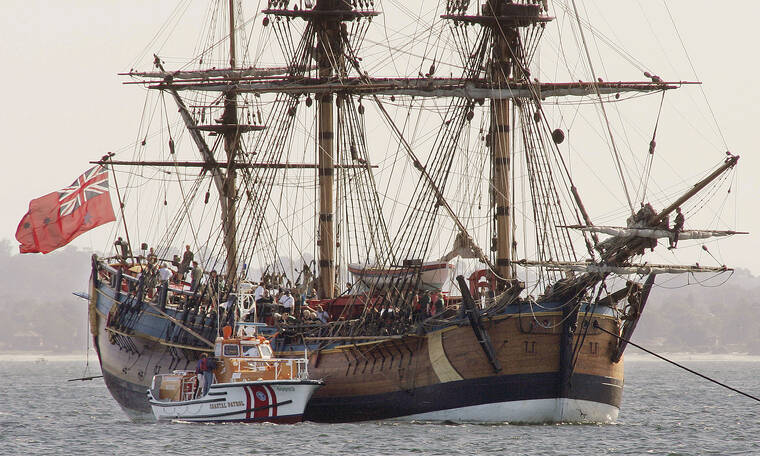
Endeavour

A ship now simply known as RI 2394 lies wrecked on the muddy seabed of Newport Harbor. It had been sunk by the British military in an American harbor.

Its location was forgotten for over two centuries until Australian maritime archaeologists worked with a team in Newport Harbor, Rhode Island, to hunt for clues that confirmed its identity.

Then, … “it is with great pride that after a 22-year program of archival and archaeological fieldwork that, based on a preponderance of evidence approach, I have concluded that an archaeological site known as RI 2394, located in Newport Harbor, Rhode Island, USA, comprises the shipwreck of HM Bark Endeavour.” (Kevin Sumpton, Australian National Maritime Museum)

However, the Rhode Island Marine Archaeology Project, reportedly the lead organization for the study in Newport harbor, says “the report that the Endeavour has been identified is premature.”

Let’s look back …

In the late-1700s, the small seaside village of Whitby was known as a ‘nursery’ for mariners, where expert shipbuilders and the most competent seafarers completed their apprenticeships. This center for commercial trade bred colliers – sturdy ships capable of carrying heavy loads, including coal, across the Baltic Sea and beyond.

They were steady workhorses that could be relied upon. Their solid, flat-floored hulls were adept in navigating shallow harbors and estuaries.

Earl of Pembroke was one such vessel, built by Thomas Fishburn for Thomas Milner in 1764. The ship was used as a coal carrier.

One of its rare and distinguishing features was a ‘deadwood’ or ‘rider’ keelson that ran along the inside bottom of the hull. This reinforcing centerline timber prevented the vessel from breaking its back when loading or unloading cargo in shallow tidal waters.

A March 27, 1768 letter from The Yard Officers, Deptford to The Royal Navy Board stated, “We have surveyed and measured the undermentioned ships recommended to your Honours to proceed on Foreign Service and send you an account of their quantities, condition, age and dimensions …”

“The Earl of Pembroke, Mr Thos. Milner, ownes was built at Whitby, her age three years nine months, square stern bark, single bottom, full built and comes nearest to the tonnage mentioned in your warrant and not so old by fourteen months, is a promising ship for sailing of this kind and fit to stow provisions and stores as may be put on board her.”

A subsequent letter from The Royal Navy to the Secretary of the Admiralty on March 29, 1768 stated, “We desire that you will inform their Lordships that we have purchased a catbuilt bark, in burthen 368 tons, and of the age of three years and nine months, for conveying such persons as shall be thought proper to the southward …”

“… for making observations of the passage of the planet Venus over the disc of the sun, and pray to be favoured with their Lordships’ directions for fitting her for this service accordingly … and that we may also receive Their commands by what name she shall be registered on the list of the Navy.”

An April 5, April 1768 response stated, “We do hereby desire and direct you to cause the said vessel to be sheathed, filled, and fitted in all respects proper for that service, and to report to us when she will be ready to receive men. And you are to cause the said vessel to be registered on the list of the Royal Navy as a bark by the name of the Endeavour”.

Captain James Cook’s first Pacific voyage (1768-1771) was aboard the Endeavour and began on May 27, 1768. It had three aims; establish an observatory at Tahiti to record the transit of Venus (when Venus passes between the earth and the sun – June 3, 1769;) record natural history, led by 25-year-old Joseph Banks; and continue the search for the Great South Land.

When Captain Cook set sail on the first of three voyages to the South Seas, he carried with him secret orders from the British Admiralty to seek ‘a Continent or Land of great extent’ and to take possession of that country ‘in the Name of the King of Great Britain’.

While each of the three journeys made by Captain Cook into the Pacific had its own aim and yielded its own discoveries, it was this confidential agenda that would transform the way Europeans viewed the Pacific Ocean and its lands. (State Library, New South Wales)

Endeavour voyaged to the South Pacific, mainly to record the transit of Venus in Tahiti in 1769. After that, the ship sailed around the South Pacific searching for the “Great Southern Land.” (Wall Street Journal)

After heading west from England, rounding Cape Horn beneath South America and crossing the Pacific, Cook landed the Endeavour in Australia’s Botany Bay on April 29, 1770. To the British, Cook went down in history as the man who ‘discovered’ Australia – despite Aboriginal Australians having lived there for 50,000 years and the Dutch traversing its shores for centuries. (Ward)

When Endeavour sailed around the coast of Australia, on June 11, 1770, she became stuck in a reef, now known as Endeavour Reef (part of the Great Barrier Reef). Cook ordered that all extra weight and unnecessary equipment be removed from the ship to help her float.

The reef had created a hole in the hull which, if removed from the reef, would cause the ship the flood. After several attempts, Cook and his crew successfully freed Endeavour but she was in a dire condition. She sailed to Batavia, part of the Dutch East Indies, to properly repair her before the voyage home.

Captain Cook’s charting of Australia’s east coast paved the way for the establishment of a penal colony. In 1788, British settlers landed in what is now downtown Sydney.

At the time Captain Cook was sailing in the Pacific and bumped into Hawai’i (January 18, 1778) recall that back in the Atlantic, the American Revolutionary War was still ongoing with the Americans (with support from the French) fighting the British.

After returning to Britain in 1771, the Endeavour was sent to Woolwich to be refitted to be used as a naval transport and store ship, frequently operating between Britain and the Falklands. In 1775 she was sold out of the navy to a shipping company Mather & Co. She was refitted and renamed Lord Sandwich.

Lord Sandwich was also contracted by the British navy to transport soldiers in 1776 to fight against the American colonists who sought to break free from British control.

In 1776, Lord Sandwich was stationed in New York during the Battle of Long Island that led to the British capture of New York. In August 1778, the British scuttled the Lord Sandwich and four other vessels at Newport Harbor to try to create a blockade to stop a fleet of French warships that had sailed in to support the American forces. (VOA News)

Cook’s second Pacific voyage (1772-1775) aboard Resolution and Adventure aimed to establish whether there was an inhabited southern continent, and make astronomical observations.

Cook’s third and final voyage (1776-1779) of discovery was an attempt to locate a North-West Passage, an ice-free sea route which linked the Atlantic to the Pacific Ocean. Cook commanded the Resolution while Charles Clerke commanded Discovery. (State Library, New South Wales)

Cook’s crew first sighted the Hawaiian Islands in the dawn hours of January 18, 1778. His two ships, the HMS Resolution and the HMS Discovery, were kept at bay by the weather until the next day when they approached Kauai’s southeast coast.

On the afternoon of January 19, native Hawaiians in canoes paddled out to meet Cook’s ships, and so began Hawai’i’s contact with Westerners. The first Hawaiians to greet Cook were from the Kōloa south shore.

The Hawaiians traded fish and sweet potatoes for pieces of iron and brass that were lowered down from Cook’s ships to the Hawaiians’ canoes.

The Island “were named by Captain Cook the Sandwich Islands, in honour of the Earl of Sandwich, under whose administration he had enriched geography with so many splendid and important discoveries.” (Captain King’s Journal; Kerr)

Hawaiian lives changed with sudden and lasting impact, when western contact changed the course of history for Hawai’i.

At the time of Cook’s arrival (1778-1779), the Hawaiian Islands were divided into four kingdoms: (1) the island of Hawaiʻi under the rule of Kalaniʻōpuʻu, who also had possession of the Hāna district of east Maui; (2) Maui (except the Hāna district,) Molokai, Lanai and Kahoʻolawe, ruled by Kahekili; (3) Oʻahu, under the rule of Kahahana; and at (4) Kauai and Niʻihau, Kamakahelei was ruler.

Throughout their stay, the ships were supplied with fresh provisions which were paid for mainly with iron, much of it in the form of long iron daggers made by the ships’ blacksmiths on the pattern of the wooden pāhoa used by the Hawaiians.

After a month’s stay, Cook got under sail again to resume his exploration of the Northern Pacific. Shortly after leaving Hawaiʻi Island, the foremast of the Resolution broke. They returned to Kealakekua. On February 14, 1779, Cook was killed. (Information here is from Australian National Maritime Museum, Ward, RIMAP, MuSEAum).)

© 2022 Ho‘okuleana LLC

Filed Under: Prominent People, Sailing, Shipping & Shipwrecks Tagged With: Endeavour, Australia, Captain Cook, Resolution, Discovery, Revolutionary War

August 26, 2022 by Peter T Young Leave a Comment

James Colnett

Captain James Cook set sail on three voyages to the South Seas.  His first Pacific voyage (1768-1771) was aboard the Endeavour and began on May 27, 1768. It had three aims; go to Tahiti to record the transit of Venus (when Venus passes between the earth and sun – June 3, 1769;) record natural history, led by 25-year-old Joseph Banks; and search for the Great South Land.

Cook’s second Pacific voyage (1772-1775) aboard Resolution and Adventure aimed to establish whether there was an inhabited southern continent, and make astronomical observations.

Cook’s third and final voyage (1776-1779) of discovery was an attempt to locate a North-West Passage, an ice-free sea route which linked the Atlantic to the Pacific Ocean.  Cook commanded the Resolution while Charles Clerke commanded Discovery.  (State Library, New South Wales)

“Every Fighting Service has, and must have, two main categories – ‘Officers’ and ‘Men.’ The Royal Navy in the late eighteenth and early nineteenth centuries was no exception. The distinction existed: was indeed more than ordinarily marked. It was not only a naval distinction, but a sharp social one too.”

“‘Officers’ as contemporary society used that word, came from one walk of life, ‘Men’ from another: and, as it was not easy in Society to pass from a lower stratum to a higher, so in the Navy, it was not easy for a ‘Man’ to become an Officer. But it was possible.” (Captain Cook Society)

“Cook had chosen his subordinates well or had been lucky. The officers of the third voyage were a remarkably intelligent group of men.” (Captain Cook Society)

“All the great remaining voyages of the eighteenth century drew on Cook’s officers. Bligh, Portlock, Vancouver, Colnett, Riou, and Hergest all got their commands and served with great distinction. These men then passed on their skills to a second generation of men such as Flinders and Broughton.”  (Mackay, Captain Cook Society)

James Colnett was born in 1753 at Plymouth, England; the Colnett family was originally from the Stepney district of East London.

His father, James Colnett senior, was in the Royal Navy and this took him and the family to Plymouth and Portsmouth. His father died in 1760.  James Jr’s mother, Sarah, was left to bring up the four children alone.

The younger James began his naval career on June 28, 1770 as an able seaman on the Hazard, a small sloop. On September 4, 1771, he became a midshipman on HMS Scorpion under James Cook and transferred to the Resolution when Cook was readying for his second Pacific voyage.

Colnett served as midshipman throughout Cook’s second voyage from 1772 until 1775. Colnett was the first European to sight New Caledonia, and Cook named Cape Colnett and Mount Colnett commemorated that sighting.

One of his midshipman colleagues, John Elliott, later described Colnett as ‘Clever and Sober’.

After Cook’s voyage, Colnett was appointed to the Juno, a 5th rank, as gunner on January 1, 1776.  He was then appointed master of the Adventure during the War of American Independence before passing for lieutenant on February 4, 1779. Ten days later he was appointed third lieutenant of the Bienfaisant, a 3rd rank, remaining on that ship until 1783.

In one of his journals, he provides advice on passage around Cape Horn (south of South America), “I have doubled Cape Horn in different seasons …”

“… but were I to make another voyage to this part of the globe, and could command my time, I would most certainly prefer the beginning of winter, or even winter itself, with moon-light nights; for, in that season, the winds begin to vary to the Eastward; as I found them, and as Captain, now Admiral, Macbride, observed at the Falkland Isles.”

“Another error, which, in my opinion, the commanders of vessels bound round Cape Horn commit, is, by keeping between the Falkland Isles and the main, and through the Straits Le Maire …”

“… which not only lengthens the distance, but subjects them to an heavy, irregular sea, occasioned by the rapidity of the current and tides in that channel, which may be avoided, by passing to the Eastward.”

“At the same time, I would recommend them to keep near the coast of Staten Land, and Terra del Fuego, because the winds are more variable, in with the shore, than at a long offing. …”

“If the navigation round Cape Horn should ever become common, such, a place we must possess; and agreeable to the last convention with Spain, we are entitled to keep possession of it, and apply it to any purpose of peace or war. Great advantages might arise from such a settlement.” (Colnett)

In 1785, a London merchant, Richard Cadman Etches, had formed the King George’s Sound Company to send ships to the Northwest coast of North America to exploit the sea otter pelt trade.

Two ships, the King George and the Queen Charlotte, had already been dispatched in 1785 under the command of Nathaniel Portlock and George Dixon and it was now proposed to send another two ships.

Colnett had been in discussions with Etches and, having obtained permission from the Admiralty for extended leave of absence, he took command of the expedition and the Prince of Wales, the larger ship. Charles Duncan was appointed to command the Princess Royal consort vessel.

The ships left Britain in October 1786 and spent the summer of 1787 trading in the Queen Charlotte Islands and the adjacent mainland.   The two ships then sailed in August 1788 for Hawai‘i. The traders had usually wintered at the Hawaiian islands.

It was then, in what appears is the first reference and suggestion that Pacific captains should hire Hawaiians to their crew.  In his journal, Colnett suggested, “If you can procure a hardy willing fellow from Isles [Hawai‘i] to embark with you to increase your strength …”

He also provides other observations about the Hawaiian, “You will in the winter Season send what Vessels you Judge proper to the Sandwich Isles for Provisions …”

“… and in their return we imagine that some of the Natives of those Isles both men and women may be embark’d and transplanted to America and made useful in our employ. This must be done by their own consent and with every precaution with regard to their health as well as happiness.” (Colnett)

Colnett had been away for five and a half years during which time his mother had died in 1790. A codicil to her will was witnessed by Nathaniel Portlock, who had led the other Etches expedition to the Pacific.

The Pacific sperm-whaling industry began with the 1789–90 voyage of the Emelia out of England. Prompted by that voyage’s success, the Emelia’s owners commissioned James Colnett in 1793 to take the Rattler to the Pacific Ocean to discover exactly where and when sperm whales congregated and to discover suitable ports and anchorages that British whalers could use.

Colnett’s narrative of the voyage was published in 1798 together with a series of charts. Colnett’s voyage opened up the South Pacific whale fishery.

Sperm oil, used in lamps, and spermaceti (a waxy substance found in the head cavities of the sperm whale), used in candles, fueled the eighteenth-century lighting revolution, inside homes and outside on public thoroughfares.

James Colnett died on September 1, 1806, at his lodgings in Great Ormond Street, London.  He was buried on September 6 in St Dunstan and All Saints, Stepney.  (Information here is from A Voyage to the South Atlantic and around Cape Horn into the Pacific Ocean, Colnett; New Histories of Pacific Whaling, Jones & Wanhalla; Captain Cook Society)

© 2022 Ho‘okuleana LLC

Filed Under: Economy, Prominent People, Sailing, Shipping & Shipwrecks Tagged With: Captain Cook, Whaling, James Colnett, Sperm Whale

July 16, 2022 by Peter T Young Leave a Comment

Hawaiʻi Nei Pae ʻĀina

Captain James Cook made three voyages into and around the Pacific.  On the first voyage (1768-1771,) the Royal Society had petitioned the British government and the Admiralty to send astronomers to observe the Transit of Venus from Tahiti in 1769 – they were also looking for the great southern continent, Terra Australis Incognita (Australia.)

His second voyage (1772-1775) expanded on the exploration of the South Pacific (he finally found Australia on this trip, as well as other locales (Easter Island, the Marquesas Islands, Tonga and the New Hebrides.)

Cook’s third and final voyage (1776-1780) took him to the North Pacific, seeking a navigable northwest passage.  On this trip, in 1778, Cook made contact (‘discovered’) the Hawaiian Islands (he was killed there in 1779 and his crew completed the voyage.)

Cook first sighted Oʻahu on January 18, 1778. On February 2, 1778 his journal entry named the island group after his patron: “Of what number this newly-discovered Archipelago consists, must be left for future investigation.”

“We saw five of them, whose names, as given by the natives, are Woahoo (Oʻahu,) Atooi (Kauaʻi,) Oneeheow (Niʻihau,) Oreehoua (Lehua) and Tahoora (Kaʻula.) … I named the whole group the Sandwich Islands, in honour of the Earl of Sandwich.”  (Cook’s Journal)

The name ‘Sandwich Islands’ stuck, at least for a while; and later foreign, as well as Hawaiian, writers referred to the Islands this way.

As an example, on May 23, 1786, Captain Portlock referenced the islands in his journal, as he made way to “Owhyhee, the principal of the Sandwich Islands.”

Later, in instructions to Captain George Vancouver (March 8, 1791,) “The King, having judged it expedient, that an expedition should be immediately undertaken for acquiring a more complete knowledge, than has yet been obtained, of the north-west coast of America” and further told him to proceed “to the Sandwich islands in the north pacific ocean, where you are to remain during the next winter”.  (Vancouver’s Journal)

Missionary Hiram Bingham in recounting the time he spent in the Islands (April 4, 1820 – August 3, 1840) named his book “A Residence of Twenty-One Years in the Sandwich Islands”.   The American Board of Commissioners for Foreign Missions, sponsors, named the mission the “Sandwich Islands Mission.”

The first English language newspaper in the islands was named the Sandwich Islands Gazette and Journal of Commerce, published in Honolulu from July, 1836 to July, 1839. Another early Honolulu newspaper was entitled the Sandwich Island Mirror.

But the “Sandwich Islands” reference was not limited to foreigner use.

In one of the first written laws in the Islands, “He Mau Kanawai no ke Ava o Honoruru, Oahu (Some Laws for the Harbor of Honolulu, Oʻahu),” noting seven rules, written in Hawaiian and English in parallel columns, Kalanimōku signed the measure noting their location, “Oahu, Sandwich Islands, June 2, 1825.” (Hawaiian Historical Society)

Another law begins with the clause, “Be it enacted by the king and Chiefs of the Sandwich Islands, in council assembled, That, after the first of January 1839, the importation of rum, brandy, gin, alcohol and all distilled spirits whatsoever, shall be entirely prohibited to be landed at any port, harbor or any other place on the Sandwich Islands ….” (Report of the Executive Committee of the American Temperance Union)

Hawaiʻi’s first treaty, signed December 23, 1826 between Hawaiʻi and the United States, notes in Article 1, “The peace and friendship subsisting between the United States, and their Majesties, the Queen Regent, and Kauikeaouli, King of the Sandwich Islands, and their subjects and people, are hereby confirmed, and declared to be perpetual.”  Further references to the Sandwich Islands are noted throughout.

The move toward constitutional governance (through the Declaration of Rights) by King Kamehameha III proclaimed the rights of the people, ensuring equal protection for both the people and the chiefs. Written by Kamehameha III and the Chiefs, and enacted on June 7, 1839, its translation notes …

“Whatever chief shall perseveringly act in violation of this Constitution, shall no longer remain a chief of the Sandwich Islands, and the same shall be true of the governors, officers and all land agents.”

Shortly after, however, was an apparent concerted effort to drop the Sandwich Islands reference, in favor of referring to the islands as the Hawaiian Islands.

“It may be safely said that the term ‘Sandwich Islands’ was never accepted by local authority, or had official use, and hence called for no legal act, or by authority notice, for the adoption of what was their own.”

“That important cluster of Islands, situated in the North Pacific Ocean, commonly known as the Sandwich Islands, were so named by Captain Cook, at the date of their discovery by him, in honor of his patron, the Earl of Sandwich, then first Lord of the Admiralty.”

“Their legitimate appellation, and the one by which they still continue to be distinguished by the aboriginal inhabitants, is ‘Hawaii nei pae ʻāina,’ a collective term, synonymous with ‘these Hawaiian Islands.’”    (Thrum, 1923)

“This term is derived from the largest of the group, Hawaiʻi, whence the reigning family originated, and is gradually taking the place of the former.”  (Jarves, 1847)

A notable change in the Constitution of 1840 shows the substitution of “Hawaiian Islands” for “Sandwich Islands,” specifically the clause from the Declaration of Rights noted above, as well as other similar references.  It is suggested that the 1840 Constitution officially named the islands the Hawaiian Islands.  (Clement)

After a transition period, generally, after that point the Hawaiian Islands label took hold.

However, still into the 1880s, when King Kalākaua was visiting New York, his spokesman it speaking with New York Times reporter noted …

“Now, before you ask me a single question, let me ask just two favors. One is that you won’t speak of the King as ‘King of the Sandwich Islands,’ the title grates on our nerves, as it were, you, know, and then, too, it is altogether improper.”

“There is now no such thing as the ‘Sandwich Islands’ — that is all changed; it is the Hawaiian Islands, and please write it that way and we will all be obliged, greatly obliged.”  (NY Times, September 24, 1881)

© 2022 Hoʻokuleana LLC

Filed Under: General, Ali'i / Chiefs / Governance, Economy Tagged With: Hawaii, Captain Cook, Sandwich Islands, Hawaiian Islands

June 25, 2022 by Peter T Young Leave a Comment

Circumnavigation of the World

With the recent voyages of Hōkūleʻa and Hikianalia on their journey around the world “to learn, create global relationships, and explore how to care for our oceans and island earth,” (PVS) we recognize they followed in the footsteps of Hawaiʻi’s last king, Kalākaua, over a century ago in sharing the Islands with others.

“O’er land and sea I’ve made my way; To farthest Ind, and great Cathay; Reached Afric’s shores, and Europe’s strand; And met the mighty of every land.”

“And as I stood by each sovereign’s side, Who ruled his realm with a royal pride, I felt how small my sway,—and weak:— My throne based on a mere volcanic peak, Where millions do these Kings obey, Some thousands only own my sway.”

“And yet I feel that I may boast, Some good within my sea-bound coast, Richer than those of my grander peers, That I within my realm need have no fears”

“May mingle with my people without dread: No danger fear for my unguarded head, And boast a treasure, sent me from above That I have indeed, my people’s love.”  (Kalākaua’s Boast, PCA)

King Kalākaua was the first ruling Monarch to tour of the world; in doing so, he made good on his motto, and motivation, proclaimed at his accession, ‘Hoʻoulu Lahui!’- (Increase the Nation!)

“Since the concert of the morning stars, or the appearance of man on the globe, sovereigns have done many great and many small things; but not one of them, even in these later days, has had the audacity or pluck to circumnavigate this little planet.”  (Armstrong)

“A deep feeling of anxiety and interest pervaded the community on the eve of the departure of the King, and all classes and races strove to outvie each other in their expressions of good-will and affection, in bidding adieu to His Majesty.”  (PCA)

“(T)he King goes but for the good of his people, to make the country richer by getting more capital and people to come this way. … So the King this time takes with him a Commissioner to enquire into and bring other people of brown skins here to re-people these isles.”  (Kapena)

The King and others were concerned about the declining Hawaiian population in the Islands.  “The King himself would be only so in name if he had no people to rule. The King will not rest until his hope of re-peopling these isles has been fulfilled.”  (Kapena)

Leaving January 20, 1881 on the Oceanic and arriving back in the Islands October 29, 1881 (nine months and nine days later,) Kalākaua travelled to the US, Japan, China, Siam, Burma, India, Egypt, Italy, Belgium, Germany, Austria-Hungary, France, Spain, Portugal and the United Kingdom.

Kalākaua wanted to gain recognition for his kingdom and learn how other monarchs ruled.  He believed the best way to conclude diplomatic relations with foreign countries was to understand their customs.

He met with the Emperor of Japan; General Li Hung Chang, of China; the Governor of Hong Kong, in the name of the British Queen; the King of Siam; the British Governors or Commissioners of Singapore, Penang, the Malacca Straits, and of Burma; the Vice-Regal Court of India; the Viceroy of Egypt; the King of Italy; the Pope, Holy Father in Rome; the British Queen; the King of Belgium; the Court of Emperor William of Germany; the officials of the Austrian Empire, in the absence of the Emperor; the officials of the French Republic; the officials of the Spanish Court, whose Regent was absent; the King of Portugal; and finally, the President of the United States.

For the most part, the King travelled incognito (his trip was claimed to have “no official significance.”) At times his unannounced arrivals caused some confusion (and missed opportunities to meet with leaders (who were out of town.))

However, he was greeted and handled with stately attendance.  He was royally entertained and decorated with the highest orders; armies were paraded before him and banquets held in his honor.

Three white men went with him as advisers and counsellors, William N Armstrong (his Attorney General,) Colonel Charles H Judd (his Chamberlain and one of his most trustworthy friends) and a personal attendant/valet (a German known as ‘Robert.’)

Armstrong and Judd were sons of American missionaries to the Islands – and the only companions of the King on the voyage.  (Armstrong)

Armstrong and Judd were Kalākaua’s schoolmates at the Chiefs’ Children’s School in 1849.  (Marumoto)  “Thirty years afterward, and after three of our schoolmates had become kings and had died (Kamehameha IV & V and Lunalio) and two of them had become queens (Emma and Liliʻuokalani,) it so happened that Kalākaua ascended the throne, and with his two old schoolmates began his royal tour.”  (Armstrong)

During the trip, Armstrong was given the additional titles of Minister of State and Royal Commissioner of Immigration. The title of Minister of State was given in order to place Armstrong in the same rank as the cabinet ministers of foreign sovereigns.  (Marumoto)

One striking incident occurred while the King was being entertained by the Khedive of Egypt at Alexandria. The royal party, during the reception, was brought out on the balcony of the palace to look out over the harbor. And while they were standing there, an attaché pointed out to King Kalākaua an old hulk used for receiving coal.

The hulk was all that was left of the Resolution, the ship in which Captain Cook ‘discovered’ the Hawaiian Islands. The King said: “Let us drink a toast to the old ship.” The wine was brought, and on the grand balcony, with the harbour lighted with rockets and lanterns, the King raised his glass and said, “Here’s to the ‘Resolution.’”  (Armstrong)

At the end of his trip Kalākaua declared that he had found nothing in the civilized world of which his nation stood in need with the exception of some well bred horses and sheep. He said that he found his own subjects to be better off than the majority of the nations he had visited.

They had enough to eat and wear and were certainly happier than any people he had seen.    (Lesley’s Monthly)  (The Pacific Commercial Advertiser (PCA) chronicled is voyage; much of the information here is from there.)

12© 2022 Hoʻokuleana LLC

Filed Under: Ali'i / Chiefs / Governance, Sailing, Shipping & Shipwrecks Tagged With: 1881, World Tour, Charles Judd, Hawaii, King Kalakaua, Captain Cook, Resolution, William Armstrong, Circumnavigate

  • « Previous Page
  • 1
  • …
  • 4
  • 5
  • 6
  • 7
  • 8
  • …
  • 12
  • Next Page »

Images of Old Hawaiʻi

People, places, and events in Hawaiʻi’s past come alive through text and media in “Images of Old Hawaiʻi.” These posts are informal historic summaries presented for personal, non-commercial, and educational purposes.

Info@Hookuleana.com

Connect with Us

  • Email
  • Facebook
  • LinkedIn
  • Twitter
  • YouTube

Recent Posts

  • Palea and the Pinnace
  • Yick Lung
  • Early Days at Kamehameha Schools
  • ʻĪmaikalani
  • About 250 years Ago … Give Me Liberty, Or Give Me Death
  • Herbert, William & Jack
  • Lake Waiau

Categories

  • American Revolution
  • General
  • Ali'i / Chiefs / Governance
  • Buildings
  • Missionaries / Churches / Religious Buildings
  • Hawaiian Traditions
  • Military
  • Place Names
  • Prominent People
  • Schools
  • Sailing, Shipping & Shipwrecks
  • Economy
  • Voyage of the Thaddeus
  • Mayflower Summaries

Tags

Albatross Al Capone Ane Keohokalole Archibald Campbell Bernice Pauahi Bishop Charles Reed Bishop Downtown Honolulu Eruption Founder's Day George Patton Great Wall of Kuakini Green Sea Turtle Hawaii Hawaii Island Hermes Hilo Holoikauaua Honolulu Isaac Davis James Robinson Kamae Kamaeokalani Kameeiamoku Kamehameha Schools Lalani Village Lava Flow Lelia Byrd Liberty Ship Liliuokalani Mao Math Mauna Loa Midway Monk Seal Northwestern Hawaiian Islands Oahu Papahanaumokuakea Marine National Monument Pearl Pualani Mossman Quartette Thomas Jaggar Volcano Waikiki Wake Wisdom

Hoʻokuleana LLC

Hoʻokuleana LLC is a Planning and Consulting firm assisting property owners with Land Use Planning efforts, including Environmental Review, Entitlement Process, Permitting, Community Outreach, etc. We are uniquely positioned to assist you in a variety of needs.

Info@Hookuleana.com

Copyright © 2012-2024 Peter T Young, Hoʻokuleana LLC

Loading Comments...