Images of Old Hawaiʻi

  • Home
  • About
  • Categories
    • Ali’i / Chiefs / Governance
    • American Protestant Mission
    • Buildings
    • Collections
    • Economy
    • Missionaries / Churches / Religious Buildings
    • General
    • Hawaiian Traditions
    • Other Summaries
    • Mayflower Summaries
    • Mayflower Full Summaries
    • Military
    • Place Names
    • Prominent People
    • Schools
    • Sailing, Shipping & Shipwrecks
    • Voyage of the Thaddeus
  • Collections
  • Contact
  • Follow

July 23, 2022 by Peter T Young Leave a Comment

Music Hall – Opera House

Opera was born circa 1600 from the desire of Renaissance Italians to recreate Greek drama, pointing to various less-elevated national theatrical traditions as important contributors to the art form.  (Abbate)

Although Hawai‘i is hardly known as an international opera powerhouse, a number of native Hawaiians have been among the art form’s stars.  Most notable was tenor Tandy Ka‘ohu MacKenzie, who was born in Hāna in 1892 and went on to become a star of the international opera stage star after he was discovered by an Irish singer who happened to drop in on a performance by MacKenzie’s Kamehameha School glee club.  (Ferrar)

In 1881, a Music Hall was built across the street from ʻIolani Palace, where Ali‘i regularly joined the audiences at performances. Queen Lili‘uokalani is even said to have written her own opera.  (Ferrar)  It was built by the Hawaiian Music Hall Association.

The Wells troupe from California opened the music hall.  “Since then many companies and individual artists from abroad have trod its boards, and given more or less delight to the inhabitants.”  (Daily Bulletin, February 12, 1895)

The building was first called the Music Hall, but shortly after its transfer to new owners, the name was changed to the Royal Hawaiian Opera House.  (Daily Bulletin, February 12, 1895)

Despite its name, the Opera House was not primarily a venue for classical entertainment. Many of its bookings were melodramas and minstrel shows, two very popular forms of theater at the time.  Then, it was the first house to show moving pictures in Hawaiʻi.

The building was of brick 120 by 60 feet on the ground floor and walls forty feet high and twenty inches thick. The front door was ten feet wide, opening into a vestibule 16 by 27 feet. The seating capacity of the house was 671 persons. The stage was forty feet deep and provided with a complete set of scenery, traps and all necessary paraphernalia. (Hawaiian Star, February 12, 1895)

On July 28, 1883, the property was sold at auction to satisfy a claim. It was purchased by Mr. WG Irwin for $21,000, John D Spreckels being a partner in the deal.  (Hawaiian Star, February 12, 1895)

“Originally there were two (private) boxes. One on the right of the stage looking out was regarded as the property of the late King Kalākaua, who had subscribed liberally to the stock of the Association.  The box on the opposite side was owned by the present proprietors, Messrs. Irwin & Spreckels. About two years ago two boxes wore opened above those mentioned for letting to whomever first applied for thorn on any occasion.”  (Daily Bulletin, February 12, 1895)

The Music Hall played a role in the Wilcox Rebellion, when it was occupied by Government sharpshooters in suppressing the insurrection of Robert Wilcox in 1889.  (Daily Bulletin, February 12, 1895)

“Wilcox and I then marched towards the gate and came by Boyd’s cannon; he told us to get out of the way he wanted to fire then, because he saw some one in the Music Hall pulling down a window; Wilcox  stopped him; we walked on toward the gate when a gun fired from the Music Hall.”  (Kauhane, Hawaiian Gazette, October 29, 1889)

“Wilcox sung out to Music Hall to “stop firing! stop firing!” three or four more shots were fired from there and then Wilcox gave order to fire; cannons were then fired; think Wilcox knew that Government were gathering forces to drive us out; not my place to surrender.”  (Kauhane, Hawaiian Gazette, October 29, 1889)

It later hosted the complimentary farewell reception and ball for Captain Wiltse, commander of the USS Boston in 1893, under the auspices of the provisional Government.

The Music Hall’s “exterior was built of red brick and the facade on King street was of a modest but presentable and harmonious style. Internally it was fitted and furnished in modern fashion, with seats on a sloping floor in semi-circular rows. There were a balcony and a gallery in the second story.”  (Daily Bulletin, February 12, 1895)

Fire nearly destroyed the building.  Irwin, owner of the property, surveyed the sodden, smoking ashes from his curtained carriage. “I have had enough of music halls,” he told a questioning newsman.

He was later persuaded to rebuild, however, when it was pointed out that the only other theatrical accommodations in the city were inadequate facilities at the YMCA and the hall in Independence Park.

A commission was appointed to inquire into the strength of the walls left standing.  After a careful inspection, it was decided that three of the walls were in sound condition, and could be built upon with perfect safety.  The rear wall had to be rebuilt.  The work began.

The opening of the New Hawaiian Opera House tonight begins another epoch in the history of Honolulu and the public finds that through the action of William G. Irwin of this city and John D. and Adolph Spreckels, of San Francisco, it has a theater equal to the leading places of amusement in the United States.  (Hawaiian Gazette, November 10, 1896)

A commission was appointed to inquire into the strength of the walls left standing.  After a careful inspection, it was decided that three of the walls were in sound condition, and could be built upon with perfect safety.  The rear wall had to be rebuilt.  The work began.

The seating capacity of the New Hawaiian was about 900, but the seats were placed so far apart, in order to make it more comfortable for the patrons, that if it were necessary, two or three hundred more chairs could be placed in the auditorium without crowding. In the rear of the orchestra are two loges, each containing six chairs.  (Hawaiian Gazette, November 10, 1896)

On February 5, 1897, the Opera House displayed Edison’s Veriscope which promised to be one of the most interesting sights ever seen in Honolulu.   One of the first projections was of a fire department response to a fire.  “The crowds gather, people run hither and thither, teams pass, some block the way, the police appear, and there are seen all the usual incidents of a street lire drill.”

“It is a wonderful advance in the stereoscopic art. It projects pictures upon a white screen, in which all the figures are in motion with life-like detail. … The exhibition of the wonderful veriscope is alone worth the evening’s attendance.”  (Hawaiian Star, February 4, 1897)

The building was demolished in 1917 to make way for the Federal Building.  One of the many eulogies for the building said:  “It is historical. It is ugly. It is like a box with a few touches of ornament to make it look unlike a box. So much for the outside. On the inside, it is as cozy and comfortable as anyone could desire.”  (Gereben)

© 2022 Hoʻokuleana LLC

Filed Under: Economy, General, Buildings Tagged With: Wilcox Rebellion, Tandy MacKenzie, Hawaii, Honolulu, Oahu, Downtown Honolulu, Opera House, Aliiolani Hale

July 12, 2022 by Peter T Young 1 Comment

Fort Street Mall

In 1815, Kamehameha I granted Russian representatives permission to build a storehouse near Honolulu Harbor.  But, instead, directed by the German adventurer Georg Schaffer (1779-1836,) they began building a fort and raised the Russian flag.

They built their blockhouse near the harbor, against the ancient heiau of Pākākā and close to the King’s complex.  There are reports that the Russians used stones from Pākākā in building their facility.  (Pākākā was the site of Kaua‘i’s King Kaumuali‘i’s negotiations relinquishing power to Kamehameha I, instead of going to war, and pledged allegiance to Kamehameha, a few years earlier in 1810.)

When Kamehameha discovered the Russians were building a fort (rather than storehouses) and had raised the Russian flag, he sent several chiefs (including Kalanimōku and John Young (his advisor,)) to remove the Russians from Oʻahu by force, if necessary.

The Russian personnel judiciously chose to sail for Kaua‘i instead of risking bloodshed.  On Kaua‘i, there they were given land by Kaua‘i’s King Kaumuali‘i; the Russian Fort Elizabeth was built soon after on Kaua‘i.

The partially built blockhouse at Honolulu was finished by Hawaiians under the direction of John Young and mounted guns protected the fort.  Its original purpose was to protect Honolulu by keeping enemy or otherwise undesirable ships out.  But, it was also used to keep things in (it also served as a prison.)

By 1830, the fort had 40 guns mounted on the parapets all of various calibers (6, 8, 12 and probably a few 32 pounders.)  Fort Kekuanohu literally means ‘the back of the scorpion fish,’ as in ‘thorny back,’ because of the rising guns on the walls.  In 1838 there were 52 guns reported.

Fort Street is named after this fort; it is one of the oldest streets in Honolulu.  Today, the site of the old fort is the open space called Walker Park, a small park at the corner of Queen and Fort streets (also fronting Ala Moana/Nimitz.)

Fort Street gradually became the retail and business center of the Island throughout the 1800s and into the 1950s; it hosted several of the largest department stores in Hawaii including Kress, Liberty House and Woolworth’s.  Other stores were located along its streets.

However, by the 1940s, some foresaw the decline of downtown.  Traffic congestion, inadequate parking and competition from suburban shopping centers drained business from downtown.

In 1949, the Hawaiʻi Chapter of the American Institute of Architects made the first proposal to close Fort Street to vehicular traffic.  Nothing happened; then, with the announcement of the planned Ala Moana Shopping Center, many feared a mass exodus from downtown.

In response, the Downtown Improvement Association was formed in 1958.  It developed a master plan for downtown.  Little happened, for another 6-years.  Then, a pilot project closed Fort Street, in conjunction with the Golden Harvest Celebration.

While downtown business declined with the opening of Ala Moana Center, more studies and plans were prepared, until, finally, the City Planning Commission hired Gruen to develop a plan.

The plan called for downtown super blocks, with a system of pedestrian malls.  In January 1968, the City Council approved Gruen mall plan, after 75% of adjoining owners indicated their consent.

Fort Street Mall is 5-blocks in length (1,738-feet,) extending from Queen Street up to Beretania Street.  Construction began in June 1968 and was completed in February 1969, at a cost of $27-millon.

The architect of the Mall was Victor Gruen Associates.  The project was funded by the City & County (55%,) private owners (44%) and Board of Water Supply (1%.)

Its average width is 50-feet, at the King Street Plaza it widens to 83-feet and at Father Damien Plaza on Beretania Street it becomes 93-feet.  There are cross streets at Merchant, King and Hotel with a pedestrian underpass (and Satellite City Hall) on King Street.

Today, the Fort Street Mall Business Improvement District Association, a nonprofit corporation consisting of property owners and ground lessees adjacent to the Mall, manages the Mall by supplementing the services (primarily maintenance and security) currently provided by the City and County of Honolulu.

Like most urban settings, Fort Street Mall’s character changes block by block.  As you walk along the Mall, the businesses and the patrons indicate changes in the Mall’s identity.

Across from the Cathedral of Our Lady of Peace at the mauka end of the Mall, the Hawaii Pacific University presence gives the Mall a college feel.  Students periodically fill the Mall when classes let out and they stroll to one of the many buildings that HPU occupies on the Mall.

(Information here if from Pedestrian Malls, Streetscapes, and Urban Spaces, Harvey M. Rubenstein and The Fort Street Mall Business Improvement District Association.)

© 2022 Hoʻokuleana LLC


Filed Under: Economy, Buildings, Place Names Tagged With: Fort Kekuanohu, Fort Street, Hawaii, Oahu, Downtown Honolulu

July 6, 2022 by Peter T Young Leave a Comment

Bishop Street

On the continent or in the Islands, in the early-1800s there was limited private and public transportation and it was expensive. Thus, workers’ homes were always within two miles of downtown – less than an hour’s walk.   For these reasons cities of the mid-1800s were virtually all small, dense and on the water.

Hawaiʻi’s streets, for the most part, started out as trails that were widened and straightened, as horses, buggies and then transit became available.  In Honolulu, over time, trails headed mauka following and crossing the Nuʻuanu River, or headed southerly (to Kālia – Waikīkī) or easterly (toward Mānoa.)

Some of the present downtown Honolulu street alignments have origins dating back to 1809. It was about this time that Kamehameha the Great moved his capital from Waikīkī to what is now downtown Honolulu.

A large yam field (pa uhi), footpaths and other sites that existed then, served as the alignment for future streets.  The field’s rock walls along its edges would later border King, Alakea, Beretania and Nuʻuanu Streets.

In 1825, Andrew Bloxam (naturalist aboard the HMS Blonde) noted in Honolulu that, “The streets are formed without order or regularity.  Some of the huts are surrounded by low fences or wooden stakes … As fires often happen the houses are all built apart from each other.  The streets or lanes are far from being clean …” (Clark, HJH)

In 1838, a major street improvement project was started. Honolulu was to be a planned town. Kinaʻu (Kuhina Nui Kaʻahumanu II) published the following proclamation: “I shall widen the streets in our city and break up some new places to make five streets on the length of the land, and six streets on the breadth of the land… .” She designated her husband, Governor Mataio Kekūanāoʻa, to head the project.

As early as 1838, sidewalks along Honolulu streets were constructed, usually of wood.  Paved streets were unknown until 1881; in that year, Fort Street was paved.

In 1845, Commander Charles Wilkes criticized the city by saying: “The streets, if so they may be called, have no regularity as to width, and are ankle-deep in light dust and sand … and in some places, offensive sink-holes strike the senses, in which are seen wallowing some old and corpulent hogs.”

It wasn’t until 1850 that streets received official names.  On August 30, 1850, the Privy Council first named Hawaiʻi’s streets; there were 35-streets that received official names that day (29 were in Downtown Honolulu, the others nearby.)

Before that, many of the streets had multiple names – mostly related to who or what was on them.  Honolulu’s first street names were printed on wooden sign posts, in both English and Hawaiian.  In that same meeting, they officially named the City of Honolulu and designated it the capital of the kingdom.

The first sidewalk made of brick was laid down in 1857 fronting a shop on Merchant Street; Hawaiʻi’s first concrete sidewalk (it already had a brick sidewalk) was poured in front of a store on Queen Street in 1886.

As Honolulu grew, so did the number of streets.  One relative latecomer to that list was Bishop Street – running mauka-makai, through what is now the core of the downtown business district.

In earlier times, the main streets were Fort or Nuʻuanu (mauka-makai) and Beretania, Merchant and Queen (heading relatively northwest-southeast.)  Back then, if you wanted to go up to Nuʻuanu, you took … Nuʻuanu Street.

Bishop Street came into existence around the turn of the century (about 1900.)  Initially, it was only a couple of blocks long, between Queen and Hotel Streets.

By 1923, it extended makai to the harbor (absorbing (and realigning) the former Edinburgh Street) – still no further extension mauka.  By 1934, it extended mauka to Beretania (it absorbed (and realigned) Garden Street.)

In 1949, Bishop only went to Beretania – with no further mauka extension (it finally popped through and extended/connected to the Pali Highway and became the windward gateway into “Town.”)

Named for Charles Reed Bishop (1822 – 1915), banker, financer, philanthropist and public official and his wife Princess Bernice Pauahi Bishop (1831-1884), great-granddaughter of King Kamehameha I and last surviving heir – whose will and landholdings established the Kamehameha Schools.

The couple lived for many years near the site of Bishop Trust Building (1000 Bishop Street) – their property was known as Haleʻākala (built by Pauahi’s father Abner Paki;) the building itself is called Aikupika.)  When Bishop Street was created, it cut through their property.

CR Bishop came to Honolulu just before the California gold rush of 1849. Mr. Bishop married Bernice Pauahi Paki, daughter of high chief Abner Paki.  In 1853, he founded Bishop and Company Bank, now First Hawaiian Bank.

Do you remember the Big Five?

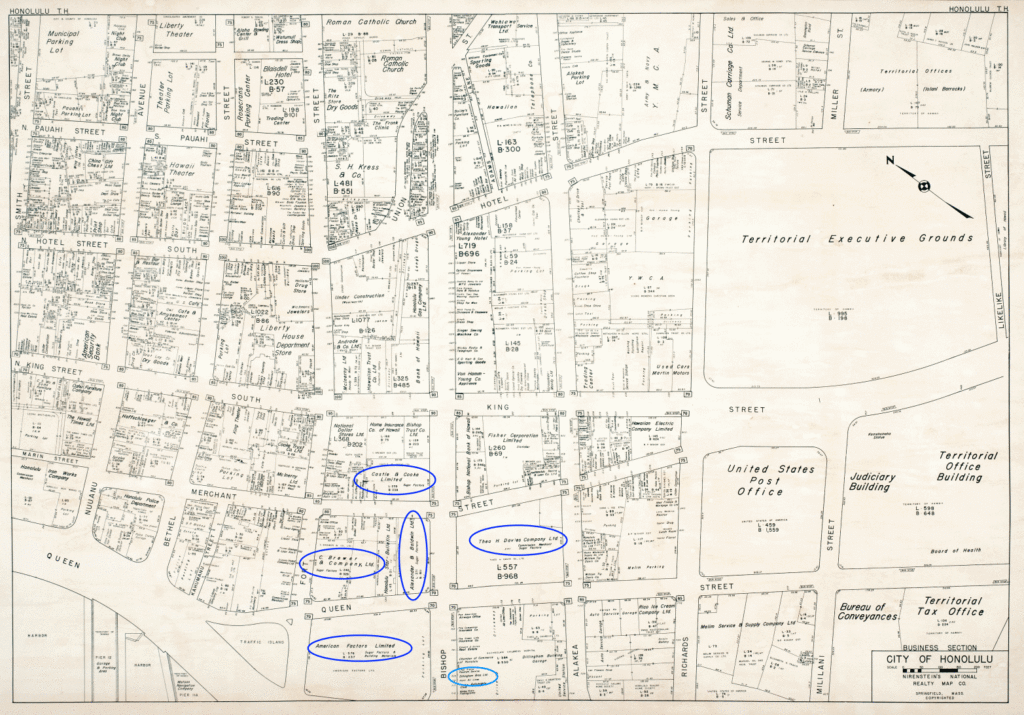
Look at the 1950 map of Honolulu.  Did you notice their placement on Bishop Street (and to each other) back then?

Five major companies emerged to provide operations, marketing, supplies and other services for the plantations and eventually came to own and manage most of them.  They became known as the Big 5: Amfac – Hackfeld & Company (1849;) Alexander & Baldwin (1870;) Theo H. Davis (1845;) Castle & Cooke (1851) and C. Brewer – (1826.)

Although it took a while to be formed, Bishop Street was and continues to be the center of Hawai‘i commerce and banking – and “the” address to have for your business.

The image is a view toward Diamond Head looking from Fort Street down King Street;   Haleʻākala (the Bishop’s house, is marked as “2”.  This was taken in 1855.

© 2022 Hoʻokuleana LLC

Filed Under: Prominent People Tagged With: Bishop Street, Hawaii, Bernice Pauahi Bishop, Honolulu, Downtown Honolulu, Paki

April 21, 2022 by Peter T Young 1 Comment

Sliver of a Building

In 1841, on the makai side of the road (Merchant Street,) from Nuʻuanu to Kaʻahumanu Street (now the breezeway through the Harbor Court,) were empty lots, with blocks of coral for fences near the corner of Merchant and Fort streets, on the makai side of the street, were the premises of Mr. William French.  (Maly)

French first came to Hawaiʻi in 1819.  He settled in Honolulu and established himself as a leading trader. Financial success during the next decade made French known as “the merchant prince.”  He also had property in Kawaihae, on the Island of Hawaiʻi.  There, in 1835, French hired John Parker as bookkeeper, cattle hunter and in other capacities.  (Wellmon)

John Parker later purchased 640-acres (1850,) then another 1,000-acres (1851) and leased land in the Waikoloa region from Kamehameha III – these formed the foundation for the future Parker Ranch.

By 1840, French made numerous shipments of live cattle to Honolulu. These cattle were fattened in the pasture close to Waimea then driven to Kawaihae and transported to Honolulu to supply the numerous whaling ships that visited the port each fall.  (Wellmon)

French’s Honolulu premises extended from Kaʻahumanu to Fort Street, surrounded by a high picket fence with some hau trees standing just within the line of the fence. The building was quite a sizable one of wood, with a high basement and large trading rooms above. Mr. French was one of the oldest residents and a person of considerable influence.  (Maly)

The property was sold to James Austin, who sold it in 1882 to James Campbell, who owned the adjacent land on the Diamond Head side (fronting Fort Street.)  He built the “Campbell Block,” a large building that included uses such as storage, shops and offices.

Merchant Street was once the main street of the financial and governmental functions in the city, and was Honolulu’s earliest commercial center.  Dating from 1854, the remaining historic buildings along this road help tell the story of the growth and development of Honolulu’s professional and business community.

A great deal of the economic and political history of Hawaiʻi was created and written by the previous occupants of these buildings. Ranging from banks to bars and post office to newspapers, they have paid silent witness to the creation of present day Hawaiʻi.  (NPS)

Today, we still see these remnants of the past:  Melchers (1854,) the oldest commercial building in Honolulu; Kamehameha V Post Office (1871;) Bishop Bank (1878,) now known as the Harriet Bouslog Building; The Friend Building (1887 and 1900,) the site of the Oʻahu Bethel Church established in 1837; Royal Saloon (1890,) now Murphy’s; TR Foster Building (1891,) forerunner to Hawaiian Airlines;  Bishop Estate Building (1896;) Stangenwald Building (1901,) the tallest structure in Hawaiʻi until 1950; Judd Building (1898;) Yokohama Specie Bank (1909) and Honolulu Police Station (1931,) one of the earliest police forces in the world, dating to 1834.

Then, in 1902, near tragedy struck when “One of the hardest fights in the history of the Honolulu Fire Department was experienced Saturday afternoon, when a fire broke out in the middle of the Hawaiian Hardware Company’s warehouse.  For two hours the whole block bounded by Merchant and Queen, Fort and Kaahumanu streets, was in danger.” (Hawaiian Star, August 25, 1902)

“The fire is said to have been caused by an accident with gasoline in the warehouse. An order for gasoline for Young Bros. launch had been received and was being filled.”  (Hawaiian Star, August 25, 1902)

The Campbell Block survived (at least that fire.)

Then, on October 11, 1964, the Sunday Star-Bulletin and Advertiser noted, “Office-Parking Building Planned by Campbell Estate on Fort Street.”

Plans called for a combined office and parking structure to replace the 2-story Campbell Block on Fort and Merchants Streets; this new building was considered an important part of the redevelopment of downtown Honolulu.  (Adamson)   The new building was completed in May 1967.

So, the Campbell Block is gone … well, sort of.

You see, a fragment of the Campbell Block remains.  It was interconnected with the adjoining Bishop Estate Building and removing it all would harm its neighbor; so, a part was retained in-place.

As you walk down Merchant Street, between Fort and Bethel (across from the Pioneer Plaza loading and parking structure access,) take a look at the (now obvious) sliver of a building; it was once the Campbell Block (and the area of the former establishment of merchant William French.)

© 2022 Hoʻokuleana LLC

Filed Under: Buildings, Economy, Prominent People Tagged With: Merchant Street, Campbell Block, William French, John Parker, Hawaii, Honolulu, Oahu, Downtown Honolulu, James Campbell

March 10, 2022 by Peter T Young 1 Comment

“Build me a house like that”

Princess Ruth wrote to Lot Kamehameha and asked that he “fence the lot at Kaakopua with boards and to put up a gate large enough for carriages to enter”, as well as “furnish lumber for a house”.  (Zambucka)

“The two storied wooden frame residence of Emma St. of Princess Ruth was destroyed by fire during the absence in Hawaiʻi.  A valuable wardrobe, mementos of chief families, jewelry etc. was lost.”  (Honolulu Advertiser, October 18, 1873; Zambucka)

Having lost her house, Princess Ruth Luka Keanolani Kauanahoahoa Keʻelikōlani sought to rebuild.  The area where the home was located was known as Kaʻakopua.

“It is said … that in looking over various plans for the construction of a mansion on Emma Street, she was particularly struck with those of a normal school building in the States.”  (Hawaiian Gazette, October 1, 1895)

“Drawing those plans from among many others she said in her imperious manner to the architect standing nearby, ‘Build me a house like that.’”    (Hawaiian Gazette, October 1, 1895)  Thus began the construction of a home; she named it Keōua Hale.

The main architect behind new structure was Charles J. Hardy, an American from Chicago, employed at the Enterprise Planing Mill in Honolulu. The gaslit interior of the mansion was celebrated for its ornate plaster work and frescoes.  It was the most expansive residence of the time; it was larger than ʻIolani Palace.

The house was completed in 1883; however, Princess Ruth Keʻelikōlani never lived in the palace. She became ill immediately after the house warming and birthday luau.

She returned to Huliheʻe, her Kailua-Kona residence, where they believed she would more quickly regain her health.  On May 24, 1883, Keʻelikōlani died at the age of fifty-seven, in her traditional grass home in Kailua-Kona.

At her death, Keʻelikōlani’s will stated that she “give and bequeath forever to my beloved younger sister (cousin), Bernice Pauahi Bishop, all of my property, the real property and personal property from Hawaiʻi to Kauaʻi, all of said property to be hers.” (about 353,000 acres, which established the land-base endowment for Pauahi’s subsequent formation of Kamehameha Schools.)

The palace was inherited by Princess Bernice Pauahi Bishop; she and her husband, Charles Reed Bishop lived in house.  Pauahi passed away in the house a year later (October 16, 1884.) “(F)rom the hour of her death until the morning of her funeral, it rained continuously, until, at the appointed time the heavens cleared, and the sun shone brightly”.  (KSBE)

In her will, Pauahi initially intended to devise Kaʻakopua to Queen Emma.  However, in her later codicils (amendments,) Pauahi devised “the Ili of “Kaʻakopua”, extending from Emma to Fort Street and also all kuleanas in the same, and everything appurtenant to said premises” to her husband, “to hold for his life, remainder to my trustees.”  (KSBE)

On April 9 1885, the first meeting of the Bernice Pauahi Bishop Trust Board of Trustees was held at Keōua Hale 21 Emma Street with Bishop chosen chairman for the evening.  (KSBE)

But the house was not destined to be the home for Kamehameha Schools.  Rather, it had the honor of serving as the campus of the first public high school in Honolulu.

“The Board of Education used every means in its power to obtain the building” (Hawaiian Gazette, October 1, 1895)  “(D)uring talks to make the house into a school, there soon were people approving and praise this conversion into a high school. The Board of Education immediately sought to obtain the house, and were fortunate to get it at a fair price ($600,000.)”  (Kuokoa, October 12, 1895)

However, the idea of the purchase was not without its detractors.

“The stupidity of the Board of Education has been made clear. The Legislature has not approved the money to purchase Kaʻakopua and Keōua Hale. This is a huge sum of money, and it is better if they purchased some other land and built buildings for the high school, and not that beautiful house which will cost a lot to clean it up, as a place for a few people to live haughtily and snobbily off the money of the Government. It is true!”  (Makaʻāinana, 8/12/1895)

The DOE purchased the property from the Bishop Estate on June 27, 1895.  (DOE, Star Advertiser)  “(E)verything (moved) forward, expeditious preparations (were) made to begin school soon, when regular school starts. The nation is proud to obtain this schoolhouse to enroll and teach children in higher learning than that taught at the other schools which teach general knowledge.”  (Kuokoa, October 12, 1895)

So began Kula Kiekie o Honolulu (Honolulu High School.)

“The instructors of this school are, Prof. M. M. Scott, principal; J. Lightfoot, teacher of Mathematics and Latin; Miss Brewer and Miss Needham, grammar teachers; Miss Beckwith, art teacher; and Miss Tucker, a teacher of singing.”  (Kuokoa, October 12, 1895)

“This institution has been developing satisfactorily during the period under review. It is not accredited at any of the universities of America, and in my opinion it is not desirable that it be so accredited. The plan of leaving each of our graduates to enter college or fail to do so on his own merits, as recent experience indicates, will produce results creditable to all concerned.”

“Besides, the preparation of candidates for college entrance examinations is but a small part of the work of a high school in Honolulu. The course of study should be such as will fit for life, and the matter of fitting for college should be relegated to its own subordinate place.”

“The Honolulu High School is especially adapted to the needs of those who speak the English language as a mother tongue and to no others. It accommodates but passably a few of the exceptionally bright pupils of the much larger class who have the language to learn after entering school. Taking into account the number of English speaking persons in Honolulu, it will be observed that the high school is of very creditable size.”  (Report of the Minister of Public Instruction, 1899)

In 1907, Honolulu High School moved out of Keōua Hale to the corner of Beretania and Victoria Streets. The school’s name was then changed to President William McKinley High School, after President William McKinley, whose influence brought about the annexation of the Hawaiian Islands to the United States.

The educational needs of Honolulu exceeded the space of Princess Ruth’s palace for several reasons. In 1920, a report was published on the survey of schools conducted by the Bureau of Education of the Federal Department of the Interior.

The report noted that typical middle class families in America were sending their children to public secondary schools, but in Hawaii, public schools were so few and geographically isolated, that many had to go to private schools or were forced to drop out.

Therefore, the commission recommended the establishment of secondary or junior high schools which should offer more academic and vocational choices to feed various high schools. And Hawaii, at this time, tried very hard to be American. (NPS)

Later, at Kaʻakopua, new school buildings replaced Keōua Hale.  Upon its official opening in 1927, the Advertiser news article described the layout which has remained relatively intact:

“Entering the main portal of the new plant, the visitor finds the principal’s office at the left and teachers’ room at the right. … Four large classrooms flank the main corridor and behind them are the kitchen and the dining pavilions. …”

“There are 11 classrooms in the old wing and in the new wing there are six classrooms on the main floor and seven on the second story. … The 31 classroom building had room for 1,500 pupils.”  (NPS)

Though called Central Middle School, as you drive down South Kukui Street (between Queen Emma Street and Nuʻuanu Pali Highway) the name “Keʻelikōlani School” is noted on the building.

DOE suggests the school there was never called that.  (Unfortunately, DOE records were lost in a fire.)  However, a July 2, 1917 Star Bulletin article notes Pedro Augusta as the Keʻelikōlani School janitor (no other school was named Keʻelikōlani.)

In October of 1994 the buildings of Central Intermediate were placed on the Hawaiʻi Register of Historic Places. The school continues to honor Princess Ruth’s generosity in providing a location for their school by celebrating her birthday February 9 of each year.  (Central Middle School)

In September 2021, the Hawaiʻi State Board of Education (BOE) approved the restoration of Central Middle School to its former name honoring Princess Ruth Keanolani Kanāhoahoa Keʻelikōlani. The change was effective immediately. Princess Ruth Keʻelikōlani Middle School currently serves 336 students in grades six through eight.

© 2022 Hoʻokuleana LLC

Filed Under: Ali'i / Chiefs / Governance, Place Names, Schools Tagged With: Downtown Honolulu, Princess Ruth, McKinley High School, Honolulu High School, Keoua Hale, Princess Ruth Keelikolani, Hawaii, Oahu

  • « Previous Page
  • 1
  • 2
  • 3
  • 4
  • 5
  • 6
  • …
  • 9
  • Next Page »

Images of Old Hawaiʻi

People, places, and events in Hawaiʻi’s past come alive through text and media in “Images of Old Hawaiʻi.” These posts are informal historic summaries presented for personal, non-commercial, and educational purposes.

Info@Hookuleana.com

Connect with Us

  • Email
  • Facebook
  • LinkedIn
  • Twitter
  • YouTube

Recent Posts

  • Nationality
  • About 250 Years Ago … Lafayette Comes to America
  • ʻŌhiʻa
  • Waiʻalae Shopping Center
  • Hoʻopuloa
  • Uncle Tom’s Cabin
  • Kanaʻina

Categories

  • Mayflower Summaries
  • American Revolution
  • General
  • Ali'i / Chiefs / Governance
  • Buildings
  • Missionaries / Churches / Religious Buildings
  • Hawaiian Traditions
  • Military
  • Place Names
  • Prominent People
  • Schools
  • Sailing, Shipping & Shipwrecks
  • Economy
  • Voyage of the Thaddeus

Tags

Albatross Al Capone Ane Keohokalole Archibald Campbell Bernice Pauahi Bishop Charles Reed Bishop Downtown Honolulu Eruption Founder's Day George Patton Great Wall of Kuakini Green Sea Turtle Hawaii Hawaii Island Hermes Hilo Holoikauaua Honolulu Isaac Davis James Robinson Kamae Kamaeokalani Kameeiamoku Kamehameha Schools Lalani Village Lava Flow Lelia Byrd Liberty Ship Liliuokalani Mao Math Mauna Loa Midway Monk Seal Northwestern Hawaiian Islands Oahu Papahanaumokuakea Marine National Monument Pearl Pualani Mossman Quartette Thomas Jaggar Volcano Waikiki Wake Wisdom

Hoʻokuleana LLC

Hoʻokuleana LLC is a Planning and Consulting firm assisting property owners with Land Use Planning efforts, including Environmental Review, Entitlement Process, Permitting, Community Outreach, etc. We are uniquely positioned to assist you in a variety of needs.

Info@Hookuleana.com

Copyright © 2012-2024 Peter T Young, Hoʻokuleana LLC

Loading Comments...