Images of Old Hawaiʻi

  • Home
  • About
  • Categories
    • Ali’i / Chiefs / Governance
    • American Protestant Mission
    • Buildings
    • Collections
    • Economy
    • Missionaries / Churches / Religious Buildings
    • General
    • Hawaiian Traditions
    • Other Summaries
    • Mayflower Summaries
    • Mayflower Full Summaries
    • Military
    • Place Names
    • Prominent People
    • Schools
    • Sailing, Shipping & Shipwrecks
    • Voyage of the Thaddeus
  • Collections
  • Contact
  • Follow

April 20, 2022 by Peter T Young Leave a Comment

John (Johnny) Henry Wilson

His story starts in 1820, when his great grandfather, Andrew Henri Blanchard (captain of the brig Thaddeus that brought the first company of Protestant missionaries to Hawaiʻi) married Koloa, a Molokaʻi chiefess.

Fast forward a couple generations and John “Johnny” Henry Wilson was born December 15, 1871 to Charles Burnett (CB) Wilson and Eveline (Townsend) Wilson.

His parents’ friends included the John and Lydia Dominus and Kalākaua.  “We had known Mr. Wilson quite well as a young man when he was courting his wife. My husband and myself had warmly favored his suit; and, with his wife, he naturally became a retainer of the household, and from time to time they took up their residence with us.”  (Liliʻuokalani)

During her imprisonment, Queen Liliʻuokalani was denied any visitors other than one lady in waiting (Mrs. Eveline Wilson – Johnny’s mother.)  Johnny would bring newspapers hidden in flowers from the Queen’s garden; reportedly, Liliʻuokalani’s famous song Kuʻu Pua I Paoakalani (written while imprisoned,) was dedicated to him (it speaks of the flowers at her Waikiki home, Paoakalani.).

Johnny Wilson attended Fort Street School and St. Alban’s College (forerunners to the present McKinley and ʻIolani High Schools.)

He had a short stint working for Dillingham’s Oʻahu Railway and Land Company – there he had interest in being a civil engineer.  In 1891, with financial support from Liliʻuokalani, Wilson was in the first class of Stanford University – there, he was known as “Kanaka” Wilson.

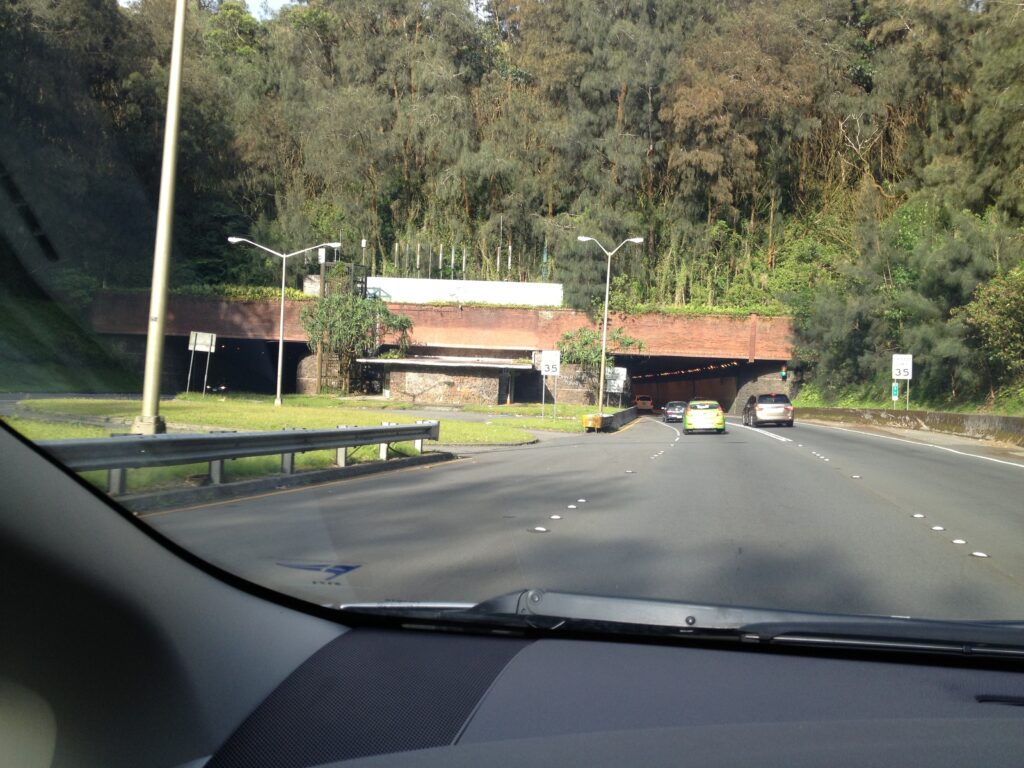
Back in Hawaiʻi, in 1897, Johnny and fellow Stanford student Louis Whitehouse won the bid to expand and construct a ‘carriage road’ over the Pali.  Ground was broken on May 26, 1897 and the road was opened for carriages on January 19, 1898.  (Later, the Pali tunnels were completed and the old road abandoned – on August 1, 1961, Mrs. Jennie Wilson (his wife) led the dedication ceremonies.)

Wilson and Whitehouse also won the contract to extend Benjamin Dillingham’s railroad around Kaʻena Point.  To keep the bid low, they carried laborers, equipment and supplies to the site and freight back by boat – on October 14, 1897, the place where the first Japanese laborers landed for this job is known to this day as “Yokohama Beach.”  (ascehawaii)

He and his wife, Jennie “Kini” Kapahu (previously a court dancer) toured the continent in 1900 with their Hawaiian Village hula troupe.  (Kini Kapahu claimed that she was the ‘first girl to leave Hawai‘i to go as a dancer in the mainland’.)

Wilson got involved with politics and is credited as being the most important Democrat in the first half of 20th-century Hawaiʻi; his name is used with Jack Burns in the party movement.  He was in a meeting on April 30, 1900 that organized the Democratic Party of Hawaiʻi.

His initial political campaign in 1918 met with failure.  Mayor Joe Fern, Honolulu’s first Mayor, appointed his good friend Wilson as road supervisor for the Honolulu district.  Later, Wilson succeeded Fern as Mayor, following the illness and death of Fern.

Fern died on February 20, 1920; the Honolulu Board of Supervisors voted in Wilson on February 25, and he was sworn in as Mayor on February 29.  He would serve three stints as mayor: 1920 to 1927, 1929 to 1931 and 1946 to 1954.  (From 1941 to 1946, he was Director of Public Works.)

Honolulu Hale was an idea started by Joseph J Fern, but he died before it came to fruition.  Mayor Wilson carried on Fern’s dream; Honolulu Hale was finally completed in 1928.

Wilson foresaw the growth on the windward side and excavation commenced on January 8, 1954 on the “Kalihi Tunnel.”  Near the end of May 1954 tunnel excavation transitioned from rock to “earth” – in the summer of 1954, several tunnel collapses and surface sinkholes subsequently led to a large collapse on August 14 that killed five construction workers.

Construction ceased while they considered alternative methods of completion.  Tunnel excavation restarted in February 1956 and the first half-mile tunnel was open to two-way traffic in 1958; both tunnels were fully operational by November 1960.

Initially known as the ‘Kalihi Tunnel,’ and often called the Likelike Tunnels, they are named in honor of John H Wilson.  (1998 brought the completion of H-3 (and the Tetsuo Harano Tunnels – named after a longtime state highways administrator.))

In addition to the John H Wilson Tunnels, the John H Wilson Elementary School on Kilauea Avenue and the adjoining Wilson Playground at Papakōlea in Waiʻalae Nui Valley are named for Wilson.

Johnny Wilson passed away on July 2, 1956 at the age of 84.

© 2022 Hoʻokuleana LLC

Filed Under: Prominent People Tagged With: Pali, Wilson Tunnel, Johnny Wilson, Yokohama, Joe Fern, Likelike Highway, Hawaii, Paoakalani, Waikiki, Honolulu, Oahu, Liliuokalani

April 26, 2020 by Peter T Young Leave a Comment

Waikīkī Ranch and Dairy

Jay P Graves, son of John James Graves (who made his fortune in mining, streetcar and railroad on the continent) purchased about 1,000-acres of land in 1904 and started Waikīkī Ranch.

Like others with means in the day, he built a mansion; it was designed by architect Kirtland Cutter. The Olmstead Brothers of Boston designed the gardens and water system, and the interiors were done by Elsie de Wolfe, America’s first well-known decorator.

Graves wanted the mansion to have a joyous atmosphere, which significantly influenced the Cutter design. The house has beautiful oak and maple floors, and unique molded-plaster ceilings.

Newspaper accounts note that a construction camp had been established on the property for the 25-100 workmen who were engaged in construction of the mansion. The camp was complete with a bunkhouse, commissary and mess tent.

The 23-room mansion and a number of smaller buildings were constructed at a cost of approximately $175,000 for construction and furnishings in 1911-1913.

Waikīkī Ranch had its own water system, which included a storage system of 100,000-gallons, as well as its own hydro-electric system, which provided all of the electrical requirements.

The beautiful staircase featured rare tigerwood and benches to sit. The one-piece carved alabaster light fixture was of exceptional size and typical of Cutters details; leaded glass was throughout the home.

For nearly twenty-five years Graves continued to make additions and alterations to the property, often with Cutter designs.

The Graves entertained many of the nation’s financial leaders and even royalty. Prince Albert, later King Albert of Belgium, was a visitor.

Waikīkī Ranch was said to have had the largest herd of thoroughbred Jersey Cattle in the Pacific. The dairy was well known throughout the world with breeding stock shipped as far away as China.

The Jersey was bred on the British Channel Island of Jersey. It apparently descended from cattle stock brought over from the nearby Norman mainland, and was first recorded as a separate breed around 1700.

Adaptable to hot climates, these are smaller cows are a popular breed due to the ability to carry a larger number of effective milking cows per unit area due to lower body weight, hence lower maintenance requirements and superior grazing ability (also the high butterfat content of its milk.)

The Waikīkī Dairy, founded in 1914, had its own special bottling, with bottles printed with brilliant red lettering around the bottom: “For the exclusive use of Waikīkī Dairy”.

In 1936, the mansion and remaining ranch property was sold to Mr. & Mrs. Charles E. Marr for $175,000. The Graves moved to Pasadena, California.

OK, before you exhaust yourself racking your brain trying to figure out where this 1,000-acre dairy/ranch was in Waikīkī … it wasn’t in Hawaiʻi, it was in Spokane, Washington.

But there are Hawaiʻi ties to the place.

Obviously the name, Waikīkī Ranch, is one. Graves had visited Waikīkī and noted the meaning of its name, ‘spouting waters.’ Since the ranch had 24-natural springs, Graves thought it an appropriate name for his property.

There’s more.

Lots of Hawaiʻi students go to college on the former ranch property.

Gonzaga University purchased the Waikīkī Mansion and 9-acres of land in 1964 for $500,000 with the intention of using it for retreats and other events.

In 1983, the Waikīkī mansion was renamed the Bozarth Mansion and Retreat Center in honor of area wheat farmer, Horace and Christine Bozarth, who gave a substantial gift to renovate the mansion and pay off the remaining debt.

Gonzaga students formed the Hawaiʻi-Pacific Islanders Club and host an annual lūʻau for students and area residents. Another Spokane school has Waikīkī Ranch ties; the ranch originally included the land on which Whitworth University is presently located.

Follow Peter T Young on Facebook 

Follow Peter T Young on Google+ 

Follow Peter T Young on LinkedIn  

Follow Peter T Young on Blogger

© 2020 Hoʻokuleana LLC

Milk Bottle from the Waikiki Dairy
Milk Bottle from the Waikiki Dairy-Spokane
Waikiki Ranch-layout
Spokane-Gonzaga-Whitworh-Waikiki_Ranch-GoogleEarth
Waikiki Ranch & Dairy - Bozarth Mansion and Retreat Center (Gonzaga)-GoogleEarth
Bozarth Mansion & Retreat Center-Front-Waikiki_Ranch_Dairy
Bozarth Mansion & Retreat Center-Gazebo-Waikiki_Ranch_Dairy
Bozarth Mansion & Retreat Center-Waikiki_Ranch_Dairy
Bozarth Mansion & Retreat Center-WaikikiRanchDairy
Bozarth Mansion and Retreat Center-WaikikiRanchDairy
Waikiki_Ranch-construction
Bozarth Mansion & Retreat Center-yard-Waikiki_Ranch_Dairy
Whitworth University-Hawaiian Club
Gonzaga University-Hawaii Pacific Islanders Club
Whitworth University Hawaiian Club Luau
Gonzaga University-Hawaii Pacific Islanders Club-Luau

Filed Under: Economy, Place Names, Schools Tagged With: Waikiki, Washington, Gonzaga University, Spokane, Waikiki Ranch and Dairy, Whitworth University, Hawaii

March 19, 2020 by Peter T Young Leave a Comment

ʻIli Lele

Ahupuaʻa are land divisions that served as a means of managing people and taking care of the people who support them, as well as an easy form of collection of tributes by the chiefs.  Ultimately, this helped in preserving resources.

A typical ahupuaʻa (what we generally refer to as watersheds, today) was a long strip of land, narrow at its mountain summit top and becoming wider as it ran down a valley into the sea to the outer edge of the reef.  If there was no reef then the sea boundary would be one-mile from the shore.

Ahupuaʻa contained nearly all the resources Hawaiians required for survival.  Fresh water resources were managed carefully for drinking, bathing and irrigation.

Mauka lands provided food, clothing, household goods, canoes, weapons and countless other useful products.  Within the coastal area and valleys, taro was cultivated in lo‘i; sweet potato, coconut, sugar cane and other food sources thrived in these areas.  The shore and reefs provided fish, shellfish and seaweed.

In ancient Hawaiian times, relatives and friends exchanged products.  The upland dwellers brought poi, taro and other foods to the shore to give to kinsmen there.  The shore dweller gave fish and other seafood.  Visits were never made empty-handed but always with something from one’s home to give.

Some ahupuaʻa were further subdivided into units (still part of the ahupuaʻa) called ʻili. Some of the smallest ahupuaʻa were not subdivided at all, while the larger ones sometimes contained as many as thirty or forty ʻili, each named with its own individual title and carefully marked out as to boundary.

Occasionally, the ahupuaʻa was divided into ʻili lele or “jumping strips”.  The ʻili lele often consisted of several distinct pieces of land at different climatic zones that gave the benefit of the ahupuaʻa land use to the ʻili owner: the shore, open kula lands, wetland kalo land and forested sections.

The gift of land to Hiram Bingham, that later became Punahou School, had additional land beyond the large lot with the spring and kalo patches where the school is situated (Ka Punahou) as part of the initial gift – the land was an ʻili lele.

Punahou included a lot on the beach near the Kakaʻako Salt Works (‘Ili of Kukuluāeʻo;) the large lot with the spring and kalo patches where the school is situated (Kapunahou) and also a forest patch on the steep sides of Manoa Valley (ʻIli of Kolowalu, now known commonly referred to as Woodlawn.)  (Congressional Record, 1893-94)

‘Ili of Kukuluāeʻo is an ‘ili lele (before the reclamation of the reefs, it was on the mauka side of the beach trail (now Ala Moana Boulevard) on the Diamond Head side of the Kakaʻako peninsula).  Included with this were the fishing rights over the reef fronting the property.

In addition to this makai, coastal property, there was an associated larger lot with a spring and kalo land, and another piece of forest land on the slopes of Mānoa Valley.

In 1829, the land was given to Hiram Bingham – who subsequently gave it to the American Board of Commissioners for Foreign Missions (ABCFM) – to establish Punahou School.

The ‘Ili of Kukuluāeʻo was bounded on Honolulu side by “Honolulu;” the mauka by “Kewalo;” and “Koula;” the Waikīkī side by “Kālia” and extended seaward out to where the surf breaks (essentially the edge of the reef.)  It included fishing grounds, coral flats and salt beds.

The land was owned by the King (Kauikeaouli – King Kamehameha III) and was originally awarded to the King as LCA 387, but he returned it to the government.

It’s not clear how/when the makai land “detached” from the other Punahou School pieces, but it did and was given to the ABCFM (for the pastor of Kawaiaha‘o Church.)

Testimony related to the land noted: “The above land was given by Boki to Mr. Bingham, then a member of the above named Mission and the grant was afterwards confirmed by Kaahumanu.“

“This land was given to Mr. Bingham for the Sandwich Island Mission by Gov. Boki in 1829… From that time to these the S. I. Mission have been the only Possessors and Konohikis of the Land.”

“The name of the Makai part is Kukuluāeʻo. There are several tenants on the land of Punahou whose rights should be respected.”

Interestingly, there are two other ʻili lele, with ʻIli Lele of Kukuluāeʻo, that make up what is now known as Kakaʻako, ‘Ili Lele of Ka‘ākaukukui and ʻIli Lele of Kewalo.

‘Ili Lele of Ka‘ākaukukui was awarded to Victoria Kamāmalu, sister of Kamehameha IV and Kamehameha V. This was on the Honolulu side of Kakaʻako and the associated fishing area included in this ʻili makes up most of what is now known as Kakaʻako Makai (the Kakaʻako peninsula.)

Kaʻākaukukui held Fisherman’s Point and the present harbor of Honolulu; then kalo land near the present Kukui street, and a large tract of forest at the head of Pauoa Valley.

ʻIli Lele of Kewalo was awarded to Kamakeʻe Piʻikoi, wife of Jonah Piʻikoi (grandparents of Prince Kūhiō;) the award was shared between husband and wife.  The lower land section extended from Kawaiahaʻo Church to Sheridan Street down to the shoreline.

The ʻIli Lele of Kewalo had a lower coastal area adjoining Waikīkī and below the Plain (Kulaokahu‘a) (270+ acres,) a portion makai of Pūowaina (Punchbowl) (50-acres, about one-half of Pūowaina,) a portion in Nuʻuanu (about 8-acres) and kalo loʻi in Pauoa Valley (about 1-acre.)

The image shows the three portions of the ʻili lele initially given to Hiram Bingham; the buff outline notes the present boundaries of the school and the blue background notes the three properties included in the initial gift.  This helps to illustrate the nature and benefits of ʻili lele – makai resource land, kalo land with water source and mauka forest land.

Follow Peter T Young on Facebook 

Follow Peter T Young on Google+ 

Follow Peter T Young on LinkedIn  

Follow Peter T Young on Blogger

© 2020 Hoʻokuleana LLC

Punahou-Ili_Lele-Property_Outline-Google_Earth
Kewalo-Bishop-Reg1090 (1884)-(Kewalo_Kaakaukukui_and_Kukuluaeo)
Kakaako-noting-ili_lele-(Kewalo_is_above_Kaakaukukui_and_Kukuluaeo)
Honolulu_Harbor_to_Diamond_Head-Wall-Reg1690-1893

Filed Under: Hawaiian Traditions, Place Names Tagged With: Waikiki, Pauoa, Hiram Bingham, Ili Lele, American Board of Commissioners of Foreign Missions, Kolowalu, Punahou, Ili, Kewalo, Kulaokahua, Kakaako, Kukuluaeo, Kaakaukukui, Kauikeaouli, Kamehameha III, Hawaii, Ahupuaa

February 25, 2020 by Peter T Young Leave a Comment

“I Love The Flower That Constantly Attracts”

It’s the national flower of the Philippines (they call it ‘sampaguita,’ there) – it’s also one of the three national flowers in Indonesia, (the other two are the moon orchid and the giant padma.)

In Cambodia, the flower is used as an offering to Buddha. In India, it’s sacred to the god Vishnu and used in religious ceremonies. In China, the flower is processed and used as the main ingredient in jasmine tea.

In Oman, it features prominently on a child’s first birthday. Flowers are sprinkled on the child’s head by other children while chanting “hol hol” (the Arabic word for one year.)

It’s known as Jasminum sambac, a species of jasmine from the olive family (native to South and Southeast Asia.) It is known as the Arabian jasmine in English. (Other countries have other names for it.) The flowers are also used for perfumes.

“Plants that wake when others sleep. Timid jasmine buds that keep their fragrance to themselves all day, but when the sunlight dies away, let the delicious secret out, to every breeze that roams about.” (Thomas More, 16th Century)

The plant was introduced to Europe in the early 16th Century, although its existence had been known about for some time by then. It probably came into Hawaiʻi in the 1800s.

In Hawaiʻi, the flowers are woven into lei (it takes about 125 buds to make a single strand.)

It was the favorite flower of Princess Kaʻiulani. Kaʻiulani liked birds, too … especially peacocks.

The name of her birds (peacock – pīkake) carried over to become the name we use in Hawaiʻi for these flowers – the Pīkake.

Mapu ia ke ala o ka pīkake
I ka o aheahe a ka makani
Aloha aʻe au i ka pua ʻume mau

The fragrance of the pīkake is wafted
By a gentle blowing of the wind
I love the flower that constantly attracts
(Flanagan and Raymond)

Click here for a fabulous rendition of Lei Pīkake by Hapa:
http://www.youtube.com/watch?v=AI92r0rkxuw

While attending a wedding at Waimea on the Big Island, Kaʻiulani got caught in a cold Waimea rain while riding on horseback with her friends, Helen and Eva Parker (daughters of Samuel Parker.) She became ill; she and her family returned to O‘ahu.

After a two-month illness, Kaʻiulani died at ʻĀinahau on March 6, 1899, at age 23. It is said that the night she died, her peacocks screamed so loud that people could hear them miles away and knew that she had died.

Princess Kaʻiulani’s mother was Princess Miriam Kapili Kekauluohi Likelike (sister of King Kalākaua and Queen Liliʻuokalani) and her father was Scottish businessman and horticulturist Archibald Scott Cleghorn, who later became Governor of Oʻahu.

In his writings, Robert Louis Stevenson endearingly recalled that Princess Victoria Kaʻiulani was “…more beautiful than the fairest flower.

Follow Peter T Young on Facebook 

Follow Peter T Young on Google+ 

Follow Peter T Young on LinkedIn  

Follow Peter T Young on Blogger

© 2020 Hoʻokuleana LLC

Kaiulani_with_peacocks_and_friends
Kaiulani_(PP-96-8-014)-1890s
Kaiulani_feeding_peacocks_at_Ainahau_1897
Ainahau_-_Kaiulani's_House-after_1897
Double_Pikake_Lei
Lei_pikake
Niihau_Shell-Pikake
Pikake lei
pikake
Pikake-blossom
pikake-farm
Pikake-jasminum_sambac__(arabian_jasmine)
MINOLTA DIGITAL CAMERA
pikake-plant

Filed Under: General, Economy, Prominent People Tagged With: Waikiki, Oahu, Likelike, Kaiulani, Cleghorn, Robert Louis Stevenson, Ainahau, Pikake, Hawaii

February 1, 2020 by Peter T Young 3 Comments

Seaside Hotel

What we think of today as the “Royal Hawaiian Hotel” actually is the second hotel of like name (the first one was in downtown Honolulu – the location of the State Art Museum and office) and, the site of the present Royal Hawaiian used to be the home of the Seaside Hotel.

But there was a link between the site and the hotel’s name. In the 1890s, the Seaside Hotel was a beach annex to the Royal Hawaiian Hotel located at Richards and Hotel streets.

There is now another “Seaside Hotel” in Waikīkī, but that’s different from the hotel we are discussing here. That other “Seaside” was built in 1970 and has been used by United Airlines as a perk for employees and company retirees.

This Seaside was really on the water and until the Royal Hawaiian took its place, it was one of the earliest hotels in Waikīkī.

It was situated on 10 coconut-covered oceanfront acres on one of the best parts of Waikīkī Beach (Kamehameha V (and others) had a residence here, on land known as Helumoa.)

It was the only Honolulu hotel where guests were accommodated in separate and distinct cottages (bungalows and tent houses.) Each was named for prominent people who stayed there (one was the Alice Roosevelt Longworth cottage – named for Teddy Roosevelt’s cigar-smoking daughter.)

It was marveled as “folksy, family-style living”) and it was a favorite of author, Jack London, who noted, “The older I grow, the oftener I come back, and the longer I stay.” (SagaOfSandwichIslands)

In 1907, the Seaside Hotel opened on the property, and was later acquired by Alexander Young’s Territorial Hotel Company, which operated the Alexander Young hotel in downtown Honolulu.

In 1924, the Seaside Hotel’s lease of the land at Helumoa was soon to expire and the land’s owners (Bishop Estate) put out a request for proposals to build a hotel.

Matson Navigation Co. had big plans to build luxury ocean liners to bring wealthy tourists to Hawaiʻi. But, they needed a hotel equally lavish at Waikīkī.

Soon Matson’s luxury ocean liner and its 650 wealthy passengers would be arriving in Honolulu every two weeks and the two largest hotels, the Alexander Hotel and the Moana, could not accommodate all of them. The availability of the Bishop Estate land began putting wheels into motion.

In March 1925, William Roth, Manager of Matson Navigation Company, his wife Lurline (whose maiden name was Matson) and Mrs. William Matson, the widow of the founder of Matson Navigation Company, arrived in Honolulu for a three-week stay so that Roth could attend the annual Matson conference.

Famous New York-based architect Charles V. Wetmore also arrived in Honolulu at the invitation of Matson Navigation Company leadership.

Wetmore advised Matson Navigation that “Honolulu is one of the wonder spots of the world, and it should have a hotel that is as much of an attraction as the city itself.”

Castle & Cooke, Matson Navigation and the Territorial Hotel Company successfully proposed a plan to build a luxury hotel, with 400 rooms, at a cost of $2 million on the parcel of Waikīkī beach to be leased from the Bishop Estate.

The ground-breaking ceremony took place on July 26, 1925, before a building permit was issued or a contract was signed with the building contractor, Ralph Wooley. By the time the contract was executed on September 5, 1925, some three hundred men were already at work.

The building permit still was not signed by August, and the City withheld granting it unless the building codes were first revised (high rises were not, then, permitted.) The planning commission did not want to revise the building code to allow high rises on Waikīkī beach.

The City and County Board of Supervisors disregarded their concerns and allowed the increase in heights. This would forever change the landscape of Waikīkī, as the decision also allowed much taller highrises to be built in the area.

The opening of the Waikīkī Royal Hawaiian on February 1, 1927, ushered in a new era of luxurious resort travel to Hawai‘i. The six-story, 400-room structure was fashioned in a Spanish-Moorish style, popular during the period and influenced by screen star Rudolph Valentino.

The Honolulu Star-Bulletin described the newly opened Royal Hawaiian as “the first resort hostelry in America.”

Follow Peter T Young on Facebook 

Follow Peter T Young on Google+ 

Follow Peter T Young on LinkedIn  

Follow Peter T Young on Blogger

© 2020 Hoʻokuleana LLC

Seaside-Hotel-(SagaOfSandwichIslands)-1916
Royal_Hawaiian_Hotel-original_wooden_structure-1900
Seaside_Hotel-(SagaOfSandwichIslands)-1903
Guests walking toward Seaside office and entry-(SagaOfSandwichIslands)-1913
Seaside-lanai-(SagaOfSandwichIslands)-1913
Royal Hawaiian Hotel-screened_patio-HSA-1890
Advertisement_for_Seaside_Hotel-1908
Waikiki-fronting_old-Seaside_Hotel-seawall-1915
Cocoa-Nut_Grove,_and_Residence_of_the_Late_King_Kamehameha_V.,_at_Waikiki,_Oahu-before-1875
BVD-14-1-31-41-Bertha Young residence and Royal Hawaiian hotel_150w-KamehamehaSchoolsArchives
Helumoa_Summer House of King Kamehameha V, Waikiki-(eBay)-1873
Bellmen_at_Porte_Cochere-(honoluluadvertiser)-1927
Coconut Grove during the hotel's construction (HHF) (1925)
Coconut_Grove_Lanai-(HHF)-1927
Dancers are from the Dan Wallace Hula Studio in the Royal Hawaiian Hotel-(HSA)-1950s-PP-33-5-023
Royal_Hawaiian-(HSA-Matson-HHF)-1927
Royal_Hawaiian_oceanside_construction-(HSA-HHF)-1926
Seaside_Hotel-noted-(Moana_Hotel-Apuakehau_Stream-marshland_behind)-1920
Waikiki scene arial view of moana & RH

Filed Under: Economy, Buildings Tagged With: Waikiki, Matson, Royal Hawaiian Hotel, Helumoa, Seaside Hotel, Hawaii

  • « Previous Page
  • 1
  • …
  • 6
  • 7
  • 8
  • 9
  • 10
  • …
  • 17
  • Next Page »

Images of Old Hawaiʻi

People, places, and events in Hawaiʻi’s past come alive through text and media in “Images of Old Hawaiʻi.” These posts are informal historic summaries presented for personal, non-commercial, and educational purposes.

Info@Hookuleana.com

Connect with Us

  • Email
  • Facebook
  • LinkedIn
  • Twitter
  • YouTube

Recent Posts

  • The 5th Gate
  • James Walker Austin
  • Hoʻomana Naʻauao
  • Jack Roosevelt Robinson
  • Plantation Camps
  • Voyaging … and Returning
  • Three Rivers

Categories

  • Economy
  • Voyage of the Thaddeus
  • Mayflower Summaries
  • American Revolution
  • General
  • Ali'i / Chiefs / Governance
  • Buildings
  • Missionaries / Churches / Religious Buildings
  • Hawaiian Traditions
  • Military
  • Place Names
  • Prominent People
  • Schools
  • Sailing, Shipping & Shipwrecks

Tags

Albatross Al Capone Ane Keohokalole Archibald Campbell Bernice Pauahi Bishop Charles Reed Bishop Downtown Honolulu Eruption Founder's Day George Patton Great Wall of Kuakini Green Sea Turtle Hawaii Hawaii Island Hermes Hilo Holoikauaua Honolulu Isaac Davis James Robinson Kamae Kamaeokalani Kameeiamoku Kamehameha Schools Lalani Village Lava Flow Lelia Byrd Liberty Ship Liliuokalani Mao Math Mauna Loa Midway Monk Seal Northwestern Hawaiian Islands Oahu Papahanaumokuakea Marine National Monument Pearl Pualani Mossman Quartette Thomas Jaggar Volcano Waikiki Wake Wisdom

Hoʻokuleana LLC

Hoʻokuleana LLC is a Planning and Consulting firm assisting property owners with Land Use Planning efforts, including Environmental Review, Entitlement Process, Permitting, Community Outreach, etc. We are uniquely positioned to assist you in a variety of needs.

Info@Hookuleana.com

Copyright © 2012-2024 Peter T Young, Hoʻokuleana LLC


Loading Comments...