Images of Old Hawaiʻi

  • Home
  • About
  • Categories
    • Ali’i / Chiefs / Governance
    • American Protestant Mission
    • Buildings
    • Collections
    • Economy
    • Missionaries / Churches / Religious Buildings
    • General
    • Hawaiian Traditions
    • Other Summaries
    • Mayflower Summaries
    • Mayflower Full Summaries
    • Military
    • Place Names
    • Prominent People
    • Schools
    • Sailing, Shipping & Shipwrecks
    • Voyage of the Thaddeus
  • Collections
  • Contact
  • Follow

October 24, 2022 by Peter T Young Leave a Comment

Kālia

In traditional times, Pi‘inaio Stream was the dominant feature of the western area of Waikīkī.

It entered the ocean as a wide, ribboned kahawai (wide delta,) bringing fresh waters from the mountain valleys and creating an area of abundance. The early-Hawaiians found this plentiful land and marine resources as an excellent place to settle (the early settlers arrived around 600 AD.).

The Stream played a vital role in the geography, and cultural usage, of the ‘ili of Kālia. The meaning of Pi‘inaio is uncertain but it could be an allusion to going inland (pi‘i), to the location of a naio (a sandalwood-like tree – as may have commonly grown in the vicinity.)  (Cultural Surveys)

Waikīkī was famous for its fishponds with one listing citing 45 ponds.  The ten fishponds at Kālia were loko puʻuone (isolated shore fishponds formed by a barrier sand berm) with salt-water lens intrusion and fresh water entering from upland ʻauwai (irrigation canals.)

The shallow relatively-protected reefs of Waikīkī and the availability of the riparian resources of the Pi‘inaio estuary made the back dune ponds easily adaptable into fish ponds.

The inland ponds may have formed along the coast where existing depressions in the sand were chosen to make the loko puʻuone, and brush was cleared out. During traditional times, the ponds were used to farm fish, usually for the Hawaiian Ali‘i (royalty). The ʻamaʻama (mullet) and the awa (milkfish) were the two types of fish traditionally raised in the ponds.

Kālia was once renowned for the fragrant limu līpoa, as well as several other varieties of seaweed such as manauea, wāwaeʻiole, ʻeleʻele, kala and some kohu.

Limu kala was harvested to make lei for offerings.  The lei limu kala was and is still offered at the kūʻula [stone god used to attract fish] by fishermen or anyone who wishes to be favored by or is grateful to the sea.

John Papa ʻĪʻī relates an account from the early-1800s of a catch at a Kālia fishpond: “so large that a great heap of fish lay spoiling upon the bank of the pond.” (The waste was disapproved of.) This abundance of fishponds may have required significant maintenance and would have provided a potentially huge source of food for distribution at chiefly discretion.

The name of the area “Kālia” translated as “waited for” has a sense of “waiting”, “loitering” or “hesitating.” While the nuance is uncertain, one could imagine that the mouth of the Pi‘inaio Stream would be a logical place for travelers to pause.

An ʻōlelo noʻeau (Hawaiian proverb/saying) speaks of the pleasant portion of the coast of Kālia in Waikīkī:  Ke kai wawalo leo leʻa o Kālia, The pleasing, echoing sea of Kālia.  (Pukui)

Kālia is also mentioned in a story about a woman who left her husband and children on Kīpahulu, Maui, to go away with a man of O‘ahu. Her husband missed her and went to see a kahuna (priest) who was skilled in hana aloha (prayer to evoke love) sorcery.

The kahuna told the man to find a container with a lid and then speak into it of his love for his wife. The kahuna then uttered an incantation into the container, closed it, and threw it into the sea. The wife was fishing one morning at Kālia, O‘ahu, and saw the container. She opened the lid, and was possessed by a great longing to return to her husband. She walked until she found a canoe to take her home (Pukui): Ka makani kāʻili aloha o Kīpahulu; The love-snatching wind of Kīpahulu (Cultural Surveys)

In Fragments of Hawaiian History John Papa ʻĪʻī described “Honolulu trails of about 1810,” including the trail from Honolulu to Waikiki. He said that: Kawaiahaʻo which led to lower Waikiki went along Kaʻananiau, into the coconut grove at Pawaʻa, the coconut grove of Kuakuaka, then down to Piʻinaio; along the upper side of Kahanaumaikai‘s coconut grove, along the border of Kaihikapu pond, into Kawehewehe; then through the center of Helumoa of Puaʻaliʻiliʻi, down to the mouth of the Āpuakēhau Stream.

Based on ʻĪʻī‘s description, the trail from Honolulu to Waikiki in 1810 coursed through the makai side of the present Fort DeRussy grounds in the vicinity of Kālia Road. It is likely that this trail was a long-established traditional route through Waikiki.

Toward the beginning of the 1900s, downtown Honolulu was the destination for Hawaiian visitors, who numbered only about 3,000. While Honolulu had numerous hotels, there were few places to stay in Waikiki.

In 1891, at Kālia, the ‘Old Waikiki’ opened as a bathhouse, one of the first places in Waikiki to offer rooms for overnight guests. It was later redeveloped in 1928 as the Niumalu Hotel; the site eventually became the Hilton Hawaiian Village.

In 1911, the Army acquired 70-acres for the construction of Fort DeRussy and started filling in the fishponds which covered most of the Fort – pumping fill from the ocean continuously for nearly a year in order to build up an area on which permanent structures could be built.

Then, as part of the government’s Waikīkī Land Reclamation project, the Waikīkī landscape was further transformed with the construction of the Ala Wai Drainage Canal – begun in 1921 and completed in 1928 – resulted in the draining and filling in of the ponds and irrigated fields of Waikīkī.

Dredging for the project was performed by Hawaiian Dredging Company, owned by Walter F. Dillingham, who then sold the dredged sediments to Waikīkī developers. The dredge produced fill for the reclamation of over 600-acres of land in the Waikīkī vicinity.

The ʻili of Kālia runs from the ʻEwa end of today’s Ala Moana Center (near Piʻikoi Street) to the vicinity of the Halekūlani Hotel (makai of Kalākaua Avenue.)  (Lots of information here from Cultural Surveys.)

© 2022 Hoʻokuleana LLC

Filed Under: Place Names Tagged With: Kalia, Niumalu Hotel, Hawaii, Waikiki, Oahu, Dillingham, Hawaiian Dredging, Fort DeRussy, Ala Wai, Hilton Hawaiian Village

August 31, 2022 by Peter T Young 1 Comment

Halekūlani Hotel

Historically, Waikīkī encompassed fishponds, taro lo‘i, coconut groves and a reef-protected beach that accommodated Hawaiian canoes.

Waikīkī shifted from agricultural to residential uses, with private residences for the Hawaiian royalty and the well-to-do.  Near the turn of the 20th-century, some of these homes were converted into small hotels and eventually into world class resorts.

Robert Lewers (whose firm Lewers & Cooke supplied much of the lumber for O‘ahu homes) built a two-story wooden frame bungalow with an open veranda overlooking a coconut grove in 1883.  Then, in 1907, Edwin Irwin leased the Lewers’ house and converted it into a small hotel called the Hau Tree.

Nearby, the J Atherton Gilman family bought 3-acres and built a two-story house from a man named Hall.  La Vancha Maria Chapin Gray rented the Gilman house in 1912 and converted it into a boarding house and named it Gray’s-by-the-Beach.  The sandy area fronting it was soon referred to as Gray’s Beach.

In 1917, Clifford and Juliet Kimball acquired the Hau Tree Inn near Gray’s Beach and, in the late 1920s, they decided to expand and bought the Gilman property, including Gray’s-by-the-Sea and an adjacent parcel belonging to Arthur Brown.

When their expansion project was completed, the Kimballs had acquired over five acres of prime Waikīkī beachfront for their resort, which they named Halekūlani, or “house befitting heaven.”

An early guest at the Halekūlani was Earl Derr Biggers, the author of a murder mystery called ‘The House Without a Key’ (1925.)  Biggers’ book title was based on his discovery that no one locked their doors there.  In memory of the author and his novel, the Halekūlani named its seaside bar and lanai “House Without a Key.”

The principal character in the story was Charlie Chan, the celebrated Chinese detective, patterned after a Honolulu detective named Chang Apana.

(Born Ah Ping Chang on December 26, 1871 in Waipiʻo, Oʻahu; he eventually became known as Chang Apana (the Hawaiianized version of the Chinese name Ah Ping.)  In 1898, Chang joined the Honolulu Police Department and the “shrewd and meticulous investigator” rose through the ranks to become detective in 1916.)

The beach in this area is a place of healing called Kawehewehe (the removal.)  The sick and the injured came to bathe in the kai, or waters of the sea.  It’s now a small pocket of sand nestled between the Halekūlani and the Sheraton Waikīkī.

Kawehewehe takes its meaning from the root word, wehe (which means to remove) (Pukui.)  Thus, as the name implies, Kawehewehe was a traditional place where people went to be cured of all types of illnesses – both physical and spiritual – by bathing in the healing waters of the ocean.

There was a Kawehewehe Pond; people with a physical ailment would come to the pond in search of healing.  A kahuna, or priest, would place a lei limu kala around their neck, and instruct them to submerge themselves in the healing waters of the pond.

When the lei came off and floated downstream, it was said that the afflicted ones were healed.  (This area is also typically known as Gary’s Beach.)

Gray’s Channel heading out from the beach was a natural channel through the reef off the Halekūlani Hotel.  It was enlarged by dredging in the early 1950s to allow catamarans to come ashore at Gray’s Beach.   Popular surf sites are just off-shore.

Eventually, the Norton Clapp family of Seattle bought Halekulani, by now consisting of a large Main Building and 37 one and two-story bungalows.

In 1981 the hotel was purchased by Mitsui Real Estate Development Co., Ltd. Today the 456-room Halekūlani Hotel is one of Waikīkī’s premier resorts.  (Lots of info here from Halekūlani and Clark.)

© 2022 Hoʻokuleana LLC

Filed Under: Economy, Buildings Tagged With: Hawaii, Waikiki, Oahu, Halekulani, Charlie Chan, Kawehewehe

August 29, 2022 by Peter T Young 1 Comment

Kaluaokau

Kaluaokau, an ʻili in Waikīkī, has been interpreted with several possible meanings.  Henry Kekahuna, a Hawaiian ethnologist, pronounced Kaluaokau as ka-lu‘a-o-ka‘u, which translates as “the grave of Ka‘u” (lu‘a means “heap, pile or grave.”)

The term Kaluaokau can also be divided as ka-lua-o-Kau, which literally translates as ka (the) lua (pit) o (of) Kau (a personal name), or “the pit of Kau.”  There are others.

Whatever the purpose of the prior naming and its meaning, this portion of Waikīkī (including Helumoa, Kaluaokau and adjacent ‘ili) was important in the lives of the Hawaiian Ali’i.

The ‘ili of Kaluaokau was eventually granted to William Lunalilo (the first democratically elected King, who defeated Kalākaua in 1873.)

The first structure on the property was a simple grass hut; Lunalilo later built and referred to his Waikīkī home as the “Marine Residence;” it consisted of a residence, a detached cottage and outbuildings, surrounded by a fence. The estate included a small section that extended makai to the sea and included several small outbuildings and a canoe shed.

Following Lunalilo’s death in 1874, his Kaluaokau home and land were bequeathed to Queen Emma, the widow of Kamehameha IV (Alexander Liholiho – who had died in 1863.)

Queen Emma had Papaʻenaʻena Heiau on the slopes of Diamond Head dismantled, and she used the rocks to build a fence to surround her Waikīkī estate.

Later litigation confirmed that the Queen Emma parcel included access to the water (ʻĀpuakēhau Stream) and the taro growing on the ‘Marine Residence” property.  Queen Emma is known to have resided occasionally on the Waikīkī property before her death.

Her will stated that her lands be put in trust with the proceeds to benefit the Queen’s Hospital in Honolulu, which Queen Emma, along with her husband, Kamehameha IV, had helped to found.

Records indicate Henry Macfarlane, an entrepreneur from New Zealand who had settled on O‘ahu owned and/or leased property within the Kaluaokau ʻili.

Reportedly, it was Macfarlane and his wife who planted the banyan tree currently growing in the center of the property. They lived on this property for a while, eventually raising six children, some of who became financiers for sugar plantations and for the early tourist industry in Waikīkī.

The site was also used by immigrant Japanese workers.  During the construction of hotels (Moana Hotel, Royal Hawaiian Hotel) in the early twentieth century (and later the Surfrider in 1952) by the Matson Navigation Company, cottages were built for housing the mostly Japanese immigrant workers and their families, and called “Japanese Camps.”  More buildings were built.

By the mid-1950s, there were more than fifty hotels and apartments from the Kālia area to the Diamond Head end of Kapiʻolani Park. The Waikīkī population by the mid-1950s was not limited to transient tourists; it included 11,000 permanent residents, living in 4,000 single dwellings and apartment buildings.

On January 16, 1955, entrepreneur Donn Beach (Don the Beachcomber) announced plans for a “Waikīkī Village” that was to be called “The International Market Place.”

The International Market Place first opened in 1957. Envisioned as a commercial center with the Dagger Bar and Bazaar Buildings, and featuring the arts, crafts, entertainment and foods of Hawaiʻi’s multicultural people, it may have been one of the earliest cultural tourist attractions in the Islands.

Designed originally to encompass 14-acres between the Waikīkī Theater and the Princess Kaʻiulani Hotel, extending from Kalākaua Avenue halfway to Kūhiō Avenue, the International Market Place was to be a “casual, tropical village with arts, crafts, entertainment, and foods of Hawai‘i’s truly diverse people … including Hawaiian, South Sea islander, Japanese, Chinese, Indian, and Filipino…” (Queen Emma Foundation)

By the late-1950s, a row of retail shops had been constructed along Kalākaua Avenue.  Other elements of the International Market Place included the Hawaiian Halau, Japanese Tea House and Esplanade buildings. The banyan tree, which still remains to this day, was also once home to Don’s tree house.

Matson sold all of its Waikīkī hotel properties to the Sheraton Company in 1959 and no longer required housing for its hotel staff. Additionally, properties were likely cleared in anticipation of the extensive development that occurred throughout Waikīkī in the 1960s and 1970s.

In 1964, Waikīkī’s entertainment hub was International Market Place; and it’s where the first Crazy Shirts shop was born (initially known as Ricky’s Crazy Shirts.) T-shirts with a message sold. Some were silly (“Suck ’em Up!”), some were logos (“Surfboards Hawaii”), and some were political (“Draft Beer Not Students”). (Crazy Shirts)

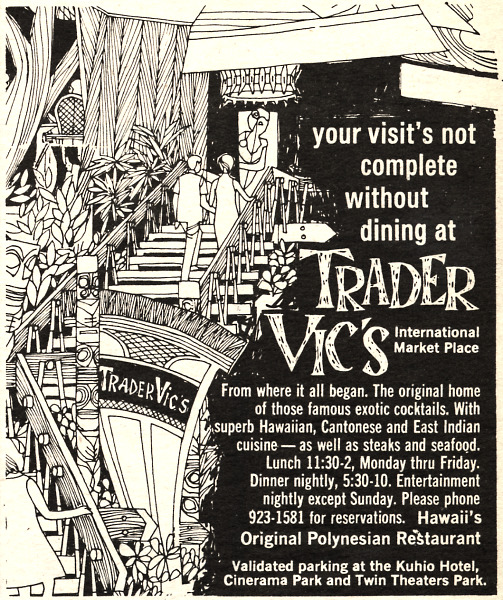
The famous Duke Kahanamoku’s (Duke’s,) where Don Ho gained fame, was once housed there. Don the Beachcomber, one of Waikīkī’s long-gone landmark restaurants, as well as Trader Vic’s also called it home.

Hawaiʻi radio icon, Hal Lewis (the self-named “J Akuhead Pupule,” best known to Island radio listeners as “Aku,”) once broadcast his popular morning talk show from the tree house in the Banyan tree.

However, over the last half-century, as the rest of Waikīkī evolved, the Market Place kept its 1960s look, as visitors wind through the carts and kiosks, hawking T-shirts, plastic hula skirts, volcano-shaped candles, and other tiki and tacky souvenirs.

Landowner Queen Emma Foundation changed that. Working with the Taubman Company, the International Market Place, Waikīkī Town Center and Miramar Hotel were demolished, and new structures took their place.

Aiming to restore “a sense of Hawaiianness,” the new International Market Place features low-rise structures, open-air shops and restaurants, paths, gardens, a storytelling hearth, a performance amphitheater and, yes, parking. And the banyan tree stays.

Today, as successor to The Queen’s Hospital, The Queen’s Medical Center is the largest private nonprofit hospital in Hawaiʻi, licensed to operate with 505 acute care beds and 28 sub-acute beds. As the leading medical referral center in the Pacific Basin, Queen’s has more than 3,500 employees and over 1,100 physicians on staff.

The royal mission and vision of The Queen’s Health Systems is directly supported through revenues generated by the lands bequeathed by Queen Emma when she passed away in 1885, including the International Market Place.

© 2022 Hoʻokuleana LLC

Filed Under: Place Names, Prominent People, Economy Tagged With: Duke Kahanamoku, Don Ho, Trader Vic's, Kaluaokau, Hawaii, Don the Beachcomber, Waikiki, Oahu, Lunalilo, Kamehameha IV, Matson, Queen Emma

July 3, 2022 by Peter T Young Leave a Comment

“The sound of the waves on the beach at Waikiki”

Webley Edwards was born November 11, 1902 in Corvallis, Oregon.  He attended Oregon Agricultural College (OAC – it was later named Oregon State University) where he became the first student manager of campus radio, KOAC.

As an OAC student, Webley “made good grades, was a popular athlete, and became the best ukulele player on campus, in an era when skill with the instrument was considered a sure way to a woman’s heart.”  (Corvallis Gazette-Times)

After graduating from OAC in 1927, Webley moved to Hawaiʻi in 1928 to work as a car salesman and play semi-pro football. Fascinated with the local music, in 1935, he arranged for a two-week trial run for a radio show of “authentic” Hawaiian music.

On July 3, 1935, Edwards created and first aired a radio program called “Hawaiʻi Calls” featuring Hawaiian music and entertainment.

The first show reached the West Coast of the continental US through shortwave radio.  Although the program enjoyed a growing popularity on the mainland, Edwards initially had a hard time making ends meet and solicited support from the Hawaiʻi Tourist Bureau.

Hawaiʻi was calling, he seemed to suggest, and to the home-bound listener freezing through an Iowa or Montana winter, making a vow to one day visit the Islands became irresistible.

From about 40,000 visitors annually in the 1930s, the number had grown to 500,000 by the time the show ended its run more than 35 years later.  (Corvallis Gazette-Times)

Except for an apparent break during World War II, the radio program aired continuously since its inception.

Edwards was the first to broadcast news of the Japanese attack on Pearl Harbor.  In his own words, “the real McCoy. All army, navy and marine personnel report to duty.”  (Corvallis Gazette-Times)

During the war, Edwards worked as a reporter for CBS Radio and landed exclusives including an interview with Colonel Paul W Tibbetts (the pilot of the B-29 Superfortress Enola Gay, who dropped the atomic bomb over Hiroshima.)

He had been chosen by lottery to be the chief announcer for the shipboard ceremony that ended hostilities between the United States and Japan and aboard the USS Missouri reported on the surrender ceremony that brought the conflict to its close.  (Ankeny)

“Attention, peoples of the world! World War II is about to come to its official closing, three years, eight months and 25 days since the attack on Pearl Harbor.  The Japanese delegation has just arrived.”

“Lined up before us are officers and men with high-ranking stars and gold braid. The deck of the Missouri stretches out before us … its great guns pointed skyward to allow for more room …”   (Corvallis Gazette-Times)

From the time of inception until January of 1972, Webley Edwards was Hawaiʻi Calls’ announcer and leading personality.

Each show opened with the sounds of the pounding surf and the enthusiastic bounding voice of Webley Edwards proclaiming “The sound of the waves on the beach at Waikiki.”

Usually that radio program was broadcast to the Mainland at about sundown. The announcer always described the beautiful sunset including the words, “and now the beautiful sun is a ball of fire, sinking, sinking, ever so slowly over the edge of the ocean–there it goes.”    (Green)

The weekly program was typically taped before a live audience at the Moana Hotel in Waikiki.  Periodically, they took the show on the road and broadcast from a neighbor island.

In its heyday, the show was heard on over 600 radio stations in North America and scores of others in Australia, New Zealand, Mexico, South America, Africa and the Far East.  It was also heard on the Voice of Freedom (the predecessor to the Voice of America) and on Armed Forces Radio throughout the world.    (Hula Records)

Throughout the 1950s, Edwards compiled and produced a series of Hawaiian music collections for Capitol Records.  He even wrote songs under a pseudonym, John Kalapana.

In all, Hawaiʻi Calls spanned 40-years, along the way popularizing tunes including “Lovely Hula Hands,” “Beyond the Reef,” “Little Brown Gal” and “The Hawaiian Wedding Song.”

“Sweet Leilani,” which Edwards debuted in 1936, won an Academy Award after Bing Crosby’s powerful, yet gentle, rendition from the movie ‘Waikiki Wedding’ thrilled people throughout the world.  (Hula Records)

In addition, he helped promote local performers, including Alfred Apaka, George Kainapau, Haleloke, and Simeon and Andy Bright.  (Ankeny)  In addition, Al Jolson and Arthur Godfrey were among the many guests featured on the program.

After Edwards left the program, Danny Kaleikini, a well-known Hawaiʻi entertainer and singer, was the announcer and a performer for the program.  (US District Court Records)  The program ended August 16, 1975.

Late in his career, Edwards made a successful run at politics, serving for more than 14-years in Hawaiʻi’s territorial legislature and then the state legislature.

Spending his last few months in a Honolulu assisted-living facility, he died October 5, 1977, after suffering a heart attack.

On October 3, 1992 there was a temporary return of Hawaiʻi Calls, taped at the Hilton Hawaiian Village’s beachside Tropics Showroom, then transmitted via satellite to affiliates.  It ran for about a year, but it failed to attract enough financial support to continue.

© 2022 Hoʻokuleana LLC12

Filed Under: Economy, Buildings Tagged With: Hawaii, Waikiki, Oahu, Moana Hotel, Moana, Hawaii Calls, Webley Edwards, Hawaii Theatre

June 22, 2022 by Peter T Young Leave a Comment

Historic Homes of Waikīkī

A Waikīkī historic home walking tour from the Historic Hawaiʻi Foundation is a self-guided itinerary, suitable for individual travelers, and focuses on sites of historic or cultural significance that are either open to the public or visible from the public way.

The Historic Homes in Waikīkī Walking Tour takes 45-minutes or more. The tour starts at the War Memorial Natatorium, then head towards Diamond Head to the Tahitienne apartment.

The traveler then weaves in between the Honolulu Tudor/ French Norman Cottages and other charming historic residential homes. At the end of the tour, the traveler will finish off with the Mediterranean inspired La Pietra School for girls.

1.  The War Memorial Natatorium is significant as a major social and recreational local landmark and for its association with the history of competitive swimming. The swimming complex was rendered in a Beaux-Arts style and was finished in the summer of 1927, the first “living” was memorial in the United States.

The property contains a 100 meter saltwater swimming pool, concrete bleachers that rises 13-levels high, and a main entryway that includes an elaborate sculpture and triumphal arch entablature. The memorial is dedicated to those from Hawai‘i who served in World War I.

2.  The Tahitienne is a nine-story apartment building rendered in a 1950 modern, utilitarian style. The Tahitienne was planned and built by California architects Bob Fraser and Paul Hammarbarg. Local Architect, Edwin L Bauer, helped design the layout and interiors of the apartments.

This building is associated with the commercial development of real estate in Hawaiʻi, and specifically with the co-operative apartments in Honolulu.  There are approximately 50 co-operative apartments which appeared during the 1950s and early 1960s in Honolulu, which remain functioning as a co-op.

3.  The Egholm Residence was built in 1926 in the Diamond Head Terraces subdivision.  It is significant as one of the few examples of small cottages in the Spanish Colonial Revival style popular in Hawai‘i in the 1920s and early 1930s. The hipped red clay tile roof, stucco exterior and arcaded entrance are characteristic features of this style.

The residence is the work of notable architect and builder Carl William Winstedt. The modest scale of this house is rare compared to the other palatial residences built in the Spanish Colonial Revival style during this time period in Hawai‘i.

4.  The Honolulu Tudor/French Norman Cottages Thematic Group are made up of fifteen different residences, built between 1923 and 1932. These homes display a high degree of craftsmanship and design detail and include the work of several local architects and builders, including: Earl Williams, Hart Wood, John Morley, Theo Davies & Co., and J Alvin Shadinger.

5.  The James JC Haynes Residence, built in 1926, is a two story, shingle sided house facing south. The house stands out as a well-constructed house, having been built by Lewers & Cooke, rendered in a distinctive colonial style distinguished by its high pitched, front facing gable roofs clad with cut shingles and closed eaves with 4″ beaded tongue and groove soffits.

The house is also significant for its adaptation of this colonial revival form to Hawai‘i’s climate. Its easy access to the outdoors bespeaks a Hawai‘i architectural tradition for informal living.

6.  The CW Dickey Residence, built in 1926, is associated with the well-known local architect, Charles William Dickey, and the development of the Hawaiian style of architecture. This cottage, with its prominent double-pitched hipped roof, became the prototype for numerous modest cottages built in the Islands during the late 1920s and 1930s.

Through the use of graceful sloping roofs, overhanging eaves, extensive windows and screened openings, and lanai, Dickey said, “I believe I have achieved a distinctive Hawaiian type of architecture” (Honolulu Advertiser, March 14, 1926). The house appears intact and serves as a well-crafted, well-designed statement of Dickey’s development of an exclusive Hawaiian style of architecture.

7.  Doctor Frank and Kathryn Plum Residence was constructed by Rudolph Bukeley in 1929.  It is significant as an example of a Cotswold Cottage style residence constructed in Hawai‘i during the time period of the late 1920s and early 1930s.

It well reflects the style with its romantic asymmetric massing, and its use of such eclectic and picturesque elements as its skewed gable, front bay window, wrought iron mock-balconet in the round arched gable vent, canted walls with their wound arched doors, double pitched roof, and shed roof dormers.

8.  Built in 1923, Fred Harrison Rental Property is a one and a half story, shiplap sided, vernacular style house. It is a good example of a dwelling constructed as a middle class rental property.

Although a modest house, it presents a distinctive appearance to the street with the curved, sweeping roofline; prominent bay window; double gable ends on the west side; and a front doorway that does not face the street.

9.  The Adolph Egholm Kiele Avenue House is a single story, Spanish Mission Revival style cottage that was constructed in 1926. It features stucco walls and a red clay tile, hipped roof with overhanging eaves and exposed rafter tails.

The house sits on a lava rock basement and is distinguished by its centered, outset, flat roofed front porch with its round arched openings.  It is significant as a good exaple of a Spanish Mansion cottage built during the 1920s.

10.  The Mrs. Josephine Ketchum Residence is a Craftsman-style bungalow built in 1931.  It is significant for its architecture as an example of a Craftsman inspired house in Hawai‘i. The naturally-stained board and batten walls and use of heavy timbering are character-defining elements of the building’s design.

In addition to these typical craftsman hallmarks, the house features the “Hawaiian” style, double-pitched hipped roof, which was very popular in the Islands during the late 1920s and early 1930s. This further accentuated the horizontal sense of the house, another typical Craftsman characteristic. The screened lanai and exterior bathroom door further fix its location near the beach, where a number of houses from this period featured such doors for use by beach goers.

11.  The Folk Residence, Tavares Residence and Coconut Avenue Residence were built by John Morley for the Pacific Trust Company and are part of the Honolulu (made up of fifteen different residences, built between 1923 and 1932.

These homes display a high degree of craftsmanship and design detail and include the work of several local architects and builders.)

12.  The Helene Morgan Residence is a single story, Hawaiian style duplex with a pair of double-pitched hipped roofs with overhanging eaves and exposed rafter tails.

Presently, the house is a single family dwelling, but originally it was two separate laid out units connected by a passage. The duplex sits on a raised, post and pier, foundation with lava rocks at the base.

13.  The Richard M Botley Residence was built in 1931.  It is significant for its architecture as a good example of a Spanish Mission Revival house built in Hawai‘i during the period 1920-1931.

It is characteristic of the style with its red tile roof and white masonry walls. The two-story, L-shaped house was designed by noted Honolulu architect Robert Miller.

14.  Constructed in 1929, Hibiscus Place is a two-family Mediterranean Revival style residence. The builder, Charles Ingvorsen and his wife, Mary M. Ingvorsen, came to the United States from Denmark. He developed a number of smaller homes in the Diamond Head Terrace subdivision, and retained this property high on the slopes of Diamond Head for his family.

Originally, the Hibiscus Place land consisted of approximately 17,739 square feet but, the property was subdivided in the 1950’s into three separate parcels. The current owner acquired and reassembled two of the three parcels of land into a single property that now consists of 12,495 square feet.

15.  La Pietra, which was constructed in 1921, is an extensive two-story Mediterranean Style building built to resemble an Italian Villa. Its two stories are arranged in a hollow square containing a central rectangular patio. The central patio is lined on all four sides with arcades supported by cut sandstone Doric columns.

La Pietra is significant as a representation of the kind of lifestyle enjoyed by the very wealthy in Hawaiʻi at that time as well as an example of Mediterranean architecture. The building was designed by prominent Chicago-based architect David Adler for Walter F Dillingham, a prominent Honolulu industrialist and businessman known as the Baron of Hawaiʻi Industry.

16.  Kapi‘olani Park was dedicated in 1877 and is a recreational open space of 160 acres. Kapi‘olani Park has an extensive and varied history. The park began as a private preserve that transitioned over the years into the present-day iconic public park. Kapi‘olani Park is historically significant for its past association with indigenous Hawaiian culture and royalty.

King Kalākaua envisioned the park as a place of recreation for all and named it after his famous Queen, Kapi‘olani. Long before the park was established, on Waikīkī/Kapiʻolani park area was the center of Hawaiian culture on Oʻahu. Agricultural cultivation, fishponds, coconut groves and indigenous settlements dotted the area.

17.  The Diamond Head Lighthouse is a 57 foot white concrete pyramidal tower with a red roof. It sits seemingly on the side of a sharp cliff when viewed from seaward, and at night the light can be seen up to 18 miles by the mariner.  It was first established in 1899 to guide mariners into the then budding port of Honolulu.

Constructed in the Monarchy period, the lighthouse and accompanying buildings have not changed since 1917. The lighthouse itself is of the classic lighthouse design – a thick white tower with a barn-red pointed roof.

Heritage Tourism Reminders
Please remember to be respectful and considerate towards the owners of the Historic Homes you are viewing.

  • Heed signs and respect the fact that each house is privately owned.
  • Please do not trespass.
  • Try not to loiter or display suspicious behavior around these houses.
  • Do not litter.

© 2022 Hoʻokuleana LLC


Filed Under: Buildings Tagged With: Waikiki, Oahu, Historic Homes of Waikiki, Historic Hawaii Foundation, Hawaii

  • « Previous Page
  • 1
  • …
  • 5
  • 6
  • 7
  • 8
  • 9
  • …
  • 17
  • Next Page »

Images of Old Hawaiʻi

People, places, and events in Hawaiʻi’s past come alive through text and media in “Images of Old Hawaiʻi.” These posts are informal historic summaries presented for personal, non-commercial, and educational purposes.

Info@Hookuleana.com

Connect with Us

  • Email
  • Facebook
  • LinkedIn
  • Twitter
  • YouTube

Recent Posts

  • The 5th Gate
  • James Walker Austin
  • Hoʻomana Naʻauao
  • Jack Roosevelt Robinson
  • Plantation Camps
  • Voyaging … and Returning
  • Three Rivers

Categories

  • Economy
  • Voyage of the Thaddeus
  • Mayflower Summaries
  • American Revolution
  • General
  • Ali'i / Chiefs / Governance
  • Buildings
  • Missionaries / Churches / Religious Buildings
  • Hawaiian Traditions
  • Military
  • Place Names
  • Prominent People
  • Schools
  • Sailing, Shipping & Shipwrecks

Tags

Albatross Al Capone Ane Keohokalole Archibald Campbell Bernice Pauahi Bishop Charles Reed Bishop Downtown Honolulu Eruption Founder's Day George Patton Great Wall of Kuakini Green Sea Turtle Hawaii Hawaii Island Hermes Hilo Holoikauaua Honolulu Isaac Davis James Robinson Kamae Kamaeokalani Kameeiamoku Kamehameha Schools Lalani Village Lava Flow Lelia Byrd Liberty Ship Liliuokalani Mao Math Mauna Loa Midway Monk Seal Northwestern Hawaiian Islands Oahu Papahanaumokuakea Marine National Monument Pearl Pualani Mossman Quartette Thomas Jaggar Volcano Waikiki Wake Wisdom

Hoʻokuleana LLC

Hoʻokuleana LLC is a Planning and Consulting firm assisting property owners with Land Use Planning efforts, including Environmental Review, Entitlement Process, Permitting, Community Outreach, etc. We are uniquely positioned to assist you in a variety of needs.

Info@Hookuleana.com

Copyright © 2012-2024 Peter T Young, Hoʻokuleana LLC


Loading Comments...