Images of Old Hawaiʻi

  • Home
  • About
  • Categories
    • Ali’i / Chiefs / Governance
    • American Protestant Mission
    • Buildings
    • Collections
    • Economy
    • Missionaries / Churches / Religious Buildings
    • General
    • Hawaiian Traditions
    • Other Summaries
    • Mayflower Summaries
    • Mayflower Full Summaries
    • Military
    • Place Names
    • Prominent People
    • Schools
    • Sailing, Shipping & Shipwrecks
    • Voyage of the Thaddeus
  • Collections
  • Contact
  • Follow

October 14, 2022 by Peter T Young Leave a Comment

Kāneʻohe Pineapple

Sugarcane was introduced to Koʻolaupoko in 1865, when the Kingdom’s minister of finance and foreign affairs, Charles Coffin Harris, partnered with Queen Kalama to begin an operation known as the Kāneʻohe Sugar Company.  (History of Koʻolaupoko)

By 1865, four plantations were in production, at Kualoa, Kaʻalaea, Waiheʻe and Kāneʻohe, and in the early 1880s, four more at Heʻeia, Kāneʻohe, Kahaluʻu and Ahuimanu, with a total of over 1,000-acres in cultivation in 1880.  (Coles)

After almost four decades of a thriving sugar industry in Koʻolaupoko, the tide eventually turned bad and saw the closures of all five sugar plantations by 1903. The closures were due to poor soil, uneven lands and the start-up of sugar plantations in ʻEwa, which were seeing much higher yields.

As sugar was on its way out in Koʻolaupoko, rice crops began to emerge as the next thriving industry.  (History of Koʻolaupoko)  In 1880 the first Chinese rice company started in the nearby Waiheʻe area. Abandoned systems of loʻi kalo were modified into rice paddies. The Kāneʻohe Rice Mill was built around 1892-1893 in nearby Waikalua.

By 1880, there were five sugar plantations in Kāneʻohe and a plantation and mill in Heʻeia. In the 1890s, the Heʻeia mill had its own railroad. By 1903 the growing of rice took over the production of sugar which had declined in Koʻolaupoko. Rice was grown in the Heʻeia wetland until the early 1920s. (Camvel)

Pineapples are typically grown in large fairly flat tracts of well-drained inter-mountain land that is composed of what is affectionately termed Hawaiian red dirt (the red color is due to the presence of the oxides of Fe). (Rubin, SOEST)

From 1901 to 1925 lands previously unused for agriculture were being covered up with pineapple fields, especially the hillsides and upslopes.  It was estimated that approximately 2500 acres of land throughout the Ko‘olaupoko region was converted to pineapple cultivation. (History of Koʻolaupoko)

The plantation was established in the windward side of O‘ahu around 1900 by the Hawaiian Development Company and became known as Koolau Fruit Company.

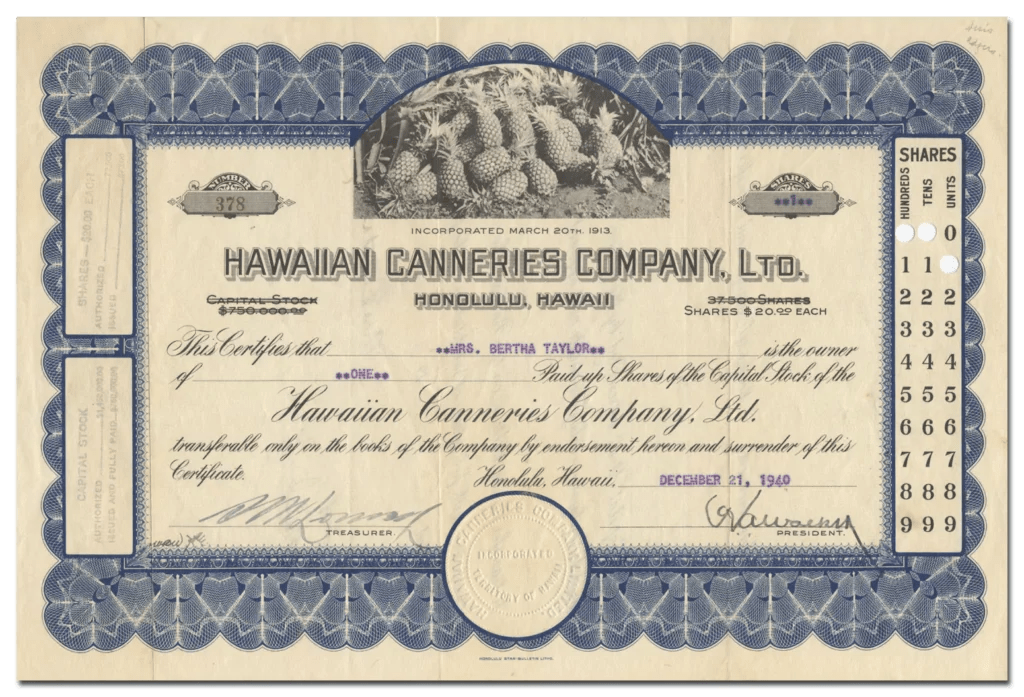
JB Castle and Walter MacFarlane were the key promoters of this early pineapple venture. In 1909, the Hawaiian Cannery Co began operating a small cannery at Kahalu‘u.  And by 1910, Castle was in possession of a thousand acres in Ahuimanu which were suitable for pineapple.

The following year, the Hawaiian Pineapple Co, which James D Dole had founded in 1901, bought out Castle’s Koolau Fruit Co., Ltd and sold it five years later to Libby, McNeil & Libby.

Libby, McNeil & Libby, with control of the Kahalu‘u land, built a large-scale cannery on the site; the cannery had an annual capacity of 250,000-cans.  (Thompson, Kahaluu)

Ten years later, the cannery represented a quarter of a million-dollar investment with a maximum of 750 regular employees, plus an additional 125 at the height of the harvesting season.

The company used a narrow-gauge railway to move the canned fruit to a wharf at the Waikāne Landing, from there sampans took the product to Honolulu for transshipment to other ports. (Conde, Light Railways)

The pineapple cannery along with numerous old-style plantation houses popped up and became known as “Libbyville” (named after its owners, Libby, McNeill, and Libby). (St John’s by the Sea now occupies the site.)

At its peak, 2,500 acres were under pineapple cultivation on Windward O‘ahu, and of this a large percentage was in the Kāne‘ohe Bay region.

The change in landscape to the Windward side by 1914 is reflected in the following sentences: “At last we reached the foot of the Pali … Joe and I looked over the surrounding hills, but looked in vain for the great areas of guava through which but a few months ago we had fought and cut our way.”

“As far as the eye could reach pineapple plantations had taken the place of the forest of wild guava.” (Cultural Surveys)  Libby’s pineapple covered the southern portion of Kāneʻohe, what is now the Pali Golf Course, Hawaiian Memorial Park and the surrounding area.

While Libby managed the operation of large tracts of land, it was noted that, “… much of the pineapple production was carried out by individual growers on small areas of five to 10 acres.”

“A man, a mule, a huli plow and a hoe provided most of the power and the equipment for these smaller operations. This was the typical pineapple production pattern in the area of Waikāne, Waiāhole, Kahaluʻu and ‘Ahuimanu.”

By 1923, it was evident that pineapple cultivation on the Windward area could not keep up with that in other O‘ahu areas. Crops on the Windward side were not yielding tonnages as compared with the Leeward side, fields were smaller, with wilt more prevalent, and growing costs considerably higher. Plantings were therefore reduced.

By this time, the condition of the Pali Road had been improved, and trucks with solid tires were available, so that the struggling pineapple operation found it more economical to haul the fresh pineapple to a central Libby Cannery in Honolulu.

The relatively inefficient, high production costs of operating many small, scattered fields resulted in a decision to discontinue pineapple growing on the Windward side.

The result was the closure of the cannery in 1923.   After the closure of the cannery, the pineapple fields were left to grow over and was then converted to grazing pasture land for cattle.  (History of Koʻolaupoko)

© 2022 Ho‘okuleana LLC

Filed Under: General, Place Names, Prominent People, Economy Tagged With: Libby, Kaneohe, Sugar, Pineapple

October 13, 2022 by Peter T Young Leave a Comment

Sandwich Islander Tax

Within ten years after Captain Cook’s 1778 contact with Hawai‘i, the islands became a favorite port of call in the trade with China.  The fur traders and merchant ships crossing the Pacific needed to replenish food supplies and water.

The maritime fur trade focused on acquiring furs of sea otters, seals and other animals from the Pacific Northwest Coast and Alaska.  The furs were mostly sold in China in exchange for tea, silks, porcelain and other Chinese goods, which were then sold in Europe and the United States.

Needing supplies in their journey, the traders soon realized they could economically barter for provisions in Hawai‘i; a triangular trade network emerged linking the Pacific Northwest coast, China and the Hawaiian Islands to Britain and the United States (especially New England).

After acquiring the “Louisiana Purchase” in 1803, under the directive of President Thomas Jefferson, the Lewis and Clark Expedition, also known as the “Corps of Discovery Expedition” (1804–1806), was the first transcontinental expedition to the Pacific coast undertaken by the United States.

As early as 1811, Hudson’s Bay Company (HBC) had already hired twelve Hawaiians on three year contracts to work for them in the Pacific Northwest.  That year John Jacob Astor built Fort Astoria, it was later sold to the North West Company.

Comfortable with the service from the Hawaiians, in 1817, North West sent a ship “to bring as many of the Sandwich Islanders to the Columbia river as we could conveniently accommodate.”  (Corney)

The number of Hawaiians working as contract laborers for the Hudson’s Bay Company steadily grew.  The large number of Hawaiian workers in the village at Fort Vancouver led to the name “Kanaka Town” in the early 1850s – “Kanaka” is the word for “person” in the Native Hawaiian language.

Historians suggest “that young Hawaiian males left Hawaiʻi as workers on whaling ships and traveled to China, Europe, Mexico, and the US mainland. In addition, many ventured into the Pacific Northwest territory, worked in the fur trade, and ended up settling in those areas.” (pbs-org)

Sandwich Islanders (Hawaiians) came to Oregon Country as seamen. Many remained in Oregon to work under contract as laborers, servants and craftsmen.

The growing population of Hawaiian into the Oregon Country resulted in growing concerns.

Then, in 1845, the Oregon legislature addressed a bill designed to reduce the flow – it was called the Sandwich Islander Tax.

It was an attempt to raise revenue by taxing employers of these Islanders, and it reflects the notion that they will not become permanent residents of Oregon.

A transcript of original drafting of the bill notes, “An Act concerning the introduction of Sandwich Islanders or natives from any of the adjoining islands.”

“Sec 1 Be it enacted by the house of Representatives of Oregon Territory as follows  – That all persons who shall hereafter introduce into Oregon Territory any Sandwich Islanders or natives from any of the neighboring Islands for a term of Service shall pay a tax of five dollars for each person so introduced;”

“Sec 2 Each and every person in this Territory shall pay a tax of three dollar per annum for each and every Sandwich Islander or any native from a neighbouring Island that they keep in their service for a term of years’”

“Sec 3 The revenue arising from said tax shall be assessed and collected as other Taxes are assessed and collected, and paid into the Territorial Treasury the same time the other Territorial Revenue is paid in.”

While introduced, the bill never passed.

“The bill to tax Sandwich Islanders, was read a third time, and indefinitely postponed.”  (December 18, 1845; Oregon Archives)

The intent was later disclosed, “For the taxation of the Sandwich Islanders, employed almost exclusively as servants and laborers, by the HB Company, and intended merely to annoy and embarass the gentlemen in charge of the said company.”  (Oregon Historical Quarterly, 1909)

However, on October 15, 1862, Oregon Governor Addison C Gibbs approved the law that had passed the House of Representations (October 8, 1862) and Senate (October 13, 1862) that stated:

“That each and every negro, Chinaman, kanaka and mulatto (“mixed” or “biracial,”) residing within the limits of this state, shall pay an annual poll tax of five dollars, for the use of the county in which such negro, Chinaman, kanaka and mulatto may reside.”

“That every such negro, Chinaman, kanaka and mulatto, shall, between the first day of January and the first day of March, of each year, pay to the county treasurer of the county in which he may reside, the sum of five dollars, and thereupon said treasurer shall make out and deliver to such person a receipt”.

“When such negro, Chinaman, kanaka and mulatto shall fail and neglect to pay the tax required by section second of this act, then it shall be the duty of the sheriff of the county wherein such tax payer may reside or be found, to immediately collect such tax, with the additional sum of one dollar, and mileage, which additional sum and mileage shall go to the sheriff, as his fees; the balance shall be paid into the county treasury, and the sheriff is required to make return to the county treasurer of the taxes collected under the provisions of this act, on the first Monday of June, and every three months thereafter.”

“Should such negro, Chinaman, kanaka or mulatto, fail to pay the tax required by section second of this act, and should the sheriff be unable to collect the same, or make the same out of property belonging to such tax payers, then it is made the duty of the sheriff to arrest such negro, Chinaman, kanaka or mulatto, and put him at work on the public highways, under the direction of the road supervisor …”

“… such taxpayers shall be required to work one day on such highways, for every half-dollar of such tax due and unpaid, and in addition thereto, shall be allowed his board, which shall be paid by the county in which such labor is performed, and the sheriff shall be allowed by the county court a reasonable sum for his service.”

© 2022 Hoʻokuleana LLC

Filed Under: Economy, General, Place Names Tagged With: Kanaka, Hudson's Bay Company, Sandwich Islander Tax, Oregon, Hawaii

October 8, 2022 by Peter T Young Leave a Comment

John Adams Cummins

John Adams Kuakini Cummins was born March 17, 1835 in Honolulu. He was a namesake of island governor John Adams Kuakini (1789–1844), who had taken the name of John Quincy Adams when Americans first settled on the islands in the 1820s.

His father was Thomas Jefferson Cummins (1802–1885) who was born in Lincoln, England, raised in Massachusetts and came to the Hawaiian Islands in 1828. His mother was High Chiefess Kaumakaokane Papaliʻaiʻaina (1810–1849) who was a distant relative of the royal family of Hawaiʻi.

In the 1840s, his father first developed a cattle ranch and horse ranch. Facing diminishing returns in the cattle market, in the 1880s, John began to grow sugar cane in place of cattle. This plantation was known as the Waimanalo Sugar Company.

He married Rebecca Kahalewai (1830–1902) in 1861, also considered a high chiefess, and had five children with her, four daughters and one son.

Cummins was elected to the House of Representatives in the legislature of the Hawaiian Kingdom in 1874. King Kalākaua appointed him to the Privy Council on June 18, 1874 shortly after Kalākaua came to the throne.

Even though Cummins voted against former Queen Emma in the election, she asked him to manage a trek for her around the islands in November 1875.

He had staged a similar grand tour the year before for Kalākaua. Emma was not disappointed.

Although many ancient Hawaiian customs had faded (due to influence of conservative Christian missionaries, for example), Cummins staged great revivals of ceremonies such as traditional hula performance.

In the legislature he advocated for the Reciprocity Treaty of 1875 with the United States, which helped increase profits in the sugar industry, and his fortunes grew.

The sugar industry became a huge success and gave way to other innovations in the area. For instance, the use of railway tracks and locomotive were due to the boom of the sugar business.

Cummins left the sugar business to William G Irwin, agent of Claus Spreckles, and developed a commercial building called the Cummins Block at Fort and Merchant streets in Downtown Honolulu.

In 1889, he represented Hawaiʻi at the Paris exposition known as Exposition Universelle. On June 17, 1890 Cummins became Minister of Foreign Affairs in Kalākaua’s cabinet and thus was in the House of Nobles of the legislature for the 1890 session.

When Kalākaua died and Queen Liliʻuokalani came to the throne in early 1891, she replaced all her ministers. Cummins resigned February 25, 1891.  He was replaced by Samuel Parker who was another part-Hawaiian.

Cummins was elected to the 1892 session of the House of Nobles, on the Hawaiian National Reform Party ticket. He also organized a group called the Native Sons of Hawaii which supported the monarchy.

After the overthrow of the Kingdom of Hawaiʻi in early 1893, Liliʻuokalani asked Cummins to travel to the continent to lobby for its help in restoration of the monarchy.

The task, which included Parker and Hermann A Widemann, ended in failure. However, on the voyage to the west coast, William T Seward, a former Major in the American Civil War who worked for Cummins and lived in one of his homes, smuggled guns and ammunition for the failed 1895 counter-revolution.

Thomas Beresford Walker, Cummins’ son-in-law (married to his eldest daughter Matilda,) was also implicated in the plot. Cummins was arrested, charged with treason and convicted. He was sentenced to prison, but released after paying a fine and agreeing to testify against the ones actively involved in the arms trading.

He died on March 21, 1913 from influenza after a series of strokes and was buried in Oʻahu Cemetery. Well liked, even his political opponents called him “the playmate of princes and the companion and entertainer of kings”.  The territorial legislature had tried several times to refund his fine, but it was never approved by the governor.

His funeral was a mix of mostly traditional symbols of the Hawaiian religion, with a Christian service in the Hawaiian language, attended by both royalists and planners of the overthrow.

Cummin’s great-grandson (through his daughter Jane Piikea Merseberg) was Mayor Neal Blaisdell.

© 2022 Hoʻokuleana LLC

Filed Under: Economy, Prominent People Tagged With: Neal Blaisdell, Waimanalo Sugar, Hawaii, Liliuokalani, Kalakaua, Waimanalo, John Adams Cummins, Queen Emma

October 7, 2022 by Peter T Young Leave a Comment

Tea

“There are few hours in life more agreeable than the hour dedicated to the ceremony known as afternoon tea.”  (Henry James)

According to legend, in 2737 BC, the Chinese emperor Shen Nung was sitting beneath a tree while his servant boiled drinking water, when some leaves from the tree blew into the water. Shen Nung, a renowned herbalist, decided to try the infusion that his servant had accidentally created. The tree was a Camellia sinensis, and the resulting drink was what we now call tea.

Containers for tea have been found in tombs dating from the Han dynasty (206 BC – 220 AD) but it was under the Tang dynasty (618-906 AD), that tea became firmly established as the national drink of China.

It became such a favorite that during the late eighth century a writer called Lu Yu wrote the first book entirely about tea, the Ch’a Ching, or Tea Classic. It was shortly after this that tea was first introduced to Japan, by Japanese Buddhist monks who had travelled to China to study.

Tea drinking has become a vital part of Japanese culture, as seen in the development of the Tea Ceremony, which may be rooted in the rituals described in the Ch’a Ching. (UK Tea)

The world began to learn of China’s tea secret in the early 1600s, when Dutch traders started bringing it to Europe in large quantities. With regular shipment to parts of Europe by 1610, tea first arrived in Britain in the 1650s, when it was served as a novelty in London’s coffee houses.

Back then, tea was a rare drink that very few consumed. The famous diarist Samuel Pepys wrote about his first tea experience, and the first written reference to tea drinking in England.

On September 25, 1660, Pepys was called to the meeting to discuss peace with Spain; he noted, “And afterwards I did send for a cup of tee (a China drink) of which I had never drank before, and went away”.  (BBC)

Tea was slow to catch on in England.

However, it may have been the wife of King Charles II, two years later, who popularized tea in the UK. In 1662, Charles II, the newly restored monarch, married Catherine of Braganza, the daughter of Portugal’s King John IV. She became Queen of England, Scotland and Ireland.

Upon arriving in Portsmouth on May 14, 1662 ahead of her marriage to the king, Catherine asked for a cup of tea. Tea had arrived by this point, but it was rare for anyone to drink it, so none was available – instead, she was offered a small ale. She was already a regular tea drinker, as the drink was already a popular beverage among the aristocracy of Portugal.

The king and queen got married on May 14, and Portugal provided several ships of luxury items as it had been agreed. One of those items included a chest of tea, the favorite drink of the Portuguese Court.

Catherine popularized the drink among British nobility, and subsequently to the wealthier members of society. The invasion of tea in the country had well and truly started. (BBC)

OK; so, how does this relate to Hawai‘i?

Beginning well before 1600, the North American fur trade was the earliest global economic enterprise. Europeans and, later, Canadians and Americans, hunted and trapped furs; but success mandated that traders cultivate and maintain dense trade and alliance networks with Native nations.

Within ten years after Captain Cook’s 1778 contact with Hawai‘i, the islands became a favorite port of call in the trade with China.  The fur traders and merchant ships crossing the Pacific needed to replenish food supplies and water.

The maritime fur trade focused on acquiring furs of sea otters, seals and other animals from the Pacific Northwest Coast and Alaska.  The furs were mostly sold in China in exchange for silks, porcelain, other Chinese goods … and Tea, which were then sold in Europe and the US.

The East India Company was perhaps the most powerful commercial organization that the world has ever seen. In its heyday it not only had a monopoly on British trade with India and the Far East, but it was also responsible for the government of much of the vast Indian sub-continent.

Both of these factors mean that the East India Company (or, to call it by its proper name, the British East India Company) was crucial to the history of the tea trade. (UK Tea)

After acquiring the “Louisiana Purchase” in 1803, under the directive of President Thomas Jefferson, the Lewis and Clark Expedition, also known as the “Corps of Discovery Expedition” (1804–1806), was the first transcontinental expedition to the Pacific coast undertaken by the United States.

Hudson’s Bay Company (HBC) was a fur trading company that started in Canada in 1670; its first century of operation found HBC firmly focused in a few forts and posts around the shores of James and Hudson Bays, Central Canada.

Fast forward 150-years and in 1821, HBC merged with North West Company, its competitor; the resulting enterprise now spanned the continent – all the way to the Pacific Northwest (modern-day Oregon, Washington and British Columbia) and the North (Alaska, the Yukon and the Northwest Territories.)

Fur traders working for the HBC traveled an area of more than 700,000 square miles that stretched from Russian Alaska to Mexican California and from the Rocky Mountains to the Pacific Ocean. 

Ships sailed from London around Cape Horn around South America and then to forts and posts along the Pacific Coast via the Hawaiian Islands.  Trappers crossing overland faced a journey of 2,000 miles that took three months.

Traders, in order to obtain the wherewithal to purchase teas and silks at Canton, spent 18-months or more of each China voyage collecting a cargo of sea-otter skins, highly esteemed by the Chinese.

Needing supplies in their journey, the traders soon realized they could economically barter for provisions in Hawai‘i; for instance any type of iron, a common nail, chisel or knife, could fetch far more fresh fruit meat and water than a large sum of money would in other ports.

A triangular trade network emerged linking the Pacific Northwest coast, China and the Hawaiian Islands to Britain and the United States (especially New England).

Practically every vessel that visited the North Pacific in the closing years of the 18th century stopped at Hawai‘i to replenish supplies, refreshment and recreation.

Fur trading on the coast remained profitable from the 1780s into the 1820s, but the successful trade in furs depended entirely on the locale. Some parts of the coast, such as Nootka Sound and Clayoquot Sound, witnessed a complete collapse of the sea otter population after only a decade of intense hunting. (Igler)

© 2022 Ho‘okuleana LLC

Filed Under: Sailing, Shipping & Shipwrecks, Economy Tagged With: Hawaii, Hudson's Bay Company, Tea, East India Company, Catherine of Braganza, King Charles II

October 6, 2022 by Peter T Young 1 Comment

Kakaʻako Pumping Station

The word “Sewer” is derived from the term “seaward” in Old English, as in ditches and ravines slightly sloped to run waste water from land to sea.

From an 1857 story in the Commercial Pacific Advertiser it appears that the first sewer facility to be constructed on Oʻahu was a storm drain located at Queen Street at the foot of Kaʻahumanu Street opposite Pier 11.  (ASCE)

Despite three outbreaks of smallpox, a typhus epidemic and two cholera epidemics between 1853 and 1895, no other serious actions were taken to improve conditions.

Honolulu was a growing city and needed a better way of disposing its wastewater.

At that time, the city had grown to approximately 30,000-people, and it was estimated that about 1.8-million gallons of sewage was being disposed of in the City septic systems daily.  This was much more than septic tank excavators could keep up with – which caused sanitation and odor concerns.

In 1897, Rudolph Hering, a New York Sanitary Engineer, was hired to prepare specifications for a Honolulu sewerage system, pumping station and ocean outfall (Hering had previously designed the New York and other large city sewage systems.)

Hering recommended a “separate system” whereby separate networks of conduits would carry sewage and storm waters, a system still used today in Honolulu.

Work on the system began in 1899 and sewer lines were laid out in a gravity flow pattern in a rectangular fashion and ran along Alapaʻi, River and South Streets, past Thomas Square, and ended in the Punahou area.

The system was extended to the remaining portion of what was then considered to be “town,” between Liliha on the ʻEwa side, Artesian Street, beyond Punahou to Judd Street, and including the Kewalo District.

The expansion was later delayed, due to a lack of funding. Much of the extension work thereafter was performed by property owners who were furnished piping and sewer components by the government.

The collection lines terminated at a main reservoir (the underground reservoir was dubbed the Hering Reservoir) at the low point at the intersection of Keawe Street and Ala Moana Boulevard in Kakaʻako.  (Darnell)  The sewage would then be pumped out to sea.

In addition, OG Traphagen (designer of the Moana Hotel) was hired to design the steam-powered sewer pumping station at this low spot.

The cost was tremendous for the construction of the lines, and construction was stopped several times due to lack of funding. The sewer outfall to the ocean was built in 1899. The outfall ran some 3,800-feet out to sea at a depth of 40-feet of water, rather than farther out to a 100-foot depth (again, due to funding constraints.)  (Darnell)

In 1900, the Kakaʻako Pumping Station was constructed; with features such as large arched windows, exterior walls of local lava rock, roofs of green tile and a smokestack 76-feet tall.

The architectural style is Industrial Romanesque with the walls constructed of locally-cut bluestone and concrete with plaster finished interior walls.

The first sewer system connections (to the Department of Health building on Punchbowl and Queen Streets, and to the Post Office building on Bethel and Merchant) were completed in 1900. This was followed by the slow conversion of other properties from cesspools to sewers.

Two additions were built to support the Pumping Station facility. In 1925, an additional “Pump” building of brick to house a high-speed, electric powered pump was added and the original plant was turned into a machine shop, storeroom and office. In 1939 a second “New” Pump House was constructed on the southwestern side of the existing structures.

The use of the Kakaʻako Pumping Station was abandoned by the City and County of Honolulu when it built a new pumping station on the southwest portion of the block, adjacent to the Historic Ala Moana Pumping Station in 1955.

Now under the jurisdiction of the Hawaiʻi Community Development Authority, it is restored by the nonprofit Hawaiʻi Architectural Foundation.

Today, the interior of the 1900 Pumping Station does not contain any historic equipment or utilities.  (Lots of information here from HCDA, HHF, ASCE and Darnell.)

© 2022 Hoʻokuleana LLC

Filed Under: Economy, General, Buildings Tagged With: Downtown Honolulu, Kakaako, Kakaako Pumping Station, Hawaii, Honolulu, Oahu

  • « Previous Page
  • 1
  • …
  • 90
  • 91
  • 92
  • 93
  • 94
  • …
  • 237
  • Next Page »

Images of Old Hawaiʻi

People, places, and events in Hawaiʻi’s past come alive through text and media in “Images of Old Hawaiʻi.” These posts are informal historic summaries presented for personal, non-commercial, and educational purposes.

Info@Hookuleana.com

Connect with Us

  • Email
  • Facebook
  • LinkedIn
  • Twitter
  • YouTube

Recent Posts

  • Ammo Tunnels
  • 250 Years Ago … Battle of Brooklyn
  • Missionary, Educator … Former Slave
  • Historic Downtown Hilo Walking Tour
  • Memorial Park
  • About 250 Years Ago … King Declares Colonies in Open Rebellion
  • Sybil’s Rocking Chair

Categories

  • Buildings
  • Missionaries / Churches / Religious Buildings
  • Hawaiian Traditions
  • Military
  • Place Names
  • Prominent People
  • Schools
  • Sailing, Shipping & Shipwrecks
  • Economy
  • Voyage of the Thaddeus
  • Mayflower Summaries
  • American Revolution
  • General
  • Ali'i / Chiefs / Governance

Tags

Albatross Al Capone Ane Keohokalole Archibald Campbell Bernice Pauahi Bishop Charles Reed Bishop Downtown Honolulu Eruption Founder's Day George Patton Great Wall of Kuakini Green Sea Turtle Hawaii Hawaii Island Hermes Hilo Holoikauaua Honolulu Isaac Davis James Robinson Kamae Kamaeokalani Kameeiamoku Kamehameha Schools Lalani Village Lava Flow Lelia Byrd Liberty Ship Liliuokalani Mao Math Mauna Loa Midway Monk Seal Northwestern Hawaiian Islands Oahu Papahanaumokuakea Marine National Monument Pearl Pualani Mossman Quartette Thomas Jaggar Volcano Waikiki Wake Wisdom

Hoʻokuleana LLC

Hoʻokuleana LLC is a Planning and Consulting firm assisting property owners with Land Use Planning efforts, including Environmental Review, Entitlement Process, Permitting, Community Outreach, etc. We are uniquely positioned to assist you in a variety of needs.

Info@Hookuleana.com

Copyright © 2012-2024 Peter T Young, Hoʻokuleana LLC

Loading Comments...