Images of Old Hawaiʻi

  • Home
  • About
  • Categories
    • Ali’i / Chiefs / Governance
    • American Protestant Mission
    • Buildings
    • Collections
    • Economy
    • Missionaries / Churches / Religious Buildings
    • General
    • Hawaiian Traditions
    • Other Summaries
    • Mayflower Summaries
    • Mayflower Full Summaries
    • Military
    • Place Names
    • Prominent People
    • Schools
    • Sailing, Shipping & Shipwrecks
    • Voyage of the Thaddeus
  • Collections
  • Contact
  • Follow

April 11, 2023 by Peter T Young Leave a Comment

Whose Footprints Are These?

Geologic evidence suggests that the modern caldera of Kīlauea formed shortly before 1500 AD. Repeated small collapses may have affected parts of the caldera floor, possibly as late as 1790. For over 300-400 years, the caldera was below the water table.

Kilauea can be an explosive volcano; several phreatic eruptions have occurred in the past 1,200 years.  (Phreatic eruptions, also called phreatic explosions, occur when magma heats ground or surface water.)

The extreme temperature of the magma (from 932 to 2,138 °F) causes near-instantaneous evaporation to steam, resulting in an explosion of steam, water, ash and rock – the 1980 eruption of Mount St. Helens was a phreatic eruption.

The 1924 eruption at Halemaʻumaʻu documents and illustrates the explosive nature of Kilauea.  However, the 1924 explosions were small by geologic standards and by the standards of some past Kilauea explosions.

The hazards of larger explosions, such as those that took place multiple times between about AD 1500 and 1790, are far worse than those associated with the 1924 series.  (USGS)

There were explosions in 1790, the most lethal known eruption of any volcano in the present United States. The 1790 explosions, however, simply culminated (or at least occurred near the end of) a 300-year period of frequent explosions, some quite powerful.  (USGS)

Keonehelelei is the name given by Hawaiians to the explosive eruption of Kilauea in 1790.  It is probably so named “the falling sands” because the eruption involved an explosion of hot gas, ash and sand that rained down across the Kaʻu Desert.  The character of the eruption was likely distinct enough to warrant a special name.  (Moniz-Nakamura)

At the time, Kaʻū Chief Keōuakūʻahuʻula (Keōua) was the only remaining rival of Kamehameha the Great for control of the Island of Hawaiʻi; Keōua ruled half of Hāmākua and all of Puna and Kaʻū Districts.  They were passing through the Kilauea area at the time of the eruption. The 1790 explosion led to the death of one-third of the warrior party of Keōua.  (Moniz-Nakamura)

Camped in Hilo, Keōua learned of an invasion of his home district of Kaʻū by warriors of Kamehameha. To reach Kaʻū from Hilo, Keōua had a choice of two routes one was the usually traveled coastal route, at sea level, but it was longer, hot, shadeless and without potable water for long distances.  (NPS)

The other route was shorter, but passed over the summit and through the lee of Kilauea volcano, an area sacred to, and the home of, the Hawaiian volcano goddess Pele. Keōua chose the volcano route, perhaps because it was shorter and quicker, with water available frequently.  (NPS)

In 1919, Ruy Finch, a geologist at the Hawaiian Volcano Observatory discovered human footprints fossilized in the Kaʻū desert ash. Soon, this area of the desert became known as “Footprints.”

Barefoot walkers left thousands of footprints in wet volcanic ash within a few miles southwest of Kīlauea’s summit.

Many historians and Hawaiians believe the footprints were made by Keōua and his warriors.  Keōua was known to be in the area at the time, and previous thought suggested this part of the desert did not have pre-contact use, so it was narrowed down to them.

Scientists later investigated – one approach was to look deeper at the evidence.

Forensic studies indicate that the length of a human foot is about 15% of an individual’s height. A man’s foot may be slightly more that 15%, a woman’s slightly less, but it is possible to estimate the height to a couple of inches.  (USGS)

They measured 405-footprints to determine how tall the walkers were.  The average calculated height is only 4-feet 11-inches, and few footprints were made by people 5-feet 9-inches or more tall. Early Europeans described Hawaiian warriors as tall; one missionary estimated an average height of 5-feet 10-inches. Many now believe that most of the footprints were made by women and children, not by men, much less warriors.  (USGS)

Meanwhile, Keōua’s party was camped on the upwind side of Kīlauea’s summit – perhaps on Steaming Flat – waiting for Pele’s anger to subside. They saw the sky clear after the ash eruption and began walking southwestward between today’s Volcano Observatory and Nāmakanipaio.  (USGS)

Suddenly, the most powerful part of the eruption began, developing a high column and sending surges at hurricane velocities across the path of the doomed group. Later, survivors and rescuers made no footprints in the once wet ash, which had dried.  (USGS)

Then, archaeologists looked for other evidence to help identify who the footprints may have belonged to.  Contrary to general thought that the area was not used by the Hawaiians, archaeological investigations discovered structures, trails and historic artifacts in the area.  (Moniz-Nakamura)

Most of the features were along the edge of the Keʻāmoku lava flow.  Several of the trails converge south of the flow, suggesting a major transportation network.  The structures are likely temporary, used as people were traversing through the desert on their way to/from Kaʻū and Hilo.  (Moniz-Nakamura)

The sheer number of temporary shelters along the Keʻāmoku flow, as well as the trail systems and quarry sites, strongly suggest that this area was frequently used by Hawaiians travelling to and through the area – before and after the 1790 eruption.  (Moniz-Nakamura)

If the footprints aren’t Keōua’s warriors, then how did one-third of his warriors die?

Several suggestions have been made: suffocation due to ash; lava, stones, ash and other volcanic material; or strong winds produced by the eruption, asphyxiation and burning killed them.  (Moniz-Nakamura)

A more recent suggestion is that a “hot base surge, composed primarily of superheated steam … (traveling at) hurricane velocity” was the cause of death.  The wind velocity prevented the people from running away; they probably huddled together, then “hot gases seared their lungs.”  (Moniz-Nakamura)

Some now suggest that, if these observations and ideas are correct, the footprints were made in 1790, but not by members of Keōua’s group.  (USGS)

A reconstruction of events suggests that wet ash, containing small pellets, fell early in the eruption, blown southwestward into areas where family groups, mainly women and children, were chipping glass from old pāhoehoe. They probably sought shelter while the ash was falling. Once the air cleared, they slogged across the muddy ash, leaving footprints in the 1-inch thick deposit.  (USGS)

On August 1, 1916, President Woodrow Wilson signed the country’s 13th national park into existence – Hawaiʻi National Park.  At first, the park consisted of only the summits of Kilauea and Mauna Loa on Hawaiʻi and Haleakalā on Maui.

Eventually, Kilauea Caldera was added to the park, followed by the forests of Mauna Loa, the Kaʻū Desert, the rain forest of Olaʻa and the Kalapana archaeological area of the Puna/Kaʻū Historic District.

In 1961, Hawaiʻi National Park’s units were separated and re-designated as Haleakalā National Park and Hawaii Volcanoes National Park.) (Lots of good information here is from USGS, NPS and Jade Moniz-Nakamura.)

© 2023 Hoʻokuleana LLC


Filed Under: General, Hawaiian Traditions Tagged With: Hawaii National Park, Keonehelelei, Hawaii, Halemaumau, Hawaii Island, Volcano, Kilauea, Kamehameha, Hawaii Volcanoes National Park, Kau, Keoua, Haleakala National Park

March 11, 2023 by Peter T Young Leave a Comment

Kānāwai Māmalahoe (Law of the Splintered Paddle)

In old Hawai‘i, people knew their place in life; some were born to be ali‘i (chiefs,) others were maka‘āinana (commoners.)
 
Each followed protocols, traditions and kapu.
 
The Ali‘i were descended from the gods and had strong mana (spiritual power.)
 
Maka‘āinana were workers (farmers, fishers, crafters and laborers.)
 
Even though kapu and traditions guided people on how to behave, sometimes innocent people got caught in the middle of feuding chiefs.
 
A story suggests that on one occasion, Kamehameha I was fighting in Puna.
 
While chasing two fishermen (presumably with the intention to kill them), his leg was caught in the reef and, in defense, one of the fisherman hit him on the head with a paddle, which broke into pieces.
 
Kamehameha was able to escape (because the fisherman fled, rather than finishing him off.)
 
The story continues that Kamehameha learned from this experience and saw that it was wrong to misuse power by attacking innocent people.
 
Years later, Kamehameha summoned the two fishermen.  When they came, he pardoned them and admitted his mistake by proclaiming a new law, Kānāwai Māmalahoe – Law of the Splintered Paddle.
 
The original 1797 law:
 
Kānāwai Māmalahoe (in Hawaiian:):
 
E nā kānaka,
E mālama ‘oukou i ke akua
A e mālama ho‘i ke kanaka nui a me kanaka iki;
E hele ka ‘elemakule, ka luahine, a me ke kama
A moe i ke ala
‘A‘ohe mea nāna e ho‘opilikia.
Hewa nō, make.
 
Law of the Splintered Paddle (English translation:)
 
Oh people,
Honor thy gods;
Respect alike [the rights of]
People both great and humble;
See to it that our aged,
Our women and our children
Lie down to sleep by the roadside
Without fear of harm.
Disobey, and die.
 
Kamehameha’s Law of the Splintered Paddle of 1797 is enshrined in the State constitution, Article 9, Section 10:
 
“Let every elderly person, woman and child lie by the roadside in safety”.
 
It has become a model for modern human rights law regarding the treatment of civilians and other non-combatants.
 
Kānāwai Māmalahoe appears as a symbol of crossed paddles in the center of the badge of the Honolulu Police Department.
 
A plaque, facing mauka on the Kamehameha Statue outside Ali‘iōlani Hale in Honolulu, notes the Law of the Splintered Paddle (it is the image noted here.)
 
© 2023 Ho‘okuleana LLC
 

Filed Under: Ali'i / Chiefs / Governance, Hawaiian Traditions Tagged With: Hawaii, Kamehameha, Law of the Splintered Paddle, Kanawai Mamalahoe

March 8, 2023 by Peter T Young Leave a Comment

Naha Stone

The legend of King Arthur (Le Morte Darthur, Middle French for “the Death of Arthur” (published in 1485)) speaks of King Arthur, Guinevere, Lancelot and the Knights of the Round Table (and foresees “Whoso pulleth out this sword of this stone is the rightwise born king of all England.”)

Many tried; many failed.

Legendary Arthur later became the king of England when he removes the fated sword from the stone. Legendary Arthur goes on to win many battles due to his military prowess and Merlin’s counsel; he then consolidates his kingdom.  (The historical basis for the King Arthur legend has long been debated by scholars.)

In Hawaiʻi, a couple legends and prophecies relate to a stone, Naha Pōhaku (the Naha Stone.)

Its weight is estimated to be two and one-half tons (5,000-pounds.)  The stone was originally located in the Wailua River, Kauai; it was brought to Hilo by chief Makaliʻinuikualawaiea on his double canoe and placed in front of Pinao Heiau.  (NPS)

The stone was reportedly endowed with great powers and had the peculiar property of being able to determine the legitimacy of all who claimed to be of the royal blood of the Naha rank (the product of half-blood sibling unions.)

As soon as a boy of Naha stock was born, he was brought to the Naha Stone and was laid upon it – one faint cry would bring him shame.  However, if the infant had the virtue of silence, he would be declared by the kahuna to be of true Naha descent, a royal prince by right and destined to become a brave and fearless soldier and a leader of his fellow men.  (NPS)

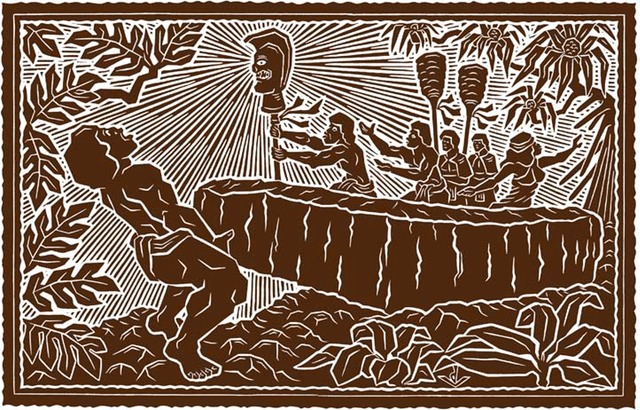
In another instance, Kamehameha traveled from Kohala to Hilo with Kalaniwahine a prophetess, who advised him that there was a deed he must do.  Although not of Naha lineage, Kamehameha came to conquer the Naha Stone.

Kalaniwahine proclaimed that if he succeeded in moving Naha Pōhaku, that he would move the whole group of Islands. If he changed the foundations of Naha Pōhaku from its resting place, he would conquer the whole group and he would prosper and his people would prosper.

Kamehameha said, “He Naha oe, a he Naha hoi kou mea e neeu ai. He Niau-pio hoi wau, ao ka Niau-pio hoi o ka Wao.” (”You are a Naha, and it will be a Naha who will move you. I am a Niaupio, the Niaupio of the Forest.”)

With these words did Kamehameha put his shoulders up to the Naha Stone, and flipped it over, being this was a stone that could not be moved by five men.  (Hoku o Hawaiʻi, November 1, 1927)

When Kamehameha gripped the stone and leaned over it, he leaned, great strength came into him, and he struggled yet more fiercely, so that the blood burst from his eyes and from the tips of his fingers, and the earth trembled with the might of his struggling, so that they who stood by believed that an earthquake came to his assistance.  (NPS)

The stone moved and he raised it on its side.

And, the rest of the history of the Islands has been pretty clear about the fulfillment of the prophecy and unification of the Islands under Kamehameha.

The Naha Stone is in front of Hilo Public Library at 300 Waiānuenue Avenue between Ululani and Kapiʻolani Street (the larger of the two stones there.)

The upright stone sitting to the makai side of the Naha Stone is associated with the Pinao Heiau, one of several that once stood in Hilo. Some of the stones that built the first Saint Joseph church and other early stone buildings in town likely came from Pinao heiau.  (Zane)

© 2023 Hoʻokuleana LLC

Filed Under: Ali'i / Chiefs / Governance, Hawaiian Traditions Tagged With: Hawaii Island, Hilo, Kamehameha, Pinao Heiau, Naha Stone, Hawaii

February 28, 2023 by Peter T Young Leave a Comment

It was a dark and stormy night …

“It was said that on a certain night of heavy down pouring rain – the lightning struck its wrathful flashes into the sky – the thunder pounded with all its might – the stormy wind veered every which way – the red water churned in the streams.”  (Poepoe, Ahlo)

The child born that night was of royal blood, and was destined to become not only the king of Hawaiʻi, but the conqueror and sovereign of the group.

They say the child was poʻolua, “that is, a child of two fathers, (it) was considered a great honor by chiefs of that period.” (Luomala)  Some say that his mother, Kekuʻiapoiwa (married to Keōua,) had a liaison with Kahekili (ruler of Maui.)

Though Kahekili was thought to possibly be his biological father, he was raised by his parents (and was considered the son of Kekuʻiapoiwa and Keōua.)

The exact year of his birth is not known; different historians/writers place the year of his birth from about 1736 to 1759.

He was said to be born at Kokoiki (”little blood,” referring to the first signs of childbirth – Kokoiki is one of the star names listed in the Kumulipo chant.)

Another notes, “(A) bright and beautiful star, appeared at Kokoiki on the night before the child was born and is hence called Kokoiki.”  (Kūʻokoʻa Home Rula, Ahlo)  (Scientific study places Halley’s Comet in the same relative position in the Hawaiian sky on December 1, 1758.  (Ahlo))

Keʻāulumoku predicted that he “would triumph over his enemies, and in the end be hailed as the greatest of Hawaiian conquerors.”  (Kalākaua)

Word went out to find and kill the baby, but the Kohala community conspired to save him.

“A numerous guard had been set to wait the time of birth. The chiefs kept awake with the guards (for a time,) but due to the rain and the cold, the chiefs fell asleep, and near daybreak Kekuʻiapoiwa went into the house and, turning her face to the side of the house at the gable end, braced her feet against the wall.”

“A certain stranger (Naeʻole) was outside the house listening, and when he heard the sound of the last bearing-down pain (kuakoko), he lifted the thatch at the side of the house, and made a hole above.”

“As soon as the child was born, had slipped down upon the tapa spread out to receive it, and Kekuʻiapoiwa had stood up and let the afterbirth (ewe) come away, he covered the child in the tapa and carried it away.”  (Kamakau)

The young child, Kamehameha, was carried on a perilous journey through Kohala and Pololū Valley to Awini.  (KamehamehaDayCelebration)

Hawi, meaning ”unable to breathe,” was where the child, being spirited away by a servant, required resuscitation and nursing. Kapaʻau, meaning ”wet blanket,” was where heavy rain soaked the infant’s kapa (blanket.)  Halaʻula (scattered blood) was the town where soldiers were killed in anger.  (Sproat – (Fujii, NY Times))  Some believe Kamehameha also spent much of his teen years in Pololū (long spear.)

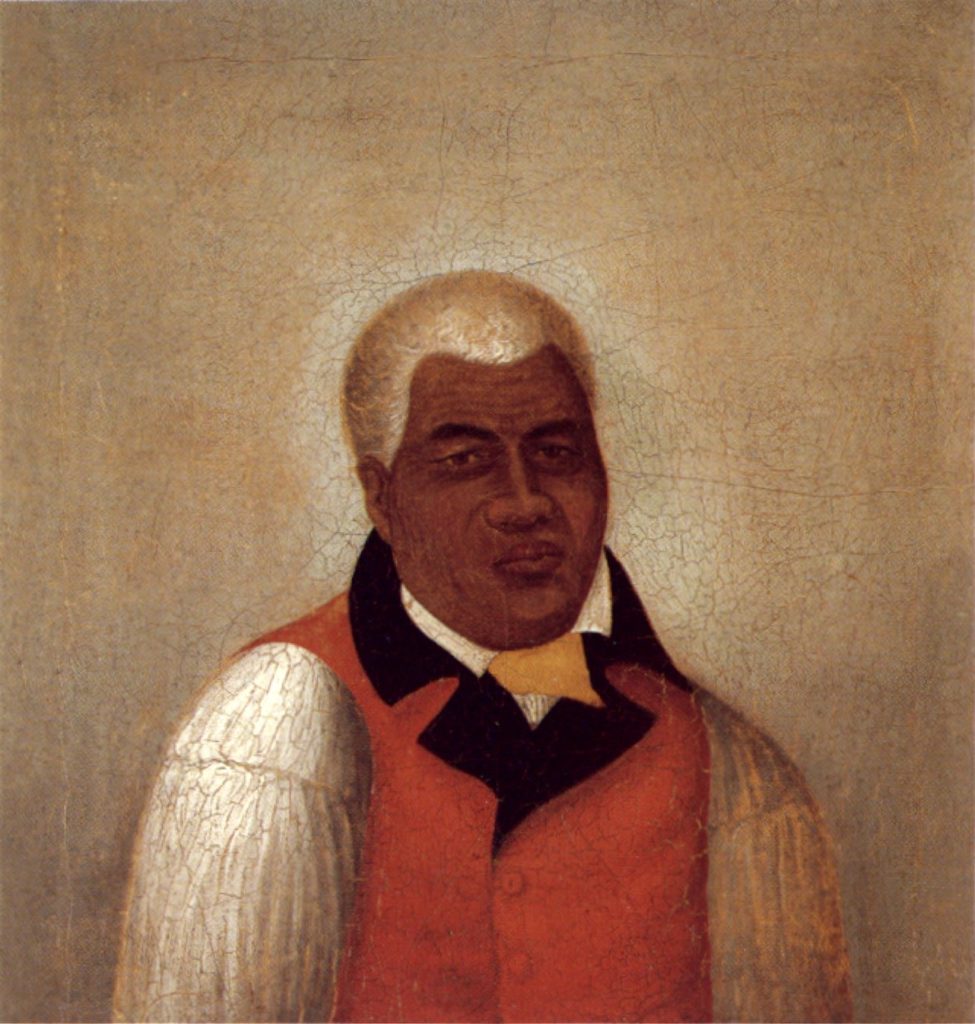
“Kamehameha (Kalani Pai‘ea Wohi o Kaleikini Keali‘ikui Kamehameha o ‘Iolani i Kaiwikapu Kaui Ka Liholiho Kūnuiākea) was a man of tremendous physical and intellectual strength. In any land and in any age he would have been a leader.”  (Kalākaua, ROOK)

While still in his youth, Kamehameha proved his right to rule over all the islands by lifting the Naha Stone at Pinao Heiau in Pi‘ihonua, Hilo (c. 1773.) (ROOK)

By the time of Cook’s arrival (1778,) Kamehameha had become a superb warrior who already carried the scars of a number of political and physical encounters. The young warrior Kamehameha was described as a tall, strong and physically fearless man who “moved in an aura of violence.” (NPS)

The impress of his mind remains with his crude and vigorous laws, and wherever he stepped is seen an imperishable track. He was so strong of limb that ordinary men were but children in his grasp, and in council the wisest yielded to his judgment. He seems to have been born a man and to have had no boyhood.  (Kalākaua)

He was always sedate and thoughtful, and from his earliest years cared for no sport or pastime that was not manly. He had a harsh and rugged face, less given to smiles than frowns, but strongly marked with lines indicative of self-reliance and changeless purpose.  (Kalākaua)

He was barbarous, unforgiving and merciless to his enemies, but just, sagacious and considerate in dealing with his subjects. He was more feared and admired than loved and respected; but his strength of arm and force of character well fitted him for the supreme chieftaincy of the group, and he accomplished what no one else could have done in his day.  (Kalākaua)

In 1790 (at the same time that George Washington was serving as the US’s first president,) the island of Hawaiʻi was under multiple rule; Kamehameha (ruler of Kohala, Kona and Hāmākua regions) successfully invaded Maui, Lanai and Molokai.

He sent an emissary to the famous kahuna (priest, soothsayer,) Kapoukahi, to determine how he could conquer all of the island of Hawaiʻi.  According to Thrum, Kapoukahi instructed Kamehameha “to build a large heiau for his god at Puʻukoholā, adjoining the old heiau of Mailekini.”

It is estimated that the human chain from Pololū Valley to Puʻukohola had somewhere between 10,000-20,000 men carrying stones from Pololū Valley to Kawaihae. (NPS)

After completing the heiau in 1791, Kamehameha invited Keōua to come to Kawaihae to make peace.  However, as Keōua was about to step ashore, he was attacked and killed by one of Kamehameha’s chiefs.

With Keōua dead, and his supporters captured or slain, Kamehameha became King of Hawaiʻi island, an event that according to prophesy eventually led to the conquest and consolidation of the islands under the rule of Kamehameha I.

It was the koa (warriors) of Hilo who supported Kamehameha in his early quest to unite Moku O Keawe. After gaining control of Moku O Keawe, Kamehameha celebrated the Makahiki in Hilo in 1794.  (ROOK)

The village and area of Hilo was named by Kamehameha after a special braid that was used to secure his canoe. Kamehameha and Keōpūolani’s son, Liholiho (Kamehameha II) was born in Hilo (1797.)  (ROOK)

Kamehameha’s great war fleet, Peleleu, that was instrumental in Kamehameha’s conquest, was built and based at Hilo (1796-1801). After uniting all of the islands under his rule in 1810, Hilo became Kamehameha’s first seat of government.  (ROOK)

It was in Hilo that Kamehameha established his greatest law, the Kānāwai Māmalahoe (Law of the Splintered Paddle).  (ROOK)  Kamehameha’s Law of the Splintered Paddle of 1797 is enshrined in the State constitution, Article 9, Section 10:  “Let every elderly person, woman and child lie by the roadside in safety”.

It has become a model for modern human rights law regarding the treatment of civilians and other non-combatants.  Kānāwai Māmalahoe appears as a symbol of crossed paddles in the center of the badge of the Honolulu Police Department.  The image shows Kamehameha as a young warrior (HerbKane.)

© 2023 Hoʻokuleana LLC


Filed Under: Ali'i / Chiefs / Governance Tagged With: Kahekili, Liholiho, Keoua, Kohala, North Kohala, Puukohola, Naha Stone, Hawaii, Kokoiki, Hawaii Island, Kekuiapoiwa, Hilo, Law of the Splintered Paddle, Kamehameha, Kanawai Mamalahoe

January 22, 2023 by Peter T Young Leave a Comment

ʻIliahi

Sandalwood (ʻiliahi) has been highly prized and in great demand through the ages; its use for incense is part of the ritual of Buddhism.  Chinese used the fragrant heart wood for incense, medicinal purposes, for architectural details and carved objects.
 
Sandalwood was first recognized as a commercial product in Hawai‘i in 1791 by Captain Kendrick of the Lady Washington, when he instructed sailors to collect cargo of sandalwood.  From that point on, it became a source of wealth in the islands, until it’s supply was ultimately exhausted.
 
Trade in Hawaiian sandalwood began as early as the 1790s; by 1805 it had become an important export item.
 
Waimea Bay became the sandalwood capital during the 1800s. Huge cargo ships would anchor offshore to load sandalwood.
 
Sandalwood trade was a turning point in Hawai‘i, especially related to its economic structure.  It moved Hawai‘i from a self-sufficient economy to a commercial economy.  This started a series of other economic and export activities across the islands.
 
In 1809, two brothers, the American ship captains Jonathan Winship of the “Albatross” and Nathan Winship of the “O’Cain,” started on a voyage that established the sandalwood trade.
 
After trading for furs on the coast of Oregon, they sailed in October, 1811, for Honolulu, where they and Captain William Heath Davis of the “Isabella” took on cargoes of sandalwood.
 
The ships sailed to Canton, where the fragrant wood was sold at a large profit. Returning to Honolulu, the three captains persuaded King Kamehameha I to grant them a monopoly of the sandalwood and cotton trade for 10 years. However, after the first trip, Kamehameha cancelled the arrangement. (St John)
 
In 1811, an agreement between Boston ship captains and Kamehameha I established a monopoly on sandalwood exports, with Kamehameha receiving 25% of the profits.  As trade and shipping brought Hawaiʻi into contact with a wider world, it also enabled the acquisition of Western goods, including arms and ammunition. 
 
Kamehameha used Western cannons and guns to great advantage in his unification of the Islands and also acquired Western-style ships, buying the brig Columbia for a price of two ship loads of sandalwood in 1817.
 
Between about 1810 and 1820, the major item of Hawaiian trade was sandalwood.  Kamehameha I rigidly maintained control of the trade until his death in 1819, at which time his son, Liholiho, took over control.
 
When Kamehameha I died, although Liholiho (his son and successor) should have inherited all of Kamehameha’s lands, the chiefs also wanted the revenue from the sandalwood.
 
Chiefs persuaded the king to give them an in on the royal sandalwood monopoly; trade continued at an accelerated rate, following Kamehameha’s death. 
 
In America, the Panic of 1819 (the first financial crisis in the United States) made it difficult for traders to obtain sandalwood for the China trade.
 
However, because the Hawaiian chiefs had become enamored of items of foreign manufacture, the islands provided an open market for goods like rum, clothing, cloth, furnishings and a host of other things.
 
Foreign traders shipped these goods to the islands, exchanging them for sandalwood, which continued to be in demand in China.
 
It was Hawaii’s first source of revenue and major debt.  Credit secured by payment in sandalwood saddled the Hawaiian Chiefs and the Islands’ struggling economy.
 
In 1826, the kingdom of Hawaiʻi enacted its first written law – a sandalwood tax.  Every man was ordered to deliver to the government 66 pounds of sandalwood, or pay four Spanish dollars, by September 1, 1827.
 
Every woman older than 13 was obligated to make a 12-by-6-foot kapa cloth.  The taxes were collected to reduce the staggering debt.
 
The common people were displaced from their agricultural and fishing duties and all labor was diverted to harvesting sandalwood.  This period saw two major famines as ʻiliahi was over-harvested to the point of commercial extinction in Hawaiʻi forests. 
 
Unfortunately, the harvesting of the trees was not sustainably managed (they cut whatever they could, they didn’t replant) and over-harvesting of ‘iliahi took place.
 
By 1830, the trade in sandalwood had completely collapsed.  Hawaiian forests were exhausted and sandalwood from India and other areas in the Pacific drove down the price in China and made the Hawaiian trade unprofitable.
 
Once reported as growing on landscape scales, today, there are only remnant patches of ‘iliahi.  Several are trying to bring sandalwood back.
 
© 2023 Hoʻokuleana LLC
 

Filed Under: Economy, General Tagged With: Hawaii, Kamehameha, Sandalwood, Iliahi, Economy, Hawaiian Economy

  • « Previous Page
  • 1
  • …
  • 6
  • 7
  • 8
  • 9
  • 10
  • …
  • 19
  • Next Page »

Images of Old Hawaiʻi

People, places, and events in Hawaiʻi’s past come alive through text and media in “Images of Old Hawaiʻi.” These posts are informal historic summaries presented for personal, non-commercial, and educational purposes.

Info@Hookuleana.com

Connect with Us

  • Email
  • Facebook
  • LinkedIn
  • Twitter
  • YouTube

Recent Posts

  • FDR in Hawaiʻi
  • Pu‘ukoholā
  • Portuguese in Hawaiʻi
  • ʻŌpūkahaʻia Leaves Hawaiʻi
  • Moku
  • About 250 Years Ago … Story of the American Soldier
  • German Town

Categories

  • General
  • Ali'i / Chiefs / Governance
  • Buildings
  • Missionaries / Churches / Religious Buildings
  • Hawaiian Traditions
  • Military
  • Place Names
  • Prominent People
  • Schools
  • Sailing, Shipping & Shipwrecks
  • Economy
  • Voyage of the Thaddeus
  • Mayflower Summaries
  • American Revolution

Tags

Albatross Al Capone Ane Keohokalole Archibald Campbell Bernice Pauahi Bishop Charles Reed Bishop Downtown Honolulu Eruption Founder's Day George Patton Great Wall of Kuakini Green Sea Turtle Hawaii Hawaii Island Hermes Hilo Holoikauaua Honolulu Isaac Davis James Robinson Kamae Kamaeokalani Kameeiamoku Kamehameha Schools Lalani Village Lava Flow Lelia Byrd Liberty Ship Liliuokalani Mao Math Mauna Loa Midway Monk Seal Northwestern Hawaiian Islands Oahu Papahanaumokuakea Marine National Monument Pearl Pualani Mossman Quartette Thomas Jaggar Volcano Waikiki Wake Wisdom

Hoʻokuleana LLC

Hoʻokuleana LLC is a Planning and Consulting firm assisting property owners with Land Use Planning efforts, including Environmental Review, Entitlement Process, Permitting, Community Outreach, etc. We are uniquely positioned to assist you in a variety of needs.

Info@Hookuleana.com

Copyright © 2012-2024 Peter T Young, Hoʻokuleana LLC

Loading Comments...