Images of Old Hawaiʻi

  • Home
  • About
  • Categories
    • Ali’i / Chiefs / Governance
    • American Protestant Mission
    • Buildings
    • Collections
    • Economy
    • Missionaries / Churches / Religious Buildings
    • General
    • Hawaiian Traditions
    • Other Summaries
    • Mayflower Summaries
    • Mayflower Full Summaries
    • Military
    • Place Names
    • Prominent People
    • Schools
    • Sailing, Shipping & Shipwrecks
    • Voyage of the Thaddeus
  • Collections
  • Contact
  • Follow

June 23, 2026 by Peter T Young Leave a Comment

Poʻolua

Poʻolua is literally broken down as Poʻo (head) and lua (two) and refers to a child who has two fathers (the child is sired by other than the husband, but he is accepted by both the husband and the sire.)

A child said to be poʻolua, “that is, a child of two fathers, was considered a great honor by chiefs of that period.” (Luomala)

Kamehameha has been referred to as poʻolua (shared, two-headed) son of Keōua and Kahekili by his mother Kekuʻiapoiwa.  (VanDyke)

Kamakau references Kamehameha was born at Kokoiki in Kohala.  His father was Keōua, younger brother of Kalaniʻōpuʻu, and his mother was Kekuʻiapoiwa, daughter of Kekela and Haʻae, both of whom belonged to families of chiefs.

Kamakau explains that it was the custom from ancient times among the chiefs of Hawaiʻi for the chief of one island to give a child to the chief of another island. This is the reason why Kahekili has often been called the father of Kamehameha, for chiefs of Hawaii and Maui were closely related.  (Kamakau)

Kamehameha, who had always thought that Chief Keōua of the island of Hawaiʻi was his natural father until a few years after he conquered all the islands but Kauaʻi.  Dibble notes that when Keōua, the father of Kamehameha, died, he commended his son to the care of Kalaniʻōpuʻu, who received him, and treated him as his own child.

Per Kamakau’s account, in 1802, Kamehameha, on hearing that Chief Kameʻeiamoku was dying at Lāhainā, went to him.  Kameʻeiamoku had attended Kamehameha since his boyhood and was one of his four Kona Uncles who had engineered his rise to power and made him king.  Kameʻeiamoku (on his deathbed) said to Kamehameha, “I have something to tell you: Kahekili was your father, you were not Keōua’s son. Here are the tokens that you are the son of Kahekili.”  (Kamakau)

Kamehameha responded, “Strange that you should live all this time and only when dying tell me that I am Kahekili’s son! Had you told me this before, my brothers need not have died; they could have ruled Maui while I ruled Hawaii.”    (Kamakau)

Kameʻeiamoku answered, “That is not a good thought; had they lived there would have been constant warfare between you, but with you alone as ruler the country is at peace.”    (Kamakau)

Kahekili’s age is not accurately known, but as by all native accounts he was the reputed father of Kamehameha I.  (Fornander)

“Kamehameha was the reputed son of Keōua otherwise called Kalanikupuapaikalaninui, a younger half-brother of Kalaniopuʻu, king of Hawaiʻi. It is said, however, that Kamehameha was the real son of Kahekili, king of Maui and that Kahekili gave him the name of his brother which was Kamehameha.”   (Dibble)

Kalākaua notes, “To this record of the tangled relationships of the chiefly families of the group at that period may be added … that Kahekili, the mōʻi of Maui, was the real father of Kamehameha; and in proof of the latter the acts and admissions of Kahekili are cited.”

When Kamehameha prepared an invasion in east Maui, Kahekili sent his younger brother, Alapaʻi, with the following orders: “Go, and bestow our kingdom upon our son; and if he will receive it, well; but if he does not recognize me as his father and will not respect the gift, but insists upon war; then, tell him that both he and his soldiers shall die in their youth, before the going down of the sun.”  (Dibble)

“If, indeed he shall listen to my request, then, say to him, ‘Wait, till the black tapa, shall cover me and my funeral rites shall be performed, then, come and receive his kingdom, without the peril of war,’ – for indeed, he is my son, and from me he received his name Kamehameha after that of my elder brother.” (Dibble)  Receiving the message, Kamehameha delayed his invasion.

Some say that Kekuʻiapoiwa had a liaison with Kahekili (ruler of Maui) and from this union was born Kamehameha.  Though Kahekili was thought to be his biological father, he was raised by his parents (and was considered the son of Kekuʻiapoiwa and Keōua.)

After Kahekili died, Fornander had an interesting perspective related to the relationships of the parties.  Fornander notes, “Kameʻeiamoku and his twin-brother Kamanawa secretly took Kahekili’s body away and hid it in one of the caves at Kaloko in North Kona, Hawaii.”

Kameʻeiamoku and Kamanawa were the children of Kekaulike of Maui, and thus half-brothers of Kahekili.  The twins (Kameʻeiamoku and Kamanawa) were Chiefs from the Kohala and North Kona districts and were uncles of and his counselors in the wars to unite the islands.

This relationship receives further confirmation from the native legends when they relate that, on learning the birth of Kamehameha, Kahekili sent these two sons of his father Kekaulike to Hawaiʻi to be and act as “Kahus” to Kamehameha.  (Fornander)

“In no other way can the otherwise singular fact be explained that two of Kamehameha’s oldest and most prominent and trusted councilor chiefs, during a time of what may be called suspended hostilities, should have repaired from Hawaii to Oahu for the purpose of securing and safely hiding (Huna-kele) the bones of Kamehameha’s political rival; nor the otherwise equally inexplicable fact that they should have been permitted by Kalanikūpule, Kahekili’s son and successor, to carry their design into effect.”  (Fornander)

Under the social system of the old regime, and of time-hallowed custom, Kamehameha would have had no power to prevent those chiefs from executing their pious errand, and Kalanikūpule would have had no motive to mistrust their honesty when resigning to them his father’s remains; and a breach of trust on their part would have consigned them to an infamy of which Hawaiian history had no precedent, and so deep, that the Hawaiian language would not have had a word detestable enough wherewith to express it.  (Fornander)

“He was the reputed and accepted son of Keōua, the half-brother of Kalaniʻōpuʻu, although it was believed by many that his real father was Kahekili, mōʻi of Maui. But, however this may have been, he was of royal blood, and was destined to become not only the king of Hawaiʻi, but the conqueror and sovereign of the group. This chief was Kamehameha.”  (Kalākaua)

Kamehameha, through the assistance of the Kona “Uncles” (Keʻeaumoku, Keaweaheulu, Kameʻeiamoku & Kamanawa (the latter two ended up on the Island’s coat of arms;)) succeeded, after a struggle of more than ten years, in securing to himself the supreme authority over that island (and later, the entire Hawaiian Islands chain.)

The image shows Kamehameha (drawn by Choris in 1816.)  

© 2026 Hoʻokuleana LLC

Filed Under: Ali'i / Chiefs / Governance, Hawaiian Traditions Tagged With: Kekaulike, Kameeiamoku, Poolua, Kamanawa, Kamehameha, Kahekili, Kalanikupule, Keoua, Kalaniopuu, Keaweaheulu, Keeaumoku, Kekuiapoiwa, Hawaii

April 16, 2025 by Peter T Young Leave a Comment

Kepuwahaʻulaʻula

“(S)everal islands were ruled by independent kings, who were frequently at war with each other, but more often with their own subjects. As one chief acquired sufficient strength, he disputed the title of the reigning prince.”

“If successful, his chance of permanent power was quite as precarious as that of his predecessor. In some instances the title established by force of arms remained in the same family for several generations, disturbed, however, by frequent rebellions … war being a chief occupation …”  (Jarves)

At the period of Captain Cook’s arrival (1778-1779), the Hawaiian Islands were divided into four kingdoms: (1) the island of Hawaiʻi under the rule of Kalaniʻōpuʻu, who also had possession of the Hāna district of east Maui; (2) Maui (except the Hāna district,) Molokai, Lānai and Kahoʻolawe, ruled by Kahekili; (3) Oʻahu, under the rule of Kahahana; and (4) Kauai and Niʻihau, Kamakahelei was ruler.

“At that time Kahekili was plotting for the downfall of Kahahana and the seizure of Oʻahu and Molokai, and the queen of Kauai was disposed to assist him in these enterprises. The occupation of the Hāna district of Maui by the kings of Hawaiʻi had been the cause of many stubborn conflicts between the chivalry of the two islands.”  (Kalākaua)

Following Kalaniʻōpuʻu’s death in 1782, the Hawaiʻi Island kingship was inherited by his son Kīwalaʻō; Kamehameha (Kīwalaʻō’s cousin) was given guardianship of the Hawaiian god of war, Kūkaʻilimoku.  Dissatisfied with subsequent redistricting of the lands by district chiefs, civil war ensued between Kīwalaʻō’s forces and the various chiefs under the leadership of Kamehameha.

In the first major skirmish, in the battle of Mokuʻōhai (a fight between Kamehameha and Kiwalaʻo in July, 1782 at Keʻei, south of Kealakekua Bay on the Island of Hawaiʻi,) Kiwalaʻo was killed.

With the death of his cousin Kiwalaʻo, the victory made Kamehameha chief of the districts of Kona, Kohala and Hāmākua, while Keōua, the brother of Kiwalaʻo, held Kaʻū and Puna, and Keawemauhili declared himself independent of both in Hilo.  (Kalākaua)

Back on Maui, Kahekili prepared for an invasion against Oʻahu and Kahahana.  He landed at Waikīkī in the beginning of 1783.  Kahekili, dividing his forces in three columns, marched from Waikīkī by Pūowaina (Punchbowl,) Pauoa and Kapena to battle Kahahana and his forces.

Kahahana’s army was routed, and he and his wife fled to the mountains.  For nearly two years or more they wandered over the mountains, secretly aided, fed and clothed by his supporters.  Kahekili’s warriors finally found and killed Kahahana.

In 1790, Kamehameha moved to take Maui – heading first to Hāna.  Hearing this, Kahekili sent Kalanikūpule back to Maui with a number of chiefs (Kahekili remaining on O‘ahu to maintain order of his newly conquered kingdom.)

Helping Kamehameha were foreigners, John Young and Isaac Davis.  John Young, a boatswain on the British fur trading vessel, Eleanora, had been stranded on the Island of Hawai‘i in 1790.  Because of his knowledge of European warfare, Young is said to have trained Kamehameha and his men in the use of muskets and cannons.

Isaac Davis arrived in Hawaii in 1790 as the sole survivor of the massacre of the crew of The Fair American.  Davis also brought western military knowledge; Young and Davis fought alongside Kamehameha in his battles.

Kahekili’s brother, Kamehamehanui (uncle to Kamehameha I,) lost Hāna, which was isolated from the rest of Maui.  Kamehameha then landed at Kahului and marched on to Wailuku, where Kalanikūpule waited for him.

The ensuing battle was one of the hardest contested on Hawaiian record.  The battle started in Wailuku and then headed up ‘l̄ao Valley – the Maui defenders being continually driven farther up the valley.

Kamehameha’s superiority in the number and use of the newly acquired weapons and canon (called Lopaka) from the ‘Fair American’ (used for the first time in battle, with the assistance from Young and Davis) finally won the decisive battle at ‘Īao Valley.

The Maui troops were completely annihilated, and it is said that the corpses of the slain were so many as to choke up the waters of the stream of ‘l̄ao – one of the names of the battle was “Kepaniwai” (the damming of the waters.)

Maui Island was conquered and its fighting force was destroyed – Kalanikūpule and some other chiefs escaped over the mountain at the back of the valley and made their way to Molokai, then to O‘ahu.  With Kalanikūpule was Kalola, daughter of King Kekaulike, sister to Kahekili and aunt of Kalanikūpule.  Kalola was also grandmother to Keōpūolani.

Kamehameha followed Kalola to Molokai and made a “request that she (Kalola) should confide her daughters and granddaughter to his care and protection. To which Kalola is said to have replied, ‘When I am dead, my daughters and granddaughter shall be yours.’” (Fornander)

Kamehameha camped on Molokai until Kalola died.  This “capture” of the women by Kamehameha, a conquering chief taking the widow and female relatives of his defeated rival, was politically important.  Taking Keōpūolani as his new wife, Kamehameha returned to Hawaiʻi Island.

The abrupt departure of Kamehameha and his fleet from Molokai and his return to Hawaiʻi took a great weight off the mind of Kahekili, and plans of vengeance occupied his thoughts and brightened his vision in the immediate future. He was doubtless encouraged by Kāʻeokūlani, who by this time had obtained the supremacy of Kauai, and who urged his brother to avenge the defeat of Kalanikūpule.  (Fornander)

Negotiations and preparations having been perfected between the Kauai and Oʻahu sovereigns during the winter months of 1790-91, Kāʻeokūlani left Kauai with a well-equipped fleet of war canoes, accompanied by a foreign gunner Mare Amara and arrived at Oʻahu in the spring of 1791.  (Fornander)

Kahekili decided that no better time could be chosen to attack Kamehameha.  The chiefs had massed their forces on Maui. Here Kāʻeokūlani, took the leadership role.  After a little rest, the Kauai fleet swept across the channel and passed down the eastern side of Hawaiʻi.  They ransacked villages along the way.  Finally Kamehameha’s canoes and ships caught up with them off Waimanu, not far from Waipiʻo.

In former years a naval battle meant the clash of canoe against canoe.  This battle was different.

Unlike the prior battle at ʻĪao, here both sides had modern firearms and people who knew how to use them (this battle was the first in Hawaiʻi that saw both sides have foreign gunners, Mare Amara with Kahekili, and Isaac Davis and John Young with Kamehameha.)

The people on the bluffs saw the red flashes of the guns and noted the increasing noise of the artillery until they could no longer hear the voices of men. As the clouds of smoke crept over the sea the battle became, in the view of the watchers, a fight between red mouthed guns, and they shouted one to another the news of the progress of the conflict according to the predominance of flashing muskets and cannon.

It was soon seen that the invaders were being defeated. The man who had the best arms and the best gunners won the victory.  The Kauai and Oʻahu Chiefs fled with their scattered fleets to Maui.

Kamehameha soon followed them, and during the next three years, step by step, passed over the islands until the kingdom was his.  (Westervelt)

The battle was so fierce that it was called Kepuwahaʻulaʻula (the Battle of the Red-Mouthed Gun.)  The image depicting the battle is artwork by Herb Kane (Kamehameha is in the Fair American.)

© 2025 Hoʻokuleana LLC

Filed Under: Ali'i / Chiefs / Governance, Place Names Tagged With: Keopuolani, Kalaniopuu, Waimanu, Kalola, Hawaii, Kepuwahaulaula, Kamehameha, Battle of the Red-Mouth Gun, Iao, Kamakahelei, Kahahana, Kaeo, Kahekili, Kalanikupule, Kepaniwai

August 20, 2024 by Peter T Young Leave a Comment

The Eight of Oʻahu

At the time of Captain Cook’s arrival (1778-1779), the Hawaiian Islands were divided into four chiefdoms: (1) the island of Hawaiʻi under the rule of Kalaniʻōpuʻu, who also had possession of the Hāna district of east Maui; (2) Maui (except the Hāna district,) Molokaʻi, Lānaʻi and Kahoʻolawe, ruled by Kahekili; (3) Oʻahu, under the rule of Kahahana; and (4) Kauaʻi and Niʻihau, Kamakahelei was ruler.

Kalaniʻōpuʻu was born about 1729; he died in April 1782.  His brother was Keōua and his son was Kiwalaʻō; he was the grandfather of Keōpūolani.  When Keōua, the father of Kamehameha, died, he commended his son to the care of Kalaniʻōpuʻu, who received him, and treated him as his own child. (Dibble)

“(W)hen Captain Cook first landed on Hawaiʻi he found the (chief) of that island absent on another warlike expedition to Maui, intent upon avenging his defeat of two years before, when his famous brigade of eight hundred nobles was hewn in pieces.”  (Kalākaua)

Kahekili was born at Hāliʻimaile, Maui, the son of the high chief Kekaulike.  In 1765, Kahekili inherited all of Maui Nui and O‘ahu and was appointed successor to his brother Kamehamehanui’s chiefdom (not to be confused with Hawai‘i Island’s Kamehameha I.)

Kahahana was high-born and royally-connected. His father was Elani, one of the highest nobles in the ʻEwa district on Oʻahu, a descendant of the ancient lords of Līhuʻe. His mother was a sister of Peleioholani, Chief of Oʻahu, and a cousin of Kahekili, Chief of Maui.  (Fornander)

Kahahana had from boyhood been brought up at the court of Kahekili, who looked upon his cousin’s child almost as a son of his own.  (Fornander)

Kamakahelei was the “queen of Kauaʻi and Niʻihau, and her husband was a younger brother to Kahekili, while she was related to the royal family of Hawaiʻi.”

“Thus, it will be seen, the reigning families of the several islands of the group were all related to each other, as well by marriage as by blood. So had it been for many generations. But their wars with each other were none the less vindictive because of their kinship, or attended with less of barbarity in their hours of triumph.”  (Kalākaua)

At the time of Cook’s arrival, “Kahekili was plotting for the downfall of Kahahana and the seizure of Oʻahu and Molokai, and the queen of Kauaʻi was disposed to assist him in these enterprises. “  (Kalākaua)

At about that time, in 1779, Kahahana had assisted Kahekili in his wars against Kalaiopuʻu of Hawaiʻi. The rupture between Kahekili and Kahahana did not occur till afterward, in 1780-81.  (Fornander)

In the early part of 1783, Kahahana was in the upper part of Nuʻuanu valley, when the news came of Kahekili’s landing at Waikīkī, and hastily summoning his warriors, he prepared as best he could to meet so sudden an emergency.  (Fornander)

In this company there were eight famous warriors, who seemed to think themselves invulnerable: Pupuka, Makaʻioulu, Puakea, Pinau, Kalaeone, Pahua, Kauhi and Kapukoa.

They had often faced danger, and returned chanting victory.

The night shadows were falling around the camp when these eight men, one by one, crept away from the other chiefs. Word had been passed from one to the other and a secret expedition partially outlined. Therefore each man was laden with his spear, club and javelins.  (Westervelt)

With the coming of morning light they found themselves not far from the old temple, which had been used for ages for most solemn royal ceremonies, a part of which was often the sacrifice of human beings, and here, aided by their gods, they thought to inflict such injuries upon the Maui men as would make their names remembered in the Maui households.

While Kahekili and his Maui army were camped near the heiau at ʻApuakehau, they were suddenly attacked by the eight of Oʻahu.

Without authorization from Kahahana, into these hundreds the eight boldly charged.

The conflict was hand to hand, and in that respect was favorable to the eight men well-skilled in the use of spear and javelin. Side by side, striking and smiting all before them, the little band forced its way into the heart of the body of its foes.

Wave upon wave of men from Maui beat against the eight, but each time the wave was shattered and scattered and destroyed. Large numbers were killed while the eight still fought side by side apparently uninjured.

It has been said that this was a fight “to which Hawaiian legends record no parallel.” Eight men attacked an army and for some time were victorious in their onslaught.  (Westervelt)

Surrounded, they were able to escape at Kawehewehe, killing dozens of their adversaries.

Only one of the eight lived to perpetuate his name among the families of Oʻahu.  Pupuka became the ancestor of noted chiefs of high rank. The others were probably all killed in the destructive battles which soon followed.  (Westervelt)

Kahahana’s army was later routed, and he and his wife fled to the mountains.  For nearly two years or more they wandered over the mountains, secretly aided, fed and clothed by his supporters.  He was finally betrayed and killed by his wife’s brother.  (Kanahele)

Kahekili conquered Oʻahu and finally received the body of Kahahana, which was taken to the temple at Waikīkī and offered in sacrifice. After this annihilation of the Oʻahu army, no hint is given of the other members of the band of the famous eight.  (Westervelt)

Kahekili and his eldest son and heir-apparent, Kalanikūpule, conquered Kahahana, adding Oʻahu under his control.   (Kahekili’s son, Kalanikūpule, inherited his chiefdom; Oʻahu was later lost to Kamehameha in the Battle of Nuʻuanu (1795.))  The image shows the Oʻahu Eight, drawn by Brook Kapukuniahi Parker.

© 2024 Hoʻokuleana LLC

Filed Under: Ali'i / Chiefs / Governance Tagged With: Kauhi, Pahua, Makaioulu, Hawaii, Pinau, Oahu, Kapukoa, Kamehameha, Eight Of Oahu, Kahahana, Pupuka, Kahekili, Kalaeone, Kalanikupule, Puakea, Kalaniopuu, Kamakahelei

October 22, 2023 by Peter T Young Leave a Comment

Kahahana

At the time of Captain Cook’s arrival (1778-1779), the Hawaiian Islands were divided into four kingdoms: (1) the island of Hawaiʻi under the rule of Kalaniʻōpuʻu, who also had possession of the Hāna district of east Maui; (2) Maui (except the Hāna district,) Molokai, Lānai and Kahoʻolawe, ruled by Kahekili; (3) Oʻahu, under the rule of Kahahana; and (4) Kauai and Niʻihau, Kamakahelei was ruler.

Kahahana was high-born and royally-connected. His father was Elani, one of the highest nobles in the ʻEwa district on Oʻahu, a descendant of the ancient lords of Lihue. His mother was Kaionuilalahai, a sister of Peleioholani, King of Oʻahu, and a cousin of Kahekili, King of Maui.  (Fornander)

While still a child, Kahahana was sent to Maui to grow  up into young manhood in close contact with one of the most noted courts among the different island kings – the court of his relative, Kahekili.

Educated in all the athletic and warlike exercises, Kahahana was remarkable for his personal beauty and manly bearing. Handsome, brave and gallant, he was the idol of the Maui court and the pride of the Oʻahu aristocracy.  (Fornander)

In 1773, back on Oʻahu, Kūmahana was High Chief.  For six generations, Oʻahu Chiefs had always been loyal to the Kākuhihewa family and they were looked upon as their representative on the Oʻahu throne.  Here, Kualiʻi and Peleioholani (grandfather and father of Kūmahana) set a standard.

Kualiʻi was celebrated for his long life and other qualities.  Stern but just, Peleioholani’s reign was a blessing to his kingdom of Oʻahu, which probably had never since the days of Maʻilikūkahi stood higher in population, wealth, and resources, than at the time of his death.  (Fornander)

Not so for Kūmahana.  His weaknesses and extravagancies were enough in three short years to alienate chiefs, priests and commoners.

While leadership was typically assumed via conquest or heredity, under Kūmahana, Chiefs, in conjunction with the High-priest Kaʻōpulupulu, called a public meeting to consider the situation of the country and for the avowed purpose of deposing Kūmahana.

Not a voice was heard nor a spear raised in defense of Kūmahana, who then and there was publicly decreed incompetent and unworthy to rule the Oʻahu kingdom. That meeting and the manner of the execution of its decree find few parallels in the most civilized of modern countries, where the people had to resort to revolution to protect the best interests of their country and their own well-being.  (Fornander)

Though Kūmahana had grown-up children at the time, the Oahu nobles passed them by in selecting a successor to the throne.  It was decided that Kahahana was the most available of all who could be accepted for their future ruler; this was the second king to be elected to succeed to the throne of Oʻahu, the first being Maʻilikūkahi who was his ancestor.

Kahahana was still in Kahekili’s court on Maui at the time and when approached to release Kahahana to return to Oʻahu, Kahekili turned to Kahahana and said, “I permit you to go. Only do me this favor, that when you are firmly established on O‘ahu, you let the land of Kualoa and the ivory that drifts ashore (palaoa-pae) be mine; let these be my property on the island.”  (Kamakau)

Then the chiefs, lesser chiefs, priests, counselors, warriors and commoners gathered from the mountains of the interior to the seacoast at the principal place at Waikīkī to make Kahahana Chief over O‘ahu.  When word of Kahekili’s request was made known to Kaʻōpulupulu he responded, “if you give away these things your authority will be lost.”  (Kamakau)

“To Kualoa belong the water courses of your ancestors, Kalumalumaʻi and Kekaiheheʻe; the sacred drums of Kapahuʻulu, and the spring of Kahoʻahuʻula; the sacred hill of Kauakahi son of Kahoʻowaha of Kualoa. Without the ivory that drifts ashore you could not offer to the gods the first victim slain in battle; it would be for Kahekili to offer it on Maui, and the rule would become his. You would no longer be ruler.”  (Koʻolaupoko HCC)

In Hawaiian tradition, the lands of Kualoa were considered to be the symbol of sovereignty and independence for Oahu, and were closely protected by the Oahu chiefs and priests.  (NPS)

The ahupuaʻa of Kualoa was once famed for the “ivory that drifts ashore (Palaoa-pae)”. The combination of wind, current and reef brought to the Kualoa shoreline the bodies of dead whales.  Whale ivory that washed ashore was considered sacred.

One of the most powerful symbols of status was the whale tooth lei or lei niho palaoa. The beaches of Kualoa on O‘ahu were a major collection point for whale ivory and as such this ‘āina was considered the spot to control in order to possess all of O‘ahu. (Bishop Museum)

Kaʻōpulupulu also strongly stated that if Kahahana had obtained the kingdom by conquest, he might do as he liked, but having been chosen by the Oʻahu chiefs, it would be wrong in him to cede to another the national emblems of sovereignty and independence. Kahahana and the chiefs agreed with Kaʻōpulupulu’s arguments, decided not to comply with the Kahekili’s demands.

All seemed OK, for a while.  When war broke out between Kalaniopuʻu of Hawaiʻi Island and Kahekili in 1779, Kahahana had come to the aid of Kahekili.

Later, things soured.

“At that time, Kahekili was plotting for the downfall of Kahahana and the seizure of Oʻahu and Molokai, and the queen of Kauai was disposed to assist him in these enterprises.”  (Kalākaua)

In a meeting between Kahahana and Kahekili, Kahekili deceived Kahahana by having him believe Kaʻōpulupulu had offered the government and throne of Oʻahu to him (Kahekili), but that out of affection for his nephew he had refused; and he intimated strongly that Kaʻōpulupulu was a traitor to Kahahana.

Kahahana believed the falsehoods and it subsequently caused friction between Kahahana and Kaʻōpulupulu and the Oʻahu King turned a deaf ear to his kahuna’s advice and by the later part of 1782 or beginning of 1783, he arranged to have Kaʻōpulupulu killed.

With his main obstacle removed, Kahekili prepared for an invasion against Oʻahu and Kahahana.  He landed at Waikīkī in the beginning of 1783.  Kahekili, dividing his forces in three columns, marched from Waikīkī by Pūowaina (Punchbowl,) Pauoa and Kapena to battle Kahahana and his forces.

Kahahana’s army was routed, and he and his wife fled to the mountains.  For nearly two years or more they wandered over the mountains, secretly aided, fed and clothed by his supporters.  Kahekili’s warriors finally found and killed Kahahana.

Kahekili and his eldest son and heir-apparent, Kalanikūpule, conquered Kahahana, adding Oʻahu under his control.   (Kahekili’s son, Kalanikūpule, inherited his kingdom; Oʻahu was later lost to Kamehameha in the Battle of Nuʻuanu (1795.))

The image shows Kualoa (KualoaRanch.)  Lots of information here from Kamakau and Fornander.

© 2023 Hoʻokuleana LLC


Filed Under: Ali'i / Chiefs / Governance Tagged With: Kamehameha, Kahahana, Kahekili, Kualoa, Kalanikupule, Palaoa, Kakuhihewa, Kumahana, Hawaii, Oahu

December 12, 2022 by Peter T Young Leave a Comment

Kalauao

At the time of Cook’s arrival (1778,) the Hawaiian Islands were divided into four kingdoms: (1) the island of Hawaiʻi under the rule of Kalaniʻōpuʻu, who also had possession of the Hāna district of east Maui; (2) Maui (except the Hāna district,) Molokaʻi, Lānaʻi and Kahoʻolawe, ruled by Kahekili; (3) Oʻahu, under the rule of Kahahana; and at (4) Kauaʻi and Niʻihau, Kamakahelei was ruler.

“At that time Kahekili was plotting for the downfall of Kahahana and the seizure of Oahu and Molokai, and the queen of Kauai was disposed to assist him in these enterprises.”  (Kalākaua)  Kamakahelei was married to Kāʻeokūlani (Kāʻeo – younger brother of Kahekili.)  Kamakahelei and Kāʻeo had a son Kaumualiʻi (born in 1778 at Holoholokū.)

Kahekili and his eldest son and heir-apparent, Kalanikūpule, conquered Kahahana, adding Oʻahu under his control.  And, in the late-1780s into 1790, Kamehameha conquered the Island of Hawai‘i and was pursuing conquest of Maui and eventually sought to conquer the rest of the archipelago.

The rich resources of the region, the shoreline fishponds, the numerous springs, and the fertile lands along the streams made ‘Ewa a prize for competing chiefs. Battles were fought for and on ‘Ewa lands, sometimes from competing O‘ahu chiefs, and sometimes by invading chiefs from other islands.  (Cultural Surveys)

At the death of Kahekili in 1793, Kāʻeo became ruling chief of Maui, Molokaʻi and Lānaʻi.  Kalanikūpule was ruler of Oʻahu.  Homesick for his friends, Kāʻeo set out to return to Kauaʻi by way of Waialua and then to Waimea.  He learned of a conspiracy to kill him and by November, 1794, Kāʻeo and Kalanikūpule were ready to fight.  (Kamakau)

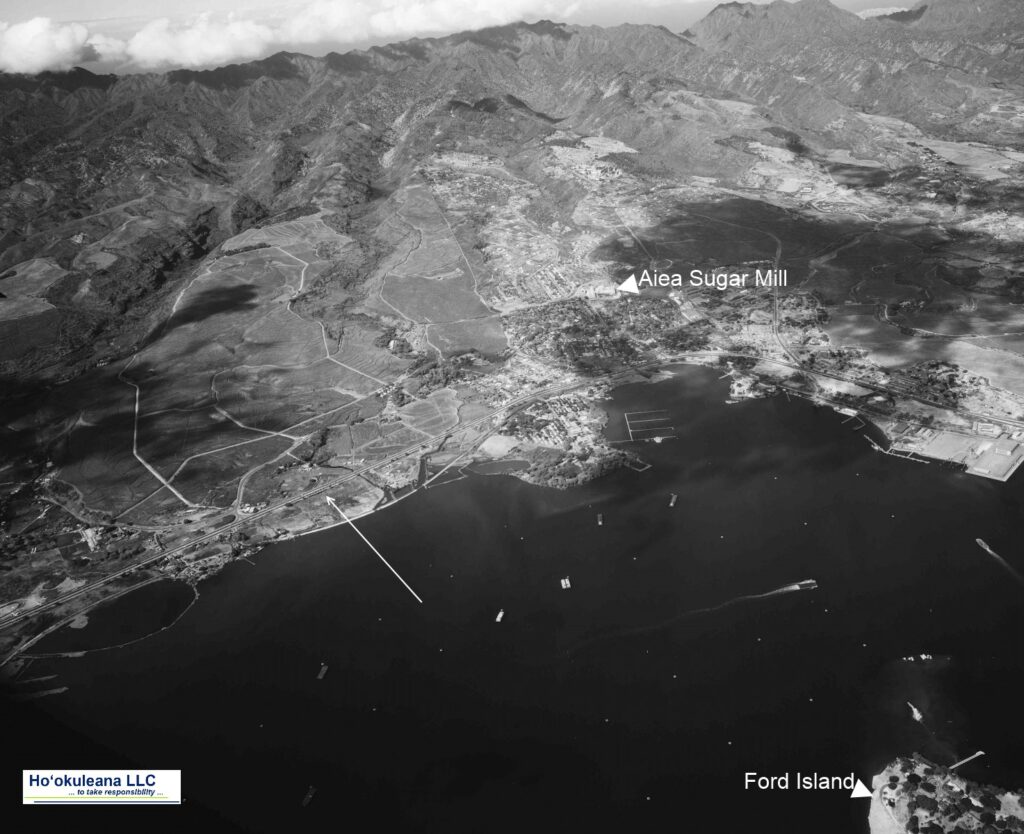
Kāʻeo was successful after some initial skirmishes.  On December 12, 1794, a great battle was fought in the area between Kalauao and ‘Aiea in ‘Ewa.  Kalanikūpule’s forces surrounded Kāʻeo.  (Cultural Surveys)

Kāʻeo with six of his men escaped into a ravine below ‘Aiea and might have disappeared there had not the red of his feather cloak been seen from the boats at sea and there shots drawn the attention of those on land. Hemmed in from above, he was killed fighting bravely.  (Kamakau)

This war, called Kukiʻiahu, was fought from November 16 to December 12, 1794 at Kalauao in ‘Ewa.  (Kamakau)  (It wasn’t long after that Kalanikūpule battled Kamehameha, again; and lost to Kamehameha at the Battle of Nuʻuanu.)

Kalauao Ahupua‘a (the multitude of clouds) extends from the East Loch of Pearl Harbor to the crest of the Koʻolau Range, generally following Kalauao Stream. Kalauao Spring is located near the Pearl Harbor coast.

The Kalauao Spring included two natural springs of percolating water.  In ancient times, the springs irrigated taro loʻi.  Later, the ancient taro lo‘i and ʻauwai (irrigation ditches) were modified and expanded to support rice cultivation.

In 1904, the area was described as, “On the morning of June 2nd, for instance, our destination was Aiea. At ten minutes past seven we boarded the first passenger train going towards Honolulu.”

“For a distance of eight miles the road skirts the shore and then turns landwards or mauka through rice and sugar plantations, Ewa Mill, Waipahu, Pearl City. …”

“Like all rice fields in Hawaii, this one is worked entirely by Chinamen, they alone being able to endure the conditions of location and climate necessary for the cultivation of this cereal.”

“On one side of the railroad track was the broad, muddy inland lake or bay of salt water, Pearl Harbor; on the other side were the terraced plots or fields, flooded to a depth of several inches with water and separated by narrow raised earthen ridges on which the careful Chinaman doubtless succeeded in walking, but which many times proved treacherous to our unsteady feet.”

“A rice plantation, laid out as it generally is on the low flats at the foot of a valley, where mountain streams empty into the sea, is an ideal collecting ground for certain kinds of algae.”  (Thrum 1904)

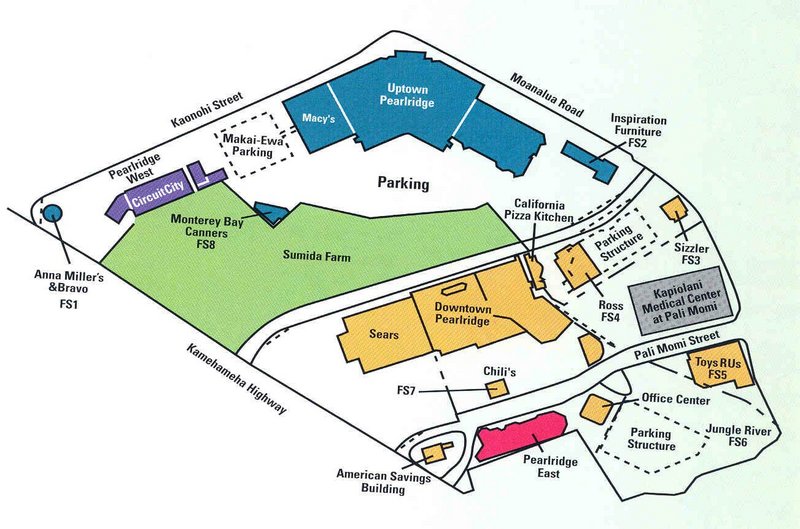
In 1928, Moriichi and Makiyo Sumida began farming assorted wetland produce on a two-acre plot of land at the springs.  Back then, the area of the springs contained many small farms growing similar produce — bananas, taro, rice, and watercress. Through the ensuing years, the Sumida property grew as they acquired neighboring leases and, by 1950, watercress became the sole crop.  (NPS)

A small waterfall along Kalauao Stream, named Kahuawai (or Kahuewai), was located along the coastal trail connecting Honolulu to Waiʻanae.  Kahuawai (water gourd container) was indicated to have been “a favorite resting place exclusively for chiefs”.  (Cultural Surveys)

Kahuawai was a noted bathing place since ancient times and was guarded so that any one did not bathe in it except the chiefs. Later it was used by all. Kākuhihewa’s daughters and the hero Kalelealuaka (their husband) bathed in this pool. Kāʻeokūlani, the chief of Kauaʻi also bathed here when he came to war here on Oʻahu.  (Cultural Surveys)

Loko Opu, a large fishpond (approximately 10.5-acres in size) located in Kalauao along the Pearl Harbor coast, is said to have been built by the chiefess Kalamanuʻia.  (Cultural Surveys)

During the Māhele, much of the lands in the ahupua‘a of ‘Ewa, as in other districts, were awarded to Ali‘i Nui (high chiefs), who were either the grandchildren or great-grandchildren of Kamehameha I.

Half of the ahupua‘a of Kalauao was awarded to Laura Konia (either granddaughter or grandniece of Kamehameha I;) the other half of Kalauao Ahupua‘a was awarded to John Meek, an important merchant in the sandalwood trade.

Today, the Pearl Country Club covers much of the lower section of Kalauao.   Pearlridge Shopping Center is on the lowest side of Kalauao (Pearlridge Uptown was opened in 1972, with an expansion in 1976 to include Pearlridge Downtown.)  Pearlridge surrounds the evidence of the water resources of old, Kalauao Spring that benefits the Sumida watercress farm.

© 2022 Hoʻokuleana LLC

Filed Under: Place Names Tagged With: Oahu, Kalanikupule, Ahupuaa, Kaeo, Ewa, Sumida Watercress, Kalauao, Pearlridge, Hawaii

  • 1
  • 2
  • 3
  • Next Page »

Images of Old Hawaiʻi

People, places, and events in Hawaiʻi’s past come alive through text and media in “Images of Old Hawaiʻi.” These posts are informal historic summaries presented for personal, non-commercial, and educational purposes.

Info@Hookuleana.com

Connect with Us

  • Email
  • Facebook
  • LinkedIn
  • Twitter
  • YouTube

Recent Posts

  • Ahahui Hoʻoulu a Hoʻola Lahui
  • Hōkūle‘a Was An Official US Bicentennial Project
  • About 250 Years Ago … E Pluribus Unum – ‘Out of Many, One’
  • 250-Years Ago … Declaration of Independence
  • 250 Years Ago … Comparing American & Hawaiian ‘Declarations’ … and War
  • Waikiki Beach
  • Cats and Dogs

Categories

  • General
  • Ali'i / Chiefs / Governance
  • Buildings
  • Missionaries / Churches / Religious Buildings
  • Hawaiian Traditions
  • Military
  • Place Names
  • Prominent People
  • Schools
  • Sailing, Shipping & Shipwrecks
  • Economy
  • Voyage of the Thaddeus
  • Mayflower Summaries
  • American Revolution

Tags

Albatross Al Capone Ane Keohokalole Archibald Campbell Bernice Pauahi Bishop Charles Reed Bishop Downtown Honolulu Eruption Founder's Day George Patton Great Wall of Kuakini Green Sea Turtle Hawaii Hawaii Island Hermes Hilo Holoikauaua Honolulu Isaac Davis James Robinson Kamae Kamaeokalani Kameeiamoku Kamehameha Schools Lalani Village Lava Flow Lelia Byrd Liberty Ship Liliuokalani Mao Math Mauna Loa Midway Monk Seal Northwestern Hawaiian Islands Oahu Papahanaumokuakea Marine National Monument Pearl Pualani Mossman Quartette Thomas Jaggar Volcano Waikiki Wake Wisdom

Hoʻokuleana LLC

Hoʻokuleana LLC is a Planning and Consulting firm assisting property owners with Land Use Planning efforts, including Environmental Review, Entitlement Process, Permitting, Community Outreach, etc. We are uniquely positioned to assist you in a variety of needs.

Info@Hookuleana.com

Copyright © 2012-2024 Peter T Young, Hoʻokuleana LLC

Loading Comments...