Images of Old Hawaiʻi

  • Home
  • About
  • Categories
    • Ali’i / Chiefs / Governance
    • American Protestant Mission
    • Buildings
    • Collections
    • Economy
    • Missionaries / Churches / Religious Buildings
    • General
    • Hawaiian Traditions
    • Other Summaries
    • Mayflower Summaries
    • Mayflower Full Summaries
    • Military
    • Place Names
    • Prominent People
    • Schools
    • Sailing, Shipping & Shipwrecks
    • Voyage of the Thaddeus
  • Collections
  • Contact
  • Follow

March 23, 2022 by Peter T Young Leave a Comment

Coaling Station

Prior to the early-1900s, most vessels were powered by sail; the absence of a fuel to move was a major factor in the flexibility of fleets. And, the carrying capacity of the sailing ship made it an indispensable element in its own logistic support.

For centuries, the most critical item of supply was water, which sailing ships found difficult to carry in sufficient quantities and to keep drinkable for long voyages. Food was somewhat less of a problem, except for its poor quality in the days before refrigeration, the sealed container and sterilization. (britannica)

The advent of steam propulsion resulted in faster and more direct travel for ships (in the early years, ships with steam engines still sailed, and used the engines only as auxiliary power – coal was burned to produce the steam to power the engines.)

The gain in control of where you were going (without reliance/variation in the wind) was a significant improvement for the long haul. But, for a time, the inordinate amount of space that had to be allocated to carry coal seriously inhibited the usefulness of early warships.

Steam warships were slow to catch on, but by the late-1850s, all new warships built by the Navy featured steam engines. The engines did not make the ships dramatically faster, and many steam ships continued to use sails preserve fuel on long trips. These ships looked and functioned much like ships from the age of sail except for the tell-tale smokestack rising above their decks. (Bailey)

The replacement of sailing ships with steam led to a requirement for fuel to be widely available. Ultimately, this produced the need for numerous coaling stations – places where the ships replenished/refueled their supply of coal.

Noting the need for a refueling site in the Pacific, Captain AT Mahan noted, “To any one viewing a map that shows the full extent of the Pacific Ocean, with its shores on either side, two circumstances will be strikingly and immediately apparent. He will see at a glance that the Sandwich Islands stand by themselves in a state of comparative isolation, amid a vast expanse of sea”.

“From San Francisco to Honolulu, 2,100 miles easy steaming distance, is substantially the same as from Honolulu to the Gilbert, Marshall, Samoan, Society, and Marquesas groups (the nearest inhabited islands,) all under European control”.

“Too much stress cannot be laid upon the immense disadvantages to us of any maritime enemy having a coaling station well within 2,500 miles of every point of our coast line from Puget Sound to Mexico. Were there many others available we might find it difficult to exclude from all. There is, however, but the one.”

“Shut out from the Sandwich Islands as a coal base, an enemy is thrown back for supplies of fuel to distances of 3,500 or 4,000 miles – or between 7,000 and 8,000, going and coming – an impediment to sustained maritime operations well nigh prohibitive.”

“It is rarely that so important a factor in the attack or defence of a coast line – of a sea frontier – is concentrated in a single position, and the circumstance renders it doubly imperative upon us to secure it, if we righteously can.”

In the 1860s, a coaling station was established in Honolulu to refuel coal burning American ships. US warships followed a policy of cruising the Hawaiian Islands starting in 1866, and rented a coaling station for them. (globalsecurity)

The lease of land for the coaling station was the first regular US Navy shore-side presence in the Hawaiian Islands. This station practically fell into disuse shortly after it was built due to the policy that required warships to use sail power wherever possible. (navy-mil)

Then, in 1873, Secretary of War, William W Belknap, issued confidential instructions to investigate the defensive capabilities of Honolulu to Major-General John McAlister Schofield (the Barracks up the hill from Pearl Harbor were later named for him (1908)) and Lieutenant-Colonel Barton S Alexander. (Young)

General Schofield reported: “The Hawaiian Islands constitute the only natural outpost to the defenses of the Pacific Coast. In possession of a foreign naval power, in time of war, as a depot from which to fit out hostile expeditions against this coast and our commerce on the Pacific Ocean, they would afford the means of incalculable injury to the United States.”

“With one exception there is no harbor on the islands that can be made to satisfy all the conditions necessary for a harbor of refuge in time of war. This is the harbor of ʻEwa, or Pearl River. … If the coral barrier were removed, Pearl River Harbor would seem to have all, or nearly all, the necessary properties to enable it to be converted into a good harbor of refuge.”

“It is to be observed that if the United States are ever to have a harbor of refuge and naval station in the Hawaiian islands in the event of war, the harbor must be prepared in advance by the removal of the Pearl river bar. When war has begun it will be too late to make this harbor available, there is no other suitable harbor on these islands.”

As a means of solidifying a site in the central Pacific, the US negotiated an amendment to the Treaty of Reciprocity in 1887. King Kalākaua, in his speech before the opening session of the 1887 Hawaiian Legislature, stated (November 3, 1887:)

“His Majesty the King of the Hawaiian Islands, grants to the Government of the US the exclusive right to enter the harbor of Pearl River, in the Island of Oʻahu, and to establish and maintain there a coaling and repair station for the use of vessels of the US and to that end the US may improve the entrance to said harbor and do all things useful to the purpose aforesaid.”

Ten years later, “Secretary Long has sent to Congress a report of the project for the establishment of a naval coaling and repairing station at Pearl Harbor, Hawaiʻi, submitted by Rear Admiral Miller, commander-in-chief of the Pacific naval station.”

“As a result of the surveys and examination Admiral Kirkland reported that … the Government should acquire possession of the whole of the Waipiʻo Peninsula, comprising 800-acres of land, if a station is to be located at Pearl Harbor.”

“Secretary Long recommend(ed) that Beckoning Point be selected as a site for the contemplated station, on account of its proximity to East Loch, which has the largest anchorage, as drydocks may be easily built, and as there is ample room for space to dock and undock vessels of any size.” (Sacramento Daily Union, April 2, 1898)

In May, 1899, a coaling station with a capacity of 1,000-tons was established and plans involved increasing that capacity 20-fold. Six months later the Naval Station, Honolulu, was established.

As an example of the coal demand for ships, the battleship USS Massachusetts burned 8-12 tons of coal per hour at full power. In order to fully stock for a deployment at sea, a warship would load thousands of tons of coal on board ship, all of it moved by hand. (Colamaria)

The US Navy dredged the first deep-draft channel into its coaling station at Pearl Harbor in 1903, and suddenly the US had a strategically important naval station in the middle of the Pacific Ocean. (Sanburn) On May 28, 1903, the first battleship, USS Wisconsin, entered the harbor for coal and water. (navy-mil)

The next decade saw steady and continuous growth. On September 23, 1912 Pearl Harbor was closed to all foreign commercial shipping, and foreign warships might enter only by special permission. (Young)

The post-World War I period was characterized by irregular growth of the Naval Operating Base. Appropriations tended to diminish with the economies of the twenties. In 1921, the Naval Station in Honolulu was forced to close because of insufficient funds. Although the Secretary of the Navy referred to Hawaiʻi as the “Crossroads of the Pacific,” nothing was being done to take advantage of its position. (navy-mil)

Networks of coaling stations were established, effectively extending the range of warships; however, the era of the steam warship powered exclusively by coal was relatively brief-lasting from 1871 until 1914.

Fuel oil was the emerging fuel technology. In the early-1900s oil refining procedures had been standardized to the point that fuel oil (bunker oil) was now a better option to feed the fires that powered the ships (plus, the bunker oil took up less storage room on the ships.) (Scott)

The USS Texas, commissioned in 1914, was the last American battleship built with coal-fired boilers. It converted to burn fuel oil in 1925 – resulting in a dramatic improvement in efficiency. By 1916, the Navy had commissioned its first two capital ships with oil-fired boilers, the USS Nevada and the USS Oklahoma.

To resupply them, “oilers” were designed to transfer fuel while at anchor, although underway replenishment was possible in fair seas. During World War I, a single oiler refueled 34 destroyers in the mid-Atlantic – introducing a new era in maritime logistics. (American Oil & Gas Historical Society)

Wartime needs called for more expansion to the Pearl Harbor base facilities. Construction began on a fourth large drydock at the location of the old Coaling Station; these went into service in 1944.

© 2021 Hoʻokuleana LLC


Filed Under: Military Tagged With: Hawaii, Oahu, Kalakaua, King Kalakaua, Pearl Harbor, Coaling Station, Schofield Barracks, John Schofield

December 29, 2021 by Peter T Young 2 Comments

Transit of Venus

Transit of Venus

Interest in the heavens goes back far into the ancient fabric of Polynesian culture. Many of the early Polynesian gods derived from or dwelt in the heavens, and many of the legendary exploits took place among the heavenly bodies.

Early Polynesians, who trusted their navigational instincts and skills to the nighttime stars above, currents, winds and waves, sailed thousands of miles over open ocean across the Pacific to Hawai‘i.

They had names for their star guides: Ka Maka – the point of the fishhook in the constellation Scorpius; Makali‘i – the Little Eyes within the Pleiades; Hoku‘ula – The Red Star in the constellation Taurus; and Hokupa‘a – the North Star (fixed star,) as well as others.

After the Polynesians came, in 1778, the Europeans, under the command of Captain James Cook, arrived. He brought with him spyglasses, clocks, sextants, charts, foreign ideas and techniques – new tools of navigation.

A new awareness of the skies was reborn under the scientific patronage of King David Kalākaua, (Kalākaua reigned over the Kingdom of Hawai‘i from 1874 to 1891.)

Kalākaua had a great interest in science and he saw it as a way to foster Hawai‘i’s prestige, internationally.

The opportunity to demonstrate this interest and support for astronomy was made available with the astronomical phenomenon called the “Transit of Venus,” which was visible in Hawai‘i in 1874.

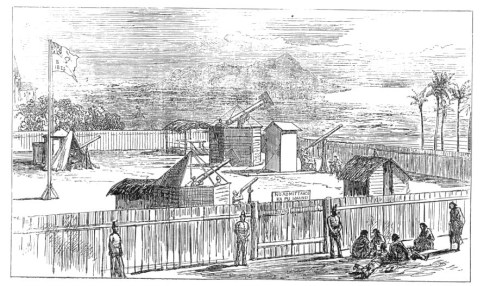
The King allowed the British Royal Society’s expedition a suitable piece of open land for their viewing area; it was not far from Honolulu’s waterfront in a district called Apua (mauka of today’s Waterfront Plaza.)

They built a wooden fence enclosure and soon a well-equipped nineteenth-century astronomical observatory took shape, including a transit instrument, a photoheliograph, a number of telescopes and several temporary structures including wooden observatories.

Subsequently, auxiliary stations – though not so elaborate as the main station in Honolulu – were established in two other island locations: one at Kailua-Kona and the other at Waimea, Kauai.

In addition, Hawai‘i was not the only site to observe the transit; under the British program, observations were also made in Egypt, Island of Rodriquez, Kerguelen Island and New Zealand. (Other countries also conducted Transit observations.)

On Dec. 8, 1874, the transit was observed by the British scientists; however, the observation at Kailua-Kona was marred by clouds. But the Honolulu and Waimea sites were considered perfect throughout the event, which lasted a little over half a day.

After the Transit of Venus observations, Kalākaua showed continued interest in astronomy, and in a letter to Captain RS Floyd on November 22, 1880, he expressed a desire to see an observatory established in Hawai‘i. He later visited Lick Observatory in San Jose.

It was not long after this that a telescope was purchased from England in 1883 and set up at Punahou School.

In 1884, the five-inch refractor was installed in a dome constructed above Pauahi Hall on the school’s campus (the first permanent telescope in Hawai‘i.)

In 1956, this telescope was installed in Punahou’s newly completed MacNeil Observatory and Science Center. (Unfortunately, it is not known where that telescope is today.

Why was the Transit of Venus important?

Although Copernicus had, by the 16th century, put the known planets in their correct order, their absolute distances remained unknown. Astronomers still needed a celestial yardstick of “Astronomical Units” with which to measure distances among the planets and to link the planets to the stars beyond.

The mission of the British expedition was to observe a rare transit of Venus across the Sun for the purpose of better determining the value of the Astronomical Unit – that is, the Earth-to-Sun distance – and from it, the absolute scale of the solar system.

The orbits of Mercury and Venus lie inside Earth’s orbit, so they are the only planets which can pass between Earth and Sun to produce a transit (a transit is the passage of a planet across the Sun’s bright disk.) Transits are very rare astronomical events; in the case of Venus, there are on average two transits every one and a quarter centuries.

Ironically, on December 8, 1874 the big day, the king was absent, being in Washington to promote Hawaiian interests in a new trade agreement with the United States.

When American astronomer Simon Newcomb combined the 18th century data with those from the 1874/1882 Venus transits, he derived an Earth-sun distance of 149.59 +/- 0.31 million kilometers (about 93-million miles), very close to the results found with modern space technology in the 20th century.

© 2021 Hoʻokuleana LLC

Observation_Huts_in_Honolulu-(copyright-RoyalObservatoryGreenwich)-1874
Testing_in_advance_of_the_Transit-Honolulu-(copyright-RoyalObservatoryGreenwich)-1874
George-Forbes-leader_of_Transit_of_Venus-Honolulu-University-of-Strathclyde-1874
Leader_of_Transit_of_Venus-Honolulu-at_telescope-1874
Transit of Venus-Honolulu-(IfA-Hawaii-edu)
Transit of Venus-Honolulu-Honolulu-Apua-Map-1874
Transit of Venus-Waimea-Kauai-Map-1874
Kauai-Transit_of_Venus_Monument-1874-(thegardenisland-com)
Transit of Venus Plaque-Hulihee_Palace
Transit of Venus Survey Marker-Hulihee_Palace-(KonaSkies)
Transit of Venus-Location-at-Hulihee_Palace-(KonaSkies)

Filed Under: General, Ali'i / Chiefs / Governance Tagged With: Transit of Venus, Kailua-Kona, Hawaii, Kalakaua, Kauai, Hulihee Palace

October 20, 2021 by Peter T Young 1 Comment

Capital Punishment

Pā‘ao (ca 1300,) from Kahiki (Tahiti,) is reported to have introduced (or significantly expanded) a religious and political code in old Hawai‘i, collectively called the kapu system.

The kapu system was the common structure, the rule of order, and religious and political code.  This social and political structure gave leaders absolute rule and authority.   This forbid many things and demanded many more, with many infractions being punishable by death.

Shortly after the death of Kamehameha I in 1819, King Kamehameha II (Liholiho) declared an end to the kapu system.  In a dramatic and highly symbolic event, Kamehameha II ate and drank with women, thereby breaking the important eating kapu.

This changed the course of the civilization and ended the kapu system, effectively weakened belief in the power of the gods and the inevitability of divine punishment for those who opposed them.  The end of the kapu system by Liholiho happened before the arrival of the missionaries; it made way for the transformation to Christianity and westernization.

While Liholiho’s brother Kauikeaouli (Kamehameha III) ruled as monarch (with shared authority with the Kuhina Nui,) he, too, took bold steps in changing the structure of governance.  Kamehameha III initiated and implemented Hawaiʻi’s first constitution (1840) (one of five constitutions governing the Islands – and then, later, governance as part of the United States.)

Included were also published “penal laws,” which outlined classes of offenses and punishments for the same – with the death penalty being allowed for acts of murder.

“Many foreigners had predicted that whenever it became necessary to enforce the Penal Laws this enacted and promulgated, leniency would be shown towards chiefs of high rank.”  (Bennet)

Then, there was enforcement and execution of the new laws on someone of rank, Kamanawa II (his father was High Chief Kepoʻokalani.)

Kamanawa, born during the days of the ancient customs with an unstructured approach to marriage, had found it difficult to live according to the increasingly Christian ways of his peers. When “one-to-one” marriage had been declared the law by royal order, his roving habits were not changed, and whenever he was attracted to a new love he followed his old ways. Kamokuiki (his wife,) adhering to the new faith, had little sympathy with his wanderings and finally went to the chiefs seeking a divorce.  (Gutmanis)

As early as 1825, the chiefs in various districts had issued edicts of law that, following Christian teachings, included prohibitions against adultery and the biblical relief of divorce and the right to remarry given the injured party. And so it was with Kamokuiki whose divorce, dated August 16, 1840, stated: because Kamanawa has repeatedly committed adultery, his wife Kamokuiki has requested a separation.  (Gutmanis)

There is no record of how Kamanawa received the decree, but six weeks later on September 26, 1840 Kamokuiki was dead. Murder being instantly suspected, an autopsy was performed and the stomach found to be “much inflamed while every thing else was in order.”  (Gutmanis)

Kamanawa and his friend Lonopuakau, captain of the Hawaiian vessel Hooikaika, confessed that Kamanawa had administered the fatal dose and that the Captain had prepared the mixture of ʻakia, ʻauhuhu and ʻawa that caused Kamokuiki’s death.

“She survived but three hours, medical assistance being of no avail. As soon as she was dead, which was about midnight, the news immediately spread and a terrible wailing commenced, which was quickly born to the other side of the island. It was so loud, so prolonged and so sudden as to awake at once almost all the residents, and at that hour, as its sepulchral cadences rose and fell, and were lost in the distance, the effect was startling and mournful in the extreme.”   (Hawaiian Gazette, October 12, 1894)

Justice was swift; on September 30, 1840, a jury of 12 chiefs was empaneled to try Kamanawa and Lonopuakau.

On “Wednesday morning a court was held at the Fort, for the trial of Kamanawa and Lono, captain of the schooner Hooikaika, for the murder of Kamokuiki, wife of the former.  Governor Kekūanāoʻa was the presiding Judge, the King and high chiefs being present.”  (The Polynesian, October 3, 1840)

“The court being organized, the trial commenced, when the following facts were developed: The first-mentioned person, it appears, had been divorced from his wife for some time past, but could not marry again while she was living: Having conceived a violent passion for another woman, he determined to rid himself of his wife, and applied to Lono, who was said to be skilled in preparing poisons. Lono also wishing to destroy his wife, the two agreed to poison both”.  (The Polynesian, October 3, 1840)

The jury found the two guilty and sentenced to hang on October 20th.

On the October 24, The Polynesian carried a short item that succinctly summed up the execution of the sentencing: “The murderers Kamanawa and Lonopuakau expiated their crime on the scaffold on Tuesday last, at the Fort in the presence of a large concourse of people.”

The site of the execution was over the gate of Fort Kekuanohu (Fort Honolulu – that once stood at the bottom of Fort Street;) the gallows was erected above the gate, so it could be easily seen for some distance.

After the hanging, either one or both of the bodies were buried at the cross-roads, in accordance with the old English custom of burying executed criminals where they would be out of the way, and the burial places be forever unknown. It is believed that the cross roads selected were at the junction of King and Punchbowl or Queen and Punchbowl streets.

I should note – Kamanawa II was no ‘ordinary’ ranking chief.

He was the grandson of Kameʻeiamoku, one of the ‘royal twins’ (uncles of Kamehameha the Great and his counselors in the wars to unite the Islands.) He was named after his famous grand uncle, the other royal twin.  (The twins are on Hawaiʻi’s Royal Coat of Arms; Kameʻeiamoku is on the right holding a kahili and Kamanawa on the left holding a spear.)

Oh, one more thing … Kamanawa II and Kamokuiki were parents of Caesar Kapaʻakea.  In 1835, Caesar married the High Chiefess Analeʻa Keohokālole; they had several children.

Most notable were a son, who on February 13, 1874 became King Kalākaua, and a daughter, who on January 29, 1891 became Queen Liliʻuokalani (they were grandchildren of Kamanawa II, the first to be charged and hanged under Hawaiʻi’s first modern criminal laws.)

It is said that after Kalākaua came to the throne, he had the body of Kamanawa taken up and the bones removed to Mauna Ala in Nuʻuanu. This is positively stated by the natives.  (Hawaiian Gazette, October 12, 1894)  Kamokuiki was buried at Kawaiahaʻo Church.

© 2021 Hoʻokuleana LLC


Filed Under: Hawaiian Traditions, Ali'i / Chiefs / Governance Tagged With: Paao, Hawaii, Kauikeaouli, Kameeiamoku, Kamehameha III, Liliuokalani, Kamokuiki, Kamanawa, Kalakaua, Kapaakea, Keohokalole, Kapu, Fort Kekuanohu, Hawaiian Constitution

April 8, 2020 by Peter T Young 2 Comments

Freemasonry in Hawai‘i

Freemasonry, with its commitment to interdenominational and international fellowship, originated in the British Isles. The secret society emerged from the medieval guilds of stonemasons in Britain and Europe that set standards, protected workers’ rights and provided other benefits.

Though only Scottish and English associations can be connected to the modern Masonic fraternity, similar craft guilds and companies existed across Europe, playing an important role in the construction of abbeys, cathedrals and castles.

Masons’ tools such as the level, square and compass served to underline the fraternity’s values: equality, honesty, spirituality. Freemasonry spread like wildfire throughout Europe and America during the eighteenth century.

Hawai‘i was first visited by Freemasons as early as the early-1790s, with the visit of George Vancouver. In addition other lesser known Freemasons (mariners, merchants and professionals) visited the Islands.

Oddly enough, it was a French mariner who introduced this British cultural export into Hawai‘i at a time when the Union Jack flew over the kingdom’s capital.

On April 8, 1843, during the reign of King Kamehameha III (Kauikeaouli,) Freemasonry was formally established in Hawai‘i by Joseph Marie Le Tellier, Captain of the French whaling barque “Ajax” when he warranted Lodge Le Progres de l’Oceanie No. 124, of the Ancient and Accepted Scottish Rite of the Supreme Council of France.

This was the first Masonic Lodge to be instituted in the Sandwich Islands (as Hawai‘i was referenced at that time) and is quite likely the first Lodge to be founded in the Pacific and West of the Rocky Mountains.

With it, Freemasonry became firmly established in the Sandwich Islands. In Honolulu, the original lodge members were European and American mariners, shopkeepers and farmers.

Membership in Masonic lodges has always served to facilitate business contacts, as well as social ones. By the late-1840s there were about thirty-five merchants and storekeepers in Honolulu, of whom about one third were Masons. Similar ratios existed for the other 150 skilled “mechanics” and professionals in town.

Hawaiian Royalty soon looked to membership. The association between Freemasonry and the Hawaiian Monarchy started with Prince Lot when he was raised in Hawaiian Lodge in 1853, and became the first Native Hawaiian to become a Freemason (he later became Kamehameha V.)

Prince Lot was followed into the fraternity by his younger brother Prince Alexander Liholiho, who later became Kamehameha IV, and was the Master of Lodge le Progres de l’Oceanie in 1859, 1861 and 1862.

In June 1853, Foreign Minister Robert Crichton Wyllie sent the lodge a request from King Kamehameha III that the reigning monarch be initiated “into our ancient and benevolent order.” Apparently, the lodge did not take the opportunity to enroll King Kamehameha III.

In July 1860, the ground breaking for Queen’s Hospital included a traditional Masonic cornerstone laying ceremony attended by thousands and presided over by the young monarch.

Later, in 1879, King Kalākaua (one of the most active members of the Craft in the Island Kingdom,) conducted a grand Masonic ceremony at the site of the new ‘Iolani Palace, using Masonic silver working tools specially crafted for the occasion.

Other public buildings dedicated under Masonic rites were Ali‘iolani Hale (now home to Hawai‘i’s Supreme Court) and Lunalilo Home.

Other notable Masons of that time included John Dominis (husband of Queen Lili’uokalani,) Archibald Cleghorn (Governor of O‘ahu,) Prince William Pitt Leleiohoku (younger brother of King Kalākaua) and Prince David Kawananakoa.

During the first decades of Masonic activity in the Islands, Americans constituted 40 percent to 50 percent of all members, and Scots, Irish and English together constituted another 30 percent.

Native Hawaiians, on the other hand, comprised no more than 5 to 10 percent of the fraternity, but because they were frequently royalty or important governmental officials, they were highly conspicuous.

In 1852, Hawaiian Lodge was chartered by the Grand Lodge of California and all Hawaiʻi lodges became part of that grand lodge from 1902 until 1989, when the Grand Lodge of Hawaiʻi was established.

After 137 years to the month (when the Hawaiian Lodge was chartered,) May 5, 1852 – May 20, 1989, of being a part of the California Jurisdiction, Hawai‘i established its own regular Grand Lodge.

On May 20, 1989, the twelve Masonic Lodges of Hawaiʻi instituted The Most Worshipful Grand Lodge of Free and Accepted Masons of the State of Hawai‘i.

The Grand Lodge of Hawai‘i is the smallest and youngest of American jurisdictions, consisting of eleven constituent lodges and about 1,700 members. Over the years, its members have included three kings, four governors and six chief justices of the Hawaiʻi Supreme Court.

Follow Peter T Young on Facebook 

Follow Peter T Young on Google+ 

Follow Peter T Young on LinkedIn  

Follow Peter T Young on Blogger

© 2020 Hoʻokuleana LLC

  • OLYMPUS DIGITAL CAMERA

Filed Under: General, Ali'i / Chiefs / Governance, Prominent People Tagged With: Alexander Liholiho, Freemasons, Leleiohoku, Cleghorn, John Dominis, Kawananakoa, Hawaii, Kalakaua, Lot Kapuaiwa

April 1, 2020 by Peter T Young Leave a Comment

Kaumakapili Church

From its first thatched-roof adobe structure erected in 1839 on the corner of Smith and Beretania Streets, to its present day structure built in 1910, the people of Kaumakapili have survived Hawaiʻi’s most turbulent times.

Starting in 1837, “the common Hawaiian folk of Honolulu” started petitioning Rev. Hiram Bingham, head of the Hawaiian Mission, to establish a second church or mission in Honolulu (Kawaiahaʻo being the first).

Governor Kekuanaoa “begged to express his manao that it should be in the village” (Honolulu); specifically, in the district of Kaumakapili where 12,000 to 13,000 people lived.  (The Friend)

They requested that the Rev. Lowell Smith be their pastor.  The 1837 annual ʻAha Paeʻaina (the annual meeting and gathering of the churches and ministers) granted their request.

The Reverend Lowell Smith and wife, Abigail Tenny Smith, arrived in Honolulu in 1833, as members of the Sixth Company. (Reverend Smith served as the first minister of Kaumakapili Church until his retirement in 1869.)

Chief Abner Pākī and wife, Konia, granted the lot on the corner of Smith and Beretania Streets for this mission – the area then known as Kaumakapili.  Pākī and Konia were parents of Bernice Pauahi Bishop, founder of the Kamehameha Schools.

On April 1, 1838, the first Sabbath of the month, the Rev. Hiram Bingham assisted Rev. Lowell Smith in organizing the church, “twenty-two persons were received by letter from Kawaiahao church two from Ewa and one from Kauai and forty-nine were received on profession of faith.”  (Smith)  This was the commencement of Kaumakapili Church.

“In early days the church was spoken of as “Smith’s Church.”  Moreover it was long thought of as the church of the common people, as distinguished from Kawaiahaʻo, known as the Chiefs’ Church.”  (The Friend)

The first Church building was constructed of adobe with a thatched pili roof and was large enough to accommodate 2,500 people.  On August 29, 1839 the church building was dedicated.

In 1865, as King Kamehameha V was nearing death, he asked High Chiefess Bernice Pauahi to be his successor, but she refused.  According to law, an election was held and Kaumakapili was used as Honolulu’s town hall during this and many future political crises.

The adobe building was torn down in 1881 to make way for a new brick edifice.

King Kalākaua took great interest in the church and wanted an imposing church structure with two steeples.  His argument was, “…that as a man has two arms, two eyes, two ears, two legs, therefore, a church ought to have two steeples.”

The cornerstone for the new church was laid on September 2, 1881 by Princess Liliʻuokalani (on her birthday.)  Seven years later the new building was completed.

It was an imposing landmark, first of its kind, and visible to arriving vessels and land travelers.  It was dedicated on Sunday, June 10, 1888.

This church played an ironic role during Kalākaua’s reign.

The Honolulu citizens held a meeting in this building protesting Kalākaua’s capriciousness and appointment of an Italian-American adventurer named Moreno as his Minister of Foreign Affairs and the appointment of a new cabinet, whose “grotesque unfitness” caused the people to be up in arms.  The result was the dismissal of Moreno four days after his appointment.

In January, 1900, disaster struck.  The presence of bubonic plague in the Chinatown area caused the health authorities to take drastic measures by burning sections of Chinatown.  Sparks fell on the wooden steeples and fire engulfed the entire building leaving only the brick walls standing.

Honolulu’s landscape was changing, so the old site at Smith and Beretania Streets was sold and a new one bought at the corner of King and the then Simerson (now Pālama) Streets in Pālama.   Services were held in a temporary small wooden chapel on Austin Lane, behind the old Palama Fire Station.

Here, for the next 10 years, the church developed its ministry with a strong emphasis on Sunday School ministering; particularly to the girls from the old Reform School that was situated on the site of the present Kaʻiulani Elementary School.

During these years and the years to follow Rev. Poepoe fostered the idea of enlisting young Hawaiian men into the Christian ministry.  This time of Kaumakapili’s history enjoyed a very active Sunday School under several outstanding superintendents – among whom were Augustus Smith, only son of Founders Rev. Lowell and Abigail Smith, and one of their daughters, Mrs. Benjamin F. Dillingham.

On May 7, 1910, Master Harold R. Erdman, great grandson of the Rev. Lowell Smith, broke ground for the third church building.  It was dedicated on June 25, 1911, the same day in which the 89th Annual Conference of the Hawaiian Evangelical Association (ʻAha Paeʻaina) was hosted by the church.

On the day of dedication of the original two stained glass windows, the great grandson of Rev. Lowell Smith, Lowell S. Dillingham, was baptized on September 13, 1912.

The Gothic Revival-style church is the most prominent feature of the urban Kalihi-Palama neighborhood. The bell tower steeple stands 96 feet above the surrounding properties. The campus features an expanse of grass lawn at the front of the building bordered by two paved parking lots and is surrounded by a low dressed-basalt wall with piers at the walk and driveway openings.

In the late twenties and early fifties, Kaumakapili was known as the “Queen of the Hawaiian Churches for she had begun missions and sister churches’ relationships as her witness to the community.” The inspiration and information on this post came primarily from kaumakapili-org and The Friend.

Follow Peter T Young on Facebook 

Follow Peter T Young on Google+ 

Follow Peter T Young on LinkedIn  

Follow Peter T Young on Blogger

© 2020 Hookuleana LLC

Kaumakapili-1stChurch-(TheFriend)
Kaumakapili-1stChurch-(kaumakapili-org)
Kaumakapili-2ndChurch-(kaumakapili-org)
River Street looking toward Punchbowl from King Street-Kaumakapili_Church-(2nd)-at right-(honoluluadvertiser)
Chinatown 6,000 Chinese-(chinatownhonolulu)-Kaumakapili_Curhc-(2nd)-in_background_right-1886
Chinatown from King and River Streets. Only the shells of Kaumakapili Church (2nd) and the fire station remain standing-1900
Kaumakapili_Church,_Honolulu_(WC)_ca._before_1899
Kaumakapili Church (2nd) in ruins after Chinatown fire of 1900
Downtown and Vicinity-Dakin-Fire Insurance- 10-Map-1891-portion
Downtown and Vicinity-Map-Over_GoogleEarth-1887-portion-noting_Kaumakapili_Church
Kaumakapili_Church-exterior-(masonarch-com)
Kaumakapili_Church (masonarch-com)
OLYMPUS DIGITAL CAMERA
Kaumakapili-3rdChurch-(kaumakapili-org)
Kaumakapili_Church-exterior
Kaumakapili_Church-(masonarch-com)
Kaumakapili_Church-pews_follow_curve_of_the_balcony-(masonarch-com)
Kaumakapili_Church-stained_glass-(masonarch-com)
Kaumakapili_Church-wooden_trusses-(masonarch-com)

Filed Under: Missionaries / Churches / Religious Buildings Tagged With: Kamehameha V, Kawaiahao Church, Paki, Chinatown, Lowell Smith, Hawaii, Kalakaua, Hiram Bingham, Kaumakapili

  • « Previous Page
  • 1
  • …
  • 6
  • 7
  • 8
  • 9
  • 10
  • …
  • 16
  • Next Page »

Images of Old Hawaiʻi

People, places, and events in Hawaiʻi’s past come alive through text and media in “Images of Old Hawaiʻi.” These posts are informal historic summaries presented for personal, non-commercial, and educational purposes.

Info@Hookuleana.com

Connect with Us

  • Email
  • Facebook
  • LinkedIn
  • Twitter
  • YouTube

Recent Posts

  • Standing Bear
  • 250 Years Ago … ‘United Colonies’ Becomes the ‘United States of America’
  • Nobuo Fujita
  • Labor Day
  • Mānoa Arboretum
  • About 250 Years Ago … First Continental Congress
  • ‘And Now I Must Pay’

Categories

  • Buildings
  • Missionaries / Churches / Religious Buildings
  • Hawaiian Traditions
  • Military
  • Place Names
  • Prominent People
  • Schools
  • Sailing, Shipping & Shipwrecks
  • Economy
  • Voyage of the Thaddeus
  • Mayflower Summaries
  • American Revolution
  • General
  • Ali'i / Chiefs / Governance

Tags

Albatross Al Capone Ane Keohokalole Archibald Campbell Bernice Pauahi Bishop Charles Reed Bishop Downtown Honolulu Eruption Founder's Day George Patton Great Wall of Kuakini Green Sea Turtle Hawaii Hawaii Island Hermes Hilo Holoikauaua Honolulu Isaac Davis James Robinson Kamae Kamaeokalani Kameeiamoku Kamehameha Schools Lalani Village Lava Flow Lelia Byrd Liberty Ship Liliuokalani Mao Math Mauna Loa Midway Monk Seal Northwestern Hawaiian Islands Oahu Papahanaumokuakea Marine National Monument Pearl Pualani Mossman Quartette Thomas Jaggar Volcano Waikiki Wake Wisdom

Hoʻokuleana LLC

Hoʻokuleana LLC is a Planning and Consulting firm assisting property owners with Land Use Planning efforts, including Environmental Review, Entitlement Process, Permitting, Community Outreach, etc. We are uniquely positioned to assist you in a variety of needs.

Info@Hookuleana.com

Copyright © 2012-2024 Peter T Young, Hoʻokuleana LLC

Loading Comments...