Images of Old Hawaiʻi

  • Home
  • About
  • Categories
    • Ali’i / Chiefs / Governance
    • American Protestant Mission
    • Buildings
    • Collections
    • Economy
    • Missionaries / Churches / Religious Buildings
    • General
    • Hawaiian Traditions
    • Other Summaries
    • Mayflower Summaries
    • Mayflower Full Summaries
    • Military
    • Place Names
    • Prominent People
    • Schools
    • Sailing, Shipping & Shipwrecks
    • Voyage of the Thaddeus
  • Collections
  • Contact
  • Follow

November 16, 2022 by Peter T Young Leave a Comment

Kolekole

From Kūkaniloko (royal birth stones near Wahiawa,) the winter solstice (December 21) occurs when the sun is aligned with Kolekole.

The Waiʻanae ahupuaʻa has an un-typical shape – it has two parts: Waiʻanae Kai, on its western side, runs from the ocean to the Waiʻanae Mountains (like a typical ahupuaʻa;) however, Waiʻanae Uka continues across Oʻahu’s central plain and extends up into the Koʻolau Mountains.

Kolekole Pass forms a low crossing point through the Waiʻanae Mountains.  A prehistoric trail crossed Kolekole pass linking Waiʻanae Uka with Waiʻanae Kai.

As a result, the trail was of strategic importance. Kolekole Pass is not far from the base of Mount Kaʻala, the highest summit on O‘ahu, an important place in Hawaiian religion, ceremony, legend and perhaps celestial observations.

When Kahekili was reigning as king of Maui, and Kahahana was king of Oʻahu, it was during this period that Kahahawai, with a number of warriors, came to make war on Oʻahu (Kahahawai was a strategist for Kahekili.)

A decisive battle in the war between Kahekili and Kahahana, fought in the Waiʻanae mountain range, took place near Kolekole Pass.

“Kahahawai told them to prepare torches. When these were ready they went one evening to the top of a hill which was near to the rendezvous of the enemies where they lighted their torches.”  (Fornander)

“After the torches were lit they moved away to a cliff called Kolekole and hid themselves there, leaving their torches burning at the former place until they died out. The enemies thought that Kahahawai and his men had gone off to sleep. They therefore made a raid … But Kahahawai and his men arose and destroyed all the people who were asleep on the hills and the mountains of Kaʻala. Thus the enemies were annihilated, none escaping.”  (Fornander)

Therefore, the conquest of Oʻahu by Kahekili was complete through the bravery and great ingenuity of Kahahawai in devising means for the destruction of the enemy.  Oʻahu remained until the reign of Kalanikūpule, Kahekili’s son – until Oʻahu was conquered by Kamehameha in 1795.

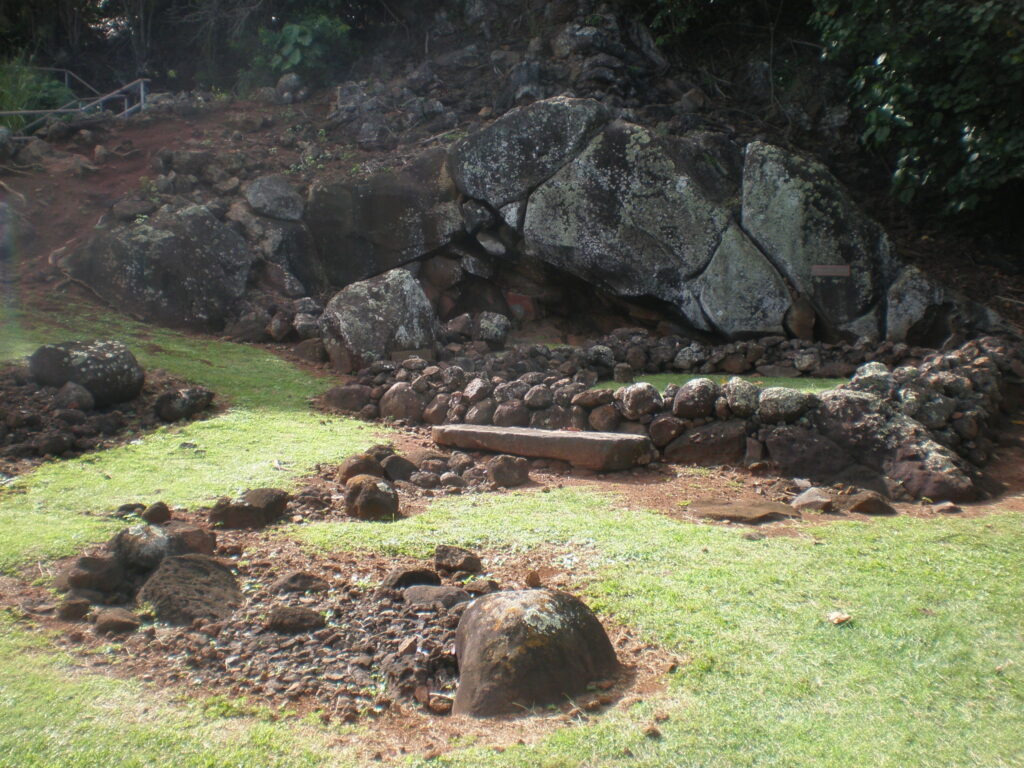
Near Kolekole Pass is the Kolekole Stone, which is described as a “sacrificial stone,” but the story that victims were decapitated over this stone may be a fairly recent rendition. Older stories suggest the stone represents the Guardian of the Pass, a woman named Kolekole.

Reportedly, Kolekole was a place where students practiced lua fighting. Students practiced their techniques on “passing victims” on the “plains of Leilehua.”  Lua was an “art” that involved dangerous hand-to-hand fighting in which the fighters broke bones, dislocated bones at the joints, and inflicted severe pain by pressing on nerve centers.

This form of fighting involved a number of skills: “first, how to grasp with the hands, second, how to prod with a kauila cane; third, how to whirl the club called the pikoi or ikoi that had one end … tied with a rope of olona fibers.”  (Na Oihana Lua Kaula 1865 – Army)

In the late-1800s, James I Dowsett had ranching interests on lands now occupied by Fort Shafter, Schofield Barracks and Wheeler Army Airfield; portions of the latter two were part of his extensive Leilehua Ranch. Cattle from George Galbraith’s Mikilua Ranch in Lualualei Valley on the Waiʻanae coast may have been herded across Kolekole Pass to pasture on Leilehua Ranch plateau lands.

With later US military use in Waiʻanae and Central Oʻahu, passage through Kolekole Pass provided a convenient short cut across the Waiʻanae Mountains between Schofield Barracks and Lualualei Naval Magazine.  The Army’s 3rd Engineers corps constructed vehicular passage in 1937.

Kolekole Pass, is located at the northern corner of the Lualualei Valley and connects the Waianae coast with Waianae Uka (the present Schofield Barracks.)

On the morning of December 7, 1941, six Japanese carriers transported torpedo planes, dive bombers and fighters to a point about 220 miles north of Oʻahu.  Launching the aircraft in two waves, the attackers achieved total surprise and wreaked havoc.

Contrary to general belief, the attacking aircraft did not come through Kolekole Pass west of Wheeler but flew straight down the island.  Most of the attacking planes approached Pearl Harbor from the south.  Some came from the north over the Koʻolau Range, where they had been hidden en route by large cumulus clouds.  (hawaii-gov)

In 1997, a 35-year-old, 35-ton white steel cross at Kolekole Pass was ordered dismantled by the Army – threatened with lawsuit, they chose removal, rather than fighting a separation of church and state claim.

The first cross at the pass was put up in the 1920s; later, a metal one was erected in 1962.  It was later replaced with an 80-foot flagpole that flew an American flag.

© 2022 Hoʻokuleana LLC


Filed Under: Ali'i / Chiefs / Governance, Military, Place Names Tagged With: Schofield Barracks, Kalanikupule, Kolekole Pass, Kahahawai, Lua, Waianae, Hawaii, Oahu, Kahahana, Kahekili

October 17, 2022 by Peter T Young Leave a Comment

Kahekili

Born at Haliʻimaile, Maui, Kahekilinui‘ahumanu (Kahekili) was the son of the high chief Kekaulike-kalani-ku‘i-hono-i-ka-moku (Kekaulike) and high chiefess Keku‘iapoiwanui-a-kalaninui-kaulele-ia-iwi.

Kalola (Kahekili’s sister and daughter of chief Kekaulike’s second wife) played an integral part in Kahekili’s reign over Maui Nui and O’ahu. Kalola, too, was a very high born ali’i.

In 1765, Kahekili inherited all of Maui Nui and O‘ahu and was appointed successor to his brother Kamehamehanui’s kingdom (not to be confused with Hawai‘i Island’s Kamehameha I.)

The power, however, that he received through this inheritance did not satisfy his desire to gain political influence through his own accomplishments. Therefore, Kahekili chose to prove himself through warfare.

He was a formidable competitor and demanded his warriors follow his lead, which they did.  And, with each success, Kahekili’s power increased.

Kahekili first proved himself a formidable adversary by defeating the Hawaiʻi army led by Kalani‘ōpu‘u in 1775. Kalani‘ōpu‘u promised revenge and, in 1776, he again went to battle against Kahekili. Unfortunately, Kalaniʻōpuʻu was not aware of the alliance between Kahekili and Kahahana, an ali‘i of O‘ahu.

This alliance greatly outnumbered Kalaniʻōpuʻu’s army. Therefore, Kahekili and Kahahana’s army defeated Kalaniʻōpuʻu’s army as they entered the sand hills of Wailuku. This battle became known as Ahulau-ka-piʻipiʻi-i-kakanilua.

In a desperate act to save what was left, Kalani‘ōpu‘u requested that his wife, Kalola, plead for peace from her brother Kahekili.

However, knowing that Kahekili would not look upon her with favor, Kalola suggested their son, Kiwalaʻō be sent instead.  Kahekili’s welcomed Kiwalaʻō and sealed his acceptance of peace.

For a time, after the great sand hills battle in Wailuku, peace and tranquility returned. Kahekili took his leadership seriously; he was faithful to his people, made changes, established rules and took active interest in the welfare of his people and lands.

During times of peace and celebration, when tournaments that required great strength, stamina and ability were held, Kahekili continued to amass great respect with his victories. Such victories assisted in further cementing his position as the son of the divine ruling family of Maui.

Later, Kahekili and his eldest son and heir-apparent, Kalanikūpule, were carrying on war and conquered Kahahana, adding Oʻahu under his control.

Through subsequent inter-island conquest, the marriage of his brother to the Queen of Kauaʻi, and appointment of his son to alternately govern Maui, Lānaʻi, Kahoʻolawe and Oʻahu during his periodic absences, by 1783, Kahekili dominated all the Hawaiian Islands, except for Hawaiʻi.

In the late-1780s into 1790, Kamehameha conquered the Island of Hawai‘i and was pursuing conquest of Maui and eventually sought to conquer the rest of the archipelago.

In 1790, Kamehameha travelled to Maui.  Hearing this, Kahekili sent Kalanikūpule back to Maui with a number of chiefs (Kahekili remained on O‘ahu to maintain order there.)

Kahekili’s rule stretched for almost thirty years. He became known for his extreme measures whether it was making sure his people were obeying the kapu and the gods, or by destroying his enemies.

He ruled on Maui before he fell ill and returned to Waikīkī, until his death in 1793 at the age of eighty-seven.  As with all ali‘i, Kahekili’s bones were carried away and hidden – thought to be in North Kohala.

Kahekili’s son, Kalanikūpule, inherited his kingdom.  Kamehameha faced Kalanikūpule in the famous battle “Kepaniwai” (the damming of the waters) in ‘Iao Valley (which Kamehameha decisively won.)

Maui Island was conquered by Kamehameha and Maui’s fighting force was destroyed – Kalanikūpule and other chiefs escaped and made their way to O‘ahu (Kalanikūpule was later defeated by Kamehameha at the Battle of Nuʻuanu in 1795.)

(Lots of good information here is from “Kahekilinuiʻahumanu – Kahekili Study Guide” (Kauahea Inc and Maui Arts & Cultural Center.)) Image of Kahekili is by Brook Parker.

© 2022 Hoʻokuleana LLC

Filed Under: Ali'i / Chiefs / Governance Tagged With: Kiwalao, Kalaniopuu, Kalola, Kamehamehanui, Kekaulike, Hawaii, Kamehameha, Kahekili, Kalanikupule

June 30, 2022 by Peter T Young Leave a Comment

Kapaeloa

The literal translation for the moku (district) of Waialua is “two” (lua) “water(s)” (wai), which may be a reference to the pair of major streams that empty into its two main bays (Waialua and Kaiaka.)  An alternative interpretations of the meaning of Waialua suggest a particular lo‘i (irrigated taro patch,) a specific place called Kemo‘o and a cruel ancient chief named Waia.

Others suggest, “Waia, grandson of Wākea was said to be a cruel chief. He cared nothing of the gods or of doing good. He had men and women killed for the fun of killing them. When he saw a maiden with shapely legs, he ordered them cut off and if a man or a woman had beautiful tatooing he was put to death. … Waia lived and practised evil deeds at Waialua – as such, the place was named for him Waia-lua (Doubly disgraceful.)”  (Handy & Pukui)

“For the 28 generations from Hulihonua (the first man in the ancient Hawaiian past) to Wākea, no man was made chief over another. During the 25 generations from Wākea to Kapawa, various noted deeds are mentioned in the traditions and well-known stories.  Kapawa was the first chief to be set up as a ruling chief. This was at Waialua, Oʻahu; and from then on, the group of Hawaiian Islands became established as chief-ruled kingdoms”. (Kamakau)

Historic evidence indicates a fishing village, or a scattering of small fishing villages, extending from the west side of Waimea Bay back towards Waialua. This area along the coast and inland was known as Kāpaeloa (it’s in Waialua, and shares a boundary with Waimea ahupuaʻa that is in the moku of Koʻolauloa.)

In times past, Kāpaeloa may have been an ahupuaʻa; however, in later references (ie LCAs) Kāpaeloa is considered an ‘ili (land division smaller than an ahupua‘a) of either Kawailoa or (in the early-nineteenth century) Kamananui ahupua‘a.

The area is a relatively dry place, generally unsuitable for wet-taro cultivation, but ideal for its access to marine resources and deep-sea fisheries.  Any cultivation would have been limited to small gardens – families likely exchanged marine resources for other foodstuffs, such as taro, with farmers from nearby areas.

Here and in close proximity are four significant sites: Kūpopolo, a large heiau (temple;) Keahuohāpu’u, a fish-attracting shrine on a rocky point; Kaʻahakiʻi a tongue-shaped stone marking the ahupua‘a boundary between Waimea and Kawailoa; and Pu‘u o Mahuka Heiau at Pūpūkea.

This area, and some of the sites above are associated with Kaʻōpulupulu the last O‘ahu born Kahuna Nui (supreme spiritual leader) of the island.

In 1773, a leadership change was decided on Oʻahu where Kahahana would replace Kūmahana; this was the second chief to be elected (rather than conquest or heredity) to succeed to the leadership of Oʻahu, the first being Māʻilikūkahi who was his ancestor.  Kaʻōpulupulu was Waimea’s presiding priest and served Kahahana.

A story says Kahahana asked Kaʻōpulupulu to determine whether the gods approved of him, and whether the island of Kaua‘i would surrender if he invaded its shores. Kaʻōpulupulu requested that a temple be built where he could “speak to the great chief Kekaulike (of Kaua‘i) through the thoughts of the great akua Mahuka.”

At first, Heiau Kūpopolo was built on the beach of Waimea Bay; however, when Kaʻōpulupulu used it, he received no answer from Kaua‘i. It was thought the temple was in the wrong location.

Off shore of this area is Wānanapaoa, a small group of islets.  Several believe they were so named (Wānanapaoa literally translates to “unsuccessful prophecy”) because Kūpopolo heiau there did not live up to its intended function.

Because the kahuna believed that “thoughts are little gods, or kupua, that travel in space, above the earth … they fly freely as soaring birds,” he had another heiau, Puʻu O Mahuka built high on the cliffs. From there, Kaʻōpulupulu sent out thought waves, and the answer quickly returned – Kaua‘i wished for peace.  (Johnson; OHA)

“At that time, Kahekili was plotting for the downfall of Kahahana and the seizure of Oʻahu and Molokaʻi, and the queen of Kauaʻi was disposed to assist him in these enterprises.”  (Kalākaua)

Kahekili deceived Kahahana by having him believe Kaʻōpulupulu had offered the government and throne of Oʻahu to him (Kahekili), but that out of affection for his nephew he had refused; and he intimated strongly that Kaʻōpulupulu was a traitor to Kahahana.

Kahahana believed the falsehoods and it subsequently caused friction between Kahahana and Kaʻōpulupulu and the Oʻahu King turned a deaf ear to his kahuna’s advice and by the later part of 1782 or beginning of 1783, he arranged to have Kaʻōpulupulu killed.

Kahahana, who dispatched his best runners and trusted warriors to kill Kaʻōpulupulu and his son, Kahulupue … On the eve of the expected arrival of the messengers of death, Kaʻōpulupulu warned his son of their doom, saying: “I see in the sudden rise of dust that death will be here anon.”…Hardly had he given utterance to those words, when father and son were dragged out and speared.

Weakened, Kaʻōpulupulu commanded his wounded son, who had gained a point where a few steps would have placed him at the mercy of the angry sea: “E nui ke aho e kuʻu keiki a pa ke kino I ka ili kai a na ke kai ka ua ʻāina la” – Spend not your strength my son until your body strikes the surface of the ocean, for the land belongs to the sea.” This cryptic message culminated in the invasion of Oʻahu by Kahekili, aliʻi nui of Maui.  (Nui; Cultural Surveys)

Back to the sites of Kāpaeloa, Keahuohāpuʻu is believed to be either a koʻa (although fishing koʻa are characterized with coral, this one does not have coral in its construction) or a kūʻula associated with the fish (or shark) god Kāneʻaukai.  (The hāpuʻu is a kind of grouper fish.)

Kaʻahakiʻi was a “tongue-shaped stones, with only the tip protruding above the ground.”  It could still be seen in 1930s; when road construction occurred here, the workers worked abound the stone.

Another stone “in the vicinity” was blasted by railroad builders “apparently causing the death of three workmen.” A local Hawaiian referred to this stone as a kupua, “which he defined as a stone belonging to a particular region”.  (McAllister; Cultural Surveys)

During the Māhele in 1848, nearly the entire ahupua‘a of Kawailoa was awarded to Victoria Kamāmalu (LCA 7713.)  During the second half of the nineteenth century, following the death of Kamāmalu in 1866, Kawailoa Ahupuaʻa was passed on to successive members of the aliʻi (chiefs) eventually to Bishop Estate.

Today, Kūpopolo Heiau is used as an outdoor classroom for archaeological field training for the North Shore Field School (a cooperative effort of Kamehameha Schools and UH.)  Students and community volunteers learn how to identify, document and investigate archaeological artifacts, features and other cultural landscapes.  (Lots of information here from Cultural Surveys)

© 2022 Hoʻokuleana LLC30

Filed Under: Place Names Tagged With: Puu O Mahuka, Kahekili, Hawaii, Oahu, Kaopulupulu, Kupopolo, Waialua, Keahuohapuu, Kapaeloa, Waimea, Kahahana

February 10, 2022 by Peter T Young Leave a Comment

Kamakahelei

Captain James Cook’s crew first sighted the Hawaiian Islands in the dawn hours of January 18, 1778.  His two ships, the HMS Resolution and the HMS Discovery, were kept at bay by the weather until the next day when they approached Kauai’s southeast coast.

Cook sailed along the coast searching for a suitable anchorage.  His two ships remained offshore, but a few Hawaiians were allowed to come on board on the morning of January 20, before Cook continued on in search of a safe harbor.  On the afternoon of January 20, 1778, Cook anchored his ships near the mouth of the Waimea River on Kauai’s southwestern shore.

At the time of Cook’s arrival, the Hawaiian Islands were divided into four kingdoms: (1) the island of Hawaiʻi under the rule of Kalaniʻōpuʻu, who also had possession of the Hāna district of east Maui; (2) Maui (except the Hāna district,) Molokai, Lānaʻi and Kahoʻolawe, ruled by Kahekili; (3) Oʻahu, under the rule of Kahahana; and at (4) Kauai and Niʻihau, Kamakahelei was ruler.

Of the four, Kamakahelei was the only woman.

Kamakahelei was the “queen of Kauai and Niʻihau, and her husband was a younger brother to Kahekili, while she was related to the royal family of Hawaiʻi. Thus, it will be seen, the reigning families of the several islands of the group were all related to each other, as well by marriage as by blood. So had it been for many generations. But their wars with each other were none the less vindictive because of their kinship, or attended with less of barbarity in their hours of triumph.”  (Kalākaua)

“At that time Kahekili was plotting for the downfall of Kahahana and the seizure of Oʻahu and Molokai, and the queen of Kauai was disposed to assist him in these enterprises.”  (Kalākaua)”

The occupation of the Hana district of Maui by the kings of Hawaii had been the cause of many stubborn conflicts between the chivalry of the two islands, and when Captain Cook first landed on Hawaii he found the king of that island absent on another warlike expedition to Maui, intent upon avenging his defeat of two years before, when his famous brigade of eight hundred nobles was hewn in pieces.”  (Kalākaua)

“The native historians all say that on the night that Cook’s ships anchored at Waimea, a grand council was held at the house of Kamakahelei, the highest chiefess on the island, and the actual hereditary sovereign of that part of Kauai, when some proposed to seize the ships by force and run them ashore for the sake of the plunder that would be obtained …”

“… while others of a more pacific or more timid mind proposed to propitiate the newcomers – whom, or rather whose captain, they in some confused manner connected with the old and distorted legend of Lono – with presents and with the charms of their women.”  (Fornander)

“The latter advice was acted on, and hogs, vegetables, kapa, and women were sent on board, and among the latter was Kamakahelei’s own daughter, Lelemahaalani; and during the last generation of Hawaiians it was openly said, and never contradicted, that that night Lelemahoalani slept with Lono (Cook.)”  (Fornander)

Surgeon Ellis, who was part of Cook’s crew, stated in 1779 that Kamakahelei “was short and lusty, about 40 years of age, and very plain with respect to person.”  That would make Kamakahelei’s birth around 1739.

Kamakahelei was the only daughter of High Chief Kaumeheiwa (the son of High Chief Lonoikahaupu and High Chiefess Kamuokaumeheiwa) and his wife, High Chief Kaʻapuwai (possibly the daughter of Peleioholani, 22nd Alii ʻAimoku of Oahu and 21st Alii ʻAimoku of Kauai.)

Kamakahelei succeeded Peleioholani as the Aliʻi of Kauai.

Kamakahelei was believed to possess a secret, most powerful and sacred prayer, greatly feared throughout Hawai‘i, called the “Aneekapuahi,” which could cause an enemy’s immediate incineration – it was feared throughout the Islands.

Kamakahelei’s first husband was Kaneoneo (Peleʻioholani’s grandson.)  With Kaneoneo, Kamakahelei had two daughters, one of whom, Kapuaʻamohu, became one of the wives of Kaumualiʻi and grandmother of Queen Kapiʻolani.

Her husband’s father, Kūmahana, was desposed by the ʻEwa chiefs who replaced him with Kahahana, who would become the last king of Oʻahu.  Kaneoneo died during the rebellion on Oʻahu against Kahekili about 1785-6.

At the time of Cook’s visit, Kamakahelei had another husband, the celebrated Kāʻeokūlani ((Kāʻeo) younger brother of Kahekili, Mōʻi of Maui.)

With Kāʻeokūlani, Kamakahelei had a son Kaumualiʻi.  Kaumualiʻi was born at Holoholokū Heiau in Wailua.  (Like its counterpart Kūkaniloko heiau in Wahiawa, Oʻahu, these royal birthing sites maintained the antiquity and purity of the chiefly lineages on O‘ahu and Kauai.  It is said that chiefs from Hawai‘i Island and Maui often sought greater prestige by marrying those with these strong ancestral lineages.)

Her second husband, Kāʻeokūlani, died on Oʻahu in 1794, but the time of her own death has not been remembered, but it probably occurred shortly after that of Kāʻeo.  (Fornander)

At his mother’s death, Kaumualiʻi became the sovereign of Kauai, and, though young in years, appears from all descriptions to have been a prince of remarkable talents and a most amiable temper.  (Fornander)

In the face of the threat of a further invasion, in 1810, at Pākākā on Oʻahu, negotiations between King Kaumuali‘i and Kamehameha I took place and Kaumualiʻi yielded to Kamehameha.  The agreement marked the end of war and thoughts of war across the islands.

© 2022 Hoʻokuleana LLC


Filed Under: Ali'i / Chiefs / Governance Tagged With: Kamakahelei, Kaeo, Kaumualii, Hawaii, Captain Cook, Holoholoku, Kukaniloko, Kauai, Kahahana, Kahekili, Kalaniopuu

December 22, 2021 by Peter T Young 2 Comments

Maui Chiefs

The following is a partial summary of various Maui Chiefs.  It is taken from a summary posted by Maui Magazine.  It is copied here from there.

Haho

The 12th and 13th centuries A.D. were a period of chiefly migrations to the Hawaiian Islands from central Polynesia. The migratory chiefs included Huanuikalala‘ila‘i and Paumakua-a-Huanuikalala‘ila‘i, grandfather and father, respectively, of Haho, who was presumably Maui-born.

Haho’s grandfather was an independent and warlike ruler of Hana. With his huge warfleet, he plundered the coasts of Moloka‘i and Hawai‘i Island, and was the aggressor in the earliest remembered war between Maui and Hawai‘i.

In Haho’s lifetime, Maui’s various districts were ruled by independent chiefs. Haho deserves recognition as the founder of the ‘Aha Ali‘i, Maui’s first Council of Chiefs, designed to consolidate power as “a protection of the native aristocracy against foreign pretenders.” The council lasted until Maui’s conquest by Kamehameha the Great, some five-and-a-half centuries later.

Kamaluohua

In the late 1300s, the warlike and ambitious ruling chief of the Ka‘u District of Hawai‘i Island embarked on the first recorded campaign of Hawaiian interisland conquest. His name was Kalaunuiohua—a direct ancestor of that famous conqueror from the Big Island, Kamehameha the Great.

Kalaunuiohua, his warriors and invasion fleet assaulted Maui’s defenses where Kamaluohua was principal chief and defender. Kamaluohua was defeated and taken along as prisoner, as Kalaunuiohua swept up the island chain, overcoming opposition on Moloka‘i and O‘ahu.

On Kauai, however, Kalaunuiohua met his Waterloo. He was crushingly defeated, himself taken prisoner and only much later allowed to return to Ka‘u. Freed by Kauai’s defenders, Kamaluohua returned safely to Maui.

Tradition says that while Kamaluohua ruled over the greater part of Maui, a vessel called Mamala arrived at Wailuku bearing light-colored foreigners with “bright, shining eyes”; one of several references to castaways who were in due time absorbed into the native Hawaiian population, chiefly and otherwise.

Kaka‘alaneo

In the early- to mid-1400s, two brothers at the royal court at Lele (the earlier name for Lahaina) emerged as noteworthy in Maui’s history. The elder, Kaka‘alaneo, was known for his thrift and energy. It was he who planted the groves of breadfruit trees for which Lele was celebrated for 400 years. Ka malu ‘ulu o Lele, the breadfruit preserve of Lele, offered shade and shelter, enhancing this part of a coastline known for its barren heat.

Kaka‘alaneo had a son whose mischief-making earned him everlasting fame. Kaulula‘au, whose pranks included uprooting his father’s breadfruit trees, was ingloriously banished to Lana‘i, an island haunted and tyrannized by akua ‘ino (evil spirits). By courage and craft, Kaulula‘au overpowered the vicious ghosts and mo‘o (dragons), restoring peace to the island, and regaining his father’s favor. Kaulula‘au was welcomed back to Lele a hero.

Of Kaka‘alaneo’s younger brother, Kaka‘e, little is remembered—yet his was the line of royal succession. Kaka‘e’s grandson Kawaoka‘ohele and granddaughter Kelea were the immediate forebears, respectively, of King Pi‘ilani and Queen La‘ielohelohe, of Maui’s Golden Age.

Pi‘ilani

The name of King Pi‘ilani is synonymous with the Golden Age of Maui (1500s–1700s), an era of profound accomplishments and remarkable royal personages.

To Pi‘ilani is attributed the political unification of East and West Maui, the island-encircling King’s Highway, ceremonial architecture on a grand scale (Pi‘ilanihale, the largest heiau, or temple, in the Hawaiian Islands), and Maui’s rise to political prominence—which continued for two-and-a-half centuries until invasion and conquest by Kamehameha the Great.

Of Pi‘ilani’s three royal marriages, the most significant was to his high-born first cousin La‘ielohelohe. Her father, Kalamakua, was a high chief of O‘ahu. Her mother, Kelea – a celebrated surfer who was reputed to be the most beautiful woman on Maui – was the sister of Pi‘ilani’s father. The union of Pi‘ilani and La‘ielohelohe produced four offspring, all of whom were to play consequential roles in Maui’s—and Hawai‘i’s—history.

Although King Pi‘ilani resided periodically in Hana and Wailuku, and made frequent tours throughout his kingdom to collect taxes, promote industry and enforce order, he ruled from Lahaina, where he was born and is known to have died.

His Lahaina residence and the nearby fishpond Mokuhinia became identified with a mo‘o (water deity), which inhabited the cavern beneath Moku‘ula island in Mokuhinia pond. Following her death, Pi‘ilani’s daughter Kala‘aiheana was deified as Kihawahine, the divine mo‘o guarding the royal family and royal descendants.

Thus, sacred Moku‘ula became the pivotal spiritual and political focus of the highest bloodlines and the most sacred kapu for the next three centuries.

Kiha-a-Pi‘ilani

Following the demise of King Pi‘ilani, succession passed to his first-born son, Lono-a-Pi‘ilani, whose character and reputation traditions recount as avaricious, surly and abusive to all. Lono’s maltreatment of his younger brother, Kiha, drove him into exile on Hawai‘i Island, where he sought the support of his sister Pi‘ikea and her husband, King ‘Umi-a-Liloa, in deposing Lono.

‘Umi-a-Liloa summoned his chiefs and warriors and prepared to invade Maui. Landing in Hana, the invaders stormed the fortress atop Ka‘uiki Hill and eventually defeated the defenders. Lono was killed in battle, and Kiha was proclaimed king of Maui. Kiha rewarded Pi‘ikea with the gift of Hana District, which thereafter was ruled, along with Kohala District, by Chief Kumalae-nui-a-‘Umi, son of  Pi‘ikea and ‘Umi-a-Liloa.

Kamalalawalu

The first-born son of Kiha-a-Pi‘ilani, Kamalalawalu succeeded his father as mo‘i (king) of Maui. His regency was highly regarded for enlightened leadership: wise government, good resource management, a genial and sumptuous royal court, peace and prosperity. No wonder Kama’s name became associated with the island in song and tradition as Maui-nui-a-Kama, Great Maui of Kama.

But Kamalalawalu’s fate ended in tragedy. Wanting to regain the Hana District his father had given to the rulers of Kohala, on Hawai‘i Island, Kamalalawalu sent his eldest son, Kauhi-a-Kama, to secretly reconnoiter the vulnerability of that coast. But Kauhi-a-Kama’s reconnaissance was grossly flawed.

Believing the region to be totally unprepared to resist invasion, Kamalalawalu launched his fleet, landed in Kohala and engaged in a disastrous battle. The best of his army perished, and Kamalalawalu was killed and sacrificed. Kauhi-a-Kama miraculously survived, returned to Maui and became its next ruler.

Ka‘ulahea II

During the 16th, 17th and 18th centuries, the Hawaiian Islands experienced a dramatic population increase; highly sophisticated and intensive aquaculture and agriculture; and an elaborate hierarchy of chiefs, priests, occupational specialists, and commoner fishermen and farmers. From mere district chiefdoms, the growing consolidation of power and authority gave rise to island and interisland kingdoms.

Intricate networks of royal kinship—with their concurrent privileges and obligations—resulted from plural and prudent political marriages. One striking example of such advantageous marital alliances is evident in the unions of Ka‘ulahea II, great-great-grandson of King Kamalalawalu.

Ka‘ulahea’s first marriage was with Kalanikauleleiaiwi, who ruled the Island of Hawai‘i with her half-brother, Keawe‘ikekahiali‘iokamoku. Their mother, Keakealaniwahine, was in her time the renowned sovereign queen of Hawai‘i.

Ka‘ulahea’s second marriage was with Papaikani‘au, his first cousin. Their son, Kekaulike, was destined to be the next king of Maui. Historians say Kekaulike “enjoyed the company of several wives and was blessed with numerous progeny.” And with his half-sister Keku‘i‘apo‘iwanui, Kekaulike fathered the next generation of Maui’s highest-born royalty, the islands-wide luminaries of the 18th century.

With his full sister Kalaniomaiheuila, Ka‘ulahea fathered a daughter who became the highest-born royal wife of King Kuali‘i of O‘ahu and the mother of that island’s next king, the notable Peleioholani.

Like royal lineages in ancient Egypt, Peru, Japan, and elsewhere in Polynesia, Hawaiian royalty once favored close kin marriages for the sake of bloodline purity and privilege. By the 18th century, Maui was the acknowledged political and military powerhouse, with the highest bloodlines and the most sacred royal taboos. How ironic, then, that a great-grandson of Ka‘ulahea II should be the one to bring Maui to its knees!

Kekaulike

Kekaulike, whose name means “impartiality,” was also known as Kalaninuiku‘ihonoikamoku: “the high chief who joins bays to the island.” By either name, he was a central figure in the rise to preeminence of the royal house of Maui in the 18th century.

Kekaulike had six known wives and was “blessed with numerous progeny,” including 11 high-born offspring. Though most of his reign as paramount ruler of Maui was characterized by peace and prosperity, he sowed the seeds of war when he invaded and plundered the domain of his brother-in-law, Alapa‘inui, king of Hawai‘i Island, who successfully repulsed the invading force.

Soon after, on his deathbed, Kekaulike named as his successor his second-born son, Kamehamehanui (not to be confused with his famous namesake of Hawai‘i Island), whose mother was of higher rank than that of Kekaulike’s first-born son, Kauhi‘aimoku.

Kauhi‘aimoku beseeched his cousin Peleioholani, king of O‘ahu and Kauai, to help him wrest the throne from Kamehamehanui. But Kamehamehanui was under the protection of their uncle Alapa‘inui, who brought his forces to Maui for the inevitable showdown between the adversarial brothers.

The year was 1738, and the confrontation, one of the bloodiest in Maui’s history, came to be known as Ke Koko o Na Moku: the Blood of the Islands. The two sides joined battle, retreated, rallied and slaughtered up and down Maui’s west coast.

The greatest carnage occurred in the vicinity of Ka‘anapali, where, to this day, heaps of human bones and skulls lie buried in the sand. The loss of life became so intolerable that the two kings, themselves brothers-in-law, met on the battlefield and made peace.

After Kauhi‘aimoku was captured and killed by order of Alapa‘inui, Kamehamehanui ruled Maui until his passing 27 years later. His younger brother, the fierce and fearsome Kahekili, then assumed power and went on to create an interisland empire that lasted until his death in 1794.

Kahekili

Kahekili, meaning “thunder,” is a short form for Kane-hekili, “Kane, god of thunder.” The son of Kekaulike and Keku‘i‘apo‘iwanui, Kahekili tattooed half his body black, perhaps to suggest thunder and lightning. He was destined to live up to his name.

His sister Kalolanui married Kalani‘opu‘u, paramount chief of Hawai‘i. A direct descendant of Pi‘ilani through Pi‘ikea, Kalani‘opu‘u wrested Hana District from Alapa‘inui and his son Keawe‘opala. Kahekili recovered Ka‘uiki Hill and Hana District in 1781, and later extended his chiefdom to O‘ahu and Moloka‘i by defeating his nephew Kahahana.

Kahekili married Kauwahine of Kaupo, with whom he had sons Kalanikupule and Koalaukani, and daughters Kalilikauoha and Kalola. After Kamehameha the Great’s success against Kalanikupule at the Battle of ‘Iao, Kahekili’s two sons joined their father at his Waikiki residence, where he died in 1794.

Kahekili may have been the biological father of Kamehameha the Great. A mighty warrior king, he created an empire that included all but Hawai‘i Island. Fate and prophecies decreed that Kahekili’s unclaimed and rivalrous son would soon conquer his father’s empire and emerge as the most significant Hawaiian leader of all time.

Kalanikupule

Eldest son and successor to Kahekili, Kalanikupule was a popular and affable ruler, but his career and his life ended when he was 35.

As heir apparent to the mighty political mastermind Kahekili, Kalanikupule found himself at war with his father’s younger brother, King Ka‘eokulani of Kauai, and then pitted against the powerful war machine of Kamehameha the Great. His struggles climaxed in the fateful rout known as the Battle of Nu‘uanu in April 1795.  (All here is from a summary by Maui Magazine) The image is Gathering of Chiefs by Brook Parker.

© 2021 Hoʻokuleana LLC

Filed Under: Ali'i / Chiefs / Governance Tagged With: Kamalalawalu, Kamaluohua, Chiefs, Haho, Kakaalaneo, Kiha-a-Piilani, Maui, Kaulahea II, Kahekili, Piilani, Kalanikupule, Kekaulike

  • « Previous Page
  • 1
  • 2
  • 3
  • 4
  • 5
  • 6
  • Next Page »

Images of Old Hawaiʻi

People, places, and events in Hawaiʻi’s past come alive through text and media in “Images of Old Hawaiʻi.” These posts are informal historic summaries presented for personal, non-commercial, and educational purposes.

Info@Hookuleana.com

Connect with Us

  • Email
  • Facebook
  • LinkedIn
  • Twitter
  • YouTube

Recent Posts

  • War Memorial Municipal Auditorium
  • Kukuionapeha Heiau
  • Protecting a Forest, Preserving a Culture
  • Sharing the Spirit of America – SharingTheSpiritOfAmerica
  • Ahahui Hoʻoulu a Hoʻola Lahui
  • Hōkūle‘a Was An Official US Bicentennial Project
  • About 250 Years Ago … E Pluribus Unum – ‘Out of Many, One’

Categories

  • General
  • Ali'i / Chiefs / Governance
  • Buildings
  • Missionaries / Churches / Religious Buildings
  • Hawaiian Traditions
  • Military
  • Place Names
  • Prominent People
  • Schools
  • Sailing, Shipping & Shipwrecks
  • Economy
  • Voyage of the Thaddeus
  • Mayflower Summaries
  • American Revolution

Tags

Albatross Al Capone Ane Keohokalole Archibald Campbell Bernice Pauahi Bishop Charles Reed Bishop Downtown Honolulu Eruption Founder's Day George Patton Great Wall of Kuakini Green Sea Turtle Hawaii Hawaii Island Hermes Hilo Holoikauaua Honolulu Isaac Davis James Robinson Kamae Kamaeokalani Kameeiamoku Kamehameha Schools Lalani Village Lava Flow Lelia Byrd Liberty Ship Liliuokalani Mao Math Mauna Loa Midway Monk Seal Northwestern Hawaiian Islands Oahu Papahanaumokuakea Marine National Monument Pearl Pualani Mossman Quartette Thomas Jaggar Volcano Waikiki Wake Wisdom

Hoʻokuleana LLC

Hoʻokuleana LLC is a Planning and Consulting firm assisting property owners with Land Use Planning efforts, including Environmental Review, Entitlement Process, Permitting, Community Outreach, etc. We are uniquely positioned to assist you in a variety of needs.

Info@Hookuleana.com

Copyright © 2012-2024 Peter T Young, Hoʻokuleana LLC

Loading Comments...