Images of Old Hawaiʻi

  • Home
  • About
  • Categories
    • Ali’i / Chiefs / Governance
    • American Protestant Mission
    • Buildings
    • Collections
    • Economy
    • Missionaries / Churches / Religious Buildings
    • General
    • Hawaiian Traditions
    • Other Summaries
    • Mayflower Summaries
    • Mayflower Full Summaries
    • Military
    • Place Names
    • Prominent People
    • Schools
    • Sailing, Shipping & Shipwrecks
    • Voyage of the Thaddeus
  • Collections
  • Contact
  • Follow
You are here: Home / Categories

April 21, 2022 by Peter T Young 1 Comment

Sliver of a Building

In 1841, on the makai side of the road (Merchant Street,) from Nuʻuanu to Kaʻahumanu Street (now the breezeway through the Harbor Court,) were empty lots, with blocks of coral for fences near the corner of Merchant and Fort streets, on the makai side of the street, were the premises of Mr. William French.  (Maly)

French first came to Hawaiʻi in 1819.  He settled in Honolulu and established himself as a leading trader. Financial success during the next decade made French known as “the merchant prince.”  He also had property in Kawaihae, on the Island of Hawaiʻi.  There, in 1835, French hired John Parker as bookkeeper, cattle hunter and in other capacities.  (Wellmon)

John Parker later purchased 640-acres (1850,) then another 1,000-acres (1851) and leased land in the Waikoloa region from Kamehameha III – these formed the foundation for the future Parker Ranch.

By 1840, French made numerous shipments of live cattle to Honolulu. These cattle were fattened in the pasture close to Waimea then driven to Kawaihae and transported to Honolulu to supply the numerous whaling ships that visited the port each fall.  (Wellmon)

French’s Honolulu premises extended from Kaʻahumanu to Fort Street, surrounded by a high picket fence with some hau trees standing just within the line of the fence. The building was quite a sizable one of wood, with a high basement and large trading rooms above. Mr. French was one of the oldest residents and a person of considerable influence.  (Maly)

The property was sold to James Austin, who sold it in 1882 to James Campbell, who owned the adjacent land on the Diamond Head side (fronting Fort Street.)  He built the “Campbell Block,” a large building that included uses such as storage, shops and offices.

Merchant Street was once the main street of the financial and governmental functions in the city, and was Honolulu’s earliest commercial center.  Dating from 1854, the remaining historic buildings along this road help tell the story of the growth and development of Honolulu’s professional and business community.

A great deal of the economic and political history of Hawaiʻi was created and written by the previous occupants of these buildings. Ranging from banks to bars and post office to newspapers, they have paid silent witness to the creation of present day Hawaiʻi.  (NPS)

Today, we still see these remnants of the past:  Melchers (1854,) the oldest commercial building in Honolulu; Kamehameha V Post Office (1871;) Bishop Bank (1878,) now known as the Harriet Bouslog Building; The Friend Building (1887 and 1900,) the site of the Oʻahu Bethel Church established in 1837; Royal Saloon (1890,) now Murphy’s; TR Foster Building (1891,) forerunner to Hawaiian Airlines;  Bishop Estate Building (1896;) Stangenwald Building (1901,) the tallest structure in Hawaiʻi until 1950; Judd Building (1898;) Yokohama Specie Bank (1909) and Honolulu Police Station (1931,) one of the earliest police forces in the world, dating to 1834.

Then, in 1902, near tragedy struck when “One of the hardest fights in the history of the Honolulu Fire Department was experienced Saturday afternoon, when a fire broke out in the middle of the Hawaiian Hardware Company’s warehouse.  For two hours the whole block bounded by Merchant and Queen, Fort and Kaahumanu streets, was in danger.” (Hawaiian Star, August 25, 1902)

“The fire is said to have been caused by an accident with gasoline in the warehouse. An order for gasoline for Young Bros. launch had been received and was being filled.”  (Hawaiian Star, August 25, 1902)

The Campbell Block survived (at least that fire.)

Then, on October 11, 1964, the Sunday Star-Bulletin and Advertiser noted, “Office-Parking Building Planned by Campbell Estate on Fort Street.”

Plans called for a combined office and parking structure to replace the 2-story Campbell Block on Fort and Merchants Streets; this new building was considered an important part of the redevelopment of downtown Honolulu.  (Adamson)   The new building was completed in May 1967.

So, the Campbell Block is gone … well, sort of.

You see, a fragment of the Campbell Block remains.  It was interconnected with the adjoining Bishop Estate Building and removing it all would harm its neighbor; so, a part was retained in-place.

As you walk down Merchant Street, between Fort and Bethel (across from the Pioneer Plaza loading and parking structure access,) take a look at the (now obvious) sliver of a building; it was once the Campbell Block (and the area of the former establishment of merchant William French.)

© 2022 Hoʻokuleana LLC

Filed Under: Buildings, Economy, Prominent People Tagged With: Hawaii, Honolulu, Oahu, Downtown Honolulu, James Campbell, Merchant Street, Campbell Block, William French, John Parker

April 20, 2022 by Peter T Young Leave a Comment

John (Johnny) Henry Wilson

His story starts in 1820, when his great grandfather, Andrew Henri Blanchard (captain of the brig Thaddeus that brought the first company of Protestant missionaries to Hawaiʻi) married Koloa, a Molokaʻi chiefess.

Fast forward a couple generations and John “Johnny” Henry Wilson was born December 15, 1871 to Charles Burnett (CB) Wilson and Eveline (Townsend) Wilson.

His parents’ friends included the John and Lydia Dominus and Kalākaua.  “We had known Mr. Wilson quite well as a young man when he was courting his wife. My husband and myself had warmly favored his suit; and, with his wife, he naturally became a retainer of the household, and from time to time they took up their residence with us.”  (Liliʻuokalani)

During her imprisonment, Queen Liliʻuokalani was denied any visitors other than one lady in waiting (Mrs. Eveline Wilson – Johnny’s mother.)  Johnny would bring newspapers hidden in flowers from the Queen’s garden; reportedly, Liliʻuokalani’s famous song Kuʻu Pua I Paoakalani (written while imprisoned,) was dedicated to him (it speaks of the flowers at her Waikiki home, Paoakalani.).

Johnny Wilson attended Fort Street School and St. Alban’s College (forerunners to the present McKinley and ʻIolani High Schools.)

He had a short stint working for Dillingham’s Oʻahu Railway and Land Company – there he had interest in being a civil engineer.  In 1891, with financial support from Liliʻuokalani, Wilson was in the first class of Stanford University – there, he was known as “Kanaka” Wilson.

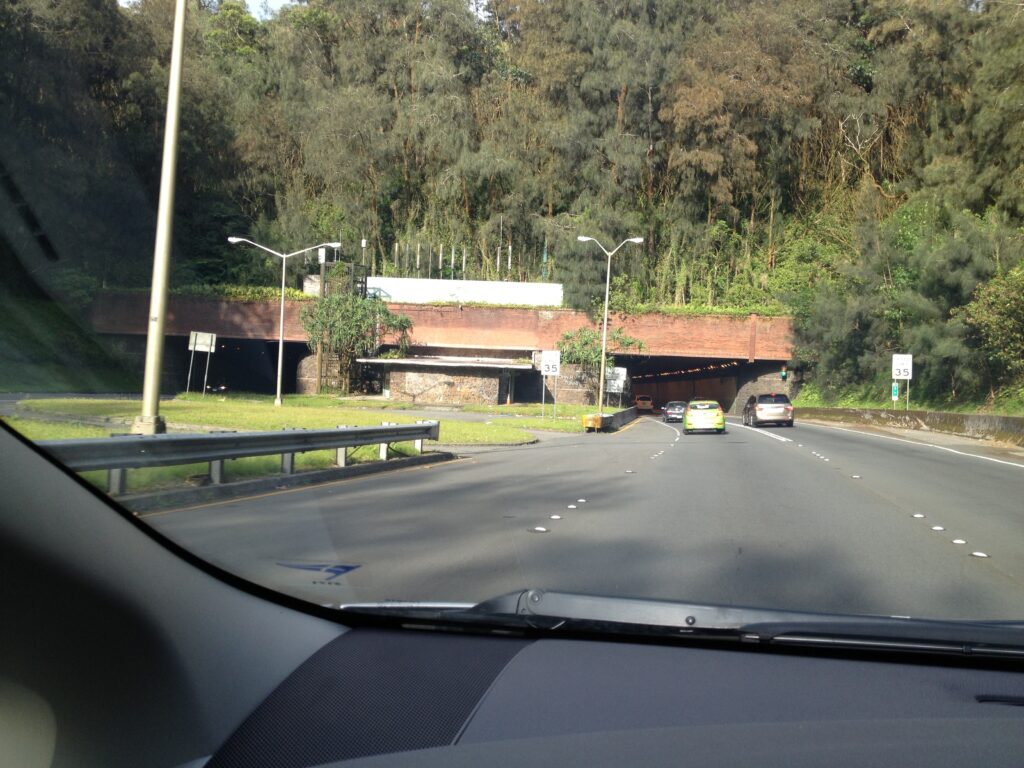
Back in Hawaiʻi, in 1897, Johnny and fellow Stanford student Louis Whitehouse won the bid to expand and construct a ‘carriage road’ over the Pali.  Ground was broken on May 26, 1897 and the road was opened for carriages on January 19, 1898.  (Later, the Pali tunnels were completed and the old road abandoned – on August 1, 1961, Mrs. Jennie Wilson (his wife) led the dedication ceremonies.)

Wilson and Whitehouse also won the contract to extend Benjamin Dillingham’s railroad around Kaʻena Point.  To keep the bid low, they carried laborers, equipment and supplies to the site and freight back by boat – on October 14, 1897, the place where the first Japanese laborers landed for this job is known to this day as “Yokohama Beach.”  (ascehawaii)

He and his wife, Jennie “Kini” Kapahu (previously a court dancer) toured the continent in 1900 with their Hawaiian Village hula troupe.  (Kini Kapahu claimed that she was the ‘first girl to leave Hawai‘i to go as a dancer in the mainland’.)

Wilson got involved with politics and is credited as being the most important Democrat in the first half of 20th-century Hawaiʻi; his name is used with Jack Burns in the party movement.  He was in a meeting on April 30, 1900 that organized the Democratic Party of Hawaiʻi.

His initial political campaign in 1918 met with failure.  Mayor Joe Fern, Honolulu’s first Mayor, appointed his good friend Wilson as road supervisor for the Honolulu district.  Later, Wilson succeeded Fern as Mayor, following the illness and death of Fern.

Fern died on February 20, 1920; the Honolulu Board of Supervisors voted in Wilson on February 25, and he was sworn in as Mayor on February 29.  He would serve three stints as mayor: 1920 to 1927, 1929 to 1931 and 1946 to 1954.  (From 1941 to 1946, he was Director of Public Works.)

Honolulu Hale was an idea started by Joseph J Fern, but he died before it came to fruition.  Mayor Wilson carried on Fern’s dream; Honolulu Hale was finally completed in 1928.

Wilson foresaw the growth on the windward side and excavation commenced on January 8, 1954 on the “Kalihi Tunnel.”  Near the end of May 1954 tunnel excavation transitioned from rock to “earth” – in the summer of 1954, several tunnel collapses and surface sinkholes subsequently led to a large collapse on August 14 that killed five construction workers.

Construction ceased while they considered alternative methods of completion.  Tunnel excavation restarted in February 1956 and the first half-mile tunnel was open to two-way traffic in 1958; both tunnels were fully operational by November 1960.

Initially known as the ‘Kalihi Tunnel,’ and often called the Likelike Tunnels, they are named in honor of John H Wilson.  (1998 brought the completion of H-3 (and the Tetsuo Harano Tunnels – named after a longtime state highways administrator.))

In addition to the John H Wilson Tunnels, the John H Wilson Elementary School on Kilauea Avenue and the adjoining Wilson Playground at Papakōlea in Waiʻalae Nui Valley are named for Wilson.

Johnny Wilson passed away on July 2, 1956 at the age of 84.

© 2022 Hoʻokuleana LLC

Filed Under: Prominent People Tagged With: Hawaii, Paoakalani, Waikiki, Honolulu, Oahu, Liliuokalani, Pali, Wilson Tunnel, Johnny Wilson, Yokohama, Joe Fern, Likelike Highway

April 19, 2022 by Peter T Young 1 Comment

Kona in the Early 1820s and 1830s

Artemas Bishop and his family were first permanently stationed at Kailua, Hawaii, in 1824, being transferred to Ewa, Oahu, in 1836, and to Honolulu in 1855, where Mr. Bishop died, Dec. 18, 1872.

Mrs. Bishop died at Kailua, Feb. 28, 1828, the first death in the mission band. She left two infant children, including Sereno Edwards Bishop, who was born at Ka‘awaloa, Hawaii, Feb. 7, 1827. The following are some of Bishop’s “Reminiscences of Old Hawaii” that he included in his book named such.

“Kailua In The 1820s … Kailua was the capital of the Island. It is situated on the west coast, twelve miles north of Kealakekua, where Captain Cook perished. It lies at the base of the great mountain Hualalai, 8,275 feet high.”

“The entire coast consists of lava flows from that mountain, of greater or less age. Here and there in the village were small tracts of soil on the lava, where grew a few cocoanut, kou, and pandanus trees.”

“There were no gardens, for lack of water. Heat and general aridity characterized the place. But it pleased the natives, on account of the broad calm ocean, the excellent fishing, and the splendid rollers of surf on which they played and slid all day.”

“North of the town, the whole region seemed to be occupied by an ocean of black billowy lava which at some recent period had flowed down from the mountain. This bounded that end of the village.”

“A vast breadth of this lava-sea had invaded the ocean for miles, beyond the older shore line of Kailua. A wide tongue of lava had bent around and partially enclosed the little cove with its deep sand beach where was the chief landing of the town.”

“Surfing And Canoes … This was a universal sport of the chiefs and common people alike. The ponderous chiefs had very large boards of light wood.”

“In the Bishop Museum may be seen today an immense surf board of the cork-like wili-wili wood, on which the famous Paki used to disport himself at Lahaina fifty years ago. I doubt whether Kuakini, with his 500 pounds, was agile enough to attempt it.”

“In handling canoes the natives were most adroit. Kona, with its great koa forests inland abounded in canoes. There were no boats. The people were skilled fishermen and often went many miles to sea, in pursuit of the larger deep-deep-sea fish.”

“A name given to Mt. Hualalai behind us, was “Kilo-waa,” or Canoe-descrier. The canoes were of elaborate form and smoothness. Most of them were single canoes with outriggers. Many large ones, however, were rigged double, six or eight feet apart, with a high platform between them.”

“All the fastenings were of carefully plaited sinnet or cocoanut fiber, the lashings being laid with great care and skill. The mast was stepped in the platform. The common people had mat sails. Those of Kuakini’s canoes were of sail-duck.”

“Appearance Of Chiefs And People … The relative rank of other natives could be approximately estimated by their stature and corpulence. There were quite a number of large fat men and women of some rank among our neighbors.”

“The leading women met weekly at our house, most of them wearing the lei-pa-Iaoa, consisting of a thick bunch of finely plaited hair passed through a large hole in a hooked polished piece of whale-tooth, and tied around the neck, forming an insignium of rank.”

“They also carried small kahilis to brush away the flies. Any chief of high rank was attended by one or more fly-brushers, by a spittoon-bearer, and other personal attendants.”

“The spittoon holder was the most honored, being responsible to let none of the spittle fall into the possession of an evil-minded sorcerer, who might compass the death of the Alii therewith. Broad, elastic cocoanut leaf fans were in constant play.”

“Hawking and spitting were continued in any gathering of natives, and were apt seriously to disturb public worship at church. But the great crowd of the common people were miserably lean, and often very squalid in appearance. “

“They were too much in the sea to appear filthy, although the heads of both high and low were thoroughly infested. It was a daily spectacle to see them picking over each other’s heads for dainties. Their vicinity rendered necessary the frequent use of a fine-toothed comb on us children, much to our discomfort. But I believe our ancestors at no remote period were little better off.”

“Styles Of Clothing … The common multitude wore no foreign cloth. Their few garments were wholly of tapa. The younger women were rarely seen uncovered beyond decency, although old crones went about with the pa-u only. The smaller children had nothing on. The men always wore the half-decent malo, and nothing more.”

“At meetings, they wore the little kihei, or shoulder cape. Before 1836, simple cotton shirts would not unfrequently be seen in the church. I never saw but two Hawaiians wearing trousers in Kailua. One was Kuakini and the other Thomas Hopu, from the Cornwall School, who came out with Bingham and Thurston.”

“The national female costume was the pa-u, which was worn by all at all times. It was a yard wide strip of bark-cloth wound quite tightly around the hips reaching from the waist to the knees, and secured at the waist by folding over the edges. Foreign cloth was also used. At one great ceremonial, a queen had her body rolled up in a pa-u of one hundred yards of rich satin.”

“Sources Of Drinking Water … The drinking water of the people was very brackish, from numerous caves which reached below the sea level.”

“The white people, and some chiefs had their water from up the mountain where were numerous depressions in the lava, full of clear, sweet rain water.”

“There were also many tunnel-caves, the channels of former lava-streams. The air from the sea, penetrating these chill caverns, deposited its moisture, and much distilled water filled the holes in the floor.”

“Sometimes the fine rootlets of ohia-trees penetrating from above, festooned the ceilings of these dark lava-ducts as with immense spider webs. If in a dry season, water was lacking on the open ground, it could always be found higher up on the mountain in such caves.”

“Twice a week one of our ohuas or native dependants went up the mountain with two huewai, or calabash bottles, suspended by nets from the ends of his mamaki or yoke, similar to those used by Chinese vegetable venders.”

“These he filled with sweet water and brought home, having first covered the bottles with fresh ferns, to attest his having been well inland. The contents of the two bottles filled a five-gallon demijohn twice a week.”

“Source Of Food Supply … The people had ample cultivable land in the moist upland from two to four miles inland at altitudes of one thousand to twenty-five hundred feet.”

“It is a peculiarity of that Kona coast that while the shore may be absolutely rainless for months gentle showers fall daily upon the mountain slope.”

“The prevailing trade-winds are totally obstructed by the three great mountain domes and never reach Kona. There are only the sweet land breeze by night, and the cooling sea-breeze by day.”

“The latter comes in, loaded with the evaporations of the sea, and floats high up the mountain slopes. As it rises, the rarification of the air precipitates more and more of its burden of vapor, so that at two thousand and three thousand feet, there are daily copious rains, and verdure is luxuriant.”

“The contrast is immense and delicious between the arid heat of the shore, and the moist cool greenness of the near-by upland. The soil is most fertile, being formed from the decay of recent lava flows.”

“There the natives found their chief means of subsistence, and, in good seasons, were sufficiently fed. In bad seasons there were drought, and more or less of ‘wi,’ or famine. The uala or sweet potatoes, and the taro, which constituted their chief food grew best on the lower and warmer ground, where was more liability to drought.”

“How Fire Was Obtained … The people commonly procured fire by friction of wood, although some of them had old files, from which they elicited sparks by strokes from a gun-flint. It was common to carry fire in a slow-burning tapa-match, especially when they wanted to smoke.”

“I first saw fire obtained from wood at our camp on Mauna Kea. A long dry stick of soft hau or linden wood was used. A small stiff splinter of very hard wood was held in the right hand, and the point rubbed with great force and swiftness in a deep groove formed in the soft wood by the friction.”

“A brown powder soon appeared in the end of the groove, began to smoke and ignited. This was deftly caught into a little nest of dry fibre and gently blown into a flame, which soon grew into an immense camp-fire.” (Bishop)

© 2022 Hoʻokuleana LLC

View of Kailua from Laniakea-1836
Persis_Goodale_Thurston_Taylor_–_Kailua_from_the_Sea,_1836
Kaawaloa, Kealakekua Bay. A copperplate engraving from a drawing by Lucy or Persis Thurston about 1835

Filed Under: General, Missionaries / Churches / Religious Buildings, Place Names, Economy Tagged With: 1820s, 1830s, Hawaii, Hawaii Island, Kona, Sereno Bishop, Artemas Bishop

April 18, 2022 by Peter T Young Leave a Comment

Changing Time

Then, they used the Julian Calendar; today, we use the Gregorian Calendar – it is different by 10-days.

Dates matter – and we need to keep in mind that how we measure time, particularly how we note specific dates, changed between the time of the Mayflower and today.

The Pilgrims were using the Julian Calendar, which is 10 days behind the Gregorian Calendar that we use today.  So, when they wrote a date down it related to the Julian Calendar, which are not the same dates that we use today (under the Gregorian Calendar).

As an example, the Mayflower Compact was signed on November 11, 1620 under the Julian Calendar (their time), which is now referenced as November 21, 1620 under the Gregorian calendar (our time.)

Calendars

Throughout history there have been numerous attempts to convey time in relation to the sun and moon.  Even now the Chinese and Islamic calendars are based on the motion of the moon around the earth, rather than the motion of the earth in relation to the sun, and the Jewish calendar links years to the cycle of the sun and months to the cycle of the moon.

Today, Americans are used to a calendar with a “year” based the earth’s rotation around the sun, with “months” having no relationship to the cycles of the moon and New Year’s Day falling on January 1.  However, that system was not adopted in England and its colonies until 1752. 

The changes implemented that year have created challenges for historians and genealogists working with early colonial records, since it is sometimes hard to determine whether information was entered according to the then-current English calendar or the “New Style” calendar we use today.

Julian Calendar

In 45 B.C., Julius Caesar ordered a calendar consisting of twelve months based on a solar year.  This calendar employed a cycle of three years of 365 days, followed by a year of 366 days (leap year). When first implemented, the ‘Julian Calendar’ also moved the beginning of the year from March 1 to January 1.

However, following the fall of the Roman Empire in the fifth century, the new year was gradually realigned to coincide with Christian festivals until by the seventh century, Christmas Day marked the beginning of the new year in many countries.

By the ninth century, parts of southern Europe began observing first day of the new year on March 25 to coincide with Annunciation Day (the church holiday nine months prior to Christmas celebrating the Angel Gabriel’s revelation to the Virgin Mary that she was to be the mother of the Messiah). The last day of the year was March 24. However, England did not adopt this change in the beginning of the new year until late in the twelfth century.

Because the year began in March, records referring to the “first month” pertain to March; to the second month pertain to April, etc., so that “the 19th of the 12th month” would be February 19.

In fact, in Latin, September means seventh month, October means eighth month, November means ninth month, and December means tenth month.  Use of numbers, rather than names, of months was especially prevalent in Quaker records.

Gregorian Calendar

During the Middle Ages, it became apparent that the Julian leap year formula had overcompensated for the actual length of a solar year, having added an extra day every 128 years.  However, no adjustments were made to compensate.

By 1582, seasonal equinoxes were falling 10 days “too early,” and some church holidays, such as Easter, did not always fall in the proper seasons.  In that year, Pope Gregory XIII authorized, and most Roman Catholic countries adopted, the “Gregorian” or “New Style” Calendar.

As part of the change, ten days were dropped from the month of October, and the formula for determining leap years was revised so that only years divisible by 400 (e.g., 1600, 2000) at the end of a century would be leap years.  January 1 was established as the first day of the new year. Protestant countries, including England and its colonies, not recognizing the authority of the Pope, continued to use the Julian Calendar.

Time of Two Calendars and Double Dating

Between 1582 and 1752, not only were two calendars in use in Europe (and in European colonies), but two different starts of the year were in use in England.  Although the “Legal” year began on March 25, the use of the Gregorian calendar by other European countries led to January 1 becoming commonly celebrated as “New Year’s Day” and given as the first day of the year in almanacs.

To avoid misinterpretation, both the “Old Style” and “New Style” year was often used in English and colonial records for dates falling between the new New Year (January 1) and old New Year (March 25), a system known as “double dating.”

Such dates are usually identified by a slash mark [/] breaking the “Old Style” and “New Style” year, for example, March 19, 1631/2.  Occasionally, writers would express the double date with a hyphen, for example, March 19, 1631-32.  In general, double dating was more common in civil than church and ecclesiastical records.

Changes of 1752

In accordance with a 1750 act of Parliament, England and its colonies changed calendars in 1752. By that time, the discrepancy between a solar year and the Julian Calendar had grown by an additional day, so that the calendar used in England and its colonies was 11 days out-of-sync with the Gregorian Calendar in use in most other parts of Europe.

England’s calendar change included three major components. The Julian Calendar was replaced by the Gregorian Calendar, changing the formula for calculating leap years.  The beginning of the legal new year was moved from March 25 to January 1.  Finally, 11 days were dropped from the month of September 1752.  The changeover involved a series of steps:

  • December 31, 1750 was followed by January 1, 1750 (under the “Old Style” calendar, December was the 10th month and January the 11th)
  • March 24, 1750 was followed by March 25, 1751 (March 25 was the first day of the “Old Style” year)
  • December 31, 1751 was followed by January 1, 1752 (the switch from March 25 to January 1 as the first day of the year)
  • September 2, 1752 was followed by September 14, 1752 (drop of 11 days to conform to the Gregorian calendar) (CT State Library)

Click the following link to a general summary about Changing Time:

https://imagesofoldhawaii.com/wp-content/uploads/Changing-Time.pdf

© 2022 Hoʻokuleana LLC

MayflowerHarbor-WC

Filed Under: Mayflower Summaries Tagged With: Mayflower, Pilgrims, Julian Calendar, Gregorian Calendar

April 17, 2022 by Peter T Young 3 Comments

ʻIliʻili Hānau o Kōloa

Ka ʻiliʻili hānau o Kōloa; ka nalu haʻi o Kāwā.
The reproducing pebbles of Kōloa; the breaking surf of Kāwā.

ʻIliʻili hānau o Kōloa (Birth Pebble of Kōloa) is the mother of rocks for Kaʻū district, referring to the porous pebbles found especially at the beach of Kōloa, Kaʻū district, on Hawaiʻi Island.

Such stones were supposed to grow from a tiny pebble to a good-sized rock and to reproduce themselves if watered once a week. Care had to be taken lest they be stepped upon or otherwise treated with disrespect.

Hence they were carefully wrapped in tapa and laid away on a high rafter of the house. At a child’s naming day or on other special occasions such as marriages, wars, and fishing expeditions they were taken down and arranged on ti leaves, together with awa root, upon a mat or table and their wisdom and blessing invoked.

Afterwards some member of the family would have a dream favorable or unfavorable to the project in hand and this was regarded as sent from the god.  (Beckwith)

These are beach worn pebbles. The interest attaching to them is derived from the belief still held by many natives with whom Emerson conversed with that they are of different sexes and beget off spring which increase in size and in turn beget others of their kind.

The males are of a smooth surface without noticeable indentations or pits. The females have these little pits in which their young are developed and in due time separate from their mothers to begin independent existence.

The ‘male’ stones are gray, basalt beach-worn pebbles having no pits or cavities. Most are flat and about an inch in size. The ‘female’ stones (a little bigger) are of the same material; however, they have small pits or cavities within which are very tiny basalt pebbles.

The “children” that are not in the “female” cavities and a less than an inch long.  (Bishop Museum)

William Ellis tells the following account from his brief visit there in 1824:

“We had not traveled far (from Hīlea) before we reached Nīnole, a small village on the sea shore, celebrated on account of a short pebbly beach called Koroa (Kōloa)”.

“(T)he stones of which were reported to possess very singular properties, among others, that of propagating their species.”

“The natives told us it was a wahi pana (place famous) for supplying … the stones for making small adzes and hatchets, before they were acquainted with the use of iron”.

“(B)ut particularly for furnishing the stones of which the gods were made, who presided over most of the games of Hawai‘i.

“Some powers of discrimination, they told us, were necessary to discover the stones which would answer to be deified.”

“When selected they were taken to the Heiau, and there several ceremonies were performed over them. Afterwards, when dressed, and taken to the place where the games were practiced, if the parties to whom they belonged were successful, their fame was established”.

“(B)ut if unsuccessful for several times together, they were either broken to pieces, or thrown contemptuously away.“

“When any were removed for the purpose of being transformed into gods, one of each sex was generally selected; these were always wrapped very carefully together in a piece of native cloth.”

“After a certain time, they said a small stone would be found with them, which, when grown to the size of its parents, was taken to the Heiau, or temple, and afterwards made to preside at the games.  We were really surprised at the tenacity with which this last opinion was adhered to”.

“Koroa [Kōloa] was also a place of importance in times of war, as it furnished the best stones for the slingers.”

“The natives told us it was a wahi pana (place famous) for supplying the black and white kōnane stone.”

“We examined some of the stones. The black ones appeared to be pieces of trap, or compact lava. The white ones were branches of white coral common to all the islands of the Pacific.”

“The angles of both were worn away, and a considerable polish given, by the attrition occasioned by the continual rolling of the surf on the beach.” (Ellis)

The ʻiliʻili from Kōloa were considered the best on the island of Hawaiʻi for hula ʻiliʻili.

© 2022 Hoʻokuleana LLC


Filed Under: Place Names, Hawaiian Traditions Tagged With: Hawaii, Hawaii Island, Konane, Hula, Iliili Hanau o Koloa, Iliili, Punaluu

  • « Previous Page
  • 1
  • …
  • 306
  • 307
  • 308
  • 309
  • 310
  • …
  • 683
  • Next Page »

Images of Old Hawaiʻi

People, places, and events in Hawaiʻi’s past come alive through text and media in “Images of Old Hawaiʻi.” These posts are informal historic summaries presented for personal, non-commercial, and educational purposes.

Info@Hookuleana.com

Connect with Us

  • Email
  • Facebook
  • LinkedIn
  • Twitter
  • YouTube

Recent Posts

  • 11th hour of the 11th day of the 11th month
  • About 250 Years Ago … Marines are Formed
  • “Oh, father, dear father, do take me back!”
  • About 250 Years Ago … Culper Spy Ring
  • Shoyu
  • Aikapu
  • Maui Grand Hotel

Categories

  • General
  • Ali'i / Chiefs / Governance
  • Buildings
  • Missionaries / Churches / Religious Buildings
  • Hawaiian Traditions
  • Military
  • Place Names
  • Prominent People
  • Schools
  • Sailing, Shipping & Shipwrecks
  • Economy
  • Voyage of the Thaddeus
  • Mayflower Summaries
  • American Revolution

Tags

Albatross Al Capone Ane Keohokalole Bernice Pauahi Bishop Charles Reed Bishop Downtown Honolulu Eruption Founder's Day George Patton Great Wall of Kuakini Green Sea Turtle Hawaii Hawaii Island Hermes Hilo Holoikauaua Honolulu Isaac Davis James Robinson Kamae Kamaeokalani Kamanawa Kameeiamoku Kamehameha Schools Lalani Village Lava Flow Lelia Byrd Liberty Ship Liliuokalani Mao Math Mauna Loa Midway Monk Seal Northwestern Hawaiian Islands Oahu Papahanaumokuakea Marine National Monument Pearl Pualani Mossman Quartette Queen Liliuokalani Thomas Jaggar Volcano Waikiki Wake

Hoʻokuleana LLC

Hoʻokuleana LLC is a Planning and Consulting firm assisting property owners with Land Use Planning efforts, including Environmental Review, Entitlement Process, Permitting, Community Outreach, etc. We are uniquely positioned to assist you in a variety of needs.

Info@Hookuleana.com

Copyright © 2012-2024 Peter T Young, Hoʻokuleana LLC

Loading Comments...