Images of Old Hawaiʻi

  • Home
  • About
  • Categories
    • Ali’i / Chiefs / Governance
    • American Protestant Mission
    • Buildings
    • Collections
    • Economy
    • Missionaries / Churches / Religious Buildings
    • General
    • Hawaiian Traditions
    • Other Summaries
    • Mayflower Summaries
    • Mayflower Full Summaries
    • Military
    • Place Names
    • Prominent People
    • Schools
    • Sailing, Shipping & Shipwrecks
    • Voyage of the Thaddeus
  • Collections
  • Contact
  • Follow

December 18, 2021 by Peter T Young 3 Comments

Nuʻuanu

In 1872, some referred to it as “Missionary Street,” although the Missionary Period had ended about 10-years earlier (the Missionary Period was from 1820 – 1863.)

You might more accurately call it the home of the elite, and that is not limited to folks of the Caucasian persuasion – both Kauikeaouli and Emma had summer residences here and included in the list of successful business people who called it home were the Afongs and others.

But you can’t help concluding the strong demand to live there based on early descriptions – even Realtors, today, would be envious of the descriptors Ellis used in 1831: “The scenery is romantic and delightful.”

“Across this plain, immediately opposite the harbour of Honoruru, lies the valley of Anuanu (Nuʻuanu,) leading to a pass in the mountains, called by the natives Ka Pari (Pali,) the precipice, which is well worth the attention of every intelligent foreigner visiting Oahu.”  (Ellis, 1831)

“The mouth of the valley, which opens immediately behind the town of Honoruru, is a complete garden, carefully kept by its respective proprietors in a state of high cultivation; and the ground, being irrigated by the water from a river that winds rapidly down the valley, is remarkably productive.”  (Ellis, 1831)

Over sixty years later (1897,) Stoddard keeps the demand momentum going by adding, “The way lies through shady avenues, between residences that stand in the midst of broad lawns and among foliage of the most brilliant description. An infinite variety of palms and tropical plants, with leaves of enormous circumference, diversify the landscape.”

Today, the descriptors of the past hold true – and the place is high in the demand (and price,) just as it was nearly two centuries ago.

So, who were some of the people who called this place home?

As noted, an early resident of Nuʻuanu was Kauikeaouli, Kamehameha III.  Consistent with tradition, his home had a name, Kaniakapūpū (sound or song of the land snail;) it was located back up into the valley at Luakaha.

Ruins today, the structure, modeled on an Irish stone cottage, was completed in 1845 and is reportedly built on top or in the vicinity of an ancient heiau.  It was a simple cottage, a square with four straight walls.

Another royal, Queen Emma, had a “mountain” home, Hānaiakamālama (Lit., the foster child of the light (or moon,)) now known as the Queen Emma Summer Palace.  In 1857, she inherited it from her uncle, John Young II, son of the famous advisor to Kamehameha I, John Young I.
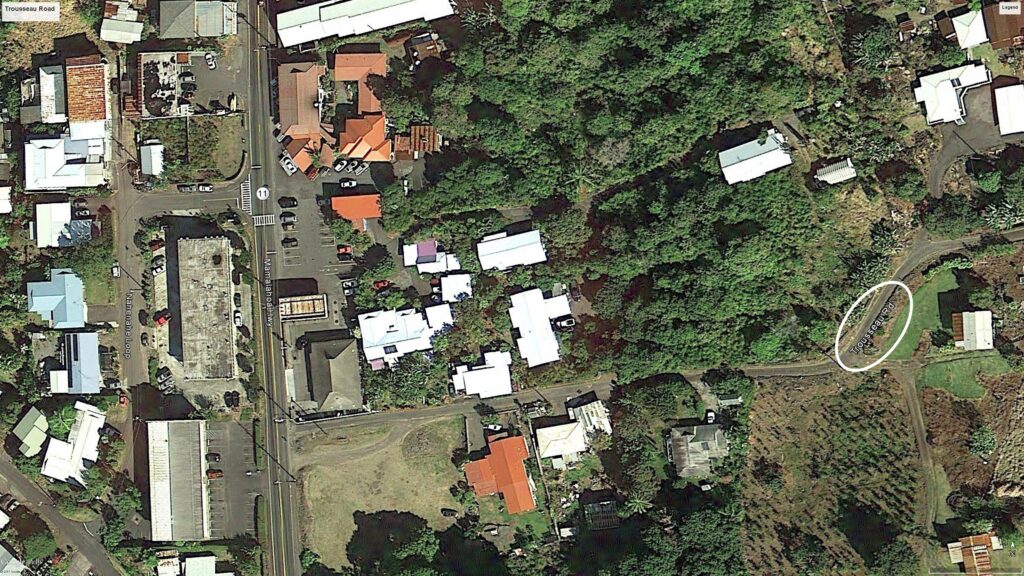
The ‘Summer Palace’ was modeled in the Greek Revival style. It has a formal plan arrangement, wide central hall, high ceilings and floor-length hinged, in-swinging shuttered casement window.  The Daughters of Hawaiʻi saved it from demolition and it is now operated as a museum and open to the public (a nominal admission fee is charged.)

On the private side, the following are only a few of the several notable residences (existing, or long gone,) in Nuʻuanu Valley.

A notable home is the “Walker Estate;” one of the few intact estates that were built in the upper Nuʻuanu Valley before and after the turn of the century (built in 1905,) it is a two story wood frame structure of Classical Revival style.  (NPS)

The home on the 5.7-acre estate was initially built for the Rodiek family, a leading businessman in Honolulu. Due to war time pressures on the family, who were German citizens, the home was sold in 1918 to Wilcox who lived there into the 1930s, when it was taken over by Henry Alexander Walker, president and chairman of the Board of Amfac (one of the Hawaiʻi Big Five businesses.)

The grounds were originally used for orchards and vegetables, although the Japanese garden was put in shortly after the house was built and is thought to be the oldest formal Japanese garden in Hawaiʻi, the stones, lamps and images specially brought from Japan for it.  (NPS)

Another notable home is former Governor George Carter’s “Lihiwai” (water’s edge.)  In the late-1920s, Carter built his 26,000-square feet home; it is reportedly “the largest and finest private residence ever constructed in Hawaiʻi (with the exception of ʻIolani Palace.)”  (NPS)

The entire building is built of shaped bluestone set in concrete and steel reinforced cement, and all the perimeter walls are 2 – 3-feet thick with the exception of the end walls, which are 6-feet thick.  It is constructed entirely of bluestone, concrete, steel, copper, bronze and teak.

Originally, the building was connected to two smaller structures — by a breezeway on the eastern side and by the porte-cochere on the western side (these structures were separated in 1957.)  The property was originally 10-acres, but portions were subdivided and sold in 1945 after the death of Helen Strong Carter. Today, the property includes the original house on a little over 1-acre.   (The home is undergoing restoration.)

A home long gone, but we are repeatedly reminded of it in on-the-air marketing for senior living in Nuʻuanu, is “Craigside.”  This was the home of Theophilus Harris Davies.  Not only was Davies’ firm, Theo H Davies, one of the Hawaiʻi Big Five, he personally served as guardian to Princess Kaʻiulani while she was studying in England (Davies had another home there – “Sundown.”)

Likewise, just up the hill, was the Paty house “Buena Vista;” it’s now gone and part of the Wyllie Street interchange with Pali Highway.  (Look for the parallel palms in the yard of the immediately-makai ‘Community Church of Honolulu.’  They used to line the Paty driveway, with the house off to the left (mauka.)

During the Spanish American War, the military took over Buena Vista and turned it into the Nuʻuanu Valley Military Hospital (also known as “Buena Vista Hospital.”)

Just mauka of Buena Vista (now also part of the Wyllie-Nuʻuanu interchange) was Robert Crichton Wyllie’ “Rosebank.”  Wyllie first worked as acting British Consul. Attracted by Wyllie’s devotion to the affairs of Hawaiʻi, in 1845, King Kamehameha III appointed him the Minister of Foreign Affairs.

Kamehameha IV reappointed all the ministers who were in office when Kamehameha III died, including Robert C Wyllie as Minister of Foreign Relations (he was in Hawaiʻi from 1844 until his death in 1865.)  Wyllie served as Minister of Foreign Relations from 1845 until his death in 1865, serving under Kamehameha III, Kamehameha IV and Kamehameha V.

Finally, a home of a missionary, Dr. Gerrit Parmele Judd, “Sweet Home” was located at the intersection of Nuʻuanu and Judd.   Judd was in the 3rd company of missionaries from the American Board of Commissioners for Foreign Missions (he was in Hawaiʻi from 1828 until his death in 1873.)  After serving the mission for 15-years, Judd was translator and later Minister of Foreign Affairs, member of the House of Nobles and Privy Council, and Minister of Finance under Kamehameha III.

Wife Laura Judd once noted, “we were supposed to be rich,” but insisted they had never been so poor, being obliged to borrow money to pay for carpenters and masons.  (Scott, Saga)  The house was torn down in 1911 and the property became part of what is now Oʻahu Cemetery.

© 2021 Hoʻokuleana LLC


Filed Under: Prominent People, Ali'i / Chiefs / Governance, Buildings, Hawaiian Traditions, Place Names Tagged With: Lihiwai, Hawaii, Rosebank, Oahu, Queen Emma Summer Palace, Queen Emma, Hanaiakamalama, Kamehameha III, George Carter, Theo H Davies, Sweet Home, Buena Vista, Craigside, Nuuanu, Gerrit Judd, Kaniakapupu, Robert Wyllie

December 17, 2021 by Peter T Young Leave a Comment

Mid-Pacific Institute

“Mid-Pacific Institute is unqualifiedly Christian. It is the fruitage of missionary enterprise and cherishes the legacy which the mission fathers and mothers have passed on to it.”

“Even possible educational advantage such as good teachers, supervised study, small classes, and an uplifting home environment, are afforded its pupils but its real claim for its right to exist and receive the support of its friends is the emphasis it places upon Christian character-building.”

“The land, buildings and endowment are the gifts of Christian men and women; the love, vision and faith which gave it birth are Christian; its purpose and ideals are Christian. Many of the students come from non-Christian homes and their first introduction to the life and teachings of Jesus Christ is received here.”

“All students attend Sunday School and Church services in the city churches. Daily chapel services are held in each department while live Christian Endeavor and Mission societies give the students ample opportunity for self-expression.”

“Mid-Pacific Institute owes its birth to the vision, enthusiasm and tireless energy of Francis W Damon. With an abiding faith in the need of such an institution he persistently and patiently urged its claims until others caught his spirit and in 1905 the Hawaiian Board of Missions sanctioned it and appointed the first Board of Managers.”

“Unlike most institutions Mid-Pacific came into life full-grown, for it was made up of schools which had already made valuable contributions to the education of Hawaii’s youth – Kawaiahaʻo Seminary for girls and Mills School for boys.”

“Mills School came into being through the efforts of Mr. Damon, who was then Superintendent of Chinese work for the Hawaiian Board, to make it possible for worthy Chinese boys from the country districts to find both a school and a home.” (John Hopwood, Mid-Pacific President, April 1923)

Kawaiaha‘o Female Seminary

In 1863, missionaries Mr. and Mrs. Luther Gulick started a boarding school for girls in Kaʻū. This was continued at Waiohinu for two years, but was moved to Oʻahu. The Gulicks’ school was established “to teach the principles of Christianity, domestic science, and the ways and usages of western civilization.”

Mrs. Gulick felt that her opportunity had come. No one else could begin the school. She had been longing for more missionary work to do, and now the door was open. She writes: “Opened school this morning with eight scholars.” (The Friend)

In 1867, the Hawaiian Mission Children’s Society (HMCS – an organization consisting of the children of the missionaries and adopted supporters) decided to support a girls’ boarding school. An early advertisement (April 13, 1867) notes it was called Honolulu Female Academy.

It started with boarders and day students, but after 1871 it has been exclusively a boarding school. “Under her patient energy and tact, with the help of her assistants, it prospered greatly, and became a success.” (Coan)

At first the school was designed to prepare Hawaiian girls to become ‘suitable’ wives for men who were at the same time preparing to become missionaries and work in the South Seas.

This objective took the back seat to industrial education as new industrial departments were added. This included sewing, washing and ironing, dressmaking, domestic arts and nursing.

Kawaiahaʻo Seminary continued to grow over the years and the student body was drawn from all over the islands and from all racial groups; some of the scholars included members of the royal family. (Attendance averaged over a hundred per year, with the largest number of pupils appears to have been in 1889, when 144 names were on the rolls.)

Mills School for Boys (Mills Institute)

Mills School for Boys was started as a small downtown missionary school in 1892, by Mr. and Mrs. Francis W Damon (descendant of missionary Rev Samuel C Damon), who took into their home a number of Chinese boys with the aim of giving them a Christian education.

Frank Damon, who was born in Hawai‘i, toured the world with Henry Carter, and married Mary Happer, a missionary’s daughter, who had been born and reared in Kuangzhou, China, and spoke fluent Cantonese. Frank Damon was appointed by the Hawaiian Evangelical Association as the superintendent of Chinese work in 1881. (Fan)

“(S)ix Chinese youths fired with the passion for knowledge, knocked at the door of the Damon home in Honolulu and asked to be taken in and taught. A room was found, instruction began, the six multiplied slowly until they have become more than four hundred who have found Mills a blessed home of light and truth.”

“The influence of this school upon our Territory can never be told. Its graduates are found in all walks of life, occupying positions of influence here, on the Pacific coast and in China.” (The Friend, October 1905)

Bringing The Two Together

Kawaiahaʻo Seminary and Mills School had much in common – they were home schools; founded by missionary couples; and had boarding of students.

With these commonalities, in 1905, a merger of the two was suggested, forming a co-educational institution in the same facility.

In order to accommodate a combined school, the Hawaiian Board of Foreign Missions purchased the Kidwell estate, about 35-acres of land in Mānoa valley.

Through gifts by GN Wilcox, JB Atherton and others, on May 31, 1906, a ceremony was held in Mānoa Valley for the new school campus – just above what is now the University of Hawaiʻi (the UH campus was not started in the Mānoa location until 1912.)

By 1908, the first building was completed, and the school was officially operated as Mid-Pacific Institute, consisting of Kawaiahaʻo School for Girls and Damon School for Boys.

Initially, while the two schools moved to the same campus, they essentially went their separate ways there for years; they had different curricula, different academic standards and different policies.

Finally, in the fall of 1922, a new coeducational plan went into effect – likewise, ‘Mills’ and ‘Kawaiahaʻo’ were dropped, and by June 1923, Mid-Pacific became the common, shared name.

In November 2003, the school decided to terminate its on-campus dormitory (which had existed since 1908). Epiphany School, established in 1937 as a small mission school by the Episcopal Church of the Epiphany, merged with Mid-Pacific Institute in 2004.

© 2021 Hoʻokuleana LLC

Mid_Pacific_Institute
Damon_Home_on_Chaplain_Lane_where_Mills_School_began
Damon_and_some_Mills_School_Boys
Damon_and_some_Mills_School_Boys-in_front_of_Morrison_Hall
Mills_School-Morrison_Hall
Honolulu and Vicinity-Dakin-Fire Insurance- 05-Map-1906-Former_Mills_Institute_Site-noted
Kawaiahaʻo_Female_Seminary,_Honolulu,_c._1867
Girl's School-Mid-Pacific_Institute
Girl’s School-Mid-Pacific_Institute
Girl's School-Mid-Pacific_Institute
Girl’s School-Mid-Pacific_Institute
Honolulu and Vicinity-Dakin-Fire Insurance- 28-Map-1906_the_YWCA_Homestead-Castle_Estate-(former_Kawaiahao_Seminary_Site)
Mid_Pacific_Institute
Mid_Pacific
Mid_Pacific
Existing_Mid-Pacific_Institute_overlooking_the_beginning_of_the_UH-Manoa_Campus-1912
Mid_Pacific_Institute
MPI-Seal
MPI-Seal

Filed Under: Missionaries / Churches / Religious Buildings, Prominent People, Schools Tagged With: Damon School for Boys, Oahu, Mills Institute, Gulick, Lydia Bingham Coan, Luther Gulick, Missionaries, Francis Damon, Manoa, Kawaiahao Seminary, Lydia Bingham, Lizzy Bingham, Mid-Pacific Institute, Hawaii

December 16, 2021 by Peter T Young 1 Comment

Manō Kihikihi

They are easy to identify … and their name tells you what to look for (their body and head shape resemble a hammer, when viewed from above (or below.))

Marine organisms generate an electric field around their body; some believe the shape of the hammerhead’s head allows electro-receptive organs in the animal to have increased sensory abilities – a beneficial quality when searching for prey.

In addition, the head shape may aid in their movements, providing lift or possibly a smaller turning radius.

Since sharks are ‘apex predators’ at the top of their food chain, they may influence the population structure of species lower in that food chain.

The sharks are found in warm and tropical waters, worldwide from 46° north to 36° south.  They can be found down to depths of over 1,600 feet, but is most often found above 80-feet.  During the day they are more often found close to shore and at night they hunt further offshore.

The scalloped hammerhead, one of the most commonly seen hammerhead sharks in Hawaiʻi, generally reaches between 5 to 10-feet in length – adults are usually found in the open ocean, often around seamounts or outer reef slopes.

Most fish hatch from eggs outside the females’ bodies, but hammerheads, as well as other sharks, are born alive – the shark babies are called ‘pups.’  As the pups grow, they spread out, forming schools that feed on the bottom at night.  At maturity, the young sharks head offshore.  (Scott)

Kāneʻohe Bay, Oahu, Hawaii, is a pupping and nursery ground for the scalloped hammerhead shark and hammerhead shark pups are the most abundant top-level predator in the bay.  (Lowe)

Females travel to shallow, protected waters in the spring and summer months to give birth.

Between April and October, adult hammerhead sharks enter Kāneʻohe Bay, deliver 15 to 30-pups about 20-inches long, mate and then leave.  (Scott)

It is estimated that as many as 5,000-10,000-shark pups are born in Kāneʻohe Bay each year and that the pups remain in the bay only 3-4 months after being born.  They eat small fish and crustaceans.

Young hammerheads graze along the bay floors, mostly at night. As the youngsters grow, they gradually move to the mouths of the bay and eventually join their relatives in the deep water.  (Scott)

Adults occur singly, in pairs, and in small schools while young scalloped hammerhead sharks live in large schools.  It is thought that male and female scalloped hammerheads may segregate during certain times of their life history.  (ufl-edu)

Hammerheads are among the majority of sharks whose attacks on people, if they happen at all, are defensive in nature. Almost all sharks will show an aggressive display if cornered, as will most animals.  (pbs)

Though hammerheads are not usually aggressive, they should be considered potentially dangerous.

© 2021 Hoʻokuleana LLC


Filed Under: General, Place Names Tagged With: Hammerhead Sharks, Hawaii, Oahu, Kaneohe Bay, Shark

December 10, 2021 by Peter T Young 1 Comment

Kahuku Air Base

In the early-1900s, a young Italian named Guglielmo Marconi had a new invention: wireless radio. Global communications (using Morse Code) took a giant leap forward, with a two-pronged system of submarine cables and transoceanic wireless communication.

A Marconi station was set up at Kahuku, Oʻahu with a transmitter/receiver radio station & antenna farm.    This put Hawaiʻi at the forefront in the use of this technology; it was the largest wireless telegraph station in the world in terms of capacity and power. By 1916, there was regular telegraphic communications between Hawaiʻi and Japan, a distance of 4,200 miles.

With the end of WWI, Radio Corporation of America (RCA) took over the facility; then, preparations and defense facilities, in anticipation of WWII, started popping up on the island.

The north-Oʻahu facility was under the overall command of the Hawaiian Air Force (HAF) headquartered at Hickam, Oʻahu. The HAF was activated on October 28, 1940, as the first air force outside the Continental US.  (Bennett)

On November 25, 1941, Army Engineers took over the RCA facility and started constructing an Army Air Base in and around it.  They also constructed two other North Shore airfields at Kawaihāpai (Mokuleʻia/Dillingham) and Haleiwa.

The old Marconi/RCA administration building was converted into air base headquarters and Commanding Officer’s quarters.  The usual theater of operations support buildings were constructed (i.e., control tower, barracks for enlisted men, officer’s quarters, mess halls, chapel, dispensaries, cold storage, two fire stations, paint shop, Post Exchange, radio station, telephone exchange, etc.)

Early attempts at building a single runway on the limestone, sand dunes and wetlands at Kahuku Point were hindered by poor drainage, which necessitated that the runway being relocated three times before a suitable location was found. To mitigate drainage problems at the location, a system of canals, subterranean drain pipes and culverts were built.

Eventually, two runways were built at Oʻahu’s northern-most point (the runways followed the original line of Marconi towers) – the military reservation was named the “Kahuku Airfield Military Reservation;” also known as “Kahuku Air Base.”

Thirty-two earthen revetments were constructed between both runways to provided minimal protection of aircraft and ground maintenance crews during any aerial or sea bombardment.  The typical revetment was trapezoidal in cross section about 14-feet high.

The air base had been planned as a stopover point for the planes on their way to the Western Pacific; the length and width of the runways were a clear indication they were designed to accommodate heavy bombers, i.e., B-17 and B-24, as well as cargo transports ranging from C-47 to C-54. The absence of hangers attested to the airfield being in operation for the duration of the war.  (Bennett)

Kahuku Army Air Base (AAB) was activated on June 26, 1942, and became an important training facility for pilots assigned to Wheeler in central Oʻahu adjacent to the large Army post of Schofield Barracks.

The runways were ideal for training flights as they possessed good approaches, appropriate length, and fine takeoff clearance.  The base accommodated various air groups and squadrons that flew an assortment of aircraft, i.e., B-24, B-25, F-7, P-47 and C-47, which flew out of Kahuku for various periods of time, either pending deployment to the Central Pacific war zone, or rotated back to Oahu for reassignment, or deactivation.

Then “(t)he large Tsunami that hit the Hawaiian Islands on 4/1/46, caused extensive damage to the air base, the NE/SW runaway was within 100 yards of the shoreline and the NW/SE runway, 200 yards.”

According to an Army Corps of Engineers report, “The wave washed over the protecting sand dunes, rushing inland in some places to a half mile, smashing buildings, uprooting parking areas, and bringing tons of sand & debris onto the runways.  Army personnel verbally informed the Estate that their previous fear that the field was too close to the water was amply borne out.”

A portion of the former facility is now part of the James Campbell National Wildlife Refuge.  It was established in 1976 to provide habitat for Hawai‘i’s four endangered waterbirds: aeʻo (Hawaiian stilt,) ʻalae keʻokeʻo (Hawaiian coot,) ʻalae ʻula (Hawaiian moorhen) and koloa maoli (Hawaiian duck.)

As part of the O‘ahu National Wildlife Refuge Complex, the refuge consists of both natural and artificially maintained wetlands. Two wetland units are included within the James Campbell Refuge, the Kiʻi Unit and the Punamano Unit.

Likewise, a portion of the former facility is within the Turtle Bay Resort area.  The Airfield, revetments and barracks occupied approximately 195-acres (23%) of the Resort property.

© 2021 Hoʻokuleana LLC


Filed Under: Military Tagged With: Kahuku, Campbell National Wildlife Refuge, Kahuku Air Base, Marconi, Turtle Bay, Hawaii, Oahu

December 9, 2021 by Peter T Young 1 Comment

Honolulu’s First Mayor

The Organic Act (enacted April 30, 1900) established the territorial status of the Islands; with it, the legislature was authorized to create towns, cities and counties within the Territory.

In 1905, the Territorial Legislature passed “The County Act” (Act 39) which formed the basis of modern local government in Hawaiʻi. It established five counties: Kaua‘i, O‘ahu, Maui, Hawai‘i and Kalawao.

Hawai‘i’s 5th County (encompassing the Kalaupapa Peninsula and surrounding land) remains under the jurisdiction of the state’s Health Department; the other four counties were governed by elected Boards of Supervisors.

Contrary to the suggestion in the name of the enabling “County Act,” State government retained many traditional county government functions and over the next many decades took on even more, making Hawai‘i the most centralized state government.

The state continued to administer the court system, public health, welfare, correctional and school systems in addition to all harbors, airports and major highways.

The County of Oʻahu began operating on July 1, 1905, and two years later was renamed the City and County of Honolulu; it was governed by a Board of Supervisors.  Later, a mayor was added to the Board of Supervisors.

Honolulu’s first campaign for Mayor had two principal candidates: John Carey Lane, Republican; and James Joseph Fern, Democrat.

On January 4, 1909, in the McIntyre building at Fort and King Streets, the City and County of Honolulu inaugurated its new municipal government and its first Mayor, Joseph “Joe” James Fern (who had won the election by just seven votes (Lane did not want a recount.))

Joseph Fern was born in Kohala on the Big Island in 1872, to James and Kaipo Fern, a Hawaiian family of modest means.

His schooling was rudimentary, and he was commonly referred to as being self-taught.  At the age of twelve he went to work for the Union Mill Plantation of Kohala, driving a bullock cart loaded with fire wood from the forests on the upper slopes down to the mill.

He left the Big Island in 1892 and headed to Honolulu.  In the city, his first job was as a mule-car driver for the Hawaiian Tramways.  He eventually worked as shipping master for the Inter Island Steamship Company.

Fern was thrice-married, his first bride, Julia Natua, presenting him with two children, Julia and James, before her death, and his second wife, Sheba Alapai, giving birth to twelve, Joseph Jr., Mary K., Nancy, George, Kaipo, Elizabeth, Marion, Mary, Keo, Santa Clara, Henry and Esta. Sheba died in April 1910. His third wife, Emma Silva, married Fern in August 1910 in Honolulu, when he was already mayor of the city, they had one child, Victoria.  (Johnson)

In 1907, Joe Fern was elected to the Board of Supervisors of the County of Oʻahu as a Democrat, one of a minority of three on the seven-man board.

Warm-hearted, welcoming, with a sense of humor, Fern brought his personal style to City Hall. He built a city government and proposed acquiring land for parks and playgrounds. A devout Catholic twice widowed, he lived modestly on Alapa‘i Lane and reared fourteen children. (Chapin)

In 1915, he lost a reelection bid against John Lane.  That year, for the first time, Honolulu’s budget passed the million-dollar mark, the increase reflecting a general growth in property valuations in the city.

After leaving office, Fern was appointed City Jailer. When Lane tried to run for reelection, Fern challenged his successor again and won by 300 votes; he retook the Mayor’s office on July 2, 1917.

Fern died February 20, 1920 from complications with diabetes, while still in office.

Evidence of his popularity among the people he served, Fern was granted a state funeral and was laid in the throne room of ʻIolani Palace. During the burial rites at the Catholic Cemetery, the United States Army Air Corps presented a fly-over ceremony in a V-formation.  Fern Elementary School and Playground are named in his honor.

The newspaper, often vehemently opposed to Fern, wrote the following: “Mr. Fern stood in the relation of a father to his people. He was one of the old school of Hawaiians, open handed, sympathetic and always ready to help his people. Daily there was a stream of Hawaiian poor crowding his waiting room and corning to him for assistance in family rows, for legal advice or a loan or to straighten out trouble with their children.”

“While the supervisors at times fought him tooth and nail and criticized him in no uncertain terms in open meeting, he nevertheless had the respect of all of them. He is sincerely mourned by the board, by all the city employees and the people of the city generally.”  (Pacific Commercial Advertiser, February 21, 1920)

© 2021 Hoʻokuleana LLC


Filed Under: Prominent People Tagged With: Hawaii, Honolulu, Oahu, Joe Fern, Honolulu Mayor

  • « Previous Page
  • 1
  • …
  • 41
  • 42
  • 43
  • 44
  • 45
  • …
  • 77
  • Next Page »

Images of Old Hawaiʻi

People, places, and events in Hawaiʻi’s past come alive through text and media in “Images of Old Hawaiʻi.” These posts are informal historic summaries presented for personal, non-commercial, and educational purposes.

Info@Hookuleana.com

Connect with Us

  • Email
  • Facebook
  • LinkedIn
  • Twitter
  • YouTube

Recent Posts

  • About 250 Years Ago … Shot Heard Round the World
  • The 5th Gate
  • James Walker Austin
  • Hoʻomana Naʻauao
  • Jack Roosevelt Robinson
  • Plantation Camps
  • Voyaging … and Returning

Categories

  • Mayflower Summaries
  • American Revolution
  • General
  • Ali'i / Chiefs / Governance
  • Buildings
  • Missionaries / Churches / Religious Buildings
  • Hawaiian Traditions
  • Military
  • Place Names
  • Prominent People
  • Schools
  • Sailing, Shipping & Shipwrecks
  • Economy
  • Voyage of the Thaddeus

Tags

Albatross Al Capone Ane Keohokalole Archibald Campbell Bernice Pauahi Bishop Charles Reed Bishop Downtown Honolulu Eruption Founder's Day George Patton Great Wall of Kuakini Green Sea Turtle Hawaii Hawaii Island Hermes Hilo Holoikauaua Honolulu Isaac Davis James Robinson Kamae Kamaeokalani Kameeiamoku Kamehameha Schools Lalani Village Lava Flow Lelia Byrd Liberty Ship Liliuokalani Mao Math Mauna Loa Midway Monk Seal Northwestern Hawaiian Islands Oahu Papahanaumokuakea Marine National Monument Pearl Pualani Mossman Quartette Thomas Jaggar Volcano Waikiki Wake Wisdom

Hoʻokuleana LLC

Hoʻokuleana LLC is a Planning and Consulting firm assisting property owners with Land Use Planning efforts, including Environmental Review, Entitlement Process, Permitting, Community Outreach, etc. We are uniquely positioned to assist you in a variety of needs.

Info@Hookuleana.com

Copyright © 2012-2024 Peter T Young, Hoʻokuleana LLC


Loading Comments...