Images of Old Hawaiʻi

  • Home
  • About
  • Categories
    • Ali’i / Chiefs / Governance
    • American Protestant Mission
    • Buildings
    • Collections
    • Economy
    • Missionaries / Churches / Religious Buildings
    • General
    • Hawaiian Traditions
    • Other Summaries
    • Mayflower Summaries
    • Mayflower Full Summaries
    • Military
    • Place Names
    • Prominent People
    • Schools
    • Sailing, Shipping & Shipwrecks
    • Voyage of the Thaddeus
  • Collections
  • Contact
  • Follow

October 22, 2022 by Peter T Young Leave a Comment

John Henry Wise

On a cold Saturday afternoon November 19, 1892, Oberlin’s Yeomen football team took the field in Ann Arbor against the heavily favored Michigan Wolverines (which had trounced them handily the year before.)  Oberlin’s new coach, Johann Wilhelm Heisman, brought an undefeated team with him to Ann Arbor.

(After several successful years of coaching, Heisman became director of the Downtown Athletic Club in Manhattan, New York.  The club awarded a trophy to the best football player east of the Mississippi River.)

(On December 10, 1936, just two months after Heisman’s death, the trophy was renamed the Heisman Memorial Trophy; it’s now given to the season’s most outstanding collegiate football player.)

OK, back to Oberlin and their fateful game.

One of Oberlin’s players was from Hawaiʻi, theology student John Henry Wise, half-Hawaiian and half-German; he came to Oberlin after graduating from Kamehameha Schools (he was part of the KS inaugural class in 1887.)

It is believed Wise was the first Hawaiian to participate in college football.  He was considered their best lineman.

Newspapers noted Wise’s immense strength, reporting that he was “able to run with three men on his back without noticing the extra weight,” and referred to Wise and his fellow lineman ‘Jumbo’ Teeters as “two of the biggest men ever seen on a football field.”

Football was quickly becoming a dominant pastime on college campuses across the country, and this young Hawaiian was one of its rising stars.  (Williams)

It’s not clear what the ‘official’ outcome of the game was.  The team captains agreed on a shortened second half, to end at 4:50 pm, so Oberlin could catch the last train home.  With less than a minute to go it was Oberlin 24, Michigan 22. As Michigan launched its last drive, the referee (from Oberlin) announced time had expired, and the Oberlin squad left the field to catch the train.

Next the umpire (from Michigan) ruled that four minutes remained, owing to timeouts that Oberlin’s timekeeper had not recorded. Michigan then walked the ball over the goal line for an uncontested touchdown and was declared the winner, 26 to 24. By that time the Oberlinians were headed home clutching their own victory, 24 to 22. (oberlin-edu)

(The scoring values in 1892 were five points for a field goal, four points for a touchdown, and two points each for a PAT (point after try) and safety.)

Who really won that game in 1892? The Michigan Daily and Detroit Tribune reported that Michigan had won the game, while The Oberlin News and The Oberlin Review reported that Oberlin had won.  Both schools continue to claim victory.  (oberlin-edu)

But being the first Hawaiian to play college football is only part of Wise’s legacy.

When Wise returned home in 1893, the Islands were in turmoil – Queen Liliʻuokalani was overthrown and a Provisional Government had been formed.  Wise became a key member of the resistance, helping plan a January 1895 counter-revolution to restore Queen Lili‘uokalani to the throne by force.

From January 6 to January 9, 1895, patriots of the Kingdom of Hawaiʻi and the forces that had overthrown the constitutional Hawaiian monarchy were engaged in a war that consisted of battles on the island of Oʻahu.

It has also been called the Second Wilcox Rebellion of 1895, the Revolution of 1895, the Hawaiian Counter-revolution of 1895, the 1895 Uprising in Hawaiʻi, the Hawaiian Civil War, the 1895 Uprising Against the Provisional Government or the Uprising of 1895.

In their attempt to return Queen Liliʻuokalani to the throne, it was the last major military operation by royalists who opposed the overthrow of the Kingdom of Hawaiʻi.  The goal of the rebellion failed; Wise and over three hundred royalists (including Prince Kūhiō) were arrested.

On February 5, 1895, Wise was tried under martial law, but refused to testify against his compatriots and pleaded guilty to “misprision of treason” (knowing of a treasonous plot and failing to inform the government.)

He was sentenced to three years’ hard labor.  Wise, though sentenced to a shorter term than many who were freed, remained behind bars. He was part of a final group of eight prisoners released on New Year’s Day 1896. (Williams)

In 1907, Prince Kūhiō, along with other prominent Hawaiian men including Wise, reorganized and restored to public light, the Royal Order of Kamehameha I. In 1917, Prince Kūhiō, along with four other prominent Hawaiian men (John C. Lane, John H. Wise, Noah Aluli and Jesse Ulihi,) established the Hawaiian Civic Clubs.  (ROOK)

Wise got into politics, serving in leadership positions for all three of the major political parties of the era: Independent Home Rule, Democratic and Republican, always as an advocate fighting for the rights of native people. (Williams)

On November 13, 1914, 200-Hawaiians (including Wise) attended a meeting at the Waikīkī residence of Prince Jonah Kūhiō Kalanianaʻole and agreed to form the Ahahui Puʻuhonua O Na Hawaiʻi (Hawaiian Protective Association), an organization which would work to uplift the Hawaiian people. US Delegate to Congress Prince Kūhiō, together with others, including Wise, were selected to draft the constitution and by-laws of the organization.  (McGregor)

In December 1918, the association’s legislative committee finalized the draft of a “rehabilitation” resolution.  Wise (who was serving as Territorial Representative (and later as Senator)) introduced it when the Territorial legislature opened in January 1919 – this set the foundation for the legislative effort to have the Hawaiian Homes Commission Act passed by Congress.

By April 25, 1919, the Territorial House of Representatives passed the resolution, and Wise was appointed to a Territorial Legislative Committee responsible for carrying the Territory’s legislative package to Congress.

In testimony before Congress, Wise stated, “The Hawaiian people are a farming people and fishermen, out-of-door people, and when they were frozen out of their lands and driven into the cities they had to live in the cheapest places, tenements. That is one of the big reasons why the Hawaiian people are dying. Now, the only way to save them, I contend, is to take them back to the lands and give them the mode of living that their ancestors were accustomed to and in that way rehabilitate them.”

“We are not only asking for justice in the matter of division of the lands, but we are asking that the great people of the United States should pause for one moment and, instead of giving all your help to Europe, give some help to the Hawaiians and see if you can not rehabilitate this noble people.”  (Congressional Record, 1920)

The effort to pass the Hawaiian Homes Commission Act took from December 1918 to July 1921; on July 9, 1921, the bill passed both houses of Congress and was signed into law.  The US Congress set aside close to 200,000-acres of former Crown and Kingdom lands for exclusive homesteading by Hawaiians of at least half Hawaiian ancestry.

It called for the formation of the Hawaiian Homes Commission to administer the homesteading program and noted that lands would be parceled out for homesteading under 99-year leases at a charge of $1 per year.

Wise retired from politics in 1925 and took up the quiet life of a farmer on Moloka‘i, where he raised pigs and grew taro. But he soon returned to Honolulu – there, he helped restore Hawaiian language instruction at his alma mater, Kamehameha Schools.

Frank Midkiff, KS president and later trustee, reminisced: “I thought it would be good to help our young people learn Hawaiian. So we got the trustees to make Hawaiian language a required course. The students were very interested in it and happy. But soon several parents came in and objected. ‘Why do you teach our children Hawaiian? … Before, here, our children were punished if they spoke Hawaiian. They were required to speak English. That is what they need.’”  (Eyre)

Midkiff continued: “I hated to give up what I knew was good for them. I took it to the trustees. … The trustees said, ‘Well, let’s make it elective. Maybe that will be acceptable.’ But before long, after it was made elective, several gave it up and before long the courses had to be withdrawn. All followed the parents’ inclination and the teaching of Hawaiian language and culture was given up for that time being.” (Eyre)

But Midkiff, a speaker of Hawaiian, did not give up. Later that year, he and Wise wrote and published a Hawaiian language textbook, “A First Course in Hawaiian Language.” (Eyre)

One year later, and two years after the first Hawaiian language course was dropped, John Wise was hired and Hawaiian was reinstated in the curriculum, using the Midkiff/Wise textbook.  (Eyre)  In the same year, Wise was also hired by the University of Hawai‘i as its second-ever professor of Hawaiian language. (Williams)

John Henry Wise was born on July 19, 1869 in Kapaʻau, North Kohala; he died of pneumonia on August 12, 1937, at the age of 68.  At a meeting soon after his death, the University of Hawai‘i, which he helped found by sponsoring the bill that created it in 1919, named the school’s athletic field Wise Field (it was torn up and relocated long ago.) (Williams)

Staying on the football theme … we used to have UH football season tickets; now we have Colorado State football season tickets. Today, UH plays CSU in Colorado – we’ll be there. Go RamBows!

© 2022 Hoʻokuleana LLC

Filed Under: Prominent People Tagged With: Hawaiian Language, Hawaii, University of Hawaii, Kamehameha Schools, Oahu, Department of Hawaiian Home Lands, Second Wilcox Rebellion, John Henry Wise, Heisman, Prince Kuhio, Oberlin, Michigan

October 3, 2022 by Peter T Young Leave a Comment

The Manual

Before her death in 1884, Bernice Pauahi Bishop, heir to the vast lands of the Kamehameha dynasty, established through her will the design to create two private schools, one for boys and one for girls. (Beyer)

Bernice Pauahi died childless on October 16, 1884.  She left her large estate of the Kamehameha lands in a trust “to erect and maintain in the Hawaiian Islands two schools, each for boarding and day scholars, one for boys and one for girls, to be known as, and called the Kamehameha Schools.”

She further stated, “I desire my trustees to provide first and chiefly a good education in the common English branches, and also instruction in morals and in such useful knowledge as may tend to make good and industrious men and women”.

Bernice Pauahi Bishop, by founding the Kamehameha Schools, intended to establish institutions which should be of lasting benefit to her country; and also to honor the name Kamehameha.

After Pauahi’s death, Charles Reed Bishop, as president of the Bernice Pauahi Bishop Estate’s board of trustees, ensured that his wife’s wish was fulfilled. He generously provided his own funds for the construction of facilities and added some of his own properties to her estate. (KSBE)

Because Pauahi’s estate was basically land rich and cash poor, Bishop contributed his own funds for the construction of several of the schools’ initial buildings on the original Kalihi campus: the Preparatory Department facilities (1888,) Bishop Hall (1891) and Bernice Pauahi Bishop Memorial Chapel (1897.)

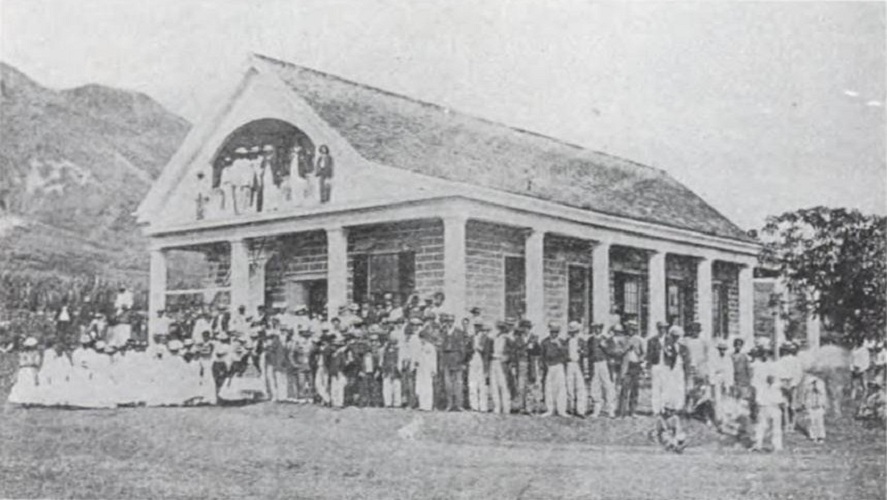
In the fall of 1887, preparations for the opening of the boys’ school were nearly complete. A workshop, dining hall, and the first two dormitories had been built at the Kaiwi‘ula campus, where the Bernice Pauahi Bishop Museum stands today.

An invitation had been sent to all Hawaiian boys over the age of 12 to take the admission test, and on October 3, thirty-seven boys arrived on campus to begin their schooling instruction.  (Armstrong-Wassel)

“King Kalākaua addressed the boys in Hawaiian and his remarks were then translated into English. He told the boys that ‘the name the school bears is the name of one who was famous first of all for habits of industry in the fields before he became famous as a warrior.’”

“He emphasized that it was not simply the work of the hands that would lead to success in life, but the intelligence for which His Majesty urged the boys to strive.” (Kilolani Mitchell, noted by Armstrong-Wassel)

“Bishop had supported industrial and moral education for the masses and elite English-standard education for the highest tier of society. His administration marked a turn toward manual and industrial education, as well as increased funding for English-medium education.”

“Although there was already a history of educating Kānaka in higher branches of academic pursuit, Bishop argued against education that failed to produce an industrial agricultural workforce.”  (Goodyear-Kaʻōpua)

Reverend William Brewster Oleson was hired from the Hilo Boarding School to become the first principal of the Kamehameha School for Boys at an annual salary of $3000.00 with house and pasturage.

Hilo Boarding school was the first manual labor type school in the Pacific.  It instituted a program of rural education based on the idea of learning by doing.  (Moe) Oleson brought that philosophy and program to Kamehameha.

By then, Hilo Boarding School was also the model for educating students at Hampton Institute in Virginia and Tuskegee Institute in Alabama.

The Kamehameha school was commonly known as the Manual Department or “The Manual.” (Beyer) The original name of the first school sponsored by the Bishop Estate was actually called the Manual Training School for Boys. (Broadbent)

Oleson penned the school song, “Sons of Hawai’i” together with Theodore Richards who adapts the tune from Yale’s “Wake, Freshman, Wake” and chose the school colors based on Yale school colors. (KSBE)

Oleson brought nine of his most prized pupils with him to Kamehameha Schools to create the school’s inaugural class.

Joining Oleson were WS Terry served as superintendent of shops, Mrs F Johnson was a matron, instructor Miss CA Reamer would later become the principal of the preparatory school and Miss LL Dressler also served as an instructor.  (KSBE)

At the opening ceremonies, “Prof Alexander on being asked for remarks expressed his regret that Hon C R Bishop who had such an interest in the school was absent on the Coast. The institution of a technical school had often been discussed in Honolulu.”

“He rejoiced that the wishes of the noble lady foundress had been so successfully carried out. Founded upon a rock the institution he hoped would long stand on the rock and that it would keep the memory of its foundress green until generations yet unborn should call her blessed.”  (Hawaiian Gazette, November 8, 1887)

A year later the Preparatory Department, for boys 6 to 12 years of age, opened in adjacent facilities.  (Organization of the Kamehameha School for Girls was delayed until 1894.)

During a visit to see General Samuel Chapman Armstrong, Hampton’s founder, Oleson picked up the idea of including military training in Kamehameha’s curriculum (1888.)  (Rath)

Officers were appointed by Oleson and were responsible for discipline and marching to and from town. Oleson was in charge of drills, but teachers joined in the marches to church or other meetings.  In September 1899, the boys wore their uniforms to class and drills.

An interesting side note relates to the role and relationship Pauahi and Liliʻuokalani had with William Owen Smith, the son of American Protestant missionaries.

During the revolutionary/overthrow period, Smith was one of the thirteen members of the Committee of Safety that overthrew the rule of Queen Liliʻuokalani (January 17, 1893) and established the Provisional Government and served on its executive council.

When not filling public office, Smith had been engaged in private law practice – Smith and his firm wrote the will for Princess Pauahi Bishop that created the Bishop Estate.

Pauahi recommended to Queen Liliʻuokalani that he write her will for the Liliʻuokalani Trust (which he did.) As a result, Liliʻuokalani and Smith became lifelong friends; he defended her in court, winning the suit brought against her by Prince Jonah Kūhiō.

© 2022 Ho‘okuleana LLC

Filed Under: General, Schools Tagged With: Kamehameha Schools, William Brewster Oleson ;, Hilo Boarding School, Manual Labor, The Manual

July 19, 2022 by Peter T Young Leave a Comment

Charles Reed Bishop

Born January 25, 1822 in Glens Falls, New York, Charles Reed Bishop was an orphan at an early age and went to live with his grandparents on their 120-acre farm learning to care for sheep, cattle and horses and repairing wagons, buggies and stage coaches. Academically, he only attended the 7th and 8th grades at Glens Falls Academy, his only years of formal schooling.

After leaving school, he becomes a clerk for Nelson J. Warren, the largest business in Warrensburgh, New York. He learned bartering, bookkeeping, taking inventory, maintenance and janitorial duties.  Bishop became an expert in barter, and ran the post office, lumber yard and farm. He becomes a capable businessman.

By January 1846, Bishop was ready to broaden his horizons. He and a friend, William Little Lee, planned to travel to the Oregon territory, Lee to practice law and Bishop to survey land.  They sailed aboard the ‘Henry’ from Newburyport, Massachusetts, around Cape Horn on the way to Oregon.

The vessel made a stop in Honolulu on October 12, 1846; both decided to stay.  (Lee later became the first Chief Justice of the Supreme Court for the Kingdom of Hawaiʻi.)

Bishop soon found work, first at Ladd and Company, a mercantile and trading establishment, then at the US Consulate in Honolulu. In 1849, Bishop signed an oath to “support the Constitution and Laws of the Hawaiian Islands” and was appointed collector of customs for the kingdom.

Bishop met Bernice Pauahi while she was still a student at the Chiefs’ Children’s School (they probably met during the early half of 1847,) and despite the opposition of Pauahi’s parents who wanted her to marry Lot Kapuāiwa (later, Kamehameha V,) Bishop courted and married Pauahi in 1850.  (His letters that mention Pauahi reveal a deep respect and affection for his wife and suggest she was a major source of his happiness throughout their 34-year marriage.)

Their home, Haleakala, became the “greatest centre of hospitality in Honolulu.” They graciously hosted royalty, visiting dignitaries, friends and neighbors as well as engaged in civic activities such as organizing aid to the sick and destitute and providing clothing for the poor.

Bishop was primarily a banker (he has been referred to as “Hawaiʻi’s First Banker.”)  An astute financial businessman, he became one of the wealthiest men in the kingdom from banking, agriculture, real estate and other investments.

However, his industrious nature and good counsel in many fields were also highly valued by Hawaiian and foreign residents alike. He was made a lifetime member of the House of Nobles and appointed to the Privy Council. He served Kings Kamehameha IV, Kamehameha V, Lunalilo and Kalākaua in a variety of positions such as: foreign minister; president of the board of education; and chairman of the legislative finance committee.

Bishop believed in the transforming power of education and supported a number of schools: Punahou, Mills Institute (now known as Mid–Pacific Institute), St Andrews Priory and Sacred Hearts Academy.  He not only contributed money to his causes, he provided sound advice and financial expertise.

He even sent presents of food or clothing to schools like Kawaiahaʻo Seminary at Christmas, “It is my wish that Mr. Raupp should send them plenty of mutton…also that they should have two turkeys or some ducks, some oranges and cakes…”

Next to her royal lineage, no other aspect of Pauahi’s life was as important to her fulfillment as a woman – and as the founder of the Kamehameha Schools – as her marriage to Charles Reed Bishop. He brought her the love and esteem she needed as a woman and the organizational and financial acumen she needed to ensure the successful founding of her estate.  (Kanahele)

Soon after Pauahi’s death in 1884 he wrote: “I know you all loved her, for nobody could know her at all well and not love her. For myself I will only say that I am trying to bear my loss and my loneliness as reasonably as I can looking forward hopefully to the time when I shall find my loved one again.”

Immediately after Pauahi’s death, Bishop, as one of first five trustees she selected to manage her estate and co-executor of her will, set in motion the process that resulted in the establishment of the Kamehameha Schools in 1887.  (The other initial trustees were Charles Montague, Samuel Mills Damon, Charles McEwen Hyde and William Owen Smith.)

Because Pauahi’s estate was basically land rich and cash poor, Bishop contributed his own funds for the construction of several of the schools’ initial buildings on the original Kalihi campus: the Preparatory Department facilities (1888,) Bishop Hall (1891) and Bernice Pauahi Bishop Memorial Chapel (1897.)

Bishop is best known for his generous contributions to his wife’s legacy, the Kamehameha Schools (when he died, he left most of his estate to hers,) and the founding of the Bernice Pauahi Bishop Museum (1889.)

In a letter to Samuel Damon, 1911, he noted, “Being interested in her plans…I decided to carry out her wishes regarding the schools and promised to do something toward a museum of Hawaiian and other Polynesian objects…in order to accomplish something quickly … I soon reconveyed to her estate the life interests given by her will and added a considerable amount of my own property…”

In 1894, Bishop left Hawai`i to make a new life in San Francisco, California. Until he died, he continued, through correspondence with the schools’ trustees, to guide the fiscal and educational policy-making of the institution in directions that reinforced Pauahi’s vision of a perpetual educational institution that would assist scholars to become “good and industrious men and women.” (Bernice Pauahi Bishop’s Will, 1883)

In 1895, Bishop established the Charles Reed Bishop Trust.  The beneficiaries of the Trust consist of 8-designated entities: Bernice Pauahi Bishop Museum, Maunaʻala, Central Union Church, Kaumakapili Church, Kawaiahaʻo Church, Kamehameha Schools, Mid-Pacific Institute (his original beneficiaries, Kawaiahaʻo Female Seminary and Mills Institute merged in 1907 to form Mid-Pac) and Lunalilo Trust.

By the time Pauahi died in 1884, Maunaʻala, the Royal Mausoleum in Nuʻuanu was crowded with caskets. Bishop built an underground vault for Pauahi and members of the Kamehameha dynasty.

Charles Reed Bishop died June 7, 1915; his remains rest beside his wife in the Kamehameha Tomb.  A separate monument to Charles Reed Bishop was built at Maunaʻala in 1916.   (Lots of information here is from KSBE.)

© 2022 Hoʻokuleana LLC

Filed Under: General, Ali'i / Chiefs / Governance, Prominent People, Schools, Economy Tagged With: Oahu, Mauna Ala, Chief's Children's School, Royal School, Bishop Museum, Bishop Bank, Bishop Street, Hawaii, Bernice Pauahi Bishop, Charles Reed Bishop, Kamehameha Schools

November 6, 2021 by Peter T Young 1 Comment

Portlock

Recent work that I have been involved with in the Portlock area on O‘ahu, reminded me of the namesake for the place, explorer and fur trader Nathaniel Portlock.

Nathaniel Portlock was born in about 1748 in Norfolk, Virginia, where his grandfather had emigrated, probably from the English south-west, around 1685. Nathaniel’s father died in 1752, leaving his wife Rebecca (formerly Ballard, who had previously been a widow with a daughter from a previous marriage).

Nathaniel’s father’s will left his property, and stay and board, to “my Daughter in Law Nancey Ballard a Negro … said children [Paul and Nathaniel] [and] their mother”.

After Portlock’s father’s death, his mother Rebecca quickly remarried a third time to a Richard Scott, who became guardian to her three surviving Portlock children and had others with her.

At about the age of 24, Nathaniel Portlock entered the British Royal Navy and was one of the loyal colonists of America, known as the “American Loyalists;” he later left that country on the close of the War of Independence.

(It is not clear what relationship a certain John Portlock had with Nathaniel; but John was born in 1765 in Shenandoah Co., Virginia and in 1781 volunteered to serve in the Virginia Regiment and fought and was “slightly wounded’ in the American Revolutionary War. It is an interesting situation if they are related.)

On March 30, 1776, he served as master’s mate on Captain James Cook’s third Pacific voyage aboard the Discovery. Portlock was transferred to the Resolution, also on the expedition, in August 1779.

Cook’s third and final voyage (1776-1779) of discovery was an attempt to locate a North-West Passage, an ice-free sea route which linked the Atlantic to the Pacific Ocean. Cook commanded the Resolution while Charles Clerke commanded Discovery. (State Library, New South Wales)

“Cook had chosen his subordinates well or had been lucky. The officers of the third voyage were a remarkably intelligent group of men.” (Captain Cook Society)

“All the great remaining voyages of the eighteenth century drew on Cook’s officers. Bligh, Portlock, Vancouver, Colnett, Riou, and Hergest all got their commands and served with great distinction. These men then passed on their skills to a second generation of men such as Flinders and Broughton.” (Mackay, Captain Cook Society)

Nathaniel Portlock and George Dixon, observed the commercial benefits that the development of the fur trade in the region could bring. In 1785, a group of London merchants formed the “King George’s Sound Co” (also known as Richard Cadman Etches and Company).

They proposed to carrying on the fur trade from the western coast of America to China, bringing home cargoes of tea from Canton for the East India Company. They bought two boats; Portlock and Dixon were selected to sail them (Dixon also previously sailed with Cook to Hawai‘i) and they set off on an expedition to North America to establish a foothold for fur trappers.

Portlock commanded the 1785-1788 expedition from the ship King George, while Dixon captained the Queen Charlotte. The purpose of the expedition was to investigate the potential of the Alaskan fur trade and to resume Cook’s search for a Northwest Passage through the continent.

The pair left England on August 29, 1785, and took nearly a year to reach Alaska, rounding Cape Horn and touching at Hawaiʻi on the way, first arriving off the coast of Kaʻū, May 24, 1786.

These were the first English ships to reach Hawai‘i following Captain Cook’s first arrival there in 1778. During the course of their 3-year expedition, they made three trips to Hawaiʻi.

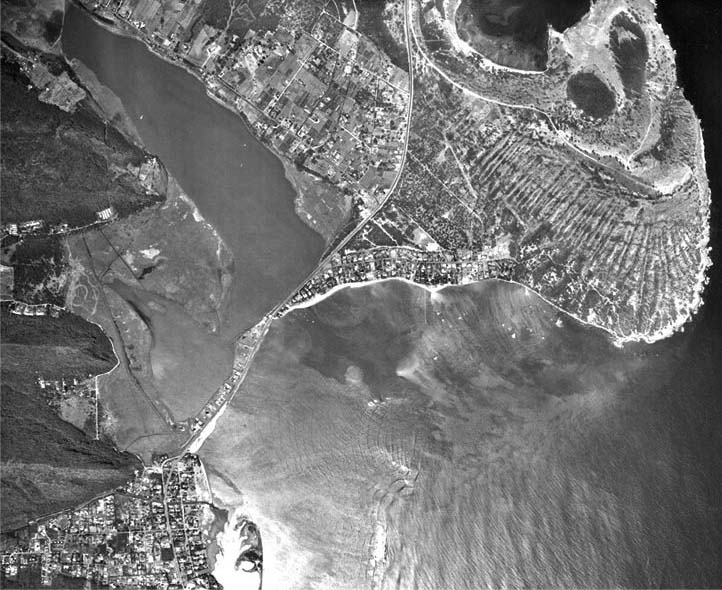
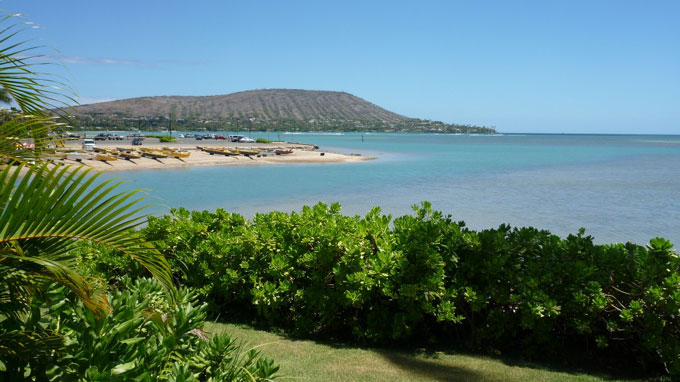
A favorite anchorage on Oʻahu for Portlock was at Maunalua Bay (which Portlock named King George’s Bay). He named the Waikiki area (Diamond Head to Honolulu) Queen Charlotte’s Bay.

The East point of the Maunalua Bay (Koko Head) Portlock named Point Dick, “in honour of Sir John Dick, the first patron of this voyage,”) and the West point (Diamond Head) that Portlock named “Point Rose, after George Rose Esq. secretary of the treasury, the second worthy patron of our undertaking.” (Portlock)

Portlock also mentioned what is probably Kuapā Pond that he described as, “a little salt water river that has a communication with King George’s Bay.”

Portlock wrote about the early challenges of getting fresh drinking water in the region as they “found that we could not water at this place without an infinite deal of trouble …”

“… besides the danger of losing our casks, getting the boats dashed to pieces against the rocks, and the inconvenience of carrying our casks so far amongst a multitude of Indians, which would make it necessary to have an armed force on shore.”

“Towards evening the surgeon returned on board with the convalescents, and informed me, that the inhabitants had behaved in a very quiet inoffensive manner, though they were rather incommoded by the multitudes which curiosity brought about them.”

“By this time all our water from the ground tier was got to hand, and the cables coiled down. The inhabitants now brought us water in such plenty, that by noon on the 4th all our empty casks were filled”.

He noted, “As good water in any quantity may be procured at this island with the greatest facility for small nails and buttons, it undoubtedly must be the safest and most expeditious method any person can adopt who may chance to touch here, to barter for their water in the manner we did.” (Portlock)

“No chiefs of consequence paid us a visit as yet: the inferior chiefs indeed came on board without any scruple, and some of them slept with us every night. Amongst rest I had a daily visit from an old priest, who always brought by way of present, a small pig, and a branch of the cocoa-nut·tree.” (Portlock)

Maunalua was thought to be well-populated in ancient times. Maunalua was known for its offshore fishing resources, a large fishpond, and sweet potato cultivation. Taro was farmed in wet areas, sweet potato was grown in the drier regions and a series of fishing villages lined the coast. (McElroy) Part of that area now carries the Portlock name.

© 2021 Hoʻokuleana LLC

Filed Under: Prominent People, Sailing, Shipping & Shipwrecks, Economy Tagged With: Kamehameha Schools, Oahu, Captain Cook, Leahi, Diamond Head, Maunalua Bay, Portlock, Nathaniel Portlock, Maunalua, Hawaii

December 19, 2019 by Peter T Young Leave a Comment

Founder’s Day

Pauahi Pākī was born on December 19, 1831 in Honolulu, Hawai‘i to high chiefs Abner Pākī and Laura Kōnia Pākī. She was the great-granddaughter of Kamehameha I. (KSBE)

Pauahi was hānai (adopted) to her aunt, Kīnaʻu (the eldest daughter of Kamehameha, who later served as Kuhina Nui as Kaʻahumanu II, a position similar to a Prime Minister.) Pauahi lived with Kīnaʻu for nearly eight years, then Kīnaʻu died suddenly of mumps (April 4, 1839.)

High Chief Caesar Kapaʻakea and his wife High Chiefess Analeʻa Keohokālole had three children, a daughter was Lydia Liliʻu Kamakaʻeha (born September 2, 1838.)

Liliʻu was hānai (adopted) to the Pākīs, who reared her with their birth daughter, Pauahi. The two girls developed a close, loving relationship.

“…their only daughter, Bernice Pauahi … was therefore my foster-sister. … I knew no other father or mother than my foster-parents, no other sister than Bernice.” (Lili‘uokalani)

They lived on the property called Haleʻākala, in a two-story coral house that Pākī built on King Street. It was the ‘Pink House,’ (the house was name ʻAikupika (Egypt.)) It later became the Arlington Hotel.

The girls attended the Chief’s Children’s School, a boarding school, and were known for their studious demeanor. Founded in 1839 during the reign of King Kamehameha III, the original Chief’s Children’s School was on what is now the capitol grounds.

Mr. and Mrs. Amos Cooke, missionaries from New England, were commissioned to teach the 16 royal children (others who joined the Pākī sisters were Alexander Liholiho (later Kamehameha IV,) Lot Kapuāiwa (later Kamehameha V,) Queen Emma, King William Lunalilo and Liliʻu’s brother, David (later King Kalākaua.) In 1846 the school’s name was officially changed to Royal School; it was opened to the general public in 1851.

In 1850, at the age of 19, Pauahi married Charles Reed Bishop, a young American businessman who had made his way to the Kingdom of Hawai‘i from Glens Falls, New York.

Charles became a pillar in the kingdom government and was a successful businessman, banker and philanthropist. He and Pauahi enjoyed traveling the world with particular fondness for museums and art. With no children of their own, they shared a deep commitment for the well-being and education of kamali‘i — young ones. (KSBE)

When her cousin, Princess Ruth Keʻelikōlani, died, Keʻelikōlani’s will stated that she “give and bequeath forever to my beloved younger sister (cousin), Bernice Pauahi Bishop, all of my property, the real property and personal property from Hawaiʻi to Kauaʻi, all of said property to be hers.”

The total land bequest included about 353,000 acres. Keʻelikōlani had previously inherited all of the substantial landholdings of the Kamehameha dynasty from her brother, Lot Kapuāiwa (King Kamehameha V.)

Bernice Pauahi died childless on October 16, 1884. She foresaw the need to educate her people and in her will she left her large estate of the Kamehameha lands in a trust “to erect and maintain in the Hawaiian Islands two schools, each for boarding and day scholars, one for boys and one for girls, to be known as, and called the Kamehameha Schools.”

She further stated, “I desire my trustees to provide first and chiefly a good education in the common English branches, and also instruction in morals and in such useful knowledge as may tend to make good and industrious men and women”.

Bernice Pauahi Bishop, by founding the Kamehameha Schools, intended to establish institutions which should be of lasting benefit to her country; and also to honor the name Kamehameha.

After Pauahi’s death, Charles as president of the Bernice Pauahi Bishop Estate’s board of trustees, ensured that his wife’s wish was fulfilled. He generously provided his own funds for the construction of facilities and added some of his own properties to her estate.

Until his death in 1915, he continued to guide her trustees in directions that reinforced her vision of a perpetual educational institution that would build a vibrant future for her people. (KSBE)

Today, December 19, is Pauahi’s birthday; it is also known as Founder’s Day at Kamehameha Schools.

Follow Peter T Young on Facebook 

Follow Peter T Young on Google+ 

Follow Peter T Young on LinkedIn  

Follow Peter T Young on Blogger

© 2019 Hoʻokuleana LLC

Bernice_Pauahi_Bishop-HerbKane

Filed Under: Prominent People, Schools, Ali'i / Chiefs / Governance Tagged With: Hawaii, Bernice Pauahi Bishop, Charles Reed Bishop, Kamehameha Schools, Liliuokalani, Queen Liliuokalani, Princess Ruth Keelikolani, Pauahi

  • « Previous Page
  • 1
  • 2
  • 3
  • 4
  • 5
  • 6
  • Next Page »

Images of Old Hawaiʻi

People, places, and events in Hawaiʻi’s past come alive through text and media in “Images of Old Hawaiʻi.” These posts are informal historic summaries presented for personal, non-commercial, and educational purposes.

Info@Hookuleana.com

Connect with Us

  • Email
  • Facebook
  • LinkedIn
  • Twitter
  • YouTube

Recent Posts

  • About the Time of Columbus
  • Hawaiian Challenge
  • Liquids Coordinator
  • Lāhainā Canal
  • Boondocks
  • About 250 Years Ago … Battle of Kings Mountain
  • Cow Laws

Categories

  • Economy
  • Voyage of the Thaddeus
  • Mayflower Summaries
  • American Revolution
  • General
  • Ali'i / Chiefs / Governance
  • Buildings
  • Missionaries / Churches / Religious Buildings
  • Hawaiian Traditions
  • Military
  • Place Names
  • Prominent People
  • Schools
  • Sailing, Shipping & Shipwrecks

Tags

Albatross Al Capone Ane Keohokalole Archibald Campbell Bernice Pauahi Bishop Charles Reed Bishop Downtown Honolulu Eruption Founder's Day George Patton Great Wall of Kuakini Green Sea Turtle Hawaii Hawaii Island Hermes Hilo Holoikauaua Honolulu Isaac Davis James Robinson Kamae Kamaeokalani Kameeiamoku Kamehameha Schools Lalani Village Lava Flow Lelia Byrd Liberty Ship Liliuokalani Mao Math Mauna Loa Midway Monk Seal Northwestern Hawaiian Islands Oahu Papahanaumokuakea Marine National Monument Pearl Pualani Mossman Quartette Thomas Jaggar Volcano Waikiki Wake Wisdom

Hoʻokuleana LLC

Hoʻokuleana LLC is a Planning and Consulting firm assisting property owners with Land Use Planning efforts, including Environmental Review, Entitlement Process, Permitting, Community Outreach, etc. We are uniquely positioned to assist you in a variety of needs.

Info@Hookuleana.com

Copyright © 2012-2024 Peter T Young, Hoʻokuleana LLC

Loading Comments...