Images of Old Hawaiʻi

  • Home
  • About
  • Categories
    • Ali’i / Chiefs / Governance
    • American Protestant Mission
    • Buildings
    • Collections
    • Economy
    • Missionaries / Churches / Religious Buildings
    • General
    • Hawaiian Traditions
    • Other Summaries
    • Mayflower Summaries
    • Mayflower Full Summaries
    • Military
    • Place Names
    • Prominent People
    • Schools
    • Sailing, Shipping & Shipwrecks
    • Voyage of the Thaddeus
  • Collections
  • Contact
  • Follow
You are here: Home / Categories

January 3, 2023 by Peter T Young Leave a Comment

Palolo Municipal Golf Course

The first public golf course in the US was the Van Cortlandt Golf Course in the Bronx, New York in 1895.  Since that time many other cities developed their own facilities both for local use and the tourist industry.

Honolulu’s first golf course was a private course built by Samuel Damon in 1898 at Moanalua Valley.  Built four miles beyond the nearest trolley line (which ended at Pālama), it was too far outside of town to use for those without private transportation.

Another private course, located in Manoa Valley, was begun in 1904, as well as O‘ahu Country Club opened in 1906 and Waialae in 1928.

Planning for a Honolulu municipal golf course was underway in 1925.  The City Planning Commission wanted a location that was not too far away from the center of the population that had access from the transit system.

They decided to concentrate their efforts for a site in Kalihi, but the price was unmanageable.  “In March 1926 Palolo Valley landowners CF Wright and CA Long approach the [Planning] Commission with a proposal to sell their land to the City for a golf course site at 8 cents per square foot”.

“The Commission decided to recommend that the Board of Supervisors [equivalent to what we call the City Council] take advantage of the Palolo Valley site for an eighteen hole golf course.” (Stephenson)

“[T]he City Planning Commission on May 13, 1926, decided to formally endorse the Palolo Valley golf course site to the City Board of Supervisors. … On December 6, 1931, the Palolo Municipal Golf Course was officially opened.” (Stephenson)

“Honolulu’s new municipal golf course, a nine-hole layout off Palolo avenue, will be thrown open to the public today with a team match bringing together the best golfers on this island as the attractions.”

“The match begins promptly at 8 am, and the players will start off in fivesomes, representing teams of Haoles, Hawaiians, Japanese, Chines and the Braves.”  (Honolulu Advertiser, December 6, 1931) “Senator Francis Brown, one of Hawaii’s best golfers, will shoot the first ball”. (Star Bulletin, Dec 5, 1931)

“You turn off Waialae road onto the Palolo belt road which branches off Waialae opposite the King’s Daughter’s home. You then drive straight up the valley on the Palolo road, the links being on the right hand side of the road about a mile from Waialae.” (Star Bulletin, Dec 5, 1931)

“Eventually the Palolo course should be extended to 18 holes.  As it is now Honolulu has a regulation nine hole municipal course.”

“This is a fine start and it won’t be long before the links start bringing money into the revolving fund, even with the low fees that are to be charged.” (Star Bulletin, Deb 9, 1931)

“The demise of the Palolo Municipal Golf Course began during World War II.  On September 22, 1944, the Honolulu City Planning Commission granted variances from existing zoning regulations to allow construction of temporary prefabricated houses on 2400 to 2500 square foot plots on the golf course.”

“This was done to help alleviate the existing wartime housing shortage.  The continued shortage of housing precluded reopening the golf course.”  (Stephenson)

Interest then went to the Territorial Fair Grounds, just mauka of the Ala Wai Canal, and the ultimate expansion of the Ala Wai Golf Course as the municipal course.

The first Territorial Fair was held during June 10-15, 1918; over a six-day period, one hundred and eighteen thousand tickets of admission were sold.  With that initial success, the Chamber sought “A Bigger and Better Fair.”

A second fair was held June 9-14, 1919.  “Help Win the War!” was the slogan that made the first Fair a success and it was based on common sense and a real need.

In 1921, the Territorial legislature appropriated funds from the “general revenues of the Territory of Hawaii for the purpose of purchasing and improving land to be used for territorial fair and amusement park purposes.”

A site was selected and “set aside for territorial fair and amusement park purposes that portion of the government lands lying mauka of the proposed Waikiki drainage canal (Ala Wai) and adjacent to Kapahulu road.”

Then field work was undertaken for the Fair Commission in connection with improvements of the fairgrounds and amusement park: polo field and race track; grandstand site was surveyed; two baseball diamonds and two indoor baseball diamonds were staked out.

The Territorial fair continued for a number of years.  However, it’s not clear why the use of the site transitioned from a Fair Grounds to something else – but a transition appears apparent, starting in 1923.

Reportedly, golf started at the Fair Grounds in 1923, when someone placed a salmon can down as its first hole.  A year later, three more holes were built for a total of four.  By 1931 five more holes were designed and it became a nine-hole course.   It was renamed the Ala Wai Golf Course.

The second nine was added in 1937, and the original clubhouse followed in 1948. In the 1980s, a new water feature was added and the course was also fitted with a new sprinkler system. The driving range was relocated to make room for expansion of the Honolulu Zoo in 1989 and, finally, a new clubhouse was built in 1990.

© 2023 Ho‘okuleana LLC

Filed Under: General Tagged With: Hawaii, Palolo, Ala Wai Golf Course, Golf, Palolo Municipal Golf Course

January 2, 2023 by Peter T Young Leave a Comment

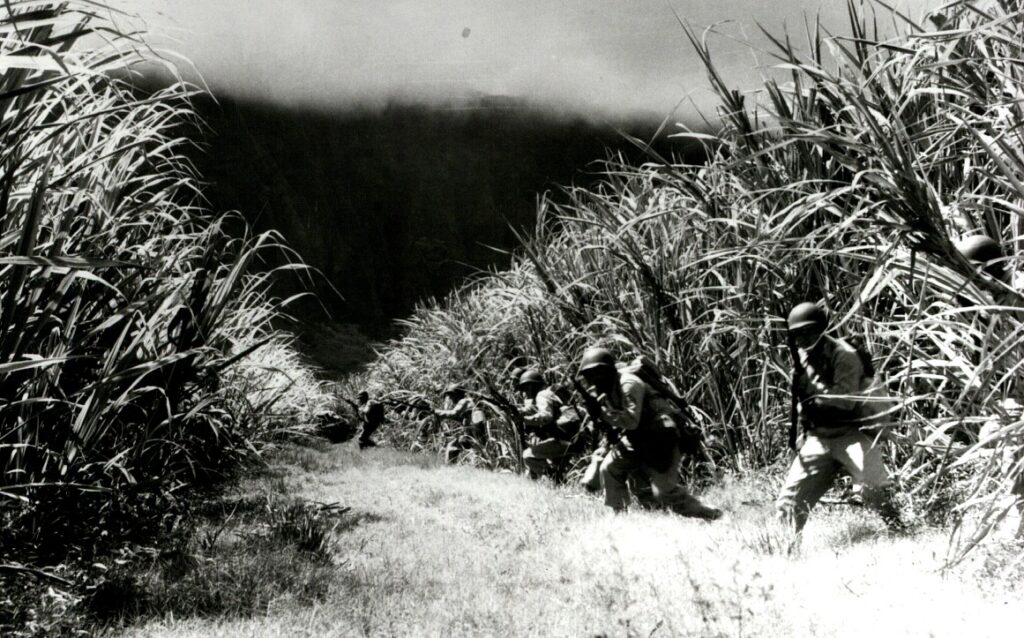
Pacific Jungle Combat Training Center

Prior to World War II, Kahana and Punalu‘u Valleys were primarily used for agricultural activities.  Taro, rice, and sugar cane were cultivated at the mouths of each valley.  The interior portions of the valleys were heavily vegetated and relatively unused.

The Army initially leased 485.25 acres in Kahana Valley from Hui of Kahana in November 1944, retroactive to May 1943.  Between 1943 and 1947, the Army acquired an additional 1,781.52 acres in the neighboring Punalu‘u Valley from various landowners through leases, licenses, and permits.

In response to an August 9, 1943 directive from the Commanding General, Hawaiian Department, Pacific Jungle Combat Training Center (CTC) was established as a school on Oahu to supplement Department Ranger and Combat School training.

It was located on the northeastern side of the island of Oahu totaling approximately 2,545 acres in the adjacent valleys of Punalu‘u and Kahana in the district of Ko‘olauloa.

Pacific Jungle CTC was also known as Unit Jungle Training Center, Unit Combat Training Center, Pacific Combat Training Center, Jungle Training, Punaluu Training Camp and Green Valley Jungle Training Camp.

Punalu‘u Valley being referred to as “Green Valley” by the Army while Kahana Valley was designated “Red Valley” during utilization of the valleys as a training area.

An Army-built coral-surfaced service road is still referred to as “Green Valley Road” by area residents. This road is also designated by Oahu Civil Defense Agency as an evacuation route to allow coastal inhabitants access to higher ground in the event of a tsunami.

Beginning in September 1943 (during World War II), this property was used as a unit-level jungle combat training center.  The Center was divided into three courses: Red, Blue, and Green.

Basic warfare training was conducted at the Red and Blue courses while advanced warfare training and Instructor Jungle Training School were conducted at the Green course.

Subjects taught during a one-week course included jungle first aid and evacuation, hand-to-hand combat training, construction and passage of wire entanglements, booby traps, patrolling and ambushing, assault of Japanese fortified areas, combat reaction proficiency, and jungle living.

The Army reportedly constructed Japanese villages and pillboxes for training purposes.  Temporary barracks, a mess hall, a bakery, and shower facilities were also erected though no longer exist.

Advanced training on Green Course was discontinued on 28 May 1944 after only its second class as it became necessary to utilize the course for basic jungle warfare training of divisions being staged for the Western Carolines operations.

Jungle warfare was de-emphasized as the war progressed from tropical regions to areas where jungle fighting was not a primary consideration.

All jungle training centers became known as Unit Combat Training Centers in March 1945. On month later, it was redesignated as Pacific Combat Training Center to deemphasize jungle warfare.  Over 241,000 men received basic, advance, or instructor training at the center.

Munitions known to have been used or recovered at the site include 75mm armor piercing rounds, 2.36-inch rockets, MKII hand grenades, rifle grenades, 105mm high explosive rounds, 81mm high explosive and practice mortar rounds, and small arms.

Postwar plans called for closing the majority of the center except for the Green Course in Punalu‘u Valley, which was to be retained to fulfill the Army’s postwar training requirements.

The Army re-opened Punalu‘u Valley on April 1, 1946 to provide emergency shelter for area residents displaced by a tsunami.  Tents were erected for sleeping quarters, to render medical treatment, and to feed approximate 1,700 individuals.

Parcels in Kahana Valley were returned to previous landowners in August 1946.  The leases, licenses, and permits for parcels in Punalu‘u Valley terminated between April 1945 and November 1950 and were reverted back to previous owners.

The Punalu‘u Valley parcels are primarily owned by Kamehameha Schools.  The Kahana Valley parcels are now owned by the State of Hawai‘i and managed by the DNLR, Division of State Parks.

The Kahana Valley parcels are located in the Ahupuaʻa ʻO Kahana State Park. The park was established as a “living park” with the primary purpose to nurture and foster native Hawaiian cultural traditions and the cultural landscape of rural windward Oahu.   (All here is from the Army Corps of Engineers.)

© 2023 Ho‘okuleana LLC

Filed Under: Military Tagged With: Ahupuaa O Kahana State Park, Pacific Jungle Training Center, Punaluu, Kahana, Army, Marines, Navy

January 1, 2023 by Peter T Young 1 Comment

Happy New Year!!!

When we were kids, we weren’t allowed to set off fireworks.

Our parents told us our uncle had lost an eye and they wanted to make sure that didn’t happen to us.

It never dawned on me, then; but, I never had an uncle with one eye … hmmm.

I still can’t believe we bit that one. (It is right up there with my sister convincing her kids that it was “white chocolate milk” in their glasses.)

Anyway, we only did sparklers – now, you can’t even do that.

I realize it is simply a change in the movement on the clock and the turning of the page on the calendar, but we still celebrate this change with anticipation and optimism.

Happy New Year, everyone!!!

Happy New Year

Filed Under: General Tagged With: Hawaii

December 31, 2022 by Peter T Young 1 Comment

Queen Kapiʻolani

Julia Napelakapuokakaʻe Kapi‘olani was born on December 31, 1834 in Hilo, Hawaiʻi. Her father was high chief Kūhiō, and her mother Kinoiki was the daughter of King Kaumualiʻi of Kauaʻi (who negotiated peace with Kamehameha I to unify the islands in 1810.) (KCC)

“Kapiʻolani remained in Hilo the place of her birth until she was eight years of age. She was then sent to Kona, the home of some of the highest chiefs that have ruled people in these islands.”

“Kona was the home of Kapiʻolani (nui) wife of Naihe and a relative of the family …. Although Kapiʻolani (nui) was not living at the time, the young chiefess was given her name.” (Evening Bulletin, June 24, 1899)

On March 8, 1852, “At the age of 16 Kapiʻolani came to Honolulu and was taken under the protection of Kauikeaouli (King Kamehameha III.) Four years later, she married the High Chief Nāmākehā.” (Evening Bulletin, June 24, 1899)

Bennet Nāmākehā – a man thirty-five years her senior – was brother of Naʻea (Queen Emma’s father.) “Queen Kapiʻolani had been aunt to Queen Emma … and had nursed the young prince, the son of Alexander Liholiho (King Kamehameha IV,) although her rank not only equaled, but was superior to, that of Queen Emma, the child’s mother.” (Lili‘uokalani)

For his health the young couple voyaged for months on The Morning Star, an American Protestant missionary vessel, among the Gilbert Islands, but in vain, for Nāmākehā died on December 27, 1860, at Honolulu. He was buried at the Wylie Crypt at Mauna ‘Ala (Royal Mausoleum.) (Kravitz)

Later, efforts were underway to arrange a marriage between Alexander Liholiho’s sister, Victoria Kamāmalu, and David Kalākaua. (Kanahele) Kalākaua was, however, attracted to Kapiʻolani. On December 8, 1863, Kalākaua’s romance with Julia Kapiʻolani crystallized, and they were married in a quiet, secret ceremony by an Episcopal minister. (Kelley)

David Kalākaua was elected to replace the deceased King Lunalilo in 1874, making Kapiʻolani Queen to King Kalākaua. Kapiʻolani was a visible monarch. Queen Kapiʻolani reigned for nearly seventeen years. (KCC)

“It was in her home life that the Queen’s womanly qualities shone to the best advantage. Sweetness and amiability, with a soft gentleness of voice and manner to all who approached her, were her chief characteristics. She had a smile for everyone.”

“In the happy old palace days her favorite pastime was to sit under the shade of the great banyan tree, in the back of the palace yard, with her ladies in waiting, lounging lazily on the grass around her, and tease them about their sweethearts or worm a confession out of this or that timid one jealously guarding the secret of her heart.”

“She went very little into society and appeared in public usually only when her presence was necessary at state dinners, balls and other functions of royalty.” (Austin’s Hawaiian Weekly, July 1, 1899)

In April 1887, Queen Kapiʻolani and Princess Liliʻuokalani traveled to England to participate in the celebration of Queen Victoria’s Golden Jubilee. They first sailed to San Francisco, traveled by train across the North American continent, spent some time in Washington and New York; they then sailed to England.

Upon their return from Europe, Queen Kapiʻolani and her entourage stopped again in Washington, DC. At that time, they toured the National Museum, later to become the Smithsonian Museum of Natural History. As a result of that visit, Queen Kapiʻolani gifted the museum with a Hawaiian outrigger canoe to add to their collection. (OHA)

Kapiʻolani made headlines when President and Mrs Grover Cleveland hosted a formal state dinner at the White House in her honor.

She also visited schools, hospitals, and other public institutions in San Francisco, Washington DC, Boston, and New York. As the first queen to visit the United States, her activities received extensive coverage in various U.S. newspapers. (KCC)

“During the political difficulties associated with the overthrow of the monarchy, and final annexation of Hawaiʻi to the United States, she has, with dignity, …”

“… kept herself free from all complications, accepting with sorrow and resignation the loss of Hawaiian nationality. Her attitude was so lofty and dignified that it wins the sympathy even of her political enemies.” (Austin’s Hawaiian Weekly, July 1, 1899)

In 1891, King Kalākaua passed away at the age of fifty-four. Since the royal couple bore no children, the king’s sister Lili‘uokalani succeeded the throne. (KCC)

“Shortly after the death of King Kalākaua in San Francisco, January, 1891, the Queen went into retirement, making the Waikiki place her permanent home but travelling about among the Islands and particularly to her old home in Kailua, Kona, from time to time.”

“It was not long ago after the King’s death that Kapiʻolani began to fail in health and she never succeeded at any time since then in fully recovering it.”

“A short time (later) she made over all her property, a considerable amount, to her two nephews, the Princes David Kawānanakoa and Cupid Kalanianaʻole (Kūhiō) who are her sole heirs.”

“To these young men she was ever a loving and indulgent aunt. It was her money that paid for the education of the young men in America and England and it is to them now that she leaves all her earthly belongings.”

“Kapiʻolani was Christian woman whose good deeds were not confined to the bosom of her family but were extended to her friends and her people. Those who were closest to her say she had not a single enemy.”

“This is indeed an enviable record and the peace that was with her at death seems but a fitting end to such a life.” (Evening Bulletin, June 24, 1899) At sixty-four years of age, she died on June 24, 1899 at Pualeilani, her modest home in Waikiki. (KCC)

Kapiʻolani Park in Waikiki was named in honor of her. She visited Kalaupapa in 1884 to learn how she could assist those who were diagnosed with leprosy and exiled there, and she raised the funds to build the Kapiʻolani Home for Girls whose parents had leprosy.

Though childless, the Queen cherished the Hawaiian family and the role of mother. In 1890, she established the Kapiʻolani Maternity Home, which is today the Kapiʻolani Medical Center for Women and Children. (KCC)

© 2022 Hoʻokuleana LLC

Queen Kapiolani wearing her coronation gown-PP-97-14-001-1883
Kapiolani-PP-97-15-021-1875
Kapiolani-PP-97-15-015-1887
Kapiolani-PP-97-15-020-1875
Kapiolani-PP-97-15-012-1880s
Kapiolani-Iolani_Palace-PP-97-14-016
Queen Kapiolani Statue
Kapiolani Park-PP-65-10-020-00001
Kapiolani Hospital-PP-40-7-015-00001-1934
USS Atlanta - manning the yards in honor of Queen Kapiolani, Brooklyn, NY-PP-97-15-009-1887
USS Atlanta – manning the yards in honor of Queen Kapiolani, Brooklyn, NY-PP-97-15-009-1887
Kapiolani Funeral-PP-26-1-002-00001
Kapiolani Funeral-PP-25-10-001-00001

Filed Under: Ali'i / Chiefs / Governance Tagged With: Kalakaua, Kapiolani, King Kalakaua, Hawaii

December 30, 2022 by Peter T Young Leave a Comment

Mount Kaʻala

The Waiʻanae Mountains, formed by volcanic eruptions nearly four-million years ago, have seen centuries of wind and rain, cutting huge valleys and sharp ridges into the extinct volcano.  Mount Kaʻala, the highest peak on the island of Oʻahu, rises to 4,025 feet.

Today, only a small remnant of the mountain’s original flat summit remains, surrounded by cliffs and narrow ridges. It’s often hidden by clouds.

Mount Kaʻala is mentioned in Hawaiian mythology as a mountain that the goddess Hiʻiaka, the sister of Pele, climbed on her way back to the island of Hawai‘i from Kaua‘i. From there she saw the destruction that Pele, enraged over her long absence, created by causing a flow of lava over her lands in Puna.

According to Hawaiian traditions, the Kaʻala bog, on the west side of the summit, was once a freshwater pond used as a fishpond. Kamaoha was the goddess of this pond in which shore fish and a kind of mullet were caught. The informant who reported the pond to McAllister called it a luakini fishpond (1933), which might indicate its use only by chiefs.  (TetraTech)

When viewed from Kūkaniloko, the sun sets directly behind the summit of Mount Kaʻala at the vernal and autumnal equinoxes. Thus, it has been suggested that these places may have been of importance in Hawaiian astronomy and calendric determinations. (TetraTech)

Kaʻala is the subject of several ʻŌlelo Noʻeau.

“Ka ua Kolowao o Kaʻala.
The Mountain-creeper rain of Kaʻala.
This rain is accompanied by a mist that seems to creep among the trees.”

Ancient Kahuna spoke of Mount Kaʻala as being clothed in the golden cloak of Kāne, the first deity of the Hawaiian pantheon. Kaʻala was the guardian of the road to the west, the path of the sun, the resting place on that great road to death where spirits of the dead return to their homeland.  (CZM)

Several ʻŌlelo No’eau speak of Kaiona, goddess of Kaʻala and the Waiʻanae Mountains.

Ka wahine hele la o Kaiona, alualu wai li‘ulā o ke kaha pua ‘ōhai.
The woman, Kaiona, who travels in the sunshine pursuing the mirage of the place where the ‘ōhai blossoms grow.

Ke kaha ‘ōhai o Kaiona.
Kaiona’s place where the ‘ōhai grows.

He lokomaika‘i ka manu o Kaiona.
Kind is the bird of Kaiona.
Said of one who helps a lost person find his way home.

Kaiona was known for her kindness and helpfulness. She rescued travelers who lost their way while crossing her mountain home by sending an ʻiwa bird to guide lost individuals to safety. This goddess was so beloved by Hawaiians that her name was given to Bernice Pauahi Bishop in mele that honor Pauahi.

In 1970, Hawaiʻi became one of the first states in the country to recognize the importance of its unique natural resources by establishing the State Natural Area Reserves System (NARS.)

Then, in 1981, the 1,100-acre Mount Kaʻala Natural Area Reserve was established to protect the diversity of native ecosystems, including native shrublands, forests and a bog.  (DLNR)

Most of the 1,100-acres of the state natural area reserve at Mount Kaʻala are made up of rugged terrain, including steep, inaccessible gulches. It ranges from wet forest at the top, to lowland dry forest.

The Mount Kaʻala NAR protects Hawaiian plants and animals and ecosystems, most found only in Hawai`i, and some very rare. The only vehicle access is a controlled government road, while arduous ridge trails lead to the summit of Mt. Kaʻala.

There, a boardwalk trail takes you on a walk through a native cloud forest. The boardwalk allows visitors to explore the misty flats of Kaʻala safely, and with a minimum of impact to the fragile plants and animals.

Protection of Mt. Kaʻala Natural Area Reserve’s watershed forests by restoring native forest ecosystems is critical for maintaining the water supply of West and Central Oahu. Volunteers reintroduced the critically endangered kamakahala – with fewer than 100 individuals remaining in the wild – to its native habitat in the ridges of Mt. Kaʻala.

(The FAA maintains an active tracking station at the summit, which is closed to the general public and secured by the US Army from Schofield Barracks. The tracking station can be clearly seen from afar as a white domed shaped structure.)

© 2022 Hoʻokuleana LLC


Filed Under: Place Names Tagged With: Hawaii, Oahu, Kukaniloko, Kaala, Natural Area Reserve, Waianae, Nanakuli, Makaha, North Shore

  • « Previous Page
  • 1
  • …
  • 216
  • 217
  • 218
  • 219
  • 220
  • …
  • 664
  • Next Page »

Images of Old Hawaiʻi

People, places, and events in Hawaiʻi’s past come alive through text and media in “Images of Old Hawaiʻi.” These posts are informal historic summaries presented for personal, non-commercial, and educational purposes.

Info@Hookuleana.com

Connect with Us

  • Email
  • Facebook
  • LinkedIn
  • Twitter
  • YouTube

Recent Posts

  • Benjamin Franklin Dillingham
  • Hollister Drug
  • Easter
  • The Alii, the Missionaries and Hawaii
  • Canec
  • Flying the American Flag
  • April Fool

Categories

  • Place Names
  • Prominent People
  • Schools
  • Sailing, Shipping & Shipwrecks
  • Economy
  • Voyage of the Thaddeus
  • Mayflower Summaries
  • American Revolution
  • General
  • Ali'i / Chiefs / Governance
  • Buildings
  • Missionaries / Churches / Religious Buildings
  • Hawaiian Traditions
  • Military

Tags

Albatross Al Capone Ane Keohokalole Archibald Campbell Bernice Pauahi Bishop Charles Reed Bishop Downtown Honolulu Eruption Founder's Day George Patton Great Wall of Kuakini Green Sea Turtle Hawaii Hawaii Island Hermes Hilo Holoikauaua Honolulu Isaac Davis James Robinson Kamae Kamaeokalani Kameeiamoku Kamehameha Schools Lalani Village Lava Flow Lelia Byrd Liberty Ship Liliuokalani Mao Math Mauna Loa Midway Monk Seal Northwestern Hawaiian Islands Oahu Papahanaumokuakea Marine National Monument Pearl Pualani Mossman Quartette Thomas Jaggar Volcano Waikiki Wake Wisdom

Hoʻokuleana LLC

Hoʻokuleana LLC is a Planning and Consulting firm assisting property owners with Land Use Planning efforts, including Environmental Review, Entitlement Process, Permitting, Community Outreach, etc. We are uniquely positioned to assist you in a variety of needs.

Info@Hookuleana.com

Copyright © 2012-2024 Peter T Young, Hoʻokuleana LLC


Loading Comments...