Images of Old Hawaiʻi

  • Home
  • About
  • Categories
    • Ali’i / Chiefs / Governance
    • American Protestant Mission
    • Buildings
    • Collections
    • Economy
    • Missionaries / Churches / Religious Buildings
    • General
    • Hawaiian Traditions
    • Other Summaries
    • Mayflower Summaries
    • Mayflower Full Summaries
    • Military
    • Place Names
    • Prominent People
    • Schools
    • Sailing, Shipping & Shipwrecks
    • Voyage of the Thaddeus
  • Collections
  • Contact
  • Follow
You are here: Home / Categories

January 19, 2023 by Peter T Young Leave a Comment

Whigs and Tories

Parliament (from Old French: parlement; Latin: parliamentum) is the original legislative assembly of England, Scotland, or Ireland and successively of Great Britain and the United Kingdom.  The British Parliament consists of the sovereign, the House of Lords, and the House of Commons.

Originally meaning a talk, the word was used in the 13th century to describe after-dinner discussions between monks in their cloisters.

In the 13th century, King Edward I (1272–1307) called joint meetings of two governmental institutions: the Magnum Concilium, or Great Council, comprising lay and ecclesiastical magnates, and the Curia Regis, or King’s Court, a much smaller body of semiprofessional advisers.

The parliament called in 1295, known as the Model Parliament and widely regarded as the first representative parliament, included the lower clergy for the first time as well as two knights from each county, two burgesses from each borough, and two citizens from each city.

Early in the 14th century the practice developed of conducting debates between the lords spiritual and temporal in one chamber, or “house,” and between the knights and burgesses in another.

Eventually, under King Henry VI (reigned 1422–61; 1470–71), the assent of both the House of Lords (a body based largely on heredity) and the House of Commons was also required.

Strictly speaking, there were, and still are, three houses: the king and his council, the lords spiritual and temporal, and the commons.  (Britannica)

In January 1679 Charles II dissolved what was known as the Cavalier Parliament, which he had first summoned in May 1661, and summoned another one for May 1679. For the last years of the Cavalier Parliament a loose grouping of Members, known as the Country party, had opposed the Court’s influence in Parliament, particularly its attempts to secure votes through bribes and patronage.

From 1679, in the wake of the Popish Plot allegations, a section of this opposition took on a more obviously religious dimension. Those who fought most vigorously against the Court’s corruption and its foreign policy also strongly opposed the Church’s persecution of Protestant Nonconformists and the possibility of the Catholic Duke of York’s succession to the throne.

This group became known as the ‘Whigs,’ and they showed their flair for organization and propaganda through their overwhelming victories in the elections for the three ‘Exclusion Parliaments’ of 1679-81. In reaction, a ‘Tory’ ideology had developed by 1681 which equally loudly supported the monarchy and the Church. (UK Parliament)

“Whig” and “Tory” are political party labels that have been in use in England since around 1681 – and their specific meaning has varied somewhat with changing historical circumstances.

In the late 17th century Toryism became identified with Anglicanism and the squirearchy (landowners collectively, especially when considered as a class having political or social influence) and Whiggism with the aristocratic, landowning families and the financial interests of the wealthy middle classes. (Britannica)

Thomas Babington Macaulay opined that the political labels “Whig” and “Tory” are “two nicknames which, though originally given in insult, were soon assumed with pride, which are still in daily use, which have spread as widely as the English race, and which will last as long as the English literature”.  (George Mason University)

As political labels, the terms derive from the factional conflict of the Exclusion Crisis (1679-81), Whigs being supporters of Exclusion (of the Catholic James, Duke of York, brother of the king and next in line for the English throne) and Tories being their Royalist opponents.

By extension, then, the Whigs were seen as asserting the primacy of Parliament over the monarch, while the Tories were seen as asserting the inverse.

Through the rest of the seventeenth and the early part of the eighteenth centuries, the terms “Whig” and “Tory” would continue to carry the weight of the Civil War conflicts even as the two factions came to be defined and redefined, first, in the Exclusion Crisis itself, then, in the aftermath of the Revolution of 1688.

British Parliament and the American Revolution

For much of the 17th century Parliament had little direct involvement in the growing colonies in America.  Most had royal origins – through either chartered trading companies (such as the Virginia Company), royal grants to favorite individuals (William Penn’s Pennsylvania) or direct royal control (Barbados).

Parliament’s largely hands-off policy towards America later became known as salutary neglect. (UK Parliament)  Due to debt from the French and Indian War Parliament started to tax the colonies by raising import duties on certain goods. The colonists continued to insist that they could not be taxed by the British Parliament without proper representation, even indirectly by customs duties.

Then on December 16, 1773 a group of protesters in Boston boarded a ship and dumped £10,000 worth of tea in the harbor, an event immortalized in the United States as the Boston Tea Party.  In angry response, Parliament passed in 1774 a series of punitive measures, known in America as the Intolerable Acts, which closed Boston harbor and strengthened the power of the royal governor over the rebellious Massachusetts legislative assembly.

The crisis of 1774 soon tipped over into armed confrontation between British troops and American colonists at Lexington and Concord in Massachusetts on19 April 1775. Eventually it led to war, after representatives of the colonies meeting in the first Continental Congress in Philadelphia formally declared their independence from Britain on 4 July 1776.

Following a protracted war, Britain formally recognized the independence of the thirteen colonies as the United States of America in the treaty of 1783. The only parts of its former North American possessions which remained were the colonies of Nova Scotia, Quebec and Newfoundland – none of which had joined the rebellion and which had received many loyalists fleeing the war-torn colonies.  (UK Parliament)

Whigs and Tories and the American Revolution

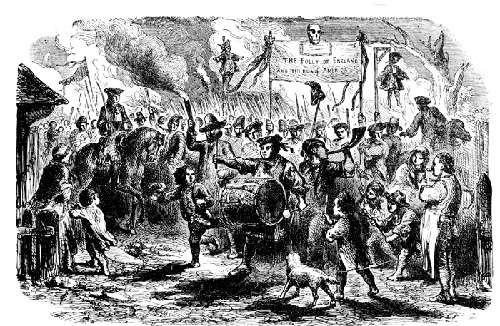
The early American activists referred to themselves as Patriots, or Whigs.  Colonists who stayed loyal to King George III were known as Loyalists, or Tories.  (LeeAnne Gellety)

Patriots, also known as Whigs, were the colonists who rebelled against British monarchial control.  The Whigs did not believe that Parliament had the right to tax the American colonies.

Their rebellion was based on the social and political philosophy of republicanism, which rejected the ideas of a monarchy and aristocracy – essentially, inherited power. Instead, the philosophy favored liberty and unalienable individual rights as its core values.

Republicanism would form the intellectual basis of such core American documents as the Declaration of Independence, the U.S. Constitution, and the Bill of Rights.

Loyalist (they were also known as King’s Men, Tories and Royalists) were colonist loyal to Great Britain during the American Revolution.  They considered themselves to be British citizens and therefore believed revolution to be treason.  Loyalists constituted about one-third of the population of the American colonies during that conflict.

They were not confined to any particular group or class, but their numbers were strongest among the following groups: officeholders and others who served the British crown and had a vested interest in upholding its authority.

The most common trait among all loyalists was an innate conservatism coupled with a deep devotion to the mother country and the crown.  Loyalists were most numerous in the South, New York, and Pennsylvania, but they did not constitute a majority in any colony. New York was their stronghold and had more than any other colony. New England had fewer loyalists than any other section. (Britannica)

Click the following link to a general summary about Whigs and Tories:

Click to access Whigs-and-Tories.pdf

© 2023 Hoʻokuleana LLC

Filed Under: American Revolution Tagged With: American Revolution, Whigs, Tories, Parliament, America250

January 18, 2023 by Peter T Young Leave a Comment

Arrival in Waimea, Kauai

We always recall that Captain James Cook died at Kealakekua Bay on the Big Island, but often overlook that the first reported contact by the white man in the islands occurred in Waimea, Kauai.

Hawaiian lives changed with sudden and lasting impact when in 1778, Cook and his crew arrived.  Western contact changed the course of history for Hawai‘i.

Cook named the archipelago the Sandwich Islands in honor of his patron, the First Lord of the Admiralty, the Earl of Sandwich.

At the time of Cook’s arrival (1778-1779), the Hawaiian Islands were divided into four kingdoms: (1) the island of Hawaiʻi under the rule of Kalaniʻōpuʻu, who also had possession of the Hāna district of east Maui; (2) Maui (except the Hāna district,) Molokai, Lānaʻi and Kahoʻolawe, ruled by Kahekili; (3) Oʻahu, under the rule of Kahahana; and at (4) Kauai and Niʻihau, Kamakahelei was ruler.

Cook’s crew first sighted the Hawaiian Islands in the dawn hours of January 18, 1778.  His two ships, the HMS Resolution and the HMS Discovery, were kept at bay by the weather until the next day when they approached Kauai’s southeast coast.

On the afternoon of January 19, native Hawaiians in canoes paddled out to meet Cook’s ships, and so began Hawai‘i’s contact with Westerners.  The first Hawaiians to greet Cook were from the Kōloa south shore.

The Hawaiians traded fish and sweet potatoes for pieces of iron and brass that were lowered down from Cook’s ships to the Hawaiians’ canoes.

Cook continued to sail along the coast searching for a suitable anchorage.  His two ships remained offshore, but a few Hawaiians were allowed to come on board on the morning of January 20, before Cook continued on in search of a safe harbor.

On the afternoon of January 20, 1778, Cook anchored his ships near the mouth of the Waimea River on Kauai’s southwestern shore.

As they stepped ashore for the first time, Cook and his men were greeted by hundreds of Hawaiians who offered gifts of pua‘a (pigs), and mai‘a (bananas) and kapa (tapa) barkcloth.

Cook went ashore at Waimea three times the next day, walking inland to where he saw Hawaiian hale (houses), heiau (places of worship) and agricultural sites.

At the time, the region was thriving with many thatched homes as well as lo‘i kalo (taro patches) and various other food crops such as niu (coconuts) and ‘ulu (breadfruit).

After trading for provisions, gathering water and readying for sail, Cook left the island and continued his search of the “Northwest Passage,” an elusive (because it was non-existent) route from the Pacific Ocean to the Atlantic Ocean.

After the West Coast, Alaska and Bering Strait exploration, on October 24, 1778 the two ships headed back to the islands; they sighted Maui on November 26 and circled the Island of Hawaiʻi.

On January 17, 1779, Cook sailed into Kealakekua Bay on the island of Hawai‘i.  After a month’s stay, Cook got under sail again to resume his exploration of the Northern Pacific.

Shortly after leaving Hawaiʻi Island, the foremast of the Resolution broke and the ships returned to Kealakekua Bay for repairs.

On February 14, 1779, at Kealakekua Bay, some Hawaiians took one of Cook’s small boats. He attempted to take hostage the King of Hawaiʻi, Kalaniʻōpuʻu. The Hawaiians prevented this and Cook and some of his men were killed. Clerke took over the expedition and they left.

© 2023 Ho‘okuleana LLC

Filed Under: Prominent People, Sailing, Shipping & Shipwrecks Tagged With: Hawaii, Captain Cook, Kauai

January 15, 2023 by Peter T Young Leave a Comment

Hawaiian Volcano Observatory

The eruption of Vesuvius in 79 C.E. prompted the first scientific expedition (by Pliny the Elder) to study volcanic phenomena, as well as the first written eyewitness account (by Pliny the Younger) of eruptive activity.

The new science of geology emerged in the 19th century, focusing on the deduction of past events from current Earth exposures – “the present is the key to the past.” (Tilling)

The history of Hawaiian Volcano Observatory (HVO) begins with a geologist named Thomas A Jaggar, who witnessed the deadly aftermath of volcanic and seismic activity during a decade-long exploration of volcanoes around the world.

The devastation he observed, particularly that caused by the 1902 eruption of Mount Pelée on the Caribbean Island of Martinique, led Jaggar to his vision and life-long work to “protect life and property on the basis of sound scientific achievement” by establishing Earth observatories throughout the world.  (USGS)

At that time, there was only one volcano observatory in the world – at Vesuvius, established in 1841 under King Fernando II to keep an eye on the active volcanoes near Naples. Jaggar thought America needed one.  (Apple)

In early 1911, Jaggar convinced Frank A Perret, a world-famous American volcanologist he had met on Vesuvius Volcano in Italy, to travel to Hawai‘i to begin the observations of Kīlauea’s volcanic activity.

From July to October 1911, Perret conducted experiments and documented the lava lake activity within Kïlauea’s Halema‘uma‘u Crater, paving the way for Jaggar to pursue his life’s goal of using multiple scientific approaches and all available tools for the observation and measurement of volcanoes and earthquakes.

In 1911, the first scientific laboratory at Kilauea consisted of a crude wooden shack constructed on the edge of Halema‘uma‘u that was called the Technology Station. The next year saw the construction by Jaggar of the Hawaiian Volcano Observatory. 

(Subsequently, the Technology Station was relocated and improved, and a structure called the “Instrument Shelter” (extending over the rim of Halemaʻumaʻu) was built with a wall open to the crater for a wide-angle view.)

Jaggar arrived at the Volcano House hotel on January 17, 1912; the Hawaiian Volcano Observatory was established by Jaggar, and for the first seven years of its existence it operated on funds provided by the Massachusetts Institute of Technology (MIT) from its Whitney Fund for research in geophysics and by the Hawaiian Volcano Research Association.

The latter is a group of persons, largely residents of Hawaii and principally businessmen, who are actively interested in the study of volcanoes.

“There is no place on the globe so favorable for systematic study of volcanology and the relations of local earthquakes to volcanoes as in Hawaii … where the earth’s primitive processes are at work making new land and adding new gases to the atmosphere.”  (Thomas A Jaggar, 1916)

Upon his arrival, he established a routine of daily observations of the ongoing eruption in Halemaʻumaʻu Crater. “Keep and publish careful records, invite the whole world of science to co-operate, and interest the business man.” (Jaggar, 1913)

He developed uniform note pads with detachable sheets for use by all employees and insisted that anyone from the observatory who visited the crater take notes of their observations.

In 1919 the administration of the Volcano Observatory was taken over by the United States Weather Bureau, which was then charged by Congress with the responsibility for earthquake investigations in the United States.

In 1924 the Observatory passed to the US Geological Survey, in 1935 to the National Park Service, and in 1948 back to the Geological Survey. It is currently a part of the Geological Survey’s volcano investigation program.

The original location of the Volcano Observatory was the site now occupied by the Volcano House. The Whitney Laboratory of Seismology is a concrete vault beneath the western end of the Volcano House. (The vault is under the grassy mound on the Halema‘uma‘u side of the hotel.)

When the present Volcano House was built in 1941, the Observatory was transferred to what is now the Park Museum and Administration Building, and in 1948 to a building on the western rim of Kilauea caldera at Uekahuna. Dr Jaggar continued as Director of the Observatory until his retirement in 1940.

Since 1912, Kilauea and Mauna Loa volcanoes have been under constant close observation by members of the Observatory staff. The purpose of the studies by the Volcano Observatory have two general aspects, the humanitarian or practical aspect and the strictly scientific.

The two are difficult to separate, because a phase that belongs to pure science today may become of great practical importance within a few years.

In general, the scientific aspects of the Observatory program are directed toward an understanding of the subsurface structure of the volcanoes, the nature and properties of the magma, how the volcano behaves, and why.

The humanitarian aspects include prediction of eruptions and the course of lava flows once the eruption has started and issuing warnings of danger from lava flows.

An example of one phase of the Observatory’s program that is of purely scientific importance is the investigation of the volcanic gases and their relation to the magma and effects on surrounding rocks.

The Observatory also makes visual observations of the volcanic eruptions, collects gas and lava samples, determines temperatures of liquid and solidifying lava and of the gases, measures the width of many cracks about Kilauea caldera as they open and close, operate tilt-meters and a series of magnetometer stations on Kilauea and the slopes of Mauna Loa, and a net of seismograph stations.

Very early in the history of the Observatory it was found that the ground surface on the slopes of the volcano was constantly tilting in one direction or another, and it was soon shown that this tilting correlated with activity of the volcanoes.

Preceding eruption the whole volcano swells up, as though it were being inflated like a big balloon. This produces an outward tilting on its sides. Following the eruption the volcano contracts and the slopes tilt inward.

This swelling and tilting can be measured by leveling, of the sort done in ordinary surveying. By leveling from sea-level at Hilo, it was found that during the interval from 1912 to 1921 a bench mark near the Observatory apparently rose about 3 feet.

Releveling in 1927, after the great collapse and steam explosions of 1924, showed that the same bench mark had lowered 3.5 feet, while a bench mark near the rim of Halema‘uma‘u had gone down about 13 feet.

Ordinarily, however, the tilting of the ground surface is measured not by leveling, but by sensitive pendulums known as tilt-meters. Such tilt-meters in operation by the Observatory are capable of indicating an angle of tilt of less than one-tenth of a second.  (A tilt of one-tenth of a second would displace the top of a pole ten miles high about a quarter of an inch).

Volcanic tilt of many seconds of arc has been measured on the tilt-meters. Strong outward tilting of the ground surface, especially when combined with numerous earthquakes, is a good indication of magma rising in the volcano and the possibility of impending eruption.

Magnetometer measurements by the Volcano Observatory were started early in 1950. A magnetometer is an instrument used to measure the strength of the earth’s magnetic attraction at any given locality.  The strength of the earth magnetism depends on several factors.

One cause of decrease in the strength of magnetism is rise in temperature of the underlying rock. As magma rises beneath the surface the surrounding rocks are heated up, and their magnetism decreases.  Detecting this aids in prediction of eruptions.

A seismograph is a device to record earthquakes. The essential portion of most seismographs is a pendulum. Because of its inertia, during earthquakes a freely suspended pendulum tends to stand still while the earth moves under it.

The effect is nearly the same at it would be if the earth were still and the pendulum vibrating. This apparent movement of the pendulum is recorded in various ways – by direct mechanical means, by directing a beam of light onto photographic paper, or electrically.

So long as the earth is quiet the writing point draws a straight line on the smoked paper, but when an earthquake occurs the pendulum vibrates with respect to the ground and the recording drum, and the line drawn on the smoked paper is wiggly.

By identifying the times of arrival of the different types of vibration, and measuring the interval of time between them, the distance from the station at which the earthquake originated can be calculated. Then, by using the distances of origin from several stations, the epicenter and depth of origin of the earthquake can be located.

Any marked increase in the number of earthquakes indicates a restlessness of the volcano in which the earthquakes originate, and the location of the earthquake indicates what portion of the volcano is involved. Commonly an eruption of either volcano is preceded by a series of earthquakes.

These earthquakes begin at a depth of 25 to 30 miles, but as the series progresses the places of origin get gradually closer to the surface and often shift laterally, finally centering at a place close to the site of the coming eruption. Thus, earthquakes are of great value to the volcanologist in predicting coming activity.  (Information is copied from NPS, Nature Notes May 1951)

During the past century, HVO has been at the forefront of developing and applying the modern techniques and instruments now used in volcano monitoring, including volcanic-gas monitors, satellite-based deformation measurements, networks of remote cameras recording eruptive activity, and seismic networks such as the Hawai‘i Regional Seismic Network.

The first seismic network in the USGS was installed on Kīlauea in the 1950s, and earthquake monitoring has been important both as a tool for volcano monitoring and for assessing seismic hazards in the State of Hawaii. HVO has been a training ground for volcanologists from the United States and around the world.

By December 1915, with Jaggar having worked in Hawai‘i for three years, the Research Association and MIT sent him to Washington DC to appeal to Congress to take over HVO as a government institution.  In addition, the governor of Hawai‘i and the Honolulu Chamber of Commerce asked him to continue to push for the establishment of a national park. (Moniz Namakura)

(On August 1, 1916, President Woodrow Wilson signed the bill establishing Hawaii National Park as the nation’s 13th national park.  It included lands surrounding Kīlauea and Mauna Loa volcanoes on Hawaiʻi Island, and Haleakalā on the island of Maui.  In July 1961, Hawai‘i National Park was split into two distinct areas:  Haleakalā National Park and Hawai‘i Volcanoes National Park.)

The US Geological Survey (USGS) has operated HVO continuously since 1947.  Before then, HVO was under the administration of various Federal agencies – the US Weather Bureau, at the time part of the Department of Agriculture, from 1919 to 1924; the USGS, which first managed HVO from 1924 to 1935; and the National Park Service from 1935 to 1947.

It currently operates under the direction of the USGS Volcano Science Center, which now supports five volcano observatories covering six US areas – Hawaiʻi (HVO), Alaska and the Northern Mariana Islands (Alaska Volcano Observatory), Washington and Oregon (Cascades Volcano Observatory), California (California Volcano Observatory), and the Yellowstone region (Yellowstone Volcano Observatory).

For much of its history, HVO was perched dramatically on the rim of Kīlauea Volcano’s summit caldera inside Hawai‘i Volcanoes National Park. That ended in 2018, when – amid ash explosions and violent earthquakes accompanying onset of partial summit collapse – HVO relocated to the town of Hilo, 30 miles distant.

Due to substantial damage to the building, new facilities in Hilo and inside the national park are planned. In the meantime, most of HVO remains in Hilo in the historic Ironworks Building on Kamehameha Avenue. HVO continues to use some facilities inside the national park and a warehouse in Kea‘au.  (USGS)

© 2023 Ho‘okuleana LLC

Filed Under: Economy, General Tagged With: Hawaii, Thomas Jaggar, Hawaii Volcanoes National Park, Hawaii National Park, Hawaiian Volcano Observatory, Frank Perret, Technology Station, Instrument Shelter

January 14, 2023 by Peter T Young Leave a Comment

Kohala Ditch

Central to Hawaiʻi’s use of water has been agriculture, sugar in particular.

Initially brought to the islands by early Polynesians, the first successful commercial sugar plantation started in 1835.  And, with it, Hawai`i’s environmental, social and economic fabric changed.  Hawaiʻi’s economy turned toward sugar in the decades between 1860 and 1880; these twenty years were pivotal in building the plantation system.

What encouraged the development of plantation centers?  For one, the American settlement of California opened lucrative avenues of trade in the Pacific.  In addition, the Civil War virtually shut down Louisiana sugar production during the 1860s, enabling Hawai’i to compete in a California market that paid elevated prices for sugar.

The Pacific whaling trade collapsed after 1860, pushing Honolulu merchants into the sugar trade.  About the same time, the closing of the Hawaiian mission left the previously supported missionaries in search of new means of income.

The 1876 Treaty of Reciprocity between the United States and the Kingdom of Hawaiʻi eliminated the major trade barrier to Hawai`i’s closest and major market.  Through the treaty, the US received a station at Pearl Harbor and Hawaiʻi’s sugar planters received duty-free entry into US markets for their sugar.

For nearly a century, agriculture was the Island’s leading economic activity. It provided Hawai`i’s major sources of employment, tax revenues, and new capital through exports of raw sugar and other farm products.

Sugarcane requires a lot of water to grow. Pioneer sugar planters solved water shortages by diverting stream water and building irrigation systems that included aqueducts (the first in 1856), artesian wells (the first in 1879), and tunnels and mountain wells (the first in 1898).  These irrigation systems enabled the planters to expand their sugar production.

These irrigation systems were modeled largely after the elaborate and extensive diversion and ditches developed by the ancient Hawaiians.  Unlike the traditional Hawaiian system, which never diverted more than 50% of stream flow, the sugar plantations diverted large quantities of water from perennial streams and moved water from one ahupuaʻa to another.

Boston missionary Reverend Elias Bond sailed with the Ninth Company of Protestant Missionaries, arriving in the Islands in 1841. He was then assigned to Kohala.

As a means to provide employment to the people in the region and support his church and schools, in 1862, Reverend Bond founded Kohala Sugar Company, known as “The Missionary Plantation;” it produced its first sugar crop in 1865.  Bond gave all his dividends and profits beyond his living expenses to the Board of Missions.

Bond included the following in a letter: “So this was the ‘Missionary Plantation’, and the prophecies were many and loud that it would not live five years”. But in the goodness of God we came through.”  (Schweitzer)

From the mid-1800s, the sugar industry developed and commercial centers sprung up around the processing mills, especially in Kapaʻau and Hawi.  The construction of the railroad and the Kohala Ditch acted to encourage the further development of these more centrally-located communities.

Seven sugar mills operated in Kohala: Kohala, Union, Niuliʻi, Hawi, Halawa, Hōʻea and Star.  With the exception of Star, which existed for only a brief period of time, each was the nucleus of a community of plantation managers, supervisors, and laborers.  (In 1937, all of the mills were consolidated into Kohala Sugar Company.)

To water the crop, John Hind first conceived of an irrigation system tapping into the abundant, wild and inaccessible rivers that ribbon the Kohala Mountains.  In 1904, JS Low acquired a license from the Territory of Hawaiʻi to “enter upon, confine, conserve, collect, impound and divert all the running natural surface waters on the Kohala-Hāmākua Watershed;” he assigned the license to the Kohala Ditch Company.

Notable engineers and other professionals became involved in the construction of irrigation ditches that were the forerunners of large irrigation projects in the Western US.  Among the engineers was Michael Maurice O’Shaugnessy; he was both an investor in the Kohala Ditch Company and the Chief Engineer for the aqueduct.  (ASCE)

The Kohala Ditch, built by the Kohala Sugar Company, diverted water from the Honokāne Nui Stream to Hikapoloa, west of Hawi.  600-Japanese laborers worked on its construction; in the process, 17 lost their lives.

The laborers were housed under corrugated iron roofs. The raised floors “nearly always two-feet above the ground and higher if practicable” provided “a place for drying the men’s clothes in wet weather.” Additionally, “a hospital and medical department was also provided for the men, who were assessed 50-cents a month apiece for this object.”  (ASCE)

The Honokāne section of Kohala Ditch was opened on June 11, 1906; waters of Honokāne began flowing to the Kohala, Niuliʻi, Halawa, Hawi and Union mills.  The Awini section was finished in 1907; it started from the Waikoloa stream and traveled over 8-miles, mostly in tunnel, to the Awini weir where the water dropped 900-feet in a manmade waterfall into the Honokāne section.

The ditch carried the water for 23-miles northwest, mostly as tunnel, toward Hawi.  The capacity was originally 70-mgd, later reduced to 50-mgd, when the original flumes were replaced with smaller ones.

The ditch drops about 80-feet in elevation from 1,045-feet at the bottom of the intake at the first large stream (Honokāne) to 956-feet at the terminus in the plantation fields.

Prosperity came to Kohala. At the peak of its production, the Sugar Company had 600-employees; 13,000-acres of land produced 45,000-tons of raw sugar a year.

As with other sugar operations, it didn’t last.  1975 saw the last harvest at Kohala Sugar Company.  The district’s economy struggled.  Almost one-third of the workforce now commutes to South Kohala to work in the hotels and resorts located there.  However, the Ditch remained open for other agricultural needs.

Vulnerability and the risks associated with reliance on the Kohala Ditch were made evident on October 15, 2006, when two earthquakes struck off Kiholo and caused extensive damage to the Kohala Ditch.  In that instant, rockslides and other damage to the ditch stopped the water from flowing through the Ditch.

Two years later, on November 25, 2008, after extensive community involvement and public/private funding ($2-million in federal money, $500,000 from the state, $500,000 from Hawai`i County, $342,000 from Kamehameha Schools and $100,000 from AT&T), water was released back into the Kohala Ditch after repairs to the damage caused by the 2006 quakes.

Agricultural and hydroelectric users continue to benefit from the Ditch; in addition, entrepreneurs saw an opportunity for recreational/visitor industry uses of the ditch with kayak and raft rides through the flumes and tunnels of the Kohala Ditch.

© 2023 Hoʻokuleana LLC

Filed Under: Economy, General, Missionaries / Churches / Religious Buildings Tagged With: Hawaii, Hawaii Island, Sugar, Treaty of Reciprocity, Kohala, Hind, Kohala Ditch, Elias Bond

January 13, 2023 by Peter T Young Leave a Comment

1960 Kapoho Eruption

The eruption in Kilauea Iki had ended on December 21, but the shallow reservoir beneath the summit of Kilauea volcano was gorged with magma. Rather than removing pressure, the eruption had, for all intents and purposes, created more.

The end of 1959 was an uneasy time for the staff at the Hawaiian Volcano Observatory.  During the last week of the year, a swarm of earthquakes started in Pāhoa (more than 1,000 earthquakes were recorded by the Pāhoa station on January 12.)

The 1960 Kapoho eruption and its predecessor, the 1959 summit eruption in Kilauea Iki Crater, together formed a summit-flank sequence. The Kapoho eruption caused havoc in lower Puna, an idyllic rural community until the lava fountains and flows covered farm land and villages.

The size and frequency of the earthquakes increased; at 8 am, January 13, the ground was severely cracked along the fault through Kapoho town.  Movement along the fault was literally pulling the town apart.

The ground was constantly shaking. The roughly 300-residents undertook voluntary evacuation, which was completed by early evening.  At 7:35 pm, January 13, 1960, a red glow above Kapoho confirmed the start of the eruption.

Within half an hour, fountaining was nearly continuous along a nearly ½ – mile long fissure.  After a couple hours, the activity focused with central fountains – for the next 11-hours powerful steam blasts roared from the vents.

The resulting fallout coated everything with a thin film of fine, wet, glassy ash. Salt crystals formed as the water evaporated; they testified to the brackish nature of the groundwater.

By noon on January 14, the steam blasts had ended and lava fountaining was confined to many sources along a 650-foot long section of the fissure.  An ʻaʻa flow, 18-feet thick and nearly 1,000-feet wide reached the ocean – a bench formed 300-feet beyond the old shoreline.

In an attempt to save Warm Springs, bulldozers pushed a rock dike; shortly after, lava overtopped it and filled the pool.

Kapoho, a bit uphill of the fissure, was near all this activity but had not been touched by lava. Pumice and lava were wreaking havoc on nearby homes and farms (papaya, coconut, orchid and coffee groves.)

ʻAʻa continued to enter the ocean; it was also spreading southward.  Bulldozers worked in forming a barrier to protect Kapoho, Kapoho School, an area of expensive homes and real estate at Kapoho Beach Lots.  By January 20, lava had reached the barrier and overtopped it on January 23; a second barrier was shoved aside on January 27.

A third barrier held the flow, but lava then moved underground, beneath the end of the barrier, emerging near Kapoho School. The buildings began to burn at 10 am and the school was lost shortly after noon.

The barrier itself remained intact, and it survived until February 5, when it was finally overtopped and almost totally buried by lava that eventually covered the Kapoho cemetery.  More coastal houses were lost.

Despite notable developments in the vent area, Kapoho village remained virtually intact except for a blanket of pumice and ash that covered everything.

For seven hours on the afternoon of January 27, the heaviest pumice fall of the entire eruption rained down on the area during strong kona winds.

However, it was the lava flow that would doom the town.

Late that night, the rapidly moving ʻaʻa flow moved through the streets, overwhelmed building after building. By midnight January 27, most of Kapoho had been destroyed; a couple days later (January 30) the town was gone.

The eruption ended slowly. Dribbles of lava continued to enter the sea north of Cape Kumukahi as late as February 13. High fountains continued until February 15, when lava was spraying upward from the main vent area to heights of 600-feet.  It gradually subsided and on the morning of February 19, the eruption stopped.

Volcanologists concluded that the Kapoho eruption was tied to events at Kilauea’s distant summit.  On January 17, four days after the Kapoho eruption had started, the summit began to subside (deflate, by analogy with a balloon) as magma was leaving the storage reservoir and heading down the east rift zone to the Kapoho area.

The eruption was the first during the modern era of volcano monitoring at Hawaiʻi Volcanoes Observatory. As a result, probably more fundamental ideas were reached from it than from any other single eruption in Hawaiʻi.

The main lesson, and really the only one that bears repeating over and over again, is clear. What happened then will happen again. That lesson should never be lost.  (All information here is from USGS.)

© 2022 Hoʻokuleana LLC

Filed Under: General, Place Names Tagged With: Volcano, Warm Springs, Waiwelawela, Puna, Kapoho, Cape Kumukahi, Pahoa, Kilauea Iki, Kilauea, Hawaii

  • « Previous Page
  • 1
  • …
  • 209
  • 210
  • 211
  • 212
  • 213
  • …
  • 659
  • Next Page »

Images of Old Hawaiʻi

People, places, and events in Hawaiʻi’s past come alive through text and media in “Images of Old Hawaiʻi.” These posts are informal historic summaries presented for personal, non-commercial, and educational purposes.

Info@Hookuleana.com

Connect with Us

  • Email
  • Facebook
  • LinkedIn
  • Twitter
  • YouTube

Recent Posts

  • Carlotta
  • Mea ‘Ono Pua‘a
  • Kaukahoku
  • Alsoberry Kaumualiʻi Hanchett
  • Evelaina
  • About 250 Years Ago … Common Friends to Mankind
  • Battery French

Categories

  • General
  • Ali'i / Chiefs / Governance
  • Buildings
  • Missionaries / Churches / Religious Buildings
  • Hawaiian Traditions
  • Military
  • Place Names
  • Prominent People
  • Schools
  • Sailing, Shipping & Shipwrecks
  • Economy
  • Voyage of the Thaddeus
  • Mayflower Summaries
  • American Revolution

Tags

Albatross Al Capone Ane Keohokalole Archibald Campbell Bernice Pauahi Bishop Charles Reed Bishop Downtown Honolulu Eruption Founder's Day George Patton Great Wall of Kuakini Green Sea Turtle Hawaii Hawaii Island Hermes Hilo Holoikauaua Honolulu Isaac Davis James Robinson Kamae Kamaeokalani Kameeiamoku Kamehameha Schools Lalani Village Lava Flow Lelia Byrd Liberty Ship Liliuokalani Mao Math Mauna Loa Midway Monk Seal Northwestern Hawaiian Islands Oahu Papahanaumokuakea Marine National Monument Pearl Pualani Mossman Quartette Thomas Jaggar Volcano Waikiki Wake Wisdom

Hoʻokuleana LLC

Hoʻokuleana LLC is a Planning and Consulting firm assisting property owners with Land Use Planning efforts, including Environmental Review, Entitlement Process, Permitting, Community Outreach, etc. We are uniquely positioned to assist you in a variety of needs.

Info@Hookuleana.com

Copyright © 2012-2024 Peter T Young, Hoʻokuleana LLC


Loading Comments...