Images of Old Hawaiʻi

  • Home
  • About
  • Categories
    • Ali’i / Chiefs / Governance
    • American Protestant Mission
    • Buildings
    • Collections
    • Economy
    • Missionaries / Churches / Religious Buildings
    • General
    • Hawaiian Traditions
    • Other Summaries
    • Mayflower Summaries
    • Mayflower Full Summaries
    • Military
    • Place Names
    • Prominent People
    • Schools
    • Sailing, Shipping & Shipwrecks
    • Voyage of the Thaddeus
  • Collections
  • Contact
  • Follow

May 7, 2026 by Peter T Young Leave a Comment

Boeing Wonderland

Maj. John F. Ohmer, Jr., of the Office of the Chief of Engineers, an expert in camouflage, found that almost nothing had been done to conceal military installations in the US. (Corps of Engineers)

The art and science of camouflage had infatuated Ohmer for years. After joining the Army in 1938, he combined his love of magic and photography to find inventive ways to fool the eye and the lens.

When Ohmer went overseas to study Britain’s wartime concealment efforts, he marveled as German attackers wasted their bombs in open fields brilliantly attired to appear as vital targets. (Popular Mechanics)

During the Battle of Britain, which lasted from July until October 1940, the Luftwaffe rained thousands of bombs over England. One of Germany’s main goals for the constant bombing was to destroy the Royal Air Force.

The Luftwaffe had a long list of important targets that included aircraft factories and airfields. The British covered their factories, warplanes and tanks with camouflaging materials and paint, and put fake airplanes and tanks in fields far away from civilization. The Luftwaffe bombed hundreds of fake targets, leaving the real targets intact. (Mishpacha)

As commander of the Army’s 604th Engineer Camouflage Battalion, Ohmer campaigned to demonstrate his craft by obscuring Hawai‘i’s Wheeler Field in 1941. His superiors rejected his proposal because of the $56,210 price tag (nearly $900,000 today).

Then on December 7, 1941, Japanese attackers bombed and strafed Oahu’s exposed airfields, along with the naval base at Pearl Harbor. Wheeler alone lost 83 warplanes, each one nearly worth the cost of Ohmer’s proposed cover-up. (Popular Mechanics)

Following the attack on Pearl Harbor, Ohmer received an urgent call from the US Army. The threat of further attack led Ohmer’s superiors to reassess the value of his vision.

The most visible and vulnerable targets were a dozen or so distinctive, wooden aircraft assembly buildings. Military leaders were concerned that just a few air-dropped incendiary bombs would burn them to the ground. The loss of just one major airplane-producing facility could lengthen the war considerably. (Popular Mechanics)

Ohmer’s assignment … he had to make everything worth bombing, from San Diego to Seattle, disappear. The long list included airfields, oil depots, aircraft warning stations, military camps, and defensive gun batteries.

“He was a Hollywood art director and designer who worked on classic musicals of the late 1930s, ones with Judy Garland and Mickey Rooney, Nelson Eddy and Jeanette MacDonald and Busby Berkeley choreographed extravaganzas, the kind of movies that lit up the theater.”

“He was an art director at Golden Age MGM, and was nominated for an Oscar in 1940. He married one of the screen’s biggest stars – Veronica Lake. John Stewart Detlie was right at the heart of Tinseltown glamour.” (Cascade PBS)

Ohmer created illusions for America’s five largest aircraft manufacturers situated in California and Washington. These manufacturing plants – from Douglas Aircraft Co., Consolidated Vultee (now Convair), North American Aviation, Lockheed Martin, and Boeing – were transformed to look like cities or towns from the air. (CoffeeOrDie)

Ohmer turned to Hollywood to find the most adept civilian workers, raiding movie studios to leverage the skills of set designers, art directors, painters, carpenters, and landscape artists for the urgent task, along with a handful of willing animators, lighting experts, and prop designers.

The crown jewel of Ohmer’s concealments took place near Seattle, where Boeing’s Plant 2 sprawled over 700,000 square feet of floor space. Inside, thousands of men and women churned out a new B-17 Flying Fortress heavy bomber roughly every 90 minutes.

Ohmer placed his top movie studio recruit on the Boeing project, architect John Detlie. He was pure Hollywood, married to movie star Veronica Lake. Before Detlie joined the war effort, he was an Oscar-nominated art director and set designer at MGM.

In Seattle, Detlie assembled 13 architects and draftsmen, eight commercial artists, seven landscape architects, five engineers, and a soil-management expert.

Thwarting an enemy reconnaissance flier took more than simply covering the factory building. A sharp-eyed scout might zero in on the adjoining airfield, parking lots, or ramp areas. Making Boeing’s entire production facility disappear meant sowing confusion over several square miles of land. (Popular Mechanics)

Located at 7755 East Marginal Way S. in Tukwila on the banks of the Duwamish River, Boeing’s Plant 2 (also known as Air Force Plant 17) was a factory building built in 1936 by The Boeing Company in Seattle, Washington – the factory goal was to build early prototypes of the B-17 Flying Fortress and the Boeing 307 Stratoliners.

By the time of the Japanese attack on Pearl Harbor, the plant had been expanded to 1,776,000 square feet. In total, 6,981 B-17s were produced in Plant 2.

Boeing Plant 2 gave birth to some of the world’s most significant aircraft and a home to ‘Rosie the Riveter’ – women who built thousands of World War II planes.

Plant 2 was so critical that Boeing camouflaged its roof with faux streets and houses of fabric and plywood, making it nearly vanish into nearby neighborhoods. Beneath the plant, tunnels led to cafeterias, restrooms and classrooms, innovations to make life easier for workers and keep them close to their jobs. (Fox)

The idea was to blend the facility into the surrounding neighborhood across the river. This elaborate pretend town was nicknamed the “Boeing Wonderland” by the Seattle Daily Times on July 23, 1945. (RareHistoricalPhotos)

Workers obscured the heart of Boeing’s facility with 26 acres of camouflage netting stretched across the roof to create the appearance of a new faux ground level elevated roughly 50 feet above the surrounding landscape.

The building’s uneven bays and distinctive saw-tooth profile required the netting to be supported by wooden scaffolding or steel cables in low spots.

Reinforced catwalks, sometimes masquerading as sidewalks, included wood and wire handrails to keep a distracted maintenance man from straying off the supported path and plunging through the netting. (Popular Mechanics)

Disguising the active runways and taxiways as an innocuous urban scene called for a two-dimensional solution to not impede aircraft operations. Planners envisioned a pattern of visual noise composed of lawns, buildings, and roads crisscrossing the active airfield.

First, builders mixed finely crushed rock into bitumen, an asphalt-like substance, and applied it to areas heavily trafficked by aircraft. The mixture provided a dull texture to the airfield’s large, flat concrete surfaces. In non-traffic spaces, the men added wood chips and cement to absorb light. (Popular Mechanics)

Over the rough texture, workmen used paint to create an intricate top-down view of a typical neighborhood, devised by Detlie’s crew. Its pigment, developed by Warner Brothers, was reputed to “resist disclosure of the camouflage through infra-red photography.”

Oil mixed with the custom paint helped establish a convincing cross-hatch of artificial roads. On the airport’s infield, men constructed six-inch-high false buildings made from concrete blocks.

From overhead, the small structures cast realistic shadows and gave just a small amount of depth, giving more life to the scene. The finished deception looked amazingly impressive from the “attacker’s-eye-view” at five to ten thousand feet. Only as a pilot came in low for landing did the hidden runway lose its illusion. (Popular Mechanics)

The strange, house-filled neighborhood could be seen in the middle of an industrial area from the air. The “neighborhood” was completed in 1944 and removed a year after the war. (Seattle Times)

Fortunately, the enemy bombers never came. (AirMailNews)

© 2026 Ho‘okuleana LLC

Filed Under: Military Tagged With: Hawaii, WWII, Camouflage, Boeing Plant 2

April 14, 2025 by Peter T Young Leave a Comment

Hālawa Naval Cemetery

As a result of the December 7, 1941 attack on Pearl Harbor, there were 2,403 people killed and 1,178 wounded. Among the deceased were 2,008 Navy personnel, 109 Marine, 218 Army and 68 civilians.  (navy-mil)

World War II brought death to more than 300,000 Americans who were serving their country overseas.  While the war was on, most of these honored dead were buried in temporary US military cemeteries.

(Punchbowl was not a cemetery at that time.  In 1943, the governor of Hawaiʻi offered the Punchbowl for use as a national memorial cemetery; in February 1948 Congress approved funding and construction began.  The first interment at Punchbowl was made January 4, 1949.)

(Initially, the graves at National Memorial Cemetery of the Pacific were marked with white wooden crosses and Stars of David; however, in 1951, these were replaced by permanent flat granite markers.)

After the attack on Pearl Harbor December 7, 1941, the Navy selected Oʻahu Cemetery to bury the dead. At the time, only 300 plots at the cemetery were available for use.  Burials began there on December 8, 1941. (navy-mil)

“Historical records show that the Navy originally purchased plots in the cemetery October 9, 1919, and additional land was acquired in 1931. The current cemetery site was acquired April, 13, 1932.”  (NAVFAC)

Several temporary cemeteries were constructed – one was in lower Hālawa Valley, overlooking Pearl Harbor.

“On Dec. 9 it became evident that sufficient land was not available in Oʻahu Cemetery for this purpose.  By direction of the commandant (of the 14th Naval District), a site for a new cemetery was selected by the public works department. This site (Hālawa) was approved by the district medical officer and remaining burials were made in this new cemetery.”  (US Naval Hospital; Cole)

Over the course of about 4-years, about 1,500 graves were prepared (some containing multiple sets of remains.)  All bodies, except those of identified officers, were placed in plain wooden caskets. “Bodies of officers were placed in standard Navy caskets in order that they might later be disinterred and shipped home if desired.”

Two officers of the Chaplain Corps and two civilian priests from Honolulu rendered proper religious rites at the hospital and at the funeral ceremonies held each afternoon in the Oʻahu and Hālawa Cemeteries. The brief military ceremony held at the burial grounds included a salute fired by a Marine guard and the blowing of taps by a Marine bugler.  (navy-mil)

Following the war, Congress passed, and the President signed, a bill that authorized the War Department to take steps to provide a reverent final burial for those who gave the last full measure of devotion.

“A first step in determining the final resting place for Americans who died outside the continental United States during World War II will be taken this week, Col George E Hartman, commanding officer of the Schenectady General depot, US Army, announced yesterday. … letters will be sent to more than 20,000 next-of-kin of American dead now in 15 of 207 temporary cemeteries overseas.”

“Next-of-kin may choose to have remains of WWII armed forces personnel who dies overseas returned to the US for burial in a private cemetery; returned to the US for burial in a National Cemetery; buried in a permanent US military cemetery overseas; or buried in a private cemetery in a foreign country which is a homeland of the deceased or next-of-kin.”    (Schenectady Gazette, March 5, 1947)

In September 1947, the American Graves Registration Service (AGRS) disinterred and moved the remains to the Schofield Barracks Central Identification Laboratory (Schofield CIL), located at the AGRS Pacific Zone Headquarters, in order to effect or confirm identifications and return the men to their next of kin for burial.

Between August and September 1947, the US military exhumed 18 remains at Kāneʻohe Bay, 339 from Oʻahu Cemetery, and 1,516 at Hālawa, according to a 1957 government report.  (Cole)

What was the Hālawa Naval Cemetery is the vicinity of the Animal Quarantine and Hālawa Industrial Park.  (Currently, there are 135 Sailors, Marines and spouses interred in Oʻahu Cemetery.)

© 2024 Hoʻokuleana LLC

Filed Under: Military Tagged With: Halawa, National Memorial Cemetery of the Pacific, Hawaii, Oahu, Pearl Harbor, Halawa Naval Cemetery, WWII, Punchbowl

December 8, 2024 by Peter T Young 2 Comments

1st POW

11 pm, December 6, 1941, Ensign Kazuo Sakamaki and Petty Officer Second Class Kiyoshi Inagaki entered their 2-man midget submarine and were released from their mother sub about 10-miles off Pearl Harbor.

They were part of Special Attack Forces, an elite 10-man group of five 2-man midget submarines that would attack Pearl Harbor.

They planned to carry out suicide attacks against the enemy with no expectation of coming back alive: “That the personnel of the midget submarine group was selected with utmost care was obvious.”

“The twenty-four, picked from the entire Japanese navy, had in common: bodily strength and physical energy; determination and fighting spirit; freedom from family care. They were unmarried and from large families.”

“None of us was a volunteer. We had all been ordered to our assignment. That none of us objected goes without saying: we knew that punishment was very severe if we objected; we were supposed to feel highly honored.”  (Sakamaki)

His 78.5-foot-long submarine, HA-19, and four other midget subs, each armed with a pair of 1,000-pound torpedoes, were to attack American destroyers or battleships.  (NYTimes)

From the beginning, things went wrong for Sakamaki and Inagaki.  Their gyrocompass was faulty, causing the submarine to run in circles while at periscope depth – they struggled for 24-hours to go in the right direction.

The submarine was spotted by an American destroyer, the Helm, which fired on them, and the midget sub later got stuck temporarily on a coral reef. The submarine became partially flooded, it filled with smoke and fumes from its batteries, causing the two crewmen to lose consciousness.

With the air becoming foul due to the battery smoking and leaking gas, the midget sub hit a coral reef again.  They abandoned the sub.

Sakamaki reached a stretch of beach, but, again, fell unconscious. In the early dawn of December 8, he was picked up on Waimanalo Beach by Lt. Paul S. Plybon and Cpt. David Akui of the 298th Infantry.  (hawaii-gov)

Sakamaki became Prisoner No. 1 (the first US Prisoner Of War in WWII.)

He was the only crewman to survive from the midget submarines; his companion’s remains later washed up on the shore.  All five subs were lost, and none were known to have caused damage to American ships.

Humbled to have been captured alive, Sakamaki inflicted cigarette burns while in prison at Sand Island and asked the Americans permission to commit suicide. His request was denied and the first prisoner of war spend the rest of the war being transferred from camp to camp.  (Radio Canada)

He spent the entire war in various POW camps in Wisconsin, Tennessee, Louisiana and Texas.  He and others were offered educational opportunities through the “Internment University” that had lectures on English, geography, commerce, agriculture, music, Japanese poetry, Buddhist scriptures and other subjects.

He became the leader of other Japanese POWs who came to his camp; he encouraged them to learn English. He also tried to address the problem of other Japanese POWs’ wanting to commit suicide after their capture, since he previously had gone through the same feelings.

At the end of the war, he returned to Japan and wrote his memoirs, ”Four Years as a Prisoner-of-War, No. 1,” in which he told of receiving mail from some Japanese denouncing him for not having committed suicide when it appeared he could be taken captive.

His memoirs were published in the United States on the eighth anniversary of the Pearl Harbor attack with the title, ”I Attacked Pearl Harbor.”  (NYTimes)

Mr. Sakamaki became a businessman, serving as president of a Brazilian subsidiary of Toyota and then working for a Toyota-affiliated company in Japan before retiring in 1987.

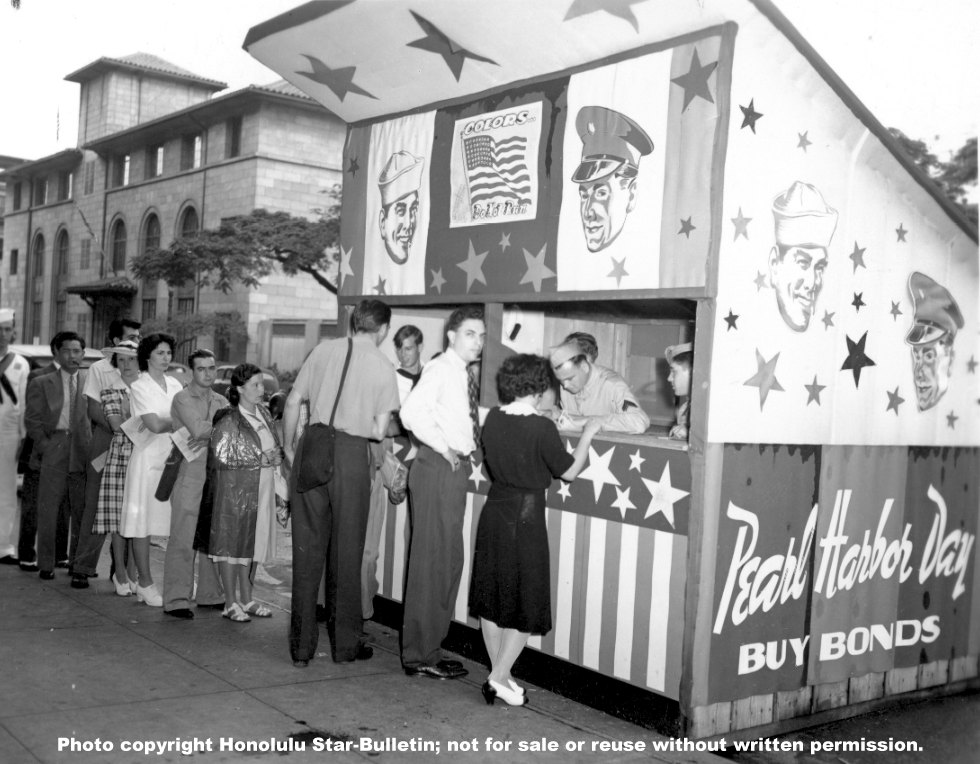
His submarine was salvaged by American troops, shipped to the United States in January 1942, and taken on a nationwide tour to sell War Bonds.  Admission to view the submarine was secured through the purchase of war bonds and stamps.

On April 3, 1943, HA-19 arrived in Washington DC for the war bond drive and for a brief time sat in front of the United States Capitol Building for people to see.

On arriving in Alexandria, Virginia, “George W. Herring, Virginia lumberman, bought $16,000 worth of war bonds yesterday for the privilege of inspecting a Jap submarine. One of the two-man submarines captured at Pearl Harbor was here for a one-day stand in the war bond sales campaign.”

“Those who buy bonds are allowed to inspect it. Herring held the record for the highest purchase and was the first Alexandrian to take a peek at the submarine. War bond sales for the day totaled $1,061,650.”  (Belvedere Daily Republican, April 3, 1943)

It was placed on display at a submarine base in Key West, Florida, in 1947 and later transferred in 1990 to its current site, the National Museum of the Pacific War in Fredericksburg, Texas, home of Admiral Chester W Nimitz (who served as Commander in Chief of the US Pacific Fleet during WWII.)

Back to Sakamaki … when he returned from America, he saw a woman working in a neighbor’s field with whom he fell in love at first sight, although he reviewed her papers (“a health certificate, academic records, a brief biography, a certificate of her family background, all certified as to their accuracy”) prior to making the commitment to marriage.

Her father and brother had died in the atomic bomb dropped on Hiroshima, so her mother and she had moved back to their ancestral home next to Sakamaki’s home. They married on August 15, 1946, the first anniversary of the end of WWII.  (Lots of information here from Gordon and hawaii-gov.)

© 2024 Hoʻokuleana LLC


Filed Under: Military Tagged With: Kazuo Sakamaki, Hawaii, Oahu, Pearl Harbor, WWII, Chester Nimitz, Bellows, Submarine, Waimanalo

November 9, 2024 by Peter T Young Leave a Comment

Merci Boxcar J58220

Britain and France entered WWII following the German invasion of Poland in September 1939. In expectation of a German advance westwards, the British Expeditionary Force, which grew to 390,000 men over the winter of 1939–40, deployed alongside the troops of its allies in France and Belgium.

Between May 9 and June 22, 1940, a German assault on north-west Europe, known as the Battle of France, resulted in the capture and overthrow of not only France but three other countries – Luxembourg, the Netherlands and Belgium. (English Heritage)

The D-Day operation of June 6, 1944, brought together the land, air, and sea forces of the allied armies in what became known as the largest amphibious invasion in military history. The operation, given the codename Overlord, delivered five naval assault divisions to the beaches of Normandy, France. The beaches were given the code names Utah, Omaha, Gold, Juno, and Sword.

By June 30, over 850,000 men, 148,000 vehicles, and 570,000 tons of supplies had landed on the Normandy shores. Fighting by the brave soldiers, sailors, and airmen of the allied forces western front, and Russian forces on the eastern front, led to the defeat of German Nazi forces. On May 7, 1945, German General Alfred Jodl signed an unconditional surrender at Reims, France. (Eisenhower Library)

After World War II came to a close, the country of France began the task of rebuilding a nation ravaged by war.  Years of German occupation had left the French people in great need of life’s everyday necessities.

In his daily column, the Merry-go-round, noted Washington newspaperman Drew Pearson suggested that America come to the aid of its European friend.

“So my suggestion to the citizens’ food committee is that this time we take steps to see that the people of Europe evaluate this campaign for exactly what it is – a genuine sacrifice from the heart of America.”

“To that end I make the further suggestion that we arrange for the collection of this food direct from the heart of America in such a way that it can be visualized and dramatized and that the real story will be told the millions of people we are trying to help.”

“Why not dramatize the story of America’s sacrifice by running a ‘friendship train’ straight across the United States, straight through the heart of America, collecting food as it goes …”

“… inspiring the housewives and farmers of the nation to spare a bag of flour or a bushel of wheat and bring it down to the friendship train as their contribution toward friendship with the people of Europe?” (Pearson, Oct 10, 1947)

Inspired by Pearson’s idea of a Friendship Train, newspapers all across the country joined in the effort and supplies were collected to send to France.  Seven hundred boxcars of food, fuel, medicine, and clothing left on a ship from New York City and arrived in France on December 18, 1947. (American Historical Society)

“Every package had this label: ‘All races and creeds make up the vast melting pot of America, and in a democratic and Christian spirit of good will toward men, we, the American people, have worked together to bring this food to your doorsteps, hoping that it will tide you over until your own fields are again rich and abundant with crops.’”

“Also on every label were these words, ‘This gift is sent to you by a tag which had these lines: ‘first and last name and address of donor’. This message was written in Italian and French and printed beside the American flag.” (Friendship Train 1947)  “In the whirlwind seven day drive, Hawaii contributes nickels, dimes and dollars to send two boxcars of sugar to France.” (Star Bulletin, March 10, 1949)

“The American Friendship Train inspired a rail worker and war veteran named Andre Picard to suggest that France reciprocate. His original idea was to present the United States with a decorated train boxcar loaded with gifts representative of his country – wines from Alsace, Bordeau, Burgandy, Champagne and the Loire Valley; white lace headdresses from Paris; clay figures from Provence. A local veterans organization adopted the proposal, and a small committee was established to solicit gifts.”

“As press and radio spread the story, however, the project gained national momentum. The government announced its official approval; the French Academy issued an endorsement; and hundreds of professional, social, and fraternal organizations asked to participate. Clearly a single boxcar would not be enough.” (Hawaiian Railway)

“On Feb 2 [1949] the French freighter Magellan steamed into New York carrying 49 antique, narrow-gauge boxcars in her hold.” (Life, Feb 28, 1949)

The French boxcars were the kind that Americans soldiers were transported to the front on the French rail system during the war. Cramped into narrow gauge boxcars, each stenciled with “40 Hommes/8 Chevaux”, denoting its capacity to hold either 40 men or 8 horses.  (La Société des Quarante Hommes et Huit Chevaux (The Society of Forty Men and Eight Horses))

“These were the cars of the Gratitude Train [‘Merci’ (Thank you) Train], France’s reply to the American Friendship Train which in 1947 toured the US and collected $40million worth of food and clothing for the hard-pressed people of France.”

“Each boxcar was packed with 5 tons of gifts, and each was addressed to a separate state. (The contents of the 49th car will be divided between the District of Columbia and Hawaii.) The gifts were of all varieties and value and they came, as the American gifts had come, from private citizens.” (Life, Feb 28, 1949)

Merci Boxcar J53220 was given to the territory of Hawai‘i and Washington DC. Washington DC unloaded the car and divided the gifts sending half the gifts to Hawaii and the boxcar. The gifts arrived in Hawaii in March 1949 aboard the APL freighter President Cleveland. The boxcar arrived in Hawaii on November 9, 1949 aboard the APL freighter President Monroe. (Hawaiian Railway)

The boxcar was originally given to the American Legion at 612 McCully St. When McCully St. was widened the boxcar was brought to the Hawaiian Railway Society for storage. After a number of years the American Legion donated the car to the HRS.

Plans and actions are underway to restore Merci Boxcar J58220 to its ca. 1949 configuration. During the restoration, every effort will be made to replace missing or broken parts with original parts. (Hawaiian Railway)

The restoration is a Hawaii Daughters of the American Revolution (DAR) project.

© 2024 Ho‘okuleana LLC

Filed Under: General, Military, Economy Tagged With: Merci Train, Friendship Train, Merci Boxcar J53220, Hawaii, WWII

May 16, 2024 by Peter T Young Leave a Comment

Life in the Islands During WWII

Japan’s method of declaring war on the US was a four-wave air attack on installations in Hawaiʻi on the morning of December 7, 1941. It was executed in what amounted to five phases.

Phase I: Combined torpedo and dive bomber attack lasting from 7:55 am to 8:25 am; Phase II: Lull in attacks lasting from 8:25 am to 8:40 am; Phase III: Horizontal bomber attacks between 8:45 am to 9:15 am; Phase IV: Dive bomber attacks between 9:15 am and 9:45 am and Phase V: General attack. Raid completed at 9:45.  (Maj Gen Green)

The first order of business was the issuance of orders immediately essential to the internal security of the Hawaiian Islands. The next was providing means for enforcing those orders.  (Maj Gen Green)  Later in the morning, the Army’s commanding officer met with Hawaiʻi’s Territorial Governor.

“General, I have thought it through. I feel that the situation is beyond me and the civil authorities and I think the safety of the Territory and its citizens require me to declare martial law.”  (Governor Joseph Boyd Poindexter to General Walter Campbell Short, December 7, 1941; Green)

“He asked General Short if he concurred in his conclusion and General Short said that he did. The Governor then asked General Short if he would accept the responsibility and General Short replied that he saw no other way out.  Whereupon, the Governor stated that he would declare martial law and inform the President in accordance with Section 67 of the Organic Act.”

The men arose, shook hands and the Governor said, “I wish you luck.”  (Maj Gen Green)

A rush of nationalism surged over the country, and everyone did his or her part to support the war effort. Children collected scrap materials, such as rubber and metal, to help supply the armed forces.  (Taylor)

Tens of thousands of young men from Hawaiʻi enlisted and were shipped out to bases on the US mainland and to fight in Europe and the Pacific. In their absence, over 500,000 soldiers from outside Hawaii were based in the Islands at the height of the war.  (PBS)

Immediately after the attack, Boy Scouts helped to extinguish fires that resulted from the attack, transported supplies and messages, went door to door informing residents of the blackout policy and even stood as sentries on roadways.

Day-to-day life during World War II, whether on the continent or in the Hawaiian Islands, changed.  Hundreds of general orders were issued under the name of the commanding general.

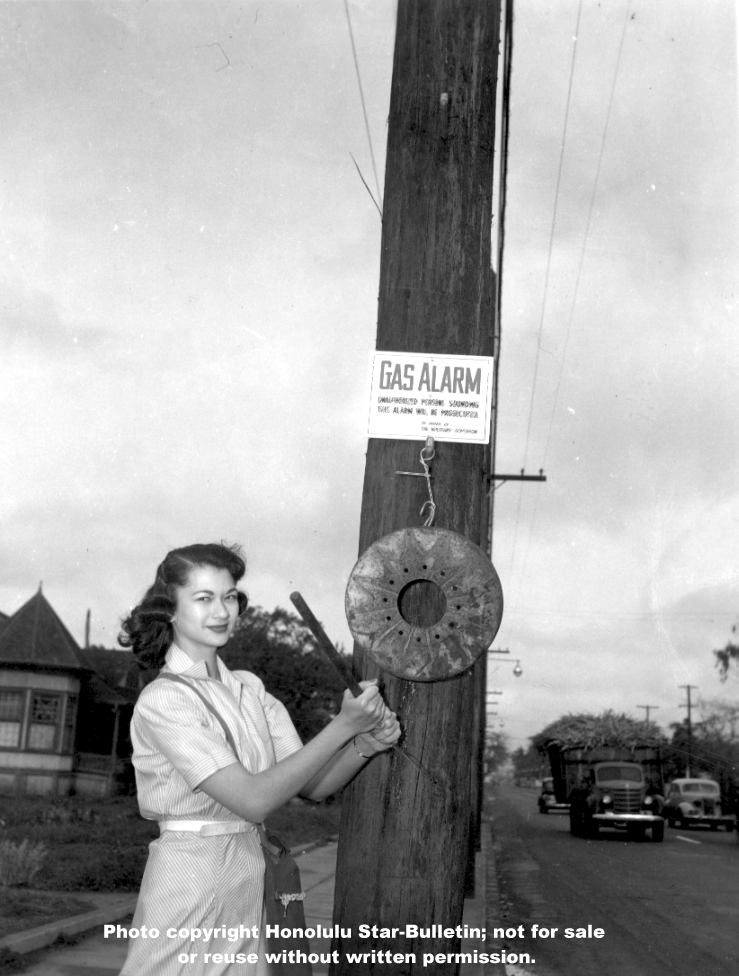
Martial law with its seemingly endless string of rules and regulations dictated minute details of daily life, setting limits on things that were once part of daily life: curfews, registration, blackouts, drills, rationing, air raid sirens, censorship … detention (for some.)

The Army also instituted a 6 pm to 6 am curfew for anyone not on official business and drew up intelligence reports on 450,000-people in Hawaiʻi.  Every citizen over the age of six years was fingerprinted, registered and issued an identification card.

The military ordered a strictly enforced nighttime blackout. Anyone caught with a lit cigarette, pipe or cigar during the blackout was subject to arrest, as was anyone else if the light of their radio dial or kitchen stove burner could be seen through the house windows.

Homes, schools and businesses were directed to prepare bomb shelters. Everyone was issued a protective gas mask and students were trained in their use and conducted drills where an Army officer would fill a classroom with tear gas and have the students walk through to be sure their masks were functioning properly.  (Taylor)

Gasoline was rationed, the possession of arms was prohibited to unauthorized persons, radio transmitting sets and short wave sets were regulated, photo materials were rationed and the local telephone company was taken over to insure the maximum availability of it to the military.    (Maj Gen Green)

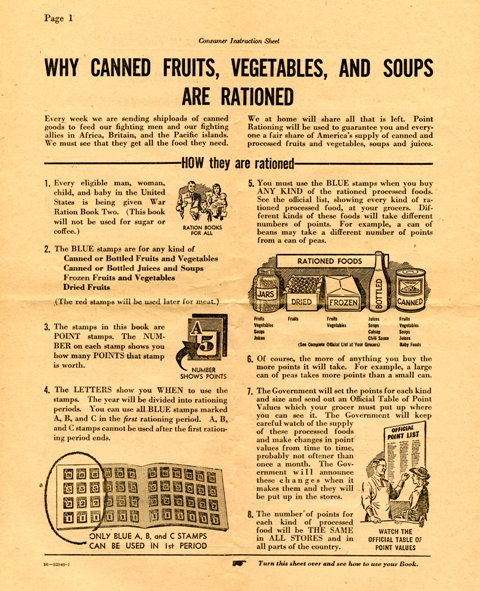
Food was rationed; sugar was the first food to be rationed.  Across the country, to prevent hoarding and skyrocketing prices, the Office of Price Administration issued 123-million copies of War Ration Book One, which contained stamps that could be used to purchase sugar.

Because the islands were so isolated, shipping and receiving supplies, and even mail, became a logistical nightmare.  To supplement food needs, Americans planted “victory gardens,” in which they grew their own food.

Transportation between the islands and the mainland was stopped.  Only those needed to fill positions in the islands were allowed to travel.  (Taylor)

All outgoing mail was read by military censors, and letters that could not be edited with black ink or scissors were returned to the sender to be rewritten. Long-distance telephone calls were required to be in English so that military personnel could listen in.  (White & Murphy)

Fearing that Japanese invaders might try to disrupt US currency, the military confiscated and burned more than $200-million in US paper money, and replaced it with bills with HAWAII overprinted on them.

In addition, people in Hawaiʻi were forbidden to make bank withdrawals of more than $200 in cash per month or to carry more than $200 in cash. (White & Murphy)

Japanese in Hawaiʻi had it worst.  Many Japanese Americans were incarcerated in at least eight locations on Hawaiʻi.  They were put in these camps, not because they had been tried and found guilty of something, but because either they or their parents or ancestors were from Japan and, as such, they were deemed a “threat” to national security.

In the Islands, between 1,200 and 1,400 local Japanese were interned, along with about 1,000 family members – 120,000 people were interned on the continent.  (Not a single Japanese American in Hawaiʻi was ever convicted of espionage, treason or sedition.) (NPS)

Although originally it was believed that martial law would last only a short time, it lasted for almost three years. After it was terminated, curfews and blackouts still remained in effect until October 24, 1944.  (Schneider)

To get a glimpse of conditions in the Islands at the time, read and see ‘Under the Blood Red Sun,’ written by Graham (Sandy) Salisbury.  (Nelia reads the book to her 5th grade class each year at Kainalu.)

© 2024 Hoʻokuleana LLC

Filed Under: Military Tagged With: Hawaii, Japanese, Pearl Harbor, WWII

  • 1
  • 2
  • 3
  • 4
  • Next Page »

Images of Old Hawaiʻi

People, places, and events in Hawaiʻi’s past come alive through text and media in “Images of Old Hawaiʻi.” These posts are informal historic summaries presented for personal, non-commercial, and educational purposes.

Info@Hookuleana.com

Connect with Us

  • Email
  • Facebook
  • LinkedIn
  • Twitter
  • YouTube

Recent Posts

  • Pele’s Hair
  • Waialua High and Intermediate School
  • Pulukai
  • Lydia Panioikawai Hunt French
  • Hawaiian Colonization
  • Winne Units
  • ʻAwa

Categories

  • Voyage of the Thaddeus
  • Mayflower Summaries
  • American Revolution
  • General
  • Ali'i / Chiefs / Governance
  • Buildings
  • Missionaries / Churches / Religious Buildings
  • Hawaiian Traditions
  • Military
  • Place Names
  • Prominent People
  • Schools
  • Sailing, Shipping & Shipwrecks
  • Economy

Tags

Albatross Al Capone Ane Keohokalole Archibald Campbell Bernice Pauahi Bishop Charles Reed Bishop Downtown Honolulu Eruption Founder's Day George Patton Great Wall of Kuakini Green Sea Turtle Hawaii Hawaii Island Hermes Hilo Holoikauaua Honolulu Isaac Davis James Robinson Kamae Kamaeokalani Kameeiamoku Kamehameha Schools Lalani Village Lava Flow Lelia Byrd Liberty Ship Liliuokalani Mao Math Mauna Loa Midway Monk Seal Northwestern Hawaiian Islands Oahu Papahanaumokuakea Marine National Monument Pearl Pualani Mossman Quartette Thomas Jaggar Volcano Waikiki Wake Wisdom

Hoʻokuleana LLC

Hoʻokuleana LLC is a Planning and Consulting firm assisting property owners with Land Use Planning efforts, including Environmental Review, Entitlement Process, Permitting, Community Outreach, etc. We are uniquely positioned to assist you in a variety of needs.

Info@Hookuleana.com

Copyright © 2012-2024 Peter T Young, Hoʻokuleana LLC

Loading Comments...