Images of Old Hawaiʻi

  • Home
  • About
  • Categories
    • Ali’i / Chiefs / Governance
    • American Protestant Mission
    • Buildings
    • Collections
    • Economy
    • Missionaries / Churches / Religious Buildings
    • General
    • Hawaiian Traditions
    • Other Summaries
    • Mayflower Summaries
    • Mayflower Full Summaries
    • Military
    • Place Names
    • Prominent People
    • Schools
    • Sailing, Shipping & Shipwrecks
    • Voyage of the Thaddeus
  • Collections
  • Contact
  • Follow

June 9, 2023 by Peter T Young Leave a Comment

William Geiger

“Few men were more familiar with the history of the settlement and improvement of the Pacific coast than Dr. William Geiger, Jr.” (Smith, Oregon Bios Project)

Geiger was born in Angelica, Allegany County, NY, September 15, 1816, and was a son of William Geiger, a farmer by occupation.  In his native town he was reared and attended a private academy.

When he was about seventeen years of age he moved with his parents to Oakville, Monroe county, Michigan, where he remained from 1833 until 1837, when he started for Quincy, Ill.  About five miles from Quincy was the Mission Institute; Geiger became a student, there. (Smith, Oregon Bios Project)

In 1838 Geiger made plans to cross the plains to the Pacific coast, accompanied by a schoolmate by the name of Benson. (Smith, Oregon Bios Project)

Geiger had been appointed a missionary teacher by the American Board of Commissioners for Foreign Missions and had been instructed to go to the Pacific Coast to do missionary work among the Indians.  When it came time for him to leave it was found that the association lacked the funds, with which to send him.

Having made up his mind to come to the Pacific Coast, he started out on his own account, traveling on horseback. He taught school at the Methodist Mission near Salem in 1840.  (History of the Columbia River Valley)

The next spring Geiger set out for California with the plan of meeting a party of his friends who were to rendezvous at Sutter’s Fort; but, going by sea to Monterey, he was forbidden to travel in the interior without a passport, which was not procurable short of getting one in the Sandwich Islands (Hawaii).

So, Geiger headed to Hawaii with the intention, in part, to get a passport.

He then went to Honolulu, where he taught at the newly formed Chiefs’ Children’s School (Royal School) for about eight months, receiving $30 per month. (Smith, Oregon Bios Project and Berger)

In February 1841, having procured a passport, Geiger left Honolulu on the American ship Lausanne for Monterey, and later went in a coaster to San Francisco.

Back then San Francisco was a small place.  The Hudson Bay Company had a double log house there, and there was a combined saloon and billiard hall and a partly finished hotel, containing about one hundred people, fully half of whom were transients.

After a short time at San Francisco, Geiger went across the bay and secured some cattle, and took them up the river to Sutter’s Fort, where he remained until the spring of 1842.  In the meantime, he surveyed Captain Sutter’s claim for him and had charge of the fort while Sutter went to Monterey for supplies. 

For his services, Sutter gave Geiger land three miles square, situated in the forks of the Yuba and Feather rivers; but in the spring of 1842 Geiger traded everything he had to Captain Sutter for horses and mules and started for the states.

Later, in August 1842, Dr. Geiger sold many of his horses and mules to the emigrants, but took the remainder down the Willamette valley and for a while he lived with Alvin T Smith, near Forest Grove.

In October of that year, in compliance with a letter from Dr Whitman, Geiger started to take charge of the Whitman mission, remaining there during a part of 1842-43, or until Dr Whitman’s return in the fall of 1843.

Before this, he had secured a donation claim where the town of Salem now stands but gave it up later because it was wanted by a Methodist mission.  He next secured a donation claim of six hundred and forty acres south of what is now Cornelius.

In 1847, Geiger married Elizabeth Cornwall, a native of the south, and a sister of Rev. JA Cornwall, a Presbyterian minister located at Sodaville, Linn county, Oregon. He then engaged in farming, also further continuing, under Dr WN Griswold, the study of medicine, which he had first taken up some years before under the direction of Dr. Whitman.

Beginning as a ‘regular’ of the blood-letting, fever-starving sort, he became a convert to the virtues of the homoeopathic group, and began the practice of homeopathy in Forest Grove in 1864 and was undoubtedly the pioneer homeopathic physician of the Pacific coast. (Oregon Pioneers-com)

Dr Geiger served as clerk of Washington county while Oregon was still a territory and was afterward county surveyor for several years.  He surveyed land and from the time of his arrival in the northwest took an active part in its development.  He was an honored member of the State Medical Society of Oregon, in which he served as president.

Dr Geiger and his wife celebrated their golden wedding, having traveled life’s journey for a half century, in 1897. Almost four years passed before they were separated by death and then Dr. Geiger was called to his final rest, June 16, 1901.

He was a consistent Christian who held membership with the Presbyterian Church and in many ways he aided his fellow men, so that the world is better for his having lived. (Smith, Oregon Bios Project)

© 2023 Ho‘okuleana LLC

Filed Under: Missionaries / Churches / Religious Buildings, Prominent People Tagged With: Chiefs' Children's School, William Geiger, Hawaii, Whitman Mission, Marcus Whitman, Royal School

July 19, 2022 by Peter T Young Leave a Comment

Charles Reed Bishop

Born January 25, 1822 in Glens Falls, New York, Charles Reed Bishop was an orphan at an early age and went to live with his grandparents on their 120-acre farm learning to care for sheep, cattle and horses and repairing wagons, buggies and stage coaches. Academically, he only attended the 7th and 8th grades at Glens Falls Academy, his only years of formal schooling.

After leaving school, he becomes a clerk for Nelson J. Warren, the largest business in Warrensburgh, New York. He learned bartering, bookkeeping, taking inventory, maintenance and janitorial duties.  Bishop became an expert in barter, and ran the post office, lumber yard and farm. He becomes a capable businessman.

By January 1846, Bishop was ready to broaden his horizons. He and a friend, William Little Lee, planned to travel to the Oregon territory, Lee to practice law and Bishop to survey land.  They sailed aboard the ‘Henry’ from Newburyport, Massachusetts, around Cape Horn on the way to Oregon.

The vessel made a stop in Honolulu on October 12, 1846; both decided to stay.  (Lee later became the first Chief Justice of the Supreme Court for the Kingdom of Hawaiʻi.)

Bishop soon found work, first at Ladd and Company, a mercantile and trading establishment, then at the US Consulate in Honolulu. In 1849, Bishop signed an oath to “support the Constitution and Laws of the Hawaiian Islands” and was appointed collector of customs for the kingdom.

Bishop met Bernice Pauahi while she was still a student at the Chiefs’ Children’s School (they probably met during the early half of 1847,) and despite the opposition of Pauahi’s parents who wanted her to marry Lot Kapuāiwa (later, Kamehameha V,) Bishop courted and married Pauahi in 1850.  (His letters that mention Pauahi reveal a deep respect and affection for his wife and suggest she was a major source of his happiness throughout their 34-year marriage.)

Their home, Haleakala, became the “greatest centre of hospitality in Honolulu.” They graciously hosted royalty, visiting dignitaries, friends and neighbors as well as engaged in civic activities such as organizing aid to the sick and destitute and providing clothing for the poor.

Bishop was primarily a banker (he has been referred to as “Hawaiʻi’s First Banker.”)  An astute financial businessman, he became one of the wealthiest men in the kingdom from banking, agriculture, real estate and other investments.

However, his industrious nature and good counsel in many fields were also highly valued by Hawaiian and foreign residents alike. He was made a lifetime member of the House of Nobles and appointed to the Privy Council. He served Kings Kamehameha IV, Kamehameha V, Lunalilo and Kalākaua in a variety of positions such as: foreign minister; president of the board of education; and chairman of the legislative finance committee.

Bishop believed in the transforming power of education and supported a number of schools: Punahou, Mills Institute (now known as Mid–Pacific Institute), St Andrews Priory and Sacred Hearts Academy.  He not only contributed money to his causes, he provided sound advice and financial expertise.

He even sent presents of food or clothing to schools like Kawaiahaʻo Seminary at Christmas, “It is my wish that Mr. Raupp should send them plenty of mutton…also that they should have two turkeys or some ducks, some oranges and cakes…”

Next to her royal lineage, no other aspect of Pauahi’s life was as important to her fulfillment as a woman – and as the founder of the Kamehameha Schools – as her marriage to Charles Reed Bishop. He brought her the love and esteem she needed as a woman and the organizational and financial acumen she needed to ensure the successful founding of her estate.  (Kanahele)

Soon after Pauahi’s death in 1884 he wrote: “I know you all loved her, for nobody could know her at all well and not love her. For myself I will only say that I am trying to bear my loss and my loneliness as reasonably as I can looking forward hopefully to the time when I shall find my loved one again.”

Immediately after Pauahi’s death, Bishop, as one of first five trustees she selected to manage her estate and co-executor of her will, set in motion the process that resulted in the establishment of the Kamehameha Schools in 1887.  (The other initial trustees were Charles Montague, Samuel Mills Damon, Charles McEwen Hyde and William Owen Smith.)

Because Pauahi’s estate was basically land rich and cash poor, Bishop contributed his own funds for the construction of several of the schools’ initial buildings on the original Kalihi campus: the Preparatory Department facilities (1888,) Bishop Hall (1891) and Bernice Pauahi Bishop Memorial Chapel (1897.)

Bishop is best known for his generous contributions to his wife’s legacy, the Kamehameha Schools (when he died, he left most of his estate to hers,) and the founding of the Bernice Pauahi Bishop Museum (1889.)

In a letter to Samuel Damon, 1911, he noted, “Being interested in her plans…I decided to carry out her wishes regarding the schools and promised to do something toward a museum of Hawaiian and other Polynesian objects…in order to accomplish something quickly … I soon reconveyed to her estate the life interests given by her will and added a considerable amount of my own property…”

In 1894, Bishop left Hawai`i to make a new life in San Francisco, California. Until he died, he continued, through correspondence with the schools’ trustees, to guide the fiscal and educational policy-making of the institution in directions that reinforced Pauahi’s vision of a perpetual educational institution that would assist scholars to become “good and industrious men and women.” (Bernice Pauahi Bishop’s Will, 1883)

In 1895, Bishop established the Charles Reed Bishop Trust.  The beneficiaries of the Trust consist of 8-designated entities: Bernice Pauahi Bishop Museum, Maunaʻala, Central Union Church, Kaumakapili Church, Kawaiahaʻo Church, Kamehameha Schools, Mid-Pacific Institute (his original beneficiaries, Kawaiahaʻo Female Seminary and Mills Institute merged in 1907 to form Mid-Pac) and Lunalilo Trust.

By the time Pauahi died in 1884, Maunaʻala, the Royal Mausoleum in Nuʻuanu was crowded with caskets. Bishop built an underground vault for Pauahi and members of the Kamehameha dynasty.

Charles Reed Bishop died June 7, 1915; his remains rest beside his wife in the Kamehameha Tomb.  A separate monument to Charles Reed Bishop was built at Maunaʻala in 1916.   (Lots of information here is from KSBE.)

© 2022 Hoʻokuleana LLC

Filed Under: Ali'i / Chiefs / Governance, Prominent People, Schools, Economy, General Tagged With: Royal School, Bishop Museum, Bishop Bank, Bishop Street, Hawaii, Bernice Pauahi Bishop, Charles Reed Bishop, Kamehameha Schools, Oahu, Mauna Ala, Chief's Children's School

September 2, 2019 by Peter T Young 2 Comments

Pākī Sisters

High Chief Abner Pākī and his wife High Chiefess Laura Kōnia (Kamehameha III’s niece) had one child, a daughter, Bernice Pauahi Pākī (born December 19, 1831.)

High Chief Caesar Kapaʻakea and his wife High Chiefess Analeʻa Keohokālole had three children, a daughter was Lydia Liliʻu Kamakaʻeha (born September 2, 1838.)

As was the custom, Liliʻu was hānai (adopted) to the Pākīs, who reared her with their birth daughter, Pauahi. The two girls developed a close, loving relationship.

“When I was taken from my own parents and adopted by Paki and Konia, or about two months thereafter, a child was born to Kīna‘u. That little babe was the Princess Victoria, two of whose brothers became sovereigns of the Hawaiian people.”

“While the infant was at its mother’s breast, Kīna‘u always preferred to take me into her arms to nurse, and would hand her own child to the woman attendant who was there for that purpose.”

“I knew no other father or mother than my foster-parents, no other sister than Bernice. I used to climb up on the knees of Paki, put my arms around his neck, kiss him, and he caressed me as a father would his child …”

“… while on the contrary, when I met my own parents, it was with perhaps more of interest, yet always with the demeanor I would have shown to any strangers who noticed me.”

“My own father and mother had other children, ten in all, the most of them being adopted into other chiefs’ families; and although I knew that these were my own brothers and sisters, yet we met throughout my younger life as though we had not known our common parentage. This was, and indeed is, in accordance with Hawaiian customs.” (Lili‘uokalani)

They lived on the property called Haleʻākala, in the house that Pākī built on King Street.  It was the ‘Pink House,’ made from coral (the house was name ʻAikupika (Egypt.))  It later became the Arlington Hotel.

The two-story coral house was built by Pākī himself, from the original grass hut complex of the same name at the same site; he financed the construction through the sale of Mākaha Valley (ʻAikupika would later become the primary residence of his daughter Bernice Pauahi and her husband.)

The girls attended the Chief’s Children’s School, a boarding school, and were known for their studious demeanor.

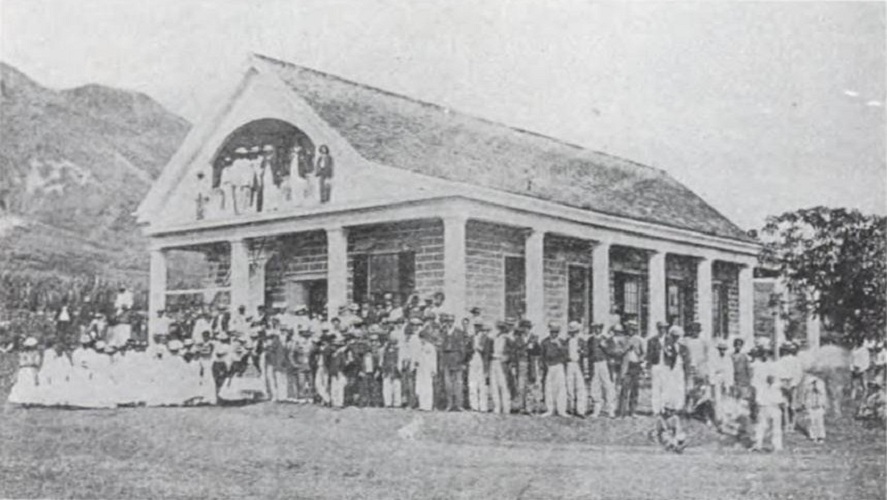
Founded in 1839 during the reign of King Kamehameha III, the original Chief’s Children’s School was in the area where the ʻIolani barracks now stand. Mr. and Mrs. Amos Cooke, missionaries from New England, were commissioned to teach the 16 royal children (others who joined the Pākī sisters were Lot Kapuāiwa (later Kamehameha V), Queen Emma, King William Lunalilo and Liliʻu’s brother, David (later King Kalākaua.)

In 1846 the school’s name was officially changed to Royal School; attendance was restricted to descendants of the royal line and heirs of the chiefs. In 1850, a second school was built on the site of the present Royal School; it was opened to the general public in 1851.

These two women left lasting legacies in Hawaiʻi.

In 1850, Pauahi was married to Mr. Charles Reed Bishop of New York, who started the bank that is now known as First Hawaiian Bank.

When her cousin, Princess Ruth Keʻelikōlani, died,  Keʻelikōlani’s will stated that she “give and bequeath forever to my beloved younger sister (cousin), Bernice Pauahi Bishop, all of my property, the real property and personal property from Hawaiʻi to Kauaʻi, all of said property to be hers.” (about 353,000 acres)  (Keʻelikōlani had previously inherited all of the substantial landholdings of the Kamehameha dynasty from her brother, Lot Kapuāiwa (King Kamehameha V.))

Bernice Pauahi died childless on October 16, 1884.  She foresaw the need to educate her people and in her will she left her large estate of the Kamehameha lands in a trust “to erect and maintain in the Hawaiian Islands two schools, each for boarding and day scholars, one for boys and one for girls, to be known as, and called the Kamehameha Schools.”

She further stated, “I desire my trustees to provide first and chiefly a good education in the common English branches, and also instruction in morals and in such useful knowledge as may tend to make good and industrious men and women”.

On September 16, 1862, Liliʻu married John O. Dominis. Dominis’ father, a ship’s captain, had built a New England style home, named Washington Place, for his family.  They lived with his widowed mother.  The home became the official residence of Hawai‘i’s Governor and today serves as a museum.

On February 12, 1874, nine days after the passing of King Lunalilo, an election was held between the repeat candidate David Kalākaua (her brother) and Queen Emma – widow of King Kamehameha IV.  Kalākaua won.

At noon of the tenth day of April, 1877, the booming of the cannon was heard which announced that King Kalākaua had named Liliʻuokalani heir apparent to the throne of Hawaiʻi. (Liliʻu’s brother changed her name when he named her Crown Princess, calling her Liliʻuokalani.)

King Kalākaua died on January 20, 1891; because he and his wife Queen Kapiʻolani did not have any children, his sister, Liliʻuokalani succeeded him to the Hawaiian throne.  Queen Liliʻuokalani was Hawaiʻi’s last monarch.

In 1909, Queen Liliʻuokalani executed a Deed of Trust that established the legal and financial foundation of an institution dedicated to the welfare of orphaned and destitute children of Hawaiʻi – Queen Liliʻuokalani Trust.

Her Deed of Trust states that “all the property of the Trust Estate, both principal and income … shall be used by the Trustees for the benefit of orphan and other destitute children in the Hawaiian Islands, the preference given to Hawaiian children of pure or part-aboriginal blood.”

The trust owns approximately 6,200-acres of Hawaiʻi real estate, the vast majority of which is located on the Island of Hawaiʻi.  92% is agriculture/conservation land, with the remaining land zoned for residential, commercial and industrial use.

The trust owns approximately 16-acres of Waikīkī real estate and another 8-acres of commercial and residential real estate on other parts of Oʻahu.

An interesting side note relates to the role and relationship Pauahi and Liliʻuokalani had with William Owen Smith, the son of American Protestant missionaries.

During the revolutionary period, Smith was one of the thirteen members of the Committee of Safety that overthrew the rule of Queen Liliʻuokalani (January 17, 1893) and established the Provisional Government and served on its executive council.

When not filling public office, Smith had been engaged in private law practice – Smith and his firm wrote the will for Princess Pauahi Bishop that created the Bishop Estate.

Pauahi recommended to Queen Liliʻuokalani that he write her will for the Liliʻuokalani Trust (which he did.) As a result, Liliʻuokalani and Smith became lifelong friends; he defended her in court, winning the suit brought against her by Prince Jonah Kūhiō.

Follow Peter T Young on Facebook 

Follow Peter T Young on Google+ 

Follow Peter T Young on LinkedIn  

Follow Peter T Young on Blogger

© 2019 Hoʻokuleana LLC

Paki_sisters-Bernice Pauahi Paki and Lydia Kamakaeha Paki (Liliuokalani)-1859
Lydia Kamakaʻeha Pākī, the future Queen Liliuokalani, in her youth possibly at Royal School.
Abner Pākī (c. 1808–1855) was a member of Hawaiian nobility. He was a legislator and judge
Laura Kōnia (c. 1808–1857) was a member of the Hawaiian royal family. She was grandaughter of King Kamehameha I
Caesar Kapaakea and Analea Keohokālole, parents of King Kalakaua and Queen Liliuokalani
(L_to_R)-Laura Cleghorn, Princess Liliʻuokalani, Princess Likelike & Keawepoʻoʻole. (L_to_R) Thomas Cleghorn, John O Dominis & Archibald S Cleghorn
Royal_School-after_1875
TRoyal_School-Chiefs' Childrens School-July 20, 1841
Haleakala-Bishop_Property-on_King_Street-1855
Haleakala-front-(DMY)

Filed Under: Ali'i / Chiefs / Governance Tagged With: Kalakaua, Keohokalole, King Kalakaua, Haleakala, Chief's Children's School, Royal School, Hawaii, Paki, Bernice Pauahi Bishop, John Dominis, Liliuokalani, Liliu, Ane Keohokalole, Queen Liliuokalani

August 26, 2019 by Peter T Young Leave a Comment

Hale Kula Ali‘i

Hale Kula Ali‘i, the Chiefs’ Children’s School (later called the Royal School), was created by King Kamehameha III; the main goal of this school was to groom the next generation of the highest-ranking chief’s children of the realm and secure their positions for Hawaii’s Kingdom.

Seven families were eligible under succession laws stated in the 1840 Constitution of the Kingdom of Hawai‘i; Kamehameha III called on seven boys and seven girls of his family to board in the Chief’s Children’s School.

In 1839, King Kamehameha III, Hoapili and Kekāuluohi (mother of William Charles Lunalilo, who became the Kuhina Nui or regent of the Hawaiian Kingdom) signed a letter asking missionaries to run the Chiefs’ Children’s School.

In a missionary general meeting, “This subject was fully considered in connection with an application of the chiefs requesting the services of Mr. Cooke, as a teacher for their children; and it was voted,

That the mission comply with their request, provided they will carry out their promise to Mr. Cooke’s satisfaction; namely, to build a school house, sustain him in his authority, over the scholars, and support the school.” (Sandwich Islands Mission General Meeting Minutes, 1839)

The school was unique because for the first time aliʻi children would be brought together in a group to be taught, ostensibly, about the ways of governance. The School also acted as another important unifying force among the ruling elite, instilling in their children common principles, attitudes and values, as well as a shared vision.

No school in Hawai‘i has ever produced so many Hawaiian leaders in one generation.

The students ranged from age two to eleven, and differed widely in their temperaments and abilities, goals and destinies. But they all had one common bond: their genealogical sanctity and mana as Aliʻi-born.

The school building was square-shaped, with a courtyard in the center and a well. The thirteen or so rooms included a large classroom, kitchen, dining room, sitting room and parlor, and living quarters for the students and the Cookes. The entire complex was surrounded by a high wall, apparently intended as much to keep people out as to keep them in.

In this school were educated the Hawai‘i sovereigns who reigned over the Hawaiian people from 1855 (age noted is the age at death:)

Alexander Liholiho (February 9, 1834 – November 30, 1863 (age 29))
Alexander Liholiho became King Kamehameha IV and ruled over Hawaiʻi January 11, 1855 – November 30, 1863

Emma Naʻea Rooke (January 2, 1836 – April 25, 1885 (age 49))
On June 19, 1856, Emma married Alexander Liholiho and became Queen Emma. In 1859, King Kamehameha IV and Queen Emma founded Queen’s Hospital.

Lot Kapuāiwa (December 11, 1830 – December 11, 1872 (age 42))
Lot Kapuāiwa became King Kamehameha V and ruled over Hawaiʻi November 30, 1863 — December 11, 1872.

William Lunalilo (January 31, 1835 – February 3, 1874 (age 39))
The first elected King of Hawaiʻi; he became King Lunalilo and ruled over Hawaiʻi January 8, 1873 – February 3, 1874.

David Kalākaua (November 16, 1836 – January 20, 1891 (age 54))
He defeated Queen Emma in an election to the throne and ruled over Hawaiʻi February 12, 1874 — January 20, 1891.

Lydia Liliʻu Kamakaʻeha (September 2, 1838 – November 11, 1917 (age 79))
Hawaiʻi’s last reigning monarch, she was named heir apparent (and her name was changed to Liliʻuokalani) and succeeded her brother to the Hawaiian throne and ruled over Hawaiʻi January 29, 1891 – January 17, 1893.

Bernice Pauahi (December 19, 1831 – October 16, 1884 (age 52))
Great-granddaughter of King Kamehameha I, her estate operates the Kamehameha Schools (established in 1887) according to Pauahi’s will.

Elizabeth Kekaʻaniau Laʻanui (September 12, 1834 – December 20, 1928 (age 94))
Daughter of High Chief Gideon Peleioholani Laʻanui and High Chiefess Theresa Owana Kaheiheimalie Rives; she was great grandniece of Kamehameha I. She was the last Royal School alumnus to die.

Moses Kekūāiwa (July 20, 1829 – November 24, 1848 (age 19))
Son of Mataio Kekūanāoʻa and Elizabeth Kīnaʻu. He was a grandson of Kamehameha I.

Jane Loeau (December 5, 1828–July 30, 1873 (age 44))
Daughter of High Chief Kalaniulumoku and High Chiefess Kuini Liliha (descended from Kahekili II, Mōʻi of Maui, and High Chief Hoapili through her mother.) She was hānai to Ahukai (Kaukualiʻi.)

Victoria Kamāmalu (November 1, 1838 – May 29, 1866 (age 27))
She served as Kuhina Nui (Prime Minister) as Kaʻahumanu IV (1855-1863;) as Kuhina Nui, she effectively served as “Queen” for a day and proclaimed her brother Lot Kamehameha V the rightful successor to Kamehameha IV, when the latter died unexpectedly in 1863.)

Peter Young Kāʻeo (March 4, 1836 – November 26, 1880 (age 44))
Hānai to his maternal uncle John Kalaipaihala Young II (Keoni Ana) (Kuhina Nui (Prime Minister) (1845-1855) and son of John Young, the English sailor who became a trusted adviser to Kamehameha I)

William Pitt Leleiōhoku (March 31, 1821 – October 21, 1848 (age 27))
Son of the Kalanimōku (Prime Minister) and Kiliwehi (daughter of King Kamehameha I.) Hānai to John Adams Kuakini (Governor of Hawaiʻi Island and brother of Queen Kaʻahumanu.) He was married to the Princess Nāhiʻenaʻena and later to Princess Ruth Keʻelikōlani.

Abigail Maheha (July 10, 1832 – ca. 1861 (age 29))
Daughter of High Chief Namaile and High Chiefess Kuini Liliha; Hānai to her aunt, Princess Kekauʻōnohi (granddaughter of Kamehameha I.)

James Kaliokalani May 29, 1835 – April 2, 1852 (age 16))
Son of High Chief Caesar Kapaʻakea and mother High Chiefess Analeʻa Keohokālole. Hānai to his maternal grandfather High Chief Aikanaka.)

Mary Polly Paʻaʻāina (1833 – May 28, 1853 (age 20))
Daughter of Henry Coleman Lewis and High Chiefess Fanny Kekelaokalani (daughter of John Young, the advisor of Kamehameha I, and was also grandniece of Kamehameha I.) Entering the school in 1843, she was the last girl to enter the school.

The cornerstone of the original school was laid on June 28, 1839 in the area of the old barracks of ʻIolani Palace (at about the site of the present State Capitol of Hawaiʻi.)

Click HERE for more on the Chiefs’ Children’s School.

Follow Peter T Young on Facebook 

Follow Peter T Young on Google+ 

Follow Peter T Young on LinkedIn  

Follow Peter T Young on Blogger

© 2019 Hoʻokuleana LLC

Chiefs_Childrens_School-Royal_School-plaque-Kawaiahao

Filed Under: Ali'i / Chiefs / Governance, Missionaries / Churches / Religious Buildings, Schools Tagged With: Chief's Children's School, Juliette Cooke, Royal School, Amos Cooke, Hale Kula Alii, Hawaii, Missionaries

January 3, 2017 by Peter T Young Leave a Comment

Timeline Tuesday … 1830s

Today’s ‘Timeline Tuesday’ takes us through the 1830s – death of Ka‘ahumanu, first successful commercial sugar, first English language newspaper and Declaration of Rights. We look at what was happening in Hawai‘i during this time period and what else was happening around the rest of the world.

A Comparative Timeline illustrates the events with images and short phrases. This helps us to get a better context on what was happening in Hawai‘i versus the rest of the world. I prepared these a few years ago for a planning project. (Ultimately, they never got used for the project, but I thought they might be on interest to others.)

Follow Peter T Young on Facebook 

Follow Peter T Young on Google+ 

Follow Peter T Young on LinkedIn  

Follow Peter T Young on Blogger

© 2017 Hoʻokuleana LLC


Timeline-1830s

Filed Under: Missionaries / Churches / Religious Buildings, Hawaiian Traditions, Prominent People, Economy, Schools, General, Ali'i / Chiefs / Governance Tagged With: Chief's Children's School, Royal School, Declaration of Rights (1839), Timeline Tuesday, Hawaii, Sandwich Island Gazette, Sugar, Mormon, Kaahumanu, Kamehameha III, Lahainaluna

  • « Previous Page
  • 1
  • 2
  • 3
  • Next Page »

Images of Old Hawaiʻi

People, places, and events in Hawaiʻi’s past come alive through text and media in “Images of Old Hawaiʻi.” These posts are informal historic summaries presented for personal, non-commercial, and educational purposes.

Info@Hookuleana.com

Connect with Us

  • Email
  • Facebook
  • LinkedIn
  • Twitter
  • YouTube

Recent Posts

  • Happy Father’s Day!
  • The Apology & the Supreme Court
  • Hawai‘i Seven
  • Bull Pen
  • About 250 Years Ago … Battle of Bunker Hill
  • About 250 Years Ago … George Washington
  • 50-Star US Flag

Categories

  • Place Names
  • Prominent People
  • Schools
  • Sailing, Shipping & Shipwrecks
  • Economy
  • Voyage of the Thaddeus
  • Mayflower Summaries
  • American Revolution
  • General
  • Ali'i / Chiefs / Governance
  • Buildings
  • Missionaries / Churches / Religious Buildings
  • Hawaiian Traditions
  • Military

Tags

Albatross Al Capone Ane Keohokalole Archibald Campbell Bernice Pauahi Bishop Charles Reed Bishop Downtown Honolulu Eruption Founder's Day George Patton Great Wall of Kuakini Green Sea Turtle Hawaii Hawaii Island Hermes Hilo Holoikauaua Honolulu Isaac Davis James Robinson Kamae Kamaeokalani Kameeiamoku Kamehameha Schools Lalani Village Lava Flow Lelia Byrd Liberty Ship Liliuokalani Mao Math Mauna Loa Midway Monk Seal Northwestern Hawaiian Islands Oahu Papahanaumokuakea Marine National Monument Pearl Pualani Mossman Quartette Thomas Jaggar Volcano Waikiki Wake Wisdom

Hoʻokuleana LLC

Hoʻokuleana LLC is a Planning and Consulting firm assisting property owners with Land Use Planning efforts, including Environmental Review, Entitlement Process, Permitting, Community Outreach, etc. We are uniquely positioned to assist you in a variety of needs.

Info@Hookuleana.com

Copyright © 2012-2024 Peter T Young, Hoʻokuleana LLC

Loading Comments...