Images of Old Hawaiʻi

  • Home
  • About
  • Categories
    • Ali’i / Chiefs / Governance
    • American Protestant Mission
    • Buildings
    • Collections
    • Economy
    • Missionaries / Churches / Religious Buildings
    • General
    • Hawaiian Traditions
    • Other Summaries
    • Mayflower Summaries
    • Mayflower Full Summaries
    • Military
    • Place Names
    • Prominent People
    • Schools
    • Sailing, Shipping & Shipwrecks
    • Voyage of the Thaddeus
  • Collections
  • Contact
  • Follow

November 29, 2019 by Peter T Young Leave a Comment

Kekaulike Dynasty

King Kekaulike (1700-1736) was the 23rd King (Mo‘i) of Maui and founder of Maui’s last ruling dynasty.

He was descended from Pi‘ilani (‘ascent to heaven’) the Great. The Prince Maui-Loa was the first independent sovereign of Maui. Twenty generations of independent monarchs ruled in Maui from the Prince Maui-Loa until the accession of Pi‘ilani the Great who is perhaps the most renowned monarch of the island Kingdom of Maui.

The kings of Maui consolidated their strength, built up their armies and created a nation strong enough to threaten at times even the might of the powerful kings of Hawai‘i.

King Kekaulike and his children built an empire that enjoyed levels of power and prestige greater than any other royal family up until that point.

In the early-1790s, Maui’s King Kahekili (son of Kekaulike) and his eldest son and heir-apparent, Kalanikūpule, were carrying on war and conquered Kahahana, ruler of O‘ahu.

By the time Kamehameha the Great set about unifying the Hawaiian Islands, members of the Kekaulike Dynasty were already ruling Maui, Molokai, Lāna‘i , O‘ahu, Kauai and Ni‘ihau.

In the late-1780s, into 1790, Kamehameha conquered the Island of Hawai‘i and was pursuing conquest of Maui and eventually sought conquer the rest of the archipelago.

In 1790, Kamehameha travelled to Maui. Hearing this, Kahekili sent Kalanikūpule back to Maui with a number of chiefs (Kahekili remained on O‘ahu to maintain order of his newly conquered kingdom.)

Kekaulike’s son, Kamehamehanui (uncle to Kamehameha I,) lost Hana, which was isolated from the rest of Maui.

Kamehameha then landed at Kahului and marched on to Wailuku, where Kalanikūpule waited for him. This led to the famous battle “Kepaniwai” (the damming of the waters) in ‘Iao Valley (which Kamehameha decisively won.)

Maui Island was conquered by Kamehameha and Maui’s fighting force was destroyed – Kalanikūpule and some other chiefs escaped and made their way to O‘ahu (to later face Kamehameha, again; this time in the Battle of Nu‘uanu in 1795.)

There the war apparently ends with some of Kalanikūpule’s warriors pushed/jumping off the Pali. When the Pali Highway was being built, excavators counted approximately 800-skulls, believed to be the remains of the warriors who were defeated by Kamehameha.

While it may be true that Kamehameha the Great conquered Maui and overthrew the Kekaulike Dynasty at the Battle of Nu‘uanu, it should also be remembered that Kamehameha’s own mother, the Princess Keku‘iapoiwa II, was a Maui princess.

Likewise, Kamehameha’s wives of rank were princesses of Maui. These were Keōpūolani, Ka‘ahumanu, Kalākua-Kaneiheimālie and Peleuli. Keōpūolani, granddaughter of Kekaulike, was the mother of the Kamehameha II and Kamehameha III.

Others from this Maui lineage include King Kaumuali‘i (of Kauai,) Abner Pākī (father of Bernice Pauahi Bishop,) Kuakini, Keʻeaumoku II and Kalanimōkū.

The Kekaulike Dynasty was a powerful line that ruled multiple islands. Although they lost to Kamehameha, the Kekaulike lineage continued through the leadership of the future leaders of Hawai‘i.

Follow Peter T Young on Facebook 

Follow Peter T Young on Google+ 

Follow Peter T Young on LinkedIn  

Follow Peter T Young on Blogger

© 2019 Hoʻokuleana LLC

Kekaulike-Brook Parker
Mahiole_of_Kaumualii,_1899- Kaumualiʻi (c. 1778 – May 26, 1824) was the last independent Aliʻi Aimoku (King of the islands) of Kauaʻi and Niʻihau
Kekaulike Family Tree
Memoir of Keopuolani, late queen of the Sandwich Islands ...
Keōpūolani-(1778–1823) was a queen consort of Hawaiʻi and the highest ranking wife of King Kamehameha I and mother Kamehameha II, Kamehameha III-1790
Abner Pākī (c. 1808–1855) was a member of Hawaiian nobility. He was a legislator and judge, and the father of Bernice Pauahi Bishop-1855
George Cox Kahekili Keʻeaumoku II (1784–1824) served as a military leader, and then became a convert to Christianity and Royal Governor of Maui
'John Adams' Kuakini, royal governor or the island of Hawai'i, circa 1823
Kaahumanu-(HerbKane)
Lydia Namahana Piʻia (c. 1787–1829) was one of the Queen consorts at the founding of the Kingdom of Hawaii. She was sister of Queen Kaahumanu
William Pitt Kalanimoku (c. 1768–1827) was a High Chief who functioned similar to a prime minister of the Hawaiian Kingdom
King_Kahekili_Approaching_Discovery_off_Maui-(HerbKane)
Maui Nui

Filed Under: Ali'i / Chiefs / Governance Tagged With: Maui, Kahekili, Piilani, Kalanikupule, Kepaniwai, Nuuanu, Kekaulike, Hawaii, Kamehameha

October 31, 2019 by Peter T Young 1 Comment

Nā Hono A Pi‘ilani

In northwest Maui, the district the ancients called Kaʻānapali, there are six hono bays (uniting of the bays,) which are legendary:  from South to North, Honokōwai (bay drawing fresh water), Honokeana (cave bay), Honokahua (sites bay,) Honolua (two bays), Honokōhau (bay drawing dew) and Hononana (animated bay).

All were extensively terraced for wet taro (loʻi) in early historic and later times. Honokahua Valley has been described as having loʻi lands. Sweet potatoes were reportedly grown between the Honokohau and Kahakuloa Ahupuaʻa.

Collectively, these picturesque and productive bays are called Nā Hono A Piʻilani, The Bays of Piʻilani (aka Honoapiʻilani.)

In the 1500s, Chief Piʻilani (“stairway to heaven”) unified West Maui and ruled in peace and prosperity.  His territory included the six West Maui bays, a place he frequented.

He ruled from the Royal Center in Lāhaina, where he was born (and died.)  His residence was at Moku‘ula.

During his reign, Piʻilani gained political prominence for Maui by unifying the East and West of the island, elevating the political status of Maui.

Piʻilani’s power eventually extended from Hāna on one end of the island to the West at Nā Hono A Piʻilani, in addition to the islands visible from Honoapiʻilani – Kahoʻolawe, Molokaʻi and Lānaʻi.

Piʻilani’s prosperity was exemplified by a boom in agriculture and construction of heiau, fishponds, trails and irrigation systems.

Famed for his energy and intelligence, Piʻilani constructed the West Maui phase of the noted Alaloa, or long trail (also known as the King’s Highway.)

His son, Kihapiʻilani laid the East Maui section and connected the island.  This trail was the only ancient pathway to encircle any Hawaiian island (not only along the coast, but also up the Kaupo Gap and through the summit area and crater of Haleakalā.)

Four to six feet wide and 138 miles long, this rock-paved path facilitated both peace and war.  It simplified local and regional travel and communication, and allowed the chief’s messengers to quickly get from one part of the island to another.

The trail was used for the annual harvest festival of Makahiki and to collect taxes, promote production, enforce order and move armies.

Missionaries Richards, Andrews and Green noted in 1828, “a pavement said to have been built by Kihapiilani, a king … afforded us no inconsiderable assistance in traveling as we ascended and descended a great number of steep and difficult paries (pali.)” (Missionary Herald)

Today, Lower Honoapiʻilani Road and parts of Route 30 (Honoapiʻilani Highway) near the beach approximately trace the route of the ancient Alaloa (parts of the Alaloa were destroyed by development and sugar plantation uses.)

On the East side, portions of the Road to Hāna are a remnant of this 16th century coastal footpath, also known in this area as the King’s Highway, King Kiha-a-pi‘ilani Trail or even Kipapa o Kiha-a-pi’ilani (the pavement of Kiha-a-pi’ilani.)

Some beaches on the east side of the Alaloa along Route 360 were often used to cross gulches, since there were no bridges.  It has also been reported that travelers would swing across the streams on ropes or vines, or climbed across the cliffs.

Around 1759, Kalaniʻōpuʻu (King of the Big Island) captured Hāna and held it for a couple decades; the footpath fell into disrepair.  In 1780, Kahekili, the King of North Maui, retook Hāna, made improvements and reopened the trail.

It was accessible only by foot until around 1900; likewise, travel by canoe, and later other vessels, provided access from Hāna to other parts of Maui.

The ancient trails have typically been covered by modern highways and other development and only a few remnants of the King’s Highway remain.

Honoapiʻilani Highway, around the western edge of West Maui, and the Pi‘ilani Highway, along the Kihei coast, remain the namesakes for Piʻilani.

Follow Peter T Young on Facebook 

Follow Peter T Young on Google+ 

Follow Peter T Young on LinkedIn  

Follow Peter T Young on Blogger

© 2019 Hoʻokuleana LLC

Na_Hono_A_Piilani-GoogleEarth
Kekaa Pt. to Kahakuloa Pt.-NOAA-UH-Manoa-3269-1912
Alaloa-beyond Keoneoio (La Perouse Bay)
Hoapili Trail-(NPS)
Hoapili_Trail-Honuaula-(Project_Kaeo)-(Horse-Cart-1824-1834)
Hoapili_Trail-Kanaloa_Point
Hoapili_Trail-Kula_Honuaula_Kahikinui_Kaupo-(Project_Kaeo)-(Horse-Cart-1824-1834)
Hoapili_Trail-LaPerouse_Bay
Hoapili_Trail-LaPerouse-Bay
Kahekili-one-lane-no-guardrail-North
Kings Highway footpath between Wainopoli State Park and Town of Hana-Hana Belt Road-(LOC)-219754pv
Kings Highway footpath from O Hale Hei au - Hana Belt Road-(LOC)-219756pv
Kings Highway footpath showing rounded rocks laid into lava bed - Hana Belt Road-(LOC)-219755pv
Maui_Alaloa
Maui-Alaloa
Na Hono A Piilani-Alaloa
Piilani Highway low along the cliffs, just southwest of the highway's end at the Kalepa Bridge

Filed Under: Ali'i / Chiefs / Governance, Hawaiian Traditions Tagged With: Piilani, Kalaniopuu, Hana, Na Hono A Piilani, Kaanapali, Kihapiilani, Honoapiilani, Hawaii, Mokuula, Maui, Kahekili, Lahaina

September 28, 2019 by Peter T Young 2 Comments

Piʻilanihale Heiau

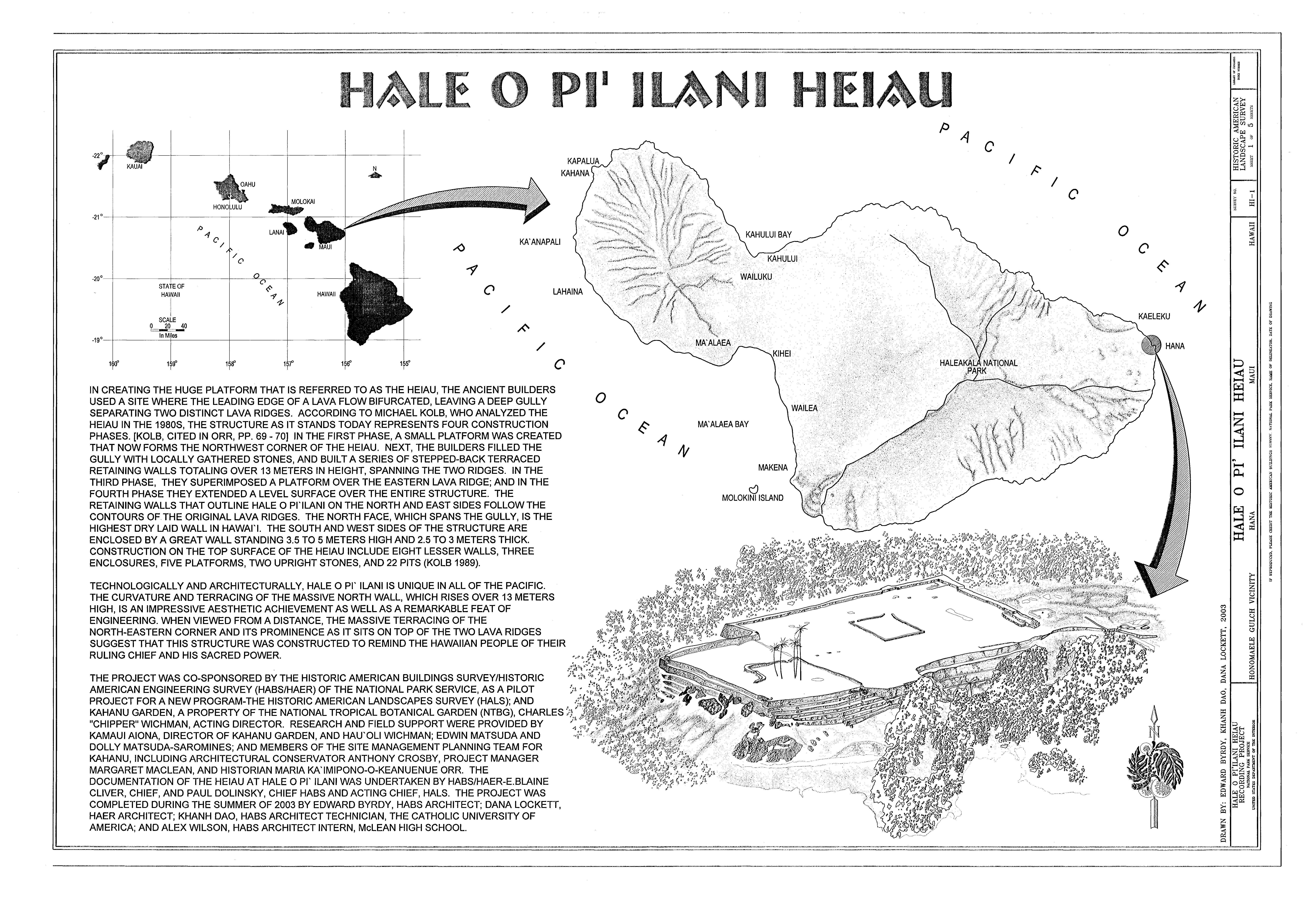
Piʻilanihale Heiau is Hawaiʻi’s (and maybe Polynesia’s) largest heiau that is still intact (it is situated near Hāna, Maui.)

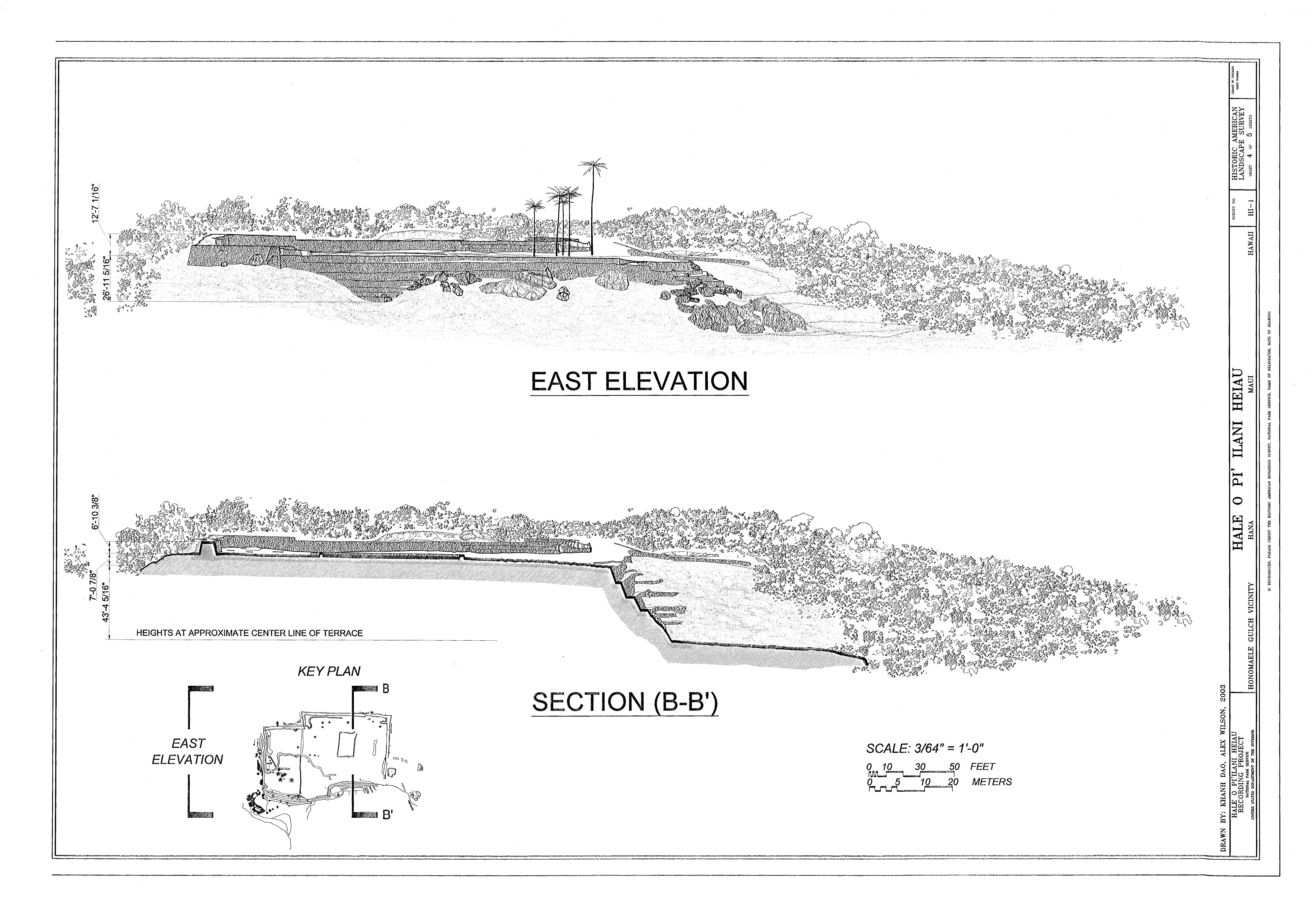
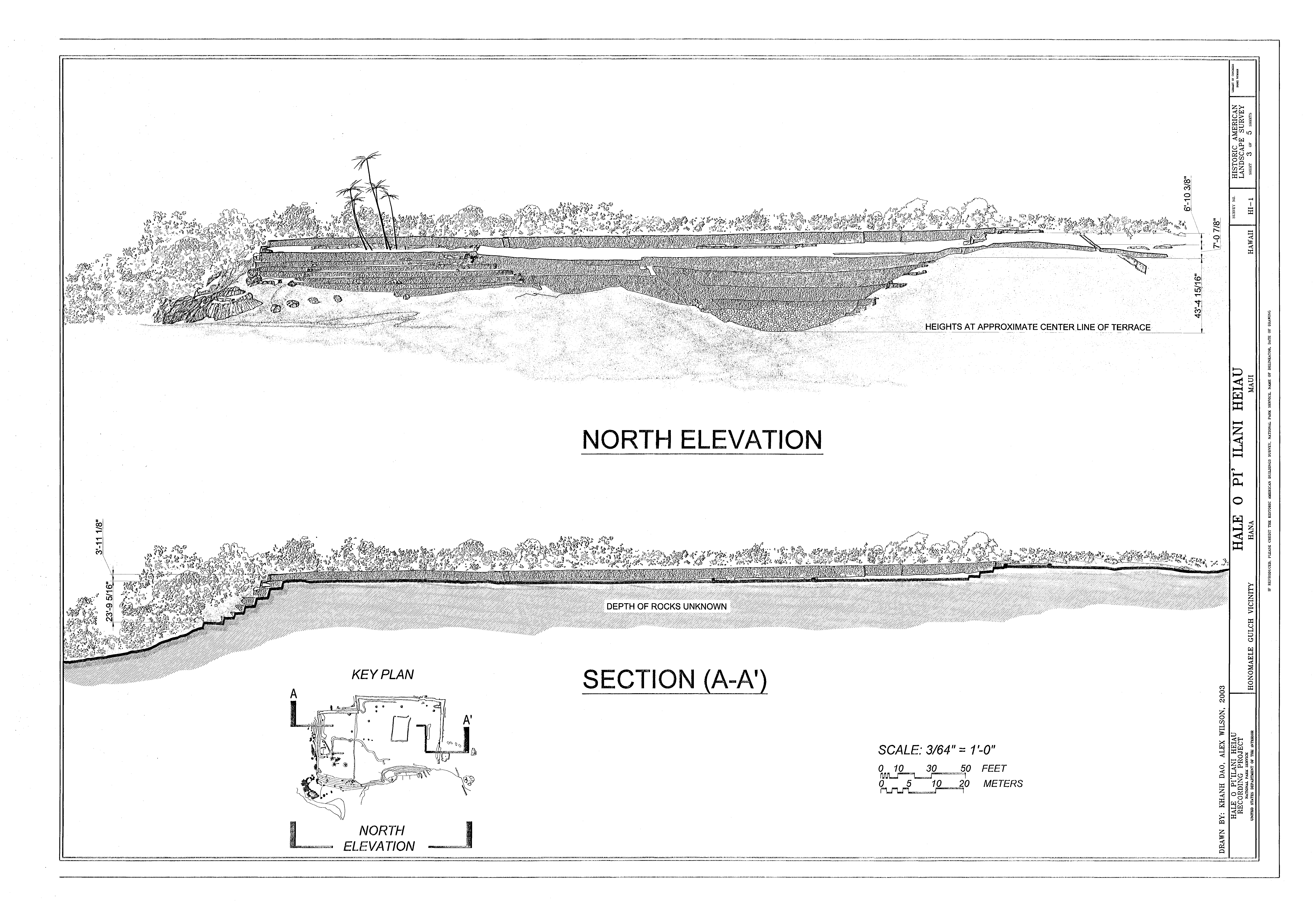
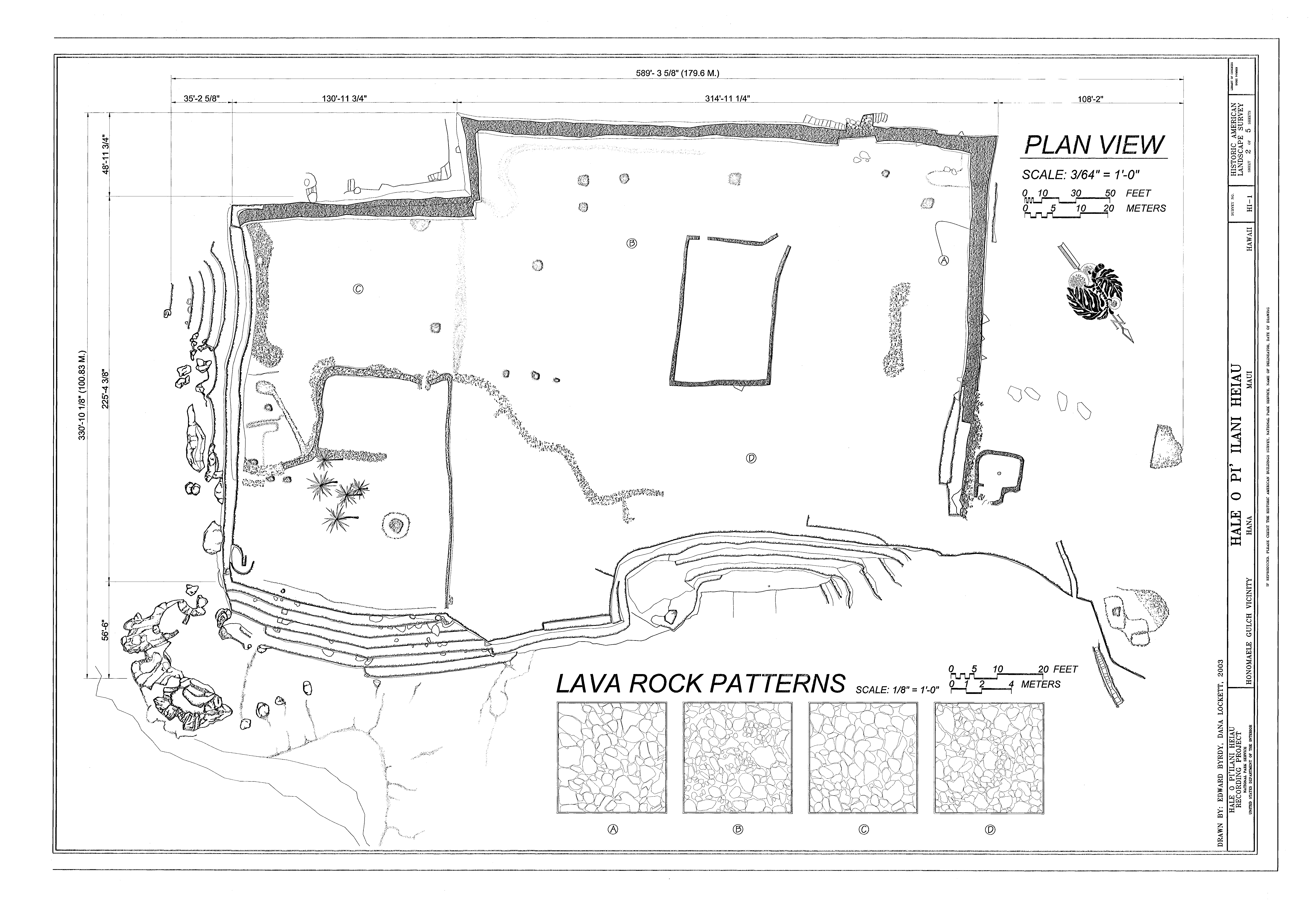
Standing over 40-feet high, the stone platform is 289-feet by 565.5-feet; Piʻilanihale Heiau is a stepped lava rock platform the size of nearly two football fields.

Interior construction consists of eight lesser walls, three enclosures, five platforms, two upright stones and 22 pits.

The north wall is the longest wall and measures 565.5-feet. It is also the highest wall, measuring about 43-feet at its maximum point.

This wall contains the most unusual feature of the Heiau, the immense retaining wall that fills a gully between the two ridges comprising the Heiau foundation.

According to Cordy, this wall is unique in Hawaii: “it is built of superbly fitted stones ….. and has four [terraced] steps up its face.”

Piʻilanihale Heiau (also identified as Hale-o-Piʻilani Heiau) is one of the most important archeological sites in the Hawaiian Islands and is impressive in size and architectural quality.

Archaeologists believe the heiau (temple) was constructed in four stages, beginning as early as the 12th century.

The earliest shrines and rituals appear to have been simple ones constructed by families and small communities and dedicated to the gods of peace, health, fertility and a good harvest of the products of the land and the sea.

With increased population growth and social organizational complexity, religion, the legitimizing sanction of directed social and political change, evolved becoming integrated with government at the state level as well as at the local and personal level. Large and complex temples were constructed for public ceremonies dedicating major events.

Sometimes the ceremonies lasted for days. Between these major events, the temple might be left untended which accounts for the seeming neglect of some of these structures recorded by early voyagers to the Islands.

According to Kamakau, state temples were constructed on the sites formerly built on by the people of old. Studies have verified that these temples were constructed in a series of stages.

Archeologically Piʻilanihale Heiau’s occupation and use span both the prehistoric and historic periods.

Each rebuilding episode may commemorate a significant event in the reign of a particular chief or king. The stylistic changes embodied in these structures, therefore, not only document evolutionary changes in social organization and the evolution of religion, but may be stylistically identifiable with prominent lineages or personages.

In addition to serving as a heiau, some archaeologists believe this structure may also be the residential compound of a high chief, perhaps that of King Piʻilani.

The royal compound probably would have included the king’s personal temple.

The literal translation of Piʻilanihale is “house (hale) [of] Piʻilani.”

It is not known if the first king of the Piʻilani line built the structure or whether it was constructed by one of his several well-known descendants: his sons Lono-a-Piilani and Kihapiilani, and his grandson Kamalalawalu.

According to oral tradition, in the 16th century, Piʻilani unified the entire island of Maui, bringing together under one rule the formerly-competing eastern (Hāna) and western (Wailuku) multi-district kingdoms of the Island.

Hāna served as one of the royal centers of the kingdom.

Several generations later, through inter-island conquest, the marriage of his brother to the Queen of Kauaʻi, and appointment of his son to alternately govern Maui, Lānaʻi, Kahoʻolawe and Oʻahu during his periodic absences, Kahekili by 1783 dominated all the Hawaiian Islands except for Hawaiʻi.

Hāna continued to be a center of royal power until 1794, when Kamehameha I, ruler of the Kingdom of Hawai‘i, defeated the Maui army and Maui came under him.

In 1848, the Hawaiian Monarchy was created and private land ownership was established. As a direct result of this new land ownership system, one-half of the ahupua‘a of Honomā‘ele, roughly 990 acres, was granted to Chief Kahanu by Kauikeaouli (King Kamehameha III).

In 1974, members of the Kahanu/Uaiwa/Matsuda/Kumaewa Family (descendants of Chief Kahanu) and Hāna Ranch deeded 61 acres of land to the then Pacific Tropical Botanical Garden to establish Kahanu Garden.

In exchange, the institution promised to restore Pi‘ilanihale, share it with the public, and provide perpetual care for this sacred site as well as the family graves that are on this ‘āina (land).

The restored Piʻilanihale Heiau is within the grounds of the National Tropical Botanical Garden’s Kahanu Garden.

Follow Peter T Young on Facebook 

Follow Peter T Young on Google+ 

Follow Peter T Young on LinkedIn  

Follow Peter T Young on Blogger

© 2019 Hoʻokuleana LLC

Piilanihale_Heiau_in_Kahanu_Garden
aerial-view-of-piilanihale-heiau
Piilanihale_Heiau-wall
Kahanu-Garden-Aerial
Maui-Kahanu_Garden
Pi`ilanihale_Heiau-(WC)
Piilanihale_Heiau
Piilanihale_Heiau_image
Piilanihale_Heiau-image
Halo_o_Piilani_Heiau-Schematics-LOC-Cover
Halo_o_Piilani_Heiau-Schematics-LOC-E_Elevation-Section
Halo_o_Piilani_Heiau-Schematics-LOC-N_Elevation-Section
Halo_o_Piilani_Heiau-Schematics-LOC-Overview
Halo_o_Piilani_Heiau-Schematics-LOC-Plan_View

Filed Under: Hawaiian Traditions, Place Names Tagged With: Maui, Heiau, Piilani, Hana, Kahanu, Piilanihale, Hawaii

September 1, 2019 by Peter T Young Leave a Comment

Moku‘ula

Moku‘ula is the site of the private residential complex of King Kamehameha III from 1837 to 1845, when Lāhainā was the capital of the kingdom of the Hawaiian Islands.

The site is a traditional home for Maui royalty, noted as being the site of King Pi‘ilani’s residence in the sixteenth century.

Almost the entire site, which consisted of fishponds, fresh water springs, islands, causeways, retaining walls, beach berms, residential and mortuary buildings, was buried under a couple feet of coral and soil fill in 1914.

Under a County Park for over a century, the site is in the process of being uncovered and eventually restored by the Friends of Moku‘ula and others.

Although most widely associated with the period of Kamehameha III, the site appears to be a place of traditional Native Hawaiian cultural significance. The islet of Moku‘ula, located in the fishpond of Mokuhinia, was a sacred place protected by royal kapu (taboo).

According to Kamakau, it was considered a grotto of a royal protector deity named Kihawahine or Mokuhinia, who traditionally swam through the surrounding fishpond of Mokuhinia in the form of a giant lizard (mo‘o.)

The goddess was a deified princess, daughter of Maui king Pi‘ilani of the sixteenth century, whose family resided at the site.

Kamehameha I, upon his conquest of Maui in the late eighteenth century, adopted this deity. His sons and successors, Kamehameha II and III, were of the indigenous Maui royal family through their mother, Keōpūolani.

The lizard goddess Kihawahine ranked in no small part as the guardian of the succeeding Kamehameha dynasty that was in the process of unifying the archipelago.

A continuing association of religious function, as a shrine to Kihawahine, continued at this site from the days of Pi‘ilani to the establishment of the royal residence by Kamehameha III.

Archaeological and historical investigations demonstrate that the surrounding Loko Mokuhinia pond was the site of indigenous Hawaiian aquaculture and pondfield (taro lo‘i) agriculture.

The royal complex established by King Kamehameha III in the early nineteenth century consisted of a large (over 120-feet by about 40-feet,) two-story western style coral block ‘palace,’ “Hale Piula,” on the beachfront of the site (intact from 1840 to 1858).

Due to lack of funds, however, it was never entirely completed and only rarely used, and then only for state receptions or meetings of the legislature.

Located immediately to the east of this coral block building was the large fishpond Mokuhinia containing a one-acre island linked by a short causeway from Hale Piula.

On this sacred island of Moku’ula was a cluster of traditional grass houses (hale pili) that were used as a secluded, private residence for the king and his household from 1837 to 1845.

The island of Moku’ula was surrounded by a stone retaining wall, and the causeway to Hale Piula was guarded by a gate with sentries during this particular historic period.

The king’s beloved sister, Princess Nāhi‘ena‘ena, was buried at Moku‘ula in early 1837. Grief-stricken, the king decided to live next to his sister’s tomb for the next eight years.

Archaeological subsurface excavations have ascertained that portions, if not most, of the encompassing retaining wall of Moku’ula is still intact beneath about 3-feet of soil and coral fill.

Other important features discovered include a preserved wooden pier that extended from the eastern shore of the island into Mokuhinia pond, postholes that might date from the period of Kamehameha Ill’s residence, and cut-and-dressed basalt blocks from near the tomb area.

The focal point of the complex, however, was a large stone building used as a combination residence and mausoleum. It was built on Moku‘ula in 1837 to house the remains of the king’s sacred mother, sister, his children and other close members of the royal family.

Bernice Pauahi Bishop, last legal descendent of the Kamehameha dynasty, had the royal remains moved from Moku‘ula to the churchyard at adjacent Waine‘e Church (Wai‘oli Church) ca. 1884.

The Friends of Moku‘ula are in the process of restoring Moku‘ula, with the goal of eventually including a Native Hawaiian cultural center. It is becoming a reality.

This project has got to be one of the most exciting restoration efforts in a very long time, and a very long time to come. Beneath a County Park in Lāhainā is one of Hawai‘i’s most historical and sacred treasures.

Follow Peter T Young on Facebook 

Follow Peter T Young on Google+ 

Follow Peter T Young on LinkedIn  

Follow Peter T Young on Blogger

© 2019 Hoʻokuleana LLC

Filed Under: Ali'i / Chiefs / Governance, Place Names Tagged With: Piilani, Kauikeaouli, Kamehameha III, Mokuula, Hawaii, Maui, Lahaina

March 4, 2015 by Peter T Young Leave a Comment

Kahana

Ka ua leina hua o Kaʻanapali
The rain of Kaʻanapali that leaps and produces fruit
ʻOlelo Noʻeau – Pukui

The song Moloka‘i Nui A Hina, primarily about Molokaʻi starts ‘Ua nani nā hono a Pi‘ilani’ ‘How beautiful are the bays of Pi‘ilani,’ referencing the view across the channel at northwest Maui, the district the ancients called Kaʻānapali.

In the 1500s, Chief Piʻilani (“stairway to heaven”) unified West Maui and ruled in peace and prosperity. His territory included the six West Maui bays, a place he frequented.

There are six hono bays: from South to North, Honokōwai (bay drawing fresh water), Honokeana (cave bay), Honokahua (sites bay,) Honolua (two bays), Honokōhau (bay drawing dew) and Hononana (animated bay).

This area was extensively terraced for wet taro (loʻi) in early historic and later times. Honokahua Valley has been described as having loʻi lands. Sweet potatoes were reportedly grown between the Honokōhau and Kahakuloa Ahupuaʻa.

In this area, between that ahupuaʻa of Honokōwai and Honokeana, was Kahana (cutting or turning point,) another ahupuaʻa of the moku (district) of Kāʻanapali.

Settlement patterns in the region followed patterns elsewhere, permanent habitation around the coastal and near shore lands, as well as the inland valley land. The forested and ridge-top lands were used for gathering forest products, and for forest plantings of various utilitarian Hawaiian plants.

Ancient Hawaiian villages on Maui were generally placed at the mouths of the larger gulches or at least within sight of the sea. Both pre-contact and historic features have been identified in the coastal and nearshore lands region. It can be inferred that the coastal lands were settled since the pre-contact period and extensively used during the historic period. (Cultural Surveys)

Handy notes, “ … the flat coastal plain all the way from Kihei and Māʻalaea to Honokahua, in old Hawaiian times, must have supported many fishing settlements and isolated fishermen’s houses, where sweet potatoes were grown in the sandy soil or red lepo (soil) near the shore.”

“For fishing, this coast is the most favorable on Maui, and, although a considerable amount of taro was grown, I think it is reasonable to suppose that the large fishing population, which presumably inhabited this leeward coast, ate more sweet potatoes than taro with their fish.”

“…the Kahana settlement pattern in AD 1848 consisted of houselots, and at least one small fishpond, extending several miles inland along the banks of Kahana Stream. No houselots were claimed beyond a few hundred feet inland. This pattern also appears to hold for at least the next three ahupuaʻa to the north of Kahana – Mailepai, ʻAlaeloa and Honokeana.” (Engledow)

When chief Kekaulike died, his younger son Kamehamehanui (uncle to Kamehameha I) was named heir to rule Maui. In 1738, Kauhi‘aimokuakama (Kauhi,) his older brother, began to wage war to win the title of ruling chief.

Battles were fought across West Maui. Kamehamehanui engaged the forces of his uncle from Hawai‘i to fight with him, whose troops numbered over 8,000, and Kauhi brought troops of warriors from O‘ahu. (Fornander)

The war ended with the battle Koko O Nā Moku (“Bloodshed of the Islands.”) Over several days, the blood of fallen warriors from both sides flowed from a stream into the shorebreak and caused the ocean to turn red. (Kamehamehanui won.) (Kāʻanapali Historical Trail)

Several socio-economic factors influenced the later evolution of West Maui. Kahana was right in the middle of these changes and played a role in the transformation.

For a couple of decades after 1812 West Maui was an important shipping point for the sandalwood trade. It became a well-known point of call for trading and exploring vessels, whose captains found the open roadstead a safe and convenient anchorage.

In 1819, the first American whaling ships reached the islands, and by 1822 there were 34-whalers making Hawaiʻi a base of refreshment. From that time the number increased rapidly. Although Honolulu was originally the port most favored by the whalers, West Maui often surpassed it in the number of recorded visits, particularly from about 1840 to 1855.

Another factor to affect the change, growth and social structure of West Maui was the arrival of the first missionaries in the Islands during 1820. The first missionaries to be established at Lāhainā, the Rev. CS Stewart and the Rev. William Richards, arrived in 1823. They came at the request of Queen Mother Keōpūolani, who moved to live in Lāhainā that year.

It was not until 1823 that several members of the Lāhainā Mission Station began to process sugar for their own use. The first commercially-viable sugar plantation, Ladd and Co., was started at Kōloa on Kaua‘i in 1835. It was to change the face of Hawai‘i forever, launching an entire economy, lifestyle and practice of mono-cropping that lasted for well over a century. By the 1840s, efforts were underway in West Maui to develop a means for making sugar a productive commodity.

James Campbell, who arrived in Hawaiʻi in 1850 ‐ having served as a carpenter on a whaling ship and then operated a carpentry business in Lāhainā ‐ started a sugar plantation there in 1860. The small mill, together with cane from Campbell’s fields, manufactured sugar on shares for small cane growers in the vicinity. His operation became Pioneer Mill.

Historically Maui’s second largest industry, pineapple cultivation, had also played a large role in forming Maui’s modern day landscape. The pineapple industry began on Maui in 1890 with Dwight D Baldwin’s Haiku Fruit and Packing Company on the northeast side of the island.

West Maui’s roots in the historic pineapple industry began in 1912, when of Honolua Ranch manager, David Fleming began growing pineapple there; almost overnight the pineapple industry boomed. The ranch was soon renamed Baldwin Packers; at one time they were the largest producer of private label pineapple and pineapple juice in the nation; it later became Maui Land and Pineapple.

As sugar and pineapple declined, tourism took its place ‐ and far surpassed it. Like many other societies, Hawaii underwent a profound transformation from an agrarian to a service economy. Resorts in Kāʻanapali (1962) and Kapalua (1978) popped up. In 1987, Hawaiian Airlines built the Kapalua Airport (situated within the Kahana ahupuaʻa.)

The visitor destinations of Lāhainā-Kāʻanapali-Kapalua continue to lead the neighbor islands in room occupancy and they lead the state in average daily room (ADR) rates and revenue per available room (ADR x occupancy rate.)

Kahana (situated in the middle of the West Maui resort community) has its share of commercial, condo, timeshare, hotel and other resort improvements along its shore.

West Maui is a full‐fledged tourist resort second only to Waikīkī. Tourism is the activity most responsible for Hawaiʻi’s current economic growth and standard of living.

Follow Peter T Young on Facebook 

Follow Peter T Young on Google+ 

Follow Peter T Young on LinkedIn  

Follow Peter T Young on Blogger

© 2015 Hoʻokuleana LLC

Kahana-GoogleEarth
Kahana-GoogleEarth
Kahana Resort Uses
Kahana Resort Uses
maui-kapalua-napili-kahana-map
Kauhi's_last_Stand_at_Kaanapali-(HerbKane)
Kauhi’s_last_Stand_at_Kaanapali-(HerbKane)
Baldwin packers cannery-(kapalua-com)
Kahana_SOEST-1949
Kahana_SOEST-1949
Kekaa Pt. to Kahakuloa Pt-1912
Kapalua_Airport
Kapalua_Airport
Kapalua_Airport-sign

Filed Under: Place Names Tagged With: Hawaii, Maui, Piilani, Kahana, West Maui, Kaanapali

  • « Previous Page
  • 1
  • 2
  • 3

Images of Old Hawaiʻi

People, places, and events in Hawaiʻi’s past come alive through text and media in “Images of Old Hawaiʻi.” These posts are informal historic summaries presented for personal, non-commercial, and educational purposes.

Info@Hookuleana.com

Connect with Us

  • Email
  • Facebook
  • LinkedIn
  • Twitter
  • YouTube

Recent Posts

  • Kalaniʻōpuʻu and Maui
  • Walter Murray Gibson Building
  • Hakipuʻu
  • Hilo Coastal Defense
  • Carrollton
  • Merry Christmas!!!
  • Merry Christmas!!!

Categories

  • Hawaiian Traditions
  • Military
  • Place Names
  • Prominent People
  • Schools
  • Sailing, Shipping & Shipwrecks
  • Economy
  • Voyage of the Thaddeus
  • Mayflower Summaries
  • American Revolution
  • General
  • Ali'i / Chiefs / Governance
  • Buildings
  • Missionaries / Churches / Religious Buildings

Tags

Albatross Al Capone Ane Keohokalole Archibald Campbell Bernice Pauahi Bishop Charles Reed Bishop Downtown Honolulu Eruption Founder's Day George Patton Great Wall of Kuakini Green Sea Turtle Hawaii Hawaii Island Hermes Hilo Holoikauaua Honolulu Isaac Davis James Robinson Kamae Kamaeokalani Kameeiamoku Kamehameha Schools Lalani Village Lava Flow Lelia Byrd Liberty Ship Liliuokalani Mao Math Mauna Loa Midway Monk Seal Northwestern Hawaiian Islands Oahu Papahanaumokuakea Marine National Monument Pearl Pualani Mossman Quartette Thomas Jaggar Volcano Waikiki Wake Wisdom

Hoʻokuleana LLC

Hoʻokuleana LLC is a Planning and Consulting firm assisting property owners with Land Use Planning efforts, including Environmental Review, Entitlement Process, Permitting, Community Outreach, etc. We are uniquely positioned to assist you in a variety of needs.

Info@Hookuleana.com

Copyright © 2012-2024 Peter T Young, Hoʻokuleana LLC


Loading Comments...