Images of Old Hawaiʻi

  • Home
  • About
  • Categories
    • Ali’i / Chiefs / Governance
    • American Protestant Mission
    • Buildings
    • Collections
    • Economy
    • Missionaries / Churches / Religious Buildings
    • General
    • Hawaiian Traditions
    • Other Summaries
    • Mayflower Summaries
    • Mayflower Full Summaries
    • Military
    • Place Names
    • Prominent People
    • Schools
    • Sailing, Shipping & Shipwrecks
    • Voyage of the Thaddeus
  • Collections
  • Contact
  • Follow

March 31, 2022 by Peter T Young 1 Comment

What a beautiful day for fishing …

In March 1865, Brigham Young (President of The Church of Jesus Christ of Latter-day Saints from 1847 until his death in 1877,) in a letter to King Kamehameha V, requested permission to locate an agricultural colony in Lāʻie. The king granted his request.

That year, Mormon missionaries (Francis Asbury Hammond and George Nebeker) purchased about 6,000-acres of the ahupuaʻa of Lāʻiewai to Lāʻiemaloʻo (in Koʻolauloa) from Mr. Thomas T Dougherty for the Mormon Church.  The missionaries hoped to create a gathering place for converts to their faith to settle in.

On April 5, 1882, King Kalākaua visited the village of Lāʻie as guest of honor for the ceremonial placement of four cornerstones for a new chapel being built by the Mormons.

The chapel remained until 1915 when the Hawaiʻi Temple was started and the chapel was moved. Unfortunately, the historic chapel burned down during renovations on July 11, 1940.

1945 saw the end of World War II. With the end came the return of the simple island life.

To replace the church they needed to raise funds.   After a few unsuccessful attempts at fundraising, the decision was made in 1947 to pull together a hukilau as a fundraising event. (PCC)

Hukilau (Huki = pull; lau = leaves, specifically, ki (ti) leaves) is a community fishing technique with long ropes, with dried ti leaves attached to frighten the fish.

The net was taken out and surrounds fish out in the water; then, the ends of the net are pulled into shore, corralling the fish.  The fish are either caught in the nets or picked up by hand.  This operation in the old days brought together men, women and children of the whole community.  (Maly)

A well-known expert fisherman, Hamana Kalili supplied the nets for fishing.  (Kalili is credited for starting the ‘shaka’ hand sign (but that is the subject of another story.))

Beatrice Ayer Patton (Mrs. George S Patton – her husband was stationed on Oʻahu during the mid-1920s) described Kalili as “a magnificent example of the pure Hawaiian. A man in his sixties, with white hair and a deeply carven face, he had the body and reactions of a teenager. He lived and fished on the windward side of the island”.  (Patton-Totten)

“… they would go out in the ocean, in a semicircle and pull the nets to shore, and that was the hukilau, part of it.  After the fish was all caught and so on, then they would go to the luau part.  And the luau, as you know, is a place where you can have lots of food, and have lots of entertainment.” (Roland Maʻiola “Ahi” Logan; Kepa Maly)

January 31, 1948, members of the Lāʻie Ward started the hukilau. (PCC)  A $5 fee was charged to enjoy the hukilau, food and hula show. Two hundred and fifty people arrived for the first fundraiser and the church raised $1,250.

Jack Owens enjoyed this Hukilau. That night, suffering sunburn, aches and pains, he was inspired to write this song. Introduced publicly at a Methodist lūʻau in Honolulu, it became an instant hit.  (Our Honolulu, Bob Krauss, Advertiser, April, 1998)

“So that became the Church fund raiser.  After the success of the first one.  That was done. … Hukilau gave the people of Lāʻie the impact of economic growth.  Next thing you knew, the ladies went into making crafts, the children were making coconut hats … the Hukilau was something that strengthened the people in the community.”  (Logan; Maly)

During that time, it was one of the most popular visitor attractions. To actually pull in the hukilau nets, feast on the lau lau and watch as the ʻama ʻama went swimming by was truly a Hawaiian activity. (PCC)  (The Hukilau continued to 1971.)

In 1959 students and faculty at the Church College of Hawaiʻi (BYU-Hawaiʻi) organized the “Polynesian Institute” (later renamed “Polynesian Panorama”) and took the show on the road.  Students performed first at the International Market Place, then put on larger performances in the Kaiser Hawaiian Dome in Waikīkī.

Two years of shuttling Church College students back and forth to Waikīkī for performances convinced decision-makers that a spirited, tourist-oriented Polynesian revue with a student cast was definitely marketable.

And although some argued that Lāʻie was too far from Honolulu, others insisted that the success of the hukilau demonstrated that they could draw audiences large enough to make the venture profitable.  (Webb)  Thus, the Polynesian Cultural Center was born.

Click HERE for a link to Owen’s Hukilau Song.

© 2022 Hoʻokuleana LLC

Filed Under: General, Missionaries / Churches / Religious Buildings, Place Names, Economy Tagged With: Mormon, Polynesian Cultural Center, Koolauloa, Jack Owens, Hukilau, Hawaii, Oahu, Church of Jesus Christ of Latter-day Saints, BYU-Hawaii, Laie

March 24, 2022 by Peter T Young Leave a Comment

Olomana

About 6,000 years ago and before the arrival of the Hawaiians, Kawainui (the large [flow of] fresh water) and Ka‘elepulu (the moist blackness) were bays connected to the ocean and extended a mile inland of the present coastline (as indicated by inland deposits of sand and coral.)

A sand bar began forming across Kawainui Bay around 2,500 years ago creating Kawainui Lagoon filled with coral, fish and shellfish.  The Hawaiians probably first settled along the fringes of this lagoon.   Gradually, erosion of the hillsides surrounding Kawainui began to fill in the lagoon with sediments.

About 500 years ago, early Hawaiians maintained a freshwater fishpond in Kawainui; the fishpond was surrounded on all sides by a system of ʻauwai (canals) bringing water from Maunawili Stream (winding/twisted mountain) and springs to walled taro lo‘i (irrigated fields.)

In 1750, Kailua (two seas (probably two currents)) was the Royal Center of power for the district of Koʻolaupoko and a favored place of the O‘ahu chiefs for its abundance of fish and good canoe landings (and probably enjoyed the surf, as well.)  Kawainui was once the largest cultivated freshwater fishpond on Oʻahu.

Farmers grew kalo (taro) in the irrigated lo‘i along the streams from Maunawili and along the edges of the fishponds.  Crops of dryland kalo, banana, sweet potato and sugarcane marked the fringes of the marsh. Fishermen harvested fish from the fishponds and the sea.

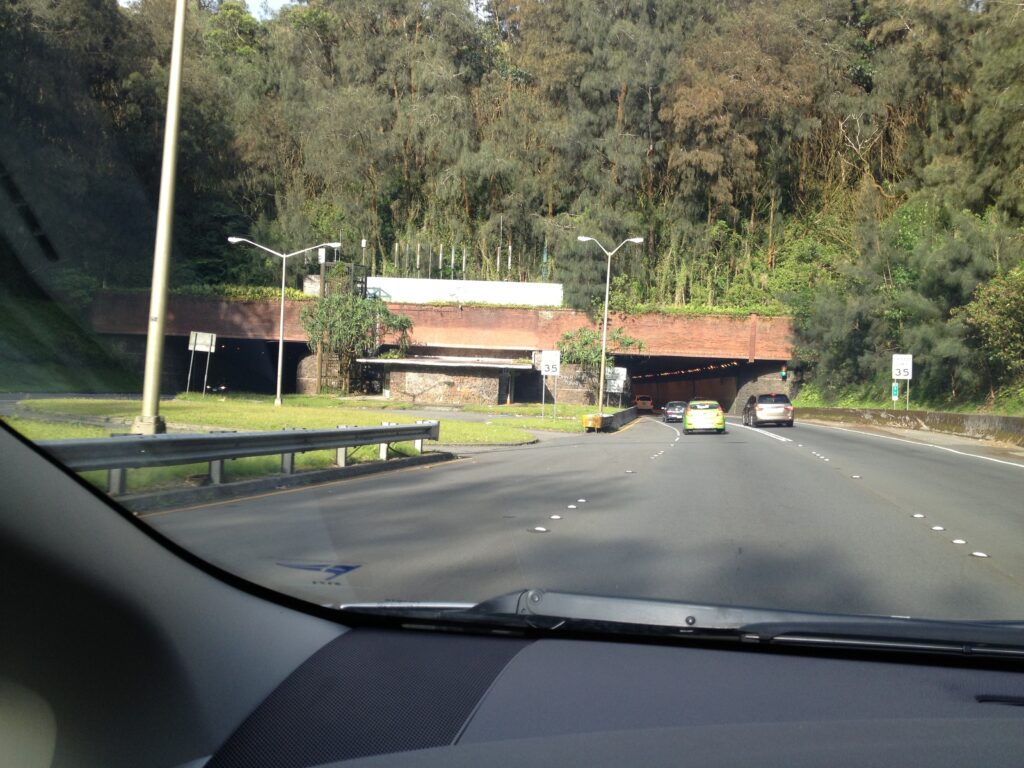
In 1845 the first road was built over the Nuʻuanu Pali (cool height – cliff) to connect Windward Oʻahu with Honolulu.  It was jointly financed by the government and sugar planters who wanted easy access to the fertile lands on the windward side of Oʻahu.  Kamehameha III and two of his attendants were the first to cross on horseback.

(In 1898 this road was developed into a highway and was later replaced by the Pali Highway.  When the current Pali Highway and its tunnels opened (1959,) the original roadway was closed and is now used by hikers.)

A story has it that Olomana was a giant and imposing warrior that ruled the area between Makapuʻu and Kualoa, in Windward Oʻahu.

Olomana was famous for his great strength and his enormous height. ʻAhuapau, the king of Oʻahu, was in fear of this man and because of this he never traveled to Koʻolau. From the Makapuʻu point to the Kaʻoio point, at Kualoa, was kapued and sacred to Olomana. (Fornander)

“Olomana was twelve yards, or six fathoms in height, if standing and measured from the head to the feet.“

When Palila arrived at the top of the Nuʻuanu cliff he laid down his club and sped on till he reached Kaʻelepulu, the place where Olomana was standing.

In this flight of the club, Palila seized hold of the end and was carried by it until he lit on the shoulder of Olomana, whereupon Olomana asked Palila: “Where are you from, you most conceited boy? for my shoulder has never been stepped on by anybody, and here you have gone and done it.” (Fornander)

Palila replied: “I am from the kapued temple; from Alanapo in Humuula, Kauai. My name is Palila and I am a soldier.” When Olomana heard this he was afraid and begged of Palila that he be saved.  (Fornander)

Palila, however, refused saying: “You shall not live.”

Palila slayed Olomana by cutting him in half.

Mount Olomana was formed as a result of a sensational battle between Olomana and Palila, a warrior sent by ʻAhuapau, the King of Oʻahu, to slay Olomana.  (KIS)

Part of Olomana became Mount Olomana; the other part of Olomana ended up on the far side of Kawainui as Mahinui, the ridge separating Kāneʻohe from Kawainui, where Kalaheo High School is located.

Olomana (“forked hill”) is actually three peaks; the tallest peak, 1,643-feet high, is named after the legendary giant, Olomana. 

The second flat-topped peak is Pakuʻi at 1,520-feet named after the konohiki for the adjacent fishponds of Ka’elepulu (at what is now generally referred to as  Enchanted Lake)  and the third knife-edged peak is Ahiki at 1,480-feet (nearest Waimānalo) named after the warrior Olomana’s konohiki or overseer responsible for the wetlands of Kawainui.

Geologists note Olomana is a residual ridge, a remnant of the old Koʻolau volcano.   (Other remnants of that volcano include Keolu Hills and the Mokulua Islands.)  (SOEST)

Olomana seems to be a favorite for hikers.  They say it’s for intermediate to expert level hikers.  The trail is approximately 2.5-miles long. The terrain is rugged with many areas only passable with the aid of ropes.

When we lived in Kailua we had a clear view of Olomana; from our house, we could see silhouettes of folks on Olomana’s peak.  Likewise, we regularly saw helicopters hovering over the area, rescuing another of these hikers.

© 2022 Hoʻokuleana LLC

Filed Under: Place Names Tagged With: Maunawili, Kawainui, Olomana, Hawaii, Oahu, Kailua, Koolaupoko

March 23, 2022 by Peter T Young Leave a Comment

Coaling Station

Prior to the early-1900s, most vessels were powered by sail; the absence of a fuel to move was a major factor in the flexibility of fleets. And, the carrying capacity of the sailing ship made it an indispensable element in its own logistic support.

For centuries, the most critical item of supply was water, which sailing ships found difficult to carry in sufficient quantities and to keep drinkable for long voyages. Food was somewhat less of a problem, except for its poor quality in the days before refrigeration, the sealed container and sterilization. (britannica)

The advent of steam propulsion resulted in faster and more direct travel for ships (in the early years, ships with steam engines still sailed, and used the engines only as auxiliary power – coal was burned to produce the steam to power the engines.)

The gain in control of where you were going (without reliance/variation in the wind) was a significant improvement for the long haul. But, for a time, the inordinate amount of space that had to be allocated to carry coal seriously inhibited the usefulness of early warships.

Steam warships were slow to catch on, but by the late-1850s, all new warships built by the Navy featured steam engines. The engines did not make the ships dramatically faster, and many steam ships continued to use sails preserve fuel on long trips. These ships looked and functioned much like ships from the age of sail except for the tell-tale smokestack rising above their decks. (Bailey)

The replacement of sailing ships with steam led to a requirement for fuel to be widely available. Ultimately, this produced the need for numerous coaling stations – places where the ships replenished/refueled their supply of coal.

Noting the need for a refueling site in the Pacific, Captain AT Mahan noted, “To any one viewing a map that shows the full extent of the Pacific Ocean, with its shores on either side, two circumstances will be strikingly and immediately apparent. He will see at a glance that the Sandwich Islands stand by themselves in a state of comparative isolation, amid a vast expanse of sea”.

“From San Francisco to Honolulu, 2,100 miles easy steaming distance, is substantially the same as from Honolulu to the Gilbert, Marshall, Samoan, Society, and Marquesas groups (the nearest inhabited islands,) all under European control”.

“Too much stress cannot be laid upon the immense disadvantages to us of any maritime enemy having a coaling station well within 2,500 miles of every point of our coast line from Puget Sound to Mexico. Were there many others available we might find it difficult to exclude from all. There is, however, but the one.”

“Shut out from the Sandwich Islands as a coal base, an enemy is thrown back for supplies of fuel to distances of 3,500 or 4,000 miles – or between 7,000 and 8,000, going and coming – an impediment to sustained maritime operations well nigh prohibitive.”

“It is rarely that so important a factor in the attack or defence of a coast line – of a sea frontier – is concentrated in a single position, and the circumstance renders it doubly imperative upon us to secure it, if we righteously can.”

In the 1860s, a coaling station was established in Honolulu to refuel coal burning American ships. US warships followed a policy of cruising the Hawaiian Islands starting in 1866, and rented a coaling station for them. (globalsecurity)

The lease of land for the coaling station was the first regular US Navy shore-side presence in the Hawaiian Islands. This station practically fell into disuse shortly after it was built due to the policy that required warships to use sail power wherever possible. (navy-mil)

Then, in 1873, Secretary of War, William W Belknap, issued confidential instructions to investigate the defensive capabilities of Honolulu to Major-General John McAlister Schofield (the Barracks up the hill from Pearl Harbor were later named for him (1908)) and Lieutenant-Colonel Barton S Alexander. (Young)

General Schofield reported: “The Hawaiian Islands constitute the only natural outpost to the defenses of the Pacific Coast. In possession of a foreign naval power, in time of war, as a depot from which to fit out hostile expeditions against this coast and our commerce on the Pacific Ocean, they would afford the means of incalculable injury to the United States.”

“With one exception there is no harbor on the islands that can be made to satisfy all the conditions necessary for a harbor of refuge in time of war. This is the harbor of ʻEwa, or Pearl River. … If the coral barrier were removed, Pearl River Harbor would seem to have all, or nearly all, the necessary properties to enable it to be converted into a good harbor of refuge.”

“It is to be observed that if the United States are ever to have a harbor of refuge and naval station in the Hawaiian islands in the event of war, the harbor must be prepared in advance by the removal of the Pearl river bar. When war has begun it will be too late to make this harbor available, there is no other suitable harbor on these islands.”

As a means of solidifying a site in the central Pacific, the US negotiated an amendment to the Treaty of Reciprocity in 1887. King Kalākaua, in his speech before the opening session of the 1887 Hawaiian Legislature, stated (November 3, 1887:)

“His Majesty the King of the Hawaiian Islands, grants to the Government of the US the exclusive right to enter the harbor of Pearl River, in the Island of Oʻahu, and to establish and maintain there a coaling and repair station for the use of vessels of the US and to that end the US may improve the entrance to said harbor and do all things useful to the purpose aforesaid.”

Ten years later, “Secretary Long has sent to Congress a report of the project for the establishment of a naval coaling and repairing station at Pearl Harbor, Hawaiʻi, submitted by Rear Admiral Miller, commander-in-chief of the Pacific naval station.”

“As a result of the surveys and examination Admiral Kirkland reported that … the Government should acquire possession of the whole of the Waipiʻo Peninsula, comprising 800-acres of land, if a station is to be located at Pearl Harbor.”

“Secretary Long recommend(ed) that Beckoning Point be selected as a site for the contemplated station, on account of its proximity to East Loch, which has the largest anchorage, as drydocks may be easily built, and as there is ample room for space to dock and undock vessels of any size.” (Sacramento Daily Union, April 2, 1898)

In May, 1899, a coaling station with a capacity of 1,000-tons was established and plans involved increasing that capacity 20-fold. Six months later the Naval Station, Honolulu, was established.

As an example of the coal demand for ships, the battleship USS Massachusetts burned 8-12 tons of coal per hour at full power. In order to fully stock for a deployment at sea, a warship would load thousands of tons of coal on board ship, all of it moved by hand. (Colamaria)

The US Navy dredged the first deep-draft channel into its coaling station at Pearl Harbor in 1903, and suddenly the US had a strategically important naval station in the middle of the Pacific Ocean. (Sanburn) On May 28, 1903, the first battleship, USS Wisconsin, entered the harbor for coal and water. (navy-mil)

The next decade saw steady and continuous growth. On September 23, 1912 Pearl Harbor was closed to all foreign commercial shipping, and foreign warships might enter only by special permission. (Young)

The post-World War I period was characterized by irregular growth of the Naval Operating Base. Appropriations tended to diminish with the economies of the twenties. In 1921, the Naval Station in Honolulu was forced to close because of insufficient funds. Although the Secretary of the Navy referred to Hawaiʻi as the “Crossroads of the Pacific,” nothing was being done to take advantage of its position. (navy-mil)

Networks of coaling stations were established, effectively extending the range of warships; however, the era of the steam warship powered exclusively by coal was relatively brief-lasting from 1871 until 1914.

Fuel oil was the emerging fuel technology. In the early-1900s oil refining procedures had been standardized to the point that fuel oil (bunker oil) was now a better option to feed the fires that powered the ships (plus, the bunker oil took up less storage room on the ships.) (Scott)

The USS Texas, commissioned in 1914, was the last American battleship built with coal-fired boilers. It converted to burn fuel oil in 1925 – resulting in a dramatic improvement in efficiency. By 1916, the Navy had commissioned its first two capital ships with oil-fired boilers, the USS Nevada and the USS Oklahoma.

To resupply them, “oilers” were designed to transfer fuel while at anchor, although underway replenishment was possible in fair seas. During World War I, a single oiler refueled 34 destroyers in the mid-Atlantic – introducing a new era in maritime logistics. (American Oil & Gas Historical Society)

Wartime needs called for more expansion to the Pearl Harbor base facilities. Construction began on a fourth large drydock at the location of the old Coaling Station; these went into service in 1944.

© 2021 Hoʻokuleana LLC


Filed Under: Military Tagged With: Schofield Barracks, John Schofield, Hawaii, Oahu, Kalakaua, King Kalakaua, Pearl Harbor, Coaling Station

March 18, 2022 by Peter T Young 2 Comments

Daniel Dole

Daniel Dole was born in Bloomfield (now Skowhegan,) Maine, September 9, 1808. He graduated from Bowdoin College in 1836 and Bangor Theological Seminary in 1839, and then married Emily Hoyt Ballard (1807-1844,) October 2, 1840 in Gardiner, Maine.

The education of their children was a concern of missionaries. There were two major dilemmas, (1) there were a limited number of missionary children and (2) existing schools (which the missionaries taught) served adult Hawaiians (who were taught from a limited curriculum in the Hawaiian language.)

During the first 21-years of the missionary period (1820-1863,) no fewer than 33 children were either taken back to the continent by their parents. (Seven-year-old Sophia Bingham, the first Caucasian girl born on Oʻahu, daughter of Hiram and Sybil, was sent to the continent in 1828. She is my great-great-grandmother.)

On July 11, 1842, fifteen children met for the first time in Punahou’s original E-shaped building. The first Board of Trustees (1841) included Rev. Daniel Dole, Rev. Richard Armstrong, Levi Chamberlain, Rev. John S Emerson and Gerrit P Judd. (Hawaiian Gazette, June 17, 1916)

By the end of that first year, 34-children from Sandwich Islands and Oregon missions were enrolled, only one over 12-years old. Tuition was $12 per term, and the school year covered three terms. (Punahou)

By 1851, Punahou officially opened its doors to all races and religions. (Students from Oregon, California and Tahiti were welcomed from 1841 – 1849.)

December 15 of that year, Old School Hall, “the new spacious school house,” opened officially to receive its first students. The building is still there and in use by the school.

“The founding of Punahou as a school for missionary children not only provided means of instruction for the children, of the Mission, but also gave a trend to the education and history of the Islands.”

“In 1841, at Punahou the Mission established this school and built for it simple halls of adobe. From this unpretentious beginning, the school has grown to its present prosperous condition.” (Report of the Superintendent of Public Education, 1900)

The curriculum at Punahou under Dole combined the elements of a classical education with a strong emphasis on manual labor in the school’s fields for the boys, and in domestic matters for the girls. The school raised much of its own food. (Burlin)

Some of Punahou’s early buildings include, Old School Hall (1852,) music studios; Bingham Hall (1882,) Bishop Hall of Science (1884,) Pauahi Hall (1894,) Charles R. Bishop Hall (1902,) recitation halls; Dole Hall and Rice Hall (1906,) dormitories; Cooke Library (1908) and Castle Hall (1913,) dormitory.

Dole Street, laid out in 1880 and part of the development of the lower Punahou pasture was named after Daniel Dole (other nearby streets were named after other Punahou presidents.)

Emily died on April 27, 1844 in Honolulu; Daniel Dole married Charlotte Close Knapp (1813-1874) June 22, 1846 in Honolulu, Oʻahu.

Daniel Dole resigned from Punahou in 1855 to become the pastor and teacher at Kōloa, Kauai. There, he started the Dole School that later became Kōloa School, the first public school on Kauai. Like Punahou, it filled the need to educate mission children.

The first Kōloa school house was a single room, a clapboard building with bare timbers inside and a thatched roof. Both missionary children as well as part-Hawaiian children attended the school. (Joesting)

Due to growing demand, the school was enlarged and boarding students were admitted. Reverend Elias Bond in Kohala sent his three oldest children to the Kōloa School, as did others from across the islands. (Joesting)

Charlotte died on Kauai in 1874 and Daniel Dole died August 26, 1878 in Kapaʻa, Kauai. Dole’s sons include Sanford Ballard Dole (President of the Republic of Hawaiʻi and 1st Territorial Governor of Hawaiʻi.) Daniel Dole was great uncle to James Dole, the ‘Pineapple King.’

© 2022 Hoʻokuleana LLC


Filed Under: Missionaries / Churches / Religious Buildings, Schools Tagged With: James Dole, Sanford Dole, Koloa, Daniel Dole, Hawaii, Oahu, Hiram Bingham, Punahou, Oahu College

March 10, 2022 by Peter T Young 1 Comment

“Build me a house like that”

Princess Ruth wrote to Lot Kamehameha and asked that he “fence the lot at Kaakopua with boards and to put up a gate large enough for carriages to enter”, as well as “furnish lumber for a house”.  (Zambucka)

“The two storied wooden frame residence of Emma St. of Princess Ruth was destroyed by fire during the absence in Hawaiʻi.  A valuable wardrobe, mementos of chief families, jewelry etc. was lost.”  (Honolulu Advertiser, October 18, 1873; Zambucka)

Having lost her house, Princess Ruth Luka Keanolani Kauanahoahoa Keʻelikōlani sought to rebuild.  The area where the home was located was known as Kaʻakopua.

“It is said … that in looking over various plans for the construction of a mansion on Emma Street, she was particularly struck with those of a normal school building in the States.”  (Hawaiian Gazette, October 1, 1895)

“Drawing those plans from among many others she said in her imperious manner to the architect standing nearby, ‘Build me a house like that.’”    (Hawaiian Gazette, October 1, 1895)  Thus began the construction of a home; she named it Keōua Hale.

The main architect behind new structure was Charles J. Hardy, an American from Chicago, employed at the Enterprise Planing Mill in Honolulu. The gaslit interior of the mansion was celebrated for its ornate plaster work and frescoes.  It was the most expansive residence of the time; it was larger than ʻIolani Palace.

The house was completed in 1883; however, Princess Ruth Keʻelikōlani never lived in the palace. She became ill immediately after the house warming and birthday luau.

She returned to Huliheʻe, her Kailua-Kona residence, where they believed she would more quickly regain her health.  On May 24, 1883, Keʻelikōlani died at the age of fifty-seven, in her traditional grass home in Kailua-Kona.

At her death, Keʻelikōlani’s will stated that she “give and bequeath forever to my beloved younger sister (cousin), Bernice Pauahi Bishop, all of my property, the real property and personal property from Hawaiʻi to Kauaʻi, all of said property to be hers.” (about 353,000 acres, which established the land-base endowment for Pauahi’s subsequent formation of Kamehameha Schools.)

The palace was inherited by Princess Bernice Pauahi Bishop; she and her husband, Charles Reed Bishop lived in house.  Pauahi passed away in the house a year later (October 16, 1884.) “(F)rom the hour of her death until the morning of her funeral, it rained continuously, until, at the appointed time the heavens cleared, and the sun shone brightly”.  (KSBE)

In her will, Pauahi initially intended to devise Kaʻakopua to Queen Emma.  However, in her later codicils (amendments,) Pauahi devised “the Ili of “Kaʻakopua”, extending from Emma to Fort Street and also all kuleanas in the same, and everything appurtenant to said premises” to her husband, “to hold for his life, remainder to my trustees.”  (KSBE)

On April 9 1885, the first meeting of the Bernice Pauahi Bishop Trust Board of Trustees was held at Keōua Hale 21 Emma Street with Bishop chosen chairman for the evening.  (KSBE)

But the house was not destined to be the home for Kamehameha Schools.  Rather, it had the honor of serving as the campus of the first public high school in Honolulu.

“The Board of Education used every means in its power to obtain the building” (Hawaiian Gazette, October 1, 1895)  “(D)uring talks to make the house into a school, there soon were people approving and praise this conversion into a high school. The Board of Education immediately sought to obtain the house, and were fortunate to get it at a fair price ($600,000.)”  (Kuokoa, October 12, 1895)

However, the idea of the purchase was not without its detractors.

“The stupidity of the Board of Education has been made clear. The Legislature has not approved the money to purchase Kaʻakopua and Keōua Hale. This is a huge sum of money, and it is better if they purchased some other land and built buildings for the high school, and not that beautiful house which will cost a lot to clean it up, as a place for a few people to live haughtily and snobbily off the money of the Government. It is true!”  (Makaʻāinana, 8/12/1895)

The DOE purchased the property from the Bishop Estate on June 27, 1895.  (DOE, Star Advertiser)  “(E)verything (moved) forward, expeditious preparations (were) made to begin school soon, when regular school starts. The nation is proud to obtain this schoolhouse to enroll and teach children in higher learning than that taught at the other schools which teach general knowledge.”  (Kuokoa, October 12, 1895)

So began Kula Kiekie o Honolulu (Honolulu High School.)

“The instructors of this school are, Prof. M. M. Scott, principal; J. Lightfoot, teacher of Mathematics and Latin; Miss Brewer and Miss Needham, grammar teachers; Miss Beckwith, art teacher; and Miss Tucker, a teacher of singing.”  (Kuokoa, October 12, 1895)

“This institution has been developing satisfactorily during the period under review. It is not accredited at any of the universities of America, and in my opinion it is not desirable that it be so accredited. The plan of leaving each of our graduates to enter college or fail to do so on his own merits, as recent experience indicates, will produce results creditable to all concerned.”

“Besides, the preparation of candidates for college entrance examinations is but a small part of the work of a high school in Honolulu. The course of study should be such as will fit for life, and the matter of fitting for college should be relegated to its own subordinate place.”

“The Honolulu High School is especially adapted to the needs of those who speak the English language as a mother tongue and to no others. It accommodates but passably a few of the exceptionally bright pupils of the much larger class who have the language to learn after entering school. Taking into account the number of English speaking persons in Honolulu, it will be observed that the high school is of very creditable size.”  (Report of the Minister of Public Instruction, 1899)

In 1907, Honolulu High School moved out of Keōua Hale to the corner of Beretania and Victoria Streets. The school’s name was then changed to President William McKinley High School, after President William McKinley, whose influence brought about the annexation of the Hawaiian Islands to the United States.

The educational needs of Honolulu exceeded the space of Princess Ruth’s palace for several reasons. In 1920, a report was published on the survey of schools conducted by the Bureau of Education of the Federal Department of the Interior.

The report noted that typical middle class families in America were sending their children to public secondary schools, but in Hawaii, public schools were so few and geographically isolated, that many had to go to private schools or were forced to drop out.

Therefore, the commission recommended the establishment of secondary or junior high schools which should offer more academic and vocational choices to feed various high schools. And Hawaii, at this time, tried very hard to be American. (NPS)

Later, at Kaʻakopua, new school buildings replaced Keōua Hale.  Upon its official opening in 1927, the Advertiser news article described the layout which has remained relatively intact:

“Entering the main portal of the new plant, the visitor finds the principal’s office at the left and teachers’ room at the right. … Four large classrooms flank the main corridor and behind them are the kitchen and the dining pavilions. …”

“There are 11 classrooms in the old wing and in the new wing there are six classrooms on the main floor and seven on the second story. … The 31 classroom building had room for 1,500 pupils.”  (NPS)

Though called Central Middle School, as you drive down South Kukui Street (between Queen Emma Street and Nuʻuanu Pali Highway) the name “Keʻelikōlani School” is noted on the building.

DOE suggests the school there was never called that.  (Unfortunately, DOE records were lost in a fire.)  However, a July 2, 1917 Star Bulletin article notes Pedro Augusta as the Keʻelikōlani School janitor (no other school was named Keʻelikōlani.)

In October of 1994 the buildings of Central Intermediate were placed on the Hawaiʻi Register of Historic Places. The school continues to honor Princess Ruth’s generosity in providing a location for their school by celebrating her birthday February 9 of each year.  (Central Middle School)

In September 2021, the Hawaiʻi State Board of Education (BOE) approved the restoration of Central Middle School to its former name honoring Princess Ruth Keanolani Kanāhoahoa Keʻelikōlani. The change was effective immediately. Princess Ruth Keʻelikōlani Middle School currently serves 336 students in grades six through eight.

© 2022 Hoʻokuleana LLC

Filed Under: Ali'i / Chiefs / Governance, Place Names, Schools Tagged With: Honolulu High School, Keoua Hale, Princess Ruth Keelikolani, Hawaii, Oahu, Downtown Honolulu, Princess Ruth, McKinley High School

  • « Previous Page
  • 1
  • …
  • 37
  • 38
  • 39
  • 40
  • 41
  • …
  • 77
  • Next Page »

Images of Old Hawaiʻi

People, places, and events in Hawaiʻi’s past come alive through text and media in “Images of Old Hawaiʻi.” These posts are informal historic summaries presented for personal, non-commercial, and educational purposes.

Info@Hookuleana.com

Connect with Us

  • Email
  • Facebook
  • LinkedIn
  • Twitter
  • YouTube

Recent Posts

  • About 250 Years Ago … Shot Heard Round the World
  • The 5th Gate
  • James Walker Austin
  • Hoʻomana Naʻauao
  • Jack Roosevelt Robinson
  • Plantation Camps
  • Voyaging … and Returning

Categories

  • Mayflower Summaries
  • American Revolution
  • General
  • Ali'i / Chiefs / Governance
  • Buildings
  • Missionaries / Churches / Religious Buildings
  • Hawaiian Traditions
  • Military
  • Place Names
  • Prominent People
  • Schools
  • Sailing, Shipping & Shipwrecks
  • Economy
  • Voyage of the Thaddeus

Tags

Albatross Al Capone Ane Keohokalole Archibald Campbell Bernice Pauahi Bishop Charles Reed Bishop Downtown Honolulu Eruption Founder's Day George Patton Great Wall of Kuakini Green Sea Turtle Hawaii Hawaii Island Hermes Hilo Holoikauaua Honolulu Isaac Davis James Robinson Kamae Kamaeokalani Kameeiamoku Kamehameha Schools Lalani Village Lava Flow Lelia Byrd Liberty Ship Liliuokalani Mao Math Mauna Loa Midway Monk Seal Northwestern Hawaiian Islands Oahu Papahanaumokuakea Marine National Monument Pearl Pualani Mossman Quartette Thomas Jaggar Volcano Waikiki Wake Wisdom

Hoʻokuleana LLC

Hoʻokuleana LLC is a Planning and Consulting firm assisting property owners with Land Use Planning efforts, including Environmental Review, Entitlement Process, Permitting, Community Outreach, etc. We are uniquely positioned to assist you in a variety of needs.

Info@Hookuleana.com

Copyright © 2012-2024 Peter T Young, Hoʻokuleana LLC


Loading Comments...