Images of Old Hawaiʻi

  • Home
  • About
  • Categories
    • Ali’i / Chiefs / Governance
    • American Protestant Mission
    • Buildings
    • Collections
    • Economy
    • Missionaries / Churches / Religious Buildings
    • General
    • Hawaiian Traditions
    • Other Summaries
    • Mayflower Summaries
    • Mayflower Full Summaries
    • Military
    • Place Names
    • Prominent People
    • Schools
    • Sailing, Shipping & Shipwrecks
    • Voyage of the Thaddeus
  • Collections
  • Contact
  • Follow

February 27, 2022 by Peter T Young 1 Comment

Marianne Cope

“I am hungry for the work. … I am not afraid of any disease, hence it would be my greatest delight even to minister the abandoned ‘lepers.’”

Farmers Peter and Barbara Koob had five children in Germany and five children in the United States.  On January 23, 1838, their daughter, Barbara Koob (variants: Kob, Kopp and now officially Cope,) was born in the German Grand Duchy of Hess-Darmstadt.   The next year, the family immigrated to the United States to seek opportunity.

The Koob family settled in Utica, New York and became members of St. Joseph Parish, where the children attended the parish school.

In 1848, young Barbara received her First Holy Communion and was confirmed at St. John Parish in Utica when, in accordance with the practice of the time, the bishop of the diocese came to the largest church in the area to administer these two sacraments at the same ceremony.

After her father’s death, Barbara, in August, 1862, entered the Sisters of the Third Order of Saint Francis in Syracuse, NY, and, on November 19, 1862, she was invested at the Church of the Assumption. She soon became known as Sister Marianne.

As a member of the governing boards of her religious community, she participated in the establishment of two of the first hospitals in the central New York area, St. Elizabeth Hospital in Utica (1866) and St. Joseph’s Hospital in Syracuse (1869). These two hospitals were among the first 50 general hospitals in the US.

Sister Marianne began her new career as administrator at St. Joseph’s Hospital in Syracuse, NY in 1870 where she served as head administrator for six of the hospital’s first seven years.

In 1877, Sister Marianne was elected Mother General of the Franciscan congregation and given the title “Mother” as was the custom of the time.

In 1883, she received a letter from Father Leonor Fouesnel, a missionary in Hawaiʻi, to come to Hawaiʻi to help “procure the salvation of souls and to promote the glory of God.”

Of the 50 religious communities in the US contacted, only Mother Marianne’s Order of Sisters agreed to come to Hawaiʻi to care for people with Hansen’s Disease (known then as leprosy).

The Sisters arrived in Hawaiʻi on November 8, 1883, dedicating themselves to the care of the 200-lepers in Kakaʻako Branch Hospital on Oʻahu.  This hospital was built to accommodate 100-people, but housed more than 200.

The condition at the hospital were deplorable.  Each Sister-nurse learned to wash the wounds, to apply soothing ointment to the wounds, and to bring a sense of order to the lawlessness that prevails when there is abandonment of hope.

In 1884, Mother Marianne Cope and the Sisters of St. Francis came to Maui and with a royal bequest from Queen Kapiʻolani, established Malulani Hospital (“Protection of Heaven”) in Wailuku, next to the site of St. Anthony’s Church.  Malulani was the first hospital established on Maui.

In 1885, realizing that healthy children of leprous patients were at high risk of contracting the disease, yet had no place to live, she founded Kapiʻolani Home on Oʻahu for healthy female children of leprosy patients.  Because of her work, she was the recipient of the Royal Medal of Kapiʻolani.

In the summer of 1886, the Sisters took care of Father Damien (later Saint Damien) when he visited Honolulu during his bout with leprosy.  He asked the Sisters to take over for him when he died.

Mother Marianne led the first contingent of Sister-nurses to Kalaupapa, Molokaʻi, where more than a thousand people with leprosy had been exiled.  Upon arrival, on November 14, 1888, she opened the CR Bishop Home for homeless women and girls with Hansen’s Disease.  To improve the bleak conditions, Mother Marianne grew fruits, vegetables and landscaped the area with trees, thus creating a better environment among the residents.

While at Kalaupapa, Mother Marianne predicted that no Franciscan Sister would ever contract leprosy. Additionally she required her sisters use stringent hand washing and other sanitary procedures.

Upon the death of Saint Damien on April 15, 1889, Mother Marianne agreed to head the Boys Home at Kalawao.  The Board of Health had quickly chosen her as Saint Damien’s successor and she was thus enabled to keep her promise to him to look after his boys.

The Boys Home at Kalawao was completely renovated between 1889 – 1895 during her administration.  During the renovation, it was renamed Baldwin Home by the Board of Health in honor of its leading benefactor, HP Baldwin.

The two new Sisters who came to run the Home were accompanied on their boat journey by poet Robert Louis Stevenson, who stayed for a week.  During his stay, he wrote a poem for Mother Marianne and later donated a piano so that “there will always be music.”

Mother Marianne’s spirit of self-sacrifice enabled her to live and work with leper patients for 35 years.  Although there was not yet a cure, the Sisters could offer the lepers some semblance of dignity and as pleasant a life as possible.

Mother Marianne died in Kalaupapa on August 9, 1918.  The Sisters of St. Francis continue their work in Kalaupapa with victims of Hansen’s Disease.  No sister has ever contracted the disease.

On December 19, 2011, Pope Benedict signed and approved the promulgation of the decree for her sainthood and she was canonized on October 21, 2012.  (Information here is primarily from Cathedral of Our Lady of Peace.)

© 2022 Hoʻokuleana LLC

Filed Under: Missionaries / Churches / Religious Buildings, Prominent People Tagged With: Saint Damien, Kalaupapa, Kalawao, Saint Marianne, Hawaii, Oahu, Molokai, Kakaako

February 3, 2022 by Peter T Young 1 Comment

Georges Phillipe Trousseau

Georges Trousseau was born in Paris on May 1, 1833 to a prominent Parisian family. His father, Armand Trousseau, a distinguished physician and surgeon, was also the author of medical books used throughout the world.  (Greenwell)

He received the usual education of a wealthy Frenchman and entered the ecole de medicine in Paris at the early age of 15.  (Hawaiʻi Holomua, May 5, 1894)

From the days in 1848 and 1852, when he as a student fought in the streets of Paris, he has unswervingly believed in the rights of the people – and early or late was he found ready to serve them as a physician as a friend or simply as a fellow-man.  (Hawaiʻi Holomua, May 5, 1894)

Trousseau married Edna Vaunois, who was also from Paris; they had two children, Armond and Rene in 1856 and 1857.  In 1865, the couple was legally separated (but never divorced.)

He followed his father’s footsteps and graduated from the Paris School of Medicine as a physician in 1858.  He became an army surgeon, seeing service in Algiers early in the fifties. He also served at Solferino and Magenta, Italy.  (Greenwell)

For personal reasons, he left France and went to Australia and New Zealand.  In part, he was at the Australian gold mines, but did not strike it rich; in fact, his estranged wife loaned him money while he was there.  (Greenwell, Hawaiʻi Holomua, May 5, 1894)

He left there and arrived in Hawaiʻi in 1872.  Almost immediately upon his arrival, he was appointed by the Board of Health to serve as Port Physician for Honolulu (there was no salary attached to the office; fees for services were worked out between the Port Physician and the ship/agent the usual charge was $25.)  (Greenwell)

He soon gained great fame as a doctor.  He served on the Board of Health for 20-years, serving as a Board member and as President.   He took an interest in Leprosy and supervised the leper treatment center in Kalihi.

In 1865, the legislature of the Hawaiian Islands had passed “An Act to Prevent the Spread of Leprosy.” This law called for a place to be set aside for the isolation of those found to have leprosy in order to curb the spread of the disease.  It was not until 1873, however, on Doctor Trousseau’s recommendation, that a vigorous effort was made to segregate lepers.  (Greenwell)

“Trousseau strongly urging that the only method, at all likely to be successful, was the immediate, energetic, and to a certain extent, unsympathetic isolation of all who were afflicted with the disease, and even that would require a generation in all probability to prove successful.”  (Board of Health, March 1, 1873)

He diagnosed Father (now Saint) Damien’s leprosy.  “… In January, 1885 Damien visited Honolulu … (and accidentally) scalded his left foot. Father Leonore, the provincial of the mission, phoned for Dr George Trousseau, whose examination of the priest’s foot and leg proved they were devoid of feeling … this discovery indicated that the peroneal nerve and its branches were dead due to leprosy.”  (Mouritz; Bushnell)

Though not an official title, Trousseau served as royal physician.  He was called on as a consultant by Doctor Ferdinand W Hutchison, Minister of the Interior, during Kamehameha V’s last illness and was at the King’s bedside when he died.

In August 1873, when it was apparent that King Lunalilo was ill, Trousseau accompanied the King and stayed with Lunalilo at Huliheʻe Palace in Kailua- Kona, from mid-November to the middle of January 1874.  After it became apparent that Lunalilo was not going to recover, and the royal party returned to Honolulu where Lunalilo died on February 3.  (Greenwell)

The rulers of Hawaiʻi honored him.   Lunalilo made him a major in his staff and his personal physician. Kalākaua befriended him and appointed him the executor of his will and the administrator of his estate.  (Hawaiʻi Holomua, May 5, 1894)

“(H)e was always ready to promote any now industry that might prove a source of benefit to his adopted country.”  This got him involved in sheep, sugar and ostriches.  (Hawaiʻi Holomua, May 5, 1894)

In 1875, he gave up his Honolulu medical practice and moved to Kona, Hawaiʻi, where he purchased a sheep and cattle ranch at Kanahaha high on the slopes of Mauna Loa.  Wool was baled at Kanahaha and transported by cart to Kainaliu Beach, from where it was shipped. (Greenwell)

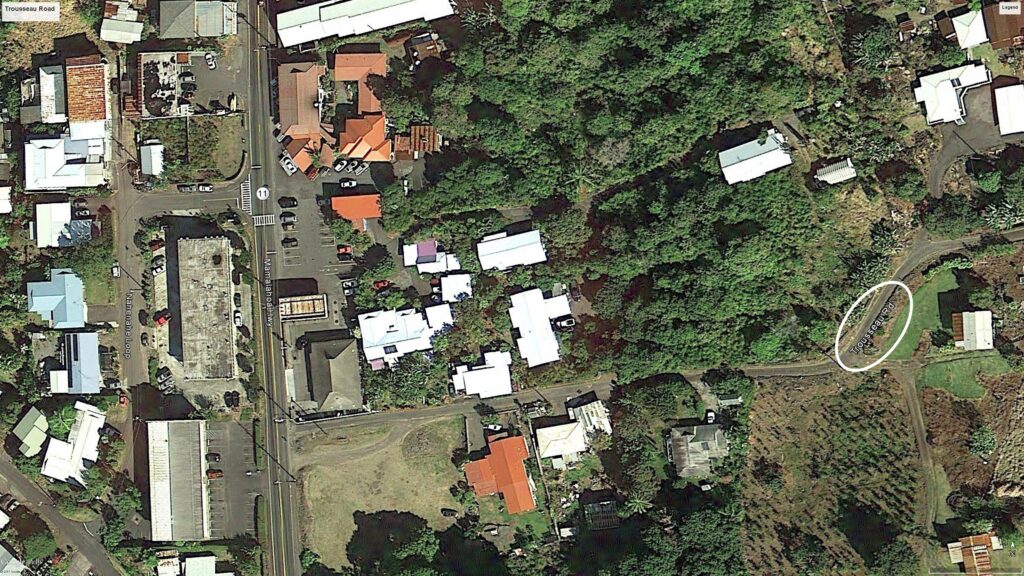
A road was constructed which ran from Kanahaha on Mauna Loa, to the beach at Kainaliu (where he also had a home.) (This old cart road is used by jeeps today and is known as the Trousseau Trail.)  Early in 1879, Trousseau sold all of his holdings in Kona to Henry N Greenwell.

After selling the sheep ranch, Trousseau bought out two sugar planters at Kukuihaele on the Hāmākua coast. He became partners in the Pacific Sugar Mill with the Purvis family. Trousseau had an excellent relationship with John Purvis and his son Herbert.  (Greenwell)

The plantation thrived for a time.  However, defects in the furnace caused difficulties.  In 1881, Trousseau suddenly and unexpectedly sold his half in the plantation to his partners.  He moved back to Honolulu and resumed his medical practice.

He tried one last agricultural venture there.  “The doctor started a new industry for these islands a few years ago (1890) by establishing an ostrich farm at Kapiʻolani Park. Many young birds have been bred from the original stock, and some of the feathers have gone into domestic exports. The farm was under the management of Captain John Morriseau (Trousseau’s nephew.)”  (Daily Bulletin, May 5, 1894)

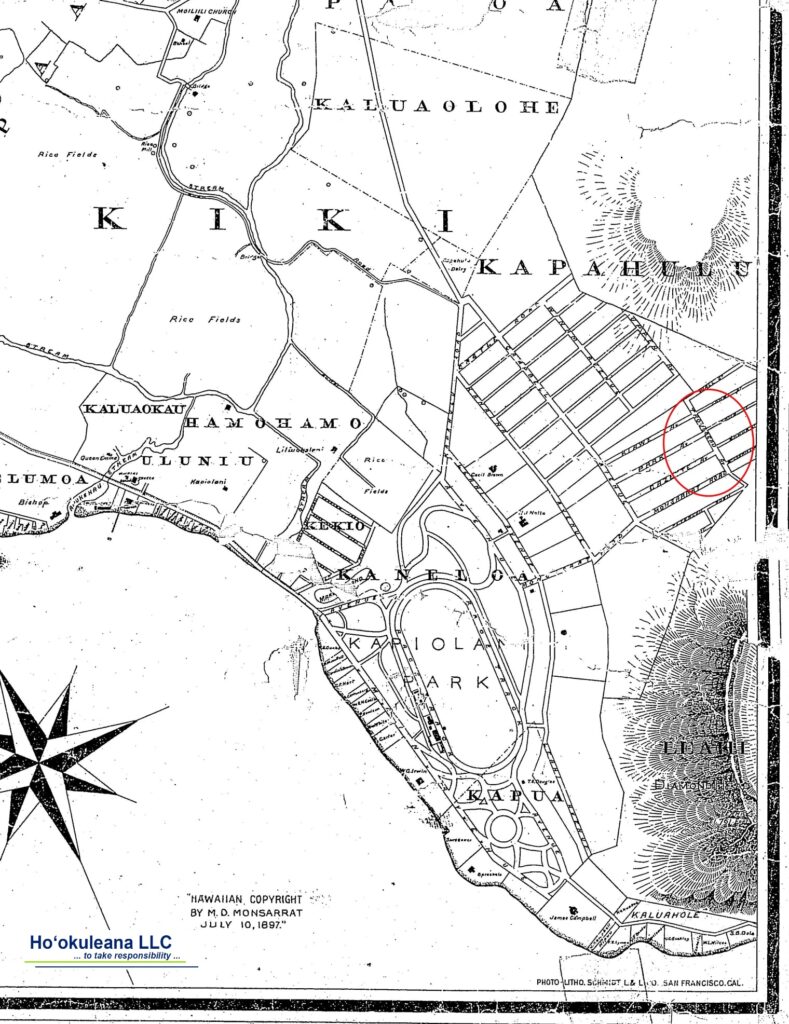
The 1,000-acre farm (purchased from the Lunalilo Estate) was located in the Kapahulu area near the present zoo; Paul Isenberg, who owned a nearby cattle ranch, later purchased the farm (Trousseau Street notes the general location.)

Though Trousseau never divorced, he did have a mistress, Makanoe; Makanoe was also married (to Kaʻaepa.)  (This relationship is referred to as ‘punalua;’ an association in which, typically, two women, often sisters, share one husband, or, as in Makanoeʻs case, two men share the affection of one woman.)  (Greenwell)

Trousseau died May 4, 1894, shortly after Kaʻaepa’s death.  Makanoe buried her husband and Trousseau side by side in a wrought iron fenced plot at Makiki Cemetery on Oʻahu.  Trousseau left all of his estate to Makanoe (she eventually moved to Salt Lake City, Utah.)

Trousseau faithfully supported the Hawaiian Monarchy and stood up for the royalists which caused bitter feelings among many of his associates who backed the annexationists.

In spite of this, his obituary noted, “It is seldom that people of all classes, opposed to each other socially and politically can gather around the bier of a fellow-citizen and unite in saying, ‘we have lost a friend.’”  (Hawaiʻi Holomua, May 5, 1894)

“Dr. Trousseau was a strong nationalist of Hawaiʻi, who believed that none but born or naturalized subjects should have a determining voice in national affairs. The Hawaiian people, who revered and confided in him, will take his death as a sort bereavement.”  (Daily Bulletin, May 5, 1894)  (Lots of information here from Jean Greenwell.)

© 2022 Hoʻokuleana LLC


Filed Under: Prominent People Tagged With: Lunalilo, Molokai, Saint Damien, Hansen's Disease, Georges Trousseau, Hawaii, Hawaii Island, Oahu, King Kalakaua

October 9, 2021 by Peter T Young 1 Comment

Snow Falls on Molokai

The initial land divisions on the island of Molokai were the Ko‘olau (windward) and the Kona (leeward) districts, or moku-o-loko.

Puko‘o was the first county seat on the island and is located on the Mana‘e, or East End of the island. Kaunakakai, presently the island’s main town, lies centrally along the southeastern coastline.

Kualapu‘u which was once a pineapple plantation town, is situated in Na‘iwa on the slopes above the Ho‘olehua plain. Its sister plantation town of Maunaloa is found on the West End in the ahupua`a of Kaluako‘i.

Large clusters of Hawaiians were living along the shore, on the lower slopes and in the larger valleys. The lands were cultivated and many plants grew strong from the rains of the mountain and water diverted from the streams. The valleys each had their own kalo lo‘i (taro patches), even those that are dry today. Productive, well-kept fishponds were strung along the shoreline.

On the east end, a mile away to the east of the Protestant church compound at Kalua‘aha, was Puko‘o, destined to become the first town in the western tradition on the island of Molokai. Puko‘o had a natural break in the reef with a perfect beach for landing canoes between Puko‘o fishpond and Pipio fishpond at Mapulehu.

The whole island was in a state of excitement when the deposed and beloved Queen Liliuokalani visited Molokai in early 1900s. She stayed at Puko‘o with the Duvauchelle family and Laura Duvauchelle Smith.

The little town of Puko‘o seemed to be thriving. The Aipas’ poi factory was right next door to the Duvauchelles, Ah Soon had the bakery and Ah Sing a store. Another store was started by Akeo and Ah Pun (Chock Pun), along with Apaiona (Lin Kee) who later leased to Chow Kwan.

His innovation was a real gas pump. Okazaki ran the soda works and also the movie theater which he operated with a hand crank until he later learned how to use the car engine. The movies were shown outside with benches for seating, while the equipment was protected by a tent. There was also a bakery over toward the old stone church closer to Kupeke fishpond.

Puko’o lacked the unifying architectural setting of shops in one continuous row. All of these little stores were run by people operating out of their own homes and they were scattered along the main thoroughfare. The set-backs varied much as the homes there do today. The Church was tucked up into a corner on a sharp turn in the road, slightly away from the main cluster of houses. (Salazar)

Then, in March 1912, there was some added excitement on Molokai …

“On her way home from Molokai, Mrs. Emma Nakuina brought proof of snow [hau sano] falling on Molokai, and you can clearly see the whitening of the mountain tops behind Pukoo with snow.”

“In the history of the inhabitation of Molokai, there has never been seen this amazing thing on that island from the beginning, and this is the first time that snow has been seen falling on Molokai. According to Mrs. Nakuina.”

“H. D. Bowen stated that snow fell in great quantities on the mountain behind Pukoo, so that you could see clearly the patches of snow in many places on the ridges as well as down in the valleys.”

You can see the snow all the way from the harbor of Pukoo and the shore, according to Mr. Bowen. He has some land … and while he was there, he saw the snow.”

“I believe this is the first time that man remembers that snow fell on Molokai, said Mrs. Nakuina.”

“So it is perhaps because of the cold we’ve had these past days that snow fell on Molokai. According to the scientists, the time is coming where the tropic zone will become arctic, and will be covered in snow. Could this be the beginning of this?” (Aloha Aina, 3/16/1912, P. 1)

“Mrs. Emma M. Nakuina, who owns land in the region of Molokai above-mentioned, gives the Star [Hawaiian Star Newspaper] the extraordinary intelligence that snow has fallen and rested long enough to have its appearance noted upon that island.”

“‘HD Bowen reports that snow has fallen on the mountain range back of Pukoo, in large enough quantities to show distinct patches in several places on the ridges and in the ravines,’ said Mrs. Nakuina this morning.”

“The snow is quite perceptible from Pukoo harbor and the beach along there, Mr. Bowen states. He lately bought a piece of land adjoining mine in that section, and has been over there looking after his property.”

“‘This is the first time in the memory of man I believe,” Mrs. Nakuina added, “that snow has fallen on Molokai.’”

“And, it is to be remembered, Mrs. Nakuina is one of the recognized authorities on Hawaiian history.”

“Heretofore anyone talking about ‘snowy slopes,’ without making it clear that only the big three mountains of the Island of Hawaii and the vast dome of Haleakala on the Island of Maui were being mentioned, would have been denounced as a traducer of the country. Such a thing did happen, eight or ten years ago, to the author of a bit of promotion literature.”

“Now, however, Molokai is to be included as a snow-supporting island of the group.”

“The evidence of that island’s advent to Arctic-crowned honors, as here given, is authentic and ranks in point of interest not far behind the discovery of the South Pole.”

“Whether the event may be taken as supporting the theory that the earth is going to enter another glacial, period is a question the scientists may be left to consider.”

“Professor W. D. Alexander when informed of the snow on Molokai, said: ‘I have never heard of any snow fall on Molokai before. The elevation of the Pukoo mountains is a little less than 5000 feet.’”

“‘About the early part of February each year snow falls on the south side of Haleakala, the elevation of which Is about 8000 feet.’”

“‘Even on Hualalai, Hawaii, snow rarely settles, although the elevation is only a little under 10,000 feet.’”

“‘The Molokai event is certainly very extraordinary, still the present cold spell is a long one, and may account for the phenomenon.’” (Hawaiian Star, March 11, 1912)

While the article suggests Molokai, for the first time in the memory of man, is decorated with snow, other reporting notes that it was half a century ago when snow first fell on that island. (Kuokoa Home Rula, 3/15/1912, p. 1)

© 2021 Hoʻokuleana LLC

Filed Under: General, Place Names Tagged With: Molokai, Snow, Pukoo

May 27, 2020 by Peter T Young 1 Comment

Kolo Wharf

In 1907, McNeill & Libby started its first fruit cannery in Sunnyvale, California. It quickly became the largest employer with a predominantly female workforce.

In the early 1900s, it established a pineapple canning subsidiary in Hawaiʻi and began to advertise its canned produce using the ‘Libby’s’ brand name.  Unlike the other bigger pineapple producers, Libby did not start in Central Oʻahu, it started in Windward O‘ahu.

Libby’s pineapple covered the southern portion of Kāne’ohe, what is now the Pali Golf Course, Hawaiian Memorial Park and the surrounding area.   By 1923, it was evident that pineapple cultivation on the Windward area could not keep up with that in other O‘ahu areas.

Then, Libby began to grow pineapple on land leased from Molokaʻi Ranch; their activities were focused primarily in the Kaluakoʻi section of the island.  Lacking facilities and housing, the plantation began building clusters of dwellings (“camps”) around Maunaloa.

By 1927, it started to grow into a small town – as pineapple production grew, so did the town.  By the 1930s, more that 12 million cases of pineapple were being produced in Hawaiʻi every year; Libby accounted for 23 percent.

There were two main pineapple growers on Molokai, Libby, situated on the west side at Maunaloa and California Packing Corporation (later known as Del Monte) in Kualapuʻu in the central part of Molokaʻi.

Then steps in a fledgling Hawaiʻi company, also seeing expansion opportunities, and it was through shipment of Libby’s pineapple from Molokaʻi to Libby’s processing plant in Honolulu that Young Brothers expanded into the freight business.

In 1900, three brothers, William, Herbert and Jack, got into business along Honolulu’s waterfront.  What started out working small, odd jobs running lines, delivering supplies and providing harbor tours ended up to be a company that has played an important role in the maritime community of the State.

In those days, there might be from five to twenty sailing ships off Sand Island.  When a ship came in, the anchor line had to be run out to secure the ship; if the ship was coming to the dock, a line had to be carried to the pier.

In the early years of the company, the brothers carried supplies and sailors to ships at anchor outside the harbor, as well as run lines for anchoring or docking vessels.  They also gave harbor tours and took paying passengers to participate in shark hunts.

Libby’s need to ship fruit from the growing area on Molokaʻi, to pineapple processing on Oʻahu created an opportunity for the brothers.  The brothers, using their first wooden barges, YB1 and YB2, hauled pineapples from Libby’s wharf to Honolulu.  “That’s how (Young Brothers) started the freight.”  (Jack Young Jr)

Libby constructed paved roads, a warehouse and worker housing in Maunaloa.  In addition, they dredged a harbor and built a wharf at Kolo on the south-west side of the Island (between what is now Hale O Lono and Kaunakakai.)

“A natural channel thru the coral reef was blown and dredged to give a minimal depth of nine feet with two hundred feet width.  Spar buoys mark the outer and inner ends of this channel.”

“The wharf is a heavily built wooden structure, having a road constructed for heavy truck traffic between it and the plantation on the summit of Mauna Loa. The only buildings at Kolo are those of the construction camp.”  (Dept of Commerce, 1925)

Back then, there was competition in hauling freight.  “The Inter-Island Steam Navigation Co, established in 1883, own(ed) and operate(d) a fleet of first-class vessels engaged exclusively in the transportation of passengers and freight between ports on the islands of the Hawaiian group.” (Annual Report of the Governor, 1939)

Regular sailings of passenger vessels are maintained from Honolulu four times weekly to ports on the island of Hawaiʻi, four times weekly to Molokaʻi, twice weekly to Kauaʻi, three times weekly to Lānaʻi and daily, except Monday and Saturday, to ports on the island of Maui. Included in the fleet are 12 passenger and freight vessels.”  (Report of the Governor, 1930)

During the 1920s, 30s, and 40s, Inter-Island Steam Navigation had the SS Haleakalā, Hualālai, Kilauea and Waiʻaleʻale. There were others that carried 12-passengers such as the SS Humuʻula, which was primarily a cattle boat.  “(Inter-Island) would run their passenger ships and heave to off Kaunakakai. And it would be passengers and mail which just went (ashore) by boat.”  (Jack Young Jr)

But those vessels had deeper drafts than the shallow barges and couldn’t service Kolo; “Kolo was a very shallow draft channel, and it was a privately owned port, owned entirely by Libby McNeil & Libby.  They had bigger acreage on the west end. That was a shorter haul for them. But the bulk of Libby’s pineapples came from Maunaloa which was shipped out of Kolo.”  (Jack Young Jr)

To handle the conditions there, Young Brothers had a special tender built, the ‘Kolo.’  “My father had the Kolo built for that. He had the propellers swung into the hull of the launch because of the shallow depth. … The tug had to remain off port.”  (Jack Young Jr)

With expanded freight service to Molokaʻi (Kolo and Kaunakakai,) around 1929, Young Brothers initiated a practice of towing two barges with one tug and became known as tandem towing.

The system was pioneered because two barges were needed to serve Molokaʻi – they would drop one barge off at Kolo and then carry on to Kaunakakai; they’d pick up the Kolo barge on the way back to Honolulu.

Then, the 1946 tidal wave struck.  “Libby would have to spend $1-million to restore it, and redredge it. And so instead of that they bought a fleet of trucks and hauled their fruit from Maunaloa to Kaunakakai. Everything went out of Kaunakakai, Libbys and (California Packing Corporation (later known as Del Monte.))  So Kolo was abandoned.”  (Jack Young Jr)

The end of the pineapple era began in 1972 when Libby sold to Dole Corp and was finalized three years later when Dole closed its Maunaloa facility. The very last pineapple harvest took place in 1986.  (West Molokai Association)

Young Brothers continues today.  In 1999, Saltchuk Resources, Inc of Seattle, Washington, the parent company of Foss Maritime, acquired Young Brothers and selected assets of Hawaiian Tug & Barge. In 2013, Hawaiian Tug & Barge was rebranded and incorporated into the Foss Maritime fleet, while Young Brothers remains a wholly own subsidiary of Foss.

The youngest of the Young Brothers, “Captain Jack,” is my grandfather; several quotes in this piece include statements from my uncle, also known as Captain Jack.

Follow Peter T Young on Facebook 

Follow Peter T Young on Google+ 

Follow Peter T Young on LinkedIn  

Follow Peter T Young on Blogger

© 2020 Hoʻokuleana LLC

Kolo_Wharf_Remnants-GoogleEarth
Kolo Wharf
USGS-Quadrangle-noting Kolo Wharf
Molokai-Kolo-UH-Manoa-USGS-4115-1950
Molokai-Maunaloa-Libby_Pineapple-UH_Manoa-USGS-4080-1949
Libbys_logo
Libby_Fruit_Crate
libby-pine-life-10-19-1953-079-a-M5-Gogd_tjs-labs_com
libby-pine-life-08-17-1953-074-a-M5
libby-pine-good-01-01-1932-013-M5-Gogd_tjs-labs_com
Libby-Pineapple-Surf
libby-life-06-16-1952-080-a-M5-Gogd_tjs-labs_com
libby-good-12-01-1934-997-M5-Gogd_tjs-labs_com
libby-good-12-01-1933-157-M5-Gogd_tjs-labs_com
libby-gh-12-01-1935-997-M5-Gogd_tjs-labs_com
YB-Barge
Young_Brothers-Fleet-1915
Young_Brothers_Boathouse-center_structure_with_open_house_for_boats_on_its_left-1910
Young-Brothers-Captain_Jack_Young_(grandfather)_on_Makaala

Filed Under: Place Names, Sailing, Shipping & Shipwrecks Tagged With: Maunaloa, Libby, Kaneohe, Inter-Island Steam Navigation, Hawaii, Hale O Lono, Kaunakakai, Young Brothers, Kolo Wharf, Kaneohe Bay, Jack Young, Del Monte, Molokai

April 23, 2020 by Peter T Young Leave a Comment

Meyer Sugar

At the age of twenty-four, Rudolph Wilhelm Meyer emigrated from Germany to Hawaiʻi where he arrived on January 20, 1850. At the time, Meyer listed his occupation as a surveyor.

His main purpose in leaving Germany was to join the “Gold Rush” to California in 1848, but he was delayed on a stopover in Sidney, Australia, and again in Tahiti, after which he landed at Lāhaina, Maui.

Meyer spoke German, French and English when he arrived in Hawaiʻi, and soon wrote and spoke fluent Hawaiian.

Meyer settled on Molokai. There, he met the Reverend Harvey Rexford Hitchcock I, who accepted him as a house guest at Kaluaʻaha, Molokai.

While living with Reverend Hitchcock, he met High Chiefess Kalama Waha, who later became his wife. Sometime later, he moved his family to Honolulu where he worked for Austin and Becker at an office located on Maunakea Street.

The Meyer family later moved back to Molokai and made their permanent residence at Kalaʻe. They eventually had eleven children, six boys and five girls.

He supported his family, in part, by holding a number of local commissions from the Royal Hawaiian government, but primarily from his diverse agricultural activity.

Ranching began on Molokai in the first half of the 19th-century when Kamehameha V set up a country estate on the island, part of which is now the Molokai Ranch. Rudolph Meyer, one of the first western farmers on Molokai, served as ranch manager for King Kamehameha V. (DLNR)

He planted at various times coffee, corn, wheat, oats, taro, potatoes, beets, cassava, peaches, mangoes, bananas and grapes. He was the first on Molokai to grow, produce and mill sugar and coffee commercially and he exported these to Honolulu and California. He also operated a large dairy from which he produced butter.

Meyer started to grow sugar at the time when the 1876 Reciprocity Treaty between the United States and Hawaiʻi removed the tariff on Hawaiian sugar sold in the United States.

Rather than the expansion and innovation that followed the Treaty, Meyer scaled his mill to satisfy the modest 50- ton annual production from his family’s 30-acres of sugar cane.

Constructed in the 1870s the RW Meyer Sugar Mill is one of the only sites in Hawaiʻi with sufficient material remains intact to demonstrate, fairly completely, a nineteenth-century process of sugar manufacture. The equipment included a mule-driven cane crusher, redwood evaporating pans and some copper clarifiers.

In the early-1880s, when the average investment in Hawaiʻi’s fifth-six sugar plantations exceeded $280,000, the Meyer family investment of $10,000 made their mill one of the smallest in Hawaiʻi.

Meyer adopted and followed mill practices more representative of the 1850s and the 1860s than the 1870s and 1880s. In the 1850s, animals powered the mill equipment; while he stuck with this method into the future, others replaced the animal power with steam and water.

The Meyer Sugar Mill easily accommodated the milling requirements of the family’s sugar lands and repaid the investment within a few years; however, during the 1880s the price paid for sugar steadily declined.

The Planters’ Monthly reported in July, 1887, that “Low prices of sugar still prevail…and many a man who once thought himself assured of reasonable wealth through sugar, now finds that it will not even yield him a competence…only running the sugar business on a large scale can it be made to pay.”

In 1892, CM Hyde reported that the Meyer Mill stopped producing sugar cane when “The low price of the product for the last few years … made it more than unprofitable to engage in sugar manufactured in a small way. Now the lands are given up to grazing.”

Meyer also served as the Superintendent of the isolated Kalawao settlement (Kalaupapa) (serving with Father Damien and Mother Marianne Cope (now, both are Saints)) from 1866 till his death in 1897 (he continued to live with his family at the top of the cliffs, rather than on the Kalaupapa Peninsula.)

He also created one of the first trails used to travel between Kalaupapa Peninsula and the mauka lands. It was used to transport cattle and supplies down to Kalawao.

RW Meyer Ltd still owns property in the southwest corner of the Kalaupapa National Historical Park near the Kalaupapa Trailhead and maintains a Memorandum of Understanding (MOU) with the Park for trail access, maintenance and the planting of native plants. The Meyer Mill has been restored and is operating as a museum. Lots of information here is from NPS and rwmeyer-com.

Follow Peter T Young on Facebook 

Follow Peter T Young on Google+ 

Follow Peter T Young on LinkedIn  

Follow Peter T Young on Blogger

© 2020 Hoʻokuleana LLC

IMG_5275
Meyer_house-late-1800s-(rwmeyer-com)
RW Meyer Sugar Mill-Museum
IMG_5285
Meyer Sugar Mill Museum (Crusher)
IMG_5276
IMG_5272
IMG_5273
IMG_5277
IMG_5278
IMG_5279
IMG_5280
IMG_5281
IMG_5282
IMG_5283
IMG_5284
Meyer Sugar Mill Museum
IMG_5286
Meyer Sugar
IMG_5269
R.W._Meyer

Filed Under: Economy, General Tagged With: Kalaupapa, Kalawao, Saint Marianne, Meyer Sugar, Hawaii, Molokai, Sugar, Treaty of Reciprocity, Saint Damien

  • « Previous Page
  • 1
  • …
  • 3
  • 4
  • 5
  • 6
  • Next Page »

Images of Old Hawaiʻi

People, places, and events in Hawaiʻi’s past come alive through text and media in “Images of Old Hawaiʻi.” These posts are informal historic summaries presented for personal, non-commercial, and educational purposes.

Info@Hookuleana.com

Connect with Us

  • Email
  • Facebook
  • LinkedIn
  • Twitter
  • YouTube

Recent Posts

  • Keʻelikōlani and Pele
  • Common Hawaiian-sounding Words … But Are They Hawaiian?
  • From Job to Job Around the World
  • Parker Ranch Manager’s House
  • Hālawa
  • Times
  • Kamakahonu

Categories

  • Mayflower Summaries
  • American Revolution
  • General
  • Ali'i / Chiefs / Governance
  • Buildings
  • Missionaries / Churches / Religious Buildings
  • Hawaiian Traditions
  • Military
  • Place Names
  • Prominent People
  • Schools
  • Sailing, Shipping & Shipwrecks
  • Economy
  • Voyage of the Thaddeus

Tags

Albatross Al Capone Ane Keohokalole Archibald Campbell Bernice Pauahi Bishop Charles Reed Bishop Downtown Honolulu Eruption Founder's Day George Patton Great Wall of Kuakini Green Sea Turtle Hawaii Hawaii Island Hermes Hilo Holoikauaua Honolulu Isaac Davis James Robinson Kamae Kamaeokalani Kameeiamoku Kamehameha Schools Lalani Village Lava Flow Lelia Byrd Liberty Ship Liliuokalani Mao Math Mauna Loa Midway Monk Seal Northwestern Hawaiian Islands Oahu Papahanaumokuakea Marine National Monument Pearl Pualani Mossman Quartette Thomas Jaggar Volcano Waikiki Wake Wisdom

Hoʻokuleana LLC

Hoʻokuleana LLC is a Planning and Consulting firm assisting property owners with Land Use Planning efforts, including Environmental Review, Entitlement Process, Permitting, Community Outreach, etc. We are uniquely positioned to assist you in a variety of needs.

Info@Hookuleana.com

Copyright © 2012-2024 Peter T Young, Hoʻokuleana LLC

Loading Comments...