Images of Old Hawaiʻi

  • Home
  • About
  • Categories
    • Ali’i / Chiefs / Governance
    • American Protestant Mission
    • Buildings
    • Collections
    • Economy
    • Missionaries / Churches / Religious Buildings
    • General
    • Hawaiian Traditions
    • Other Summaries
    • Mayflower Summaries
    • Mayflower Full Summaries
    • Military
    • Place Names
    • Prominent People
    • Schools
    • Sailing, Shipping & Shipwrecks
    • Voyage of the Thaddeus
  • Collections
  • Contact
  • Follow

December 8, 2021 by Peter T Young 1 Comment

R&R Facility to Prison

A century after Captain James Cook’s arrival in Hawaiʻi, sugar plantations started to dominate the Hawai‘i landscape. Hawai‘i’s economy turned toward sugar in the decades between 1860 and 1880; these twenty years were pivotal in building the plantation system.

However, a shortage of laborers to work in the growing (in number and size) sugar plantations became a challenge.  The only answer was imported labor.

Starting in the 1850s, when the Hawaiian Legislature passed ‘An Act for the Governance of Masters and Servants,’ a section of which provided the legal basis for contract-labor system, labor shortages were eased by bringing in contract workers from Asia, Europe and North America.

There were three big waves of workforce immigration: Chinese 1852; Japanese 1885; and Filipinos 1905.  Several smaller, but substantial, migrations also occurred: Portuguese 1877; Norwegians 1880; Germans 1881; Puerto Ricans 1900; Koreans 1902 and Spanish 1907.

In March 1881, King Kalākaua visited Japan during which he discussed with Emperor Meiji Hawaiʻi’s desire to encourage Japanese nationals to settle in Hawaiʻi.

Kalākaua’s meeting with Emperor Meiji improved the relationship of the Hawaiian Kingdom with the Japanese government and an economic depression in Japan served as motivation for Japanese agricultural workers to move from their homeland.  (Nordyke/Matsumoto)

The first 943-government-sponsored, Kanyaku Imin, Japanese immigrants to Hawaiʻi arrived in Honolulu on February 8, 1885.  Subsequent government approval was given for a second set of 930-immigrants who arrived in Hawaii on June 17, 1885.

With the Japanese government satisfied with treatment of the immigrants, a formal immigration treaty was concluded between Hawaiʻi and Japan on January 28, 1886. The treaty stipulated that the Hawaiʻi government would be held responsible for employers’ treatment of Japanese immigrants.

The Issei (first generation) were born in Japan and emigrated to Hawai‘i from 1885 to 1924 (when Congress stopped all legal migration.)  (The Immigration Act of 1924 (aka Johnson-Reed Act) limited the number of immigrants allowed entry into the US through a national origins quota. It completely excluded immigrants from Asia.  (State Department))

The sugar industry came to maturity by the turn of the century; the industry peaked in the 1930s. Hawaiʻi’s sugar plantations employed more than 50,000 workers and produced more than 1-million tons of sugar a year; over 254,500-acres were planted in sugar.

Like the other ethnic immigrant groups, the Issei worked on sugar and pineapple plantations.  The children of the Issei were the Nisei, the second generation in Hawaiʻi.  They are the first generation of Japanese descent to be born and receive their entire education in America, learning Western values and holding US citizenship.

Over time, many Issei and Nisei moved to Honolulu and other developing urban centers. The alien land laws encouraged urbanization since non-citizens could not own land. Many of the Issei became independent wage earners, merchants, shopkeepers, and tradesmen. They sought and began to achieve upward mobility.  (Nordyke and Matsumoto)

On July 7, 1937, Japan invaded China to initiate the war in the Pacific; while the German invasion of Poland on September 1, 1939, unleashed the European war.

If the US and Japan went to war, Japanese in Hawai‘i were seen as potentially dangerous.  Both the Army and the FBI gathered data on Japanese residents in the late-1930s.

Fingerprinting and registering of aliens began in August of 1940 under provisions of the federal Alien Registration Act; some 6,000 aliens in Hilo alone were registered and fingerprinted beginning in September of 1940.  (Farrell)

During the Fall of 1941 diplomatic relations between the US and Japan, which had been steadily deteriorating, took a sudden turn for the worse.

As to Hawaiʻi, War Department message of November 27, 1941 read as follows: “Negotiations have come to a standstill at this time. No diplomatic breaking of relations and we will let them make the first overt act. You will take such precautions as you deem necessary to carry out the Rainbow plan [a war plan]. Do not excite the civilian population.”  (Proceedings of Army Pearl Harbor Board)

An FBI memo, dated December 4, 1941, referenced the “custodial detention list,” a listing of people who should be arrested in the event of outbreak of war. (Farrell)

On December 7, 1941, Japan attacked the US at Pearl Harbor. At that time, Hawaii’s Japanese population was about 158,000, more than one-third of the territory’s total population. (Cohen)

Less than 4 hours after the Pearl Harbor attack, territorial governor Joseph B Poindexter invoked the Hawaii Defense Act giving him absolute wartime power in Hawai‘i.

By mid-afternoon (3:30 pm) the decision to place the territory under martial law was made, suspending the writ of habeas corpus and placing control of Hawaiʻi under Lieutenant General Walter C. Short, who became Military Governor.

The War Department, working under the authority of martial law, ordered that everyone on the list be interned. (Moniz Nakamura)

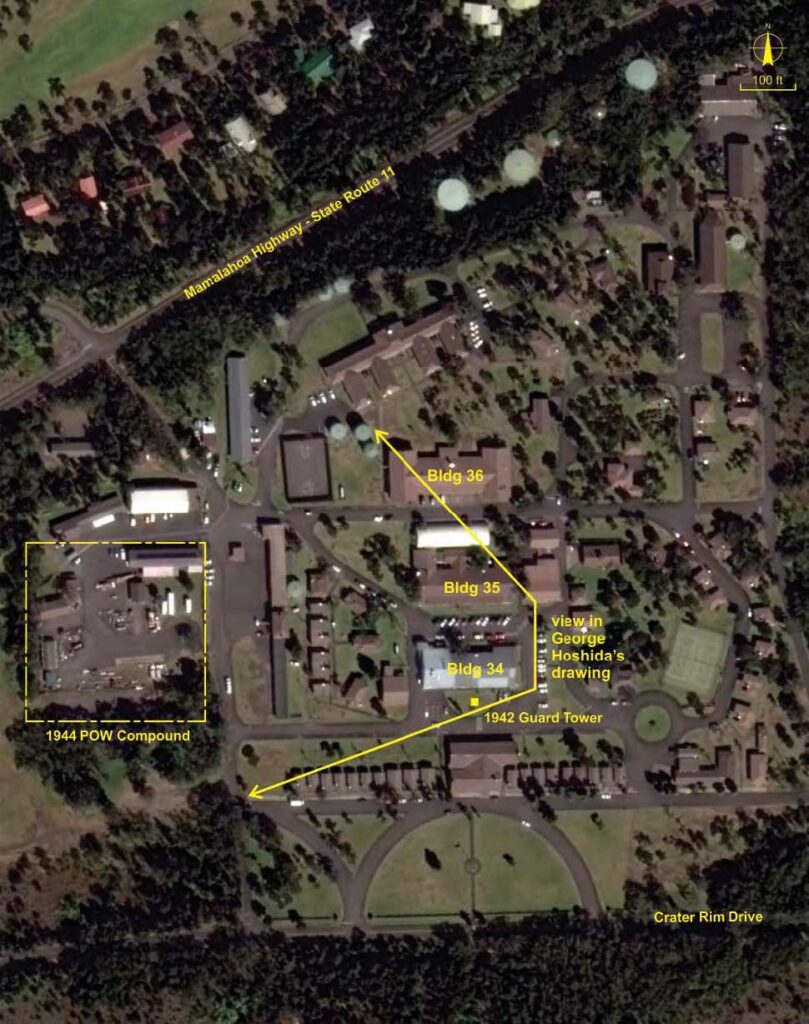
Kilauea Military Camp (KMC) at Hawaiʻi Volcanoes National Park (then known as Hawaii National Park) had been a quiet military recreation facility. By the end of the day on December 7th, it became a detainment camp.

For the island of Hawai‘i, the FBI’s detention list included a total of 82 individuals: 67 consular agents, 3 priests, and 12 “others” (business leaders and other important people in the Japanese American community). (Farrell)

The local police, with assistance from the FBI and Army Intelligence, immediately rounded up and detained the “suspicious aliens” – most of them prominent figures in the Japanese community.  (Chapman)

Traveling under police custody in several cars, they passed the Hilo entrance of the park and proceeded to KMC where they were held under military guard in the small camp stockade and in nearby barracks. Within a few days, others had joined this group, which eventually expanded to approximately 130 men.

The detainees included prominent Japanese residents from Hilo and outlying planation areas, many of them familiar to both military and NPS personnel. Many were teachers; others were prominent business or community figures. (Chapman)

“At Kilauea, internees had to walk among soldiers armed with bayonets. While food was plentiful and nutritious, the dignity of the people was taken away. Internees were constantly accompanied by soldiers – even to the latrine”.

At mealtime, inmates lined up to go to the mess hall, which was across the open ground from their barracks, between ten guards with guns and fixed bayonets (Hoshida; Farrell)

In the mess hall, prisoners were initially surprised by the bounty of food that was available to them and as detainee Myoshu Sasai reported, “we could eat all that we wanted to. If they ran out of something, all we had to do was to raise our hand.”

A long serving counter separated the kitchen from the mess hall. Inmates picked up stainless serving trays and silverware and walked single file in front of the serving tables while waiting for kitchen personnel to serve them food, then sat six to wooden tables and benches.  (Nakamura; Densho)

A sense of camaraderie developed among the inmates as noted by inmate Yoshio “George” Hoshida who observed that “here, sharing together the same fate in this time of emergency, they were brought together closer as humans on equal plane and closer comradeship.” (Nakamura; Densho)

For one hour every day, detainees were allowed outside for exercise. Inmates also occupied their days reading magazines and books, walking around, or writing letters. For many, letter writing was the only way of communicating with their families and maintaining personal ties.

Although letters were censored with officials cutting out any account of the camp, Hoshida recalled that “letter writing became the main consolation and receiving them was a source of great pleasure to be looked forward to each day.”  (Nakamura; Densho)

Building 34, now the Crater Rim Café, Lava Lounge and post office, was used as the internee barracks. Building 35, now the recreation center, was built as an enlisted men’s mess hall and converted to a dormitory in 1919. It was used as the internee mess hall in 1943, but became the recreation hall in 1945. (Farrell)

Internee hearings were held in the Federal Building on Waianuenue Avenue in downtown Hilo. Because the hearings lasted several days, it is probable that internees were held overnight at the Old Police Station, on Kalākaua Street and directly across Kalākaua Park from the Federal Building. (Farrell)

By mid-February 1942, the military government determined that under the Geneva Convention interned aliens could not be held in a combat zone.

On February 15, authorities announced that immediate family members could visit. In anticipation of an imminent transfer to another facility, families were advised to bring warm clothes and that each internee could possess $50.

Noting that the internees were not prisoners of war, the authorities soon began the process of relocation to Sand Island or eventual transfer to the continental United States. The first group of 106 internees departed Kīlauea on March 6; the last group of 25 left on May 12. (Chapman)

In all, between 1,200 and 1,400 local Japanese in Hawai’i were interned, along with about 1,000 family members.  By contrast, Executive Order 9066, signed by President Franklin D. Roosevelt on February 19, 1942, authorized the mass exclusion and detention of all Japanese Americans living in the West Coast states, resulting in the eventual incarceration of 120,000 people.

The detainees were never formally charged and granted only token hearings.  Many of the detainees’ sons served with distinction in the US armed forces, including the legendary 100th Battalion, 442nd Regimental Combat Team and Military Intelligence Service.

Following the departure of Japanese inmates in 1942, in June 1944, an addition to KMC was built on the west side, in the area that is now the motor pool. These facilities would serve as a prisoner of war (POW) camp for Koreans and Okinawans who had been brought to the US from islands captured from the Japanese. (Moniz Nakamura)

Military authorities assigned the POWs to maintenance work around the camp. The prisoners generally worked without supervision, mostly on landscape projects and other maintenance work. (Chapman)

The current chain link fence around Tours & Transportation (Bldg 84), Housekeeping (Bldg 81) and Fire & Paramedic Services (Bldg 59) follows the same footprint as the outer wire of the POW camp enclosure. (KMC Walking Tour Narrative)

© 2021 Ho‘okuleana LLC

Filed Under: Military Tagged With: Japanese, WWII, Kilauea Military Camp, Internment, KMC

April 18, 2020 by Peter T Young 2 Comments

Generations

Ichi, Ni, San, Shi, Go, Roku, Shichi, Hachi, Kyu, Jyu

That’s counting in Japanese, from 1 to 10.

A shortage of laborers to work in the growing (in size and number) sugar plantations became a challenge. The only answer was imported labor.

Starting in the 1850s, when the Hawaiian Legislature passed “An Act for the Governance of Masters and Servants,” a section of which provided the legal basis for contract-labor system, labor shortages were eased by bringing in contract workers from Asia, Europe and North America.

The first to arrive were the Chinese (1852.) The sugar industry grew, so did the Chinese population in Hawaiʻi. Concerned that the Chinese were taking too strong a representation in the labor market, the government passed laws reducing Chinese immigration. Further government regulations, introduced 1886-1892, virtually ended Chinese contract labor immigration.

In 1868, an American businessman, Eugene M Van Reed, sent a group of approximately 150-Japanese to Hawaiʻi to work on sugar plantations and another 40 to Guam. This unauthorized recruitment and shipment of laborers, known as the gannenmono (“first year men”,) marked the beginning of Japanese labor migration overseas. (JANM)

However, for the next two decades the Meiji government prohibited the departure of “immigrants” due to the slave-like treatment that the first Japanese migrants received in Hawaiʻi and Guam. (JANM)

In March 1881, King Kalākaua visited Japan during which he discussed with Emperor Meiji Hawaiʻi’s desire to encourage Japanese nationals to settle in Hawaiʻi.

Kalākaua’s meeting with Emperor Meiji improved the relationship of the Hawaiian Kingdom with the Japanese government and an economic depression in Japan served as motivation for agricultural workers to move from their homeland. (Nordyke/Matsumoto)

The first 943-government-sponsored, Kanyaku Imin, Japanese immigrants to Hawaiʻi arrived in Honolulu aboard the Pacific Mail Steamship Company City of Tokio on February 8, 1885. Subsequent government approval was given for a second set of 930-immigrants who arrived in Hawaii on June 17, 1885.

With the Japanese government satisfied with treatment of the immigrants, a formal immigration treaty was concluded between Hawaiʻi and Japan on January 28, 1886. The treaty stipulated that the Hawaiʻi government would be held responsible for employers’ treatment of Japanese immigrants.

OK, why the initially counting lesson?

As suggested by the title, the respective generations of Japanese in the Islands and elsewhere are identified by the simple numbering pattern. Literally speaking, the Japanese terms Issei, Nisei, Sansei, etc mean first, second and third generation.

The Issei (first generation) were born in Japan and emigrated here from 1885 to 1924 (when Congress stopped all legal migration.) (The Immigration Act of 1924 (aka Johnson-Reed Act) limited the number of immigrants allowed entry into the United States through a national origins quota. It completely excluded immigrants from Asia. (State Department))

Like the other ethnic immigrant groups, the Issei worked on sugar and pineapple plantations. The term Issei came into common use and represented the idea of a new beginning and belonging.

The children of the Issei were the Nisei, the second generation in Hawaiʻi and the first generation of Japanese descent to be born and receive their entire education in America, learning Western values and holding US citizenship.

However, to some degree, preservation of their mother language and culture was reinforced by attending Japanese language schools and by being members of the audience at Japanese cultural plays.

The Nisei hold a significant legacy in Hawaiʻi – this is the generation through the World War II years that included internment for some and service in the US military for many.

In all, between 1,200 and 1,400-local Japanese were interned in Hawaiʻi, along with about 1,000-family members. The number of Japanese in Hawai‘i who were detained was small relative to the total Japanese population here, less than 1%.

By contrast, Executive Order 9066, signed by President Franklin D. Roosevelt on February 19, 1942, authorized the mass exclusion and detention of all Japanese Americans living in the West Coast states, resulting in the eventual incarceration of 120,000-people.

The Nisei made up the storied 442nd Combat Team and 100th Infantry Battalion (which later became the 1st Battalion of the 442nd,) composed entirely of Americans of Japanese ancestry.

Having been born in the Islands, all of the men were citizens of the US; however, very few had ever been to Japan and most of them could not speak Japanese. The “Go For Broke” soldiers of the 442nd are the most decorated infantry regiment in the US Army.

Another term used to describe some of the generations that followed the Issei were the Kibei (return to America) – those who were American born, but who were educated in Japan and returned home to America.

Subsequent generations follow the simple counting patter; the Sansei were children born to the Nisei (the third generation;) Yonsei, the fourth generation – born to at least one Sansei parent and Gosei, the fifth generation – the generation of people born to at least one Yonsei parent, etc.

The Japanese did not just emigrate to Hawaiʻi and the US. Brazil is home to the largest Japanese population outside of Japan (they first started emigrating there in 1908 to work on the coffee plantations.) There were between 1.5-million people of Japanese descent in Brazil; 1.3-million in all of the US, with a little over 185,000 in Hawaiʻi.

Follow Peter T Young on Facebook 

Follow Peter T Young on Google+ 

Follow Peter T Young on LinkedIn  

Follow Peter T Young on Blogger

© 2020 Hoʻokuleana LLC

Filed Under: General, Economy Tagged With: Plantation Camps, Issei, Hawaii, Japanese, Sugar, Nisei

March 18, 2020 by Peter T Young 1 Comment

Kapaʻa Japanese Stone Lantern (Ishidoro)

The first Japanese immigrants to the Islands, like the Chinese, appeared not long after Western contact, but the greatest numbers arrived in the mid-1800s to fill the labor needs of the sugar plantations.

The growth of the sugar industry as the base for the Hawaiian economy in the 1850s gave impetus to an increased demand for imported labor.

Japan was not open to Western recruitment until 1868; that year, the first group of 148 Japanese immigrants included 140 men, six women and two children.

In 1872, Politician Walter Murray Gibson declared to the Chamber of Commerce of Hawaiʻi: “You have considered the races that are desirable, not only to supply your needs of labor but to furnish an increase of population that will assimilate with the Hawaiian. …”

“We must look to races, who whilst being good workers, will not much affect the identity of the Hawaiian, and whose gradual influx will harmonize with, and strengthen, by the infusion of new blood, the native stock.”

“A moderate portion of the Japanese, of the agricultural class, will not conflict with the view that I present, and if they bring their women with them, and settle permanently in the country, they may be counted upon as likely to become desirable Hawaiian subjects.”

King Kalākaua visited Japan for ten days in 1881 while making a global tour. His meeting with Emperor Meiji improved the relationship of the Kingdom with the Japanese government, and an economic depression in Japan served as an impetus for agricultural workers to leave their homeland.

The US Chinese Exclusion Act of 1882 stopped the flow of Chinese workers to the Islands; sugar planters turned to Japan. Farmers and peasants from southern Japan (mostly from the areas of Hiroshima, Yamaguchi and Kumamoto,) having suffered a series of crop failures at home, filled the Hawaiʻi jobs promising comparatively high wages.

The trickle of workers arriving in 1868 turned to a flood by 1886.

Earlier contracts which provided a wage of $4 a month plus food, housing and medical care were replaced with new arrangements for free steerage passage, wages per month of $9 for men and $6 for women, food allowance, lodging, medical care, fuel, no taxes and a required savings account.  (Nordyke/Matsumoto)

While only 116-Japanese were reported as residents in the 1884 census of the Hawaiian Kingdom, the Territory of Hawaiʻi recorded 47,508-men and 13,603-women of the Japanese race in 1900. (Nordyke/Matsumoto)

The Russo-Japanese War (1904 –1905) was “the first great war of the 20th century.”  It grew out of rival imperial ambitions of the Russian Empire and the Empire of Japan over Manchuria and Korea.  With Vladivostok only operational during the summer season, Russians sought a warm water port on the Pacific Ocean for their navy, as well as for maritime trade.

Japanese residents on Kauaʻi raised funds to support Japan’s war effort.   After the Japanese victory, in appreciation of the community’s support, Japan sent money to be used to build monuments honoring the Japanese soldiers who had lost their lives in the war.

In 1915, two such monuments were erected, one in Kapaʻa, the other in Līhuʻe. They were also intended to honor Emperor Taishō’s ascension to the throne that year.

Emperor Taishō was the 123rd Emperor of Japan, reigning from 1912, until his death in 1926.  (The Emperor’s personal name was Yoshihito.  He was followed by his son Hirohito.)

(A tasty side note: Emperor Taishō was initially exposed to new foods by the Western diplomatic corps. Through this exposure he created beef fried Taishō Tonkatsu. After World War I, his personal chef released this menu publicly. Today, Taishō Tonkatsu is a very popular dish.)

The Kapaʻa monument was a 15-foot Ishidōrō (stone lantern) placed across the dirt highway from Miura Store.

Over the centuries the Ishidōrō evolved and were adapted for the practical purpose of lighting the grounds of religious sites, and have since become popular by placing them (in varying sizes) in the gardens of tea houses and private residences.

The Kapaʻa project work was accomplished by JS Teraoka, Masanobu Nitta and Mr. Fujiwara; the Ishidōrō was made of concrete, designs etched in redwood were pressed into the wet concrete.  Many plantation workers would stop by after their long work hours to help out.   (Inspiration Journal)

For many, the monument represented the Japanese immigrants’ respect for their culture and homeland, and for others, their intention to return to their families and communities in Japan, after saving up money from plantation work on Kauaʻi.

However, as World War II heated up, anti-Japanese sentiments grew, and community pressure built to remove the monument.  In April 1943, county work crews toppled and buried the massive structure.

According to The Garden Island newspaper, “The monuments were pulled down by the county in response to numerous protests from civilians who felt that they were inappropriate at this time when Russia is considered an ally of the United States.”  A headline from The Garden Island stated, “Reminders of Japanese Victory Removed.”  (Inspiration Journal)

Over the decades, the Ishidōrō was long forgotten.

Then, in 1972, some children playing at Kapaʻa Beach Park noticed a metal rod sticking out of the ground and feared people could get injured.  The County crews working to remove it soon realized that it was part of the old Ishidōrō monument; Kauaʻi Historical Society stepped in and urged it be removed.

It was later re-erected through a community effort led by Mayor Tony Kunimura, the Kaua’i Historical Society and others. For the next 20 years, the damaged and aged lantern stood supported by steel braces.

In 2008, with funding from the Kauaʻi County/HUD Community Development Block Grant Program, the Ishidōrō was fully restored, through the efforts of the Kapaʻa Business Association and others.

Congratulations to the community and coordinators Larry Dill, Pat Pannell and Rayne Regush of the Kapa‘a Business Association, and Leadership Kaua‘i on earning a ‘2009 Leadership in History Award’ from the ‘American Association for State and Local History’ for the Japanese Stone Lantern Restoration, Kapaʻa, Kaua‘i.

Follow Peter T Young on Facebook 

Follow Peter T Young on Google+ 

Follow Peter T Young on LinkedIn  

Follow Peter T Young on Blogger

© 2020 Hoʻokuleana LLC

Kapaa-Stone-Lantern
Kapaa_Stone-Lantern
Japanese Stone Lantern-(Round)
Japanese Stone Lantern
Japanese_Stone Lantern-(Round)
japanese_stone_lantern
Kapaa_Japanese_Stone_Lantern
SAMSUNG DIGITAL CAMERA
Kapaa_Stone_Lantern
Kapaa-Japanese_Stone-Lantern
Restored Japanese Stone Lantern Memorial—Kapaa
SI Exif
SI Exif
Kapaa_Japanese-Stone-Lantern_plaque
Emperor_Taisho-1912
Emperor_Taisho's_sons_Hirohito, Takahito, Nobuhito and Yasuhito-1921
Bronze statue of Japanese sugarcane workers first immigration to Hawaii (Maui) 1885
Japan_Russia_Treaty_of_Peace_5_September_1905
Japanese_Coming_Off_Ship-(HSA)-PPWD-20-4-001
Battlefields_in_the_Russo_Japanese_War-1904-05
Taisho_Tonkatsu

Filed Under: Missionaries / Churches / Religious Buildings Tagged With: Hawaii, Japanese, Kauai, Kapaa, Tonkatsu, Ishidoro, Emperor Taisho, Kapaa Japanese Stone Lantern

October 25, 2019 by Peter T Young 5 Comments

Glass Balls

I suspect many people would believe the occasional glass fishing float found on our shores is strictly a Japanese and Pacific Ocean phenomenon.

Actually, the first glass fishing floats probably came from Norway and were used in the Atlantic.  From 1762 to 1880, a Norwegian glass company was in business and it is believed they were producing glass floats as early as the late-1700s.

The first time these “modern” glass fishing floats are mentioned is in the production registry for Hadelands Glassverk in 1841. The registry shows that this is a new type of production.

However, there might have been some other versions of glass floats in use before that time. In the early 19th-century, the Schimmelmanns Glassverk (1779–1832) produced dark brown and very thick, bottle glass floats.

Aasnaes Glasvaerk, in business from 1813 to 1883, produced 122,493 glass floats just in the year 1875. A glass float with Aasnaes’s mark on the seal button is a collector’s item.

Early evidence of glass floats being used by fishermen comes from Norway in 1844, where small egg-sized floats were used with fishing line and hooks. Around the same time, glass was also used to support fishing nets.

The Japanese started producing small glass floats in the early-1900s and the first Asian floats came ashore along the West Coast just before 1920.

These Japanese floats are part of early recycling efforts – initial Japanese floats were made from recycled sake bottles.  Most floats are shades of green because that is the color of glass from these sake bottles (especially after long exposure to sunlight).

Other brilliant tones such as emerald green, cobalt blue, purple, yellow and orange were primarily made in the 1920s and 1930s. The most prized and rare color is a red or cranberry hue.

To accommodate different fishing styles and nets, the Japanese experimented with many different sizes and shapes of floats, ranging from 2 to 20 inches in diameter. Most were rough spheres, but some were cylindrical or “rolling pin” shaped.

Asahara Glass Company had several factories and made a variety of sizes.  Asahara made baseball- to orange-size floats for tako jigs, salmon gillnetting and seine fishing; grapefruit-size floats for seine and long-line cod fishing; basketball-size for tuna operations, bottom trawls and crab trapping; and the small rolling pin floats were used for tako jigs and troll fishing.

The earliest floats, including most Japanese glass fishing floats, were hand made by a glassblower. Recycled glass, especially old sake bottles, was typically used and air bubbles in the glass are a result of the rapid recycling process.

After being blown, floats were removed from the blowpipe and sealed with a “button” of melted glass before being placed in a cooling oven. This sealing button is sometimes mistakenly identified as a pontil mark (scar where the punt was broken from a work of blown glass.) However, no pontil (or punty) was used in the process of blowing glass floats.

While floats were still hot and soft, marks were often embossed on or near the sealing button to identify the float for trademark. These marks sometimes included kanji symbols.

A later manufacturing method used wooden molds to speed up the float-making process. Glass floats were blown into a mold to more easily achieve a uniform size and shape.

Seams on the outside of floats are a result of this process. Sometimes knife markings where the wooden molds were carved are also visible on the surface of the glass.

By 1939, millions of Japanese glass floats were being used; although Japanese glass fishing floats are no longer being manufactured for fishing, there are thousands still floating in the Pacific Ocean.

By the 1940s, glass had replaced wood or cork throughout much of Europe, Russia, North America and Japan.

Today most of the glass floats remaining in the ocean are stuck in a circular pattern of ocean currents in the North Pacific Gyre.

Off the east coast of Taiwan, the Kuroshio Current starts as a northern branch of the western-flowing North Equatorial Current.  It flows past Japan and meets the arctic waters of the Oyashio Current.

At this junction, the North Pacific Current (or Drift) is formed which travels east across the Pacific before slowing down in the Gulf of Alaska.

As it turns south, the California Current pushes the water into the North Equatorial Current once again, and the cycle continues.

Although the number of glass floats is decreasing steadily, many floats are still drifting on these ocean currents. Occasionally, storms or certain tidal conditions will break some floats from this circular pattern and bring them to ashore.

They most often end up on the beaches of Hawaiʻi, Alaska, Washington or Oregon in the United States, Taiwan or Canada.

Today, most of the remaining glass floats originated in Japan because it had a large deep sea fishing industry which made extensive use of the floats; some were made by Taiwan, Korea and China.

Follow Peter T Young on Facebook 

Follow Peter T Young on Google+ 

Follow Peter T Young on LinkedIn  

Follow Peter T Young on Blogger

© 2019 Hoʻokuleana LLC

Large_Glass_Fishing_Float_with_Net-14_inches
3-piece mold float thought to have originated in Korea. It has an amber seal button
14-in diameter-honey amber color. The float on the right is purple about 12-in diameter
AASNAES_from_Norway_1883
Blunt Nosed Torpedo
Blunt Nosed Torpedo
Camaleyre-French
Camaleyre-French
Cobalt blue seal buttons
'Cranberry dot' on the seal button
Duraglas, made in USA, vintage 2-piece molded float with the Duraglas mark on the base
Estonian-Teardrop
Estonian-Teardrop
'Fortex' were made in Scotland in the period 1910-1920
‘Fortex’ were made in Scotland in the period 1910-1920
Glass_Float_Collection
Hokkaido roller & is about 6-in long
Hokkaido rolling pin
Irish_Shamrock
Irish_Shamrock
Janson. Import
Japan_Bullet_Rollers
Mexican Swirl Float
Mexican Swirl Float
Norwegian Amber M Egg Float
Oriental_Fishing_Floats-1938
Overlapping_3_Fish_Euro
Pie Crust seal honey amber glass fishing float
Raised Neck Seals
Relsky
Russian_Snakeskin
Russian_Snakeskin
Sapri-brown-amber Italian Societa Altare
Torpedo Roller
Vigo
North Pacific Currents

Filed Under: General, Sailing, Shipping & Shipwrecks Tagged With: Hawaii, Japanese, Atlantic, North Pacific Gyre, Glass Balls, Pacific

July 10, 2019 by Peter T Young 3 Comments

Japanese Internment

During World War II, Japanese Americans were incarcerated in at least eight locations in Hawaiʻi.

These sites that include Honouliuli Gulch, Sand Island, and the U.S. Immigration Station on Oahu, the Kilauea Military Camp on the Big Island, Haiku Camp and Wailuku County Jail on Maui, and the Kalaheo Stockade and Waialua County Jail on Kauai.

The forced removal of these individuals began a nearly four-year odyssey to a series of camps in Hawaiʻi and on the continental United States.

They were put in these camps, not because they had been tried and found guilty of something, but because either they or their parents or ancestors were from Japan and, as such, they were deemed a “threat” to national security.

In all, between 1,200 and 1,400 local Japanese were interned, along with about 1,000 family members. The number of Japanese in Hawai‘i who were detained was small relative to the total Japanese population here, less than 1%.

By contrast, Executive Order 9066, signed by President Franklin D. Roosevelt on February 19, 1942, authorized the mass exclusion and detention of all Japanese Americans living in the West Coast states, resulting in the eventual incarceration of 120,000 people.

The detainees were never formally charged and granted only token hearings. Many of the detainees’ sons served with distinction in the US armed forces, including the legendary 100th Battalion, 442nd Regimental Combat Team and Military Intelligence Service.

During the war, there was a Hawaii Defense Act, Order No. 5 that stated “all aliens were forbidden from possessing weapons, firearms, explosives short-wave radio receiving sets, transmitting sets, cameras, or maps of any United States military or naval installation.”

They could not travel by air, change residence or occupation or move without written permission from the provost marshal.

On December 8, 1941, the first detention camp was set up on Sand Island. Several factors made Sand Island a logical place for establishment of the first detention camp. Geographically, it was an island immediately adjacent to the city of Honolulu in the Honolulu Harbor.

The Territorial Quarantine Hospital had been located on Sand Island and it had housing, food prep and administrative facilities.

Within one week of the attack on Pearl Harbor, the FBI detained 370 Japanese, 98 German and 14 Italians. Almost all of the Japanese detainees were men; of the European detainees, many were women. The European and Japanese internees were segregated.

The first POW of the war (Ensign Kazuo Sakamaki, of the captured Japanese submarine that beached at Waimanalo) was also interned at Sand Island.

Each compound operated its own mess and maintained its own sanitary and internal administrations. The detainees supplied their own recreational activities, such as softball and volleyball games. Each compound had its own spokesman.

While most of the internees were residents of Oʻahu, there were Japanese detained on the Neighbor Islands.

On Kauai internees were crowded into the county jail. According to Gwen Allen (Hawaii War Years), the December 12, 1941 issue of the Kauai newspaper reported that “the men are building double decker bunks.” On the Big Island, detainees were interned at Kilauea Military Camp at Volcano.

Restrictions at each were different. On Kau‘i, after two days of war, a newspaper announcement invited families to call on detainees any day between 1 pm and 3 pm and they were allowed to take clean laundry and simple Japanese food.

On Maui, each detainee was given a questionnaire asking if they had any animals that needed feeding and other care, and if so, where can they be found. On the Big Island, there was no public visiting until February 14, 1942.

For some O‘ahu internees, they began their detention at the Immigration Station at Fort Armstrong and were then moved to Sand Island. Internees at Sand Island lived in tents until wooden barracks were built.

“Until books and other materials were allowed, the internees passed the time by smoothing sea shells for necklaces by rolling them on the concrete floors.”

In March 1942, Sand Island closed. Some detainees were sent to Honouliuli Internment camp.

Because arrests and detentions continued through the war, the community remained on edge, fearful as to who might be next. Japanese culture became equated with Japanese political affiliation, and Japanese language clothing and customs suddenly disappeared.

Though some detainees were released after a short imprisonment, the majority were detained for the duration of the war, with most eventually transferred to camps on the continental United States, for a period approaching four years.

Most eventually returned to Hawai‘i after the war.

In 2006, President Bush signed the Camp Preservation Bill (HR 1492), which authorized $38 million in funding for the preservation of former World War II confinement sites.

In part, the intent is that the Honouliuli site become a public historical park where the Hawai‘i internees story can be shared with future generations.

The fact that the internment did happen here in the Hawaiʻi are something to never forget.

Follow Peter T Young on Facebook 

Follow Peter T Young on Google+ 

Follow Peter T Young on LinkedIn  

Follow Peter T Young on Blogger

© 2019 Hoʻokuleana LLC

JapaneseAmericansChildrenPledgingAllegiance1942
Honouliuli-
Honouliuli-
Honouliuli_Camp
Honouliuli_Camp
Honouliuli_Camp
Honouliuli_Camp
Sand_Island-Gate-Fence
Sand_Island-camp
Sand_Island-camp
Sand_Island-Aerial
Sand_Island-Aerial
Sand Island-Internee tents shortly after the camp opened in December, 1941
Sand Island, 1946. What remains of the internment camp can be seen in the middle portion of the image.
Kilauea Military Camp, 1942
Hawai‘i internee group at Sante Fe camp, 1944
Ansel_Adams,_Baseball_game_at_Manzanar,_1943
Sand_Island-Camp-Layout
japanese-internment-poster

Filed Under: General, Military Tagged With: WWII, Kilauea Military Camp, Internment, Sand Island, Detention Camp, Hawaii, Japanese, Honouliuli

  • « Previous Page
  • 1
  • 2
  • 3
  • 4
  • 5
  • 6
  • 7
  • Next Page »

Images of Old Hawaiʻi

People, places, and events in Hawaiʻi’s past come alive through text and media in “Images of Old Hawaiʻi.” These posts are informal historic summaries presented for personal, non-commercial, and educational purposes.

Info@Hookuleana.com

Connect with Us

  • Email
  • Facebook
  • LinkedIn
  • Twitter
  • YouTube

Recent Posts

  • The Hawaiian Club
  • Linekona School
  • Kalihi Air Crash
  • ʻAukelenuiaʻīkū
  • D-Day
  • Ka‘ahumanu’s Death
  • Chinatown

Categories

  • Sailing, Shipping & Shipwrecks
  • Economy
  • Voyage of the Thaddeus
  • Mayflower Summaries
  • American Revolution
  • General
  • Ali'i / Chiefs / Governance
  • Buildings
  • Missionaries / Churches / Religious Buildings
  • Hawaiian Traditions
  • Military
  • Place Names
  • Prominent People
  • Schools

Tags

Albatross Al Capone Ane Keohokalole Archibald Campbell Bernice Pauahi Bishop Charles Reed Bishop Downtown Honolulu Eruption Founder's Day George Patton Great Wall of Kuakini Green Sea Turtle Hawaii Hawaii Island Hermes Hilo Holoikauaua Honolulu Isaac Davis James Robinson Kamae Kamaeokalani Kameeiamoku Kamehameha Schools Lalani Village Lava Flow Lelia Byrd Liberty Ship Liliuokalani Mao Math Mauna Loa Midway Monk Seal Northwestern Hawaiian Islands Oahu Papahanaumokuakea Marine National Monument Pearl Pualani Mossman Quartette Thomas Jaggar Volcano Waikiki Wake Wisdom

Hoʻokuleana LLC

Hoʻokuleana LLC is a Planning and Consulting firm assisting property owners with Land Use Planning efforts, including Environmental Review, Entitlement Process, Permitting, Community Outreach, etc. We are uniquely positioned to assist you in a variety of needs.

Info@Hookuleana.com

Copyright © 2012-2024 Peter T Young, Hoʻokuleana LLC

Loading Comments...