Images of Old Hawaiʻi

  • Home
  • About
  • Categories
    • Ali’i / Chiefs / Governance
    • American Protestant Mission
    • Buildings
    • Collections
    • Economy
    • Missionaries / Churches / Religious Buildings
    • General
    • Hawaiian Traditions
    • Other Summaries
    • Mayflower Summaries
    • Mayflower Full Summaries
    • Military
    • Place Names
    • Prominent People
    • Schools
    • Sailing, Shipping & Shipwrecks
    • Voyage of the Thaddeus
  • Collections
  • Contact
  • Follow

September 4, 2022 by Peter T Young Leave a Comment

Broken Leg

In 1834, John Paty sailed for the first time to Hawai‘i in the brig Avon, of which he was master and part owner, accompanied by his wife and brother, and arrived at Honolulu in June of that year.  (They had three children while in Hawaiʻi, John Henry Paty (1840,) Mary Francesca Paty (1844) and Emma Theodora Paty (1850.)

In 1860, “Capt John Paty, as a ship master out of Honolulu, and the valuable assistance rendered by him in the furtherance of commercial intercourse between the Hawaiian Islands and adjacent ports in foreign countries, as evidenced by the accomplishment of his one hundredth passage across the Pacific.”   (The Friend, November 1, 1860)

In 1865, Paty, on another run to the Islands, hired Benjamin Franklin (Frank) Dillingham as first mate on the bark Whistler, on the San Francisco/Honolulu run.

Frank, the son of Benjamin Clark Dillingham, a shipmaster, and Lydia Sears (Hows) Dillingham, was born on September 4, 1844 in West Brewster, Massachusetts. Frank left school at 14 and shipped on his uncle’s vessel for a voyage around the Horn to San Francisco. 

“A brief sojourn in the city enabled me to realize that I had no training in any other vocation, save that of the sea, and learning that Capt. Paty of the bark Whistler plying between the coast and Honolulu was in need of officers, I applied and obtained the position of first mate without delay.”  (Dillingham; Chiddix & Simpson)

Dillingham wrote that he felt at home the first time he came ashore in Honolulu: “After my tempstuous experiences in rounding Cape Horn and the Cape of Good Hope, the trip seemed to me like a pleasure excursion.”

“It felt as if I had anchored in a home port; the cordiality I experienced from all those whom I met removed at once the feeling of being in a foreign land though the streets were filled with several nationalities. The luxuriant foliage, the balmy breezes, the tropical fruits, all afforded such delights that I felt sure I should return.”

He would indeed return, and on his third trip aboard the Whistler, he rented a horse. “Sailors are notoriously unfamiliar with horses” he later wrote—describing his collision with a carriage. Ships and sailors were of economic import in the Islands, and on July 29, 1865, the Pacific Commercial Advertiser ran a short piece on his accident:

“The first officer of the bark Whistler Mr Dillingham, whose leg was broken last Friday night by being thrown from a horse, in a collision with a carriage on the vally road, is now at the American Marine Hospital, where he receives every care and attention, and is in a favorable condition for recovery.”

The Whistler could not wait and sailed without him. Ultimately, and unknown to anyone at the time, this changed to course of economic history in the Islands and resulted in lasting legacies.

While recovering, Dillingham had a long time to reflect upon his options. This time he was more serious about staying ashore. Already in love with these Islands, he had met Emma Louise Smith on an earlier visit.

Despite tales of her nursing him back to health, she was away in New England while Frank was recuperating. She was also engaged to another man whom by all accounts she did not love. Dillingham’s patience in slowly courting Emma demonstrated a determination for which he later became known.

He accepted a job as a clerk in a hardware store called H. Dimond & Son for $40 per month. The store was owned by Henry Dimond, formerly a bookbinder in the 7th Missionary Company. In 1850 Dimond had been released from his duties at the Mission and had gone into business with his son.

Dillingham later bought the company with partner Alfred Castle (son of Samuel Northrup Castle, who was in the 8th Company of missionaries and ran the Mission business office;) they called the company Dillingham & Co (it was later known as Pacific Hardware, Co.)

On April 26, 1869, Dillingham married Emma Smith, daughter of 6th Company missionaries Reverend Lowell and Abigail Smith.

But hard times came on Dillingham with the collapse of whaling and the rise of sugar. Large suppliers pulled Dillingham’s credit lines, and his accounts were paid late.  Then Dillingham was given the opportunity to buy the James Campbell lands in Ewa.

While he couldn’t raise the money to buy it, Campbell leased the land for 50-years.  Dillingham realized that to be successful, he needed reliable transportation.

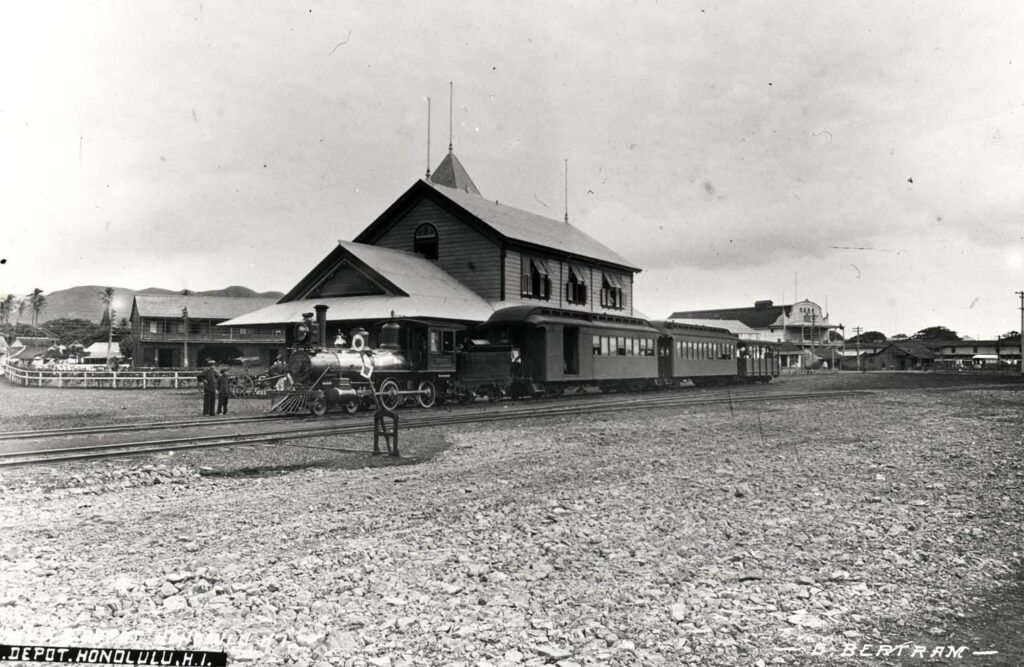
On September 4, 1888, Frank Dillingham’s 44th birthday, the legislature gave Dillingham an exclusive franchise “for construction and operation on the Island of O‘ahu a steam railroad … for the carriage of passengers and freight.”

They laughed at him and called it ‘Dillingham’s Folly.’ But Benjamin Franklin Dillingham’s dream of a railroad into the wilderness of West Oahu carried the promise of a sugar industry and major developments that would change Hawaii forever. (Wagner)

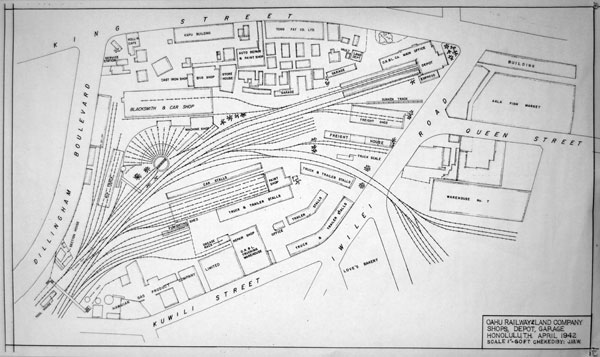
Dillingham formed O‘ahu Railway and Land Company (OR&L,) a narrow gauge rail, whose economic being was founded on the belief that O‘ahu would soon host a major sugar industry.

“Among the most important works now in process of rapid construction, is the Oahu railway to Pearl Harbor, which is already approaching completion, so far as grading is concerned. Eleven miles of this line will have the grading completed in two weeks; and of this length ten miles are already finished.”

“The depot itself will be of imposing size and made as ornamental in appearance as convenience and traffic requirements will allow. … The progress of this important work has been so rapid during the month of July that we give it first place among the works in progress during the past month.”  (Pacific Commercial Advertiser, July 27, 1889)

“Mr BF Dillingham, promoter of the Oahu Railway and Land Company [OR&L], on his birthday a year previous, was accosted by an acquaintance with the remark: ‘Well, Mr. Dillingham, you have got your franchise: when are you going to give us the railway?’”

“Mr. Dillingham replied that on his next birthday, that day one year, he hoped to treat his friends to a railway ride.  … with a strong company now at his back, the originator of the enterprise, having taken the contract to build the road, resolutely pushed operations to their present advanced stage.”

On September 4, 1889, Mr. Dillingham’s forty-fifth birthday, the first train to run out of Honolulu took an excursion party one-half mile into the Palama rice fields.

‘Dillingham’s Folly’ had now become the greatest single factor in the development of O‘ahu and Honolulu.  (Nellist)

“With a shrill blast from the whistle and the bell clanging, the engine moved easily off with its load. Three rousing cheers were given by the passengers, and crowds assembled at the starting point responded.”  (Daily Bulletin, September 5, 1889)

The rail line was extended, reaching Waianae in 1895 and, with Waialua plantation enormously expanded under Mr. Dillingham’s driving leadership, the railroad eventually was extended there and on to Kahuku. (Nellist)

Ultimately, OR&L sublet land, partnered on several sugar operations and/or hauled cane from Ewa Plantation Company, Honolulu Sugar Company in ‘Aiea, O‘ahu Sugar in Waipahu, Waianae Sugar Company, Waialua Agriculture Company and Kahuku Plantation Company, as well as pineapples for Dole.

By the early-1900s, the expanded railway cut across the island, serving several sugar and pineapple plantations, and the popular Haleʻiwa Hotel.  They even included a “Kodak Camera Train” (associated with the Hula Show) for Sunday trips to Hale‘iwa for picture-taking.

When the hotel opened on August 5, 1899, guests were conveyed from the railway terminal over the Anahulu stream to fourteen luxurious suites, each had a bath with hot-and-cold running water.

Thrum’s ‘Hawaiian Annual’ (1900,) noted, “In providing so tempting an inn as an adjunct and special attraction for travel by the Oahu Railway – also of his (Dillingham’s) creation – the old maxim of ‘what is worth doing is worth doing well’ has been well observed, everything about the hotel is first class …”

The weekend getaway from Honolulu to the Haleʻiwa Hotel became hugely popular with the city affluent who enjoyed a retreat in ‘the country.’

In addition, OR&L (using another of its “land” components,) got into land development.  It developed Hawai‘i’s first planned suburban development and held a contest, through the newspaper, to name this new city.  The winner selected was “Pearl City” (the public also named the main street, Lehua.)

The railway owned 2,200-acres in fee simple in the peninsula.  First they laid-out and constructed the improvements, then invited the public on a free ride to see the new residential community.  The marketing went so well; ultimately, lots were auctioned off to the highest bidder.

“Mr. Dillingham, besides creating the O‘ahu Railway, a line for which he struggled twenty-seven years against a public prejudice that would not see its financial possibilities, established Olaʻa plantation on the Island of Hawai‘i and McBryde plantation on Kauai.”  (Sugar, May 1918) 

On his death in 1918 at age 74, Dillingham was hailed as a “master builder” and Honolulu’s financial district closed its doors out of respect.   (Wagner)  The Islands would have been different, if not for a sailor breaking his leg riding a horse.

The Dillingham Transportation Building was built in 1929 for Walter F Dillingham of Honolulu, Hawaiʻi, who founded the Hawaiian Dredging Company (later Dillingham Construction) and ran the Oahu Railway and Land Company founded by his father, Benjamin Franklin Dillingham. (Information in this post taken, in part, from ‘Next Stop Honolulu.’)

© 2022 Ho‘okuleana LLC

Filed Under: Economy, Buildings, Missionaries / Churches / Religious Buildings, Prominent People, Sailing, Shipping & Shipwrecks Tagged With: Dillingham, Benjamin Franklin Dillingham, OR&L, Hawaii, Kodak Hula Show, Oahu Railway and Land Company, Haleiwa Hotel

April 16, 2022 by Peter T Young 2 Comments

Hilo Railroad Company – Hawaiian Consolidated Railway

The Treaty of Reciprocity (1875) between the United States and the Kingdom of Hawai‘i eliminated the major trade barrier to Hawai‘i’s closest and major market.  Through the treaty and its amendments, the US obtained Pearl Harbor and Hawai‘i’s sugar planters received duty-free entry into US markets for their sugar.

At the industry’s peak in the 1930s, Hawaiʻi’s sugar plantations employed more than 50,000 workers and produced more than 1-million tons of sugar a year; over 254,500-acres were planted in sugar.

Sugar cultivation exploded on the Big Island.  As a means to transport sugar and other goods, railroading was introduced to the Islands in 1879.

On March 28, 1899, Dillingham received a charter to build the original eight miles of the Hilo Railroad that connected the Olaʻa sugar mill to Waiākea, that was soon to become the location of Hilo’s deep water port.

Rail line extensions continued.  Extensions were soon built to Pāhoa, where the Pahoa Lumber Company was manufacturing ʻōhia and koa railroad ties for export to the Santa Fe Railroad.

Although not the first railway on the Big Island, the Hilo Railroad was arguably the most ambitious.  The Olaʻa line was completed in 1900, immediately followed by a seventeen mile extension to Kapoho, home of the Puna Sugar Company plantation.

Immediately after that two branch lines were constructed (also to sugar plantations,) and then the railroad was extended north into Hilo itself.

All the sugar grown in East Hawaiʻi, in Puna and on the Hāmākua Coast, was transported by rail to Hilo Harbor, where it was loaded onto ships bound for the continent.

An early account stated that the rail line crossed over 12,000 feet in bridges, 211 water openings under the tracks, and individual steel spans up to 1,006 feet long and 230 feet in height.

Some of the most notable were those over Maulua and Honoliʻi gulches, the Wailuku River and Laupāhoehoe.  Over 3,100 feet of tunnels were constructed, one of which, the Maulua Tunnel, was over half a mile in length.

While the main business of the railroad remained the transport of raw sugar and other products to and from the mills,  it also provided passenger service.

A chiefly tourist line, branching from Olaʻa, was built inland 12.5 miles up the mountain to Glenwood where visitors to the Volcano House near Kilauea Volcano would then transfer to buses. Due to stiff competition from motor vehicles, the Glenwood extension was scaled back to Mountain View in 1932.

Between 1909 and 1913, the Hāmākua Division of the railroad was constructed to service the sugar mills north of Hilo. Unfortunately, the cost of building the Hāmākua extension essentially destroyed the Hilo Railroad, which was sold in 1916 and reorganized as the Hawaiʻi Consolidated Railway.

Targeting tourists to augment local passenger and raw sugar transport, the Hawaiʻi Consolidated Railway ran sightseeing specials under the name “Scenic Express.”

Not for the faint of heart, these trips included a stop on the trestles, where passengers disembarked to admire the outstanding scenery.

The Great Depression saw a decrease in business, but business picked up in the 1940s, when thousands of battle-weary troops packed the passenger cars en route to Camp Tarawa, in Waimea, to rest, recuperate and prepare for another campaign.

But the end was near for the Hawaiʻi Consolidated Railway. Early in the morning of April 1, 1946, a massive tsunami struck Hawaiʻi. The railroad line between Hilo and Paʻauilo suffered massive damage; bridges collapsed, trestles tumbled and one engine was literally swept off the tracks.

The expensive option of rebuilding the railway was rejected. Hawaiʻi Consolidated offered the rights-of-way, tracks and remaining bridges, trestles and tunnels to the Territory of Hawaiʻi, but the offer was refused, and finally the company sold the entire works to the Gilmore Steel and Supply Company.

Shortly thereafter, realizing its error, the Territory bought it all back.  Much of the current highway along the coast follows the route of the old railroad; five original railroad trestles have been converted into highway bridges.  (This route averaged better than one bridge per mile over its 40-mile length.)

At the time of the tsunami, plantations were already phasing out rail in favor of trucking cane from the field to the mill. It was inevitable that trucking would also replace rail as the primary means of transporting sugar to the harbor. The tsunami accelerated that transition.

Most sugar from Hāmākua was trucked to Hilo Harbor, although the Hāmākua Sugar Company continued to use its offshore cable landing at Honokaʻa until 1948.

A few remnants of the railway are still visible. Hawaiʻi Consolidated’s yards were in the Waiākea district of Hilo, where the roundhouse still stands today, next to the county swimming pool on Kalanikoa Street.

In Laupāhoehoe, a concrete platform remains where Hula dancers once performed for tourists. And the Laupāhoehoe Train Museum is housed in the former home of Mr. Stanley, the superintendent of maintenance.

Today, the Laupāhoehoe Train Museum and Visitors Center keeps the memory of Hawaiʻi Consolidated Railway alive.  Although the Laupāhoehoe Train Museum is among the state’s smallest museums, it attracts an estimated 5,000 visitors a year. The admission fee is $4 for adults, $3 for seniors, and $2 for students. Special rates for tours are also offered.

The museum is open weekdays from 9 am to 4:30 pm and on weekends from 10 am to 2 pm. The address is 36-2377 Māmalahoa Highway, Laupāhoehoe, Hawaiʻi 96764.  (Lots of information here for Laupāhoehoe Train Museum and Ian Birnie.)

© 2022 Hoʻokuleana LLC


Filed Under: General, Prominent People, Economy Tagged With: Hawaiian Consolidated Railway, Hilo Railroad, Hawaii, Hawaii Island, Hilo, Treaty of Reciprocity, Hamakua, Laupahoehoe, Laupahoehoe Train Museum, Dillingham, Big Island

December 19, 2021 by Peter T Young 4 Comments

O‘ahu Railway and Land Company (OR&L)

The story of Hawaii’s “Big Five” companies (Alexander & Baldwin, Amfac (American Factors), Castle & Cooke, C. Brewer & Co. and Theo. H Davies & Co.) dominates the state’s economic history.
 
Their common trait: they were founded in agriculture – sugar and pineapple.
 
Another Hawai‘i family and company, Dillingham, started business in the late-1800s; although not a “Big Five,” deserves some attention.
 
It’s beginning, in part, is traced to O‘ahu Railway and Land Company.  They didn’t necessarily produce agriculture, but they played a critical role in agricultural operations.
 
Benjamin Franklin (Frank) Dillingham formed OR&L (a narrow gauge rail,) whose economic being was founded on the belief that O‘ahu would soon host a major sugar industry.
 
In 1885, Dillingham embarked on a land development project west of Honolulu and, like his continental counterparts, realized that this venture would not succeed without improved transportation to the area.  He also figured that a railroad needed to carry freight, as well, in order to be profitable.
 
The drilling of the first artesian well on the Ewa Plain by James Campbell in 1879 presented Dillingham another opportunity.  He obtained 50-year leases beginning in 1887 from Campbell in Ewa.
 
In 1888, the legislature gave Dillingham an exclusive franchise “for construction and operation on the Island of O‘ahu a steam railroad … for the carriage of passengers and freight.”
 
Ultimately OR&L sublet land, partnered on several sugar operations and/or hauled cane from Ewa Plantation Company, Honolulu Sugar Company in ‘Aiea, O‘ahu Sugar in Waipahu, Waianae Sugar Company, Waialua Agriculture Company and Kahuku Plantation Company, as well as pineapples for Dole.
 
Likewise, OR&L hauled various stages in the pineapple harvesting/production, including the canning components, fresh pineapple to the cannery, ending up hauling the cased products to the docks.
 
By 1895 the rail line reached Waianae.  It then rounded Kaena Point to Mokuleia, eventually extending to Kahuku.  Another line was constructed through central O‘ahu to Wahiawa.
 
Passenger travel was an add-on opportunity that not only included train rides, they also operated a bus system.  However, the hauling for the agricultural ventures was the most lucrative.
 
They even included a “Kodak Camera Train” (associated with the Hula Show) for Sunday trips to Haleiwa for picture-taking.  During the war years, they served the military.
 
Just like the rail programs on the continent, the railroad owned and operated the Haleiwa Hotel and offered city folks a North Shore destination with beaches, boating, golf, tennis and hunting.
 
In addition, OR&L (using another of its “land” components,) got into land development.  It developed Hawai‘i’s first planned suburban development and held a contest, through the newspaper, to name this new city.
 
The winner selected was “Pearl City” (the public also named the main street, Lehua.)
 
The railway owned 2,200-acres in fee simple in the peninsula.  First they laid-out and constructed the improvements, then invited the public on a free ride to see the new residential community.
 
The marketing went so well; ultimately, lots were auctioned off to the highest bidder.
 
Multiple factors affected the ultimate demise of the rail operations: sugar/pineapple production fizzled in the islands; more and more people were getting automobiles for travel; a 1946 tsunami damaged tracks and the war’s end stopped military travel.
 
The last ride on OR&L’s train operations was on December 31, 1947, ending 58-years of steam locomotives hauling all kinds of people, freight and other around O‘ahu.
 
The Dillinghams were out of transportation, but were active in development, construction and dredging.
 
My father served as manager of the land department of OR&L (1952-1961.)  When OR&L and Hawaiian Dredging and Construction Company merged to form the Dillingham Corporation, he was manager and vice president at Dillingham until 1968.  As a kid, I remember going down to the old OR&L facility in Iwilei.
 
© 2021 Hoʻokuleana LLC
 

Filed Under: General, Prominent People, Economy Tagged With: Hawaii, Oahu Railway and Land Company, Dillingham, Images of Old Hawaii

October 6, 2021 by Peter T Young Leave a Comment

Big Five (plus 2)

“By 1941, every time a native Hawaiian switched on his lights, turned on the gas or rode on a street car, he paid a tiny tribute into Big Five coffers.” (Alexander MacDonald, 1944)

The story of Hawaii’s largest companies dominates Hawaiʻi’s economic history. Since the early/mid-1800s, until relatively recently, five major companies emerged and dominated the Island’s economic framework. Their common trait: they were focused on agriculture – sugar.

They became known as the Big Five:

C. Brewer & Co.
Founded: October 1826; Capt. James Hunnewell (American Sea Captain, Merchant; Charles Brewer was American Merchant)
Incorporated: February 7, 1883

Theo H. Davies & Co.
Founded: 1845; James and John Starkey, and Robert C. Janion (English Merchants; Theophilus Harris Davies was Welch Merchant)
Incorporated: January 1894

Amfac
Founded: 1849; Heinrich Hackfeld and Johann Carl Pflueger (German Merchants)
Incorporated: 1897 (H Hackfeld & Co;) American Factors Ltd, 1918

Castle & Cooke
Founded: 1851; Samuel Northrup Castle and Amos Starr Cooke (American Mission Secular Agents)
Incorporated: 1894

Alexander & Baldwin
Founded: 1870; Samuel Thomas Alexander & Henry Perrine Baldwin (American, Sons of Missionaries)
Incorporated: 1900

Some suggest they were started and run by the missionaries. Actually, only Castle & Cooke had direct ties to the mission – Castle ran the ‘depository’ and Cooke was a teacher.

Alexander & Baldwin were sons of missionaries, but not a formal part of the mission. Brewer was an American sea captain and merchant; the founders of Davies were English merchants and the founders of Amfac were German merchants.

Hawaiʻi’s industrial plantations began to emerge at this time (1860s;) they were further fueled by the Treaty of Reciprocity – 1875 between the United States and the Kingdom of Hawai‘i eliminated the major trade barrier to Hawai‘i’s closest and major market. Through the treaty, the US obtained Pearl Harbor and Hawai‘i’s sugar planters received duty-free entry into U.S. markets for their sugar.

As the sugar industry pushed ahead, something else new was introduced into the economic scheme of things. In Honolulu two or three new firms began business solely to handle the affairs of the scattered plantations.

They began by acting as selling agents for the planters. Gradually they took over other functions: financing crops, importing labor, purchasing machinery for the planters and serving in all ways as their business agents. The new businesses soon found themselves running the sugar industry.

By the 1880s, five of these concerns, called factors, eventually dominated the field. How effectively the Big Five could band together as one against outside forces whether the enemy was foreign capital, insects, labor, competing products or disease was well demonstrated by their Hawaiian Sugar Planters Association, more familiarly known as the HSPA. (MacDonald)

This group organization for Hawaii’s sugar industry was founded in 1882 as the Planters’ Labor and Supply Company when the planters found they had common problems in irrigating the sugar lands, growing the cane, and finding labor. That was its immediate official purpose.

“Everything that comes into the territory comes through a large corporation. The independent businessman who attempts to enter business here immediately finds that even nationally advertised lines from the mainland are tied up by the Big Five. It is almost impossible to get an independent line of business as they have everything – lumber paint, right down the line.” (Edward Walker, High Sheriff of Hawaiʻi, 1937; Kent)

Acting as agents for thirty-six of the thirty-eight sugar plantations, the Big Five openly monopolized the sugar trade. Twenty-nine firms, producing seven out of every eight tons of sugar exported from the Islands, refined, markets and distributed through the Big Five’s wholly owned California and Hawaiian Sugar Company, whose refinery, the largest in the world, was on San Francisco Bay. (Kent)

They branched out into other businesses. To squeeze additional profits out of the sugar trade, they started their own refinery in California; it was to become the largest in the world. They built up a fleet of ships, the Matson line, to carry the sugar away and to bring back goods and passengers.

They developed inter-island shipping, built hotels, put capital into insurance, cattle, pineapples, banking. They took over bodily the wholesaling of goods coming into the Islands; ninety percent of retail stock came from their warehouses.

Their capital started the public utilities. Their street railway transported Hawaiians, their gas and electric plants lighted the city, they acquired the communications systems. (MacDonald)

The sugar industry was the prime force in transforming Hawaiʻi from a traditional, insular, agrarian and debt‐ridden society into a multicultural, cosmopolitan and prosperous one. (Carol Wilcox)

With statehood in 1959 and the almost simultaneous introduction of passenger jet airplanes, the tourist industry began to grow rapidly.

The industry came to maturity by the turn of the century; the industry peaked in the 1930s. Hawaiʻi’s sugar plantations employed more than 50,000 workers and produced more than 1-million tons of sugar a year; over 254,500-acres were planted in sugar. (That plummeted to 492,000-tons in 1995.)

A majority of the plantations closed in the 1990s. As sugar declined, tourism took its place – and far surpassed it. Like many other societies, Hawaii underwent a profound transformation from an agrarian to a service economy.

There were a couple other associated entities that were associated with the Big 5” Dillingham (Benjamin Franklin Dillingham) and Campbell (James Campbell) and their associated companies.

Click HERE to view/download for more information on Hawai‘i’s Big 5 (plus 2).

© 2021 Hoʻokuleana LLC

Downtown_Honolulu-Building_ownersh
Alexander & Baldwin-logo
Alexander & Baldwin Building-PP-7-4-006-00001
Amfac-logo
Amfac-logo
American Factors (formerly H.Hackfield)-PP-7-5-019-00001
C Brewer-logo
C Brewer-logo
Brewer Building-Burlingame-SB
Castle & Cooke-logo
Castle & Cooke-logo
Castle_&_Cooke-PP-8-1-008-00001
Theo Davies-logo
Theo Davies-logo
Theo. H. Davies Co., Bishop St-PP-8-3-010-00001
James_Campbell_Building-(Williams, Adamson)-1967
Dillingham Transportation Building-PP-8-4-003-00001

Filed Under: Prominent People, Economy Tagged With: Castle and Cooke, Hawaii, James Campbell, Big 5, Alexander and Baldwin, Theo H Davies, C Brewer, Amfac, American Factors, Dillingham

September 30, 2021 by Peter T Young 5 Comments

Brothers Continue The Legacy

For much of the 1800s, sailing ships calling at Honolulu Harbor were serviced using double-hulled canoes or rowboats.
In 1900, three brothers, Jack, Herbert and William, formed Young Brothers and started doing small jobs around the Harbor.
Early in the century, there was only a narrow opening in the reef, so sailing ships anchored outside where they had room to maneuver. They then came ashore in their own boats or used launch services from the harbor.
Jack Young once reminisced about arriving in Honolulu in 1900 with a few cans of fruit, a large trunk and only twenty-five cents in cash – too little to pay to have his trunk brought ashore. So he rustled up a spare rowboat and rowed in his own gear.
In those days, there might be from five to twenty sailing ships off Sand Island. When a ship came in, the anchor line had to be run out to secure the ship; if the ship was coming to the dock, a line had to be carried to the pier.
In the early years of the company, Young Brothers used its first boat, Billy, to service the ships by carrying supplies and sailors to ships at anchor outside the harbor, as well as run lines for anchoring or docking vessels.
They also pulled boats off the reefs, conducted salvage operations and various other harbor-related activities (including harbor tours.)
The company grew over the years into an active interisland freight company.
When original brother Jack’s two sons became old enough, they joined the operation.
Jack Young Jr., joined the company as a regular employee in 1933. He soon captained various boats; in 1936 he became the permanent master of the Mamo (which in 1930 was the first all-steel tugboat in maritime history.)
Jack’s younger brother, Kenny Young, joined Young Brothers in 1946, after a stint in the Navy and graduation from Stanford.
He immediately became superintendent of Young Brothers’ freight department, a position he held until 1952. That same year, Young Brothers merged with Oahu Railway and Land Company (OR&L.)
Jack Jr. resigned from Young Brothers in 1952 (having disagreed with the merger and its resulting changes in management policies.)
However, Jack Jr. continued to broaden his maritime skills, earning a Master Maritime license and becoming a Harbor Pilot for the Territory of Hawai‘i, then Harbor Master for the State. (Jack Jr. passed away in 1994.)
Kenny remained with the company after the merger and served as manager of the land department of OR&L (1952-1961.)
When OR&L merged with Dillingham Corporation, he was manager and vice president at Dillingham until 1968.
He then moved to Kona and started his own real estate company. (Kenny passed away in 2004.)
Jack Young of the original Young Brothers is my grandfather; Jack Young Jr, my uncle; and Kenny Young, my father.
The Young family legacy at Young Brothers continued; for a while, my older brother, David Young, served as a Hawai‘i County Community Advisory Board Member for the Young Brothers Community Gift Giving program.
I am the youngest brother of the youngest brother of the youngest brother of Young Brothers.
© 2021 Hoʻokuleana LLC

Jack Edgar and Will Young 1903
Young_Brothers-first_boat-Billy
Young-Brothers-Captain_Jack_Young_(grandfather)_on_Makaala
Kenny Young
Kenny Young
Da_Braddahs
Young_Brothers-Fleet-1915
Young_Brothers_Boathouse-center_structure_with_open_house_for_boats_on_its_left-1910
Young Brothers Launch 'Sea Scout' in Honolulu Harbor-Lucas_Tower_in_background-PPWD-9-3-030-1905-400
Young Brothers Launch ‘Sea Scout’ in Honolulu Harbor-Lucas_Tower_in_background-PPWD-9-3-030-1905-400
Young_Brothers_Boathouse-1902
Young Brothers shark hunt
Kapena Jack Young Drawing
IMG_2905
IMG_7931

Filed Under: Prominent People, Economy, Sailing, Shipping & Shipwrecks Tagged With: Hawaii, Jack Young, Young Brothers, Honolulu Harbor, Oahu Railway and Land Company, Dillingham, Kenny Young, Images of Old Hawaii, Captain Jack

  • « Previous Page
  • 1
  • 2
  • 3
  • 4
  • 5
  • Next Page »

Images of Old Hawaiʻi

People, places, and events in Hawaiʻi’s past come alive through text and media in “Images of Old Hawaiʻi.” These posts are informal historic summaries presented for personal, non-commercial, and educational purposes.

Info@Hookuleana.com

Connect with Us

  • Email
  • Facebook
  • LinkedIn
  • Twitter
  • YouTube

Recent Posts

  • Robin’s Egg Blue Chamber
  • Japanese Contact
  • Ammo Tunnels
  • 250 Years Ago … Battle of Brooklyn
  • Missionary, Educator … Former Slave
  • Historic Downtown Hilo Walking Tour
  • Memorial Park

Categories

  • Hawaiian Traditions
  • Military
  • Place Names
  • Prominent People
  • Schools
  • Sailing, Shipping & Shipwrecks
  • Economy
  • Voyage of the Thaddeus
  • Mayflower Summaries
  • American Revolution
  • General
  • Ali'i / Chiefs / Governance
  • Buildings
  • Missionaries / Churches / Religious Buildings

Tags

Albatross Al Capone Ane Keohokalole Archibald Campbell Bernice Pauahi Bishop Charles Reed Bishop Downtown Honolulu Eruption Founder's Day George Patton Great Wall of Kuakini Green Sea Turtle Hawaii Hawaii Island Hermes Hilo Holoikauaua Honolulu Isaac Davis James Robinson Kamae Kamaeokalani Kameeiamoku Kamehameha Schools Lalani Village Lava Flow Lelia Byrd Liberty Ship Liliuokalani Mao Math Mauna Loa Midway Monk Seal Northwestern Hawaiian Islands Oahu Papahanaumokuakea Marine National Monument Pearl Pualani Mossman Quartette Thomas Jaggar Volcano Waikiki Wake Wisdom

Hoʻokuleana LLC

Hoʻokuleana LLC is a Planning and Consulting firm assisting property owners with Land Use Planning efforts, including Environmental Review, Entitlement Process, Permitting, Community Outreach, etc. We are uniquely positioned to assist you in a variety of needs.

Info@Hookuleana.com

Copyright © 2012-2024 Peter T Young, Hoʻokuleana LLC

Loading Comments...