Images of Old Hawaiʻi

  • Home
  • About
  • Categories
    • Ali’i / Chiefs / Governance
    • American Protestant Mission
    • Buildings
    • Collections
    • Economy
    • Missionaries / Churches / Religious Buildings
    • General
    • Hawaiian Traditions
    • Other Summaries
    • Mayflower Summaries
    • Mayflower Full Summaries
    • Military
    • Place Names
    • Prominent People
    • Schools
    • Sailing, Shipping & Shipwrecks
    • Voyage of the Thaddeus
  • Collections
  • Contact
  • Follow

April 7, 2026 by Peter T Young 2 Comments

Benjamin Franklin Dillingham

Benjamin Franklin (Frank) Dillingham was the son of Benjamin Clark Dillingham, a shipmaster, and Lydia Sears (Hows) Dillingham, born on September 4, 1844 in West Brewster, Massachusetts.

He left school at 14 and shipped on his uncle’s vessel for a voyage around the Horn to San Francisco. During the Civil War, on June 6, 1863, he was nineteen-year-old third mate on the clipper ship Southern Cross bound for New York with a cargo of ‘log wood.’

‘Florida’ was flying the British ensign, though as she steamed closer, she ran up the rebels’ ‘stars and bars.’ A squad of armed Confederate sailors boarded and took Dillingham and the rest of the clipper’s small crew prisoner.

Then, as the new prisoners watched from the deck of their captor, the Southern Cross was set ablaze and sunk. Eventually they were put ashore at Rio de Janeiro and worked their way back to the war-torn United States.

Dillingham headed west, determined to take up residence in San Francisco and find work ashore. An unsuccessful hunt for employment led him back to the sea, and in 1865 he was hired by Captain John Paty as first mate on the bark Whistler, on the San Francisco/Honolulu run.

“A brief sojourn in the city enabled me to realize that I had no training in any other vocation, save that of the sea, and learning that Capt. Paty of the bark Whistler plying between the coast and Honolulu was in need of officers, I applied and obtained the position of first mate without delay.” (Dillingham; Chiddix & Simpson))

Dillingham wrote that he felt at home the first time he came ashore in Honolulu: “After my tempstuous experiences in rounding Cape Horn and the Cape of Good Hope, the trip seemed to me like a pleasure excursion.”

“It felt as if I had anchored in a home port; the cordiality I experienced from all those whom I met removed at once the feeling of being in a foreign land though the streets were filled with several nationalities. The luxuriant foliage, the balmy breezes, the tropical fruits, all afforded such delights that I felt sure I should return.”

He did return, and ultimately stayed after an unfortunate encounter between his horse and a carriage; “The first officer of the bark Whistler, Mr. Dillingham, whose leg was broken last Friday night, by being thrown from a horse, in collision with a carriage, on the valley road …”

“(Dillingham) is now at the American Marine Hospital, where he receives every care and attention, and is in favorable condition for recover.” (Pacific Commercial Advertiser, July 29, 1865) Unfortunately for him, the Whistler left him in Honolulu and sailed away.

He accepted a job as a clerk in a hardware store called H. Dimond & Son for $40 per month. The store was owned by Henry Dimond, formerly a bookbinder in the 7th Missionary Company. In 1850 Dimond had been released from his duties at the Mission and had gone into business with his son.

Dillingham later bought the company with partner Alfred Castle (son of Samuel Northrup Castle, who was in the 8th Company of missionaries and ran the Mission business office;) they called the company Dillingham & Co (it was later known as Pacific Hardware, Co.)

On April 26, 1869, Dillingham married Emma Smith, daughter of 6th Company missionaries Reverend Lowell and Abigail Smith.

But hard times came on Dillingham with the collapse of whaling and the rise of sugar. Large suppliers pulled Dillingham’s credit lines, and his accounts were paid late. Then Dillingham was given the opportunity to buy the James Campbell lands in Ewa.

While he couldn’t raise the money to buy it, Campbell leased the land for 50-years. Dillingham realized that to be successful, he needed reliable transportation.

On September 4, 1888, Frank Dillingham’s 44th birthday, the legislature gave Dillingham an exclusive franchise “for construction and operation on the Island of O‘ahu a steam railroad … for the carriage of passengers and freight.”

Dillingham formed O‘ahu Railway and Land Company (OR&L,) a narrow gauge rail, whose economic being was founded on the belief that O‘ahu would soon host a major sugar industry.

“Among the most important works now in process of rapid construction, is the Oahu railway to Pearl Harbor, which is already approaching completion, so far as grading is concerned. Eleven miles of this line will have the grading completed in two weeks; and of this length ten miles are already finished.”

“The depot itself will be of imposing size and made as ornamental in appearance as convenience and traffic requirements will allow. … The progress of this important work has been so rapid during the month of July that we give it first place among the works in progress during the past month.” (Pacific Commercial Advertiser, July 27, 1889)

“Mr BF Dillingham, promoter of the Oahu Railway and Land Company, on his birthday a year previous, was accosted by an acquaintance with the remark: ‘Well, Mr. Dillingham, you have got your franchise: when are you going to give us the railway?’”

“Mr. Dillingham replied that on his next birthday, that day one year, he hoped to treat his friends to a railway ride. … with a strong company now at his back, the originator of the enterprise, having taken the contract to build the road, resolutely pushed operations to their present advanced stage.”

“When the appointed day arrived Mr Dillingham was ready to celebrate. His engine had been set up some days. Two third class cars, the best passenger accommodation as yet on the ground, were put together. … With a shrill blast from the whistle and the bell clanging, the engine moved easily off with its load. Three rousing cheers were given by the passengers, and crowds assembled at the starting point responded.” (Daily Bulletin, September 5, 1889)

Ultimately OR&L sublet land, partnered on several sugar operations and/or hauled cane from Ewa Plantation Company, Honolulu Sugar Company in ‘Aiea, O‘ahu Sugar in Waipahu, Waianae Sugar Company, Waialua Agriculture Company and Kahuku Plantation Company, as well as pineapples for Dole.

By the early-1900s, the expanded railway cut across the island, serving several sugar and pineapple plantations, and the popular Haleʻiwa Hotel. They even included a “Kodak Camera Train” (associated with the Hula Show) for Sunday trips to Hale‘iwa for picture-taking.

When the hotel opened on August 5, 1899, guests were conveyed from the railway terminal over the Anahulu stream to fourteen luxurious suites, each had a bath with hot-and-cold running water.

Thrum’s ‘Hawaiian Annual’ (1900,) noted, “In providing so tempting an inn as an adjunct and special attraction for travel by the Oahu Railway – also of his (Dillingham’s) creation – the old maxim of ‘what is worth doing is worth doing well’ has been well observed, everything About the hotel is first class…”

The weekend getaway from Honolulu to the Haleʻiwa Hotel became hugely popular with the city affluent who enjoyed a retreat in ‘the country.’

In addition, OR&L (using another of its “land” components,) got into land development. It developed Hawai‘i’s first planned suburban development and held a contest, through the newspaper, to name this new city. The winner selected was “Pearl City” (the public also named the main street, Lehua.)

The railway owned 2,200-acres in fee simple in the peninsula. First they laid-out and constructed the improvements, then invited the public on a free ride to see the new residential community. The marketing went so well; ultimately, lots were auctioned off to the highest bidder.

“Mr. Dillingham, besides creating the O‘ahu Railway, a line for which he struggled twenty-seven years against a public prejudice that would not see its financial possibilities, established Olaʻa plantation on the Island of Hawai‘i and McBryde plantation on Kauai.”

“He retained active management of the Oahu Railway & Land Company until 1915, when he relinquished it to George P. Denison.” (Sugar, May 1918) Dillingham died April 7, 1918 (aged 73.) (Information in this post taken, in part, from ‘Next Stop Honolulu.’)

The Dillingham Transportation Building was built in 1929 for Walter F Dillingham of Honolulu, Hawaiʻi, who founded the Hawaiian Dredging Company (later Dillingham Construction) and ran the Oahu Railway and Land Company founded by his father, Benjamin Franklin Dillingham.

© 2026 Hoʻokuleana LLC

Filed Under: Prominent People, Economy, Buildings Tagged With: Hawaii, Kodak Hula Show, Oahu Railway and Land Company, Haleiwa Hotel, Benjamin Franklin Dillingham, Dillingham Transportation Building, OR&L, Pearl City

April 30, 2024 by Peter T Young Leave a Comment

Kamokuʻakulikuli

Coral doesn’t grow in fresh water.  So, where a stream enters a coastal area, there is typically no coral growth at that point – and, as the freshwater runs out into the ocean, a coral-less channel is created.

In its natural state, thanks to Nuʻuanu Stream, Honolulu Harbor originally was a deep embayment formed by the outflow of Nuʻuanu Stream creating an opening in the shallow coral reef along the south shore of Oʻahu.

Honolulu Harbor (it was earlier known as Kuloloia) was entered by the first foreigner, Captain William Brown of the English ship Butterworth, in 1794.

They called the harbor “Fair Haven” which may be a rough translation of the Hawaiian name Honolulu (it was also sometimes called Brown’s Harbor.)  The name Honolulu (meaning “sheltered bay” – with numerous variations in spelling) soon came into use.

More sailors came.  Captain William Sumner arrived in the Islands in 1807.  Arriving first at Kaua‘i, Sumner jumped-ship and lived amongst the Hawaiians there.  Kaumuali‘i was the king of Kaua‘i at the time, and when he saw Sumner, he was entranced by this youth, and took him as a “keiki hoʻokama” (adopted him.)

In the Islands, Kamehameha I, who had been living at Waikiki, moved his Royal Residence to Pākākā at Honolulu Harbor in 1809. Sumner served as one of the captains on ships in this fleet.

Some foreigners, like Sumner who sailed ships for Kamehameha, Liholiho (Kamehameha II) and Kauikeaouli (Kamehameha III,) were awarded land grants for their services.

In 1819, Kamehameha I gave land to Sumner for services rendered.  This site was at the corner of today’s Hotel and Punchbowl Streets (near where the present Barracks are at ʻIolani Palace.)

Sumner was also awarded “… a fishery of the 647-Diamond Head acres of the reef lying between the Kalihi and Honolulu Harbor Channels.  The area carried the Hawaiian name of Kaholaloa (Koholaloa, Kahololoa, Kaholoa.)  The Ewa portion of this reef was designated Mokauea.”

Hawai‘i’s whaling era began in 1819 when two New England ships, the Balena out of New Bedford, and the Equator, out of Nantucket, became the first whaling ships to arrive in the Hawaiian Islands.

Rich whaling waters were discovered near Japan and soon hundreds of ships headed for the area.   The central location of the Hawaiian Islands between America and Japan brought many whaling ships to the Islands.

With increased whalers to the Islands, so did disease.  A law was passed noting, “All vessels having had contagious diseases on board … on arrival at Sandwich Islands, or at any port hereof, shall be entirely at the direction of the Board of Health … all vessels quarantined … shall keep constantly flying, during the day, a yellow flag at the main top.”  (Quarantine Laws, May 29, 1839)

The first efforts to deepen Honolulu Harbor were made in the 1840s. The idea to use the dredged material, composed of sand and crushed coral, to fill in low-lying lands was quickly adopted.   Some of the material was deposited on the fringing reef.

“In the year 1849 … the land of Kahololoa, was confirmed to William Sumner by Land Commission Award No, 153 … The title to these lands passed to JI Dowsett and John K Sumner, and from them to the Dowsett Company, Limited, and the Oahu Railway & Land Company.”

In 1872, the small island off Iwilei – “Kamokuʻakulikuli” – became the site of a quarantine station used to handle the influx of immigrant laborers drawn to the islands’ developing sugar plantations. The site is described as “little more than a raised platform of sand and pilings to house the station, with walkways leading to the harbor edge wharf, where a concrete sea wall had been constructed” and as “a low, swampy area on a reef in the harbor”.

Improvements were made.   “Looking seaward from the prison I noticed a building which had been erected upon the reef, and on enquiry found it to be a Quarantine Station. … (it was) used occasionally as a temporary accommodation for immigrants.”

Then, the arrival “of a vessel bringing twenty-five Chinese passengers, among whose crew small-pox had broken out, demonstrated the foresight of the Government in erecting this commodious building…”  (Bowser, 1880-1881; Maly)

More came.  “Over seven hundred Chinese immigrants, mostly men, who came here on the steamer Septima on the 13th of last month, were placed in quarantine on their arrival, on account of the existence of small pox among them. For nine days they were detained on board of the ship in the harbor, until the quarters were prepared for them on the quarantine island.”

“Those ill with small-pox were removed from among the others as soon as the disease appeared, and finally when about twenty days had passed since the last case had been removed the Board of Health allowed them to go as fast as they found employment; or as they found responsible persons who would become responsible to the Board of Immigration that they would not become vagrants or a charge on the community for their support.”  (Hawaiian Gazette, March 23, 1881)

By 1888, Kamokuʻākulikuli Island had been expanded and was known as “Quarantine Island.”  If vessels arrived at the harbor after 15 days at sea and contagious disease was aboard, quarantine and disinfecting procedures were required at Quarantine Island.  (Cultural Surveys)

“Upon annexation of the islands the United States took possession of Quarantine Island in the belief that the title to that land had been vested in the Hawaiian government. (Dowsett and OR&L filed suit.)”

In a compromise, “in 1902 the (Oʻahu Railway & Land Company) and the Dowsett Company turned over to the federal government 550-acres of what is now Quarantine Island and adjacent ground, and for themselves kept only 82-acres.  (They also retained wharfage privileges and rights to access the channel/harbor.)”  (Honolulu Star Bulleting, June 16, 1914)

Quarantine Island became the largest United States quarantine station of the period, accommodating 2,255-individuals.  This facility included two hospitals and a crematorium.  (Cultural Surveys)

Dredged materials from improvements to Honolulu harbor had enlarged Quarantine Island again and by 1906 the island was encircled by a seawall and was 38-acres.  By 1908 the Quarantine Station consisted of Quarantine Island and the reclaimed land of the Quarantine wharf (with a causeway connecting the two.)

On February 15, 1910, Honolulu Harbor Light station was built and the beacon went into service. Soon, with added filling and subsequent connection of the two emergent islands on the reef, the resulting single island took the name Sand Island.

In 1916, Sand Island Military Reservation was established on the reclaimed land of the quarantine station. Subsequent episodes of harbor improvements resulted in enlarging the island and, by 1925 the reef around Sand Island had been removed and the island was completely surrounded by water.  (Dye)

Following the bombing of Pearl Harbor and declaration of martial law on December 7, 1941, military authorities immediately rounded up Japanese and placed them in internment camps.  Those arrested on Oʻahu were initially crowded into the Honolulu Immigration Station pending a hearing or a short boat ride to Sand Island.

In May 1942, military authorities turned the quarantine station into the Sand Island Detention Center, complete with 10-foot-tall fences.  Other internment facilities were constructed in the Islands and on the continent.  By the end of the war, an estimated 1,440-people were detained or interned in Hawai’i at one of five locations on O’ahu, the Big Island, Maui and Kaua’i.

During the early-1940s, Sand Island became the headquarters of the Army Port and Service Command and in the early 1940s the island was further enlarged with fill materials from the dredging of the seaplane runway.  (Dye)

In 1959, the Department of the Army transferred Sand Island to the Territory of Hawaiʻi, and in 1963 ownership was transferred to the State of Hawaiʻi.  (Star Bulletin, March 12, 1991)  The island was once home to the Jaycee’s 50th State Fair.

Initial vehicular access was via a causeway; in April 1962, the Army Corps of Engineers completed the Lt John R Slattery Bridge (Slattery was the first Army Corps of Engineers Honolulu District Engineer in 1905.) The two-lane bascule bridge (draw bridge) originally could be raised and lowered to allow boat traffic to pass underneath.

In the late-1980s, though, the state permanently sealed the metal bridge and built a new concrete bridge alongside, creating four lanes to accommodate the growing commercial traffic on and off the island.

Several other names have been associated with Sand Island. Lot Kamehameha (Kamehameha V) gave the name Mauliola to the island in reference to the island’s use as a quarantine station. (Star Bulletin, April 28, 1969)  Older names for the island were Kamokuʻākulikuli or Kahaka‘aulana. Rainbow Island and ʻĀnuenue were names used in the 1970s. (Dye)

© 2024 Hoʻokuleana LLC


Filed Under: Economy, Place Names, Sailing, Shipping & Shipwrecks Tagged With: Quarantine Island, Hawaii, Oahu, Honolulu Harbor, Oahu Railway and Land Company, Captain William Sumner, Kamokuakulikuli, Sand Island

April 15, 2024 by Peter T Young Leave a Comment

Kodak Hula Show

The earliest photographs of Hawaiʻi residents were the daguerreotypes made of Timoteo Haʻalilio and William Richards when the two men were in Paris on a diplomatic mission in 1843.    (Schmitt)

Later, on the US continent, George Eastman formed a photography company.  In naming his company, he wanted his trademark short and “incapable of being misspelled to an extent that will destroy its identity.”  And, “it must mean nothing.”

Eastman liked the letter ‘K;’ “it seemed a strong, incisive sort of letter.  Therefore, the word I wanted had to start with ‘K.’ Then it became a question of trying out a great number of combinations of letters that made words starting and ending with ‘K.’ The word ‘Kodak’ is the result”.  (Eastman; Kiplinger)

In 1888, the Eastman Kodak camera was placed on the market, with the slogan, “You press the button – we do the rest.” This was the birth of snapshot photography, as millions of amateur picture-takers know it today.  (Kodak)

In Hawaiʻi, amateur photography began to flourish in the late-1880s. The first retail establishments with camera counters were two Fort Street drug stores, Hollister & Co. and Benson, Smith & Co., both in 1887.

The first business establishment to advertise “printing done for amateurs” was the studio of Theo P Severin, on December 17, 1888. The first camera club was the Hawaiian Camera Club, organized January 10, 1889, with C Hedemann as its president.  (Schmitt)

All of this set the stage for a long-time (although now gone) iconic outdoor stage at Waikīkī, that also ended up with a travelling road show on Dillingham’s OR&L.

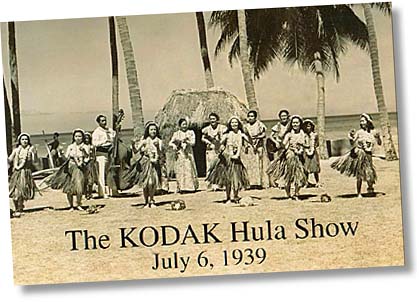
Intent on selling film, in 1937, Fritz Herman, then-vice president and manager of Kodak Hawaiʻi, founded the Kodak Hula Show. This allowed visitors to take pictures of hula shows outdoors in the daylight (rather than at the too-dark venues of the nighttime lūʻau.)

In addition, Herman wanted dancers to wear ti-leaf skirts and pose in natural settings, rather than the typical nighttime indoor wardrobe of cellophane skirts and paper lei.  (Desmond)

The first show, on the lawn behind the beach at San Souci, featured five dancers, four musicians and an audience of 100. The popular shows later expanded to 20 female and six male performers, 15 musicians, two chanters and audiences of 3,000 each week.

For many tourists, their only exposure to Hawaiian dance was the Kodak Hula Show.  And, it was free.

The Kodak Hula Show began with the introduction of the fictionalized character “King Kali,” and through the course of a performance a moderator would explain to the visitors the history of various dances, costumes, gestures, and at predetermined moments, dancers would form a display giving the audience ample opportunity to take pictures.  (sfsu-edu)

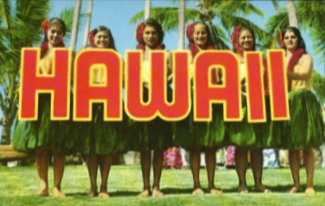
The classic “Kodak moment” happened when visitors were invited to aim their cameras at the cast as the performers held the huge H-A-W-A-I-I red and yellow letters.  The P-A-U sign closed each performance.

According to Kodak officials, only Disneyland and Disney World sold more film than the Kodak Hula Show.  (sun-sentinel)

Seeking to expand passenger travel, Oʻahu Railway and Land Company expanded railway cut across the island, serving several sugar and pineapple plantations, and the popular Haleiwa Hotel.

They even included a “Kodak Camera Train” (associated with the Hula Show) for Sunday trips to Haleiwa for picture-taking.

During WW II, there were no tourists, but hundreds of thousands of military personnel passed through the islands. The show worked with the military.  However, “You couldn’t even take photos of the beaches in those days.”  (Bartlett)

In 1969, the Kodak Company moved the Hula Show from the beach area to an amphitheater adjacent to the Waikīkī Shell in Kapiʻolani Park.

The show grew from once a week in the summer to four times a week year-round.  The hula show regularly drew capacity crowds from nearby Waikīkī hotels for its 10 am shows.

It was so popular that audiences were advised to arrive at least 30-minutes early to find a seat.  (sun-sentinel)

In July 1999, the Hogan Family Foundation took over operation of the Hawaiian tradition and renamed it the Pleasant Hawaiian Hula Show (Kodak film was still for sale in a kiosk beside the bleachers.)

The Foundation sponsored the Hula Show for three years at a cost of over $500,000 annually.

In 2002, the Foundation’s Board of Directors felt that it would be better to use these funds towards educational programs in the islands.

After months of looking for a suitable sponsor to assume the operation of the Hula Show, the show was officially closed on September 26, 2002.  (HoganFoundation)

An estimated 20-million people had seen the show from 1937-2002.  (Harada)

© 2024 Hoʻokuleana LLC

Filed Under: Economy Tagged With: Hawaii, Kodak Hula Show, Kodak Moment, Timothy Haalilio, William Richards, Oahu Railway and Land Company, Pleasant Hawaiian

July 14, 2023 by Peter T Young 2 Comments

Ke Awa Lau O Puʻuloa

During ancient times, various land divisions were used to divide and identify areas of control. Islands were divided into moku; moku were divided into ahupuaʻa. A common feature in each ahupuaʻa was water, typically in the form of a stream or spring.

The Island of O’ahu had six Moku: Kona, Koʻolaupoko, Koʻolauloa, Waialua, Waiʻanae and ʻEwa.

‘Ewa was divided into 12-ahupua‘a, consisting of (from east to west): Hālawa, ‘Aiea, Kalauao, Waimalu, Waiau, Waimano, Mānana, Waiʻawa, Waipi‘o, Waikele, Hōʻaeʻae and Honouliuli.

Some stories, when first recorded in the 19th- Century, refer to ʻEwa as the first area populated on Oʻahu by the immigrant Polynesians. ‘Ewa was at one time the political center for O‘ahu chiefs.

This was probably due to its abundant resources that supported the households of the chiefs, particularly the many fishponds around the lochs of Puʻuloa (“long hill,) better known today as Pearl Harbor. (Cultural Surveys)

Each had fisheries in the harbor, floodplains with irrigated kalo and fishponds, and interior (lower kula valley streams/gulches) and mountain forests. (Kirch)

Puʻuloa or Ke Awa Lau O Puʻuloa (the many harbored-sea of Puʻuloa) is situated here.

All water sources in each of the twelve ahupuaʻa of ʻEwa met in Puʻuloa. This was the only moku in all the islands where all waters from its ahupuaʻa did this.

Puʻuloa and Ke Awa Lau O Puʻuloa are just a couple of its traditional names. It was also known as Awawalei (“garland (lei) of harbors,”) Awalau (“harbor with many inlets”) and Huhui na ʻōpua i Awalau (The clouds met at Awalau.)

Today, we generally call this place Pearl Harbor. The name Pearl Harbor is one of the few English place names in Hawaiʻi that is a close translation of another of its traditional Hawaiian names, Wai Momi (“Pearl Water.”)

Some of the traditional themes associated with this area include connections with Kahiki (Tahiti,) the traditional homeland of Hawaiians.

Legend tells that Kanekuaʻana (a moʻo, or water lizard) came from Kahiki and brought with her the pipi, or pearl oyster. The harbor was teeming with pearl-producing oysters until the late-1800s. (The general belief is that runoff sedimentation eventually smothered the oyster habitat.)

The pipi was called the “iʻa hamau leo” or “fish with a silenced voice.” It was not the pipi that was silent but the people who gathered them (if they spoke, wind would ripple the water and the oysters would vanish.)

There are several versions of the chief Kahaʻi leaving from Kalaeloa (Barber’s Point) for a trip to Kahiki; on his return to the Hawaiian Islands, he brought back the first breadfruit and planted it at Puʻuloa.

Traditional accounts indicate several of the fishponds in the Puʻuloa area were believed to have been constructed by Kāne and Kanaloa. Directing the menehune, they made the pond Kapākule (aka Pākule,) which they stocked with all manner of fish. (Kumupono, Hoakalei)

“On the left side of [Kapākule] pond stood the stone called Hina, which represented a goddess of the sea by that name. Each time the sea ebbed, the rock became gradually visible, vanishing again under water at high tide. Ku, another stone on the right, was never seen above sea level. This stone represented Ku’ula, Red Ku, a god of fish and fishermen. (Pukui)

“[T]he harbor of Ewa, or Pearl River, [is] situated on the Island of Oahu, about 7 miles west of Honolulu. Pearl River is a fine sheet of deep water extending inland about 6 miles from its month …”

“Pearl River is not a true river; it partakes more of the character of an estuary. It is divided into three portions called ‘locks’ – the east lock, the middle lock, and the west lock, the three together affording some 30 miles of water front, with deep water in the channels.” (General JM Schofield and General BS Alexander, 1872)

Puʻuloa Salt Works (property of JI Dowsett) “are at the west side of the entrance to Pearl River, and the windmill is a prominent object in the landscape as we enter. It is also one of the guides in steeling vessels inward. On the eastern side and opposite to the Puʻuloa buildings, is the fishery, where are a number of buildings inhabited by Chinamen.” (Daily Bulletin, January 6, 1889)

Puʻuloa was originally an extensive, shallow embayment. Keaunui, the head of the powerful and celebrated ʻEwa chiefs, is attributed for having cut a navigable channel near the Puʻuloa saltworks, by which the great estuary, known as “Pearl River,” was for the first time rendered accessible to navigation.

Puʻuloa was regarded as the home of the shark goddess Kaʻahupahau and her brother Kahiʻuka in Hawaiian legends. They were said to live in a cave at the entrance to Puʻuloa and guarded the waters against man-eating sharks.

“There is ample evidence that the lonely scenes, upon which we now gaze with wondering curiosity, were once thickly peopled; and at that period the gospel had not reached Pearl River. Among the objects of their heathen worship was the shark, whoso numbers at Pearl River in those days were very abundant.” (Daily Bulletin, January 6, 1889)

Moku‘ume‘ume (meaning “island of strife”) is a small island located in Pearl Harbor on the Island of Oʻahu. It is entirely surrounded by water deep enough to accommodate deep draft ocean-going vessels. We now call it Ford Island.

The first known foreigner to enter the channel of the Pearl Harbor area, Captain George Vancouver, started to explore the area, but stopped when he realized that the entrance was not deep enough for large ships to pass through.

“If the water upon the bar should be deepened, which I doubt not can be effected, it would afford the best and most capacious harbor in the Pacific.” (Commodore Charles Wilkes, 1840)

In the nineteenth century, the peninsula between Middle Loch and East Loch (part of the Mānana ahupuaʻa) had numerous fishponds, some rice fields, pasture land at the tip, and oyster beds offshore.

As a means of solidifying a site in the central Pacific, the US negotiated an amendment to the Treaty of Reciprocity in 1887. King Kalākaua in his speech before the opening session of the 1887 Hawaiian Legislature stated (November 3, 1887:)

“I take great pleasure in informing you that the Treaty of Reciprocity with the United States of America has been definitely extended for seven years upon the same terms as those in the original treaty …”

“… with the addition of a clause granting to national vessels of the United States the exclusive privilege of entering Pearl River Harbor and establishing there a coaling and repair station.”

“This has been done after mature deliberation and the interchange between my Government and that of the United States of an interpretation of the said clause …”

“… whereby it is agreed and understood that it does not cede any territory or part with or impair any right of sovereignty or jurisdiction on the part of the Hawaiian Kingdom and that such privilege is coterminous with the treaty.”

“I regard this as one of the most important events of my reign, and I sincerely believe that it will re-establish the commercial progress and prosperity which began with the Reciprocity Treaty.” (Kalākaua)

In 1890 some of the Mānana lands became the first planned subdivision outside of urban Honolulu (Pearl City, named in a contest and developed by Benjamin F Dillingham as a way to increase passenger traffic on his Oahu Railway and Land Company (OR&L) trains.)

© 2023 Hoʻokuleana LLC

Filed Under: Place Names Tagged With: Hawaii, Oahu, Kalakaua, Pearl Harbor, Treaty of Reciprocity, Oahu Railway and Land Company, Dillingham, Ewa, Ke Awa Lau O Puuloa

March 3, 2023 by Peter T Young Leave a Comment

Nānākuli

There are lots of theories are out there about what Nānākuli means – several suggest it relates to looking at knees – others reference other body parts.

A common perception is that Nānākuli was a poor land with little agriculture, leading the few residents to instead rely on marine resources. One translation of the naming of the ahupua‘a, which seems to support this perception, is that Nānākuli means, “to look deaf”.

This is said to refer to the behavior of Nānākuli residents, who, embarrassed about not being able to offer food to passing strangers, pretended to be deaf.  (Cultural Surveys)

The ahupua‘a of Nānākuli encompasses a little over 1,000-acres and is bounded on the east by Honouliuli in the ‘Ewa District and on the west by Lualualei in the Waiʻanae District

This leeward area is especially noted for its susceptibility to drought and famine. In valleys such as Nānākuli, where perennial streams are lacking, agricultural resources would have been sparse due to poor water and land resources.

It is probable that there were small, scattered settlements here and there whose main subsistence was the ‘uala (sweet potato.)  (Cultural Surveys)

“The eastern slopes of the southern end of the Waiʻanae Mountains below Pu‘u Puna were famous for sweet potato growing. Although there was a little taro grown in the valleys of Wai‘anae-uka, sweet potatoes grown on the kula lands were the main food of the people here.”

“On the other side of the Waiʻanae Mountains sweet potatoes were planted on the dry slopes of Nānākuli, Lualualei, Waiʻanae-kai, and the other small valleys as far as Mākua. With the exception of Waiʻanae-kai, the sweet potato was the staple for the inhabitants of this dry section.”  (Handy, Cultural Surveys))

Pukui related a story told to her by Simeona Nawaʻa in 1945: “In the olden days, this place was sparsely inhabited because of the scarcity of water. The fishing was good but planting very poor. When it rained, some sweet potatoes would be put into the ground, but the crops were always poor and miserable.”

“There were a few brackish pools from which they obtained their drinking water and it is only when they went to the upland of Waiʻanae that they were able to get fresh water. They carried the water home in large calabashes hung on mamaka or carrying sticks and used their water very carefully after they got it home.”

“They spent most of their time fishing and most of the fish they caught were dried as gifts for friends and relatives in the upland. Sometimes they carried dried and fresh fish to these people in the upland and in exchange received poi and other vegetable foods. As often as not, it was the people of the upland who came with their products and went home with fish.”  (Cultural Surveys)

To make up for this agricultural deficit, the coastal areas were rich in marine resources and there was always an abundant supply of fish.

Accounts of early foreign observers give only a generalized picture of the late pre-contact/early historic patterns of population and activity within the Waiʻanae District and Nānākuli Ahupua‘a. Captain George Vancouver, sailing along the Waiʻanae Coast in 1793, noted:

“The face of the country did not…promise an abundant supply (of water;) the situation was exposed.” He described the coast as “one barren rocky waste nearly destitute of verdure, cultivation or inhabitants”.

The only village Vancouver observed was “at Waianae, located in a grove of coconut and other trees on the southern side of a small sandy bay”. It is probably this village that was visited in 1815 by John B. Whitman, who described the western coast of O‘ahu between Waiʻanae and Honolulu:

“After proceeding for some time over an uncultivated plain, we arrived at small village situated on the sea shore. It consisted of about twenty huts occupied by fishermen”.  (The “uncultivated plain” Whitman observed before reaching Waiʻanae likely encompassed Nānākuli.)

In 1816, Boki was made governor of O‘ahu (and chief of the Waiʻanae district) and served in that capacity until 1829, when he sailed in search of sandalwood.

In the mid-1800s, the back of Nānākuli Valley used primarily for ranching purposes and probably did not support permanent habitation. Tax records from the mid-1800s for coastal Nānākuli indicate that possibly as many as 50-people resided along the shore.

The population in the area dropped precipitously during the 1800s, and in 1888, the Hawaiian Island Directory referenced only four residents of Nānākuli.

O‘ahu Railway and Land Company’s Benjamin Dillingham, a prominent business man and developer, envisioned populating the western side of O‘ahu by introducing agriculture; however, the lack of water proved to be an obstacle until the discovery of artesian water solved the issue in the early 1880s.

Dillingham saw that reliable transportation was needed to move crops from the west side of the island into Honolulu; he formed the O‘ahu Railway and Land Company (OR&L) in February 1889 and the rail stretched around Kaʻena Point as far as Kahuku by 1899.

The families returned.  In 1895, the Republic of Hawai‘i decided to open up lands for homesteading.  The Dowsett-Galbraith ranch lease was set to expire in 1901, and the Hawaiian Government intended to auction off these lands to the highest bidder.

There were two waves of homesteading on the Waiʻanae Coast. The first had more of an impact on Lualualei, while the second resulted in development of Nānākuli as a residential area.

The early wave of homesteading passed by dry, barren Nānākuli; however, despite an insufficient water supply, Nānākuli was an attraction to some people:  Because of its water shortage, parched Nānākuli had never attracted many residents. It remained a kiawe wilderness.

Yet, the very fact that nobody wanted it turned the area into a kind of informal public park. Some came for the summer; others camped all year round.

In 1916, Benjamin Zablan was appointed as Waiʻanae District Manager. He moved his family to Nānākuli and made his home on a beach stretch, now the stretch adjacent and south of Nānākuli Avenue. The southeastern end of this stretch was a safe swimming spot and was soon known as “Zablan’s Beach”.

The beach was eventually named Nānākuli Beach, but local residents wished to give it a more specific name. In 1940, local residents petitioned the board of supervisors to name the park Kalanianaʻole, in honor of Prince Jonah Kūhiō Kalanianaʻole, the “father of the Hawaiian Homestead Act.” In recent years, Kalanianaʻole was combined with nearby Piliokahe Park to the south to form the Nānākuli Beach Park.

In 1917, the US Government set aside land located where Nānāikapono Elementary School is presently located as ‘Camp Andrews.’  It was used as a rest and recreation (R&R) area for military personnel, both prior to and during World War II.

The retreat at Camp Andrews consisted of cabins, cook house, a canteen, septic systems, a barber shop, armory, etc.   The Navy acquired the property from the Army in 1952. All structures on the property were demolished. The Navy transferred the property to the State of Hawai‘i in 1962.

World War II greatly affected the Waiʻanae coast. Military troops were sent in to train and practice maneuvers. Concrete bunkers and gun emplacements were built on the beaches and ridges, and barbed wire was strung along the beaches.

After WWII ended, the lower portions of Nānākuli and Lualualei Valleys were further developed into residential lots after Chinn Ho bought the Waiʻanae Sugar Plantation.

© 2023 Hoʻokuleana LLC

Filed Under: Place Names Tagged With: Hawaii, Oahu Railway and Land Company, Boki, Prince Kuhio, Waianae, Camp Andrews, Lualualei, Nanakuli

  • 1
  • 2
  • 3
  • …
  • 5
  • Next Page »

Images of Old Hawaiʻi

People, places, and events in Hawaiʻi’s past come alive through text and media in “Images of Old Hawaiʻi.” These posts are informal historic summaries presented for personal, non-commercial, and educational purposes.

Info@Hookuleana.com

Connect with Us

  • Email
  • Facebook
  • LinkedIn
  • Twitter
  • YouTube

Recent Posts

  • Honolulu Oil
  • Likelike
  • Possibly the Last Human Sacrifice
  • Piggly Wiggly
  • About 250 Years Ago … Shot Heard Round the World
  • The 5th Gate
  • James Walker Austin

Categories

  • Economy
  • Voyage of the Thaddeus
  • Mayflower Summaries
  • American Revolution
  • General
  • Ali'i / Chiefs / Governance
  • Buildings
  • Missionaries / Churches / Religious Buildings
  • Hawaiian Traditions
  • Military
  • Place Names
  • Prominent People
  • Schools
  • Sailing, Shipping & Shipwrecks

Tags

Albatross Al Capone Ane Keohokalole Archibald Campbell Bernice Pauahi Bishop Charles Reed Bishop Downtown Honolulu Eruption Founder's Day George Patton Great Wall of Kuakini Green Sea Turtle Hawaii Hawaii Island Hermes Hilo Holoikauaua Honolulu Isaac Davis James Robinson Kamae Kamaeokalani Kameeiamoku Kamehameha Schools Lalani Village Lava Flow Lelia Byrd Liberty Ship Liliuokalani Mao Math Mauna Loa Midway Monk Seal Northwestern Hawaiian Islands Oahu Papahanaumokuakea Marine National Monument Pearl Pualani Mossman Quartette Thomas Jaggar Volcano Waikiki Wake Wisdom

Hoʻokuleana LLC

Hoʻokuleana LLC is a Planning and Consulting firm assisting property owners with Land Use Planning efforts, including Environmental Review, Entitlement Process, Permitting, Community Outreach, etc. We are uniquely positioned to assist you in a variety of needs.

Info@Hookuleana.com

Copyright © 2012-2024 Peter T Young, Hoʻokuleana LLC


Loading Comments...