Images of Old Hawaiʻi

  • Home
  • About
  • Categories
    • Ali’i / Chiefs / Governance
    • American Protestant Mission
    • Buildings
    • Collections
    • Economy
    • Missionaries / Churches / Religious Buildings
    • General
    • Hawaiian Traditions
    • Other Summaries
    • Mayflower Summaries
    • Mayflower Full Summaries
    • Military
    • Place Names
    • Prominent People
    • Schools
    • Sailing, Shipping & Shipwrecks
    • Voyage of the Thaddeus
  • Collections
  • Contact
  • Follow

February 21, 2026 by Peter T Young Leave a Comment

‘Kakela me Kuke’

In 1837 Samuel Northrup Castle and Amos Starr Cooke landed in the Sandwich Islands (Hawaiʻi,) as part of the 8th Company of the American Board of Commissioners for Foreign Missions.

Neither were missionary ministers. Castle was assigned to the ‘depository’ (a combination store, warehouse and bank) to help the missionaries pool and purchase their supplies, to negotiate shipments around the Horn and to distribute and collect for the goods when received. Cooke was a teacher.

Twelve years after Castle and Cooke had landed in the Islands, the American board decided that its purposes had been accomplished. It advised its representatives that their work was done and the board’s financial support would end.

Over the years Castle, who felt Cooke’s accounting abilities would help the depository, kept trying to convince his friend to join him. Cooke firmly declined until 1849, when his schooling of the royal children was complete. He needed to make a living since monetary support from Missions headquarters had been discontinued.

Castle and Cooke, good friends, decided they would become business partners. Many of the missionaries were planning to remain. Their needs must be met. So those of other residents and the crews of the whaling ships which wintered in Honolulu harbor.

So a business was born. On June 2, 1851, Samuel Northrup Castle and Amos Starr Cooke signed their names to partnership papers. A sign reading ‘Kakela me Kuke’ (‘Castle & Cooke’) was installed at the entrance to the Honolulu depository.

Money could be made by trading with the community at large, while mission posts could be supplied at cost. They took up the matter with the Mission Board in Boston, which, after two years, decided to release the partners from the mission and pay each a yearly salary of $500.

In 1853 a branch store was opened downtown, to be closer to the considerable action the California Gold Rush brought. Also in 1853, Castle and Cooke purchased their first ship, the Morning Star to ship produce to California. By 1856, the partners elected to sell the depository, located on the outskirts of Honolulu, to concentrate on their burgeoning downtown business.

In 1858, Castle and Cooke first ventured out of the mercantile business to make an investment in the new sugar industry. In the late 1860s they branched into the shipping business, handling shore-side business for a number of transpacific schooners and several inter-island vessels.

Despite these diversifications, however, the mercantile portion of the business continued to provide the bulk of the profits. One of the most active customers was Kanaʻina, husband of High Chiefess Kekāuluohi and father of the boy who was to become King Lunalilo.

Then, the Civil War started; goods became hard to get and sales slumped. Then, business with the whalers failed; oil found in Titusville, Pennsylvania replaced whale oil. Castle & Cooke almost went out of business. It was sugar that encouraged the partners to continue their business.

They had generally avoided the policy of investing their firm’s funds in other enterprises, but had bought personally into ventures that attracted them. This often led to relationships producing merchandise and shipping business for the firm and occasionally resulted in its appointment as fiscal agent for a company — as in the case of Kohala Sugar Company.

Kohala Sugar was founded in 1863 by the Rev Elias Bond; he organized the venture to create jobs for the Hawaiians living in Kohala. (It was not until 1910 that Castle & Cooke as a firm acquired an interest in the Kohala Sugar Company, though it had served as its agent for nearly 50 years.)

Then, in 1890, BF Dillingham’s railroad (OR&L,) started with the help of $100,000 invested by Castle, ended at Pearl City. To go further the line needed freight revenues. None were in sight – unless the Ewa land could be made to grow sugar by tapping its underlying fresh water sources to irrigate the crop.

From the organization of Kohala in 1863 until the Ewa lands were leased for sugar in 1890, Castle & Cooke at one time or another served as agent for nine plantations.

On December 28, 1894, the Castle & Cooke partnership was incorporated. The company continued to believe in the profitability of the Ewa Plantation and the risk paid off. In 1898, the original merchandise business was sold.

Diversification did not stop, however. In the ensuing years Castle & Cooke involved itself in an automobile company, the Hawaiian Fertilizer Company, and a big but short venture into the sugar refinery business with the Honolulu Sugar Refining Company.

Although Castle & Cooke had been in the shipping business for 50 years, a 1907 agreement with William Matson to be the agent for his Matson Navigation Company greatly increased the business in this area. The agreement endured for 56 years.

To insure a supply of oil for his ships, Captain Matson bought some wells in California and built a pipeline to the coast. In 1910 he founded the Honolulu Oil Corporation. Castle & Cooke, with other island firms, helped him finance his oil venture.

Pineapple cultivation on a commercial scale began in Hawaii in 1886 when Captain John Kidwell set out a thousand plants in Mānoa valley. By 1909, Castle & Cooke, as agent for Waialua, had negotiated leases of over 3,000 acres of the plantation’s upper lands to James D Dole and other growers for pineapple plantings.

Castle & Cooke had no substantial direct investment in the pineapple industry until 1932 when Hawaiian Pineapple Company (later Dole) encountered financial trouble. In that year Castle & Cooke and Waialua jointly under wrote the reorganization of the pineapple company and for a few years thereafter, Castle & Cooke served as its agent and took over the operations.

Castle & Cooke recognized the need for diversification which led to investment in tuna canning (Hawaiian Tuna Packers, 1946) and macadamia nuts (Royal Hawaiian Macadamia Nuts, 1948.)

For a time in the 1960s, Castle & Cooke were the biggest of the Big Five (C Brewer (1826;) Theo H. Davies (1845;) Amfac – starting as Hackfeld & Company (1849;) Castle & Cooke (1851) and Alexander & Baldwin (1870;)) however, Amfac later outpaced it.

Later, the company was the subject of several takeover bids; ultimately, David Murdock took firm control of Castle & Cooke (1985,) reorganized it into a holding company for three separate operations: Flexi-Van, Dole Food and Oceanic Properties, and relocated its headquarters to Los Angeles. (Lots of information is from Castle & Cooke, Greaney and FundingUniverse.)

© 2026 Hoʻokuleana LLC

Filed Under: Economy, Buildings, Missionaries / Churches / Religious Buildings, Prominent People Tagged With: Castle and Cooke, Hawaii

November 1, 2022 by Peter T Young Leave a Comment

Kai‘ahulu

In the legend of Pele and Hi’iaka, Hi’iaka, the sister of the volcano goddess Pele, travels around the islands. In one instance, Hi‘iaka’s canoe is beached on the sands of Mokulē‘ia Hi‘iaka leaves her companions to pay her respects to her ancestor, Pohaku-o-Kauai, and to her ancestral divinity Ka‘ena.

She passes Ka‘ena Point on O‘ahu, and enters the hot and arid region of Waialua. As she climbs up into the Wai‘anae Mountains above the lands of Keālia and Kawaihāpai, she offers the following chant:

Kunihi Kaena, holo i ka malie:
Wela i ka La ke alo o ka pali;
Auamo mai i ka La o Kilauea;
Ikiiki i ka La na Ke-awa-ula,
Ola i ka makani Kai-a-ulu Kohola-leleHe
makani ia no lalo

Ka’ena’s profile fleets through the calm,
With flanks ablaze in the sunlight –
A furnace heat like Kilauea;
Ke-awa-ula shelters in heat;
Kohala-lele revives in the breeze,
That breath from the sea, Kai-a-ulu.

Recorded accounts of early foreign explorers gives an indication of what pre-contact Hawai‘i was like.  After the death of Captain James Cook on the Island of Hawai‘i, the crew of the Resolution sailed to O‘ahu.  Captain Charles Clerke, after anchoring in Waimea Bay, describes the highly populated and lush northwest coast of O‘ahu:

“I stood into a Bay just to the Wtward [Westward] of this point the Eastern Shore of which was by far the most beautifull Country we have yet seen among these Isles, here was a fine expanse of Low Land bounteously cloath’d with Verdure, on which were situate many large Villages and extensive plantations;”

“… at the Water side it terminated in a fine sloping, sand Beach . . . This Bay, its Geographical situation consider’d is by no means a bad Roadsted, being sheltered from the NEbN [Northeast by North] SEterly [Southeasterly] to SWbW [Southwest by West] with a good depth of Water and a fine firm sandy Bottom; it lays on the NW [Northwest] side of this Island of Wouahoo [O‘ahu] … surrounded by a fine pleasant fertile Country.”

In 1813 , Waialua was described by John Whitman, an early missionary visitor, as: … a large district on the N.E. extremity of the island, embracing a large quantity of taro land, many excellent fishing grounds and several large fish ponds one of which deserves particular notice for its size and the labour bestowed in building the wall which encloses it.”

Another missionary, Levi Chamberlain, described the vicinity of Kawaihāpai in 1826: “At 11 o’ck we set out and walked along a path leading over an extended plain covered with high grass. “

“After walking about 3 miles we took a path leading over a marshy tract to the mountains which we were designing to cross in order that we might avoid a bad piece of traveling along the western shore. The mountains here run in nearly a N.W. and N.E. direction being somewhat circular.”

“We ascended by a rough & difficult path, shrubs, long grass, wild plants and bushes sprung up grew luxuriantly among the rocks being plentifully moistened by little streams which trickled down the steep sides of the mountains.”

“After ascending several hundred feet, we came to a beautiful little run of water conducted by sprouts furnishing sufficient moisture for a number of taro patches below.”

“I was told that the water never failed and the district into which it passes is called Kawaihapai (Water lifted Up) on account of the water’s being conducted from such an elevation.”

“The prospect from the acclivity is very fine. The whole district of Waialua is spread out before the eye with its cluster of settlements, straggling houses, scattering trees, cultivated plats & growing in broad perspectives the wide extending ocean tossing its restless waves and throwing in its white foaming billows fringing the shores all along the whole extent of the district.” (Cultural Surveys)

As early as the 1840s, cattle were known to have grazed on the lowlands of Waialua. In 1897, B.F. Dillingham purchased the Kawailoa Ranch in Mokulē‘ia. The ranch included over 2,000 head of cattle and over a hundred horses and mules on 10,000-acres of land.

Dillingham also leased additional property in Mokulē‘ia, including the Gaspar Silva Ranch, the James Gay Estate, and other lands in the area that he could secure.

Dillingham’s plan was to later sublease or sell the land at a profit, as the lands had potential for being developed into large-scale sugar plantations. He anticipated the land would become valuable once extensive irrigation systems were in place, and when the O’ ahu Railway and Land Co. (O.R. & L.) railroad was constructed around Ka‘ena Point and along the north shore to Kahuku.

By 1898, the O.R. & L railroad was constructed through the Waialua District, with stations in both Kawaihāpai and Mokulē’ia. Soon thereafter, Dillingham began selling off or subleasing much of his lands in western Waialua.

Also in 1898, the Halstead Brothers had a small sugar cane plantation and mill at Waialua town.  Dillingham believed that the Halstead Brothers’ land could be turned into a profitable sugar plantation, especially since there was now a rail line to Honolulu.

The Waialua Agricultural Company was established in 1898 by JB Atherton, ED Tenney, BF Dillingham, WA Bowen, H Waterhouse and MR Robinson, and was incorporated by the company Castle & Cooke.

They bought the Halstead Brothers’ land and mill, and began to buy or lease the adjacent lands.  By the early 1900s, sugarcane plantations and large ranches came to dominate the lands of western Waialua.

The Makaleha Stream empties into a large bay called Kai‘ahulu (“the foamy sea”) located makai of the Mokulē‘ia Polo Field. Kapala‘au Stream (“the wooden fence”) is also known to flow into Kai‘ahulu Bay.

Tenney bought some land on the water, here, and built a house.  In a letter to Castle & Cooke VP FC Atherton, Tenney wrote, “My beach place at Mokuleia, Waialua, commonly known aa Kaiahulu was the source of much pleasure to Mrs. Tenney, she took particular delight on entertaining her friends there.”

“With her passing, I would like to deed this place to Castle & Cooke, Ltd for its employees, to be used by them primarily as a place where they can spend week-ends and periods during their vacation.  This, I feel, would insure the continued use of the property as a means of providing recreation and pleasure to others.”

Today, near the sandy point that forms the eastern boundary of Kai‘ahulu Bay is a recreational area for the business firm of Castle and Cooke. The land was bequeathed to the company by Edward Tenney, an employee for many years, and was set aside for the use of Castle and Cooke personnel. (John Clark)

© 2022 Ho‘okuleana LLC

Filed Under: Place Names, Prominent People, Economy Tagged With: Waialua, Castle and Cooke, OR&L, Kaiahulu, Edward Tenney

January 30, 2022 by Peter T Young Leave a Comment

Palikū

In 1837, Samuel Northrup Castle arrived in Honolulu as a missionary.  He left Hawaiʻi for a short time, then returned as a businessman for the mission.

With Amos Cooke, he founded Castle & Cooke Company, in 1851 – it grew into being one of Hawaiʻi’s “Big Five” companies.

One of his ten children would surpass him as a businessman; James Bicknell Castle was born November 27, 1855 in Honolulu to Samuel and Mary (Tenney) Castle.

Harold Kainalu Long Castle was born July 3, 1886 in Honolulu, son of wealthy landowner James Bicknell Castle and Julia White, and grandson of Castle & Cooke founder Samuel Northrop Castle.

In 1917, Harold Castle purchased about 9,500-acres of land on the windward side of Oʻahu, in what became Kāneʻohe Ranch.  Later acquisitions added several thousand acres of land, with holdings from Heʻeia to Waimanalo.  The Castle fortune was built on ranching and dairying.

The family had land in Waikīkī, as well; it was formerly called Kalehuawehe. The surf break ‘Castles’ is named after the Castle family’s three-story beachfront home; they called it Kainalu.  They later sold it to the Elks Club, who now use part of the site and lease the rest to the Outrigger Canoe Club.

With the widening and paving of Old Pali Road in 1921 (which helped to initiate the suburban commute across the Koʻolau,) the Castles realized that the Windward side of the island of Oʻahu was a beautiful place to live and could become a vibrant community.  (The Pali Highway and its tunnels opened in 1959.)

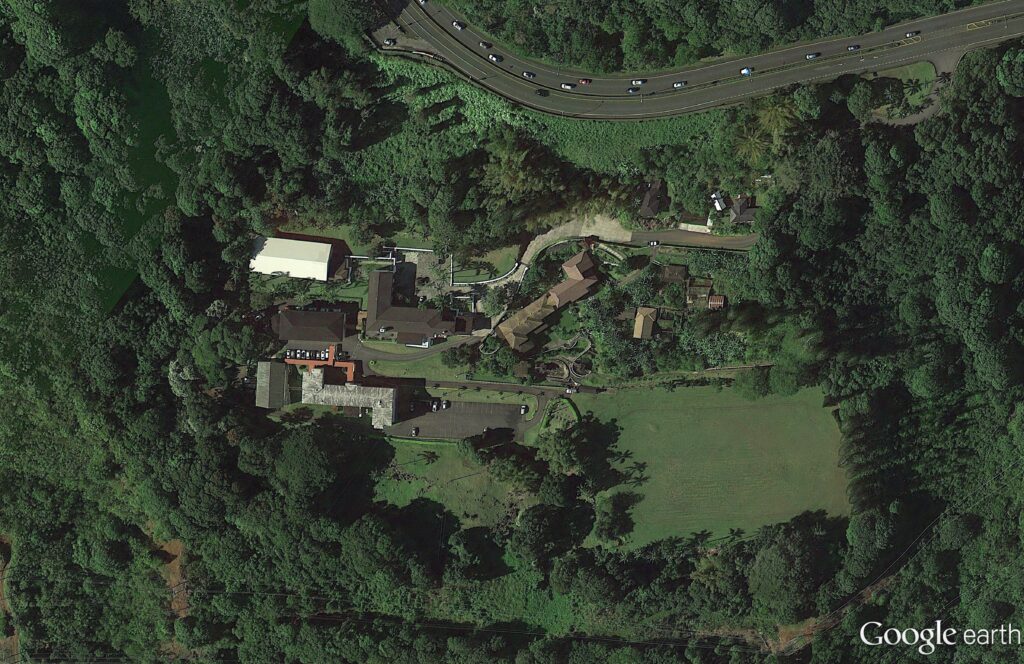
In 1927, Harold and his wife Alice Hedemann Castle built a home for themselves that overlooked much of their land holdings.  It was just below the hairpin turn, below the Pali.

They called the home Palikū (Lit., vertical cliff.)

Architect Bertram Grosvenor Goodhue designed it (Goodhue’s other work included Los Angeles Central Public Library, the Nebraska State Capitol and Saint Thomas Church, New York City;) there were 27 rooms with ornamental ironwork, redwood beams, plumbing and electricity – one of the first buildings on the windward side of the island to have those amenities. (Brennan, Honolulu Advertiser)

In 1946, the Castles sold the 22-acre Palikū to the Catholic Church for the Saint Stephen Seminary (the seminary closed in 1970; it’s now the St. Stephen’s Diocesan Center (the driveway is makai, just below the scenic lookout at the hairpin turn.))

St. Stephen’s Seminary was shut down for a time after a mysterious occurrence in October 1946.

Some suggest the seminary was haunted; when one night there were methodical clicking and tapping sounds; invisible pressure on a person in bed; dishes, pots and pans strewn all over – they suggest it was “diabolical obsession.”  Later, “I understand there was some kind of a blessing done,” said Bishop Joseph Ferrario, the retired bishop of Honolulu. (honoluluadvertiser)

After the seminary’s ultimate closure, the facility was transformed into a diocesan center housing various offices of the diocesan curia (a diocesan center (chancery) is the branch of administration which handles all written documents used in the official government of a Roman Catholic diocese.)

The former Castle home also serves as the residence of the Bishop of Honolulu, Clarence Richard Silva, popularly known as Larry Silva (born August 6, 1949), bishop of the Roman Catholic Church. He is the fifth Bishop of Honolulu, appointed by Pope Benedict XVI on May 17, 2005.

In 1962, Castle founded the Harold KL Castle Foundation. On his death in 1967, he bequeathed a sizeable portion of his real estate assets to the Foundation.

Throughout his life, Castle donated land for churches of all different denominations because he felt that churches would bring congregations, congregations would bring stability, and that would benefit the community that was growing around them.

Mr. Castle also donated land and money to Hawaii Loa College, Castle Hospital, ʻIolani School, Castle High School, Kainalu Elementary School and the Mōkapu peninsula land, which would become the Kāneʻohe Marine Corps Base.

His foundation has annually provided millions of dollars in support to worthy causes, a good chunk of it going to the windward side of Oʻahu.

© 2022 Hoʻokuleana LLC

Filed Under: Buildings, Prominent People, Economy Tagged With: Koolaupoko, Kaneohe Ranch, Windward, Mokapu, Paliku, Hawaii, Castle and Cooke, Oahu, Kaneohe, Kailua, Kainalu, Harold Castle

October 6, 2021 by Peter T Young Leave a Comment

Big Five (plus 2)

“By 1941, every time a native Hawaiian switched on his lights, turned on the gas or rode on a street car, he paid a tiny tribute into Big Five coffers.” (Alexander MacDonald, 1944)

The story of Hawaii’s largest companies dominates Hawaiʻi’s economic history. Since the early/mid-1800s, until relatively recently, five major companies emerged and dominated the Island’s economic framework. Their common trait: they were focused on agriculture – sugar.

They became known as the Big Five:

C. Brewer & Co.
Founded: October 1826; Capt. James Hunnewell (American Sea Captain, Merchant; Charles Brewer was American Merchant)
Incorporated: February 7, 1883

Theo H. Davies & Co.
Founded: 1845; James and John Starkey, and Robert C. Janion (English Merchants; Theophilus Harris Davies was Welch Merchant)
Incorporated: January 1894

Amfac
Founded: 1849; Heinrich Hackfeld and Johann Carl Pflueger (German Merchants)
Incorporated: 1897 (H Hackfeld & Co;) American Factors Ltd, 1918

Castle & Cooke
Founded: 1851; Samuel Northrup Castle and Amos Starr Cooke (American Mission Secular Agents)
Incorporated: 1894

Alexander & Baldwin
Founded: 1870; Samuel Thomas Alexander & Henry Perrine Baldwin (American, Sons of Missionaries)
Incorporated: 1900

Some suggest they were started and run by the missionaries. Actually, only Castle & Cooke had direct ties to the mission – Castle ran the ‘depository’ and Cooke was a teacher.

Alexander & Baldwin were sons of missionaries, but not a formal part of the mission. Brewer was an American sea captain and merchant; the founders of Davies were English merchants and the founders of Amfac were German merchants.

Hawaiʻi’s industrial plantations began to emerge at this time (1860s;) they were further fueled by the Treaty of Reciprocity – 1875 between the United States and the Kingdom of Hawai‘i eliminated the major trade barrier to Hawai‘i’s closest and major market. Through the treaty, the US obtained Pearl Harbor and Hawai‘i’s sugar planters received duty-free entry into U.S. markets for their sugar.

As the sugar industry pushed ahead, something else new was introduced into the economic scheme of things. In Honolulu two or three new firms began business solely to handle the affairs of the scattered plantations.

They began by acting as selling agents for the planters. Gradually they took over other functions: financing crops, importing labor, purchasing machinery for the planters and serving in all ways as their business agents. The new businesses soon found themselves running the sugar industry.

By the 1880s, five of these concerns, called factors, eventually dominated the field. How effectively the Big Five could band together as one against outside forces whether the enemy was foreign capital, insects, labor, competing products or disease was well demonstrated by their Hawaiian Sugar Planters Association, more familiarly known as the HSPA. (MacDonald)

This group organization for Hawaii’s sugar industry was founded in 1882 as the Planters’ Labor and Supply Company when the planters found they had common problems in irrigating the sugar lands, growing the cane, and finding labor. That was its immediate official purpose.

“Everything that comes into the territory comes through a large corporation. The independent businessman who attempts to enter business here immediately finds that even nationally advertised lines from the mainland are tied up by the Big Five. It is almost impossible to get an independent line of business as they have everything – lumber paint, right down the line.” (Edward Walker, High Sheriff of Hawaiʻi, 1937; Kent)

Acting as agents for thirty-six of the thirty-eight sugar plantations, the Big Five openly monopolized the sugar trade. Twenty-nine firms, producing seven out of every eight tons of sugar exported from the Islands, refined, markets and distributed through the Big Five’s wholly owned California and Hawaiian Sugar Company, whose refinery, the largest in the world, was on San Francisco Bay. (Kent)

They branched out into other businesses. To squeeze additional profits out of the sugar trade, they started their own refinery in California; it was to become the largest in the world. They built up a fleet of ships, the Matson line, to carry the sugar away and to bring back goods and passengers.

They developed inter-island shipping, built hotels, put capital into insurance, cattle, pineapples, banking. They took over bodily the wholesaling of goods coming into the Islands; ninety percent of retail stock came from their warehouses.

Their capital started the public utilities. Their street railway transported Hawaiians, their gas and electric plants lighted the city, they acquired the communications systems. (MacDonald)

The sugar industry was the prime force in transforming Hawaiʻi from a traditional, insular, agrarian and debt‐ridden society into a multicultural, cosmopolitan and prosperous one. (Carol Wilcox)

With statehood in 1959 and the almost simultaneous introduction of passenger jet airplanes, the tourist industry began to grow rapidly.

The industry came to maturity by the turn of the century; the industry peaked in the 1930s. Hawaiʻi’s sugar plantations employed more than 50,000 workers and produced more than 1-million tons of sugar a year; over 254,500-acres were planted in sugar. (That plummeted to 492,000-tons in 1995.)

A majority of the plantations closed in the 1990s. As sugar declined, tourism took its place – and far surpassed it. Like many other societies, Hawaii underwent a profound transformation from an agrarian to a service economy.

There were a couple other associated entities that were associated with the Big 5” Dillingham (Benjamin Franklin Dillingham) and Campbell (James Campbell) and their associated companies.

Click HERE to view/download for more information on Hawai‘i’s Big 5 (plus 2).

© 2021 Hoʻokuleana LLC

Downtown_Honolulu-Building_ownersh
Alexander & Baldwin-logo
Alexander & Baldwin Building-PP-7-4-006-00001
Amfac-logo
Amfac-logo
American Factors (formerly H.Hackfield)-PP-7-5-019-00001
C Brewer-logo
C Brewer-logo
Brewer Building-Burlingame-SB
Castle & Cooke-logo
Castle & Cooke-logo
Castle_&_Cooke-PP-8-1-008-00001
Theo Davies-logo
Theo Davies-logo
Theo. H. Davies Co., Bishop St-PP-8-3-010-00001
James_Campbell_Building-(Williams, Adamson)-1967
Dillingham Transportation Building-PP-8-4-003-00001

Filed Under: Prominent People, Economy Tagged With: Dillingham, Castle and Cooke, Hawaii, James Campbell, Big 5, Alexander and Baldwin, Theo H Davies, C Brewer, Amfac, American Factors

January 30, 2020 by Peter T Young 1 Comment

Molokai Ranch

One-and-a-half-million years ago, two large volcanoes emerged and created the island of Molokai, Kamakou in the east and Maunaloa in the west. Somewhat later, a third and much smaller caldera, Kauhako, rose to form the Makanalua peninsula on the north side.

Over eons, the north side of the island eroded and fell into the sea, leaving behind the vertical sea cliffs which today make up most of Molokai’s impressive North Shore.

It’s the fifth largest island in the Hawaiian archipelago; 260 square miles in area, 38 miles long and ten miles wide at its widest point.

Situated in the center of the 8 major Hawaiian Islands, Molokai is 25-miles southeast of Oʻahu, and a 25-minute flight from Maui. From the eastern end of the island, it’s only 8-miles across the Pailolo Channel to Maui.

The oldest known settlement on Molokai occurred in Hālawa Valley, at the eastern end of the island. This side of the island was heavily populated in pre-contact Hawaii, a result of ample water from the mountains, fertile and level land for farming, and a rich and abundant ocean.

In November, 1778, Captain James Cook sighted Molokai on his first visit to the Sandwich Islands (as he named these islands,) but it wasn’t until 1786 when Captain George Dixon anchored off Molokai’s coast, that Europeans first visited this island.

Lot Kapuāiwa, who later became King Kamehameha V, gained the title to land on the western side of the island. He had a summer house and began raising cattle. Title later passed to Princess Ruth Keʻelikōlani and then to Princess Bernice Pauahi Bishop and then (with additional land purchased by Charles R. Bishop) became part of the Bishop Estate.

In 1897, a group of Honolulu businessmen (including Judge Alfred S Hartwell, Alfred W Carter, and AD McClellan) purchased 70,000 acres from the trustees of the Bishop Estate and leased another 30,000 acres from the Hawaiian government. Molokai Ranch was formed. At that time, American Sugar Company began sugar cane production on the lands.

About 10 years later, the land was bought out by Charles M Cooke and under his son, George P Cooke, they raised cattle, planted sweet potato and wheat crops and produced honey. It became the second largest cattle ranch in Hawaiʻi and a major producer of beef.

In the early days, the focus was on raising beef cattle for market, plus horses and mules for use and for sale elsewhere. Over time, other ventures were tried, with varying degrees of success. Some of these included raising sheep for market, honey production, a small dairy, and various grains and row crops.

Between 1923 and 1985, several thousand acres were leased to Libby and Del Monte for pineapple cultivation. During those years, pineapple was an economic mainstay for Molokai.

The Cooke family owned Molokai Ranch for almost 80 years until the late-1980s. It was operated as a family corporation separate, from Castle and Cooke.

More recently, activities related to the visitor industry were tried. However, in May 2008, the Ranch reduced its operations on the island. Today, Molokai Ranch encompasses about 53,000-acres which is roughly one-third of the island.

Follow Peter T Young on Facebook 

Follow Peter T Young on Google+ 

Follow Peter T Young on LinkedIn  

Follow Peter T Young on Blogger

© 2020 Hoʻokuleana LLC

  • OLYMPUS DIGITAL CAMERA
  • IDL TIFF file

Filed Under: Economy, Place Names Tagged With: Libby, Lot Kapuaiwa, Kamehameha V, Molokai Ranch, Castle and Cooke, Hawaii, Del Monte, Molokai

  • 1
  • 2
  • Next Page »

Images of Old Hawaiʻi

People, places, and events in Hawaiʻi’s past come alive through text and media in “Images of Old Hawaiʻi.” These posts are informal historic summaries presented for personal, non-commercial, and educational purposes.

Info@Hookuleana.com

Connect with Us

  • Email
  • Facebook
  • LinkedIn
  • Twitter
  • YouTube

Recent Posts

  • Kauikeōlani
  • About 250 Years Ago … Articles of Confederation and Perpetual Union
  • Kukona
  • Hāmākua Ditch
  • Ka Waʻa O Maui
  • Everybody Has It – Everybody Needs It
  • Laʻanui and Namahana

Categories

  • Hawaiian Traditions
  • Military
  • Place Names
  • Prominent People
  • Schools
  • Sailing, Shipping & Shipwrecks
  • Economy
  • Voyage of the Thaddeus
  • Mayflower Summaries
  • American Revolution
  • General
  • Ali'i / Chiefs / Governance
  • Buildings
  • Missionaries / Churches / Religious Buildings

Tags

Albatross Al Capone Ane Keohokalole Archibald Campbell Bernice Pauahi Bishop Charles Reed Bishop Downtown Honolulu Eruption Founder's Day George Patton Great Wall of Kuakini Green Sea Turtle Hawaii Hawaii Island Hermes Hilo Holoikauaua Honolulu Isaac Davis James Robinson Kamae Kamaeokalani Kameeiamoku Kamehameha Schools Lalani Village Lava Flow Lelia Byrd Liberty Ship Liliuokalani Mao Math Mauna Loa Midway Monk Seal Northwestern Hawaiian Islands Oahu Papahanaumokuakea Marine National Monument Pearl Pualani Mossman Quartette Thomas Jaggar Volcano Waikiki Wake Wisdom

Hoʻokuleana LLC

Hoʻokuleana LLC is a Planning and Consulting firm assisting property owners with Land Use Planning efforts, including Environmental Review, Entitlement Process, Permitting, Community Outreach, etc. We are uniquely positioned to assist you in a variety of needs.

Info@Hookuleana.com

Copyright © 2012-2024 Peter T Young, Hoʻokuleana LLC


Loading Comments...