Images of Old Hawaiʻi

  • Home
  • About
  • Categories
    • Ali’i / Chiefs / Governance
    • American Protestant Mission
    • Buildings
    • Collections
    • Economy
    • Missionaries / Churches / Religious Buildings
    • General
    • Hawaiian Traditions
    • Other Summaries
    • Mayflower Summaries
    • Mayflower Full Summaries
    • Military
    • Place Names
    • Prominent People
    • Schools
    • Sailing, Shipping & Shipwrecks
    • Voyage of the Thaddeus
  • Collections
  • Contact
  • Follow

October 21, 2021 by Peter T Young 1 Comment

House Without a Key

“The koa-wood key has reached me and it is a lovely thing – but that was to be expected, since it came from Hawaii.”

“I am proud of the friends I have made in the Islands and prouder of this key than of anything that has happened to me in 20 years of writing.  I was eager to draw a true picture of Hawaii, but was not entirely confident of success. “

“I was only a malihini, a stranger, and what would the thousands who had known and loved the islands for many years think of the story?  That I did not entirely fail, this gift is proof, and that is only one of the reasons why I shall always prize it highly.”

“I should add at once that my long delay in writing you was due to the fact that the key was only just reached me, having traveled to New York, and thence back to the coast.”

“Most people who have been to Hawaii long to return, and in the future I shall long a bit more ardently than most. I hope before many months I shall be able to do so.”

“In the meantime I want all those who had anything to do with the key to know that their thought of me has touched my heart.  Please than them all for me.”

“Their unexpected, graceful gift is characteristic of Hawaii, and just another proof that he who has friends in the islands is rich indeed.”  (Star-Bulletin, June 19, 1925)

The thank you letter above was written by Earl Derr Biggers and sent to the Hawaii Tourist Bureau in 1925.

On January 24, 1925, ‘The Saturday Evening Post’ began its serialization of the book that would make Earl Derr Biggers famous: The House Without a Key, the first of the Charlie Chan series.

The principal character in the story was Charlie Chan, the celebrated Chinese detective.  Chan was modeled after Chang Apana.  In 1897, Helen Kīna‘u Wilder was given the authority to enforce animal cruelty laws.  She was appointed a special constable by the Marshall of the Republic of Hawai‘i.

She and her friends pooled their resources to pay a salary to hire Chang Apana, the first officer to investigate animal crimes, who inspired author Earl der Biggers’ popular Charlie Chan series of detective novels. (Hawaiian Humane Society)

Born Ah Ping Chang on December 26, 1871 in Waipiʻo, Oʻahu; he eventually became known as Chang Apana (the Hawaiianized version of the Chinese name Ah Ping.)  In 1898, Chang joined the Honolulu Police Department and the “shrewd and meticulous investigator” rose through the ranks to become detective in 1916.

Biggers was an early guest at the Halekūlani Hotel in Waikiki. Biggers’ book title was based on his discovery that no one locked their doors there.  In memory of the author and his novel, the Halekūlani named its seaside bar and lanai “House Without a Key.”

“’The House Without a Key’ is the story of a very rich man who has many enemies. He wants a certain locked chest in San Francisco cast into the sea – until it is beyond the reach of man he will know no peace.”

“He commissions his nephew to do the deed. But before the nephew reaches Honolulu the man is dead – murdered by an unknown assailant.”

“The secret of the chest. By mystery of the murder and the enmity that existed between the dead man and his brother furnish a lively plot”. (Stockton Independent, December 4, 1926)

The ”Decision to present the key to Biggers was made at a recent meeting of the tourist bureau, and arrangements for having it made were left to WH Hussman, Hawaii representative of the bureau.”

The key measures 25 inches in length and is six inches in width at both ends.  It was made at the Hilo Boarding School manual training shop. (Star Bulletin, April 6, 1925)

“The present of the Hawaii Tourist Bureau was for a time displayed in Benson, Smith & Co.’s window, where it attracted much interest.” (Star-Bulletin, April 15, 1925)

Bigger’s book and subsequent movies helped to put Hawaii and one of its iconic hotels on the map.

The key had an inscription, “Hawaii is still the ‘House without a Key’: you have it.  Use it often.”  True to his word, Biggers would soon return to the Islands.

Earl Derr Biggers was born in 1884 in Warren, Ohio. He graduated from Harvard University in 1907 with a Bachelor of Arts degree. After college, Biggers went to work at The Boston Traveler, where he wrote a humorous column, and then reviews, until 1911.

Biggers ultimately wrote six Charlie Chan mystery novels: The House Without A Key, The Chinese Parrot, Behind That Curtain, The Black Camel, Charlie Chan Carries On, and Keeper of the Keys.

The Charlie Chan movies were one of the most successful screen series in history, with over 40 movies based on the character. There were also numerous Chan radio adaptations and comic strips, as well as attempts to bring the character to television. Earl Biggers died in Pasadena, California, in April of 1933 at the age of 48, from a heart attack.

© 2021 Hoʻokuleana LLC

Filed Under: General, Place Names, Prominent People, Economy Tagged With: House Without a Key, Earl Biggers, Charlie Chan

October 6, 2021 by Peter T Young Leave a Comment

Big Five (plus 2)

“By 1941, every time a native Hawaiian switched on his lights, turned on the gas or rode on a street car, he paid a tiny tribute into Big Five coffers.” (Alexander MacDonald, 1944)

The story of Hawaii’s largest companies dominates Hawaiʻi’s economic history. Since the early/mid-1800s, until relatively recently, five major companies emerged and dominated the Island’s economic framework. Their common trait: they were focused on agriculture – sugar.

They became known as the Big Five:

C. Brewer & Co.
Founded: October 1826; Capt. James Hunnewell (American Sea Captain, Merchant; Charles Brewer was American Merchant)
Incorporated: February 7, 1883

Theo H. Davies & Co.
Founded: 1845; James and John Starkey, and Robert C. Janion (English Merchants; Theophilus Harris Davies was Welch Merchant)
Incorporated: January 1894

Amfac
Founded: 1849; Heinrich Hackfeld and Johann Carl Pflueger (German Merchants)
Incorporated: 1897 (H Hackfeld & Co;) American Factors Ltd, 1918

Castle & Cooke
Founded: 1851; Samuel Northrup Castle and Amos Starr Cooke (American Mission Secular Agents)
Incorporated: 1894

Alexander & Baldwin
Founded: 1870; Samuel Thomas Alexander & Henry Perrine Baldwin (American, Sons of Missionaries)
Incorporated: 1900

Some suggest they were started and run by the missionaries. Actually, only Castle & Cooke had direct ties to the mission – Castle ran the ‘depository’ and Cooke was a teacher.

Alexander & Baldwin were sons of missionaries, but not a formal part of the mission. Brewer was an American sea captain and merchant; the founders of Davies were English merchants and the founders of Amfac were German merchants.

Hawaiʻi’s industrial plantations began to emerge at this time (1860s;) they were further fueled by the Treaty of Reciprocity – 1875 between the United States and the Kingdom of Hawai‘i eliminated the major trade barrier to Hawai‘i’s closest and major market. Through the treaty, the US obtained Pearl Harbor and Hawai‘i’s sugar planters received duty-free entry into U.S. markets for their sugar.

As the sugar industry pushed ahead, something else new was introduced into the economic scheme of things. In Honolulu two or three new firms began business solely to handle the affairs of the scattered plantations.

They began by acting as selling agents for the planters. Gradually they took over other functions: financing crops, importing labor, purchasing machinery for the planters and serving in all ways as their business agents. The new businesses soon found themselves running the sugar industry.

By the 1880s, five of these concerns, called factors, eventually dominated the field. How effectively the Big Five could band together as one against outside forces whether the enemy was foreign capital, insects, labor, competing products or disease was well demonstrated by their Hawaiian Sugar Planters Association, more familiarly known as the HSPA. (MacDonald)

This group organization for Hawaii’s sugar industry was founded in 1882 as the Planters’ Labor and Supply Company when the planters found they had common problems in irrigating the sugar lands, growing the cane, and finding labor. That was its immediate official purpose.

“Everything that comes into the territory comes through a large corporation. The independent businessman who attempts to enter business here immediately finds that even nationally advertised lines from the mainland are tied up by the Big Five. It is almost impossible to get an independent line of business as they have everything – lumber paint, right down the line.” (Edward Walker, High Sheriff of Hawaiʻi, 1937; Kent)

Acting as agents for thirty-six of the thirty-eight sugar plantations, the Big Five openly monopolized the sugar trade. Twenty-nine firms, producing seven out of every eight tons of sugar exported from the Islands, refined, markets and distributed through the Big Five’s wholly owned California and Hawaiian Sugar Company, whose refinery, the largest in the world, was on San Francisco Bay. (Kent)

They branched out into other businesses. To squeeze additional profits out of the sugar trade, they started their own refinery in California; it was to become the largest in the world. They built up a fleet of ships, the Matson line, to carry the sugar away and to bring back goods and passengers.

They developed inter-island shipping, built hotels, put capital into insurance, cattle, pineapples, banking. They took over bodily the wholesaling of goods coming into the Islands; ninety percent of retail stock came from their warehouses.

Their capital started the public utilities. Their street railway transported Hawaiians, their gas and electric plants lighted the city, they acquired the communications systems. (MacDonald)

The sugar industry was the prime force in transforming Hawaiʻi from a traditional, insular, agrarian and debt‐ridden society into a multicultural, cosmopolitan and prosperous one. (Carol Wilcox)

With statehood in 1959 and the almost simultaneous introduction of passenger jet airplanes, the tourist industry began to grow rapidly.

The industry came to maturity by the turn of the century; the industry peaked in the 1930s. Hawaiʻi’s sugar plantations employed more than 50,000 workers and produced more than 1-million tons of sugar a year; over 254,500-acres were planted in sugar. (That plummeted to 492,000-tons in 1995.)

A majority of the plantations closed in the 1990s. As sugar declined, tourism took its place – and far surpassed it. Like many other societies, Hawaii underwent a profound transformation from an agrarian to a service economy.

There were a couple other associated entities that were associated with the Big 5” Dillingham (Benjamin Franklin Dillingham) and Campbell (James Campbell) and their associated companies.

Click HERE to view/download for more information on Hawai‘i’s Big 5 (plus 2).

© 2021 Hoʻokuleana LLC

Downtown_Honolulu-Building_ownersh
Alexander & Baldwin-logo
Alexander & Baldwin Building-PP-7-4-006-00001
Amfac-logo
Amfac-logo
American Factors (formerly H.Hackfield)-PP-7-5-019-00001
C Brewer-logo
C Brewer-logo
Brewer Building-Burlingame-SB
Castle & Cooke-logo
Castle & Cooke-logo
Castle_&_Cooke-PP-8-1-008-00001
Theo Davies-logo
Theo Davies-logo
Theo. H. Davies Co., Bishop St-PP-8-3-010-00001
James_Campbell_Building-(Williams, Adamson)-1967
Dillingham Transportation Building-PP-8-4-003-00001

Filed Under: Prominent People, Economy Tagged With: Castle and Cooke, Hawaii, James Campbell, Big 5, Alexander and Baldwin, Theo H Davies, C Brewer, Amfac, American Factors, Dillingham

October 5, 2021 by Peter T Young 2 Comments

Kalama Beach Park

“Hardware is one of the best businesses there is. I like that line, I was brought up in it. Axes and hammers don’t go out of style like so many other things.” This quotation was published in the Rocky Mountain News in April of 1934, when Charles Boettcher’s business enterprises had turned him into a national figure.

Charles was born into the hardware business; his parents, Frederick and Susanna Boettcher, ran a hardware store in Kolleda, Germany. When Charles finished Gymnasium (secondary school) his parents sent him to America to visit his older brother Herman, who was working in a hardware store in Cheyenne, Wyoming.

Once in America, Charles admired the western landscapes and was soon working alongside Herman at Hoyer & Company Hardware. As a fringe benefit, he was allowed to sleep under the store counter. Charles figured out early that he was better off saving his money than spending it foolishly in the town saloons.

Charles as his partner, and in the summer of 1871 the brothers acquired another new store, this time in Evans, Colorado, just four miles from Greeley. Less than a year later, Charles moved to the new agricultural colony, Fort Collins. In Fort Collins, Charles met and married Fannie Augusta Cowan.

During their first year of marriage the couple moved south, to Boulder, where Charles opened the first hardware store in his own name. The Boulder store was so prosperous that Charles was able to build a large new building at 12th and Pearl, in the young town’s central commercial district (it’s still there).

By the end of the 1880s Charles Boettcher owned multiple hardware businesses and had his hand in mining, electricity, ranching, and banking.

In 1892, two years after the Boettchers moved to Denver, Henry C. Brown, along with two partners, Maxcy Tabor and William Bush, turned a triangular cow pasture at Seventeenth and Champa into the finest hotel in the West, the Brown Palace.  Unfortunately for the partners, only a year after construction was complete the Silver Panic of 1893 hit.

In 1922, Horace Bennett and his associates, including Charles Boettcher, purchased the still-struggling hotel. After the crash of 1929, Bennett was forced to liquidate his interest, and Charles and Claude Boettcher became the hotel’s sole proprietors.

In the 1890s his interests would grow to include a meat packing company, a railroad, and Capitol Life Insurance. He started Colorado’s first sugar beet factory and formed Great Western Sugar.

The second generation of Colorado pioneers came of age in the 1890s. Claude graduated from Harvard and returned to

Denver and dedicated himself to expanding his father’s enterprises.

In 1908, Denver witnessed the completion of its first reinforced concrete building at the corner of Seventeenth and Champa, built by Charles Boettcher to promote the use of cement.

After two decades of progress Ideal Cement had plants all over the West and the cement industry had led Charles and his son Claude into a variety of other industries, most importantly, potash. After Charles’ death, Ideal merged with Potash of America and became Ideal Basic Industries.

As Claude’s only child, Charles Boettcher II grew up with all the advantages wealth brings. After completing his education, Charles too returned to Denver and began participating in the management of the family’s empire.

Charles II became a partner in Boettcher & Company in the 1920s, was involved in the Ideal Cement Company, and eventually inherited most of the offices formerly held by his father and grandfather at many Boettcher enterprises.

Then, one evening in 1933 (occurring the year after the Lindbergh kidnapping), Charles II and his wife, Anna Lou Boettcher, returned home from a dinner party and were accosted in their garage.

Charles II was held at gunpoint while another man passed a ransom note to Mrs. Boettcher. The kidnappers then sped away with

Charles II.  Charles II was held for two weeks while Claude tried to make contact with the kidnappers. After Claude paid the $60,000 ransom, Charles was released.  (Boettcher Foundation)

Needless to say, it was unsettling for everyone in the family. Apparently Charles and his wife, Mae, then started looking for a place that was far away from and far different than their surroundings in Denver.

So in 1935 they found the property in Hawaii – 4 acres of prime land on Kailua Beach. It was to be their get-away-from-it-all vacation home. (Cheever)

Charles II commissioned Vladimir Ossipoff to build him a house; it was designed by Ossipoff and built by contractor M. Kiuchi.  (HHF)

Ossipoff came to Hawaii in late 1932. The Russian-born architect was educated at the University of California at Berkeley and had worked in San Francisco prior to moving to Hawaii.

Ossipoff started his architectural career in the islands as the head of the Home Building Department of Theo H. Davies. He also worked in architect C.W. Dickey’s office prior to starting his own practice in 1936.

Ossipoff’s work is characterized by its mixture of Hawaiian influenced design and more modern trends, such as the ranch style of house for domestic commissions. (National Register)

The one-story house has a distinctive steeply-pitched, cross-hip, “Hawaiian-style” roof, covered with shakes. The building’s U-shaped plan wraps around an in-set lanai supported by coral stone columns. The open side of the U faces the mountains, protecting the lanai from the prevailing onshore winds.

The home’s design combines many elements of indoor/outdoor living associated with the architecture of Hawaii during this period. The bath and dressing rooms open directly to the exterior, and the large lanai has a fireplace. (HHF)
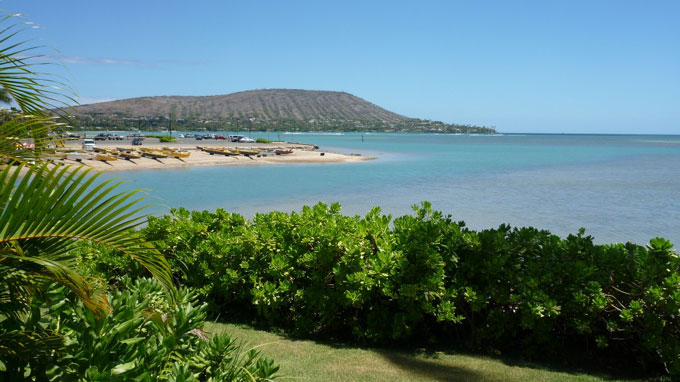
The Boettcher family lived in Colorado and came to Hawaii for their holidays. During World War II, the family opened their home to the US Navy to use as Officers’ Quarters for the Waves. (National Register)

In September 1978 the City and County of Honolulu acquired the property for use as a park. It is now the central structure in the Kalama Beach Park.

© 2021 Hoʻokuleana LLC

Filed Under: Buildings, Place Names, Prominent People

October 2, 2021 by Peter T Young 4 Comments

Courageous Dissent

Hiram (Harry) Bingham IV grew up in a Connecticut family whose members were well known for being missionaries (Hiram I & II) and explorers (Hiram III.)
He was a US diplomat stationed in Marseilles, France during World War II when Germany was invading France.
At great personal risk and against State Department orders, he (a Protestant Christian) used his government status to help over 2,500 Jewish people escape the Holocaust as they escaped Hitler’s occupied Europe from 1939-1941.
He organized clandestine rescue efforts and escapes, harbored many refugees at his diplomatic residence and issued “visas for life” and affidavits of eligibility for passage.
Hiram IV helped some of the most notable intellectuals and artists to escape, including Marc Chagall, (artist;) Leon Feuchtwanger, (author;) Golo Mann, (historian, son of Thomas Mann;) Hannah Arendt, (philosopher;) Max Ernst, (artist and poet;) and Dr. and Mrs. Otto Meyerhof, (Nobel Prize winning physicist.)
When the State Department learned of his actions, he was transferred to Lisbon, Portugal and later to Argentina.
In the eyes of the State Department, he was an insubordinate member of the US diplomatic service, a dangerous maverick who was eventually demoted.
He was not following established State Department policy – ultimately, he had to resign from the Foreign Service.
Bingham refrained from speaking about his service; his family had limited information about what he had done during the war.
Little was known of his extraordinary activities until after his death; then, family members found thousands of letters and official documents attesting to his quiet heroism.
His son, Robert “Kim” Bingham, wrote a book about him titled, “Courageous Dissent: How Harry Bingham Defied his Government to Save Lives”.
In 1998, Hiram IV was recognized as one of eleven diplomats who saved 200,000-lives from the Holocaust, which amounts to one-million descendents of survivors today.
He is the only US Diplomat who has been officially honored by the State of Israel as a “righteous diplomat.”
He was the only American diplomat recognized during Israel’s 50th Anniversary at the Holocaust Museum in Jerusalem.
Sixty years after leaving the Foreign Service (in 2002,) the State Department posthumously recognized Bingham with the department’s American Foreign Service Association “Constructive Dissent” award.
In 2005, Bingham was posthumously given a letter of commendation from Israel’s Holocaust Museum.  In 2006, a US commemorative postage stamp was issued in his honor.
More than 450 supporters of the Simon Wiesenthal Center gathered for the 2011 Humanitarian Award Dinner. There, the Medal of Valor was awarded posthumously to Sir Winston Churchill, Hiram Bingham IV and Pope John Paul II.
Hiram I is my great-great-great-grandfather, Hiram Bingham IV is a cousin. We did not know this story until a couple years ago.  Kim came to visit in Hawaiʻi and we had the opportunity to sit down with him and learn more about his father (Hiram IV, Harry.)
© 2021 Hoʻokuleana LLC

Hiram Bingham IV-ID card
Hiram Bingham IV circa 1980
Hiram Bingham IV-Medal of Valor
Hiram Bingham IV-MedalOfValor_Citation
Hiram_Bingham_IV

Filed Under: Prominent People Tagged With: Hiram Bingham IV, Hiram Bingham, Harry Bingham, Holocaust

September 30, 2021 by Peter T Young 5 Comments

Brothers Continue The Legacy

For much of the 1800s, sailing ships calling at Honolulu Harbor were serviced using double-hulled canoes or rowboats.
In 1900, three brothers, Jack, Herbert and William, formed Young Brothers and started doing small jobs around the Harbor.
Early in the century, there was only a narrow opening in the reef, so sailing ships anchored outside where they had room to maneuver. They then came ashore in their own boats or used launch services from the harbor.
Jack Young once reminisced about arriving in Honolulu in 1900 with a few cans of fruit, a large trunk and only twenty-five cents in cash – too little to pay to have his trunk brought ashore. So he rustled up a spare rowboat and rowed in his own gear.
In those days, there might be from five to twenty sailing ships off Sand Island. When a ship came in, the anchor line had to be run out to secure the ship; if the ship was coming to the dock, a line had to be carried to the pier.
In the early years of the company, Young Brothers used its first boat, Billy, to service the ships by carrying supplies and sailors to ships at anchor outside the harbor, as well as run lines for anchoring or docking vessels.
They also pulled boats off the reefs, conducted salvage operations and various other harbor-related activities (including harbor tours.)
The company grew over the years into an active interisland freight company.
When original brother Jack’s two sons became old enough, they joined the operation.
Jack Young Jr., joined the company as a regular employee in 1933. He soon captained various boats; in 1936 he became the permanent master of the Mamo (which in 1930 was the first all-steel tugboat in maritime history.)
Jack’s younger brother, Kenny Young, joined Young Brothers in 1946, after a stint in the Navy and graduation from Stanford.
He immediately became superintendent of Young Brothers’ freight department, a position he held until 1952. That same year, Young Brothers merged with Oahu Railway and Land Company (OR&L.)
Jack Jr. resigned from Young Brothers in 1952 (having disagreed with the merger and its resulting changes in management policies.)
However, Jack Jr. continued to broaden his maritime skills, earning a Master Maritime license and becoming a Harbor Pilot for the Territory of Hawai‘i, then Harbor Master for the State. (Jack Jr. passed away in 1994.)
Kenny remained with the company after the merger and served as manager of the land department of OR&L (1952-1961.)
When OR&L merged with Dillingham Corporation, he was manager and vice president at Dillingham until 1968.
He then moved to Kona and started his own real estate company. (Kenny passed away in 2004.)
Jack Young of the original Young Brothers is my grandfather; Jack Young Jr, my uncle; and Kenny Young, my father.
The Young family legacy at Young Brothers continued; for a while, my older brother, David Young, served as a Hawai‘i County Community Advisory Board Member for the Young Brothers Community Gift Giving program.
I am the youngest brother of the youngest brother of the youngest brother of Young Brothers.
© 2021 Hoʻokuleana LLC

Jack Edgar and Will Young 1903
Young_Brothers-first_boat-Billy
Young-Brothers-Captain_Jack_Young_(grandfather)_on_Makaala
Kenny Young
Kenny Young
Da_Braddahs
Young_Brothers-Fleet-1915
Young_Brothers_Boathouse-center_structure_with_open_house_for_boats_on_its_left-1910
Young Brothers Launch 'Sea Scout' in Honolulu Harbor-Lucas_Tower_in_background-PPWD-9-3-030-1905-400
Young Brothers Launch ‘Sea Scout’ in Honolulu Harbor-Lucas_Tower_in_background-PPWD-9-3-030-1905-400
Young_Brothers_Boathouse-1902
Young Brothers shark hunt
Kapena Jack Young Drawing
IMG_2905
IMG_7931

Filed Under: Prominent People, Economy, Sailing, Shipping & Shipwrecks Tagged With: Honolulu Harbor, Oahu Railway and Land Company, Dillingham, Kenny Young, Images of Old Hawaii, Captain Jack, Hawaii, Jack Young, Young Brothers

  • « Previous Page
  • 1
  • …
  • 92
  • 93
  • 94
  • 95
  • 96
  • …
  • 175
  • Next Page »

Images of Old Hawaiʻi

People, places, and events in Hawaiʻi’s past come alive through text and media in “Images of Old Hawaiʻi.” These posts are informal historic summaries presented for personal, non-commercial, and educational purposes.

Info@Hookuleana.com

Connect with Us

  • Email
  • Facebook
  • LinkedIn
  • Twitter
  • YouTube

Recent Posts

  • Missionary, Educator … Former Slave
  • Historic Downtown Hilo Walking Tour
  • Memorial Park
  • About 250 Years Ago … King Declares Colonies in Open Rebellion
  • Sybil’s Rocking Chair
  • Overthrow
  • Foodland

Categories

  • Economy
  • Voyage of the Thaddeus
  • Mayflower Summaries
  • American Revolution
  • General
  • Ali'i / Chiefs / Governance
  • Buildings
  • Missionaries / Churches / Religious Buildings
  • Hawaiian Traditions
  • Military
  • Place Names
  • Prominent People
  • Schools
  • Sailing, Shipping & Shipwrecks

Tags

Albatross Al Capone Ane Keohokalole Archibald Campbell Bernice Pauahi Bishop Charles Reed Bishop Downtown Honolulu Eruption Founder's Day George Patton Great Wall of Kuakini Green Sea Turtle Hawaii Hawaii Island Hermes Hilo Holoikauaua Honolulu Isaac Davis James Robinson Kamae Kamaeokalani Kameeiamoku Kamehameha Schools Lalani Village Lava Flow Lelia Byrd Liberty Ship Liliuokalani Mao Math Mauna Loa Midway Monk Seal Northwestern Hawaiian Islands Oahu Papahanaumokuakea Marine National Monument Pearl Pualani Mossman Quartette Thomas Jaggar Volcano Waikiki Wake Wisdom

Hoʻokuleana LLC

Hoʻokuleana LLC is a Planning and Consulting firm assisting property owners with Land Use Planning efforts, including Environmental Review, Entitlement Process, Permitting, Community Outreach, etc. We are uniquely positioned to assist you in a variety of needs.

Info@Hookuleana.com

Copyright © 2012-2024 Peter T Young, Hoʻokuleana LLC

Loading Comments...