Images of Old Hawaiʻi

  • Home
  • About
  • Categories
    • Ali’i / Chiefs / Governance
    • American Protestant Mission
    • Buildings
    • Collections
    • Economy
    • Missionaries / Churches / Religious Buildings
    • General
    • Hawaiian Traditions
    • Other Summaries
    • Mayflower Summaries
    • Mayflower Full Summaries
    • Military
    • Place Names
    • Prominent People
    • Schools
    • Sailing, Shipping & Shipwrecks
    • Voyage of the Thaddeus
  • Collections
  • Contact
  • Follow

December 2, 2022 by Peter T Young Leave a Comment

“East Wind, Rain”

Takeo Yoshikawa, a Japanese spy, arrived in Honolulu on March 27, 1941, aboard the Japanese liner Nitta Maru.  His papers identified him as Tadashi Morimura, the name he was always referred to while in the Islands (and subsequent investigative records.)  (He’ll be referred to here by his real name, Yoshikawa.)

Born on March 7, 1914, Yoshikawa had been approached in 1936 to work as a civilian for Japan’s naval intelligence service: “Since I had been studying English, I was assigned to the sections dealing with the British and American navies. I became the Japanese navy’s expert on the American navy.”

“I read everything; diplomatic reports from our attachés, secret reports from our agents around the world. I read military commentators like Hanson Baldwin (New York Times military affairs editor.)” Yoshikawa also studied Jane’s Fighting Ships and memorized the silhouettes of all the American ships, something that would later prove critical.  (Savela)

Posing as junior diplomat, Yoshikawa was to keep current on the status of the US fleet and its anchorages, reporting his observations to Tokyo by coded telegraph messages.  Thanks to Hawaiʻi’s large Japanese-American population, Yoshikawa easily blended in.

When Kita briefed Yoshikawa, he reminded him, “Don’t make yourself conspicuous; maintain a normal, business-as-usual attitude, keep calm under all circumstances; avoid taking unnecessary risks; stay away from guarded and restricted areas and be aware of the FBI.” (Prange; Savela)

In keeping with his cover, Yoshikawa avoided illegally entering military bases or stealing classified documents. He shunned cameras and notepads, relying instead on memory. He supplemented his observations with items of interest gleaned from daily newspapers.

Yoshikawa familiarized himself with the principal Hawaiian Islands and their military installations, which were concentrated on Oʻahu. He frequently relied on a hired cab driven by John Mikami, a Japanese-Hawaiian who often performed chores for the consulate.  (Deac)

Other times, Yoshikawa was chauffeured by Richard Kotoshirodo, a consular clerk. It did not take long for Yoshikawa to scout out the various US Army and Navy bases on central, southern and eastern Oʻahu. Predictably, the focus of his attention was Pearl Harbor, the nearly landlocked US Pacific Fleet anchorage on the south coast of the island.

The assignment fit into a plan outlined in January 1941 by Combined Fleet Commander Isoroku Yamamoto. The plan called for an aerial assault on Hawaiʻi as the opening move of a war between the United States and Japan. Yoshikawa was to become his country’s only military spy in the islands and Yamamoto’s most valuable source of current information on Oʻahu.  (Deac)

And with its relatively open landscape, sloping elevations, and limited restrictions on movement, he readily compiled useful intelligence. His encyclopedic knowledge of US ships and his methodical charting of their movements made his reports all the more valuable.  His contribution to the Japanese effort was ultimately “an important one.”  (Savela)

Yoshikawa did not work alone.  Later joining him in espionage was a ‘sleeper agent’ Bernard Otto Julius Kuehn and his family, Nazi spies sent to the Islands by Nazi Propaganda Minister Joseph Goebbels.  (Washington Times)

The Kuehns arrived in Hawaiʻi in 1935, they blended in, and waited; no one seriously suspected that Caucasians would carry on espionage for the Empire of Japan, so Kuehn, his wife Friedel, their daughter and son, Hans Joachim, were virtually inconspicuous as a white family on the windward side.

However, every member of the family contributed towards collecting and documenting military activities at Pearl Harbor from 1935 right up to the day the bombs fell from Japanese aircraft.

On December 2, days before the attack, Kuehn provided specific – and highly accurate – details on the fleet in writing. That same day, he gave the consulate the set of signals that could be picked up by nearby Japanese submarines.  (FBI)

At midafternoon on December 6, Yoshikawa made his final reconnaissance of Pearl Harbor from the Pearl City pier.  Back at the consulate, he coordinated his report with Kita, and then saw that the encoded message was transmitted to Tokyo.

At 1:20 am on December 7, 1941, on the darkened bridge of the Japanese aircraft carrier Akagi, Vice Admiral Chui­chi Nagumo was handed the following message:

“Vessels moored in harbor: 9 battleships; 3 class B cruisers; 3 seaplane tenders, 17 destroyers. Entering harbor are 4 class B cruisers; 3 destroyers. All aircraft carriers and heavy cruisers have departed harbor…. No indication of any changes in US Fleet or anything unusual.”  (Savela)

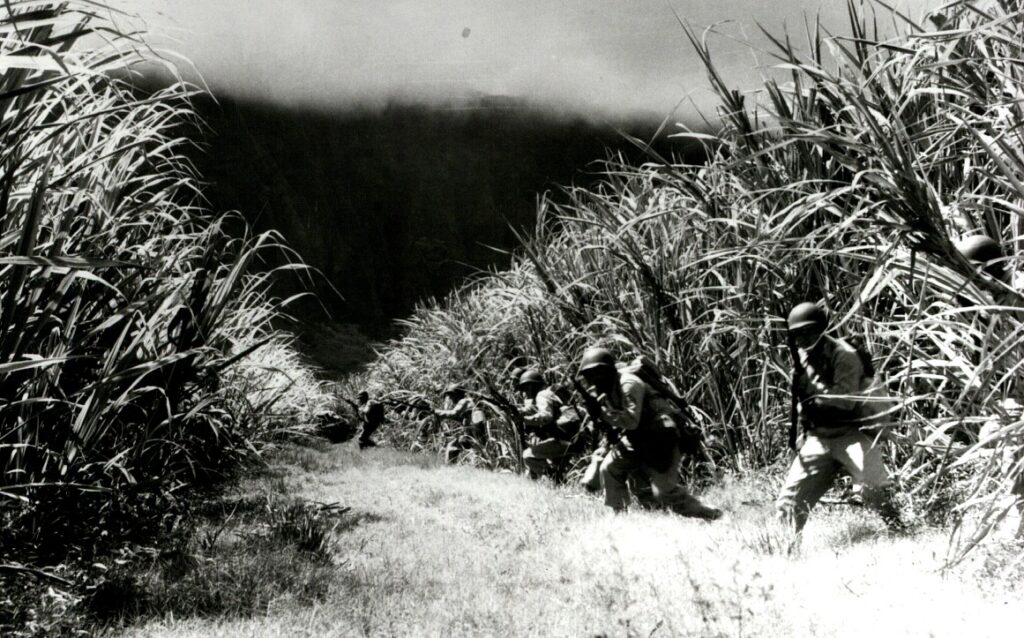
In the early morning of December 7, 1941, Japanese pilots flew toward the island of Oʻahu from six aircraft carriers (the Akagi, Kaga, Soryu, Hiryu, Shokaku and Zuikaku;) two waves of planes attacked various military installations on Oʻahu.

The prearranged coded signal “East wind, rain,” part of the weather forecast broadcast over Radio Tokyo, alerted Japanese Consul General Nagao Kita in Honolulu, and others, that the attack on Pearl Harbor had begun.

The first wave of 183-planes (43-fighters, 49-high-level bombers, 51-dive bombers and 40-torpedo planes) struck its targets at 7:55 am.  The second wave of 167-Japanese planes (35-fighters, 54-horizontal bombers and 78-dive bombers) struck Oʻahu beginning at 8:40 am.

The Japanese consulate staff locked the consulate doors and began burning all their codebooks and classified material. “Smoke was pouring out of the chimney.”   At about 9:30 am, December 7, the consulate staff was arrested and later shipped to Phoenix, Arizona.

By 9:45 am, the Japanese attack on Oʻahu was over.

© 2022 Hoʻokuleana LLC

Takeo Yoshikawa
Japanese Consulate Staff-Honolulu-(NationalArchives)
Japan's Spy in Hawaii-(Barclay)
Nitta-maru_1940
SPY, WIFE, HERO - TAKEO YOSHIKAWA, HIS WIFE, ETSUKO, AND HIS LIFETIME HERO, ADMIRAL TSOROKU YAMAMOTO, SUPREME COMMANDER AND PLANNER OF THE JAPANESE ATTACK FORCE THAT ATTACKED PEARL HARBOR. EXCLUSIVE PHOTO BY RON LAYTNER FOR EDIT INTERNATIONAL.
SPY, WIFE, HERO – TAKEO YOSHIKAWA, HIS WIFE, ETSUKO, AND HIS LIFETIME HERO, ADMIRAL TSOROKU YAMAMOTO, SUPREME COMMANDER AND PLANNER OF THE JAPANESE ATTACK FORCE THAT ATTACKED PEARL HARBOR. EXCLUSIVE PHOTO BY RON LAYTNER FOR EDIT INTERNATIONAL.
Takeo Yoshikawa-(Barclay)
SITTING ON HIS HORSE 'JONNY' THE LEGENDARY PEARL HARBOR SPY, TAKEO YOSHIKAWA, SAID "I WAS BORN IN THE DAYS OF THE GREAT JAPANESE EMPIRE WHEN THE YAMATO RACE WALKED TALL ACROSS ASIA AND BOYS WERE DESTINED FOR GREATNESS." EXCLUSIVE PHOTO COPYRIGHT BY RON LAYTNER, EDI INTERNATIONAL.
SITTING ON HIS HORSE ‘JONNY’ THE LEGENDARY PEARL HARBOR SPY, TAKEO YOSHIKAWA, SAID “I WAS BORN IN THE DAYS OF THE GREAT JAPANESE EMPIRE WHEN THE YAMATO RACE WALKED TALL ACROSS ASIA AND BOYS WERE DESTINED FOR GREATNESS.” EXCLUSIVE PHOTO COPYRIGHT BY RON LAYTNER, EDI INTERNATIONAL.
"IN MY YOUTH I WAS A SAMURAI. I BELIEVED IN WAR AND DEATH IN BATTLE. I SHAPED HISTORY. NOW I AM OLD AND BELIEVE IN PEACE AND LOVE." TAKO YOSHIKAWA, THE PEARL HARBOR SPY, INTERVIEWED BEFORE HIS DEATH IN 1984. WORLD EXCLUSIVE PHOTOGRAPH COPYRIGHT BY RON LAYTNER AND EDIT INTERNATIONAL.
“IN MY YOUTH I WAS A SAMURAI. I BELIEVED IN WAR AND DEATH IN BATTLE. I SHAPED HISTORY. NOW I AM OLD AND BELIEVE IN PEACE AND LOVE.” TAKO YOSHIKAWA, THE PEARL HARBOR SPY, INTERVIEWED BEFORE HIS DEATH IN 1984. WORLD EXCLUSIVE PHOTOGRAPH COPYRIGHT BY RON LAYTNER AND EDIT INTERNATIONAL.
WATCHING THE NEW JAPAN THROUGH HIS WINDOW, THE OLD SPY SAID: "I AM NOT SORRY ABOUT PEARL HARBOR - ONLY THAT JAPAN HAS NOT HONORED ME. ALL THOSE WHO DIED IN THE ATTACK - ALL THE AMERICANS AND THE FEW JAPANESE TOO - THEY DIED FOR THE GLORY OF HISTORY," SAID UNREPENTENT JAPANESE SUPER SPY TAKEO YOSHIKAWA, WHO WAS DIRECTLY RESPONSIBLE FOR PROVIDING JAPANESE FORCES WITH INTELLIGENCE FROM PEARL HARBOR. EXCLUSIVE PHOTO COPYRIGHT BY RON LAYTNER FOR EDIT INTERNATIONAL.
WATCHING THE NEW JAPAN THROUGH HIS WINDOW, THE OLD SPY SAID: “I AM NOT SORRY ABOUT PEARL HARBOR – ONLY THAT JAPAN HAS NOT HONORED ME. ALL THOSE WHO DIED IN THE ATTACK – ALL THE AMERICANS AND THE FEW JAPANESE TOO – THEY DIED FOR THE GLORY OF HISTORY,” SAID UNREPENTENT JAPANESE SUPER SPY TAKEO YOSHIKAWA, WHO WAS DIRECTLY RESPONSIBLE FOR PROVIDING JAPANESE FORCES WITH INTELLIGENCE FROM PEARL HARBOR. EXCLUSIVE PHOTO COPYRIGHT BY RON LAYTNER FOR EDIT INTERNATIONAL.
THE MOST EFFECTIVE SPY IN HISTORYM TAJEI ISGUJAWAM DRUBJS TI FIRGET UB NATSYTANA IB SGUBIJY USKABDM "JAPAN NOW THINKS ONLY OF MONEY AND HOW TO WIN NEW MRKETS," HE SAID SADLY. EXCLUSIVE PHOTO COPYRIGHT BY RON LAYTNER FOR EDIT INTERNATIONAL.
THE MOST EFFECTIVE SPY IN HISTORYM TAJEI ISGUJAWAM DRUBJS TI FIRGET UB NATSYTANA IB SGUBIJY USKABDM “JAPAN NOW THINKS ONLY OF MONEY AND HOW TO WIN NEW MRKETS,” HE SAID SADLY. EXCLUSIVE PHOTO COPYRIGHT BY RON LAYTNER FOR EDIT INTERNATIONAL.

Filed Under: Military Tagged With: Hawaii, Oahu, Pearl Harbor, Bernard Kuehn, Takeo Yoshikawa

November 16, 2022 by Peter T Young Leave a Comment

Kolekole

From Kūkaniloko (royal birth stones near Wahiawa,) the winter solstice (December 21) occurs when the sun is aligned with Kolekole.

The Waiʻanae ahupuaʻa has an un-typical shape – it has two parts: Waiʻanae Kai, on its western side, runs from the ocean to the Waiʻanae Mountains (like a typical ahupuaʻa;) however, Waiʻanae Uka continues across Oʻahu’s central plain and extends up into the Koʻolau Mountains.

Kolekole Pass forms a low crossing point through the Waiʻanae Mountains.  A prehistoric trail crossed Kolekole pass linking Waiʻanae Uka with Waiʻanae Kai.

As a result, the trail was of strategic importance. Kolekole Pass is not far from the base of Mount Kaʻala, the highest summit on O‘ahu, an important place in Hawaiian religion, ceremony, legend and perhaps celestial observations.

When Kahekili was reigning as king of Maui, and Kahahana was king of Oʻahu, it was during this period that Kahahawai, with a number of warriors, came to make war on Oʻahu (Kahahawai was a strategist for Kahekili.)

A decisive battle in the war between Kahekili and Kahahana, fought in the Waiʻanae mountain range, took place near Kolekole Pass.

“Kahahawai told them to prepare torches. When these were ready they went one evening to the top of a hill which was near to the rendezvous of the enemies where they lighted their torches.”  (Fornander)

“After the torches were lit they moved away to a cliff called Kolekole and hid themselves there, leaving their torches burning at the former place until they died out. The enemies thought that Kahahawai and his men had gone off to sleep. They therefore made a raid … But Kahahawai and his men arose and destroyed all the people who were asleep on the hills and the mountains of Kaʻala. Thus the enemies were annihilated, none escaping.”  (Fornander)

Therefore, the conquest of Oʻahu by Kahekili was complete through the bravery and great ingenuity of Kahahawai in devising means for the destruction of the enemy.  Oʻahu remained until the reign of Kalanikūpule, Kahekili’s son – until Oʻahu was conquered by Kamehameha in 1795.

Near Kolekole Pass is the Kolekole Stone, which is described as a “sacrificial stone,” but the story that victims were decapitated over this stone may be a fairly recent rendition. Older stories suggest the stone represents the Guardian of the Pass, a woman named Kolekole.

Reportedly, Kolekole was a place where students practiced lua fighting. Students practiced their techniques on “passing victims” on the “plains of Leilehua.”  Lua was an “art” that involved dangerous hand-to-hand fighting in which the fighters broke bones, dislocated bones at the joints, and inflicted severe pain by pressing on nerve centers.

This form of fighting involved a number of skills: “first, how to grasp with the hands, second, how to prod with a kauila cane; third, how to whirl the club called the pikoi or ikoi that had one end … tied with a rope of olona fibers.”  (Na Oihana Lua Kaula 1865 – Army)

In the late-1800s, James I Dowsett had ranching interests on lands now occupied by Fort Shafter, Schofield Barracks and Wheeler Army Airfield; portions of the latter two were part of his extensive Leilehua Ranch. Cattle from George Galbraith’s Mikilua Ranch in Lualualei Valley on the Waiʻanae coast may have been herded across Kolekole Pass to pasture on Leilehua Ranch plateau lands.

With later US military use in Waiʻanae and Central Oʻahu, passage through Kolekole Pass provided a convenient short cut across the Waiʻanae Mountains between Schofield Barracks and Lualualei Naval Magazine.  The Army’s 3rd Engineers corps constructed vehicular passage in 1937.

Kolekole Pass, is located at the northern corner of the Lualualei Valley and connects the Waianae coast with Waianae Uka (the present Schofield Barracks.)

On the morning of December 7, 1941, six Japanese carriers transported torpedo planes, dive bombers and fighters to a point about 220 miles north of Oʻahu.  Launching the aircraft in two waves, the attackers achieved total surprise and wreaked havoc.

Contrary to general belief, the attacking aircraft did not come through Kolekole Pass west of Wheeler but flew straight down the island.  Most of the attacking planes approached Pearl Harbor from the south.  Some came from the north over the Koʻolau Range, where they had been hidden en route by large cumulus clouds.  (hawaii-gov)

In 1997, a 35-year-old, 35-ton white steel cross at Kolekole Pass was ordered dismantled by the Army – threatened with lawsuit, they chose removal, rather than fighting a separation of church and state claim.

The first cross at the pass was put up in the 1920s; later, a metal one was erected in 1962.  It was later replaced with an 80-foot flagpole that flew an American flag.

© 2022 Hoʻokuleana LLC


Filed Under: Ali'i / Chiefs / Governance, Military, Place Names Tagged With: Oahu, Kahahana, Kahekili, Schofield Barracks, Kalanikupule, Kolekole Pass, Kahahawai, Lua, Waianae, Hawaii

September 18, 2022 by Peter T Young Leave a Comment

Ho‘olehua Airport

When Emory Bronte and Ernest Smith made history on July 15, 1927 with the first successful trans-Pacific flight by civilians, there was no airport on Molokai.

They were expected to land at Wheeler Field on Oahu, but ran out of fuel over Molokai and crashed into kiawe trees on the southeast coast of Molokai.

Later that year, the Territorial Governor signed Executive Order No. 307 setting aside an area of 204.8 acres of Territorial land at Ho‘olehua, Molokai; the Territorial Legislature appropriated funds for an airport.

On December 15, 1927, what was then called Ho‘olehua Airport was placed under the control and management of the Territorial Aeronautical Commission. It was effectively a level grassy field that was marked and cleared so that take offs and landings could be made.

It was proposed to eventually fully-improve the field for all commercial and military purposes.  The field could be used by the large and heavy trans-Pacific land planes expected to pass through the Territory.

Inter-Island Airways inaugurated interisland air service from Honolulu to Molokai on November 11, 1929 in Sikorsky S-38 amphibians.  The fare was $17.50.

By the end of 1929, a small waiting room and telephone booth were added and a pole and windsock were erected. In 1930, it was renamed Molokai Airport.

The Army got interested in the airport in 1931 and by 1937 Molokai Airport consisted of three runways—1,000, 2,600 and 2,600 feet long, 300 feet wide with 100 feet of grading on each side.  The Army called it Homestead Field Military Reservation.

Molokai Airport was one of the principal airports of the Territory during the pre-war development of aviation in the Islands.   The Army maintained a radio station and Inter-Island Airways, Ltd. had a Station House at the field.

On December 7, 1941 the airport was taken over by the Army and Navy and the services remained in possession until 1947.  During this period the U.S. Army made extensive improvements (two paved runways, one 4,400 feet in length and the other 3,200 feet in length, each with a width of 200 feet; taxiways, plane parking areas and runway lighting.

By agreement with the Army, the Territory assumed responsibility for the operation and maintenance of the airport in 1947 under the management of the Hawaii Aeronautics Commission.

In addition to its peace-time function, the airport had continuing importance to the Army and Navy.  The extension of the North-South Runway was particularly important because the runway was not adequate for large aircraft except with restricted loading.

Location of this field was such that during heavy rains excess mud and water flowed onto the operating area, sometimes necessitating closing the field until an emergency crew was able to clean up.  A system of drainage ditches was designed and completed in September 1953 to alleviate this.

Hawaiian Airlines, Ltd. and Trans-Pacific Airlines, Ltd., provided scheduled service to Molokai, and Andrew Flying Service flew on a non-scheduled basis.

A new Molokai Airport Terminal was officially dedicated on June 15, 1957 with pioneer aviator Emory Bronte in attendance.

In the mid-1970s, there were preliminary planning for moving the site of Molokai Airport.  The engineering analysis to be used in the site selection for a new airport for Molokai continued.  Construction of new hotel facilities on Molokai accounted for the increase in passengers served at Molokai Airport. 

The site study for a new Molokai Airport was completed in 1978 with a recommendation that 500 to 600 acres of land be set aside in the northwest corner of the island.

The report recommended against immediate construction at the new site in view of the high cost for a new airport compared to the relatively low air traffic to Molokai.  The estimated cost was $25.8 million in 1978.

The report recommended continued improvements to the existing airport at Hoolehua until such time that traffic warranted the construction of the new airport.

A renovated passenger terminal and support facilities were dedicated on October 19, 1994. The 24,000 square foot terminal had an upgraded passenger waiting area, ticket lobby, air cargo handling facilities and tenant lease area.  (Information here is from Hawai‘i DOT Airports.)

© 2022 Ho‘okuleana LLC

Filed Under: Place Names, Economy, General, Military Tagged With: Molokai, Molokai Airport, Hoolehua Airport, Homestead Field Military Reservation

September 11, 2022 by Peter T Young Leave a Comment

Halekoa

Halekoa was a part of the ambitious building program undertaken by the Hawaiian monarchy in the 1860s and ‘70s. The buildings which remain today, besides Halekoa, are Aliiolani Hale (the judiciary building), the Royal Mausoleum, the old post office at the corner of Merchant and Bethel Streets, and Iolani Palace.

The site occupied by the barracks is doubly interesting, for it first accommodated the Chiefs’ Children’s School, which was begun in 1839 by Mr. and Mrs. A. S. Cooke, and which was moved in 1851 to the lower slopes of Punchbowl.

Theodore C. Heuck, a Honolulu merchant and gifted amateur architect from Germany, submitted his original plans on March 14, 1866, to John O. Dominis, then Governor of Oahu. The sketches provided for a structure with a frontage of 70 feet and a depth of 80 feet, built around a 30×40-foot open central court.

This was early in the reign of Kamehameha V. Years passed. Finally, early in 1870, the project began to move, although slowly. The post office was being built at the same time, and a shortage of proper workmen delayed both jobs.

Halekoa did not appear in the appropriations bills passed by the various legislatures. It was financed by the War Department as a part of military expenses, an cash as needed was deposited with the banking firm of Bishop and Company.

Foundations were being laid in May, 1870. J. G. Osborne was the builder. Participating suppliers included, among others, such well-known Honolulu houses as E. O. Hall and Son, Dowsett and Co., AS Cleghorn, Lewers and Dickson (predecessors of Lewers and Cooke, the Honolulu Iron Works, JT Waterhouse, H. Hackfeld and Co. (American Factors, AmFac) and Oahu Prison.

Halekoa was made of the ever-useful coral blocks hewn from the Honolulu reef. As often happened, many blocks were cannibalized from other structures, rather than chopped from the reef.

Most of the second-hand building blocks came from the wall fronting the old post office, and from the old printing office. But the reef had to yield up its treasures, too, and Marshal WC Parke received credit for 204 man-days of prison labor, at fifty cents a day, for the hauling of blocks therefrom.

By mid-February, 1871, both the barracks and the post office were nearing completion. Finishing touches on the former, however, required several more months.

An exotic example of this, among the accounts to be found today in the Archives of Hawaii, is a bill dated May 20, levying a charge of $12.50 for painting spittoons.

Even before it was completed, Halekoa was rushed into service. At the end of February a considerable number of soldiers were sick, and the new barracks was requisitioned as an infirmary.

Originally it was some 48 feet long. The size of the inner court was increased to approximately 34×54 feet, also. The side galleries were built longer than Heuck at first specified, because of the lengthening of the court, and about two feet narrower, because of the widening of the court, making them 18 feet rather than 20 feet in width.

Iolani Barracks displays a service record almost as complicated as its building alterations. The barracks was made originally to house the regular standing army of the Kingdom of Hawaii, the small force known in the early 1870s and before as the Household Troops.

Their function was to guard the palace, the prison, and the treasury, and to appear at various parades and ceremonies.

In September, 1873, the Household Troops mutinied. They barricaded themselves in Halekoa. After the mutiny the troops were disbanded, then later reorganized, and under one title or another they continued to occupy Halekoa throughout the remaining period of the monarchy.

Liliuokalani’s Household Guards, Captain Samuel Nowlein commanding, surrendered to the revolutionary Provisional Government about five o’clock on the afternoon of January 18, 1893.

The Guards were paid off and disbanded; the Provisional Government took over munitions stored in the barracks and at once occupied the building with a strong force. This government and the succeeding Republic of Hawaii used Halekoa to house their military.

After Hawaii was annexed to the US, President McKinley issued an executive order (December 19, 1899) transferring the barracks and the barracks lot to the control of the US War Department.

Thereupon, Halekoa was occupied by the Quartermaster Corps of the US Army and used for office and warehouse space. Quartermaster use continued until late in 1917, when the Corps moved out.

At that time the War Department planned to preserve Halekoa as a historic structure. For the first time in its long and colorful history, the old barracks ceased to be a station for soldiers.

In the summer of 1920 an elaborate remodeling job was in progress and it then served as a service club, with a dormitory added on the Waikiki side for visiting service personnel. The service club phase lasted about a decade.

November, 1929, found Governor Lawrence Judd trying to get President Hoover to issue an executive order returning the barracks to the Territory. The Hawaii National Guard wanted Halekoa for its headquarters.

Judd was successful, and the transfer took place officially on March 16, 1931. But the Hawaii National Guard did not benefit from it. Instead the barracks became the offices of the supervising school principals for Honolulu and Rural Oahu.

World War II came, and the Guard continued to use the aging barracks. Midway in that war (October, 1943) an imaginative postwar plan for Halekoa was announced. It was to become a military museum. Interested civic groups and individuals pledged to participate in planning and financing the project.

But the plans never materialized. The pressure for office space doomed Halekoa to a series of repairs, renovations, and remodelings as various government agencies succeeded one another in their occupancy of the barracks.

In November, 1960, Halekoa was embarrassed to find itself encumbering the site of a proposed multi-million-dollar state capitol. Although regarded in some quarters as an antiquarian nuisance, the barracks managed to cling to existence as officials delayed their decision regarding its disposition.

The above is taken from Richard Greer’s article on Halekoa in the October 1962 Hawaii Historical Review. It was written before Halekoa was relocated to make way for the State Capitol.

Click the link for Greer full article in the Hawaii Historical Review:
https://imagesofoldhawaii.com/wp-content/uploads/Halekoa-HHR-Revival-Greer.pdf

Here is the rest of the story …

Following Statehood, there were plans for the State’s new capitol building being considered. Architect John Carl Warnecke, son of a German-born father, was influential in the design and construction of the new capitol. (Warnecke also designed John F Kennedy’s grave site at Arlington National Cemetery, and lots of other things.)

Halekoa was in the way; the Barracks was condemned and, in 1962, abandoned. In 1964-65, to make room for the new capitol building, the coral shell of the old building was removed to a corner of the ʻIolani Palace grounds for eventual reconstruction.

This was accomplished by breaking out large sections of the walls. Then stone masons chipped out the original coral blocks and re-set them. Many were so badly deteriorated that they were unstable.

However, the stone in the ʻEwa wing (an addition to the original Barracks) was salvageable (they left that part out of the reconstruction, but used the material from it.) Today’s reconstruction bears only a general resemblance to the original structure. (NPS)

Several other older buildings in the area, including the large vaulted-roofed Armory and the remnant of the older Central Union Church on Beretania Street, facing the Queen’s former residence at Washington Place, were also demolished to make way for the capitol building.

© 2022 Hoʻokuleana LLC

Filed Under: Military, Ali'i / Chiefs / Governance Tagged With: Mauna Ala, Hawaii, Honolulu, Downtown Honolulu, Iolani Palace, Iolani Barracks, Fort Kekuanohu, Theodore Heuck, Capitol, Royal Guard

September 7, 2022 by Peter T Young Leave a Comment

Mutiny At ʻIolani Barracks

In the 1860s, the Hawaiian military was made up by the Royal Guard, a unit assigned to guard the sovereign.  They were also known as the Household Guard, Household Troops, Queen’s Guard, King’s Own and Queen’s Own – they guarded the king and queen and the treasury, and participated in state occasions.

Later, the Guard was quartered in ʻIolani Barracks (Halekoa.) (Built in 1871 (before ‘Iolani Palace,) the Barracks was located on a site now occupied by the State Capitol behind ʻIolani Palace across Hotel Street, formerly Palace Walk.  In 1965, the coral block building was dismantled piece-by-piece and reassembled on the Palace grounds.)

The Guard was an elite group of 60-men from which the King’s body guards were drawn, with a heritage which extended far back into Hawaiʻi’s history.

In 1873, King Lunalilo became ill. The Guard mutinied – not against the King, but rather, unanimously against their drill master Captain Joseph Jajczay, a Hungarian.

While Lunalilo was convalescing and regaining temporarily part of his lost strength, he stayed at his marine residence at Waikiki. To that seaside resort went his ministers to consult with him on matters of public business; his physicians to watch the state of his health; friends, real and pretended, on simple visits of courtesy or personal advantage.

The mutiny started on Sunday, September 7. The simple origin of it is to be found in the bitter dislike of the Household Troops for their martinet drill-master, Captain Joseph Jajczay, a Hungarian, and resentment over some acts of the adjutant general, Charles H. Judd.

An attempt by the captain to enforce some disciplinary measure was resisted; he was knocked down and otherwise mishandled. The governor of O‘ahu, John O Dominis, and the adjutant general having been called, the latter was attacked and the governor was defied or was simply disregarded.

The other soldiers joined the mutineers and they united in demanding the removal of Jajczay and Judd.  (Kuykendall)

While some reports suggest the mutiny was triggered because the drill-master was very strict and planned to punish some of the men for a breach of duty, other reports suggest otherwise.

No particular action was taken until Tuesday, when a court of inquiry was held, without much result, and a message from the king was read to the mutineers ordering them to return to duty at once; otherwise, to be dismissed from the service, lay down their arms, and vacate the barracks.

Some of them obeyed the order, but thirty-four remained insubordinate, saying the message was only a trick of the officers. Two companies of volunteers, the Honolulu Rifles and the Hawaiian Cavalry, some forty men in all, were called out but were given nothing to do beyond serving as a rather ineffectual guard for parts of two days.

A warrant for the arrest of the mutineers was read to them by Marshal Parke; their response was to slam the door of the barracks in his face.

Shortly after, at the request of the king, a delegation of three of the mutineers went out to see him at Waikīkī; he told them they must submit to orders and trust to his clemency.

The mutineers obeyed his order to stack arms, but they stayed in the barracks, instead of going to their homes as they were expected to do.

Major William Luther Moehonua was placed temporarily in charge of the barracks; late in the day a second delegation visited the king, who said he would put his message to them in writing.

Accordingly, on Friday morning, the King’s letter, addressed “to my subjects now assembled at the Barracks in Honolulu,” was read to the mutineers, who were referred to in the body of the letter as “my loving people”; they were ordered to relinquish possession of all government property and to depart, each by himself, to their homes.

“If you shall implicitly obey this my command, then I will be on your side, as a Father to his children, and I will protect you from injury.” After a little further dickering, the mutineers obeyed the king’s order.  (Kuykendall)

One report noted, “During the reign of Lunalilo a mutiny occurred among the Household Guard which was then occupying the old stone barracks now used by the United States Army Quarter Masters Department.”

“The men mutinied over the kind of poi being issued to them as rations and defied the authority of the king to make them obey orders until new poi was given them.”   (The Independent, March 13, 1902)

“Two companies of volunteers, the Honolulu Rifles and the Hawaiian Calvary, some forty men in all, were called out but were given nothing to do beyond serving as a rather ineffectual guard for parts of two days.”  (Kuykendall)

Lunalilo then issued a decree disbanding the Household Troops, except the band, and the kingdom was thus left without any regular organized military force. (Kuykendall)

But Lunalilo died a year later, and the newly-elected king, Kalākaua, restored the army, and named it the Household Guard.  (It was reported Kalākaua sympathized and sided with the mutineers and advised and instigated them.)

In 1893, the Provisional government disbanded the guards and used the Barracks for munitions storage.  It is unclear how many soldiers made up the Hawaiian army.  Some suggest the 60 Household Guards was the total strength.

Kuykendall put the Hawaiian army at 272; this is consistent with the Blount report that noted an affidavit by Nowlein, commander of the palace troops that put its strength at 272 (with an additional local police force of 224.)

The memory and legacy of the Royal Guard lives on through two venues.  In 1916, the US Army’s 32nd Regiment was first organized on Oʻahu.  At its activation, it was known as “The Queen’s Own” Regiment, a title bestowed by the last queen of Hawaiʻi, Liliʻuokalani.

In addition, the Royal Guard of the Hawaiʻi National Guard is an Air National Guard ceremonial unit which re-enacts the royal bodyguards of the Kingdom of Hawaiʻi.

The unit is structured in the same way as the original organization. The governing body, or “Na Koa Hoomalu Kini O Ka Moi” (King’s Body Guards), is composed of five men elected by the general membership. The five men, in turn, select the “Kapena Moku” (Commander of Troops).

The impact of the re-creation of the Royal Guard on the community was best described by Hawaiʻi’s Governor, John A. Burns when he said, “The traditions of the past are, to me, means by which we gain strength to meet the trials of the present and the future.”  (ngef-org)

© 2022 Ho‘okuleana LLC

Filed Under: Ali'i / Chiefs / Governance, Military Tagged With: Iolani Barracks, Royal Guard, Hawaii, Lunalilo

  • « Previous Page
  • 1
  • …
  • 13
  • 14
  • 15
  • 16
  • 17
  • …
  • 45
  • Next Page »

Images of Old Hawaiʻi

People, places, and events in Hawaiʻi’s past come alive through text and media in “Images of Old Hawaiʻi.” These posts are informal historic summaries presented for personal, non-commercial, and educational purposes.

Info@Hookuleana.com

Connect with Us

  • Email
  • Facebook
  • LinkedIn
  • Twitter
  • YouTube

Recent Posts

  • Battle of Kuamo‘o
  • Duke Kahanamoku Beach
  • Drying Tower
  • Kamehameha’s Wives
  • About 250 Years Ago … Boston Tea Party
  • Kīkā Kila
  • DUKW (Duck)

Categories

  • Missionaries / Churches / Religious Buildings
  • Hawaiian Traditions
  • Military
  • Place Names
  • Prominent People
  • Schools
  • Sailing, Shipping & Shipwrecks
  • Economy
  • Voyage of the Thaddeus
  • Mayflower Summaries
  • American Revolution
  • General
  • Ali'i / Chiefs / Governance
  • Buildings

Tags

Albatross Al Capone Ane Keohokalole Archibald Campbell Bernice Pauahi Bishop Charles Reed Bishop Downtown Honolulu Eruption Founder's Day George Patton Great Wall of Kuakini Green Sea Turtle Hawaii Hawaii Island Hermes Hilo Holoikauaua Honolulu Isaac Davis James Robinson Kamae Kamaeokalani Kamanawa Kameeiamoku Kamehameha Schools Lalani Village Lava Flow Lelia Byrd Liliuokalani Mao Math Mauna Loa Midway Monk Seal Northwestern Hawaiian Islands Oahu Papahanaumokuakea Marine National Monument Pearl Pualani Mossman Queen Liliuokalani Thomas Jaggar Volcano Waikiki Wake Wisdom

Hoʻokuleana LLC

Hoʻokuleana LLC is a Planning and Consulting firm assisting property owners with Land Use Planning efforts, including Environmental Review, Entitlement Process, Permitting, Community Outreach, etc. We are uniquely positioned to assist you in a variety of needs.

Info@Hookuleana.com

Copyright © 2012-2024 Peter T Young, Hoʻokuleana LLC


Loading Comments...