Images of Old Hawaiʻi

  • Home
  • About
  • Categories
    • Ali’i / Chiefs / Governance
    • American Protestant Mission
    • Buildings
    • Collections
    • Economy
    • Missionaries / Churches / Religious Buildings
    • General
    • Hawaiian Traditions
    • Other Summaries
    • Mayflower Summaries
    • Mayflower Full Summaries
    • Military
    • Place Names
    • Prominent People
    • Schools
    • Sailing, Shipping & Shipwrecks
    • Voyage of the Thaddeus
  • Collections
  • Contact
  • Follow

August 3, 2025 by Peter T Young Leave a Comment

Explorers and Traders … the Pacific and Hawai‘i

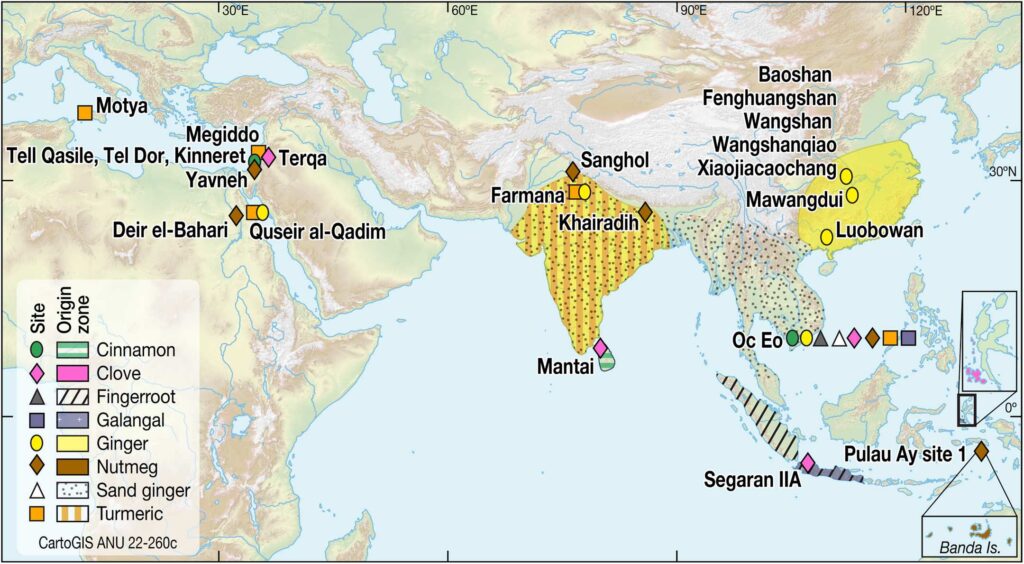
The word ‘spice’ is derived from the Latin ‘species’, or ‘special wares’, and refers to an item of special value, as opposed to ordinary articles of trade.  Spices were highly valued because, as well as being used in cooking, many had ritual, religious or medical uses.

They were of high value because of their relative geographical scarcity. Spices could only be grown in the tropical East; South Asia served as a major source of spices – in the South of China, Indonesia, as well as in Southern India and Sri Lanka.

Among the most widespread were the spices cinnamon, pepper, clove, nutmeg, and mace. (Hancock)  Some spices, such as cloves and nutmeg, grew nowhere else in the world.

The spice trade was conducted mostly by camel caravans over land routes (known as the Silk Roads).  The Silk Roads were important routes connecting Asia with the Mediterranean world, including North Africa and Europe. (Deepanjana, UNESCO)

From as early as 2000 BC, spices, such as cinnamon from Sri Lanka and cassia from China, were exported along the Silk Road as far west as the Arabian Peninsula and the Iranian Plateau. Other goods were also exchanged/traded – cargoes from China included ivory, silk, porcelain, metals and gemstones.  (Deepanjana, UNESCO)

Later, Spice Routes were established; these were the name given to the network of sea routes that linked the East with the West.  The journey of the goods between all these links in the chain is called a trade route (the word ‘trade’ derives from a term meaning a track or course).

One of the major motivating factors in the European Age of Exploration was the search for direct access to the highly lucrative Eastern spice trade.

in 1513, a Spanish captain, Vasco Nuñez de Balboa, went into the interior of Darien (Panama). On September 24, 1513, Balboa sighted a new ocean. He called it the Mar del Sur, or ‘sea of the south’ (South Sea); later (1520), Ferdinand Magellan called it the Mare Pacificum, or Pacific Ocean.

The accounts of the first explorers revealed the potential for high-value commodity exchange, and voyages of exploration were soon followed by those of spice traders. (BOEM)

From 1500 AD onward, first Portugal, and then other European powers, attempted to control the spice trade, the ports which marketed spices, and eventually the territories which grew them. (Cartwright)

The Portuguese established trading posts in China at Macau in 1513, in Timor in 1515, and finally at Nagasaki, Japan in 1543. Within the next decades, Dutch competitors followed the Portuguese across the Indian Ocean and into Southeast Asia. (BOEM)

Then came the Spanish … on November 28 1520, Spaniard Fernao de Magalhais (Ferdinand Magellan) entered the eastern Pacific from the opposite direction, by way of the tip of South America, discovering the strait that now bears his name, and thereby opened up to Spain the possibility of an alternative route between Europe and the spices of the Orient.”  (Lloyd)

Magellan crossed the ocean to the Philippines, which he named Las Islas Filipinas in honor of the Spanish king, Felipe. (Spate) The Spanish ultimately prevailed against other European competition in terms of Pacific trade. They did this through the founding of their outpost at Manila (Philippines) in 1571 and the establishment of regular transpacific Manila Galleon voyages.

Once a year, gold and silver were transported west from Acapulco to Manila in exchange spices (pepper, clove and cinnamon), porcelain, ivory, lacquer and elaborate fabrics (silk, velvet, satin), collected from both the Spice Islands (Moluccas, Indonesia) and the Asian Pacific coast.

The Pacific fur trade was pioneered by the Russians, working east from Kamchatka along the Aleutian Islands to the southern coast of Alaska. (ESDAW)

Originally, Russia exported raw furs, consisting in most cases of the pelts of martens, beavers, wolves, foxes, squirrels, and hares. Between the 16th and 18th centuries, Russians began to settle in Siberia, a region rich in many mammal fur species, such as Arctic fox, lynx, sable, sea otter and stoat (ermine).

it was the French and  British who dominated Pacific exploration in the eighteenth century. Beginning in the mid-1700s, the rival nations began to send out scientific expeditions to explore and chart the islands of the Pacific.

British explorers included Samuel Wallis (1767–68) and Philip Carteret (1767–68). But by far the most wide-ranging and accomplished of the eighteenth-century explorers was the Englishman Captain James Cook, who made three separate voyages to the Pacific in 1768-71, 1772-75, and 1776-80. (Kjellgren, MetMuseum)

After Cook was killed in Hawai‘i, one of his officers – and later a Captain – George Vancouver continued to explore and chart the Northwest Coast.  Commercial traders soon followed, exchanging copper, weapons, liquor, and varied goods for sea otter pelts. (Barbour)

Following Cook’s ‘discovery’ of the opportunities in the fur trade, the North American maritime fur trade became the earliest global economic enterprise.  Cook’s ‘discovery’ resulted in the British and then the Americans participating in the trade.

Following the American Revolution, the new nation needed money and a vital surge in trade. In 1787, two ships (Columbia, captained by John Kendrick, and Lady Washington, captained by Robert Gray) left Boston on a mission around Cape Horn and into the Pacific Ocean. to establish new trade with China, settle an outpost on territory claimed by the Spanish, and find the legendary Northwest Passage.

Within ten years after Captain Cook’s 1778 contact with Hawai‘i, the islands became a favorite port of call in the trade with China.  The fur traders and merchant ships crossing the Pacific needed to replenish food supplies and water.

Needing supplies in their journey, the traders soon realized they could economically barter for provisions in Hawai‘i; for instance, any type of iron, a common nail, chisel or knife, could fetch far more fresh fruit, meat, and water than a large sum of money would in other ports.

A triangular trade network emerged linking the Pacific Northwest coast, China and the Hawaiian Islands to Britain and the United States (especially New England).  Practically every vessel that visited the North Pacific in the closing years of the 18th century stopped at Hawai‘i for refreshment and recreation.

As trade and commerce expanded across the Pacific, numerous countries were looking for faster passage and many looked to Nicaragua and Panama in Central America for possible dredging of a canal as a shorter, safer passage between the two Oceans.

Finally, in 1881, France started construction of a canal through the Panama isthmus.  By 1899, after thousands of deaths (primarily due to yellow fever) and millions of dollars, they abandoned the project and sold their interest to the United States.

After Panamanian independence from Columbia in 1903, the US restarted construction of the canal in 1905.  Finally, the first complete Panama Canal passage by a self-propelled, oceangoing vessel took place on January 7, 1914.

Later, when Navy Commander John Rodgers and his crew arrived in Hawaiʻi on September 10, 1925 on the first trans-Pacific air flight, they fueled the imaginations of Honolulu businessmen and government officials who dreamed of making Hawaiʻi the economic Crossroads of the Pacific, and saw commercial aviation as another road to that goal.

Two years later on March 21, 1927, Hawaii’s first airport was established in Honolulu and dedicated to Rodgers.  1959 brought two significant actions that shaped the present day make-up of Hawai‘i, (1) Statehood and (2) jet-liner service between the mainland US and Honolulu (Pan American Airways Boeing 707.)

Here is a link for more on Explorers and Traders: https://imagesofoldhawaii.com/wp-content/uploads/Explorers-and-Traders.pdf

© 2025 Ho‘okuleana LLC

Filed Under: General, Sailing, Shipping & Shipwrecks, Economy Tagged With: Hawaii, Pacific, Traders, Ecplorers, Silk Road, Spice Route

August 2, 2025 by Peter T Young Leave a Comment

Pipi Chute

In the middle 1800s, ranching became a significant economic engine in the Hawaiian Islands. On Lānai, Mānele Landing served as the port of call for ships picking up cattle, sheep and goats; and also in service of passengers and freight.

Ranching was the primary commercial enterprise on Lānai between 1860 to 1922. Initial activities focused on goats and sheep, but by the early 1900s cattle had become the primary stock.

To ship the cattle (in Hawaiian, pipi) to Honolulu, the animals were driven down to Mānele, held in pens, and then loaded on interisland steamers.

“They used to send cattle out, and then the Inter-island Steam [Navigation] Company’s boat, you know, freighters, used to come in, take those cattle to Honolulu, O’ahu, anyway.” (Fusako Nishimura Uchimura, UHM Oral History)

“In the early 1900s there were not as many wharves as there are today, and it was in few places that stock could be loaded onto the vessels through chutes as is more general now. The steamer would be anchored out from the shore and a heavy line run to some attachment on the land.”

“A boat was then tied to this shoreline and held in deep water. The cattle would be in a corral above high water or were driven out into the water and kept there by the surrounding cowboys.”

“On Lānai the corral was at Mānele at the top of a wide beach separating it from the sea. A lasso was thrown over the horns of one of the animals in the corral, the other end held by a man on horseback, and it was herded out and down the beach following the horse.”

“The animal’s efforts to escape brought it into the water as the horse headed for the boat. When within reach, just as the led animal lost its footing and the horse was reaching for the bottom with its hind feet the cowboy threw the rope to the men in the boat who would then throw another rope back to him.”

“The boat, with several beasts securely tied to the thwarts on each side, would be towed back to the steamer. Slings were adjusted to the animals and in turn they were hoisted to the deck and tied along the sides.”

“In fine weather this worked out well, but when rough it was risky, and sometimes cattle were injured or drowned. … so we devised a portable chute in sections, for bringing the stock to the water’s edge. The sections were drawn up when not in use. This was a great improvement, but we were not yet satisfied.”

“A corral was then built at the top of a low cliff overlooking a small tidal shelf with fairly deep water close to it. A chute was run out to above the edge of the tidal shelf close to deep water and supported there by posts.”

“Into this another chute was telescoped which, when run out over the water, reached to the deck of the steamer. By using a calf led down the chute, the large cattle were induced to follow, and the loading was done in a few minutes.”

“The calf was brought ashore ready for the next shipment. The steamer then pulled out, and the cattle were tied up as she proceeded on her way.”

“Even with this method, the work could still prove more or less harassing with changes of weather. After the Hawaiian Pineapple Company built the Kaumalapau Harbor and wharf, the cattle were shipped from the wharf through a chute. The pen and chutes were movable and, when not in use, kept out of the way of other work.” (Munro:105)

“I think more in the ‘20s, maybe, that’s when they built that chute. That thing was really something. You know they’d lead the calf down. The cows all follow the calf, they go right onto the ship.”

“But one time that thing broke, the cattle fell in the water. Some died; some, you see them swim. I didn’t know they could swim, they good swimmers. The cows, yeah.” (Violet Keahikoe Gay, UHM Oral History)

“They put the chute down onto the deck of the ship, and the ship would be going [i.e., bobbing] up and down, and the cattle would be bawling their heads off, and they’d have to be prodded to go down this chute to get onto the deck of the ship.” (Jean Forbes Adams, UHM Oral History)

“When I came over here, they had the chute and they had down. When too rough, the boat no can go by the side [of the chute], so they go by the sand side, everybody go swim. Over there, they rope ‘em and drag ‘em inside the water.” (Ernest S. Richardson, UHM Oral History)

After Kaumālapa’u harbor was built, “they still used Manele and the chute … Probably, since that was all built there. Yeah, Kaumalapau was strictly for pineapple shipping.” (Jean Forbes Adams, UHM Oral History)

With construction of the chute, the pipi could be driven along the cliffs to the chute and walked across the water onto the waiting boat. In addition to the “Pipi Chute,” a series of mortar salt making beds were built on the shore of the landing in the 1930s.

In May 1943, the salt making beds were moved to the cliffs. On the south side of the boat harbor were the salt beds and an old fence line that contained cattle as they were being driven down the chute for shipping to Honolulu. The salt beds were periodically filled with salt water, which evaporated and provided fresh sea salt for drying meat and treating hides.

On rough days, when the steamers couldn’t safely draw along the Mānele cliff side, cattle were driven into the ocean at Hulopo’e Beach. They were then tied up to a launch, which took them out to the steamer, and hoisted onto the boat for transport. Typically, anywhere from 30 to 70 cattle from Lānai were shipped in one trip.

By 1918, Charles Gay and family began experiments in planting pineapple on Lānai in the uplands near what would become Lānai City. Once harvested, the fruits would be taken by truck down to Mānele Landing via a stone and dirt trail that was almost impassable.

The crop was then loaded onto a small boat and transferred to Maui for canning. It was a difficult trip which caused the loss of much of the fruit, due to bruising. However, as a result of the Gay family’s success, James Dole’s Hawaiian Pineapple Company knew that the crop could be grown, and in 1922 Dole purchased almost the entire island of Lānai.

And the rest, as they say, “is history.”

© 2025 Ho‘okuleana LLC

Filed Under: Prominent People, Economy Tagged With: Pipi Chute, Cattle Chute, Hawaii, Lanai, George Munro, Manele, Lanai Ranch

August 1, 2025 by Peter T Young Leave a Comment

Swastikas … to Waikiki Surf-Boards

Founded in 1908 by William Butte, Pacific Ready-cut Homes, later Pacific System Homes, made ’kit’ homes.

They were considered one of the largest mass producers of pre-cut houses in the US; over the course of about 30-years, they delivered approximately 40,000-homes.

In the 1920s, working class people aspired to the “good life” of home and auto ownership and Pacific System was there to provide the little California bungalow that they were dreaming of. (AntiqueHome)

When the Stock Market crashed in October of 1929, Butte’s son Meyers was at Stanford and training for the Olympics in wrestling. Sales of homes were slow; the economic crash forced Meyers to come home and get involved with the family business.

When Meyers came on board, he convinced the family that manufacturing surfboards would be a good way to diversify the business. He began to change a small part of the production of Pacific System to surfboards.

Pacific System was one of the first companies to produce commercial surfboards.

Back then, boards were made of single pieces of redwood – and weighed about 100-lbs.

The first Pacific System boards were like the rest at Waikiki Beach – finless, single-slab redwood planks.

Recognizing the solid planks were too heavy, they looked for other options.

To lighten the load, Pacific System started making laminated surfboards; the big break came when they found a water-proof glue that would hold the slabs of wood used in board construction together. (Gault-Williams)

The new, lighter boards were constructed from glued and doweled balsa and redwood strips. They were 10 to 12-feet in length, 20-inches wide and a few inches thick (and weighed closer to 50-lbs.)

At first, the company logo was a swastika on the deck; the boards became known as ‘Swastika’ models.

“The Swastika boards were droolers,” shaper Dale Velzy is quoted as saying. “Everybody had homemades or hand-me-downs, so people really wanted a Pacific System.” (Velzy; Gault-Williams)

Although most boards continued to be custom made by surfers themselves, for the period leading into World War II, Swastikas became the most widely-used production board. (Gaul-Williams)

With the rise of Nazi Germany later in the decade, in about 1938, the swastika name and logos were dropped and the boards became known as ‘Waikiki Surf-Boards.’ (Motil)

Pacific System employed a number of well-known surfers, including Pete Peterson and Lorrin ‘Whitey’ Harrison. (They were the first of the hardcore California surfers to surf Waikiki.) (SurfMuseum)

“All ‘Waikiki’ boards are precision built with modern up-to-date machinery for a life-time of service in the world’s largest home-building plant.”

“The woods are specially selected. The Balsa wood is hand-sorted from finest imported stocks, scientifically kilned, laminated and cabinet finished by expert craftsmen under the personal direction of a professional surf-board aqualist.” (Pacific System Ad)

According to Butte’s son, his father took “great pride in the fact that he had pioneered the making of light surfboards.”

Pacific System models were popular and demand grew; they were shipping 60-boards a month to Hawaiʻi. (Marcus)

Pacific System Homes, as a Butte family enterprise, soon changed; although Pacific System still sold ready-cut houses throughout the thirties, homebuilding did not really recover until after World War II. (Flynn; Gault-William)

Founder/father William Butte died in 1936; sons Meyers and Robert ran the business for a while, then sold the company in 1942 and enlisted in the military. (Flynn; Gault-Williams)

© 2025 Hoʻokuleana LLC

Filed Under: Hawaiian Traditions, Economy Tagged With: Hawaii, Surfing, Surf

July 25, 2025 by Peter T Young Leave a Comment

Waikahalulu Falls

‘Pan-Pacific Union’ was the local expression of the larger ‘Hands-around-the-Pacific’ movement, which embraced all countries in and about the vast western ocean – the future theatre of the world’s greatest activities. (The Friend, May 1, 1918)

The projected calling of a Pan-Pacific conference to meet in Hawaiʻi, the establishment of a Pan-Pacific commercial college in Honolulu and the project of a Pan-Pacific peace exposition here after the war was launched by a number of influential business men. (Mid-Pacific Magazine, 1918)

A Pan-Pacific commercial college was considered one of the best means to bring Hawaiʻi into closer communion with the countries of the Far East while the exposition and general conference would create a sentiment in the countries of the Pacific to make the Pacific independent in its resources and make Hawaiʻi a real cross-road of the Pacific. (Oregon News, June 26, 1918)

Folks selected a site along the Nuʻuanu Stream, in the heart of Honolulu, near two waterfalls, as the nucleus of a Pan-Pacific Park; here all resident races of the Pacific might re-create their national life and customs.

It turns out the site was at the former home of the former Queen, Liliʻuokalani. Here, once stood the grass house of the parents of Hawaiʻi’s last Queen. As a child she played and bathed in the pool below the falls. (Some call it the Queen’s Bath.)

At first, the Japanese offered to make of Liliʻuokalani Gardens a bit of old Japan. With more land, they suggested different nations around the Great Ocean come for the 1920 Exposition. (Mid-Pacific Magazine, January 1917)

During initial discussions of the proposed Pan-Pacific Exposition came up, Mr Ishii announced that he would provide a Japanese tea house section that would be a credit and honor to his race in Hawaiʻi.

In the garden, and tea houses, there should be no intoxicants of any kind, and only the real lovers of simple pleasures, and those who enjoy the beautiful in nature, would be welcomed. (Mid-Pacific Magazine, August 1918)

Ishii’s Garden in Pan-Pacific Park, a bit of old Japan in Hawaii, was looked upon as one of the most charming spots in Honolulu. The entire grounds were formerly known as Yoraku-en—the Pan-Pacific tea garden.

The garden was planted with Japanese grass, and the landscape gardening there is patterned after the Land of the Cherry Blossoms. Buildings, too, are designed along Japanese lines. It was Ishii’s plan to will the park and garden to the Pan-Pacific Union as its headquarters.

For ten years, Ishii has been improving these remarkable Japanese gardens. They adjoin the Liliʻuokalani Park, one of the most beautiful bits of landscape in Hawaii. The building of a native Hawaiian village is contemplated, adjoining both Liliʻuokalani and Ishii’s gardens, so that in time all may be thrown into one Pan-Pacific park.

Here, perhaps each Pacific race in Hawaiʻi may have its individual club house and grounds. Mr. Ishii is a public benefactor in pointing the way for better understanding and co-operation among the men of all races in Honolulu. (Pan-Pacific Union, March 1923)

Glance up the Nuʻuanu Stream, beneath the finest (and most forgotten) avenue of monkeypod trees in the Island. It was a bit of Japan at its fairest, and there, far up at the end of the arching of green, were two tumbling white waterfalls.

There are many beauty spots in Hawaiʻi, but none more beautiful than those that congregate about that section of the Nuʻuanu Stream, flowing through Honolulu, where it was proposed to hold the Pan-Pacific Peace Exposition after World War I.

Their philosophy was, work hard enough and long enough for the thing you want, and you will get it; and so any good idea may be made to grow into a reality.” (Mid-Pacific Magazine, August 1918)

Unfortunately, there are no records of the Pan-Pacific Union holding the exposition (like a World’s Fair) in Honolulu. The City later acquired the Liliʻuokalani Park – it’s now a small, streamside passive park. Waikahalulu Falls are still there, too.

The City notes, portions of this garden were once the property and favorite picnic grounds of Queen Liliʻuokalani, the last reigning monarch of Hawaiʻi. She later donated her land to the City and County of Honolulu to be used for the public’s enjoyment. This developing garden is devoted to native Hawaiian plants. (C&C)

Records do note that the Nagoya Pan-Pacific Peace Exposition was a world’s fair held in Japan from March 15 to May 31, 1937.

It was intended to promote industry, transportation, education, science, construction, architecture, social welfare, tourism, fine arts and crafts. The Second Sino-Japanese War (1937–1945) erupted only two months after the Exposition closed.

© 2025 Hoʻokuleana LLC

Queen-Liliuokalani-Gardens
Waikahalulu-Falls
Waikahalulu-Falls
Waikahalulu-Falls-HonoluluBotanicalGardens
Waikahalulu-Falls-arjunaheim
Waikahalulu_Falls-HonoluluBotanicalGardens
Lili'uokalani_Botanical_Garden
Lili’uokalani_Botanical_Garden
Waikahalulu_Falls
Waikahalulu_Falls
Part of Ishii's Pan-Pacific Gardens-Pan-Pacific Union March 1923
Part of Ishii’s Pan-Pacific Gardens-Pan-Pacific Union March 1923
Main tower at the Nagoya Pan-Pacific Peace Exposition-1937

Filed Under: Economy, General Tagged With: Waikahalulu Falls, Pan-Pacific Park, Pan-Pacific, Hawaii

July 19, 2025 by Peter T Young Leave a Comment

Ranch House

This place had a lot of owners and went by a lot of names; it even had two different street addresses (it stayed in the same place, but it is not clear when or why the address changed).

It started with Robert Hind and his dairy operation.  While it didn’t start with that name, more often than not it was called some derivation of the Ranch House.  The structure was remodeled at least twice (1951 and 1971). 

In 1918 Robert Hind started Kapahulu Dairy.  (Kelly)  In 1924, Hind purchased 2,090-acres and established the Hind-Clarke Dairy with John K Clarke. “Rancher and Cattleman To Import 100 Pure Bred Guernseys At Once Will Be Added To Stock Ready for Opening of Hind-Clarke Dairy”

“One hundred pure bred Guernsey milch cows for the Hind-Clarke dairy, which is to be opened for business in the Waialae district later in the summer, will arrive from San Francisco June 30, announces Robert Hind, rancher and dairyman, who returned from the mainland on the steamer Wilhelmina Tuesday.”

“‘These cows will produce the highest quality of milk, which will be of a rich color and of a taste for which the Guernsey is famous. The animals have the best kind of pedigrees and would be valuable additions to any dairy.’”

“The dairy already has 150 Holstein cows, which produce milk In quantity, and the coming herd will increase his herd to at least 250 milk producers.” (Star Bulletin, June 10, 1925)

The Hind-Clarke Dairy was a favored stop along the road, as noted in a 1930 visitor’s guide … “The Hind-Clarke Dairy, a short way ahead and to our left with a large sign over the entrance, is not to be passed unnoticed.”

“The dairy is a model of its kind and well affords an opportunity to see dairying in its most scientific form. The cottage cheese on sale is, perhaps, the most delicious you have ever tasted.”  (Cultural Surveys)

“And Hind-Clarke Dairy had this drive-in where they had their own ice cream parlor [Hind-Clarke Drive Inn]. And later on it got to be known as M’s Ranch House.” (‘M’ referencing Mona Hind Holmes, Robert’s daughter.)

“Until only recently it was still there, and they finally closed down. But it started out as a Hind-Clarke Dairy ice cream parlor, but people drove in there to buy ice cream.” (Yamaguchi Oral History)

The Hind Clarke Dairy operation occupied the area presently occupied by the ‘Āina Haina Shopping Center and ‘Āina Haina Elementary School.

It stretched into the valley and over the ridge (now the Hawaii Loa Ridge subdivision). Hind Clark Dairy also had a small zoo near the library site today; there was a zebra in a pen. (Archaeological Consultants)

The former cattle pasture was subdivided into lots to form a new residential community called ‘Āina Haina (which means “Hind’s land”).

A little-known fact, lost (for the most part) to history, is that the Hind-Clarke Drive Inn became the Six Star Drive Inn briefly (around 1945) before coming M’s Ranch House.   (Darren Conley)

A September 1, 1945 advertisement in the Star Bulletin stated, “Opening Today the Six Star Drive-in, Fountain Service, Sandwiches. A La Carte Menus, Open Daily… 5202 Kalanianaole Highway. Near the Hind-Clarke Dairy Under the management of Mona Hind and Harry Shingle”.

However, Harry’s participation soon ended with an announcement, “Notice is herby given that Harry Kusuhara, also known as Harry Shingle, is no longer connected with the Six Star Drive Inn located at 5202 Kalanianaole Highway … I have returned to General Contracting and Catering as of the 15th day of January 1946.” (SB, Jan 25, 1946)

Then, “Notice is hereby given that on the 16th of May, 1947, Mona Hind Holmes and Charles W Lucas Jr, entered into a copartnership doing business under the name of The Ranch House, operating, maintaining and conducting a restaurant at 5202 Kalanianaole Highway, Honolulu, TH.” (Advertiser, May 17, 1947)

“Originally opened as the ice cream drive-inn for the Hind-Clarke Dairy and creamery, it was converted into a full service dining restaurant after the Dairy was sold in 1946, and the valley was subdivided into residential lots.”

“We moved into Aina Haina in 1949, and as a child growing up, our favorite thing was to play ‘cowboys’. We could choose between riding our bikes over to Niu Valley and feeding Lani Moo in her corral, or riding our bikes to M’s Ranch House, and play in the covered wagon.”  (Navas, Territorial Airwaves)

In 1971, the restaurant was “renewed” and “has a new look so different and so handsome that we hasten to reassure its family of customers that inside the doors, the food, the services, the hospitality, and the informality are all as they were before – only nicer.”

The Ranch House was “completely redecorated and refurbished … with a new roof line new paint and signs – but still the basically unchanged ‘dining home’ of thousands of Island families … [and] prices did not go up after all the remodeling and redecorating.” (SB, Jan 10, 1971)

The Ranch House was demolished in 1991, and Longs Drugs was built and still occupies the site; the ice cream parlor, drive In, fountain, Alibi Cocktail Room, hearty meals, live music entertainment … and covered wagon are now gone.

© 2025 Ho‘okuleana LLC

Filed Under: General, Buildings, Prominent People, Economy Tagged With: Hawaii, Aina Haina, Hind-Clarke Dairy, Ranch House, Six Star Drive Inn

  • « Previous Page
  • 1
  • …
  • 26
  • 27
  • 28
  • 29
  • 30
  • …
  • 238
  • Next Page »

Images of Old Hawaiʻi

People, places, and events in Hawaiʻi’s past come alive through text and media in “Images of Old Hawaiʻi.” These posts are informal historic summaries presented for personal, non-commercial, and educational purposes.

Info@Hookuleana.com

Connect with Us

  • Email
  • Facebook
  • LinkedIn
  • Twitter
  • YouTube

Recent Posts

  • About 250 Years Ago … Benedict Arnold
  • Papa Koa Lumber Company
  • About 250 Years Ago … Battles of Saratoga
  • ‘A Swarm of B’s Has Come’
  • About 250 Years Ago … US Constitution
  • Hiram Bingham: I – IV
  • Haui ka Lani

Categories

  • Ali'i / Chiefs / Governance
  • Buildings
  • Missionaries / Churches / Religious Buildings
  • Hawaiian Traditions
  • Military
  • Place Names
  • Prominent People
  • Schools
  • Sailing, Shipping & Shipwrecks
  • Economy
  • Voyage of the Thaddeus
  • Mayflower Summaries
  • American Revolution
  • General

Tags

Albatross Al Capone Ane Keohokalole Archibald Campbell Bernice Pauahi Bishop Charles Reed Bishop Downtown Honolulu Eruption Founder's Day George Patton Great Wall of Kuakini Green Sea Turtle Hawaii Hawaii Island Hermes Hilo Holoikauaua Honolulu Isaac Davis James Robinson Kamae Kamaeokalani Kameeiamoku Kamehameha Schools Lalani Village Lava Flow Lelia Byrd Liberty Ship Liliuokalani Mao Math Mauna Loa Midway Monk Seal Northwestern Hawaiian Islands Oahu Papahanaumokuakea Marine National Monument Pearl Pualani Mossman Quartette Thomas Jaggar Volcano Waikiki Wake Wisdom

Hoʻokuleana LLC

Hoʻokuleana LLC is a Planning and Consulting firm assisting property owners with Land Use Planning efforts, including Environmental Review, Entitlement Process, Permitting, Community Outreach, etc. We are uniquely positioned to assist you in a variety of needs.

Info@Hookuleana.com

Copyright © 2012-2024 Peter T Young, Hoʻokuleana LLC

Loading Comments...