Images of Old Hawaiʻi

  • Home
  • About
  • Categories
    • Ali’i / Chiefs / Governance
    • American Protestant Mission
    • Buildings
    • Collections
    • Economy
    • Missionaries / Churches / Religious Buildings
    • General
    • Hawaiian Traditions
    • Other Summaries
    • Mayflower Summaries
    • Mayflower Full Summaries
    • Military
    • Place Names
    • Prominent People
    • Schools
    • Sailing, Shipping & Shipwrecks
    • Voyage of the Thaddeus
  • Collections
  • Contact
  • Follow

August 13, 2023 by Peter T Young Leave a Comment

Dreamwood

Lyman Herbert Bigelow came to Hawaii as a civil engineer and construction superintendent in the United States army quartermaster corps in 1911.

Shortly after arrival, he started work in the private sector, then was appointed as Superintendent of Public Works by Gov. Charles McCarthy for a four-year term. He was reappointed by Governors Wallace Farrington and Lawrence Judd.

He was charged with the task of supervising the expenditure of millions of dollars for improvements throughout the Territory.  He held the dual position of superintendent of public works and chairman of the board of harbor commissioners for more than a decade.

“‘Mr. Bigelow had the difficult and important task of beading the City’s Building Department during and following World War II.’”

“‘In directing the City’s tremendous construction program to catch up with the backlog of building needs and to provide the many new facilities needed after the war, he contributed much to the building of present day Honolulu.’”

“‘The City was indeed fortunate to have had a man like Mr. Bigelow in its service during such a critical period. He gave generously of himself to his work and won not only the high respect but warm regard of his associates.’” (Blaisdell, Star Bulletin, June 20, 1966)

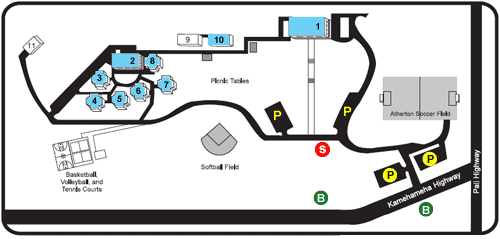
He also built his home, Dreamwood, along Kaneohe Bay.  “‘Dreamwood,’ which grew out of a haole koa wilderness, is a ready-made park. There are graceful wrought iron gates guarding the entrance. A private driveway, bordered by palms, crotons and bougainvillea, leads to the three-story Bigelow home.”

“There are six tropical fish ponds, lily pools and fountains on the grounds. Walkways are bordered by orchids. There are secluded

picnic areas.  Three large greenhouses are used to cultivate orchids and rare ferns.  A long pier extends into Kaneohe Bay. It has a boat shed on it.”

“Bigelows’ life-long interest in horticulture has brought rare and unusual plants to ‘Dreamwood.’ His professional skill as an engineer is seen in the intricate pools, walkways, patios and terraces.” (Advertiser, August 11, 1966)

“Dreamwood,. his 2½ acre estate at the end of Waikalua Road on Kaneohe Bay, was a gardener’s showplace which, Mayor Blaisdell said, ‘he shared generously with the community.’”

“In recent months the Bigelows, Kaneohe community leaders and City Councilmen have discussed the possibility of acquiring Dreamwood for public park purposes.”

“The bayfront estate apparently becoming too much to keep up, and Mr Bigelow wanted the tropical property to be enjoyed rather than subdivided.  He and his wife said they would build a smaller home a portion of the Dreamwood estate.”

“An orchid hobbyist for more than 40 years, Mr. Bigelow won his share of prizes. He spent three decades designing, planting and

improving his gardens.”  (Star Bulletin, June 20, 1966)

“Kaneohe Community leaders are proposing that the acre and a half estate with its home and marine peir be purchased and added to an existing City park at the end of Waikalua Road which borders the Bigelow property.”

“The Bigelows are planning to build a small home on the portion of ‘Dreamwood’ property which they have reserved for their own use.” (HnlAdv, Jan 13, 1966)

Other thoughts on future use suggested that the “home could house a restaurant with its operation and menu tailored to a botanical garden setting. The home’s many rooms could be set up to provide breakfast, luncheon or dinner meeting places for groups of under 100 persons.”

“Other portions of the house could be used for music club gatherings, monthly club meetings and art exhibits.  The grounds would be maintained as a park where the public and tourists could enjoy the tropical plantings, orchid and fern houses.” (HnlAdv, Jan 22, 1966)

The City acquisition and park plans did not move forward. “It really is a shame the City can’t acquire more of these.  But in the end it all boils down to the finances of the matter.” (City Council Chairman, Herman Lemke, HnlAdv, Jan 22, 1966)

Following Bigelow’s death, repeated advertisements noted that the 1.47-acre waterfront ‘Dreamwood’ estate was listed for sale for $275,000.

Then, the Dreamwood School was initiated on the site; it was “an experiment in therapeutic learning” offering “a therapeutic educational experience to the drug user who wants to stop and to the school drop-out”.  Star Bulletin, Sep 22, 1970)

“The name is incidental, kept at the request of the owner of Bigelow mansion, which is part of Dreamwood Acres. The name fits.”

“Dr Fred Weaver and the 25 people inside the mansion have a dream they believe can come true. They are creating a school for disenchanted and alienated young to help teach them how to live happily, creatively, constructively, in today’s society while fulfilling their own dreams.”

“Weaver, psychiatrist and adolescent unit chief at Hawaii State Hospital, is acting as consultant to Dreamwood School. … The school’s primary aim is to reintegrate adult and young relationships and satisfy learning needs which the staff feels are often not supplied within the system.”

“‘We have a philosophy that sometimes the system kills initiative,’ Weaver explained. ‘You have to be turned on to learning and we want to make the turn-on natural.’”

“‘’We feel that human values are the most important – feeling good, doing what uou do, being responsible for yourself in your relationships and in what you do.’ Weaver believes that alienation occurs often because adults ‘manipulate or push the young into things.”

“‘The crisis today is too severe to allow us the luxury of treating symptoms, It is time to work on the cause.’” (Star Bulletin, Sep 22, 1970)

Then in 1971, Habilitat “signed a five-year lease with Mrs Lyman Bigelow for her Kaneohe property”.  Habilitat bought the property in 1976 and continues to be the fee owner and operates its programs there.

Vinny Marino founded Habilitat on January 27, 1971 as a long term addiction treatment programs.  “My idea of survival is strength found in the family. Family life is the most important experience in our lives; a good family life does shape character, and is reflected in a person’s attitude about survival. Good family life is hard to find these days; you either have it or you don’t.”

“That’s why Habilitat exists today. Habilitat believes in the family as the basis of survival. Habilitat believes the family unit must be preserved. Habilitat offers positive survival to those who want to learn. Through the family structure at Habilitat, our residents form their values, morals, conscience, and a way of life that will help them survive in this mad, mad, mad, mad world.”

“Very simply, Habilitat is an extended family of individuals who realize they need help to change, and survive without sick dependencies.” (Vinny Marino)

© 2023 Ho‘okuleana LLC

Filed Under: Economy, Buildings, Prominent People Tagged With: Lyman Herbert Bigelow, Dreamwood, Dreamwood School, Habilitat

August 6, 2023 by Peter T Young Leave a Comment

Hilo Fire Department

When arguing against a legislative budget appropriation for fire equipment for Hilo, a representative rationalized that, “it never got dry enough in Hilo for a fire.” (Pacific Commercial Advertiser, Oct 18, 1890)

However, others saw that “Hilo needs a hook and ladder company at once”. (Hawaiian Gazette. Jan 17, 1888) “… but since then no one seems to feel any interest in the matter.  Insurance must be higher here than it would otherwise be, as there is no protection against fire.” (PCA, Nov 29, 1888)

During the 1890 legislative session, Rep. Nawahi moved to insert $5,000 “to provide fire apparatus for Hilo” into the budget.  “Rep Brown said $5,000 wouldn’t build the house for the engine let alone buy the engine.  A good engine costs from $10,000 to $15,000.”

“The only way to have a fire department is to organize it, and to do that you must pass an Act.  Therefore instead of putting this in the Appropriation Bill it had better go to a select committee.”  They were told, “Without a law authorizing the organization of a fire department nothing can be done.”

“Rep Lucas stood out numerous calls of ‘question,’ and said that $4,000 or $5,000 would be enough.  A very good hand machine could be got for $2,000 to $3,000. The Item passed.”  (PCA, Aug 2, 1890)

On January 9, 1893 Lili‘uokalani approved an act that, “There shall be a Fire Department for the town of Hilo, on the Island of Hawaii, which shall consist of a Chief Engineer, not over two assistants, and as many firemen as may be approved by the Board of Representatives of the Department duly chosen as by its by-laws”.

“Any person may be a member of the Fire Department of Hilo by the affirmative vote of a majority of the members of any fire company to which such person shall have applied, provided always, that such person shall not be a vagrant or disorderly person, and shall not have been convicted of any felony which shall not have been pardoned.” (Evening Bulletin, Jan 26, 1893)

On July 27, 1893, “The first election for chief engineer of the Hilo fire department … was held in the court-house … Daniel Porter, Clerk of the third and fourth circuit court, was elected chief for two years and A Wall assistant engineer for the same period.”

“Now that the organization is complete, and the Hilo fire department an accomplished fact, it is expected that the property-owners about the town will take more interest it its welfare and assist the fire company by making donations to its building fund. And by joining the Provisional government to enlarge and improve our water works system.”

“A movement is on foot to establish a hose company among the native Hawaiians, and a meeting was held at the court house, August 1st, to effect arrangements of the organization.” (Hawaiian Gazette, August 15, 1893)

Although initially volunteer firefighters, “Members of the Fire Department who shall have been in the active performance of their duties for at least a year … shall be exempt for the payment of poll, school and road tax in each year.” (Evening Bulletin, Jan 26, 1893)

Later that year, Andrew Brown, chairman of the Board of Fire Commissioners in Honolulu, purchased the bell “which has so long occupied a position in the Bell Tower [of the Mechanic’s Engineer Company No. 2]; and after having it cleaned and its fittings painted … present[ed] it to the Hilo Fire Department.” (Hawaiian Star, Sep 4, 1893)

By 1899, “Chief Engineer Vannatta has had but little actual fire-fighting to engage in but he keeps the department ‘up to date’ in drill and discipline.” (Godfrey)

Steam Fire Engine Co., No. 1 was the first fire station and was located at the corner of Waianuenue Avenue and Kekaulike Street.  A steamer and hose wagon were located in the new station.

“Wood was used to fire the boiler, which produced steam to run the fire pump. By 1910 the Hilo Volunteer Fire Department had 60 members and responded to 11 fire calls that year. Additional equipment in service included a chemical wagon mounted on a car and a second car was used to tow the steam engine.”

“During 1919 the first motorized apparatus, a 750 gpm Seagraves engine was placed in service. The first career firefighters were hired in 1924 and included William Todd the first paid chief, an assistant chief, drivers, and hosemen; seven personnel total.”

“The career service was supplemented by volunteers, which continue in service today. In 1927 the second motorized apparatus was purchased, which was a 1,000 gpm Seagraves.”

“During 1931, 12 additional personnel were hired, and in 1937 a third engine was placed in service. Emergency medical service (EMS) was added to the department in 1972 with the first two firefighters trained as emergency medical technicians (EMTs).” (Robert A Burke)

© 2023 Ho‘okuleana LLC

Filed Under: General, Buildings, Economy Tagged With: Hilo Fire Department, Hawaii, Hilo, Fire

August 4, 2023 by Peter T Young 1 Comment

Kōloa Heritage Trail

The Kōloa District is the name of a modern political-judicial district encompassing the south shore of Kauai.
 
In ancient times, the Kōloa District was part of a larger district called Kona.  The Kōloa Heritage Trail travels through four ahupuaʻa. From east to west, they are: Māhāʻulepu, Paʻa, Weliweli and Kōloa.
 
Poʻipū is part of the Kōloa ahupua’a.  One meaning of the name Poʻipū is crashing, as in waves crashing.
 
The Kōloa Heritage Trail is a 10-mile walk, bike ride or drive which includes 14 stops and monuments describing the significance of the location.
 
1. Spouting Horn Park
Spouting Horn Park was called puhi, or blowhole, by early Hawaiians.  Legends tell of a huge mo‘o, or lizard, caught in this puhi, which was formed when waves eroded softer, underlying rock and wore through the harder top rock.  Water rushing into the hole is forced through the narrow opening and shoots skyward.
 
2. Prince Kūhiō Birthplace & Park
Prince Jonah Kūhiō Kalaniana‘ole was born in Kōloa in a grass hut near this beach to Princess Kinoike Kekaulike and High Chief David Kahalepouli Pi‘ikoi.  He became a delegate to U.S. Congress after Hawai`i became a Territory in 1900, serving for 19 years.  He worked tirelessly on behalf of the Hawaiian people.
 
3. Hanakaʻape Bay & Kōloa Landing
Once, Kōloa Landing was the third largest whaling port in all of Hawai`i and the only port of entry for foreign goods.  The Sugar industry increased its use until 1912, when better facilities became available elsewhere.  Goods and people were transferred by hand and small boat to ships in Hanaka‘ape Bay.
 
4. Pa‘u a Laka – Moir Gardens
What began as a hobby garden by the Kōloa Plantation Manager’s wife became celebrated as one of the world’s best of its kind.  Numerous cactus planted in the 1930s thrived in the arid, rocky soil here.  Many escaped to surrounding areas to become naturalized over time.  You’ll also find water lily-filled lava rock ponds, koi and a variety of orchid and cactus species.
 
5. Kihahouna Heiau
The walled heiau (temple) that once stood here was 130 feet by 90 feet; dedicated to Kane, a major god of Hawaii; Hulukoki, a bird god; and Ku-hai-moana and Ka-moho-alii, two shark gods.  Three hala-lihilihi-ula trees situated on the outside of the naupaka hedge mark the heiau perimeter.
 
6. Po‘ipū Beach Park
Abundant, easy-to-view marine life in calm waters is a major attraction at Po‘ipū Beach.  The endangered native Hawaiian Monk seal and threatened Green sea turtle are frequent visitors.  From November through May, the endangered Humpback whale appears.  Ancient Hawaiians fished and played here and harvested salt in dug-out evaporating pans nearby.
 
7. Keoneloa Bay
Between 200 and 600 A.D., early visitors arrived at Keoneloa Bay, meaning long sand, likely from the Marquesas Islands.  They used the area as a temporary fishing camp, leaving behind stone-age tools, remnants of heiau, or temples, and ahu, or altars.  They prayed to Kane‘aukai, an important fishing god.
 
8. Makawehi & Pa‘a Dunes
The lithified sand dunes of Makawehi, calm face, and Pa‘a, hard rock, yield fossilized plant roots, bird bones, crab claws and other treasures.  Prior to extensive wave erosion, this prominent limestone ridge extended across Keoneloa Bay.  During March through November, water birds visit and sea birds nest and roost in the dunes.
 
9. Pu‘uwanawana Volcanic Cone
More than 5 million years ago, a hotspot in the earth spewed lava upward to form the volcanic mountain island of Kaua‘i. Nearby Ha‘upu Ridge and Mountain contain some of the oldest geologic formations.  Look for the youngest volcanic cones such as Pu‘uwanawana, within view.  Weathered volcanic material produced rich agricultural plains.
 
 10. Hapa Road (Hapa Trail)
Lava rock walls near Hapa Road signify Hawaiian habitation ca. 1200 AD, while the road dates to the late 1800s.  Nearby tracks once held trains hauling cane to Kōloa Plantation for milling.  Hapa Road served as a supply and emergency evacuation route during World War II, and at various times a foot- and bicycle path.
 
 11. Kōloa Jodo Mission
Buddhist temples provided Japanese immigrants a place to worship, study their language, learn martial arts and participate in social events.  This Jodo Mission used a specialist in temple architecture from Japan to build the large temple’s interior.  Hand-painted, wooden ceiling tiles were a gift from the Japanese artist who rendered them.
 
12. Sugar Monument
Ancient Polynesians were the first to bring sugar cane to Hawai’i.  Starting with its first cane seeding in 1835, Kōloa Plantation was the first in Hawai’i to successfully mill cane commercially for export.  It set the precedent for free housing and medical benefits for its immigrant employees from China, Japan, East and West Germany, Portugal and the Philippines.
 
13. Yamamoto Store & Kōloa Hotel
Built at the turn of the 20th century, The Yamamoto Building functioned at various times as a plantation camp store and general store with service station.  Behind it, the Kōloa Hotel offered rooms to traveling salesmen and actors.  The o-furo, or hot tub, provided a relaxing soak to guests.
 
14. Kōloa Missionary Church
Kōloa Missionary Church sanctuary is part of a homestead once owned by Dr. James W. Smith, a medical missionary.  In 1842, he began a practice of over 40 years, later becoming an ordained minister at The Church at Kōloa.  His grandson, Dr. Alfred Herbert Waterhouse, added a clinic to the homestead in 1933.
 
The Poʻipū Beach Resort Association and its Po‘ipū Beach Foundation are the major sponsors of the trail map and brochures.
 
All of these sites are Points of Interest in the Holo Holo Kōloa Scenic Byway; we worked with the Kōloa and Poʻipū communities and prepared the Corridor Management Plan for their Scenic Byway.
 
© 2023 Ho‘okuleana LLC
 

Filed Under: General, Buildings, Place Names Tagged With: Hawaii, Koloa, Holo Holo Koloa Scenic Byway, Poipu, Koloa Heritage Trail

July 29, 2023 by Peter T Young Leave a Comment

Hānaiakamalama

In the mid-1880s, EP Adams was marketing for sale ‘Hānaiakamalama,’ “formerly occupied by WL Green, Esq, as a private residence”.

But this isn’t just *any* house; Hānaiakamalama, also known as the Queen Emma Summer Palace, was the ‘mountain’ home of Queen Emma, wife of Kamehameha IV. (Its name is Lit., the foster child of the light (or moon) – it is also the name for the Southern Cross.)

“It was a delightful country home for Queen Emma and many a happy reunion of the family took place there. The last I remember was a great reception given to the Duke of Edinburgh when he was here in the Galatea in 1869.”

“It was one of the most memorable of the luaus for which Hawai‘i nei has obtained a worldwide reputation.” (Girvin, Pacific Commercial Advertiser, July 18, 1906)

It was through this land that Kamehameha the Great marched during what would become the Battle of the Nuʻuanu in April 1795.

Coincidently, Kamehameha was aided by foreigners, including John Young, Queen Emma’s grandfather, who provided the cannons and tactical know-how used in the battle. (Rivera)

The house was originally constructed by John George Lewis in 1848. John Young II (Keoni Ana) bought it in 1850 and named the home “Hānaiakamalama” (after a favorite family homestead in Kawaihae.) (Rivera) Queen Emma inherited it from her uncle, John Young II, in 1857.

Queen Emma was born Emma Naʻea in Honolulu on January 2, 1836, the daughter of a British aristocratic woman and a Hawaiian high chief.

She became the hānai child of Dr and Mrs TC and Grace Rooke, her mother’s sister, who had no children of their own. Emma grew up speaking both Hawaiian and English, the latter ‘with a perfect English accent.’

OK, back to the home …

A notice in the Pacific Commercial Advertiser (November 11, 1890) noted that the government Water Works department purchased Hānaiakamalama for $8,000.

It was acquired “for the special purpose of a site for establishing (water system) filter beds, and a distributing reservoir for the city, which was looked upon then as one of the much-needed public works recognized, as a public necessity by the then administration.”

“The scheme then under consideration and practically settled upon was part of the plans in connection with the storage reservoir above Luakaha, for the increased capacity of the Nuʻuanu system.” (Pacific Commercial Advertiser, April 30, 1906)

The water works plan waned and thoughts of a park at the site were considered; there was, reportedly, a proposal to tear down the house and put in a baseball diamond.

However, “Governor Carter has expressed his disapproval of the retention of the Queen Emma property in Upper Nuʻuanu valley for park purposes in a letter to the secretary of the Improvement Club in that district, which passed resolutions urging that that be done.”

“I beg to say that I do not approve of the setting aside as a public park of the Hānaiakamalama premises, for the following reasons: First. Public parks are for the relief of thickly populated districts, where the congestion is such that the residents do not have breathing spaces … “

“… Second. The taxpayers are contributing at present about all they can stand and this is not sufficient to properly take care of all those areas that are already parked.” (Carter, Pacific Commercial Advertiser, September 6, 1906)

On May 12, 1906, The Pacific Commercial Advertiser noticed, “there will be sold at Public Auction … the following certain portions of land situate in the District of Kona, Island of Oahu, TH: … The land known as ‘Hānaiakamalama’ or the ‘Queen Emma Place’ (upset price of $10,000, possession given September 1, 1906.)”

Hānaiakamalama was saved from demolition by the Daughters of Hawaiʻi.

(Daughters of Hawai‘i was founded in 1903 and is made up of women members who are directly descended from a person who lived in Hawai‘i prior to 1880. Their purpose is “to perpetuate the memory and spirit of old Hawai‘i and of historic facts, and to preserve the nomenclature and correct pronunciation of the Hawaiian language.”)

Then, the newspaper announced, “Rules and regulations bearing on Hānaiakamalama, the Nuʻuanu home of the late Queen Emma, were adopted at a meeting on Wednesday of the Daughters of Hawai‘i, which society now has charge of the home. The rules are as follows:”

“1. The object of Hānaiakamalama is to preserve articles formerly owned by the late Queen Emma and such other articles of historic interest as may be given the Daughters of Hawaii for safe keeping.”

“2. The building shall be open to visitors daily from 9 to 12 in the morning and from 2 to 4 in the after noon, excepting Sunday and other days that may be designated.”

“3. The house can only be used as a meeting place for the Daughters of Hawai‘i and cannot be engaged for any other purpose.”

“4. A fees of 25 cents will be charged all visitors, members excepted.”

“5. Visitors are requested not to handle or deface any article in the building.” (Honolulu Star Bulletin, October 19, 1916)

In addition to Hānaiakamalama, the Daughters own and maintain Kamehameha III’s birth site at Keauhou Bay, Kona. Through an agreement with the State of Hawaiʻi, the Daughters use and maintain Huliheʻe Palace in Kailua-Kona on the Big Island.

Hānaiakamalama is open to the public with self – and docent-guided tours, Tue, Thu, Fri, Sat 10 am – 3:30 pm; closed Sun, Mon, Wed & major holidays; Admission fees vary ($16-Kamaaina adult docent-led).

(When you are there, look over the patio to the right (as you face the entrance); you will hear and see a portion of the Paki auwai that fed the Queen’s kalo just downhill of the patio. See the attached map.)

© 2023 Hoʻokuleana LLC

Queen_Emma_Summer_Palace_(Hanaiakamalama) 1875
Queen_Emma_Summer_Palace_(Hanaiakamalama) circa 1890
Queen_Emma_Summer_Palace-front
Queen_Emma
Queen_Emma
Keoni_Ana_and_niece_Emma
Royal cabinet-a wedding gift from Prince Albert of England and Queen Victoria to Emma and Alexander
Queen_Emma_Summer_Palace_Parlor
Parlor of Hānaiakamālama — the Summer Palace of Queen Emma
Silver christening vessel
Royal cabinet-a wedding gift from Prince Albert of England and Queen Victoria to Emma and Alexander
Fire Truck
Fire Truck
Trousers and coat
Trousers and coat
Fire Outfit
Fire Outfit
Hanaiakamalama - Queen Emma Summer Palace
Hanaiakamalama – Queen Emma Summer Palace
Paki Auwai-Boy Scouts-below-600
Queen_Emma_Summer_Palace-Kalo_Patches-Auwai-Nuuanu-Paki_Auwai-Reg1002 (1877) (por)

Filed Under: Buildings, Ali'i / Chiefs / Governance Tagged With: Hawaii, Kamehameha IV, Queen Emma, Keoni Ana, John Young, Queen Emma Summer Palace, Hanaiakamalama

July 24, 2023 by Peter T Young Leave a Comment

Royal Hawaiian Hotel

The first Royal Hawaiian Hotel was not in Waikīkī.  It was in downtown Honolulu where the “One Capitol District” building now stands.  By the 1900s, the Royal Hawaiian lost its guests to the newer Alexander Young hotel a few blocks away.

The downtown Royal Hawaiian was converted to a YMCA building in 1917.  The building was demolished in 1926, and a new YMCA in a similar style was built in its place.

For centuries, Helumoa in Waikīkī was the home to Hawaiʻi’s royalty.  Portions of this area would eventually become the home to the new Royal Hawaiian Hotel.

In the 1890s, the property was leased as a seaside annex to the downtown Royal Hawaiian Hotel located at Richards and Hotel streets.

In 1907, the Seaside Hotel opened on the property, and was later acquired by Alexander Young’s Territorial Hotel Company, which operated the Alexander Young hotel in downtown Honolulu.

In 1924, the Seaside Hotel’s lease of the land at Helumoa was soon to expire and the land’s owners (Bishop Estate) put out a request for proposals to build a hotel.

This was the time before flight; Matson Navigation Co. had luxury ocean liners bringing wealthy tourists to Hawaii – but, they needed a hotel equally lavish to accommodate their passengers at Waikīkī (at that time, the 650 passengers arriving in Honolulu every two weeks were typically staying at Hawaiʻi’s two largest hotels, the Alexander Hotel and the Moana.)

The availability of the Waikīkī land began putting wheels into motion.  A new hotel was planned and conceived as a luxurious resort for Matson passengers, the brainchild of Ed Tenney (who headed the “big five” firm of Castle and Cooke and Matson Navigation) and Matson manager William Roth (son-in-law to William Matson founder of Matson Navigation.)

Castle & Cooke, Matson Navigation and the Territorial Hotel Company successfully proposed a plan to build a luxury hotel, The Royal Hawaiian, with 400 rooms on the 15-acre parcel of Waikiki beach to be leased from Bishop Estate.

The ground-breaking ceremony took place on July 26, 1925.  However, the official building permits were delayed while city officials changed the building code to allow increased building heights.  After $4 million and 18 months, the resort was completed.

On February 1, 1927, the Royal Hawaiian (nicknamed The Pink Palace) was officially opened with the gala event of the decade.  At the same time, and associated with the hotel, the Territorial Hotel Co opened the Waiʻalae Golf Course.

Duke Kahanamoku, the legendary Olympic swimmer and surfer, frequented the Royal Hawaiian Hotel restaurants and private beachfront. The Royal Hawaiian Hotel became a favorite stomping ground for Kahanamoku’s famed group, dubbed the “Waikiki Beach Boys”.

Over the following decades, the Royal Hawaiian was THE place to stay and the Pink Palace hosted world celebrities, financiers, heads of state and the elite from around the world.

World War II, with its associated martial law and blackout measures, meant significant changes at the Royal Hawaiian.  In January of 1942, the U.S. Navy signed a lease with the Royal Hawaiian to use the facilities as a rest and relaxation center for officers and enlisted personnel serving in the Pacific.

During the war, over 200,000 men stayed at the Royal Hawaiian. Each day as many as 5,500 service-related visitors (most of who were not staying at the hotel) passed through the front gates to enjoy the beach or social activities.

At the conclusion of World War II, the hotel was given a makeover to restore her to the level of luxury her guests would expect.

ITT Sheraton purchased The Royal Hawaiian from Matson in June 1959.  The Royal Tower Wing was added to the existing structure in 1969.  The resort was sold in 1974 to Kyo-ya Company, Ltd., with Starwood Hotels & Resorts operating it under a long-term management contract.

In 2008, the Royal Hawaiian again underwent significant renovation (to the tune of $85-million) and held its official grand reopening on March 7, 2009.  The Tower section was renovated yet again in November 2010 and reopened as The Royal Beach Tower with upgraded rooms.

Why the color pink?  Bob Krauss once reported that the Royal Hawaiian’s pink color is due to the typically pink-painted homes in Lisbon, Portugal.

Friends of William Roth (Kimo and Sarah Wilder) had visited Lisbon and upon returning repainted their home pink with blue-green shutters.  Roth commented, “I love what you’ve done to your house. Can I paint my hotel the same color?”

© 2023 Hoʻokuleana LLC

Filed Under: Economy, Buildings Tagged With: Alexander Hotel, Hawaii, Waikiki, Oahu, Moana Hotel, Matson, Duke Kahanamoku, Royal Hawaiian Hotel

  • « Previous Page
  • 1
  • …
  • 21
  • 22
  • 23
  • 24
  • 25
  • …
  • 70
  • Next Page »

Images of Old Hawaiʻi

People, places, and events in Hawaiʻi’s past come alive through text and media in “Images of Old Hawaiʻi.” These posts are informal historic summaries presented for personal, non-commercial, and educational purposes.

Info@Hookuleana.com

Connect with Us

  • Email
  • Facebook
  • LinkedIn
  • Twitter
  • YouTube

Recent Posts

  • Queen Anna
  • Waikamoi
  • Sharing the Spirit of America – Mark Your Calendars – SharingTheSpiritOfAmerica
  • Poʻolua
  • Ties to the Santa Fe
  • Happy Father’s Day!
  • The Apology & the Supreme Court

Categories

  • Missionaries / Churches / Religious Buildings
  • Hawaiian Traditions
  • Military
  • Place Names
  • Prominent People
  • Schools
  • Sailing, Shipping & Shipwrecks
  • Economy
  • Voyage of the Thaddeus
  • Mayflower Summaries
  • American Revolution
  • General
  • Ali'i / Chiefs / Governance
  • Buildings

Tags

Albatross Al Capone Ane Keohokalole Archibald Campbell Bernice Pauahi Bishop Charles Reed Bishop Downtown Honolulu Eruption Founder's Day George Patton Great Wall of Kuakini Green Sea Turtle Hawaii Hawaii Island Hermes Hilo Holoikauaua Honolulu Isaac Davis James Robinson Kamae Kamaeokalani Kameeiamoku Kamehameha Schools Lalani Village Lava Flow Lelia Byrd Liberty Ship Liliuokalani Mao Math Mauna Loa Midway Monk Seal Northwestern Hawaiian Islands Oahu Papahanaumokuakea Marine National Monument Pearl Pualani Mossman Quartette Thomas Jaggar Volcano Waikiki Wake Wisdom

Hoʻokuleana LLC

Hoʻokuleana LLC is a Planning and Consulting firm assisting property owners with Land Use Planning efforts, including Environmental Review, Entitlement Process, Permitting, Community Outreach, etc. We are uniquely positioned to assist you in a variety of needs.

Info@Hookuleana.com

Copyright © 2012-2024 Peter T Young, Hoʻokuleana LLC

Loading Comments...