by Peter T Young 1 Comment


by Peter T Young Leave a Comment
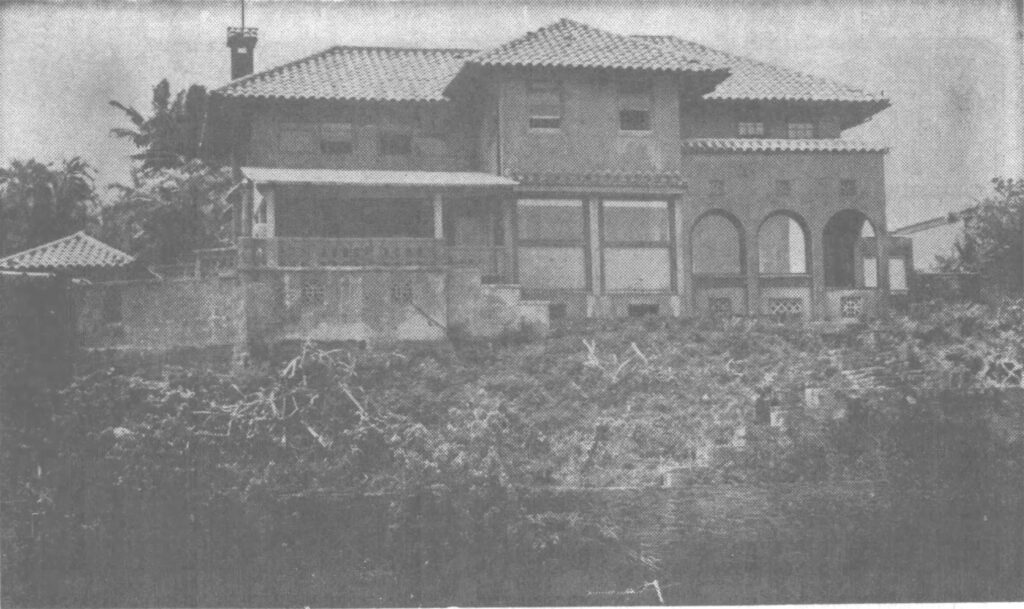
In the mid-1880s, EP Adams was marketing for sale ‘Hānaiakamalama,’ “formerly occupied by WL Green, Esq, as a private residence”.
But this isn’t just *any* house; Hānaiakamalama, also known as the Queen Emma Summer Palace, was the ‘mountain’ home of Queen Emma, wife of Kamehameha IV. (Its name is Lit., the foster child of the light (or moon) – it is also the name for the Southern Cross.)
“It was a delightful country home for Queen Emma and many a happy reunion of the family took place there. The last I remember was a great reception given to the Duke of Edinburgh when he was here in the Galatea in 1869.”
“It was one of the most memorable of the luaus for which Hawai‘i nei has obtained a worldwide reputation.” (Girvin, Pacific Commercial Advertiser, July 18, 1906)
It was through this land that Kamehameha the Great marched during what would become the Battle of the Nuʻuanu in April 1795.
Coincidently, Kamehameha was aided by foreigners, including John Young, Queen Emma’s grandfather, who provided the cannons and tactical know-how used in the battle. (Rivera)
The house was originally constructed by John George Lewis in 1848. John Young II (Keoni Ana) bought it in 1850 and named the home “Hānaiakamalama” (after a favorite family homestead in Kawaihae.) (Rivera) Queen Emma inherited it from her uncle, John Young II, in 1857.
Queen Emma was born Emma Naʻea in Honolulu on January 2, 1836, the daughter of a British aristocratic woman and a Hawaiian high chief.
She became the hānai child of Dr and Mrs TC and Grace Rooke, her mother’s sister, who had no children of their own. Emma grew up speaking both Hawaiian and English, the latter ‘with a perfect English accent.’
OK, back to the home …
A notice in the Pacific Commercial Advertiser (November 11, 1890) noted that the government Water Works department purchased Hānaiakamalama for $8,000.
It was acquired “for the special purpose of a site for establishing (water system) filter beds, and a distributing reservoir for the city, which was looked upon then as one of the much-needed public works recognized, as a public necessity by the then administration.”
“The scheme then under consideration and practically settled upon was part of the plans in connection with the storage reservoir above Luakaha, for the increased capacity of the Nuʻuanu system.” (Pacific Commercial Advertiser, April 30, 1906)
The water works plan waned and thoughts of a park at the site were considered; there was, reportedly, a proposal to tear down the house and put in a baseball diamond.
However, “Governor Carter has expressed his disapproval of the retention of the Queen Emma property in Upper Nuʻuanu valley for park purposes in a letter to the secretary of the Improvement Club in that district, which passed resolutions urging that that be done.”
“I beg to say that I do not approve of the setting aside as a public park of the Hānaiakamalama premises, for the following reasons: First. Public parks are for the relief of thickly populated districts, where the congestion is such that the residents do not have breathing spaces … “
“… Second. The taxpayers are contributing at present about all they can stand and this is not sufficient to properly take care of all those areas that are already parked.” (Carter, Pacific Commercial Advertiser, September 6, 1906)
On May 12, 1906, The Pacific Commercial Advertiser noticed, “there will be sold at Public Auction … the following certain portions of land situate in the District of Kona, Island of Oahu, TH: … The land known as ‘Hānaiakamalama’ or the ‘Queen Emma Place’ (upset price of $10,000, possession given September 1, 1906.)”
Hānaiakamalama was saved from demolition by the Daughters of Hawaiʻi.
(Daughters of Hawai‘i was founded in 1903 and is made up of women members who are directly descended from a person who lived in Hawai‘i prior to 1880. Their purpose is “to perpetuate the memory and spirit of old Hawai‘i and of historic facts, and to preserve the nomenclature and correct pronunciation of the Hawaiian language.”)
Then, the newspaper announced, “Rules and regulations bearing on Hānaiakamalama, the Nuʻuanu home of the late Queen Emma, were adopted at a meeting on Wednesday of the Daughters of Hawai‘i, which society now has charge of the home. The rules are as follows:”
“1. The object of Hānaiakamalama is to preserve articles formerly owned by the late Queen Emma and such other articles of historic interest as may be given the Daughters of Hawaii for safe keeping.”
“2. The building shall be open to visitors daily from 9 to 12 in the morning and from 2 to 4 in the after noon, excepting Sunday and other days that may be designated.”
“3. The house can only be used as a meeting place for the Daughters of Hawai‘i and cannot be engaged for any other purpose.”
“4. A fees of 25 cents will be charged all visitors, members excepted.”
“5. Visitors are requested not to handle or deface any article in the building.” (Honolulu Star Bulletin, October 19, 1916)
In addition to Hānaiakamalama, the Daughters own and maintain Kamehameha III’s birth site at Keauhou Bay, Kona. Through an agreement with the State of Hawaiʻi, the Daughters use and maintain Huliheʻe Palace in Kailua-Kona on the Big Island.
Hānaiakamalama is open to the public with self – and docent-guided tours, Tue, Thu, Fri, Sat 10 am – 3:30 pm; closed Sun, Mon, Wed & major holidays; Admission fees vary ($16-Kamaaina adult docent-led).
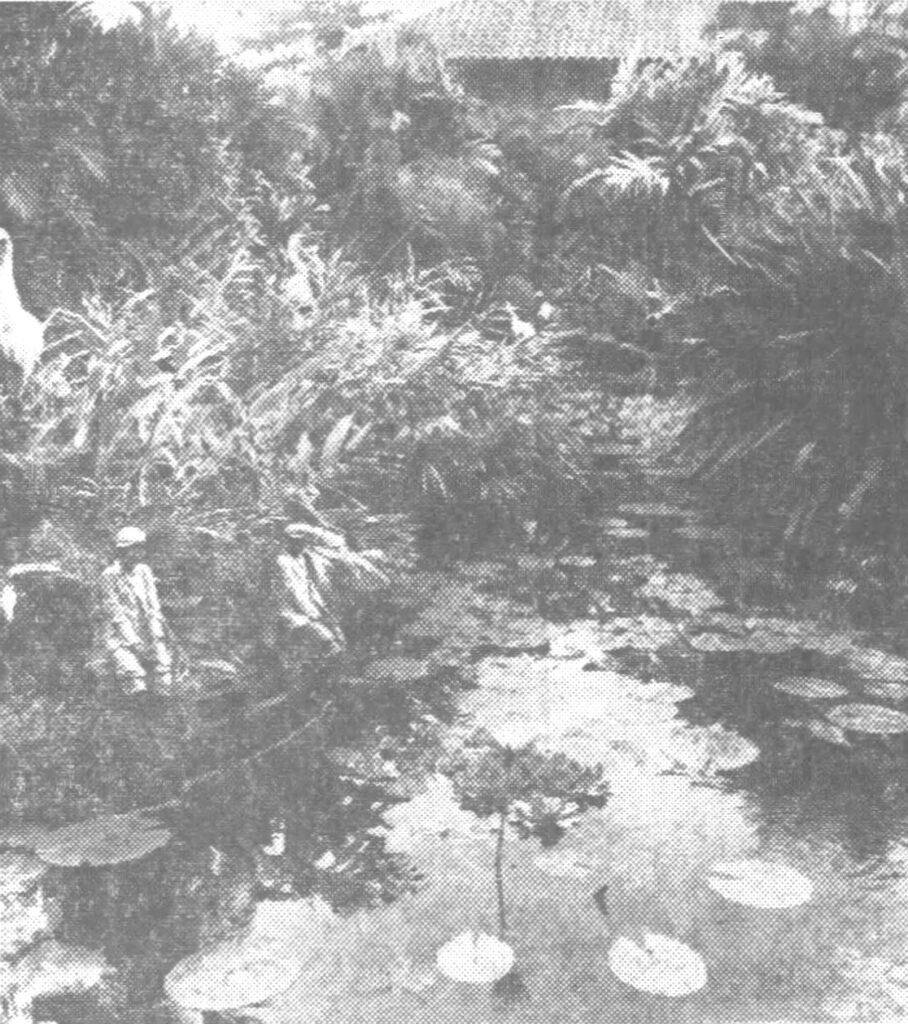
(When you are there, look over the patio to the right (as you face the entrance); you will hear and see a portion of the Paki auwai that fed the Queen’s kalo just downhill of the patio. See the attached map.)
by Peter T Young Leave a Comment
The first Royal Hawaiian Hotel was not in Waikīkī. It was in downtown Honolulu where the “One Capitol District” building now stands. By the 1900s, the Royal Hawaiian lost its guests to the newer Alexander Young hotel a few blocks away.
The downtown Royal Hawaiian was converted to a YMCA building in 1917. The building was demolished in 1926, and a new YMCA in a similar style was built in its place.
For centuries, Helumoa in Waikīkī was the home to Hawaiʻi’s royalty. Portions of this area would eventually become the home to the new Royal Hawaiian Hotel.
In the 1890s, the property was leased as a seaside annex to the downtown Royal Hawaiian Hotel located at Richards and Hotel streets.
In 1907, the Seaside Hotel opened on the property, and was later acquired by Alexander Young’s Territorial Hotel Company, which operated the Alexander Young hotel in downtown Honolulu.
In 1924, the Seaside Hotel’s lease of the land at Helumoa was soon to expire and the land’s owners (Bishop Estate) put out a request for proposals to build a hotel.
This was the time before flight; Matson Navigation Co. had luxury ocean liners bringing wealthy tourists to Hawaii – but, they needed a hotel equally lavish to accommodate their passengers at Waikīkī (at that time, the 650 passengers arriving in Honolulu every two weeks were typically staying at Hawaiʻi’s two largest hotels, the Alexander Hotel and the Moana.)
The availability of the Waikīkī land began putting wheels into motion. A new hotel was planned and conceived as a luxurious resort for Matson passengers, the brainchild of Ed Tenney (who headed the “big five” firm of Castle and Cooke and Matson Navigation) and Matson manager William Roth (son-in-law to William Matson founder of Matson Navigation.)
Castle & Cooke, Matson Navigation and the Territorial Hotel Company successfully proposed a plan to build a luxury hotel, The Royal Hawaiian, with 400 rooms on the 15-acre parcel of Waikiki beach to be leased from Bishop Estate.
The ground-breaking ceremony took place on July 26, 1925. However, the official building permits were delayed while city officials changed the building code to allow increased building heights. After $4 million and 18 months, the resort was completed.
On February 1, 1927, the Royal Hawaiian (nicknamed The Pink Palace) was officially opened with the gala event of the decade. At the same time, and associated with the hotel, the Territorial Hotel Co opened the Waiʻalae Golf Course.
Duke Kahanamoku, the legendary Olympic swimmer and surfer, frequented the Royal Hawaiian Hotel restaurants and private beachfront. The Royal Hawaiian Hotel became a favorite stomping ground for Kahanamoku’s famed group, dubbed the “Waikiki Beach Boys”.
Over the following decades, the Royal Hawaiian was THE place to stay and the Pink Palace hosted world celebrities, financiers, heads of state and the elite from around the world.
World War II, with its associated martial law and blackout measures, meant significant changes at the Royal Hawaiian. In January of 1942, the U.S. Navy signed a lease with the Royal Hawaiian to use the facilities as a rest and relaxation center for officers and enlisted personnel serving in the Pacific.
During the war, over 200,000 men stayed at the Royal Hawaiian. Each day as many as 5,500 service-related visitors (most of who were not staying at the hotel) passed through the front gates to enjoy the beach or social activities.
At the conclusion of World War II, the hotel was given a makeover to restore her to the level of luxury her guests would expect.
ITT Sheraton purchased The Royal Hawaiian from Matson in June 1959. The Royal Tower Wing was added to the existing structure in 1969. The resort was sold in 1974 to Kyo-ya Company, Ltd., with Starwood Hotels & Resorts operating it under a long-term management contract.
In 2008, the Royal Hawaiian again underwent significant renovation (to the tune of $85-million) and held its official grand reopening on March 7, 2009. The Tower section was renovated yet again in November 2010 and reopened as The Royal Beach Tower with upgraded rooms.
Why the color pink? Bob Krauss once reported that the Royal Hawaiian’s pink color is due to the typically pink-painted homes in Lisbon, Portugal.
Friends of William Roth (Kimo and Sarah Wilder) had visited Lisbon and upon returning repainted their home pink with blue-green shutters. Roth commented, “I love what you’ve done to your house. Can I paint my hotel the same color?”


by Peter T Young 1 Comment
“The ‘Wandering Minstrel’ was purchased in Hong Kong … Sailors believe in lucky and unlucky ships. I never did – but I do now. She ruined her builders; everyone that owned her, regretted it; … From the time of sailing, Friday, October the 13th, 1887, we had nothing but gales, a typhoon and ill luck ….” (Walker)
So starts the story of Captain Frederick Dunbar Walker, born in Dublin, Ireland, December 3, 1838, and his family – their misadventures aboard the ‘Wandering Minstrel’ and life in Honolulu.
“The Wandering Minstrel, a 500-ton bark, left Hong Kong on September 3, 1887, on a shark fishing expedition. It was Captain Walker’s intention to be gone a year and a half. The first port touched at was Honolulu”. (Pacific Commercial Advertiser, August 15, 1900)
“(S)he sailed from Honolulu, December 10th, 1887, on a fishing cruise, with a crew of 24 hands and 4 passengers, arrived at French Frigate Shoals on the 18th December, left same place December 27th, arrived at Midway Island, and anchored in Welles’ Harbour, Jan. 9th, 1888.”
“On February 2nd a strong wind and sea sprung up, so that she was unable to get out, and on the following day became a total loss.” (Board of Trade Wreck Report for ‘Wandering Minstrel,’ 1889)
“During their enforced sojourn on this forsaken place the Walkers existed entirely on bird’s egg, fish and a shark and a turtle which they were fortunate to capture … Sometimes the party were a week without food…”
“On the Island was found a man named Jorgensen, a Dane, who was one of the crew of the ship named the General Siegel, which had been wrecked on the Island some time before.”
“Jorgensen had murdered the captain and a man of the ‘General Siegel,’ and after the killing the crew had deserted him, having previously destroyed another boat and gone in the remaining boat to the Marshall Islands six months before the Wandering Minstrel went to pieces on the reef.” (Pacific Commercial Advertiser, August 15, 1900)
“About three months after the wreck six of the crew took the best boat we had at nighttime, and went to Green Island, and from thence the following day started for the open sea. A heavy gale set in that night, and there is no doubt all perished, as no tidings were ever heard of them.”
“Our life was one continual hunt for food. Six men left for Green Island and lived there and were never sick, though the water was a dirty greenish color, owing to decayed vegetable matter. Several of us on Sand Island, however, were ill with scurvy. Three died.” (Pacific Commercial Advertiser, October 24, 1909)
“The castaways were at last rescued by the schooner Norma, from Yokohama, engaged in shark fishing. The captain of the Norma had been told by friends of the Walkers in Yokohama to keep a sharp lookout for them, and he called at Midway Island in pursuance of what he admitted to be forlorn hope.” (Pacific Commercial Advertiser, August 15, 1900)
“Of the twenty-nine souls wrecked, six were drowned by the upsetting of a boat, one was murdered, three succumbed to the ravages of beri-beri, two died of starvation, one died on the way home and was buried at sea, and only sixteen of the original complement came back alive to Honolulu”.
“(A)mong that number are the five members of the Walker family, whose survival is all the more wonderful on account of their being the least fitting to stand the hardships endured. (Pacific Commercial Advertiser, August 15, 1900)
Walker’s three sons “have grown up with the town as enterprising and useful citizens, while he himself had been active to the last in various commercial and industrial projects.” (Honolulu Star Bulletin, November 20, 1916)
The sons are, “Frederick GE Walker (a photographer,) Henry E Walker of the Walker rice mill, and Charles D Walker who is engaged in the boat-building business here.” (Hawaiian Gazette, November 21, 1916)
The experience obviously didn’t deter the brothers from going to sea. They raced boats; Charles, “recently returned from Japan, where he had gone to challenge Japanese yachtsmen to compete for a Hawaiian cup … stating that he will race a Hawaiian-built boat in Japanese waters on certain conditions.” (Pacific Commercial Advertiser, January 13, 1904)
Son Henry showed, “The milling of rice is not confined to the Chinese, as is the cultural phase of the industry. One of the largest and most modern of the rice mills is conducted by Mr HE Walker in Honolulu.” (Hawaiʻi Experiment Station, 1906)
The three boys also left a lasting legacy to their mother, Elizabeth. Down the short Mission Lane, just below Hawaiian Mission Houses Historic Site and Museum, in the shadow of Kawaiahaʻo Church, is the ‘Elizabeth Building.) (It’s still there.)
The brothers lived on the top two floors and maintained a carriage shop on the street level. The older brick building next door (‘Mews’) served as their place of business, which included carriage and boat shops. (“Mews” is a British slang term for stables.) (Burlingame)
Another family legacy lives on … “Captain Walker once related the story to Mr Strong, a son-in-law of Robert Louis Stevenson, and it is shrewdly suspected in certain quarters that the diverting tale of “The Wrecker” is based on none other than the experiences of the survivors of the Wandering Minstrel.” (Pacific Commercial Advertiser, August 15, 1900)
Walker liked life in the Islands. “Homeward bound – for Honolulu – beautiful Honolulu, justly called the ‘Paradise of the Pacific.’ I am unable to state how many residents there are who came as visitors, either on business or pleasure, and remained permanently.”
“Many, like myself, are sea waifs, rescued from shipwreck, brought here and declined to move on, but commenced life anew, and are now well satisfied with their decision.” (Walker) Walker became a naturalized citizen on September 21, 1906.


by Peter T Young Leave a Comment
(The bill to designate Haleakala Section as a separate National Park was introduced in Congress and approved in 1960. The formal dedication for Haleakala National Park was held on July 1, 1961, at the summit in the Haleakala Visitor Center parking lot. (NPS))
Between 1934 and 1941 the Civilian Conservation Corps (CCC) operated work camps at Haleakalā. The CCC was a federally funded work relief program designed to generate income for young unemployed men during the Great Depression.
At Haleakalā National Park the CCC was engaged in a variety of projects. CCC enrollees removed invasive plants and feral animals such as pigs and goats and constructed a number of trails and structures in the park. They had a base camp at Pu‘u Nianiau.
In 1940, “the Army sought sites on both Haleakala and Mauna Loa for ‘unspecified defense installations.’ A ‘thorough’ study was referred to, but only the very tops of both peaks were surveyed. It was determined that the ‘two sites selected in the National Park offer the only sites which are suitable for these proposed defense purposes.’”
“The National Park sites were ‘not only the most suitable but also the only acceptable sites.’ The Mauna Loa site was approved by the National Park Service for Army use in November 1940, but no work was ever done there by the Army.” (Jackson)
“By April 1941, the War and Interior Departments had worked out an agreement for the use of the area. A Special Use Permit was signed on April 29, 1941, covering a six acre installation site at Red Hill, and the Army agreed to use for its base camp the Civilian Conservation Corps (CCC) camp at the 7,000 foot elevation which would be vacated by the CCC in May 1941.” (Jackson)
The Pu‘u Nianiau area of Haleakala National Park was used by the US Army as a base camp from 1941 to 1946 for facilities being operated at the summit of Haleakala.
After the Army’s departure, base camp buildings were used in 1947 for the ‘Haleakala Mountain Lodge’ by Robert “Boy” von Tempsky who held a concession with the park.
Mr. von Tempsky offered saddle and pack trips through the crater as well as bus transportation from docks, landing fields and hotels in Maui.
The name of the facility was changed to the ‘Silversword Inn’ under new operators in 1958. “Just above the park entrance, Silversword Inn, a National Park concession, offers meals, rooms, souvenirs, horseback riding and guided horseback trips into the crater.” (The silversword (ʻāhinahina) is a rare plant (one of the rarest species in the Hawaiian Islands) found on Haleakala.)
“Haleakala Crater is a favorite with those who like the back-country; its inspiring scenery and restful solitude are great reward for time and effort. The National Park Service maintains three cabins on the crater floor and 30 miles of well-marked trails for hikers and horseback parties.” (Hawaii Nature Notes, NPS Haleakala Guide, 1959)
The Silversword Inn in the park closed in 1961 (the concession agreement expired and, after a national advertisement, no one bid for the construction and operation of a new 30-room lodge. (Star Bulletin, Sept 4, 1961).
Shortly after, the news reported, “Hale Moi‘ Lodge at Kula will now be called Silversword Inn”; the property had been run by Glenn and Cathy Simons and was subsequently operated by Florence Ellis. The Elisses “formerly operated the Haleakala National Park lodging and restaurant concession as Silversword Inn.” (Honolulu Advertiser, March 16, 1962)
Just the year before, Hale Moi Lodge had “Opened on a small scale by Glenn and Kathy Simons … The first of six chalet-type studio cottages under construction has just been completed and the others will follow.” (Star Bulletin, March 27, 1961)
Then, in the early-1970s and beyond, the property was plagued with litigation – there were transfers of ownership, defaults and bankruptcy. At one point, the Court started a filing asking “Who owns the Silversword Inn?”
“This seemingly innocuous question has been litigated vigorously for nearly two decades in various bankruptcy proceedings and in the state courts of Hawaii.” (US Court of Appeals, 9th Circuit)
Later, as part of the County’s Community Plan that included the Kula area, Maui County designated the “Silversword Inn Project District 2” allowing 12-hotel units and Hawai‘i Tourism Authority, Tourism Research Visitor Plant Inventory report notes such.
But the name (and ownership) of the place changed again and searches for the old name and address (15427 Haleakalā Hwy) lead you to Kula Sandalwoods Café & Inn. It notes “Our Tradition – Hospitality 60 years of Aloha” with its restaurant and “6 comfortable hillside view cottages”.