Images of Old Hawaiʻi

  • Home
  • About
  • Categories
    • Ali’i / Chiefs / Governance
    • American Protestant Mission
    • Buildings
    • Collections
    • Economy
    • Missionaries / Churches / Religious Buildings
    • General
    • Hawaiian Traditions
    • Other Summaries
    • Mayflower Summaries
    • Mayflower Full Summaries
    • Military
    • Place Names
    • Prominent People
    • Schools
    • Sailing, Shipping & Shipwrecks
    • Voyage of the Thaddeus
  • Collections
  • Contact
  • Follow

November 14, 2019 by Peter T Young 2 Comments

Fort DeRussy

The Artillery District of Honolulu was established in 1909 and consisted of Forts Ruger, DeRussy, Kamehameha and Armstrong.  The District was renamed Headquarters Coast Defenses of Oahu sometime between 1911 – 1913.

Battery Randolph within Fort DeRussy was built between 1909 and 1911 and gained international, national, state and local significance at a time when British, French, Russian, German and even the Japanese had ships in the Pacific, and were expressing interest in Hawai‘i.

The Army mission in Hawai‘i was defined as “the defense of Pearl Harbor Naval Base against damage from naval or aerial bombardment or by enemy sympathizers and attack by enemy expeditionary force or forces, supported or unsupported by an enemy fleet or fleets.”

The Army fortified O‘ahu’s harbors with a system of gun emplacements employing mortars and long-range rifled guns.  Although its guns are gone, the old batteries are still there.

Batteries at Fort DeRussy, including Battery Randolph and Battery Dudley, were responsible for the defense of Honolulu Harbor.

In 1906, the US War Department acquired more than 70-acres in the Kālia portion of Waikīkī for the establishment of a military reservation to be called Fort DeRussy.

Back then, nearly 85% of present Waikīkī (most of the land west of the present Lewers Street or mauka of Kalākaua) were in wetland agriculture or aquaculture.

Fort DeRussy has evolved immensely when it was sold as a 72-acre parcel of “undesirable” land, to the building of Battery Randolph at the east end of Fort DeRussy in 1911, to the significant roles that Fort DeRussy played during WWII.

The Army started filling in the fishponds which covered most of the Fort – pumping fill from the ocean continuously for nearly a year in order to build up an area on which permanent structures could be built.  Thus, the Army began the transformation of Waikīkī from wetlands to solid ground.

Battery Randolph at Fort DeRussy demonstrates the shift in emphasis from fortification structures to the weapons contained therein. In contrast to the stark, vertical walls of older forts, the new works of reinforced concrete were designed to blend, so far as possible, into the surrounding landscape.

The low profile, massive emplacements all possess concrete frontal walls as much as twenty feet thick behind 30 or more additional feet of earth.  The batteries were (and still are) all but invisible and invulnerable from the seaward direction. The permanency of construction is also evident by their present condition.

In its heyday, Battery Randolph had two 14-inch guns and Battery Dudley had two six-inch guns mounted on disappearing carriages. When they were installed, they were the largest guns in the entire Pacific from California to the Philippines.

The disappearing carriages allowed the guns to remain hidden from sight of approaching battleships by solid concrete walls called parapets, capable of withstanding a direct hit from a 2,000-pound artillery shell.

To get the gun into the firing position, the artillery crew tripped a lever attached to a 50-ton weight. As the weight fell, it lifted the gun tube into battery (the firing position), and the gun was then ready to fire again.

A crew of roughly 14 artillerymen would load a shell in the breech, and then load 340-pounds of gun powder behind it.

After lobbing the 1,556-pound shells up to 14 miles out to sea, the recoil automatically pushed the gun carriage back down behind its concrete parapet; the gun was then reloaded.

A well-trained crew could fire a round downrange every 30-seconds.  As one round was impacting its mark, the second round was already half way in flight to hit the target again.

Protecting Soldiers inside the battery, the overhead concrete was up to 12-feet thick.  On the ocean side of the battery, concrete was the equivalent of 30-feet thick.

These 1890s-era weapons were very accurate.  Observation points on top of Diamond Head and Tantalus were used to triangulate the distance, direction and speed of potential adversaries via telephone to the plotting room at Battery Randolph.

The guns were capable of hitting a 20-foot target from six miles away – the equivalent of hitting a bus in Kāneʻohe (or a fly on a wall 60-feet away with a bullet the size of a pinhead, all without the aid of a computer.)

With the end of World War II came the realization that the fort was no longer capable of meeting the needs of the US military in Hawaiʻi. The giant guns were cut up and sold for scrap, having never fired a shot in anger or defense.

Battery Dudley was razed to the ground; Battery Randolph was eventually abandoned and briefly became a warehouse storage facility.  In 1976, the Army designated Battery Randolph home of the US Army Museum of Hawaiʻi.

Today, Fort DeRussy Armed Forces Recreation Center is the home of the Hale Koa Hotel (House of the Warrior,) an 817-room, world–class resort hotel and continued favorite R&R destination for our country’s military personnel and the US Army Museum of Hawaiʻi.

The museum houses a gift store that sells military memorabilia, books, clothing, military unit insignia and World War era music.

The museum is funded by the Department of Defense and admission is free of charge and open to the public, Tuesday through Saturday, 9 am-5 pm, and closed on some federal holidays, but open on military holidays.

Follow Peter T Young on Facebook 

Follow Peter T Young on Google+ 

Follow Peter T Young on LinkedIn  

Follow Peter T Young on Blogger

© 2019 Hoʻokuleana LLC

Battery_Randolph-Fort_DeRussy-(army-mil)
Target Practice by the 10th Company, CAC, with the 14-inch guns of Battery Randolph in July 1915-(CoastDefenseJournal)
Target Practice at Battery Dudley-(CoastDefenseJournal)-1938
'South Gun' at Ft. DeRussy -originally from USS New Hampshire(CharlesBugajsky)
Saratoga and Lexington off Diamond Head
One of Battery Randolph’s 14-inch M1907M1 guns on its disappearing carriage-(CoastDefenseJournal)
Loading practice at Battery Randolph, ca. 1920-(CoastDefenseJournal)
Ft DeRussy Tents ca. 1913
From 1908 until 1917 most of the troops at Fort DeRussy lived under canvas-(CoastDefenseJournal)
DeRussy Beach Waikiki-(vic&becky)-1953
BtryRandolph_14inDC_FtDeRussy-J. Bennnett Coll.
Battery_Randolph-(hiarmymuseumsoc-org)
Battery A, 16th CA, conducts a target practice with a mobile 155 mm GPF gun at DeRussy Beach-(CoastDefenseJournal)-late-1930s
Fort DeRussy is nearly complete - area north (right) is still generally undeveloped-Battery Dudley in lower center-CoastDefenseJourna)-1919
14-inDCGun_B-Randolph-JBennettColl
14-inchDCGuncrew_BtryRandolph-J. Bennnett Coll.
'North Gun' at Ft. DeRussy-originally from USS New Hampshire (CharlesBugajsky)
Battery_Randolph_1977-by_skoshi8
Battery_Randolph_by_skoshi8
OLYMPUS DIGITAL CAMERA
Army_History_Museum (anry-mil)
DCF 1.0
DCF 1.0
Fort_DeRussy-Layout

Filed Under: Military Tagged With: Fort DeRussy, Hale Koa, Battery Randolph, Battery Dudley, Hawaii, Waikiki, Army Coast Artillery Corps

November 13, 2019 by Peter T Young 1 Comment

Aloha Spirit (It’s the Law)

Pīlahi Pākī’s translation of the meaning of aloha was the genesis of the Aloha Spirit Bill adopted by the Legislature in 1986.

The Aloha Spirit is codified in Hawai‘i Revised Statutes (the Hawai‘i Laws – HRS – Chapter 5 – Section 7.5)

[§5-7.5]  “Aloha Spirit”

(a)  “Aloha Spirit” is the coordination of mind and heart within each person.  It brings each person to the self.  Each person must think and emote good feelings to others.  In the contemplation and presence of the life force, “Aloha”, the following unuhi laula loa may be used:

“Akahai”, meaning kindness to be expressed with tenderness;

“Lokahi”, meaning unity, to be expressed with harmony;

“Oluolu”, meaning agreeable, to be expressed with pleasantness;

“Haahaa”, meaning humility, to be expressed with modesty;

“Ahonui”, meaning patience, to be expressed with perseverance.

These are traits of character that express the charm, warmth and sincerity of Hawaii’s people.  It was the working philosophy of native Hawaiians and was presented as a gift to the people of Hawaiʻi.

“Aloha” is more than a word of greeting or farewell or a salutation.

“Aloha” means mutual regard and affection and extends warmth in caring with no obligation in return.

“Aloha” is the essence of relationships in which each person is important to every other person for collective existence.

“Aloha” means to hear what is not said, to see what cannot be seen and to know the unknowable.

(b)  In exercising their power on behalf of the people and in fulfillment of their responsibilities, obligations and service to the people, the legislature, governor, lieutenant governor, executive officers of each department, the chief justice, associate justices, and judges of the appellate, circuit, and district courts may contemplate and reside with the life force and give consideration to the “Aloha Spirit”.

“These are traits of character that express the charm, warmth and sincerity of Hawai‘i’s people. It was the working philosophy of native Hawaiians and was presented as a gift to the people of Hawai‘i,” said Pīlahi Pākī.

In 1917, after Queen Lili‘uokalani had seen the end of the Hawaiian monarchy, she said to her hānai daughter, Lydia K. Aholo,
“To gain the kingdom of heaven is to hear what is not said, to see what cannot be seen, and to know the unknowable – that is Aloha.  All things in this world are two: in heaven there is but One.”  (Queen Lili‘uokalani (1917))

“Aloha is the essence of God in man,” Pīlahi Pākī.

Remember, Aloha Spirit … it’s the law.

Follow Peter T Young on Facebook 

Follow Peter T Young on Google+ 

Follow Peter T Young on LinkedIn  

Follow Peter T Young on Blogger

© 2019 Hoʻokuleana LLC

Aloha

Filed Under: Ali'i / Chiefs / Governance, Hawaiian Traditions Tagged With: Hawaii, Queen Liliuokalani, Aloha

November 12, 2019 by Peter T Young Leave a Comment

Grove Farm Homestead – Kaua‘i

The decline of the whaling industry following the discovery of petroleum oil in Titusville, Pennsylvania in 1859 created a temporary economic vacuum in Hawai‘i.

Although sugar had a relatively slow start after the initial first successful sugar plantation at Kōloa, Kaua‘i (1835,) it soon started to prosper.

However, it wasn’t until the American Civil War, which virtually shut down Louisiana sugar production during the 1860s, that Hawai‘i was able to compete in a California market that paid elevated prices for sugar.

It was about this time (1864) that George Norton Wilcox (known as GN,) the second son of eight boys, born in Hilo August 15, 1839 to missionary parents, Abner and Lucy Wilcox, took over the lease for Grove Farm sugar operation on Kaua‘i and quickly became its sole owner.

The plantation had initially been chopped out of a large grove of kukui trees and was thereafter called the Grove Farm.

Initially schooled at Punahou, he then studied engineering on the mainland at the Sheffield Scientific School, now a part of Yale University; GN was an enterprising innovator of plantation sugar culture.

GN realized that his plantation lacked enough water, which is the key to successfully growing sugar.  His first major innovation was the engineering and digging of an extensive irrigation ditch, in which water was brought from the mountains to his thirsty sugar fields.

Many modernizing changes occurred throughout the plantation, from the construction of the innovative water irrigation system to the creation of new cultivating machinery and planting methods to the use of the first sugar cane seed planter in the islands.

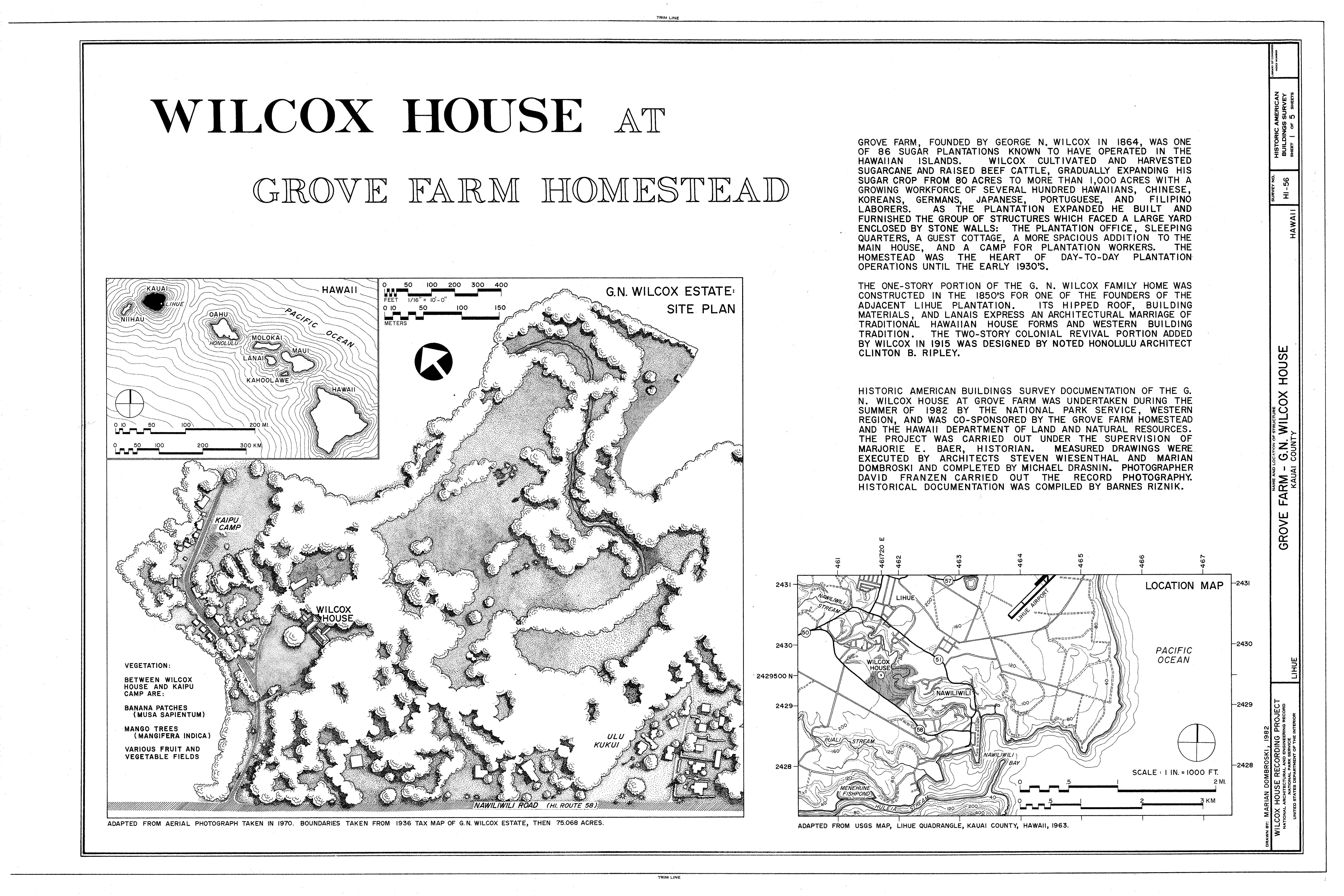
His Grove Farm Homestead was the center of operations for the developing sugar plantation and involved the relationship of family life, plantation activity, household work, gardening and farming which continue as a part of the experience of visiting Grove Farm today.

Today, the 100-acre Grove Farm Homestead preserves the earliest surviving set of domestic, agricultural and sugar plantation buildings, furnishings and collections, surrounding orchards and pasturelands in Hawaiʻi.

Grove Farm Homestead is the finest example in Hawaii of a complete plantation operation still in its original form.  The estate was added to the National Register of Historic Places listings in Hawaii on June 25, 1974.

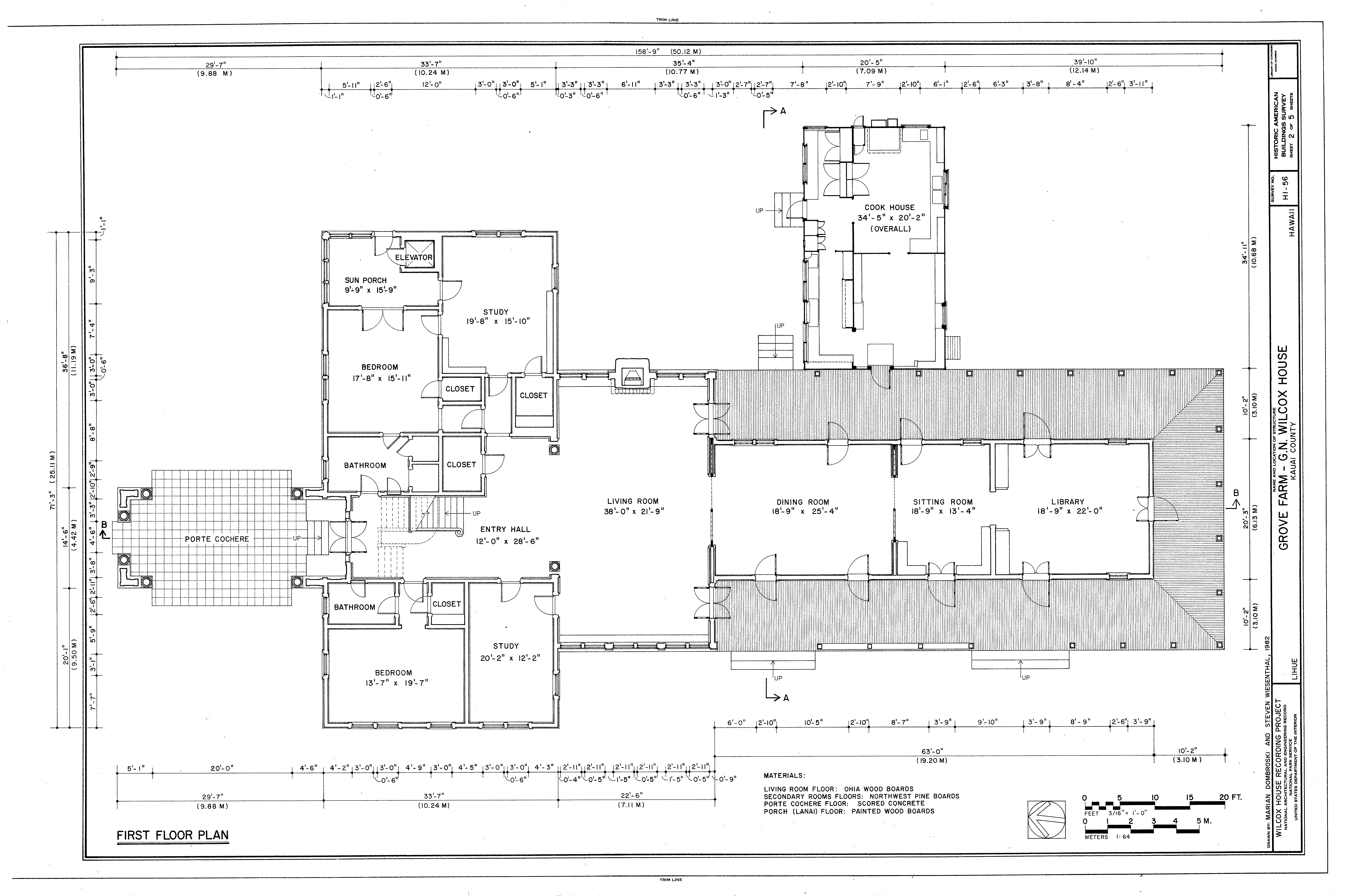
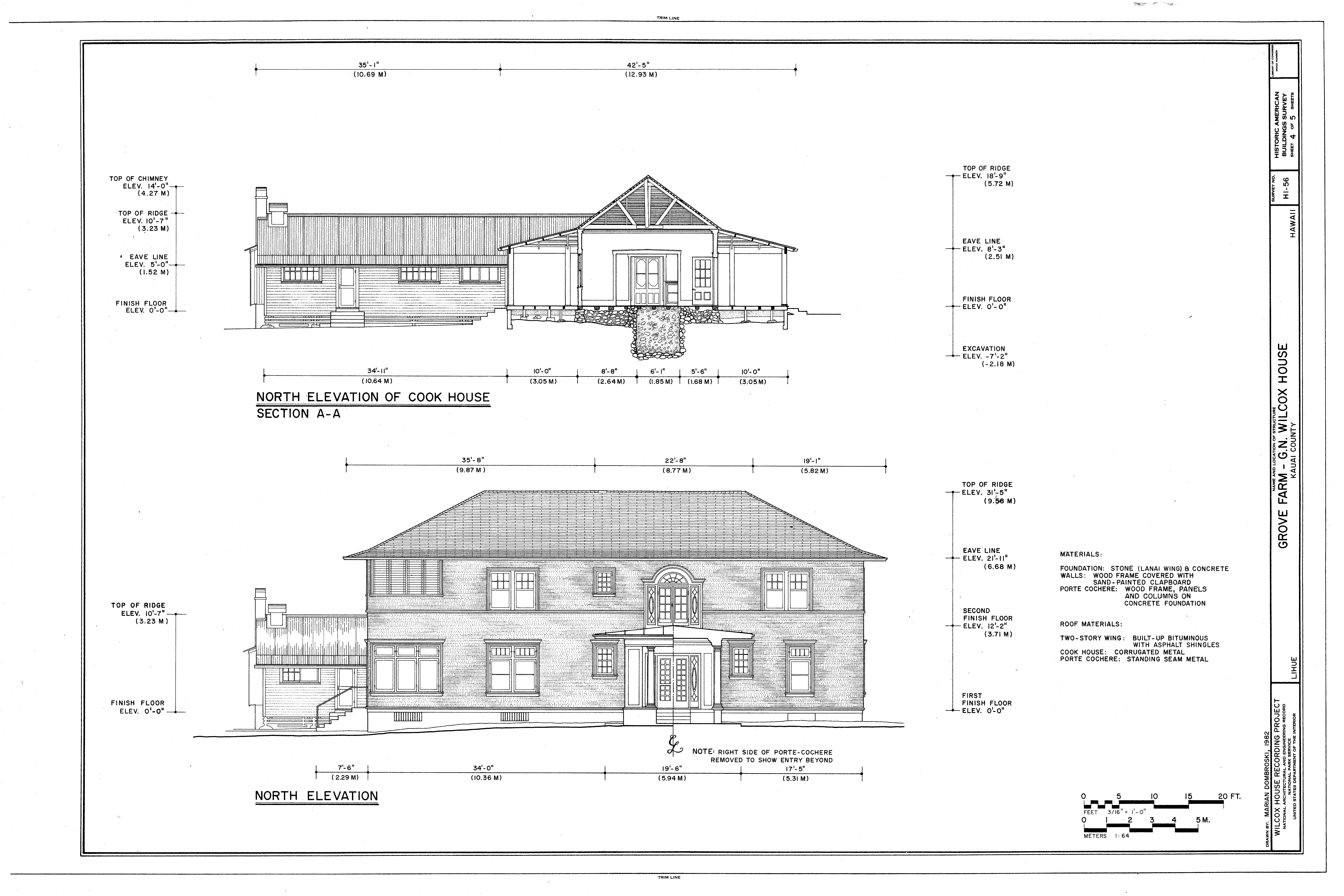
The original house (pre-dated 1854; exact date unknown) started as a single story, wood frame structure with a very high pitched hip roof with very wide eave overhand which is supported by square wood posts at the eave and covers a veranda which encircles the house on three sides.

To the rear of this building is a kitchen-food preparation building with access off the veranda.

During a 1915 renovation of the structure (under the direction of CW Dickey,) walls were removed and large openings placed adjoining each of the three rooms creating a feeling of openness and flow from one space to another.

The main estate house has two bedrooms, writing room, two bathrooms and a library on the first floor.  A grand staircase leads up to the second floor which has more bedrooms.  Behind the main house is a hexagonal gazebo styled after a Japanese teahouse, built in 1898.

To the south is a guest cottage divided into two living areas, built around 1890.  Another single story cottage was built in 1877 for GN Wilcox, and an office building was built in 1884.  A number of support buildings include a tool shed (dated 1870,) a garage and a number of small, single-story, wood-frame plantation workers’ houses.

The plantation buildings reflect a style adaptive to climatic conditions in the area (wide veranda, high pitched roofs), while the main house is a unique reminder of the 1850s renovated into the 20th Century.

Historically, Grove Farm Homestead is of great importance to Hawai‘i.  It was developed under the direction of George N. Wilcox, one of the most important men in Hawaiʻi from the 1860s to 1933, when he died at the age of 93.

GN Wilcox was not only a plantation owner; he was also an engineer, statesman, businessman and a world traveler. More importantly, he was also a philanthropist and humanist, who left an extensive legacy of endowments and public donations behind him.

The main house is now a private museum with tours by appointment.  Advance reservations are required for an unhurried two-hour guided tour of the buildings, gardens and grounds at Grove Farm.

Tours are given in small groups and are led by Kaua‘i residents familiar with life on the island, and are offered on Mondays, Wednesdays, and Thursdays, beginning promptly at 10 am and 1 pm.  There is a $20 requested donation for adults and $10 for children 5-12 years old.

A few decades ago, I had the opportunity to have a private tour of the Grove Farm Homestead with Barnes Risnik, then manager of the Grove Farm Homestead Museum.  That was an awesome and memorable experience.

Follow Peter T Young on Facebook 

Follow Peter T Young on Google+ 

Follow Peter T Young on LinkedIn  

Follow Peter T Young on Blogger

© 2019 Hoʻokuleana LLC

BEDROOM, LOWER LEVEL, LOOKING NORTHEAST-LOC
George_N_Wilcox
19991001 - George N. Wilcox. 1880? Press release photo.
19991001 – George N. Wilcox. 1880? Press release photo.
BEDROOM, SECOND FLOOR, NORTHEAST CORNER0LOC
BEDROOM, UPSTAIRS, NORTHWEST CORNER LOOKING SOUTHWEST-LOC
DINING ROOM, LOOKING SOUTHEAST, DOOR IN CENTER GOES TO LANAI AND COOK HOUSE-LOC
DRAWING ROOM, LIBRARY ON LEFT, LOOKING SOUTHWEST-LOC
grove-farm-entrance
LANAI AND ORIGINAL STRUCTURE, LOOKING SOUTHEAST-LOC
LIBRARY LOOKING NORTH TOWARD DRAWING ROOM (NOTE-THREE ENTRIES TO LIBRARY FROM OUTSIDE; LEFT, RIGHT, AND BEHIND PHOTOGRAPHER-LOC
LIVING ROOM, HIP ROOF BUILDING, LOOKING SOUTH THROUGH DINING, DRAWING ROOM-LOC
SEWING ROOM, SECOND FLOOR, SOUTHWEST CORNER-LOC
UPSTAIRS BEDROOM, SOUTHEAST CORNER, LOOKING NORTHEAST, ROOF OF LAUNDRY HOUSE CAN BE SEEN OUT WINDOW-LOC
VIEW FROM SOUTHEAST-LOC
VIEW FROM SOUTHWEST-LOC
WILCOX'S OFFICE, LOOKING NORTHWEST FROM DOOR TO LIVING ROOM-LOC
Grove_Farm-Plans-Cover-LOC
Grove_Farm-Plans-1st_Floor_Plan-LOC
Grove_Farm-Plans-2nd_Floor_Plan-LOC
Grove_Farm-Plans-N_Elevation-LOC
Grove_Farm-Plans-W_Elevation-Section-LOC
Grove_Farm-Homestead-Location-Map

Filed Under: Economy, Buildings, Prominent People Tagged With: Hawaii, Kauai, GN Wilcox, Wilcox, Grove Farm

November 11, 2019 by Peter T Young 1 Comment

11th Hour of the 11th Day of the 11th Month

World War I – known at the time as “The Great War” – officially ended when the Treaty of Versailles was signed on June 28, 1919, in the Palace of Versailles outside the town of Versailles, France.

However, fighting ceased seven months earlier when an armistice, or temporary cessation of hostilities, between the Allied nations and Germany, went into effect on the 11th hour of the 11th day of the 11th month.

For that reason, November 11, 1918, is generally regarded as the end of “the war to end all wars.”

In November 1919, President Wilson proclaimed November 11 as the first commemoration of Armistice Day with the following words:

“To us in America, the reflections of Armistice Day will be filled with solemn pride in the heroism of those who died in the country’s service and with gratitude for the victory, both because of the thing from which it has freed us and because of the opportunity it has given America to show her sympathy with peace and justice in the councils of the nations…”

The United States Congress officially recognized the end of World War I when it passed a concurrent resolution on June 4, 1926, with these words:
“Whereas the 11th of November 1918, marked the cessation of the most destructive, sanguinary, and far reaching war in human annals and the resumption by the people of the United States of peaceful relations with other nations, which we hope may never again be severed, and”

“Whereas it is fitting that the recurring anniversary of this date should be commemorated with thanksgiving and prayer and exercises designed to perpetuate peace through good will and mutual understanding between nations; and”

“Whereas the legislatures of twenty-seven of our States have already declared November 11 to be a legal holiday: Therefore be it Resolved by the Senate (the House of Representatives concurring), that the President of the United States is requested to issue a proclamation calling upon the officials to display the flag of the United States on all Government buildings on November 11 and inviting the people of the United States to observe the day in schools and churches, or other suitable places, with appropriate ceremonies of friendly relations with all other peoples.”

An Act (52 Stat. 351; 5 U. S. Code, Sec. 87a) approved May 13, 1938, made the 11th of November in each year a legal holiday—a day to be dedicated to the cause of world peace and to be thereafter celebrated and known as “Armistice Day.”

Armistice Day was primarily a day set aside to honor veterans of World War I, but in 1954, after World War II had required the greatest mobilization of Soldiers, Sailors, Marines and Airmen in the Nation’s history; and later, American forces had fought aggression in Korea, the 83rd Congress, at the urging of the veterans service organizations, amended the Act of 1938 by striking out the word “Armistice” and inserting in its place the word “Veterans.”

With the approval of this legislation (Public Law 380) on June 1, 1954, November 11th became a day to honor American veterans of all wars.

Later that same year, on October 8th, President Dwight D. Eisenhower issued the first “Veterans Day Proclamation” which stated:

“In order to insure proper and widespread observance of this anniversary, all veterans, all veterans’ organizations, and the entire citizenry will wish to join hands in the common purpose.”

“Toward this end, I am designating the Administrator of Veterans’ Affairs as Chairman of a Veterans Day National Committee, which shall include such other persons as the Chairman may select, and which will coordinate at the national level necessary planning for the observance. I am also requesting the heads of all departments and agencies of the Executive branch of the Government to assist the National Committee in every way possible.”

The first Veterans Day under the new law was observed with much confusion on October 25, 1971. It was quite apparent that the commemoration of this day was a matter of historic and patriotic significance to a great number of our citizens, and so on September 20th, 1975, President Gerald R. Ford signed Public Law 94-97 (89 Stat. 479), which returned the annual observance of Veterans Day to its original date of November 11, beginning in 1978.

This action supported the desires of the overwhelming majority of state legislatures, all major veterans service organizations and the American people.

Veterans Day continues to be observed on November 11, regardless of what day of the week on which it falls. The restoration of the observance of Veterans Day to November 11 not only preserves the historical significance of the date, but helps focus attention on the important purpose of Veterans Day:

Today, Veterans Day, is a celebration to honor America’s veterans for their patriotism, love of country, and willingness to serve and sacrifice for the common good.

To all who served, Thank You.

Follow Peter T Young on Facebook 

Follow Peter T Young on Google+ 

Follow Peter T Young on LinkedIn  

Follow Peter T Young on Blogger

© 2019 Hoʻokuleana LLC

Army-Navy-Air Force-Marines-Coast Guard-Merchant Marines

Filed Under: General, Military Tagged With: Hawaii, Veterans Day

November 9, 2019 by Peter T Young Leave a Comment

Crossroads of the Pacific

When whaling was strong in the Pacific (starting in 1819 and running to 1859,) Hawaiʻi’s central location between America and Japan whaling grounds brought many whaling ships to the Islands.  Whalers needed food and the islands supplied this need from its fertile lands.

In those days, European and East Coast continental commerce needed to round Cape Horn of South America to get to the Pacific (although the Arctic northern route was shorter and sometimes used, it could mean passage in cold and stormy seas, and in many cases the shorter distance might take longer and cost more than the southern route.)

As trade and commerce expanded across the Pacific, numerous countries were looking for faster passage and many looked to Nicaragua and Panama in Central America for possible dredging of a canal as a shorter, safer passage between the two Oceans.

Finally, in 1881, France started construction of a canal through the Panama isthmus.  By 1899, after thousands of deaths (primarily due to yellow fever) and millions of dollars, they abandoned the project and sold their interest to the United States.

After Panamanian independence from Colombia in 1903, the US restarted construction of the canal in 1905.  Finally, the first complete Panama Canal passage by a self-propelled, oceangoing vessel took place on January 7, 1914.

The Panama Canal is a 51-mile ship canal in Panama that connects the Atlantic Ocean (via the Caribbean Sea) to the Pacific Ocean. The canal cuts across the Isthmus of Panama and is a key conduit for international maritime trade.  The American Society of Civil Engineers named the Panama Canal one of the seven wonders of the modern world.

The first cargo ship passing westward through the Panama Canal to call at Honolulu was the American Hawaiian Steamship Company’s SS Missourian commanded by Captain Wm. Lyons, on September 16, 1914.

By 2008, more than 815,000 vessels had passed through the canal, many of them much larger than the original planners could have envisioned; the largest ships that can transit the canal today are called Panamax.

OK, so what does this have to do with Hawaiʻi?

In 1893, the Rev. Sereno Bishop of Hawaiʻi spoke of the commercial relationship between Hawaiʻi and the future isthmian canal:  “Honolulu is directly in the route of a future part of heavy traffic from the Atlantic to the Pacific which is waiting for the creation of a canal.  Trade to and from China and Japan will use the canal route.”

“Impending commerce using the future canal will have serious importance to the political relations of the Hawaiian Kingdom. Honolulu will be a convenient port of call for China-bound California steamers.”

“The opening of the canal will increase Hawaii’s importance as a coaling and general calling station. Tremendous new cargoes of supplies that will cross the Pacific, because of the canal, will need shelter and protection at a common port of supply – Honolulu.”  (Historic Hawaii Review)

In 1900, Alfred Thayer Mahan, a US Navy flag officer, geostrategist and historian (called “the most important American strategist of the nineteenth century,”) believed that the American line of communications to the Orient was by way of Nicaragua and Panama, as that of Europe was by the Suez.

Mahan saw that the Caribbean, areas surrounding the future canal, Hawaiʻi and the Philippines composed the strategic outposts for the future isthmian canal.

Mahan also stated, “Whether the canal of the Central American isthmus be eventually at Panama or Nicaragua matters little to the question at hand…. Whichever it be, the convergence there of so many ships from the Atlantic and Pacific will constitute a centre of commerce”.  (Hawaii Historical Review)

In 1912, this strategy and declaration was claimed in an article in ‘Paradise of the Pacific’ that Hawaiʻi was truly deserving of the name, “Crossroads of the Pacific”.

The Chamber of Commerce of Hawaiʻi promoted the idea, naming its early-1900s official publication “Honolulu At the Crossroads of the Pacific.”

Testimony in Washington, DC, in 1915, noted that the opening of the canal would affect Hawaiʻi in two ways: traffic to and from the Orient would use Hawaiʻi as a way-station for supplies and instructions; and Hawaiʻi would also be a destination for freight, passengers and tourists.

Later, when Navy Commander John Rodgers and his crew arrived in Hawaiʻi on September 10, 1925 on the first trans-Pacific air flight, they fueled the imaginations of Honolulu businessmen and government officials who dreamed of making Hawaiʻi the economic Crossroads of the Pacific, and saw commercial aviation as another road to that goal.

Two years later on March 21, 1927, Hawaii’s first airport was established in Honolulu and dedicated to Rodgers.

1959 brought two significant actions that shaped the present day make-up of Hawai‘i, (1) Statehood and (2) jet-liner service between the mainland US and Honolulu (Pan American Airways Boeing 707.)

Follow Peter T Young on Facebook 

Follow Peter T Young on Google+ 

Follow Peter T Young on LinkedIn  

Follow Peter T Young on Blogger

© 2019 Hoʻokuleana LLC

Kau Kau Corner sign
Kau Kau Corner sign
Crossroads_of_the_Pacific-sign-(hawaii-gov)
Panam_Canal-(NEH)
Panama_Canal_Map
Crossroads_of_the_Pacific_sign-(whishingonastar)
My beautiful picture
Crossroads_of_the_Pacific_sign-at Arizona_Memorial-(whishingonastar)
MYDC0049.JPG
MYDC0049.JPG
Panama_Canal_under_construction,_1907
Kroonland_in_Panama_Canal,_1915
Panama-Canal
Panama_Canal
Pan_Am-707-at_Honolulu_Airport
Great_Circle_Sailing_Chart
29th_Infantry_Brigade_distinctive_unit_insignia-blue-cross-is-suggested-by-Hawaiis-nickname-Crossroads-of-the-Pacific.
29th_Infantry_Brigade_sleeve_insignia-blue-cross-is-suggested-by-Hawaiis-nickname-Crossroads-of-the-Pacific

Filed Under: Military, Sailing, Shipping & Shipwrecks, Economy Tagged With: Chamber of Commerce, Kau Kau Corner, Arizona Memorial, Hawaii, Whaling, Honolulu International Airport, Rodgers Airport, John Rodgers, Panama Canal, Crossroads of the Pacific, Crossroads

  • « Previous Page
  • 1
  • …
  • 376
  • 377
  • 378
  • 379
  • 380
  • …
  • 680
  • Next Page »

Images of Old Hawaiʻi

People, places, and events in Hawaiʻi’s past come alive through text and media in “Images of Old Hawaiʻi.” These posts are informal historic summaries presented for personal, non-commercial, and educational purposes.

Info@Hookuleana.com

Connect with Us

  • Email
  • Facebook
  • LinkedIn
  • Twitter
  • YouTube

Recent Posts

  • Liquids Coordinator
  • Lāhainā Canal
  • Boondocks
  • About 250 Years Ago … Battle of Kings Mountain
  • Cow Laws
  • Palea and the Pinnace
  • Yick Lung

Categories

  • Ali'i / Chiefs / Governance
  • Buildings
  • Missionaries / Churches / Religious Buildings
  • Hawaiian Traditions
  • Military
  • Place Names
  • Prominent People
  • Schools
  • Sailing, Shipping & Shipwrecks
  • Economy
  • Voyage of the Thaddeus
  • Mayflower Summaries
  • American Revolution
  • General

Tags

Albatross Al Capone Ane Keohokalole Archibald Campbell Bernice Pauahi Bishop Charles Reed Bishop Downtown Honolulu Eruption Founder's Day George Patton Great Wall of Kuakini Green Sea Turtle Hawaii Hawaii Island Hermes Hilo Holoikauaua Honolulu Isaac Davis James Robinson Kamae Kamaeokalani Kameeiamoku Kamehameha Schools Lalani Village Lava Flow Lelia Byrd Liberty Ship Liliuokalani Mao Math Mauna Loa Midway Monk Seal Northwestern Hawaiian Islands Oahu Papahanaumokuakea Marine National Monument Pearl Pualani Mossman Quartette Thomas Jaggar Volcano Waikiki Wake Wisdom

Hoʻokuleana LLC

Hoʻokuleana LLC is a Planning and Consulting firm assisting property owners with Land Use Planning efforts, including Environmental Review, Entitlement Process, Permitting, Community Outreach, etc. We are uniquely positioned to assist you in a variety of needs.

Info@Hookuleana.com

Copyright © 2012-2024 Peter T Young, Hoʻokuleana LLC

Loading Comments...