Images of Old Hawaiʻi

  • Home
  • About
  • Categories
    • Ali’i / Chiefs / Governance
    • American Protestant Mission
    • Buildings
    • Collections
    • Economy
    • Missionaries / Churches / Religious Buildings
    • General
    • Hawaiian Traditions
    • Other Summaries
    • Mayflower Summaries
    • Mayflower Full Summaries
    • Military
    • Place Names
    • Prominent People
    • Schools
    • Sailing, Shipping & Shipwrecks
    • Voyage of the Thaddeus
  • Collections
  • Contact
  • Follow

February 26, 2023 by Peter T Young Leave a Comment

Kenichi Maehara

“After 20 years of service as clerk in the Hilo post office, K Maehara will retire to private life at the end of this month.  He is leaving the postal service on account of impaired eyesight and will devote his entire attention to the management of the Camera Craft Shop at Kamehameha Ave.” (Star Bulleting, May 21,1921)

Born in Japan on April 2, 1880, Kenichi (also Kenzo) Maehara was a prominent Hawaiian photographer who owned the Camera Craft Shop in Hilo.  He also held the photography concession in the Hawai‘i National Park (now known as the Hawai‘i Volcanoes National Park.

He built and operated the Volcano Photo Studio adjacent to the on-site hotel, the Volcano House, near what is today’s Kīlauea Visitor Center.  (He also operated an “up-to-date portrait studio” in the Osorio building in Hilo.

Maehara specialized in developing, printing, enlarging, coloring, and framing pictures, photographs, and lantern slides of park and island scenes. He also sold postcards, some from photographs taken by others.

Maehara came to Hawai‘i from Hiroshima, Japan in 1896 and over his 30-year career grew to become a renowned and respected local businessman whose photos of volcanic eruptions were published and distributed around the world.

He photographed the Kilauea 1924 eruption; then, Mauna Loa (“Long Mountain”) began erupting at 6:20 pm on November 21, 1935.

Lava flows from Mauna Loa were generally fast-moving and voluminous.  Lava moved relentlessly at a rate of five-miles each day; it pooled up between Mauna Kea and Mauna Loa at about where the Saddle Road is situated.

The ponded lava eventually began to follow the lay of the land, a natural drainage … Then, things “got interesting.”  Lava was heading directly toward Hilo. (USGS)

Dr. Thomas A Jaggar Jr, the government volcanologist, estimated that the flow would reach Hilo by January 9, 1936. He suggested using dynamite to collapse lava tubes near the source of the flow in order to stop or divert it.

Explosives were first suggested as a means to divert lava flows threatening Hilo during the eruption of 1881.  However, Jaggar’s plan of mule teams hiking the explosives up the mountain would take far too long – the lava flows were moving a mile a day.

It was suggested to use US Army Air Corps bombers to precisely deliver explosives. Jaggar agreed, and the call was made. The US Army Air Corps approved, and the mission and plans to strategically bomb Mauna Loa were set into motion.

Maehara took photos of the lava bombing on request from the director of the Hawaiian Volcano Observatory.  Ironically the same photos that were commissioned by the US government.

As it turned out, after the Japanese military attack on Pearl Harbor on December 7, 1941, Maehara was arrested and detained under suspicion of disloyalty to the United States.  Evidence used against him included photos he took of the 1935 US military bombing of a Mauna Loa lava flow. 

Because of this and his participation in the local Japanese community, Maehara was declared a security threat. Army intelligence officers discovered a significant amount of cash at his premises as well as a large number of pornographic pictures, which, apparently, he had sold regularly to visiting soldiers.  (Chapman)

Maehara was sent to detention facilities in Honolulu, and he was later transferred to an internment camp in the state of New Mexico.

Shortly thereafter, the newspaper reported, “The permit of K Maehara to operate a photographic concession in the Kilauea section was cancelled December 31 and will not be renewed. Mr Maehara, a Japanese alien, is interned by the authorities.” (Star Bulletin, August 12, 1942)

With the photography concession canceled on December 31, 1941, the Park’s chief clerk deposited the former concessioner’s cash; NPS employees removed his equipment to a vacant park residence, and boarded up the concession building for the time being.  (Chapman)

In 1943, while he was still interned, Maehara’s Volcano Photo Studio was demolished. He would never return to the national park in an official capacity.

He returned to the Islands. In 1950, Kenichi and his wife Matsue Maehara changed their names to Yokoyama (Honolulu Advertiser Sep 25, 1950) Daughter Masako Yokoyama received her PhD from Yale in 1949; she married Floyd G Lounsbury and joined her husband teaching at Yale. (Lots here is from NPS.)
© 2023 Ho‘okuleana LLC

Filed Under: Economy, Prominent People Tagged With: Volcano, Hawaii Volcanoes National Park, Kenichi Maehara, Volcano Photo Studio, Camera Craft Shop, Hawaii

January 13, 2023 by Peter T Young Leave a Comment

1960 Kapoho Eruption

The eruption in Kilauea Iki had ended on December 21, but the shallow reservoir beneath the summit of Kilauea volcano was gorged with magma. Rather than removing pressure, the eruption had, for all intents and purposes, created more.

The end of 1959 was an uneasy time for the staff at the Hawaiian Volcano Observatory.  During the last week of the year, a swarm of earthquakes started in Pāhoa (more than 1,000 earthquakes were recorded by the Pāhoa station on January 12.)

The 1960 Kapoho eruption and its predecessor, the 1959 summit eruption in Kilauea Iki Crater, together formed a summit-flank sequence. The Kapoho eruption caused havoc in lower Puna, an idyllic rural community until the lava fountains and flows covered farm land and villages.

The size and frequency of the earthquakes increased; at 8 am, January 13, the ground was severely cracked along the fault through Kapoho town.  Movement along the fault was literally pulling the town apart.

The ground was constantly shaking. The roughly 300-residents undertook voluntary evacuation, which was completed by early evening.  At 7:35 pm, January 13, 1960, a red glow above Kapoho confirmed the start of the eruption.

Within half an hour, fountaining was nearly continuous along a nearly ½ – mile long fissure.  After a couple hours, the activity focused with central fountains – for the next 11-hours powerful steam blasts roared from the vents.

The resulting fallout coated everything with a thin film of fine, wet, glassy ash. Salt crystals formed as the water evaporated; they testified to the brackish nature of the groundwater.

By noon on January 14, the steam blasts had ended and lava fountaining was confined to many sources along a 650-foot long section of the fissure.  An ʻaʻa flow, 18-feet thick and nearly 1,000-feet wide reached the ocean – a bench formed 300-feet beyond the old shoreline.

In an attempt to save Warm Springs, bulldozers pushed a rock dike; shortly after, lava overtopped it and filled the pool.

Kapoho, a bit uphill of the fissure, was near all this activity but had not been touched by lava. Pumice and lava were wreaking havoc on nearby homes and farms (papaya, coconut, orchid and coffee groves.)

ʻAʻa continued to enter the ocean; it was also spreading southward.  Bulldozers worked in forming a barrier to protect Kapoho, Kapoho School, an area of expensive homes and real estate at Kapoho Beach Lots.  By January 20, lava had reached the barrier and overtopped it on January 23; a second barrier was shoved aside on January 27.

A third barrier held the flow, but lava then moved underground, beneath the end of the barrier, emerging near Kapoho School. The buildings began to burn at 10 am and the school was lost shortly after noon.

The barrier itself remained intact, and it survived until February 5, when it was finally overtopped and almost totally buried by lava that eventually covered the Kapoho cemetery.  More coastal houses were lost.

Despite notable developments in the vent area, Kapoho village remained virtually intact except for a blanket of pumice and ash that covered everything.

For seven hours on the afternoon of January 27, the heaviest pumice fall of the entire eruption rained down on the area during strong kona winds.

However, it was the lava flow that would doom the town.

Late that night, the rapidly moving ʻaʻa flow moved through the streets, overwhelmed building after building. By midnight January 27, most of Kapoho had been destroyed; a couple days later (January 30) the town was gone.

The eruption ended slowly. Dribbles of lava continued to enter the sea north of Cape Kumukahi as late as February 13. High fountains continued until February 15, when lava was spraying upward from the main vent area to heights of 600-feet.  It gradually subsided and on the morning of February 19, the eruption stopped.

Volcanologists concluded that the Kapoho eruption was tied to events at Kilauea’s distant summit.  On January 17, four days after the Kapoho eruption had started, the summit began to subside (deflate, by analogy with a balloon) as magma was leaving the storage reservoir and heading down the east rift zone to the Kapoho area.

The eruption was the first during the modern era of volcano monitoring at Hawaiʻi Volcanoes Observatory. As a result, probably more fundamental ideas were reached from it than from any other single eruption in Hawaiʻi.

The main lesson, and really the only one that bears repeating over and over again, is clear. What happened then will happen again. That lesson should never be lost.  (All information here is from USGS.)

© 2022 Hoʻokuleana LLC

Filed Under: General, Place Names Tagged With: Volcano, Warm Springs, Waiwelawela, Puna, Kapoho, Cape Kumukahi, Pahoa, Kilauea Iki, Kilauea, Hawaii

December 20, 2022 by Peter T Young Leave a Comment

Three Volcano Pioneers of the Mid-19th Century Hawaii

“Keep and publish careful records, invite the whole world of science to co-operate, and interest the business man.” (Jaggar)

The efficiency of an institution which is essentially educational and not commercial, productive of ideas rather than dollars, must be measured by its effect on productive men of learning in stimulating them to production; that is, to new discovery, experiment investigation and publication.

The founding of the Volcano Observatory and the formation of the group of subscribers here called the “Research Association,” were themselves evolved productions of the inspiring work of early investigators, as well as of the natural intellectual stimulus created in man by the unexplained Kilauea lake of boiling nebulous flux.

Three names stand out above all others as recorders of the work of the Fire Goddess in Hawaii in the middle decades of the nineteenth century : Titus Coan, James Dwight Dana, and William Lowthian Green.

Coan the missionary, earnest seeker after truth, for more than a third of the century watched every detail of the evolution of the volcanoes, pondered their meaning, and moreover made truthful record in scores of letters which were promptly published.

This genius for recording is rare among men, and is an all-important requirement in science; many men are good observers, but millions of valuable observations are forever lost, because of a lack of appreciation of the value of a jotting down – day, hour, minute, event, stages, appearances.

All science is no more than a categoric jotting-down, and the grouping of facts into new categories, until some of these reach the dignity of “theory.”

Coan without apparatus or endowment was an institution, a first Hawaiian volcano observatory, and in actual output he was a better observer and recorder than some institutions which have been elaborately equipped.

Professor Dana of Yale, foremost American geologist, was with the Wilkes Expedition at Kilauea in 1840, revisited Hawaii later, and wrote in 1891 a book, “Characteristics of Volcanoes,” which stands preeminent among volcano memoirs.

It was inspired by Kilauea and Mauna Loa, but is broad and sane, and presents a most painstaking and thoughtful summary of the progress of Hawaiian volcanic events, and their bearing on geology. Dana published in New Haven Coan’s letters, and it was doubtless Dana who stimulated much of Coan’s recording.

Green, the man of business, in his leisure moments student of volcanic life and of the inspiring heights and depths of the globe, conceived: to scale, with its film of waters and its blanket of gas, wrote a remarkable book in two volumes, “Vestiges of the Molten Globe.”

His second volume deals especially with the volcanoes, which he visited many times, and of it Professor Daly of Harvard writes: “It is certainly a pity that the second part of Green’s work is not more generally known. The book is almost as remarkable a contribution to the philosophy of vulcanism as Part 1, ‘On the Tetrahedral Theory of the Earth,’ is important in cosmogonic philosophy.”

Green’s work foreshadowed theoretic conceptions which modem thought has fixed more firmly, and his interest, as a business man, in the affairs of pure science was forerunner of the wider interest of many business men (and intelligent women) of Hawaii who now make up the Hawaiian Volcano Research Association.

These three men, Coan and Green resident here, Dana from an eastern university, typify the reason for the creation of an Hawaiian Volcano Observatory, and their portraits should forever hang in honored place upon its walls.

Coan, the systematic observer, showed the value of record and system; Green, the merchant, fascinated by the spell of Pele and inspired by the problems of position of this mid-Pacific pinnacle, Hawaii, rising 37,000 feet above the ocean deep, adopted volcanology for avocation, and left monumental work to inspire specialist and layman alike.

While Dana the scholar, coming from a distant seat of learning, hospitably entertained in the islands by Coan, Green, Bishop, Brigham, Alexander and a host of kind friends, rewarded their kindness by making famous to the whole world the achievements of his Hawaiian scientific colleagues.

Dana added new volcano lore and illustrated what production may come from scientific hospitality. (All here is copied from Special Bulleting of Hawaiian Volcano Observatory, 1913, as stated by Thomas Jaggar.)

© 2022 Ho‘okuleana LLC

Filed Under: Missionaries / Churches / Religious Buildings, Place Names, Prominent People, General Tagged With: Hawaii, Volcano, Titus Coan, James Dana, William Green

December 9, 2022 by Peter T Young Leave a Comment

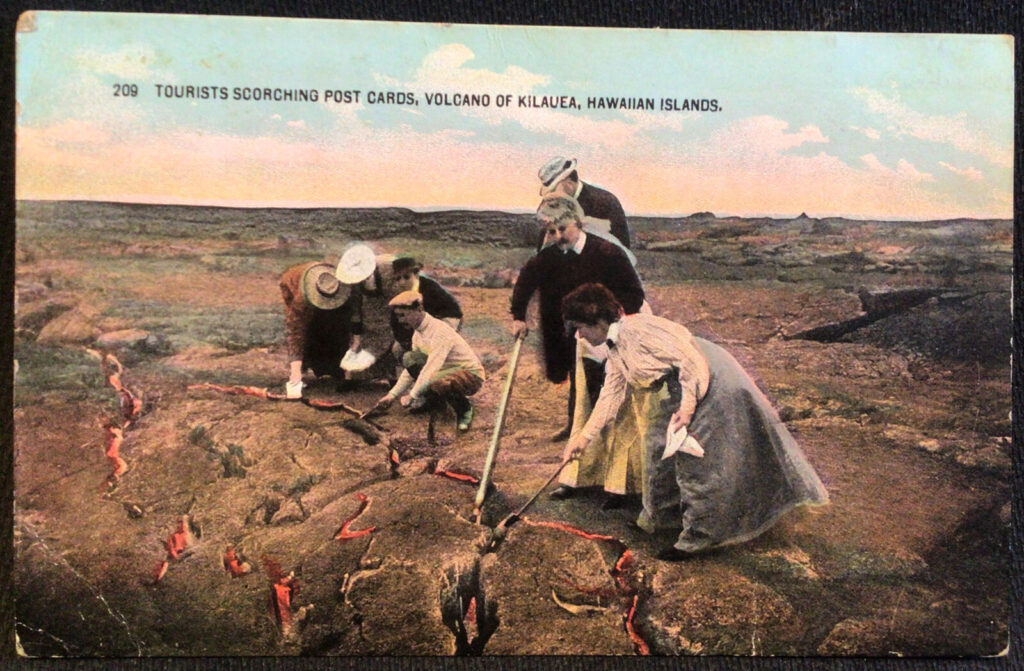
Scorching Post Cards

According to Thrum, the first white man to stay overnight in Kilauea Caldera was CS Bartow, the postmaster of Lahaina on Maui, visiting Hawaii. Bartow suggested the nighttime excursion to his fellow travelers, and while they decided against the idea, the postmaster could not be dissuaded.

In 1898, Lorrin Thurston owner of Volcano House and head of the Hawai‘i Promotion Committee (forerunner to the Hawai‘i Visitors and Convention Bureau) worked closely with the Inter-Island Steam Navigation Company to create an excursion business from Honolulu to his hotel at Kīlauea.

Although he sold his interest in Volcano House to hotelier George Lycurgus (1858–1960) in 1904, Thurston continued to promote Kīlauea and Hawai‘i’s other natural sites.

Thurston helped with the establishment of the Hawaiʻi National Park, an entity to encompass both Kīlauea and Haleakalā.  Hawai‘i’s new National Park, established August 1, 1916, was the thirteenth in the new system and the first in a US territory.  (Chapman)

Visiting Hawaii’s volcanoes in the late nineteenth and early twentieth centuries – both before and after their designation as a National Park in 1916 – was an adventurous experience.

From Hilo, travelers had the choice of two routes to the volcanic craters; they could travel the entire thirty miles via automobile or take the railroad for twenty-two miles and a car for the remaining eight. The tourists’ destination at the crater was often Volcano House.

The majority of guidebooks from the late nineteenth century list the best time to hike the caldera as midafternoon because it provided visitors with both safe sightseeing in daylight and a closer look at Halema‘uma‘u Crater’s lava glowing in the evening.

Most travelers preferred visiting the crater in guided groups, and – armed with food, supplies, and postcards provided by Volcano House – trekked down the caldera’s well-marked trail and enjoyed lava-formed wonders.  (Chisholm)

“Visitors to Kilauea Caldera used to take sport in lowering sticks with food or souvenirs into the fissures.  Some enjoyed a dinner of eggs and potatoes cooked by the volcano, while others scorched postcards to mail back home.”  (Alice Kim)

“A unique entertainment tendered us was a dinner served within five feet of the pit. Lumber to build table and benches had been brought down on the backs of horses.”

“An excellent meal was served, everything being cooked at the hot cracks on the crater. This is a favorite method of visitors, many of whom make steaming hot coffee over the cracks …” (Congressional Party in Hawaii, May 1907)

“[T]he sulphur and steam cracks in the crust were especially hot, prompting tourists to lower sticks holding food and souvenirs into the fissures. Many tours enjoyed a dinner of eggs and potatoes cooked by the volcano’s heated vents, while others brewed coffee”. (Postal Museum)

“These cracks can be found at many places for some distance around the pit. … Nothing quite so elaborate had ever been attempted here before.”

“The desolate grandeur of the place was impressive and the weird surroundings made a scene such as one will seldom look upon in a lifetime.” (Congressional Party in Hawaii, May 1907)

“In letters written about his own experience at Kilauea in 1907, Pennsylvania Representative Ernest Acheson remarked that, ‘An excellent meal was served, everything being cooked at the hot cracks on the crater … and the weird surroundings made a scene such as one will seldom look upon in a lifetime.’” (Postal Museum)

© 2022 Ho‘okuleana LLC

Filed Under: General Tagged With: Volcano, Post Card, Scorching, Hawaii Island

October 5, 2022 by Peter T Young Leave a Comment

Hawaiian Volcano Research Association

“Keep and publish careful records, invite the whole world of science to co-operate, and interest the business man.” (Jaggar, 1913)

In contemplating the formation of a volcano observatory in Hawai‘i, Thomas Jaggar enlisted support from the Chamber of Commerce and the leading citizens of Honolulu.

In 1909, subscriptions were started by personal interview through the agency of Mr. Thurston and volunteer solicitors, after a lecture on volcanoes by Professor Jaggar, delivered at the University Club of Honolulu. A generous response came from a number of organizations and individuals.

The Chamber of Commerce appointed a committee to seek subscriptions in June, 1909.  These were: Charles M. Cooke, Ltd., C. H. Cooke, Acting Director; Inter-Island Steam Navigation Co., Ltd., James A. Kennedy, General Manager; Mr. W. G. Irwin; Kilauea Volcano House, Ltd., E. W. Campbell, Treasurer; Hilo Rail Road Co., Lorrin A. Thurston, General Manager; Hawaiian Promotion Committee; Mr. George Wilcox; Mr. Aug. Knudsen and the Bishop Museum.

The founding of the Volcano Observatory and the formation of the group of subscribers called the “Research Association,” were themselves evolved productions of the inspiring work of early investigators, as well as of the natural intellectual stimulus created in man by the unexplained Kilauea lake of boiling nebulous flux.

October 5, 1911, at a well-attended meeting in the University Club, Honolulu, an informal organization of the Research Association was adopted and placed in the hands of a committee consisting of L. A. Thurston, chairman; A. F. Judd, representing the trustees of the Bishop Museum; President J. W. Gilmore, representing the College of Hawaii; C. H. Cooke, treasurer of the association; J. A. Kennedy.

Mr. Thurston at this meeting pointed out that there should be no break in the collection of records at Kilauea so well started by Mr. Perret, and suggested that a committee of five be appointed with power to act, to draw up a form of organization and to solicit subscriptions to help cover daily operations.

The persons who signed the subscription list of 1909 had been interviewed and had mostly expressed themselves as willing to renew their subscriptions. He reviewed the history of the observatory movement and then suggested that a voluntary, unincorporated, local organization be formed, to secure funds to carry on volcanic research; such funds to be administered and expended by an unpaid executive committee of five to be annually elected by the association.

The meeting of October, 1911 put the money-raising in the hands of the committee of five, and the estate of CM Cooke, Ltd. became guarantor of a fund of $5,000 annually, the actual subscriptions in Hawaii at first amounting to some three-quarters of that sum.

Mr. Jaggar by personal interviews raised $2,800 additional in 1912, assisted by a new subscription blank approved July 10, 1912, by the Honolulu Chamber of Commerce. In January of that year he had raised $1,785 in Hilo through the energetic assistance of Mr. Demosthenes Lycurgus, with the approval of the Hilo Board of Trade, this money being for the Observatory building.

A few small gifts have been made for special purposes such as the motorcar and certain specimens destined for the Bishop Museum.

The subscriptions are partly for five years, but many are renewable from year to year. Their motto was Ne plus haustae aut obrutae urbes (No more shall the cities be destroyed).

President Gilmore mentioned the many unsolved problems at the volcanoes and the necessity for continuous and concerted effort to collect data. He pointed out the extensive instrumental equipment which would be necessary and agreed for the College of Hawaii to give such assistance as its rules would permit.

Mr. Judd expressed great interest on the part of the Bishop Museum and undertook to investigate thoroughly what funds could be used to this end under the trust deed of that Institution.

Mr. C. H. Cooke, president of the Bank of Hawaii, deplored the multiplicity of organizations in Honolulu and expressed the belief that it would be to the welfare of all concerned if the Massachusetts Institute of Technology (MIT) would take the scientific responsibility of the work.

Governor Frear cited two main propositions as involved in the plan of work of the proposed Volcano Research Association, one concerning the scientific value of the work and the other the advertising of the Islands to the world.

He did not know whether the government could assist but it might profitably be brought before the legislature. He thought the project would be heartily endorsed by the Hawaiian members.

Mr. T. Clive Davies expressed the hope that the scientific motive would greatly dominate the publicity idea as he feared the “blighting hand of commercialism” would seriously interfere with good research.

The net result of this meeting was to establish an association for the private subscription of money to volcano research.  Through this, the Hawaiian Volcano Observatory was formed.

According to its constitution, the name of this Association shall be the Hawaiian Volcano Research Association. The objects of this Association shall be:

  • To encourage and promote investigation of and research concerning volcanoes and volcanic phenomena, and all matters connected therewith or incidental thereto;
  • To establish and maintain an observatory at the Volcano of Kilauea, with subordinate stations at other points, from which investigation and research may be conducted, and at which records may be made and kept for the information of all, subject to the rules of the Association;
  • To invite scientific institutions and observers to make use of the buildings, apparatus and facilities of the Association, subject to the rules of the Association, and, so far as possible, to assist such institutions and observers in carrying on their work;
  • To promote the publication and dissemination of knowledge concerning volcanology and allied subjects, and to accumulate literature, photographs, models, maps and specimens, relating thereto, for the information of all, subject to the rules of the Association.

Membership was open to Any person, corporation, association or institution signing an application blank, whose name may be approved by the Board of Directors and who shall pay the dues prescribed by the Constitution, shall thereby become a member of the Association.  (The membership dues shall be $5.00 per annum, payable annually in advance.)

Those who contribute to the support of the Association other than or in addition to the membership dues, shall be known as ”Patrons” of the Association.

The Hawaiian Volcano Observatory (HVO), in operation from July 1, 1912, under the direction of the Department of Geology of the Massachusetts Institute of Technology, in part, received initial funding from trustees of the Estates of Edward and Caroline Whitney.

The Whitney Fund provided $25,000 to the Massachusetts Institute of Technology where the principal and interest of the fund was for the conduct of research or teaching in geophysics.

MIT cooperated with the Hawaiian Volcano Research Association by becoming its largest subscriber for the five years, through the income of the Whitney fund and other payments.  The Research Association’s funding support continued for several decades.

By December 1915, with Jaggar having worked in Hawai‘i for three years, the Research Association and MIT sent him to Washington DC to appeal to Congress to take over HVO as a government institution. In addition, the governor of Hawai‘i and the Honolulu Chamber of Commerce asked him to continue to push for the establishment of a national park. (Moniz Namakura)

The US Geological Survey (USGS) has operated HVO continuously since 1947.  Before then, HVO was under the administration of various Federal agencies – the US Weather Bureau, at the time part of the Department of Agriculture, from 1919 to 1924; the USGS, which first managed HVO from 1924 to 1935; and the National Park Service from 1935 to 1947.

It currently operates under the direction of the USGS Volcano Science Center, which now supports five volcano observatories covering six US areas – Hawaiʻi (HVO), Alaska and the Northern Mariana Islands (Alaska Volcano Observatory), Washington and Oregon (Cascades Volcano Observatory), California (California Volcano Observatory), and the Yellowstone region (Yellowstone Volcano Observatory). (Information here is from various documents of USGS, HVO and NPS.)

© 2022 Ho‘okuleana LLC

Filed Under: General, Economy Tagged With: Volcano, Kilauea, Lorrin Thurston, Hawaiian Volcano Research Association, Hawaiian Volcano Observatory

  • « Previous Page
  • 1
  • …
  • 3
  • 4
  • 5
  • 6
  • 7
  • …
  • 9
  • Next Page »

Images of Old Hawaiʻi

People, places, and events in Hawaiʻi’s past come alive through text and media in “Images of Old Hawaiʻi.” These posts are informal historic summaries presented for personal, non-commercial, and educational purposes.

Info@Hookuleana.com

Connect with Us

  • Email
  • Facebook
  • LinkedIn
  • Twitter
  • YouTube

Recent Posts

  • Sybil’s Rocking Chair
  • Overthrow
  • Foodland
  • Kauhale
  • Story of the American Soldier
  • Order of Kamehameha I
  • Maunalei Sugar

Categories

  • Place Names
  • Prominent People
  • Schools
  • Sailing, Shipping & Shipwrecks
  • Economy
  • Voyage of the Thaddeus
  • Mayflower Summaries
  • American Revolution
  • General
  • Ali'i / Chiefs / Governance
  • Buildings
  • Missionaries / Churches / Religious Buildings
  • Hawaiian Traditions
  • Military

Tags

Albatross Al Capone Ane Keohokalole Archibald Campbell Bernice Pauahi Bishop Charles Reed Bishop Downtown Honolulu Eruption Founder's Day George Patton Great Wall of Kuakini Green Sea Turtle Hawaii Hawaii Island Hermes Hilo Holoikauaua Honolulu Isaac Davis James Robinson Kamae Kamaeokalani Kameeiamoku Kamehameha Schools Lalani Village Lava Flow Lelia Byrd Liberty Ship Liliuokalani Mao Math Mauna Loa Midway Monk Seal Northwestern Hawaiian Islands Oahu Papahanaumokuakea Marine National Monument Pearl Pualani Mossman Quartette Thomas Jaggar Volcano Waikiki Wake Wisdom

Hoʻokuleana LLC

Hoʻokuleana LLC is a Planning and Consulting firm assisting property owners with Land Use Planning efforts, including Environmental Review, Entitlement Process, Permitting, Community Outreach, etc. We are uniquely positioned to assist you in a variety of needs.

Info@Hookuleana.com

Copyright © 2012-2024 Peter T Young, Hoʻokuleana LLC

Loading Comments...