Images of Old Hawaiʻi

  • Home
  • About
  • Categories
    • Ali’i / Chiefs / Governance
    • American Protestant Mission
    • Buildings
    • Collections
    • Economy
    • Missionaries / Churches / Religious Buildings
    • General
    • Hawaiian Traditions
    • Other Summaries
    • Mayflower Summaries
    • Mayflower Full Summaries
    • Military
    • Place Names
    • Prominent People
    • Schools
    • Sailing, Shipping & Shipwrecks
    • Voyage of the Thaddeus
  • Collections
  • Contact
  • Follow

August 10, 2024 by Peter T Young Leave a Comment

Pōhakuloa CCC Camp

In 1876, the legislature passed “An Act for the Protection and Preservation of Woods and Forests” in response to water crisis in Honolulu due to deforestation and decrease in stream flow Nuʻuanu Stream, the main source of water for Honolulu. 

In 1882, the first government tree nursery was established to provide tree seedlings for reforestation of mauka lands above Honolulu. 50,000 tree seedlings are planted on the denuded slopes of Tantalus (Honolulu). (DLNR-DOFAW)

In 1903, the Hawaii Territorial Legislature passed Act 44 establishing the Board of Agriculture and Forestry, predating the USDA Forest Service by one year. Act 44 expanded on the Forestry Act of 1876 and provided the legal vehicle for the creation of reserves encompassing private as well as public lands.

The Forest Reserve System was created by the Territorial Government of Hawai’i through Act 44 on April 25, 1903.  It was cooperative arrangement between the Hawai‘i Sugar Planters Association and the territorial government.

Plantations needed wood for fuel, but they also needed to keep the forests intact to draw precipitation from the trade winds, which in turn fed the irrigation systems in the cane fields below. (DLNR-DOFAW)

The first Territorial forester, Ralph S Hosmer, suggested that the forest had been declining in the uplands as a result of fire, grazing and insects. In order to preserve the forest, it was necessary to keep the ungulates out. From 1924 to 1926 hundreds of thousands of pigs, sheep, cattle and goats were reportedly removed from Hawaii’s Territorial forests.

But the planters were also worried about hunters in the woods starting fires from their camps. Likewise, the commercial ranchers were also wary of individual hunters who could also shoot cattle from the ranch.  (Peter Mills)

Then the US economy took a hit … after a decade of national prosperity in the Roaring Twenties, Americans faced a national crisis after the Crash of 1929. The Great Depression saw an unemployment rate of more than twenty-five percent in the early 1930s. (pbs)

As a means to make work Franklin Delano Roosevelt authorized the New Deal; the Civilian Conservation Corps (CCC) succeeded the Emergency Conservation Work agency, which started in 1933. In 1939, the CCC became part of the Federal Security Agency. (It was eliminated in 1943.) (UH Mānoa)

The purpose of the CCC and its predecessors was to provide employment in forestry and conservation work. It “brought together two wasted resources, the young men and the land, in an effort to save both.” (NPS)

From FDR’s inauguration on March 4, 1933, to the induction of the first CCC enrollee, only 37 days had elapsed. The goals of the CCC according to the law were: “1) To provide employment (plus vocational training) and 2) To conserve and develop ‘the natural resources of the United States.’”

By the end of the third year, there were 2,158-CCC camps in the nation and 1,600,000-men had participated in the program. (NPS)

There were five primary CCC camps built in Hawaiʻi (the CCC Compound at Kokeʻe State Park, the most intact today; what is now a YMCA camp at Keʻanae on Maui; a research facility on the Big Island; Hawaiian Homes Property with only two buildings remaining on the Big Island; and part of Schofield Barracks in Wahiawa on Oʻahu.) Other temporary campgrounds were spotted in work areas around the Islands. (NPS)

While the first 57 CCC enrollees on Hawaiʻi Island began working in 1934, it was not until June of 1935 the first CCC camp was established (in Hawai‘i National Park – as Hawai‘i Volcanoes National Park was originally called), which housed 200 enrollees.

The territorial foresters’ camp at Keanakolu was expanded into a Civilian Conservation Corps (CCC) field camp. All of these buildings are still standing today.

Additional camps were also constructed around Mauna Kea Forest Reserve boundaries to house crews of CCC enrollees. In 1935, a CCC camp was at Pōhakuloa.  It included a cluster of buildings and tents that included a recreation/ dining hall, two bunkhouses, two cottages, seven cabins, and seven outbuildings.

Pu‘u Pōhakuloa is a cinder cone overlooking the PTA headquarters area on the Saddle Road.  Pōhakuloa means long stone.  It also refers to a deity of the forest lands that extended across Mauna Loa towards Mauna Kea. Pōhakuloa, the deity, was a form of the akua Kū, a lover of Poliʻahu, a patron of canoe makers, and in his human form an ʻolohe expert and woodworker,

The hill gives its name to the respective Pōhakuloa references in this area.  One early name was associated with a Civilian Conservation Corps (CCC) camp in this area.

The Civilian Conservation Corps (CCC) undertook fencing, road building and visitor facilities on Mauna Kea.  The CCC built a stone cabin at Hale Pōhaku, which gained its name (house of stone) from that structure. The cabin at Hale Pōhaku provided a shelter for overnight hikers, hunters and snow players.

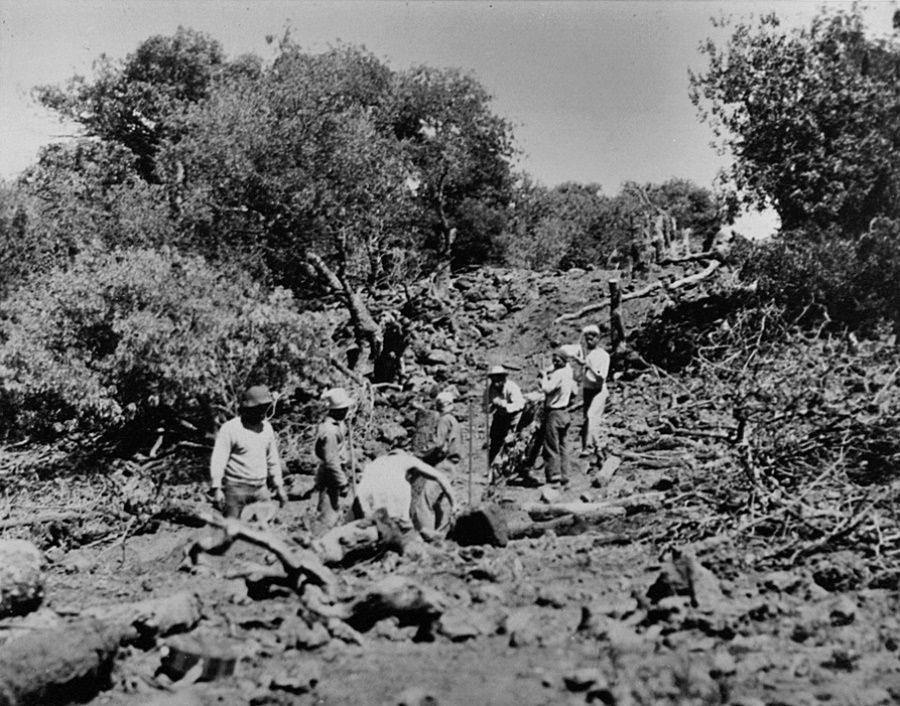
In 1935-36, as part of the effort to eradicate wild sheep from the mountain, the CCC took on the project of building a fence around the Mauna Kea Forest Reserve (over 60 miles of fencing).  Sheep drives were then carried out in an attempt to eliminate the sheep from the reserve.

The CCC brought water down to Pōhakuloa from a mountain spring … “The CCC days … Up the gulch, up on the mountain, remember, they tapped one of the springs up there …”

“Yes, they had one of the pipes going up.  You can see the pipe when you go, it’s coming down.” (Jess Hannah; Maly) “[T]hat water for Pōhakuloa, there’s a spring, Hopukani Spring.  CCC boys built the pipeline.” (Davd Woodside; Maly) The spring provided a “continuous supply of pure water.” (Bryan; ASM) (Spring water is no longer used; water is trucked in from Hilo or Waimea.)

The advent of World War II brought an end to the CCC program, as the remaining manpower and funding for the program were redirected toward the war effort.

By July 1, 1942, all Territory of Hawaiʻi CCC camps were closed, transferred to the military, or abandoned.  The Army operated Camp Pōhakuloa between 1943 and 1945.  The army also took over the old CCC camp house at Pōhakuloa and used it during the war.

After the end of the CCC programs and World War II, the old CCC facilities at Pōhakuloa were primarily used by staff of the Territorial Divisions of Forestry, Fish and Game including lodging by sheep and bird hunters or by other members of the public seeking recreational accommodations.

“Sheep hunters usually gather at Pohakuloa, the lodge maintained by the Hawaiian Board of Forestry and Agriculture. Here they spend the night under piles of blankets (because of the 6,500 foot elevation, the nights are almost always cold) and start out before sunrise for the mountain ridges.”

“They climb to the ten thousand foot elevation, where wild sheep and goats are in abundance. The Board of Forestry encourages hunting, as the animals have caused serious erosion by eating vegetation, and some authorities believe that the sheep and goats will never be entirely exterminated.”

“In its desire to provide hunting facilities, the Territory maintains not only Pohakuloa lodge, with its bedding accommodations for fifty people, but smaller lodges at Kemole and Kahinahina.” (Paradise of the Pacific, May 1948; Maly)

In 1954, the Division of Territorial Parks was created, and the former CCC facilities became part of Pōhakuloa Park, also called “Pohakuloa Hunting Lodge”.

The division began a series of improvements that would eventually replace the existing CCC cabins with all new buildings. (No physical evidence of the original CCC structures remain, as they were removed by 1968.)

In August 1962, DLNR’s Division of State Parks officially assumed all responsibility for administering these facilities and booking overnight accommodations. Forestry, Fish and Game staff continued to use a number of older structures.

The transformation of the Pōhakuloa CCC camp into the Pōhakuloa Park and later Mauna Kea State Recreation Area happened between 1961 and 1970.

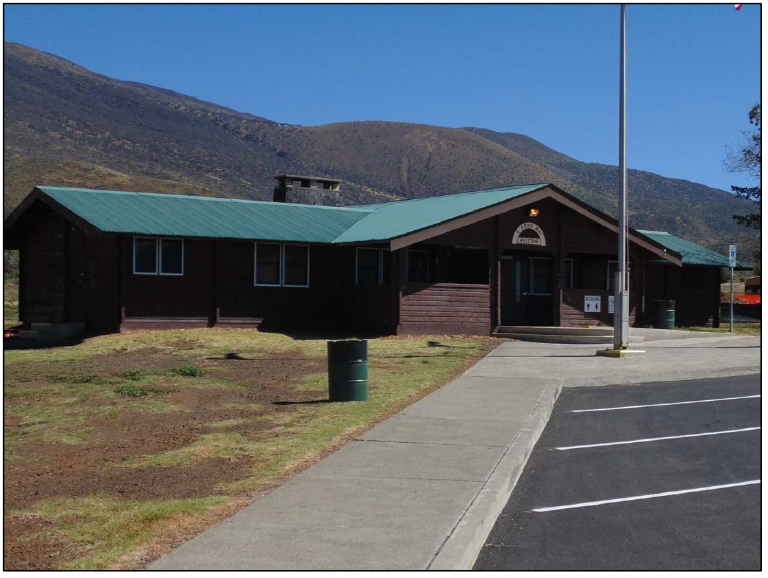
The first of these improvements was a picnic area south of the Saddle Road from the CCC cabins. In 1961, major improvements to the Park began with the addition of new cabins. The first three cabins, variously called the “Housekeeping,” “Family,” or “Vacation” cabins, were built northeast of the former CCC complex, followed by two more the following year.

These five identical cabins, built on post-and-pier foundations, were prefabricated cedar structures manufactured by Loxide Structures of Tacoma, Washington. The cabins were roofed with cedar shakes and were replaced with corrugated metal in 1989.

Each of these cabins was named after a native Hawaiian plant as illustrated by a wooden plaque near its door with the plant name. In 1963, the existing comfort station was built, using a combination of fir, pine, and hollow tile.

A new headquarters building, caretaker’s cabin, and a storage building were constructed. Each of these were pre-fabricated by Pan-Abode Company in Washington State. The buildings are tongue-in-groove cedar log cabins built on post-and-pier foundations and roofed with cedar shakes.

The two “Family” cabins (now the ADA accessible cabins) were also built near the cluster of vacation cabins on the other side of the recreation area. These cabins, like the other new buildings, were prefabricated tongue-ingroove cedar kit cabins supplied by the Pan-Abode Company.

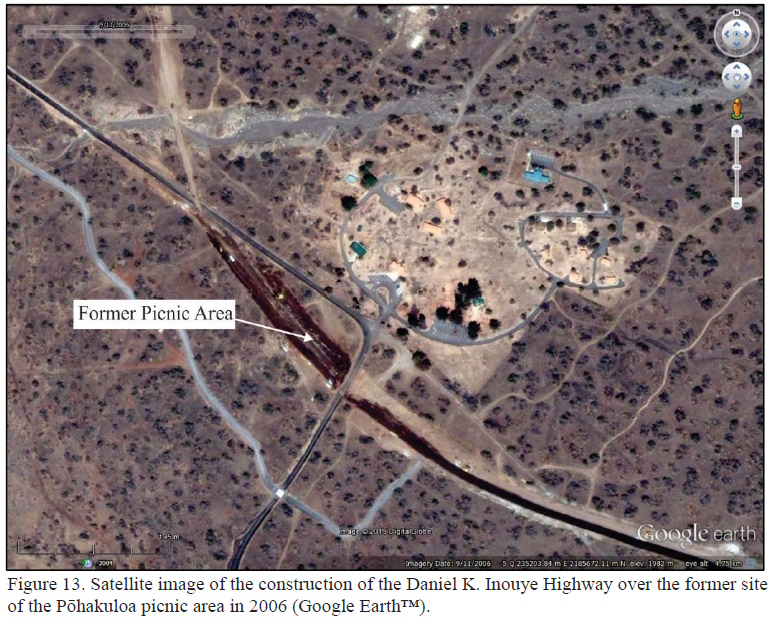
With the construction of the Comfort Station, the park’s picnic area was relocated from south of Saddle Road to its present location.

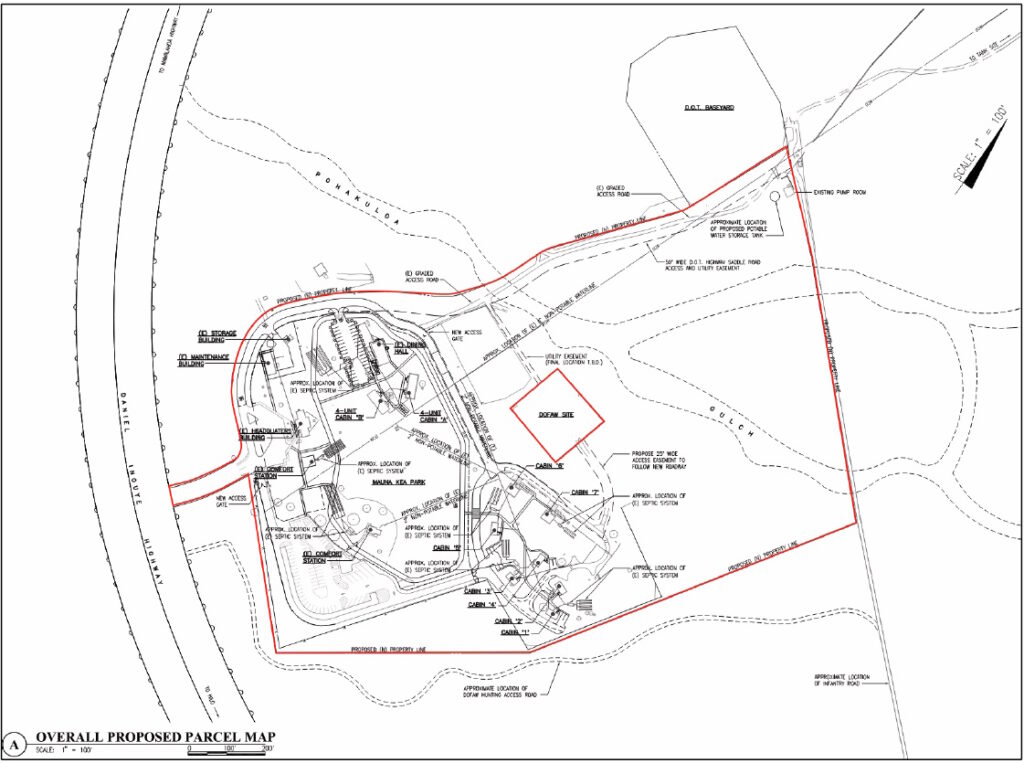
At its meeting on March 28, 2014, BLNR approved the management transfer of the State Park to the Department of Parks and Recreation, County of Hawai‘i; and approved the withdrawal of the park area from the Mauna Kea Forest Reserve and set aside to the County for park purposes.

The park was renamed Gilbert Kahele Recreation Area in 2019.  The late Hawai‘i Island State Senator, Gilbert Kahele, “worked just down the road from the recreation area for 34 years as Director of the Public Works Division at the Pōhakuloa Training Area.”

“When he served in the state legislature he was instrumental in achieving park improvements by way of the transfer of the management to Hawai‘i County.” (Kahele; DLNR Release) Lots here is from Cultural Surveys, ASM and Rosendahl.)
© 2024 Ho‘okuleana LLC

Filed Under: Economy, General, Buildings, Place Names, Prominent People Tagged With: Gilbert Kahele, Hawaii, Mauna Kea, Civilian Conservation Corps, CCC, Pohakuloa, Pohakuloa Training Area

July 20, 2024 by Peter T Young Leave a Comment

Ka Houpo o Kāne

E ui aku ana au ia oe,
Aia i hea ka Wai a Kane?
Aia i lalo, i ka honua, i ka Wai hu,
I ka wai kau a Kane me Kanaloa
He waipuna, he wai e inu,
He wai e mana, he wai e ola,
E ola no, ea!

One question I ask of you:
Where flows the water of Kane?
Deep in the ground, in the gushing spring,
In the ducts of Kane and Loa,
A well-spring of water, to quaff,
A water of magic power-
The water of Life!
Life! O give us this life!
(Emerson; Unwritten Literature of Hawaii)

Precipitation includes rain, snow, and fog drip. Evapotranspiration is the water that is either evaporated directly into the atmosphere or that which is used by plants and transpired back into the atmosphere. Runoff is the component that contributes to streamflow.

Groundwater recharge is the component of precipitation that percolates into the subsurface and is not lost to the atmosphere via evapotranspiration.  (Intera)

Fresh water travels down into the earth through a process called percolation. On the Hawaiian Islands, water first percolates through soil, if present, then through porous volcanic rock to the water table within the lava. (BWS)

During the volcanic eruptions that created the Hawaiian Islands, molten rock beneath the surface flowed up from the center of the volcanoes; dikes formed when magma stopped flowing to the surface, then cooled over time to form dense, nonporous rock.

Fresh water percolating down between the dikes compartment becomes trapped between the nearly impenetrable walls of the dikes. The water can only escape when its level rises and overflows the walls of the dike, or when great internal pressure causes leakage. Sometimes a freshwater spring will form above ground when such water spews from a dike. (BWS)

Sometimes percolating water becomes trapped when it meets layers of fine volcanic ash or clay-like soil that occur between the remnants of Hawaii’s ancient underground lava flows.  This perched water can no longer seep downward, so it collects and moves sideways, sometimes appearing as a spring (BWS)

“Ka-houpo-o-Kāne (literally, The-bosom-of Kāne), is the sacred region of Mauna Kea (between the 10,000 – 11,000 foot elevation), in which are found the springs fed by Ka-wai-hū-a-Kāne; by a rivulet from Waiau to the head of Pōhakuloa Gulch.” (“Houpokāne is mistakenly written Hopukani on most maps dated after 1900.”) (Maly)

Ka Houpo o Kāne represents the springs of the island of Hawaii. (Vredenburg)  “The area identified as Ka-houpo-o-Kāne is situated below Waiau, on the southwestern slopes of Mauna Kea, in the land of Ka‘ohe.”

“The god Kāne is believed to be foremost of the Hawaiian gods, and is credited with creation, procreation, light, waters of life, abundance, and many other attributes.”

“A land being likened to the chest of Kāne, can imply that the land was cherished and blessed by the god Kāne. … SN Hale‘ole’s tradition of Lā‘ie-i-ka-wai (In Kū ‘Oko‘a 1862-1863), records that “Kahoupokane” was one of three companions of Poli‘ahu. The other two companions were Lilinoe and Waiau.”

“The area identified as Ka-houpo-o-Kāne is situated below Waiau, on the southwestern slopes of Mauna Kea, in the land of Ka‘ohe.” (Maly)

“One of the primary attributes of Kāne are the wai ola (life giving waters), sacred springs and water sources made by Kāne around the islands, to provide for the welfare of the people and the land). Interestingly, at Kahoupo-o-Kāne are found the waters of Pōhakuloa, Hopukani, and Waihū (also known by the name “Ka-wai-hū-a-Kāne”).   (Maly)

“A spring on the southern side of the mountain, called ‘Wai Hu,’ is believed by the natives to be connected with [Lake Waiau].” (Pacific Commercial Advertiser, Sep 14, 1892)

“The few small springs on the glaciated peak of Mauna Kea in Hawaii are fed by ground water perched on and in glacial drift deposits. Their presence is note-worthy because of the light they throw on geologic history and on hydrologic principles rather than for the amount of water produced.”

“Springs in Hawaii fall into two chief categories: (1) high-level springs fed by ground-water bodies perched on or confined by intrusive bodies, ash beds, or modem or ancient soils and (2) basal springs fed from a great body of ground water which is kept in hydrostatic balance with sea water at a few feet above sea-level.” (Wentworth & Powers)

“Conditions on Mauna Kea favor rapid percolation of most rain and meltwater from the winter snow. Toward higher elevations rock-weathering becomes progressively more physical in type.”

“The largest springs on Mauna Kea are found at several points in the Waihu branch of Pohakuloa Valley, on the southwest slope between 8,900 and 10,400 feet.”

“The upper part of the Waihu springs area forms, in summer, a notably green little valley with many small patches of lush grass quite in contrast to the almost complete barrenness of the surrounding terrane, which is above timber line.”

“In the area to the east and up the slope from the springs are numerous small heaps of pre-European stone adz workings.  Certain lava caves contain evidence of habitation, suggesting that the springs were frequented by adz workers.”

“In addition to these larger springs there are some dozens of smaller seeps where trickling water or greener vegetation shows the emergence of small amounts of ground water.” (Wentworth & Powers)

© 2024 Ho‘okuleana LLC

Filed Under: Hawaiian Traditions, Economy Tagged With: Spring, Hawaii, Mauna Kea, Pohakuloa, Water, Houpo O Kane, Ka-wai-hu-a-Kane, Kahoupokane

July 26, 2023 by Peter T Young 1 Comment

Pōhakuloa

“E ku a mu mu.” (Be still! It is a god!)

“In ancient time women when they were to become Mothers made a pageant of love and ambition to this stone (Pōhakuloa) giving a Mohai (offering) laying before this God a fish called Hilu and emblem of gentleness, graceful, and good disposition in the child.”

“The fish Hilu was accompanied with the leaves of the Lama (a very large wood used in building houses for the Gods), and Emblem of wisdom, ambition and brightness for the child, Lamalama a torch (a beacon of light.)” (Montano – Galioto)

Pukui says it’s a “Large stone believed to bless expectant mothers and endow children with strength and wisdom.”  “The Pōhakuloa stone … was worshipped by Hawaiian women who prayed for their children to have wisdom and strength.”  (Aluli & McGregor)

About 1830, Queen Ka‘ahumanu ordered that a wall should be built from Punchbowl past Punahou to keep cattle from the inland residential areas. The stone wall also marked a path across Makiki that was first called Stonewall Street (it’s now known as Wilder Avenue.)

The Queen wished to form a gateway at Punahou School through this wall, and wanted two large stones on each side of the gate.

The stone would not move at first, so a kahuna was consulted.  The kahuna suggested that a lūʻau, or feast, be prepared with certain foods. After the lūʻau, the stone was moved easily to its new spot.

“My father had great difficulty in persuading them to move a large stone, which they revered as a Kupua, or local deity.  This was to be placed at one side of the upper gate as a part of the wall. It was considered very dangerous to move a Kupua, and disaster was almost sure to follow.”

“The workmen believed that the rock would remain stationary and refuse to be up-rooted, but it was displaced without any calamity and dragged by a team of oxen to the gate.”  (Rice, The Friend, March 1924)

“The stone was to be transported from the northeastern slope of Round Top (near the former home of Mrs. FM Swanzy). Its sacred nature required that ‘So sacred was Pōhakuloa that none but the king himself could sanction its removal and for that ceremony even the presence of the king was necessary, stripling though he was.'” (Damon, The Friend, March 1924).

“The big rock was exhumed from its bed (on the west side of the road leading to Manoa Valley, opposite the old “Cow Pen”) and rolled upon a framework of ship’s spars. The young King (Kamehameha III) then seated himself upon the apex of the rock, and gave the word of command …”

“… when rock, King and all were lifted upon the shoulders of the hulumanus – numerous as ants tugging at a kernel of corn – and carried down to its place.”  (Damon, The Friend, March 1924)

Pōhakuloa was shaped like a “mammoth taro leaf.”  Originally nine feet in length, the rock stood seven feet above ground and two below.

“(T)he huge lava boulder that stood guard at the Punahou gate. A monumental pyramid it seemed, towering upward in grim majesty, – probably ten feet.”

“A challenge it was to enterprising boys, with an instinct to decorate scenery with their initials, to climb its dizzy heights and leave their sculptured letters on the only “Walhalla” within reach.”  (Weaver, The Friend, March 1924)

“This rock was a curiosity about twelve feet high, and weighing several tons, and of the shape of a mammoth kalo. Often have I climbed to its top and eaten my lunch from my tin-pail thereon, and to my childish imagination it seemed as high as a church-tower.”  (Judd, The Friend, March 1924)

In 1854-59, Pōhakuloa, too large to move, was broken into pieces because it stood in the way of a road widening project.  A remainder of Pōhakuloa still stands at Punahou’s front gate.

“The other part of the stone … was given to a Japanese consul living at the corner of Beretania and Makiki streets. Kapiʻolani Maternity Home was later built at this site and some believe that the mana (divine power) of this pōhaku was a factor in its siting.”  (Aluli & McGregor)

Reportedly, there is another significant stone at Punahou, called Keapopo.  The story suggests it and Pōhakuloa would call to each other: “You come over here,” “No, you come here.”  (Manoa Heritage)

The image shows a remnant of the once larger Pōhakuloa at the Punahou School entrance (the plaque states “Punahou School Founded 1841”.)

© 2023 Hoʻokuleana LLC

Filed Under: Missionaries / Churches / Religious Buildings, Schools Tagged With: Kaahumanu, Pohakuloa, Hawaii, Hiram Bingham, Punahou

Images of Old Hawaiʻi

People, places, and events in Hawaiʻi’s past come alive through text and media in “Images of Old Hawaiʻi.” These posts are informal historic summaries presented for personal, non-commercial, and educational purposes.

Info@Hookuleana.com

Connect with Us

  • Email
  • Facebook
  • LinkedIn
  • Twitter
  • YouTube

Recent Posts

  • About 250 Years Ago … Gerrymandering
  • The Donna
  • How Did The Aliʻi Feel About non-Hawaiians?
  • Pohaku O Lanai
  • Veterans Day
  • 250 Years Ago … Marines are Formed
  • Missile-Age Minutemen

Categories

  • General
  • Ali'i / Chiefs / Governance
  • Buildings
  • Missionaries / Churches / Religious Buildings
  • Hawaiian Traditions
  • Military
  • Place Names
  • Prominent People
  • Schools
  • Sailing, Shipping & Shipwrecks
  • Economy
  • Voyage of the Thaddeus
  • Mayflower Summaries
  • American Revolution

Tags

Albatross Al Capone Ane Keohokalole Archibald Campbell Bernice Pauahi Bishop Charles Reed Bishop Downtown Honolulu Eruption Founder's Day George Patton Great Wall of Kuakini Green Sea Turtle Hawaii Hawaii Island Hermes Hilo Holoikauaua Honolulu Isaac Davis James Robinson Kamae Kamaeokalani Kamanawa Kameeiamoku Kamehameha Schools Lalani Village Lava Flow Lelia Byrd Liliuokalani Mao Math Mauna Loa Midway Monk Seal Northwestern Hawaiian Islands Oahu Papahanaumokuakea Marine National Monument Pearl Pualani Mossman Queen Liliuokalani Thomas Jaggar Volcano Waikiki Wake Wisdom

Hoʻokuleana LLC

Hoʻokuleana LLC is a Planning and Consulting firm assisting property owners with Land Use Planning efforts, including Environmental Review, Entitlement Process, Permitting, Community Outreach, etc. We are uniquely positioned to assist you in a variety of needs.

Info@Hookuleana.com

Copyright © 2012-2024 Peter T Young, Hoʻokuleana LLC


Loading Comments...