by Peter T Young 5 Comments
by Peter T Young 1 Comment
Repeatedly evidenced in the early years of rail across the continent, railroads looked to expand their passenger business by operating hotels at the ends of the lines.
Once a railroad was being built to a new location, the land speculators would prepare for cashing in on their investment. A hotel would typically be in place by the time the railroad service began.
Prospective buyers needed to have a place to stay, so they could become enamored of the scenery and have time to be enticed into buying a piece of property.
Likewise, an ocean liner, while it served as a moving hotel, needed to make sure people had places to stay where the cruise ships stopped.
Simply look at the early history of trains and ships, the pattern is apparent. Several in Hawai‘i followed this example in the planning of their transportation systems.
Here’s a summary of a few hotels and attractions associated with Hawaiʻi’s transportation providers:
OR&L – Haleiwa Hotel
Dillingham’s Haleiwa Hotel was conceived as part of a larger concept. O‘ahu Railway & Land Company was built with the primary purpose of transporting sugar from western Honolulu and the North Shore to Honolulu Harbor.
Dillingham hoped to capitalize on his investment (and expand upon the diversity of users on his trains) by encouraging passenger travel as well; his new hotel was a means to this end. It thrived.
Matson – Moana Hotel
The Moana officially opened on March 11, 1901. Its first guests were a group of Shriners, who paid $1.50 per night for their rooms. Matson Navigation Company bought the property in 1932; they needed land-based accommodations equally lavish to house their cruisers to Hawaiʻi.
Over the course of Matson’s ownership of the Moana, it grew along with the popularity of Hawaiian tourism. Two floors were added in 1928 along with Italian Renaissance-styled concrete wings on each side of the hotel, creating its H shape seen today.
In 1952, a new hotel was built adjacent to the Moana called the Surfrider Hotel (on the east side of the Moana.) In the late-1960s (after the new Sheraton Surfrider Hotel was built on the west side of the Moana,) the old Surfrider building was made into a wing of the Moana Hotel.)
Matson – Royal Hawaiian Hotel
With the success of the early efforts by Matson Navigation Company to provide steamer travel to America’s wealthiest families en route to Hawaiʻi, Captain William Matson proposed the development of a hotel in Honolulu for his passengers.
This was in hope of profiting from what Matson believed could be the most lucrative endeavor his company could enter into. The Royal Hawaiian (Pink Palace of the Pacific) opened its doors to guests on February 1, 1927 with a black tie gala attended by over 1,200 guests. The hotel quickly became an icon of Hawaiʻi’s glory days.
Matson – Princess Kaʻiulani
After the war, tourism to Hawaiʻi expanded in the mid-1950s. To capitalize on this increasing boom in travel and trade, Matson constructed its third hotel, the Princess Kaʻiulani in 1955. Formerly the site of the Moana cottages, the land was cleared in 1953 to make way for a new high-rise.
At the time, the hotel’s Princess Wing was the tallest building in Hawaiʻi (11 stories, 131 feet above the ground). It was the largest hotel built in Hawai‘i, since The Royal Hawaiian in 1927.
In 1959 (the year Hawai‘i entered statehood and jet airline travel was initiated to the State,) Matson sold all of its hotel properties, including the four year-old Princess Kaʻiulani Hotel, to the Sheraton hotel chain.
Hotels weren’t the only end-of-the-line attraction.
Honolulu Rapid Transit and Land Company – Waikīkī Aquarium
The Waikīkī Aquarium opened on March 19, 1904; it is the third oldest aquarium in the United States. Its adjacent neighbor on Waikīkī Beach is the Natatorium War Memorial.
Then known as the Honolulu Aquarium, it was established as a commercial venture by the Honolulu Rapid Transit and Land Company, who wished to “show the world the riches of Hawaiʻi’s reefs”.
It was also a practical objective of using the Aquarium as a means of enticing passengers to ride to the end of the new trolley line in Kapi‘olani Park, where the Aquarium was located. (The trolley terminus was across Kalākaua Avenue from the Aquarium, near the current tennis courts.)
Follow Peter T Young on Facebook
Follow Peter T Young on Google+
Follow Peter T Young on LinkedIn
Follow Peter T Young on Blogger
by Peter T Young Leave a Comment
Keawaʻula was believed to be part of the Kaʻena Point leina a ka ʻuhane (leaping places of souls into the spirit world;) at the northern part of the Waiʻanae coastline, it is at the western most point of Oʻahu.
Keawaʻula (red harbor or land) got the name from the squid that used to come into the area. When the squid would come into the ocean, from the shore it would appear as a reddish brown color. (ksbe)
Archaeologists turned up evidence of ancient agriculture in Keawaʻula when terraces indicating a former taro site were found at the bottom of the cliff. Several fishing shrines also existed here. (WaiʻanaeHS)
Poha Cave is said to have existed here. This cave had streams of fresh water running through it that were carried to Kaieiewaho Channel between Oʻahu and Kauaʻi. It is said that ancient Hawaiians out fishing would dive down at certain places with large calabashes and come up with fresh water from these streams. (WaiʻanaeHS)
Many years later, in 1859, when a house lot was being cleared in this area, a cave entrance covered by three large, flat stones was found. Freshwater was found inside, and people came from miles around to drink. This cave has since been named Keawaʻula Cave, but many believe it to be the fabled Poha Cave. (WaiʻanaeHS)
Missionary Levi Chamberlain during a trip along the Waiʻanae and Waialua coastline sometime prior to 1849 traveled northwest by canoe from the village of Keawaʻula to a “cove,” presumably a canoe landing, at the southeastern side of Kaʻena Point. (DLNR)
In “front of the little cove” was “a cave used by fishermen occasionally for a residence” which was about 30 feet high and had dimensions of 30 and 15 paces. The cave is described as being at “nearly the west point of the island” and south of the Waiʻanae and Waialua District boundary which dissects Kaʻena Point in an east-west direction. (DLNR)
He traveled from the cave “a short distance over a very rough path along the shore and came to the mokuna (boundary) of the large divisions of the island Wainai and Waiarua.” This may be the cave called “Ke Ana Moe of Kaʻena” in 1954 which was said to be used by travelers from Mākua to Waialua. This cave may have been obscured by construction of the railway bed. (DLNR)
Keawaʻula was known for its aku and ahi fishing grounds. The coastal fisheries were also noted as particularly productive when submerged, woven basket traps (hinaʻi) were used to catch kala and hinalea. (DLNR)
When describing basket traps in general, Kamakau notes a particular pattern and size of basket trap that was made for kala fish and also states it to be “a land abounding in kala fishs”. (DLNR)
Most of the government lands and private lands at Keawaʻula were leased for ranching during the second half of the 1800s and first half of the 1900s. A major portion of Keawaʻula became government land after Laʻamaikahiki relinquished “½” of the ahupuaʻa to the King during the 1848 Māhele and the King then designated it government land. (DLNR)
When the privately-owned lands along the coast were acquired by the State of Hawaiʻi in the 1970s to create Kaʻena Point State Park, all were owned by ranching interests or by families with ranching interests in the area. The Keawaʻula section of the point was owned by Elizabeth Marks who inherited McCandless Ranch.
Keawaʻula is now generally referred to as Yokohama Bay. Several stories suggest the later name. One story suggests this was a favorite fishing spot for Japanese living on Oʻahu; they gave it the nickname Yokohama after the famous fishing village in Japan. (ksbe)
When OR&L extended its rail line around Kaʻena Point, boats carried Japanese laborers, equipment and supplies to the site and freight back; on October 14, 1897, the place where the first Japanese laborers landed for this job is known to this day as “Yokohama Beach.” (ascehawaii)
Another story is that there was a Japanese man who ran the train station there. Because he was Japanese, people nicknamed him “Yokohama” – and thus the place carried it. (WaiʻanaeHS)
The Bay is at the beginning of the Kaʻena Natural Area Reserve. There is a lifeguard and restroom (only at the reserve entrance;) no facilities exist beyond that point. Under the Natural Area Reserve system, off-road driving is prohibited in the area to protect native plant and animal habitats.
Follow Peter T Young on Facebook
Follow Peter T Young on Google+
Follow Peter T Young on LinkedIn
Follow Peter T Young on Blogger
by Peter T Young Leave a Comment
Very few people lived there, but that shouldn’t suggest the place was without activity.
By the time of first contact with Europeans, the downtown area of Honolulu, known then as Kou, was comprised of shoreward fishponds and taro lo‘i fed by streams extending into the Nu‘uanu and Pauoa valleys.
On the opposite side (ʻEwa) of Nu‘uanu stream was a fishpond, identified as “Kawa” or the “King’s fish pond.” Iwilei at that time was a small, narrow peninsula, less populated than the Honolulu-side of Nuʻuanu stream.
Offshore from Iwilei was a small island on the coral reef on the west site of the bay. On the island was a small hut referred to as “Ka-moku-‘akulikuli” or “Kaha-ka-‘au-lana” (the early names for it were “Quarantine Island,” then “Sand Island” – it was a lot smaller, then, too.)
The first wharf at Honolulu Harbor was just north of Nuʻuanu Street. It was constructed from an old hulk sunk at the spot in 1825. This was replaced and expanded in 1837.
On the shoreline (at about what is now the intersection of Queen and Nimitz) Fort Kekuanohu was constructed. Its original purpose was to protect Honolulu by keeping enemy or otherwise undesirable ships out. Later, it was used as a prison.
In 1852, the legislature adopted a resolution directing the minister of the interior to remove the Fort and to use the material obtained thereby “in the construction of prisons, and the filling up of the reef.”
The Fort, being used as a prison, could not be removed until a new prison was built; construction for the new prison began in 1855, but not entirely completed until more than two years later. The Fort was then removed in 1857. (Kuykendall)
The Prison was on a marshy no-man’s land almost completely cut off from the main island by two immense fishponds. The causeway road (initially called “Prison Road,” later “Iwilei Street”) split Kawa Pond into Kawa and Kūwili fishponds.
Sometimes called the “Oʻahu Prison,” “King’s Prison,” “Kawa Prison” or, simply, “The Reef,” it was a coral block fortress built upon coral fill at the end of a coral built road over the coral reefs and mudflats of Iwilei.
In 1886, Mark Twain visited the prison and wrote: “… we presently arrived at a massive coral edifice which I took for a fortress at first, but found out directly that it was the government prison. A soldier at the great gate admitted us without further authority than my countenance, and I supposed he thought he was paying me a handsome compliment when he did so; and so did I until I reflected that the place was a penitentiary”.
The Prison was later relocated to Kalihi (1916) and renamed O‘ahu Jail; this is now known as O‘ahu Community Correctional Facility.
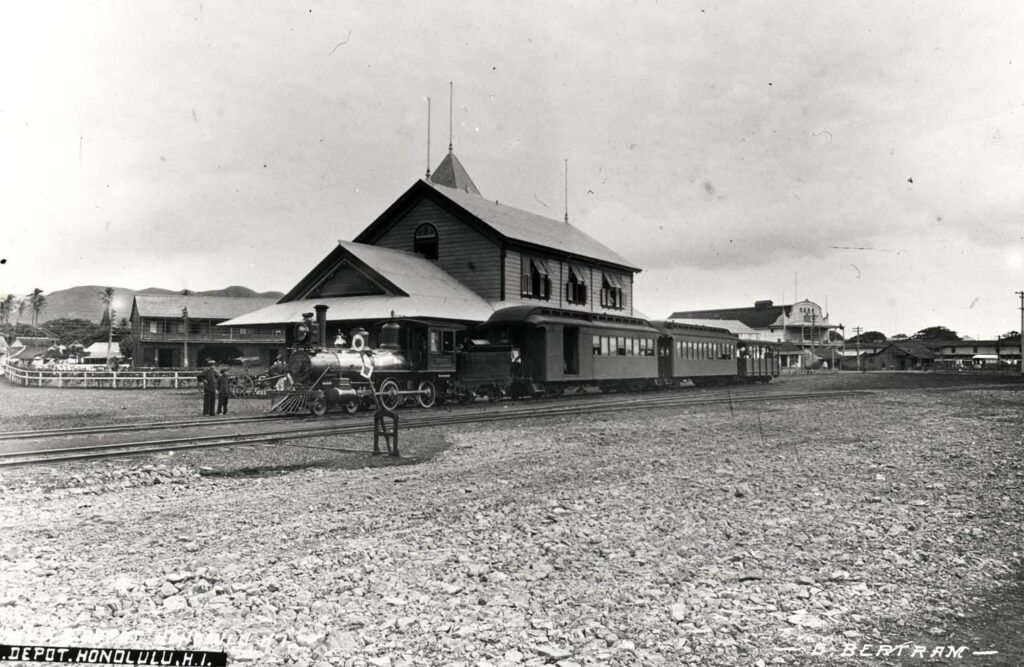
Another Iwilei activity included a railway station. In 1889, a group of businessmen led by Benjamin Dillingham founded the O‘ahu Railway and Land Company (OR&L).
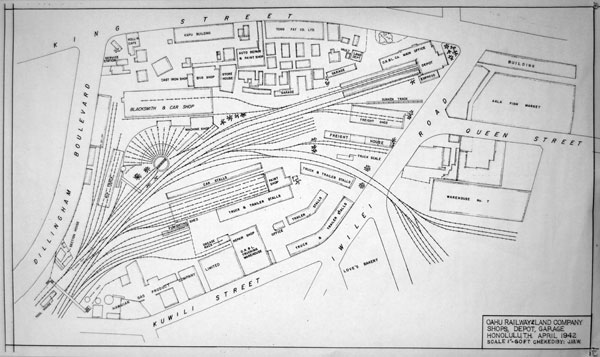
OR&L built Honolulu’s first depot between Kūwili fishpond and King Street, west of Iwilei Street. The July 27, 1889 Advertiser noted, “Plans have been approved by which the main depot will be placed 180 feet from King Street in what is now a fishpond dividing Oahu Prison from the royal stables. A large portion, if not all, of this extensive fishpond will be filled in without delay…”
The railroad carried sugarcane from the plantations to Iwilei – it carried people, too. To accommodate this, the marshes and fishponds were filled in and new wharfs built. By 1901, the OR&L and other business interests had created about 500 acres of waterfront land. The docks could accommodate over 20 deepwater sailing vessels, unloading coal and loading sugar.
The last of the activities at early Iwilei was the business of sex. (Before there was Hotel Street (the 1940s gathering place,) there was Iwilei.) They called it the ‘Iwilei Stockade.’
Inside a high stockade wall were long rows of rooms, each 8×10; there were 225 of them. Most of the women were from Japan. From 4 pm to 2 am, the stockade gates were open. (Gallagher)
These women did not live at Iwilei; they only went there in the evenings, and then returned to their uptown homes at night. Some had homes of their own, others were servants of families; but all went back to town. They were in no sense isolated; Iwilei was not their home; they neither eat nor sleep there. (Special Legislative Committee Report, 1905)
Local law enforcement condoned and controlled the activities, under the guise that it was “a public necessity.” “The whole of Iwilei makai of the Oʻahu Prison has been used for the purpose of prostitution for some time past.” (Special Legislative Committee Report, 1905)
“The High Sheriff of the Territory, through his agents, has ordered all of such women (prostitutes) that are found in different parts of the City, and also in some portions of Iwilei, to move to one particular part as follows: on the makai side of Iwilei rice mill, and on the Ewa side of the Iwilei road.” (Special Legislative Committee Report, 1905)
The Iwilei brothels (or “boogie houses,” as they were also called back then) were later forced to relocate to Hotel Street and a few adjoining parts of Chinatown. By 1916, the Iwilei Stockade was shut down.
It has been suggested that one of the former Iwilei prostitutes became the role model for the key character in the silent film “Sadie Thompson,” based on W. Somerset Maugham’s short story “Rain” (as well as other adaptations.)
As time went on, more of the fringing reefs were filled, which made way for expanded commercial use. By the 1920s, small and large businesses moved in – and, now, gone are the Prisoners, Pullmans and Prostitutes from Iwilei.
Follow Peter T Young on Facebook
Follow Peter T Young on Google+
Follow Peter T Young on LinkedIn
Follow Peter T Young on Blogger
by Peter T Young 3 Comments
Kawaihāpai Ahupua’a is nestled between Keālia and Mokuleʻia ahupuaʻa in the Waialua District on the island of Oʻahu. West of Keālia is Kaʻena Ahupuaʻa.
The oral traditions explain the origin of the name as: “A drought once came there in ancient times and drove out everyone except two aged priests. Instead of going with the others, they remained to plead with their gods for relief.”
“One day they saw a cloud approaching from the ocean. It passed over the house to the cliff behind. They heard a splash and when they ran to look, they found water.”
“Because it was brought there by a cloud in answer to their prayers, the place was named Kawaihāpai (the carried water) and the water supply was named Kawaikumuʻole (water without source).” (Alameida, HJH)
Kawaihāpai was known for its large loʻi (irrigated terraces) and sweet potato fields as well as excellent fishing grounds. The loʻi extended into Keālia, where small terraces at the foot of the pali (cliff) grew varieties of taro.
In addition to shore or reef fishing, ponds were built for the breeding and nurturing of fish. Handy pointed out that, “these enterprises varied from small individual efforts to large-scale cooperative undertakings directed by ruling chiefs, and varied also according to locality and natural advantages.” (Alameida, HJH)
Kamakau wrote that the loko iʻa of various sizes beautified the land, and that “a land with many fishponds was called a ‘fat’ land” (ʻāina momona.) The well-known loko iʻa of Waialua were Lokoea and ʻUkoʻa in the ahupuaʻa of Kawailoa. While Kamehameha I was living on Oʻahu, he worked in the fishponds on the island, including ʻUkoʻa in Waialua.
After the death of Kinaʻu, daughter of Kamehameha I, all of her lands in Waialua were inherited by her infant daughter Victoria Kamaʻmalu. Although only nine years old at the time of the Māhele, Kamāmalu was the third largest land holder in the kingdom.
However, she gave up all of her lands between the ahupua’a of Kamananui and Kaʻena to the government to satisfy the one third commutation requirement set by the Land Commission.
Kauikeaouli (Kamehameha III) then designated these lands at the western end of Waialua district as government lands, distinct from those he reserved for himself; this included Kawaihāpai, Kamananui, Mokuleʻia, Keālia and Kaʻena. (As such, people, residents and foreigners, were able to purchase the land in fee simple.)
Those who bought government lands were issued documents called grants or often referred to as Royal Patent Grants signed by Kamehameha III. These differed from the awards issued by the Land Commission.
By the late-1800s, some of the heirs of the original Kawaihāpai landowners were selling land. By the mid-1920s, the Dillinghams owned land from Mokuleʻia to Kaʻena.
Army use of land just south of the Oahu Railroad & Land Company (OR&L) railway in Mokuleʻia began in 1922 with the establishment of Camp Kawaihāpai as a communications station. In the 1920s and 1930s, the site was also used as a deployment site for mobile coast artillery, which was transported by railroad.
The US government acquired about 105-acres from Walter F. Dillingham, whose father, Benjamin F. Dillingham, had built Oʻahu Railway & Land Co.
The military was looking for a site for an airfield. The area was originally called Kawaihāpai Military Reservation in 1927. By December 7, 1941, a fighter airstrip had been established on additional leased land and Mokuleʻia Airstrip had been established.
P-40 aircraft were deployed at North Shore airstrips at Kahuku, Haleiwa and Mokuleʻia when the Pearl Harbor attack took place. At the outbreak of World War II, the area was re-designated Mokuleʻia Airfield and was expanded to accommodate bombers.
Mokuleʻia Airfield was improved to a 9,000-foot by 75-foot paved runway, a crosswind runway and many aircraft revetments from 1942-1945. By the end of World War II, Mokuleʻia Airfield could handle B-29 bombers.
In 1946, the U.S. Army acquired the additional 583 acres of leased land by condemnation. In late 1946, the US Army Air Force became the US Air Force by order of President Truman, so Mokuleʻia Airfield became an Air Force installation.
In 1948, the airfield was inactivated and the area was renamed Dillingham Air Force Base in memory of Captain Henry Gaylord Dillingham, a B-29 pilot who was killed in action in Kawasaki, Japan, July 25, 1945.
Captain Dillingham was the son of Walter F. Dillingham who was a noted pilot on Oʻahu in the 1930s. Henry was also the grandson of Benjamin F. Dillingham (who founded the OR&L, which evolved into Hawaiian Dredging Company and the Dillingham Corporation.)
In the 1970s the state had examined the airfield’s potential as a reliever airport. The Defense Authorization Act of 1990 provided that the 67 acres of ceded land of old Camp Kawaihapai be transferred to the state after an agreement on future joint-use of the airfield was reached.
The 2001 Legislature passed Act 276 (effective in 2005) that changed the official name of the airfield located at Kawaihāpai, formerly known as Dillingham Airfield, to Kawaihāpai Airfield (although some still refer to it today as Dillingham.)
It serves as a public and military use airport, operated by the Hawaiʻi Department of Transportation. The airport is primarily used for gliding and sky diving operations. Military operations consist largely of night operations for night vision device training.
Follow Peter T Young on Facebook
Follow Peter T Young on Google+
Follow Peter T Young on LinkedIn
Follow Peter T Young on Blogger