Images of Old Hawaiʻi

  • Home
  • About
  • Categories
    • Ali’i / Chiefs / Governance
    • American Protestant Mission
    • Buildings
    • Collections
    • Economy
    • Missionaries / Churches / Religious Buildings
    • General
    • Hawaiian Traditions
    • Other Summaries
    • Mayflower Summaries
    • Mayflower Full Summaries
    • Military
    • Place Names
    • Prominent People
    • Schools
    • Sailing, Shipping & Shipwrecks
    • Voyage of the Thaddeus
  • Collections
  • Contact
  • Follow

August 15, 2022 by Peter T Young Leave a Comment

Mokuʻaikaua Church

This stone and mortar building, completed in 1837, is the oldest surviving Christian church in the state of Hawaiʻi, started by the first Protestant missionaries to land in Hawaiʻi.

With the permission of Liholiho (Kamehameha II), the missionaries built a grass house for worship in 1823 and, later, a large thatched meeting house.

Missionary Asa Thurston directed the construction of the present Mokuʻaikaua Church, then the largest building in Kailua-Kona. Its massive size indicates the large Hawaiian population living in or near Kailua at that time.

Mokuʻaikaua, with its 112-foot-tall steeple, is a reminder of the enthusiasm and energy of the first American missionaries and their Hawaiian converts.

Built of stones taken from a nearby heiau and lime made of burned coral, it represents the new western architecture of early 19th-century Hawaiʻi and became an example that other missionaries would imitate.

The original thatch church which was built in 1823 but was destroyed by fire in 1835, the present structure was completed in 1837. Mokuʻaikaua takes its name from a forest area above Kailua from which timbers were cut and dragged by hand to construct the ceiling and interior.

Mokuʻaikaua Church is centered in a small level lot near the center of Kailua. Its high steeple stands out conspicuously and has become a landmark from both land and sea.

Huge corner stones, said to have been hewn by order of King ʻUmi in the 16th century for a heiau, were set in place and offers evidence of the heavy labor which contributed to the Church’s construction.

The central core of the steeple is polygonal with alternating sections of wide and narrow clapboard.  The wider sections are articulated with louvered arches. The 48 by 120 feet lava rock and coral mortared church is capped with a gable roof.

Construction beams are made from ʻōhiʻa wood. Pieces of the wooden structure were joined with ʻōhiʻa pins.  The spanning beams are fifty feet long and are made from ʻōhiʻa timbers. Corner stones were set in place 20 to 30 feet above the ground.

Mokuʻaikaua Church is the first and one of the largest stone churches in Hawaiʻi, outstanding for its simple, well-proportioned mass and construction.

The interior open timber structure with high galleries is a fine architectural and engineering design. The architectural interest is further enhanced by the church’s historical significance (it is on the Register of Historic Places.)

In 1910, a memorial arch was erected at the entrance to the church grounds to commemorate the arrival of the first missionaries.

Congregationalist missionaries from Boston crossed the Atlantic Ocean, rounded Cape Horn, aboard the Brig Thaddeus.   A replica of the Thaddeus is in Mokuʻaikaua Church.

On the morning of April 4, 1820, 163 days from Boston, the Congregational Protestant missionaries, led by Hiram Bingham, aboard the Thaddeus, came to anchor off the village of Kailua.

They came ashore at the “Plymouth Rock” of Hawaiʻi, where Kailua Pier now stands.  Christian worship has taken place near this site since 1820.  Mokuʻaikaua is known as the “First Christian Church of Hawaiʻi.”

Inspired by the dream of Hawaiian Henry ʻŌpūkahaʻia, seven couples were sent by the American Board of Commissioners for Foreign Missions to convert the Hawaiians to Christianity.

Two Ordained Preachers Hiram Bingham and his wife Sybil and Asa Thurston and his wife Lucy; Two Teachers, Mr. Samuel Whitney and his wife Mercy and Samuel Ruggles and his wife Mary; A Doctor, Thomas Holman and his wife Lucia; A Printer, Elisha Loomis and his wife Maria; A Farmer, Daniel Chamberlain, his wife and five children.

The Thurstons remained in Kailua, while their fellow missionaries went to establish stations on other Hawaiian islands.

© 2022 Hoʻokuleana LLC

Filed Under: Ali'i / Chiefs / Governance, Buildings, Missionaries / Churches / Religious Buildings Tagged With: Hawaii, Hiram Bingham, Henry Opukahaia, Kailua-Kona, Liholiho, Asa Thurston, Mokuaikaua

July 8, 2022 by Peter T Young Leave a Comment

Sad Sailing of the HMS Blonde

Ka‘iana‘ahu‘ula was the first Hawaiian chief to travel to foreign countries; he went to Canton, China in 1787 returning in 1788.
 
In November 1823, Kamehameha II (Liholiho) and Queen Kamāmalu were the first Ali‘i to travel to England.
 
They commissioned the British whaling ship L’Aigle (French for “the Eagle”) to carry them to London to gain firsthand experience in European ways and to seek an audience with King George IV to negotiate an alliance with England.
 
Going along were High Chief Boki and wife High Chiefess Liliha, and other chiefs and retainers.  Liholiho and Boki brought with them several feather cloaks and capes, visual symbols of Hawaiian royalty.  Kamāmalu and Liliha took with them fine kapa clothing suitable for their rank.
 
In February 1824, along the way, after rounding Cape Horn, they arrived at Rio de Janeiro in newly-independent Brazil where they met Emperor Pedro I.
 
The Emperor gave Kamehameha II a ceremonial sword, and in return was presented with a native Hawaiian feather cloak made from rare tropical bird feathers.
 
L’Aigle arrived on May 17, 1824 in Portsmouth, and the next day the entourage moved into the Caledonian Hotel in London.  Foreign Office Secretary George Canning appointed Frederick Gerald Byng to supervise their visit.
 
In London, the royal party was fitted with the latest fashion and they toured London, visiting Westminster Abbey, attended opera and ballet at Royal Opera House in Covent Garden, and the Theatre Royal in Drury Lane.  On May 28 a reception with 200 guests, including several Dukes, was held in their honor.
 
King George IV finally scheduled a meeting for June 21, but it had to be delayed; Liholiho and Kamāmalu became ill.  The Hawaiian court had caught the measles (like other Hawaiians, they did not have immunity to outside diseases.)
 
It is believed they probably contracted the disease on their visit to the Royal Military Asylum (now the Duke of York’s Royal Military School.)
 
Virtually the entire royal party developed measles within weeks of arrival, 7 to 10 days after visiting the Royal Military Asylum housing hundreds of soldiers’ children.
 
Kamāmalu (aged 22) died on July 8, 1824.  The grief-stricken Kamehameha II (age 27) died six days later on July 14, 1824.  Prior to his death he asked to return and be buried in Hawai‘i.
 
Boki took over leadership of the delegation and finally did have an audience with King George IV. 
 
Shortly thereafter, the British Government dispatched HMS Blonde to convey the bodies of Liholiho and Kamāmalu back to Hawaii, along with the entourage.  The Captain of the Blonde, a newly commissioned 46-gun frigate, was Lord Byron (a cousin of the poet.)
 
The Blonde arrived back in Honolulu on May 6, 1825.
 
Kalanimōkū (who was not on the trip) had been notified of the deaths in a letter, so Hawaiian royalty gathered at his house where the bodies were moved for the funeral.
 
Liholiho and Kamāmalu were buried on the grounds of the ʻIolani Palace in a coral house meant to be the Hawaiian version of the tombs Liholiho had seen in London.  They were eventually moved to Mauna ‘Ala, the Royal Mausoleum.
 
Kamehameha II was succeeded by his younger brother Kauikeaouli, who became King Kamehameha III.
 
Before 1848 measles was unknown in Hawaii.  Several epidemics struck Hawaiʻi in late-1848, beginning with measles and whooping cough, then the flu.
© 2022 Ho‘okuleana LLC

Filed Under: Ali'i / Chiefs / Governance Tagged With: Liholiho, Kamehameha II, Kauikeaouli, Kamehameha III, Kalanimoku, Boki, Kamamalu, Liliha, Hawaii, Iolani Palace, Mauna Ala

June 17, 2022 by Peter T Young Leave a Comment

Ke Ana O Ke Kiʻi

The ancient Hawaiian religion, kapu, was an oppressive system of prohibitions. The law of kapu was extended to every act in life, and it even followed the believer beyond the grave.  (Bishop Museum)

Heiau (temples) were so numerous in the thickly settled country near the shore that from the walls of one the next was plainly to be seen. Ellis (1823) tells us that from Kailua to Kealakekua on Hawaiʻi there was at least one heiau to every half-mile along the trail.  (Brigham)

While Kū, Kāne, Lono and Kanaloa were the great gods, almost every man had his private deity, while his wives had others. There was Laka (hula dancers,) Kuʻula (fishermen,) Hina (the wives,) Laʻamaomao (the winds) and so on that were worshipped.

Anything connected with the gods and their worship was considered sacred, such as idols, heiau and priests.  Because chiefs were believed to be descendants of the gods, many kapu related to chiefs and their personal possessions.

The features of their religion were embodied in idols which were of every variety imaginable, from hideous and deformed sculptures of wood, to the utmost perfection of their art.  (Jarves)

Idols were made of different materials; some of the wooden idols were carved from the ʻōhia tree.  In cutting the haku ʻōhia, as the idol was first called, many prayers were uttered and tedious ceremonies lasted days or even weeks if the omens were unpropitious.

In the making of an idol, a suitable ʻōhia tree had previously been selected, one that had no decay about it, because a perfect tree was required for the making of the haku-ʻōhia idol; and when they had reached the woods, before they felled the tree, the kahuna haku ʻōhia approached the tree by one route, and the man who was to cut the tree by another; and thus they stood on opposite sides of the tree.  (Malo)

This intricate system that supported Hawai‘i’s social and political structure directed every activity of Hawaiian life, from birth through death, until its overthrow by King Kamehameha II (Liholiho).

Shortly after the death of Kamehameha I in 1819, King Kamehameha II (Liholiho) declared an end to the kapu system.  In a dramatic and highly symbolic event, Kamehameha II ate and drank with women, thereby breaking the important eating kapu.

When the meal was over, Liholiho issued orders to destroy the heiau and burn the idols, and this was done from one end of the kingdom to the other.  (Kuykendall)

This changed the course of the civilization and ended the kapu system, effectively weakened belief in the power of the gods and the inevitability of divine punishment for those who opposed them.

The end of the kapu system by Liholiho (Kamehameha II) happened before the arrival of the missionaries; it made way for the transformation to Christianity and westernization.

Later, in 1831, Kaʻahumanu visited all of the islands to encourage the people to learn to read and write; she also pronounced certain laws orally about which she wished to instruct the people, including “Worshiping of idols such as sticks, stones, sharks, dead bones, ancient gods, and all untrue gods is prohibited. There is one God alone, Jehovah. He is the God to worship.”  (Kamakau)

However, not all agreed.  There were a large number who refused to cast aside their old practices; and many idols, instead of being burned, were merely hidden from sight. Even among those who outwardly conformed to the new order were many who secretly clung to their idols; the old gods of Hawaiʻi had their devotees for a long time after 1819.  (Kuykendall)

In part, this was evidenced in 2005, when a North Kona lava tube containing more than 30 kiʻi (Hawaiian religious images) were discovered during the construction at what was then known as “The Shores of Kohanaiki.”  Some believe the cave served as storage or a hiding place. Some have also suggested that it might have been a secret place of worship.

The discovery is regarded as especially significant because there were no human remains found with the objects, leading many to believe that they were hidden away after the abolishment of the ‘ai kapu system in 1819.  (OHA)

An initial chamber about 12-feet high and 60-feet long leads to a second, smaller chamber containing the wooden images and stone uprights.  “(A)side from the initial puncture point in the ceiling, the cave interior appears to be structurally sound and does not present a threat of collapsing at this time.”

“About three-dozen of the wooden images are made from limbs of varying dimensions, carved with slits for eyes and a mouth. They were left in this natural state with no other carved or stylistic features.”

“They are all similar and may have been carved by the same person or personages who were schooled under the same priestly order. A few of the kiʻi retain the ‘Y’ shaped fork created by the outgrowth of two branches, with eyes and mouth carved below the split.”  (OHA)

This isn’t the first such find.

The Pacific Commercial Advertiser reported (September 23, 1876,) “Recently some of the employees of Dr Trousseau in North Kona Hawaiʻi discovered a lot of wooden idols of the olden time, in a cave on the mountain.  They were in a good state of preservation and had doubtless been undisturbed in their hiding place since the time when they were deposited there to escape the general destruction of idols by order of Kaahumanu”.

This earlier discovery on the side of Hualālai was the first reported discovery of such a large clutch of images, under circumstances suggesting either the survival of a secret cult, or a shrine predating the abrogation of the traditional religion.  (Rose)

All were carved from ʻōhia logs; the bark was removed and both ends were roughly hacked to blunt points.  Although some individuality was in each carving, several similarities stand out: wide grooves and shallow cuts to delineate circular eyes and mouths.

King Kalākaua acquired the great majority of the images from the Mt Hualālai cave; it is not clear whether he actually visited the cave.  Despite, or perhaps because of, their relative simplicity, they share some claim to be numbered among the most unusual of all Hawaiian carvings.  (Rose)  Of the total 26 or so post images taken from the Mt Hualālai cave, 12 are preserved in three museums in Europe and the US.

The two finds noted here, although both in North Kona, were in significantly different areas: Kohanaiki near the shoreline (that cave with all the kiʻi has been sealed in 2006) and the other is way up the side of Hualālai (all of the contents of that cave were removed by 1885.)  Some have labeled these caves as “Ke Ana O Ke Kiʻi” (The Cave of Images.)

© 2022 Hoʻokuleana LLC

Filed Under: Hawaiian Traditions, Prominent People Tagged With: Hawaii Island, Kii, Kapu, Kaahumanu, Liholiho, Cave of Images, Georges Trousseau, Ke Ana O Ke Kii, Hawaii

May 26, 2022 by Peter T Young Leave a Comment

James Kahuhu

On October 23, 1819, the Pioneer Company of American Protestant missionaries from the northeast US set sail on the Thaddeus for the Sandwich Islands (now known as Hawai‘i.)  There were seven American couples sent by the ABCFM in this first company.

These included two Ordained Preachers, Hiram Bingham and his wife Sybil and Asa Thurston and his wife Lucy; two Teachers, Mr. Samuel Whitney and his wife Mercy and Samuel Ruggles and his wife Mary; a Doctor, Thomas Holman and his wife Lucia; a Printer, Elisha Loomis and his wife Maria; and a Farmer, Daniel Chamberlain, his wife and five children.

By the time the Pioneer Company arrived, Kamehameha I had died and the centuries-old kapu system had been abolished; through the actions of King Kamehameha II (Liholiho,) with encouragement by former Queens Kaʻahumanu and Keōpūolani (Liholiho’s mother,) the Hawaiian people had already dismantled their heiau and had rejected their religious beliefs.

One of the first things the missionaries did was begin to learn the Hawaiian language and create an alphabet for a written format of the language.   Their emphasis was on teaching and preaching.

The first mission station was at Kailua-Kona, where they first landed in the Islands, then the residence of the King (Liholiho, Kamehameha II;) Asa and Lucy Thurston manned the mission, there.

Liholiho was Asa Thurston’s first pupil. His orders were that “none should be taught to read except those of high rank, those to whom he gave special permission, and the wives and children of white men.”

James Kahuhu and John ʻlʻi were two of his favorite courtiers, whom he placed under Mr. Thurston’s instruction in order that he might judge whether the new learning was going to be of any value.  (Alexander, The Friend, December 1902)

In 1820, Missionary Lucy Thurston noted in her Journal, “The king (Liholiho, Kamehameha II) brought two young men to Mr. Thurston, and said: ‘Teach these, my favorites, (John Papa) Ii and (James) Kahuhu. It will be the same as teaching me. Through them I shall find out what learning is.’”

“To do his part to distinguish and make them respectable scholars, he dressed them in a civilized manner. They daily came forth from the king, entered the presence of their teacher, clad in white, while his majesty and court continued to sit in their girdles.”

“Although thus distinguished from their fellows, in all the beauty and strength of ripening manhood, with what humility they drank in instruction from the lips of their teacher, even as the dry earth drinks in water!”

“After an absence of some months, the king returned, and called at our dwelling to hear the two young men, his favorites, read. He was delighted with their improvement, and shook Mr. Thurston most cordially by the hand – pressed it between both his own – then kissed it.” (Lucy Thurston)

Kahuhu was among the earliest of those associated with the chiefs to learn both spoken and written words. Kahuhu then became a teacher to the chiefs.

In April or May 1821, the King and the chiefs gathered in Honolulu and selected teachers to assist Mr Bingham.  James Kahuhu, John ʻĪʻi, Haʻalilio, Prince Kauikeaouli were among those who learned English.  (Kamakau)

On October 7, 1829, it seems that Kauikeaouli (Kamehameha III) set up a legislative body and council of state when he prepared a definite and authoritative declaration to foreigners and each of them signed it.  (Frear – HHS)  Kahuhu was one of the participants.

King Kamehameha III issued a Proclamation “respecting the treatment of Foreigners within his Territories.”  It was prepared in the name of the King and the Chiefs in Council:  Kauikeaouli, the King; Gov. Boki; Kaʻahumanu; Gov. Adams Kuakini; Manuia; Kekūanāoʻa; Hinau; ʻAikanaka; Paki; Kīnaʻu; John ʻIʻi and James Kahuhu.

In part, he states, “The Laws of my Country prohibit murder, theft, adultery, fornication, retailing ardent spirits at houses for selling spirits, amusements on the Sabbath Day, gambling and betting on the Sabbath Day, and at all times.  If any man shall transgress any of these Laws, he is liable to the penalty, – the same for every Foreigner and for the People of these Islands: whoever shall violate these Laws shall be punished.”

It continues with, “This is our communication to you all, ye parents from the Countries whence originate the winds; have compassion on a Nation of little Children, very small and young, who are yet in mental darkness; and help us to do right and follow with us, that which will be for the best good of this our Country.”

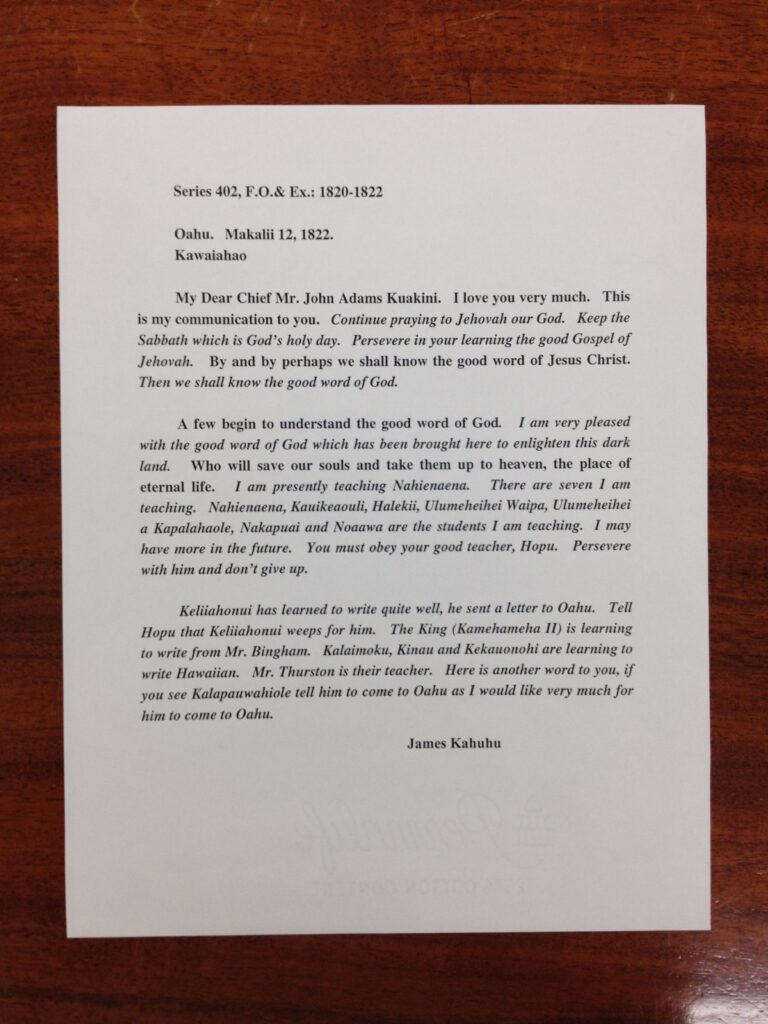
The Hawaiʻi State Archives is the repository of significant historic documents for Hawaiʻi; reportedly, the oldest Hawaiian language document in its possession is a letter written by James Kahuhu.

Writing to Chief John Adams Kuakini, Kahuhu’s letter was partially in English and partially Hawaiian (at that time, Kuakini was learning both English and written Hawaiian.)

Below is a transcription of Kahuhu’s letter.  (HSA)

Oahu. Makaliʻi 12, 1822.
Kawaiahaʻo.
My Dear Chief Mr. John Adams Kuakini. I love you very much. This is my communication to you. Continue praying to Jehovah our God. Keep the Sabbath which is God’s holy day. Persevere in your learning the good Gospel of Jehovah. By and by perhaps we shall know the good word of Jesus Christ. Then we shall know the good word of God.

A few begin to understand the good word of God. I am very pleased with the good word of God which has been brought here to enlighten this dark land. Who will save our souls and take them up to heaven, the place of eternal life. I am presently teaching Nahiʻenaʻena. I am teaching seven of them. Nahienaena, Kauikeaouli, Halekiʻi, Ulumāheihei Waipa, Ulumāheihei a Kapalahaole, Nakapuai and Noaʻawa are the students I am teaching. I may have more in the future. You must obey your good teacher, Hopu. Persevere with him and don’t give up.

Keliʻiahonui has learned to write quite well, he sent a letter to Oahu. Tell Hopu that Keliʻiahonui misses him. The King is learning to write from Mr. Bingham. Kalanimōku, Kīnaʻu and Kekauōnohi are learning to write Hawaiian. Mr. Thurston is their teacher. Here is another word to you, if you see Kalapauwahiole tell him to come to Oahu as I would like very much for him to come to Oahu.
James Kahuhu

(Makaliʻi was the name of a month: December on Hawai‘i, April on Moloka’i, October on Oʻahu.  (Malo))

The image shows the first page of the Kahuhu letter to Kuakini (HSA.) 

© 2022 Hoʻokuleana LLC


Filed Under: Missionaries / Churches / Religious Buildings Tagged With: Hawaii, Asa Thurston, Hawaii Island, Kaiakeakua, Kuakini, Kamehameha III, Hiram Bingham, American Board of Commissioners of Foreign Missions, ABCFM, Missionaries, Kailua-Kona, Liholiho, Kamehameha II, Kauikeaouli

April 10, 2022 by Peter T Young 1 Comment

Kaʻahumanu’s Coffin

While on a trip to the continent, Queen Kamāmalu (age 22) died on July 8, 1824; King Kamehameha II (Liholiho, age 27) died six days later on July 14, 1824.  (Prior to his death he asked to return and be buried in Hawai‘i.)

Upon their arrival in Hawai‘i, in consultation between the Kuhina Nui (former Queen Kaʻahumanu) and other high chiefs, and telling them about Westminster Abbey and the underground burial crypts they had seen there, it was decided to build a mausoleum building.

In 1825, Pohukaina (translated as “Pohu-ka-ʻāina” (the land is quiet and calm)) was constructed on what is now the grounds of ʻIolani Palace to house the remains of Kamehameha II (Liholiho) and Queen Kamāmalu.

The mausoleum was a small 18 x 24-foot Western style structure made of white-washed coral blocks with a thatched roof; it had no windows.   Kamehameha II and Queen Kamāmalu were buried on August 23, 1825.

About this same time, April 25, 1825, Richard Charlton arrived in the Islands to serve as the first British consul. He had been in London during Kamehameha II’s visit in 1824.

Nearly 10-years later, in 1832, Kaʻahumanu died; her death took place at ten minutes past 3 o’clock on the morning of June 5, “after an illness of about 3 weeks in which she exhibited her unabated attachment to the Christian teachers and reliance on Christ, her Saviour.”  (Hiram Bingham)

The Kaʻahumanu services were performed by Bingham.  After the sermon in Hawaiian, he addressed the foreigners present and the mission family.  After the close of the services, the procession was again formed and walked to Pohukaina, where the body was deposited, with the remains of others in the Royal family.  (The Friend, June 1932)

The above helps set the stage for subsequent events that happened there.

Nearly 10-years later, in 1840, Charlton made a claim for several parcels of land in Honolulu.   At the time the lease was made, Kaʻahumanu was Kuhina Nui and only she and the king could make such grants.  The land was Kaʻahumanu’s in the first place, and Kalanimoku certainly could not give it away.  (Hawaiʻi State Archives)  The dispute dragged on for years.

This, and other grievances purported by Charlton and the British community in Hawai‘i, led to the landing of George Paulet on February 11, 1843.

He noted in a letter to the King, “I have the honor to notify you that Her Britannic Majesty’s ship Carysfort, under my command, will be prepared to make an immediate attack upon this town at 4 pm tomorrow (Saturday) in the event of the demands now forwarded by me to the King of these islands not being complied with by this time.”

On February 25, the King acceded to his demands.  Under the terms of the new government the King and his advisers continued to administer the affairs of the Hawaiian population.

It soon became clear that Paulet had no intention of limiting his rule to the affairs of foreigners.  New taxes were imposed, liquor laws were relaxed.   Paulet refused to restore the old laws.  After raising multiple objections to the actions by Paulet, Judd resigned from the commission on May 11.  (Daws)

Fearing that Paulet would seize some of the archives and other national records, Gerrit P Judd took them from the government house, and secretly placed them in the royal tomb at Pohukaina.  He used the mausoleum as his office.

By candlelight, using the coffin of Kaʻahumanu for a table, Judd prepared appeals to London and Washington to free Hawaiʻi from the illegal rule of Paulet.

Dispatches were sent off in canoes from distant points of the island; and once, when the king’s signature was required, he came down in a schooner and landed at Waikīkī, read and signed the prepared documents, and was on his way back across the channel, while Paulet was dining and having a pleasant time with his friends.  (Laura F Judd)

For about five months the islands were under the rule of the British commission set up by Lord George Paulet.  Queen Victoria, on learning these activities, immediately sent an envoy to the islands to restore sovereignty to its rightful rulers.  Finally, Admiral Richard Thomas arrived in the Islands on July 26, 1843 to restore the kingdom to Kamehameha III.

Then, on July 31, 1843, Thomas declared the end of the Provisional Cession and recognizes Kamehameha III as King of the Hawaiian Islands and the Islands to be independent and sovereign; the Hawaiian flag was raised.  This event is referred to as Ka La Hoʻihoʻi Ea, Sovereignty Restoration Day, and it is celebrated each year in the approximate site of the 1843 ceremonies, Thomas Square.

Nearly 20-years later, Pohukaina was the final resting place for the Hawaiʻi’s Kings and Queens, and important chiefs of the kingdom.  Reportedly, in 1858, Kamehameha IV brought over the ancestral remains of other Aliʻi – coffins and even earlier grave material – out of their original burial caves, and they are buried in Pohukaina.

In 1865, the remains of 21-Ali‘i were removed from Pohukaina and transferred in a torchlight procession at night to Mauna ‘Ala, a new Royal Mausoleum in Nu‘uanu Valley.  In a speech delivered on the occasion of the laying of the Cornerstone of The Royal Palace (ʻIolani Palace,) Honolulu, in 1879, JH Kapena, Minister of Foreign Relations, said:

“Doubtless the memory is yet green of that never-to-be-forgotten night when the remains of the departed chiefs were removed to the Royal Mausoleum in the valley.”

“Perhaps the world had never witnessed a procession more weird and solemn than that which conveyed the bodies of the chiefs through our streets, accompanied on each side by thousands of people until the mausoleum was reached, the entire scene and procession being lighted by large kukui torches, while the midnight darkness brought in striking relief the coffins on their biers.”

“Earth has not seen a more solemn procession what when, in the darkness of the night, the bodies of these chieftains were carried through the streets”.  (Hawaiian Gazette, January 14, 1880)

In order that the location of Pohukaina not be forgotten, a mound was raised to mark the spot.  After being overgrown for many years, the Hawaiian Historical Society passed a resolution in 1930 requesting Governor Lawrence Judd to memorialize the site with the construction of a metal fence enclosure and a plaque.

© 2022 Hoʻokuleana LLC

Filed Under: Ali'i / Chiefs / Governance, Prominent People Tagged With: Kamehameha II, Kamehameha III, Richard Charlton, Kamamalu, Pohukaina, Hawaii, Thomas Square, Iolani Palace, Gerrit Judd, Ka La Hoihoi Ea, Mauna Ala, Kaahumanu, Liholiho

  • « Previous Page
  • 1
  • 2
  • 3
  • 4
  • 5
  • 6
  • …
  • 8
  • Next Page »

Images of Old Hawaiʻi

People, places, and events in Hawaiʻi’s past come alive through text and media in “Images of Old Hawaiʻi.” These posts are informal historic summaries presented for personal, non-commercial, and educational purposes.

Info@Hookuleana.com

Connect with Us

  • Email
  • Facebook
  • LinkedIn
  • Twitter
  • YouTube

Recent Posts

  • It Wasn’t ‘Bloodless’
  • Universal Remedy
  • Aiʻenui
  • Victoria Kamāmalu
  • Ginaca
  • Bill Anderson
  • Foreign Mission School

Categories

  • Sailing, Shipping & Shipwrecks
  • Economy
  • Voyage of the Thaddeus
  • Mayflower Summaries
  • American Revolution
  • General
  • Ali'i / Chiefs / Governance
  • Buildings
  • Missionaries / Churches / Religious Buildings
  • Hawaiian Traditions
  • Military
  • Place Names
  • Prominent People
  • Schools

Tags

Albatross Al Capone Ane Keohokalole Archibald Campbell Bernice Pauahi Bishop Charles Reed Bishop Downtown Honolulu Eruption Founder's Day George Patton Great Wall of Kuakini Green Sea Turtle Hawaii Hawaii Island Hermes Hilo Holoikauaua Honolulu Isaac Davis James Robinson Kamae Kamaeokalani Kameeiamoku Kamehameha Schools Lalani Village Lava Flow Lelia Byrd Liberty Ship Liliuokalani Mao Math Mauna Loa Midway Monk Seal Northwestern Hawaiian Islands Oahu Papahanaumokuakea Marine National Monument Pearl Pualani Mossman Quartette Thomas Jaggar Volcano Waikiki Wake Wisdom

Hoʻokuleana LLC

Hoʻokuleana LLC is a Planning and Consulting firm assisting property owners with Land Use Planning efforts, including Environmental Review, Entitlement Process, Permitting, Community Outreach, etc. We are uniquely positioned to assist you in a variety of needs.

Info@Hookuleana.com

Copyright © 2012-2024 Peter T Young, Hoʻokuleana LLC


Loading Comments...