Images of Old Hawaiʻi

  • Home
  • About
  • Categories
    • Ali’i / Chiefs / Governance
    • American Protestant Mission
    • Buildings
    • Collections
    • Economy
    • Missionaries / Churches / Religious Buildings
    • General
    • Hawaiian Traditions
    • Other Summaries
    • Mayflower Summaries
    • Mayflower Full Summaries
    • Military
    • Place Names
    • Prominent People
    • Schools
    • Sailing, Shipping & Shipwrecks
    • Voyage of the Thaddeus
  • Collections
  • Contact
  • Follow

September 15, 2022 by Peter T Young Leave a Comment

Ahuimanu College

On July 7, 1827, the pioneer French Catholic mission arrived in Honolulu. It consisted of three priests of the Order of the Sacred Hearts of Jesus and Mary; Father Alexis Bachelot, Abraham Armand and Patrick Short.  They were supported by a half dozen other Frenchmen.

The Congregation of the Sacred Hearts of Jesus and Mary and of the Perpetual Adoration of the Most Holy Sacrament of the Altar (SS.CC.) (better known as the Congregation of Picpus) is a Roman Catholic religious institute of brothers, priests and nuns. (The letters following their names, SS.CC., are the Latin initials for Sacrorum Cordium, “of the Sacred Hearts”.)

Their first mass was celebrated a week later on Bastille Day, July 14, and a baptism was given on November 30, to a child of Don Francisco de Paula Marin.

In 1837, two other Catholic priests arrived (Rev Louis Maigret was one of them). However, the Hawaiian government forced them back onto a ship.  Maigret sailed to Pohnpei in Micronesia to set up a mission there; he was the first missionary they had seen. He later departed for Valparaiso (Chile.)

American, British and French officials in Hawaii intervened and persuaded the king to allow the priests to return to shore.  On June 17, 1839, King Kamehameha III issued the Edict of Toleration permitting religious freedom for Catholics.

The King also donated land where the first permanent Catholic Church would be constructed; the Catholic mission was finally established on May 15, 1840 when the Vicar Apostolic of the Pacific arrived with three other priests – including Rev. Louis Maigret.

Father Maigret was appointed the first Vicar Apostolic of the Sandwich Islands (now the Roman Catholic Diocese of Honolulu.)  They sought to expand the Catholic presence.

At the end of the year 1840, Maigret jotted down this balance sheet: Vicariate of Oceania: Catholics: 3,000; Heretics: 30,000 and Unbelievers: 100,000.  (Charlot)

Maigret oversaw the construction of what would become his most lasting legacy, the Cathedral of Our Lady of Peace, still standing and in use in downtown Honolulu.  Maigret was officially ordained as a Bishop on November 28, 1847.

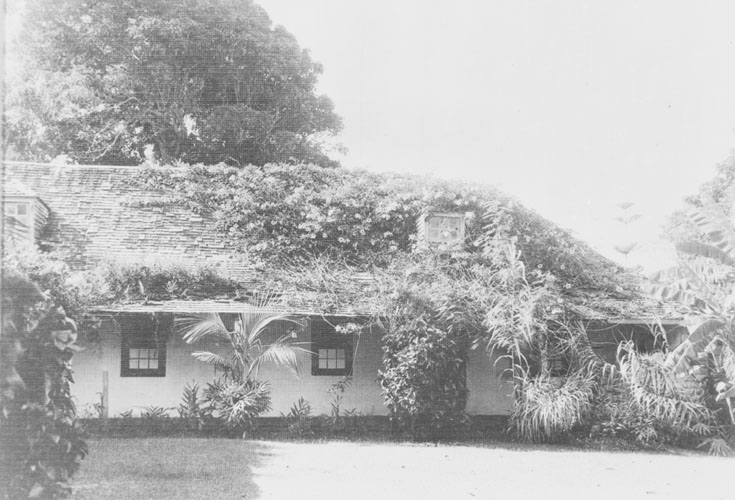
Maigret divided Oʻahu into missionary districts. Shortly after, the Windward coast of Oʻahu was dotted with chapels.  The Sacred Hearts Father’s College of Ahuimanu was founded by the Catholic mission on the Windward side of Oʻahu in 1846.

“Outside the city, at Ahuimanu, Maigret has now a country retreat that he refers to by the Hawaiian word māla.  It is a combination garden, orchard and kitchen garden.”

“The venerable bishop has built his own vineyard and planted his own orchard … His retreat in the mountain, his ‘garden in the air’ as he terms it, is a pleasant and profitable sight … with a small stone-walled cottage about fifteen feet by ten.  When the pressure of events allows it, Maigret takes refuge there.” (Charlot)

“The situation of Ahuimanu is very fine. It is in a basin formed by volcanic action. The sea is in the foreground; and its background is a lofty mountain ridge, eight hundred feet high, which is a very wall, whose coping stones are ever in the clouds, and whose foot is buttressed by outreaching spurs, like the everlasting ramparts made by the hand of God.”

“The men of faith who claim that their church is founded on a Rock, have founded this establishment within a ‘munition of rocks,’ from whose fissures there gush forth sweet cool streams in refreshing bounty flowing like waters of life over a hungry land.”

“This ample irrigation feeds redundant taro patches, well burthened banana groves, well loaded peach orchards, producing the most delicious fruit we have eaten in those isles; also groves of mangoes, chirimoyas, rose apples, Tahitian wi, and other choice fruits of tropic lands.” (Nuhou, 7/15/1873)

One of its students was Jozef de Veuster; he was born in Tremeloo, Belgium, in 1840. Like his older brother Pamphile, Jozef studied to be a Catholic priest in the Congregation of the Sacred Hearts.

Jozef arrived in Hawaiʻi on March 9, 1864, at the time a 24-year-old choirboy.  Determined to become a priest, he had the remainder of the schooling at the College of Ahuimanu.

Bishop Maigret ordained Jozef as Father Damien at the Cathedral of Our Lady of Peace, on May 21, 1864.  “Here I am a priest, dear parents, here I am a missionary in a corrupt, heretical, idolatrous country.  How great my obligations are!  How great my apostolic zeal must be!” (Damien to parents; Daws)

Early in June, 1864, Maigret appointed Damien to Puna on the east coast of the island of Hawai‘i; another new missionary, Clement Evrard, was appointed to Kohala-Hāmākua.

Damien learned the Hawaiian language (he had just previously learned English during his long journey to Hawai‘i).  His Hawaiian was far from perfect, but he could manage to get by with it.  Damien’s name became ‘Kamiano.’

Like most Catholic missionaries of that time, he saw his mission in intense competition with that of the Protestant ‘heretics,’ who did not kneel while praying and who distributed the local kalo (taro,) instead of bread for communion and even water instead of wine.  (de Volder)

Shortly after arriving in Puna, in a letter to Pamphile, Damien wrote, “I regret not being a poet or a good writer so as to describe our new country to you.”  Although he had not yet seen the active Kilauea volcano erupting, he added, “from what the other Fathers say it seems there is nothing like it in the world to give a correct idea of Hell.”  (Daws)

A few months in Puna taught Damien at first-hand what he had heard in advance from the Maui missionaries: that life in the field was nothing like life as a novice in the religious order in Europe.

“Instead of a tranquil and withdrawn life, it is a question of getting used to traveling by land and sea, on horseback and on foot; instead of strictly observing silence, it is necessary to learn to speak several languages with all kinds of people …”

“… instead of being directed you have to direct others; and the hardest of all is to preserve, in the middle of a thousand miseries and vexations, the spirit of meditation and prayer.” (Damien in letter to father-general of the Sacred Hearts, 1862; Daws)

Father Clement Evard, his closest but distant neighbor, had an even more formidable area to cover: the double district of Kohala-Hāmākua, about a quarter of the Island.  He was not as strong as Damien.

Damien carried his church on his back (a portable alter which he set up with four sticks pounded into the ground and a board balances on top with a cover cloth.)

His life was simple – with the help of the faithful, Damien began to do some small farming (keeping sheep pigs and chickens; bees for honey and wax for candle making; etc).  “The calabash of poi is always full; there is also meat; water in quantity, coffee and bread sometimes, wine and beer never.”  (Daws)

Eight months after they arrived in their respective districts, Damien and Clement discussed exchanging posts; in early 1865, Damien left Puna for Kohala-Hāmākua.

In 1873, Maigret assigned him to Molokai.  Damien spent the rest of his life in Hawaiʻi.  In 2009, Damien was canonized by Pope Benedict XVI.

The College of Ahuimanu changed locations and also changed its name a couple of times.  In 1881, it was renamed “College of St. Louis” in honor of Bishop Maigret’s patron Saint, Louis IX.  It was the forerunner for Chaminade College and St Louis High School.

© 2022 Ho‘okuleana LLC

Filed Under: Buildings, Missionaries / Churches / Religious Buildings, Schools Tagged With: Catholics, Jozef de Veuster, Saint Damien, Ahuimanu, College of Ahuimanu, Catholicism, Maigret

April 12, 2019 by Peter T Young 2 Comments

Catholicism in Hawaiʻi

The first church in Hawaiʻi was built by the New England Protestant missionaries who arrived in Hawaiʻi in 1820. However, Western religious services had been held in the islands prior to that.

Some would suggest that Catholicism started in Hawaiʻi with the arrival of Don Francisco de Paula Marin (Manini) to the Hawaiian Islands in 1793 or 1794 (at about the age of 20.)

While Marin was reportedly a Spanish Catholic, he did live a polygamous life while in Hawaiʻi. Never-the-less, there are several reports of him baptizing Hawaiian chiefs and others (over three hundred) into the Catholic religion.

In 1819, Kalanimōkū was the first Hawaiian Chief to be formally baptized a Catholic, aboard the French ship Uranie. “The captain and the clergyman asked Young what Ka-lani-moku’s rank was …”

“… and upon being told that he was the chief counselor (kuhina nui) and a wise, kind, and careful man, they baptized him into the Catholic Church” (Kamakau). Shortly thereafter, Boki, Kalanimoku’s brother (and Governor of Oʻahu) was baptized.

It wasn’t until July 7, 1827, however, when the pioneer French Catholic mission arrived in Honolulu. It consisted of three priests of the Order of the Sacred Hearts of Jesus and Mary; Father Alexis Bachelot, Abraham Armand and Patrick Short. They were supported by a half dozen other Frenchmen.

Their first mass was celebrated a week later on Bastille Day, July 14, and a baptism was given on November 30, to a child of Marin.

The American Protestant missionaries and the French Catholics did not get along.

The Congregationalists encouraged a policy preventing the establishment of a Catholic presence in Hawaiʻi. Catholic priests were forcibly expelled from the country in 1831. Native Hawaiian Catholics accused King Kamehameha III and his government of imprisoning, beating and torturing them.

Later that year, Commodore John Downes, of the American frigate Potomac, made a plea for freedom of religion, telling the Hawaiian court that civilized nations did not persecute people for their religion.

While his intervention brought about a brief let-up, the king continued to forbid the presence of Catholic priests.

Finally, on September 30, 1836, the captain of the French Navy ship La Bonté persuaded the king to allow a Catholic priest to disembark in Honolulu. The king restricted the priest’s ministry to foreign Catholics, forbidding him to work with Native Hawaiians.

On April 17, 1837, two other Catholic priests arrived. However, the Hawaiian government forced them back onto a ship on April 30. American, British and French officials in Hawaii intervened and persuaded the king to allow the priests to return to shore.

France, historically a Catholic nation, used its government representatives in Hawaiʻi to protest the mistreatment of Catholic Native Hawaiians. Captain Cyrille-Pierre Théodore Laplace, of the French Navy frigate “Artémise”, sailed into Honolulu Harbor in 1839 to convince the Hawaiian leadership to get along with the Catholics – and the French.

King Kamehameha III feared a French attack on his kingdom and on June 17, 1839 issued the Edict of Toleration permitting religious freedom for Catholics in the same way as it had been granted to the Protestants.

The King also donated land where the first permanent Catholic Church would be constructed, the Cathedral of Our Lady of Peace; the Catholic mission was finally established on May 15, 1840 when the Vicar Apostolic of the Pacific arrived with three other priests – one of whom, Rev. Louis Maigret, had been refused a landing at Honolulu in 1837.

On July 9, 1840, ground was broken for the foundation of the present Cathedral of Our Lady of Peace, and schools and churches were erected on other islands to advance the mission.

At the end of the year 1840, Maigret jots down this balance sheet: Vicariate of Oceania: Catholics: 3,000; Heretics: 30,000 and Unbelievers: 100,000. (Charlot)

On August 15, 1843, the newly-finished cathedral of Honolulu was solemnly dedicated and 800 Catholics received Holy Communion.

From the very start, the Catholic mission also established, wherever feasible, independent schools in charge, or under the supervision, of the priest.

Maigret divided Oʻahu into missionary districts. Shortly after, the Windward coast of Oʻahu was dotted with chapels. The Sacred Hearts Father’s College of Ahuimanu was founded by the Catholic mission on the Windward side of Oʻahu in 1846.

“Outside the city, at Ahuimanu, Maigret has now a country retreat that he refers to by the Hawaiian word māla. It is a combination garden, orchard and kitchen garden.”

Nuhou describes it, “The venerable bishop has built his own vineyard and planted his own orchard … His retreat in the mountain, his “garden in the air” as he terms it, is a pleasant and profitable sight … with a small stone-walled cottage about fifteen feet by ten.” When the pressure of events allows it, Maigret takes refuge there.” (Charlot)

Although the College of Ahuimanu flourished, as apparently reported by the Bishop in 1865, “The college and the schools are doing well. But as the number of pupils is continually on the increase, it has become necessary to enlarge the college. First we have added a story and a top floor with an attic; then we have been obliged to construct a new building. And yet we are lacking room.”

One of its students, Damien (born as Jozef de Veuster,) arrived in Hawaiʻi on March 9, 1864, at the time a 24-year-old choirboy. Determined to become a priest, he had the remainder of the schooling at the College of Ahuimanu.

Bishop Maigret ordained Father Damien de Veuster at the Cathedral of Our Lady of Peace, on May 21, 1864; in 1873, Maigret assigned him to Molokaʻi. Damien spent the rest of his life in Hawaiʻi. In 2009, Father Damien was canonized by Pope Benedict XVI.

The College of Ahuimanu changed locations and also changed its name a couple of times. In 1881, it was renamed “College of St. Louis” in honor of Bishop Maigret’s patron Saint, Louis IX. It was the forerunner for Chaminade College and St Louis High School.

In 1859 the Sisters of the Sacred Hearts of Jesus and Mary arrived at Honolulu to take charge of a boarding and day-school for girls. In 1883-84 the Brothers of Mary, from Dayton, Ohio, took charge of three schools for boys: St. Louis’s College at Honolulu, St. Mary’s School at Hilo and St. Anthony’s School at Wailuku.

In 1882, the mission received a considerable increase by the immigration of Portuguese imported from the Azores as laborers for the plantations.

In January 1883, Walter Gibson, Minister of Foreign Affairs and president of the Board of Health, appealed to Hermann Koeckemann, Bishop of Olba, head of the Catholic Mission in Hawai‘i, to obtain Sisters of Charity from one of the many sisterhoods in the US to come and help care for leprous women and girls in the Islands.

On October 23, 1883, Mother Marianne and her companions set off for Hawai’i, arriving on November 9. These were: Sister M Bonaventure Caraher, Sister Crescentia Eilers, Sister Ludovica Gibbons, Sister M Rosalia McLaughlin, Sister Renata Nash and Sister Mary Antonella Murphy.

Father Damien himself succumbed to leprosy on April 15, 1889. Upon the death of Damien, Mother Marianne agreed to also head the Boys Home at Kalawao. The Board of Health had quickly chosen her as Saint Damien’s successor and she was thus enabled to keep her promise to him to look after his boys.

Mother Marianne was canonized on Oct. 21, 2012, making her the first Franciscan woman to be canonized from North America and only the 11th American saint. Forevermore, she will be known as St Marianne Cope, with the title “beloved mother of outcasts.”

By 1911, Hawaiʻi had 85 priests, 30 churches and 55 chapels. The Catholic population was 35,000; there were 4 academies, a college and 9 parochial schools established by the mission, and the total number of pupils was 2,200.

Follow Peter T Young on Facebook 

Follow Peter T Young on Google+ 

Follow Peter T Young on LinkedIn  

Follow Peter T Young on Blogger

© 2019 Hoʻokuleana LLC

Our Lady of Peace Cathedral, Honolulu, 1843
Portrait Of Monsignor Louis Désiré Maigret SS.CC., (1804 - 1882), The First Apostolic Vicar Of The Apostolic Vicariate Of The Sandwich Islands
Portrait Of Monsignor Louis Désiré Maigret SS.CC., (1804 – 1882), The First Apostolic Vicar Of The Apostolic Vicariate Of The Sandwich Islands
First Catholic Church in the Islands-Puna-PP-14-9-014-00001
'Portrait_of_Father_Damien',_attributed_to_Edward_Clifford-1868
‘Portrait_of_Father_Damien’,_attributed_to_Edward_Clifford-1868
Father Damien-Pineiro
Father_Damien_the year he went to Kalaupapa-in_1873
Sr. M. Rosalia, Sr. M Martha, Sr M. Leopoldina, Sr. M Charles, Sr. M. Crescentia, and Mother Marianne rear-Walter Murray Gibson-1886
Gibson with the Sisters of St. Francis and daughters of Hansen’s disease patients, at the Kakaako Branch Hospital-1886
Mother_Marianne_Cope_in_her_youth

Filed Under: Missionaries / Churches / Religious Buildings Tagged With: Downtown Honolulu, Missionaries, Don Francisco de Paula Marin, Kamehameha III, Kalanimoku, Boki, Catholicism, Paul Emmert, Hawaii

March 23, 2019 by Peter T Young Leave a Comment

$20,000 as a Guarantee

On July 21, 1838, the French minister of the navy dispatched orders to Captain Cyrille-Pierre-Theodore Laplace, who at the time was already en route to the Pacific on a voyage of circumnavigation. Laplace received these orders, along with supporting documents, at Port Jackson, Australia, in March 1839.

The plight of French Catholics in Hawai‘i being distressingly similar to that of French Catholics in Tahiti, these orders read: “… What the English Methodists are doing in Tahiti, American Calvinist missionaries are doing in the Sandwich Islands.”

“They have incited the king of these islands, or rather those who govern in his name, to actions that apply to all foreigners of the Catholic faith – all designated, intentionally, as ‘Frenchmen.’”

“They found themselves prohibited from practicing their religion, then ignominiously banished from the Island … You will exact, if necessary with all the force that you command, complete reparation for the wrongs that they have committed and you will not leave those shores until you have left an indelible impression.”

In addition to the religious persecution, “Our wines, brandies, fabrics, and luxury goods find ready purchasers in Honolulu as well as in Russian, British, and Mexican settlements; but these articles are imported by American merchants (or replaced by substitutes of American manufacture).”

“French wines and brandies are subject to excessively high duties, on the grounds that bringing them into the Sandwich Islands would be harmful to the morals of the native population. American rum, on the other hand, is brought in – whether legally or illegally, I do not know—and consumed in prodigious quantities.” (Laplace; Birkett)

France, historically a Catholic nation, used its government representatives in Hawaiʻi to protest the mistreatment of Catholic Native Hawaiians. Captain Cyrille-Pierre Théodore Laplace, of the French Navy frigate ‘Artémise’, sailed into Honolulu Harbor in 1839 to convince the Hawaiian leadership to get along with the Catholics – and the French.

Captain Laplace and his fifty-two-gun frigate L’Artemise arrived in the Hawai‘i in July 1839. Laplace was the first Frenchman to visit the Islands with specific instructions from Paris to enter into official diplomatic relations with the Hawaiian government.

“It was my task to end this prohibition so detrimental to our commercial interests. I succeeded in doing so through a convention with the king of the Islands where he agreed that in the future French wines and brandies would be subject to no more than a 6 percent ad valorem duty when imported under the French flag.”

“The American missionaries raged and fumed at me, claiming that I was anti-Christian. They brought down on me all the curses of New and Old World Bible societies, to whom they depicted me as championing drunkenness among their converts …”

“… as if the way in which they were running things allowed these poor people to earn enough to buy Champagne, Bordeaux, or even Cognac brandy. Despite these diatribes, as unjust as they were treacherous, I carried my project to completion.” (Laplace; Birkett)

During the brief conflict, Laplace issued a ‘Manifesto’ “to put an end either by force or by persuasion to the ill-treatment of which the French are the victims at the Sandwich Islands” – Haʻalilio was taken hostage by the French. He was later exchanged for John ʻĪʻi who went on board the L’Artemise.

Item 4 of the Manifesto noted, “That the king of the Sandwich Islands deposit in the hands of the Captain of the l’Artemise the sum of twenty thousand dollars, as a guarantee of his future conduct towards France, which sum the government will restore to him when it shall consider that the accompanying treaty will be faithfully complied with.”

“However harsh the exaction of the $20,000 as a guarantee for the faithful observance by the King and chiefs of the treaty of the 12th July, 1839, the exaction of such pledges, and, even of hostages was a common practice, in remote ages of nations, now the leaders of civilization and the greatest in power.”

“It was the humiliating penalty which strength imposed on doubtful faith, before a higher civilization had rendered it the greatest reproach to a monarch, or the supreme director of a slate, to commit a breach of national faith, or break his word.” (Polynesian, May 12, 1855)

King Kamehameha III feared a French attack on his kingdom and on June 17, 1839 issued the Edict of Toleration (173-years ago today) permitting religious freedom for Catholics in the same way as it had been granted to the Protestants.

The King also donated land where the first permanent Catholic Church would be constructed, the Cathedral of Our Lady of Peace; the Catholic mission was finally established on May 15, 1840 when the Vicar Apostolic of the Pacific arrived with three other priests – one of whom, Rev. Louis Maigret, had been refused a landing at Honolulu in 1837.

On July 9, 1840, ground was broken for the foundation of the present Cathedral of Our Lady of Peace, and schools and churches were erected on other islands to advance the mission.

So, what became of the $20,000? … “The following notice respecting the visit of Rear Admiral Hamelin to these Islands, is taken from the Moniteur of 10th August, 1846:”

“M. le contre Admiral Hamelin, commanding in the Pacific Ocean and on the west coast of America, arrived at the Sandwich Islands in March last, in the frigate Virginie.”

“After being made aware that the treaty of 1839, made by Captain Laplace, had been executed with fidelity, that officer general, by the advice of M. Dudoit, the Consul of Prance, restored, to the Hawaiian Government $20,000, the guarantee of the fulfilment of that treaty.” (Polynesian, May 1, 1847)

“This was effected with all formality, on the 23d of March (1846), the money being delivered in the original cases, No. 1, 2, 3, 4, secured by the seals of the French Royal Navy, and that of the Hawaiian Government, to M. Kekuanaoa, C. Kanaina and Wm. Richards, Esq., as the King’s Commissioners.” (Wyllie; Polynesian, August 22, 1846)

“I saw a couple of handcarts containing several ironbound boxes, and guarded by files of French marines, proceeding up Nuuanu street from the wharf, and on enquiring was told that the boxes contained the twenty thousand dollars …”

“… which was being returned to the Hawaiian Government. The same seals were on the boxes which had been affixed when they were delivered to Captain La Place, seven years before.” (Sheldon)

“The benevolent disposition of the Hawaiian Government towards the Catholics established there, and the protection accorded our missionaries by the authorities of the country, fully justify that measure, which has produced good effect. It has proved the sincerity of the French Government, and we have no doubt, will secure to our compatriots in the Archipelago the protection due to them.”

“Admiral Hamelin and suite visited King Kamehameha, and remitted to him and his Minister a few presents, consisting of firearms, which were received with satisfaction.”

“The King invited Admiral Hamelin and his officers to a dinner, which was followed by a soiree at the Consulate of France. The next morning the King was received on board the frigate where he evidently appreciated the attention shown him by the Admiral.
It is pleasing to know that the transactions in March, 1846, had given satisfaction to the French people in regard to all parties concerned.”

“The protection of the French missionaries has been the award due to their good conduct, and it is their right under the existing laws.”

“The irregularities of 1837 and 1889 have disappeared with the excitements that created them; and the Consul of France may justly boast of having emerged from difficulties unusually great, and gained for himself and compatriots a high measure of popular esteem.” (Polynesian, May 1, 1847)

Follow Peter T Young on Facebook 

Follow Peter T Young on Google+ 

Follow Peter T Young on LinkedIn  

Follow Peter T Young on Blogger

© 2019 Hoʻokuleana LLC

L'Artemise,_Arthus_Bertrand
L’Artemise,_Arthus_Bertrand

Filed Under: Missionaries / Churches / Religious Buildings, Prominent People, Sailing, Shipping & Shipwrecks, Economy, General, Ali'i / Chiefs / Governance Tagged With: Laplace, Captain Cyrille-Pierre-Theodore Laplace, Manifesto, Hawaii, Timothy Haalilio, Catholicism, John Papa Ii, French, L'Artemise, $20000

July 27, 2018 by Peter T Young Leave a Comment

Brother Bertram

Father William Joseph Chaminade founded the Society of Mary (Marianists). It was founded with the principles that education would be the best way to reintroduce Catholic values into society. (St Louis Alumni)

In the Islands, first the Sacred Hearts Father’s College of Ahuimanu was founded on the Windward side of Oʻahu in 1846 by the Catholic Mission under the direction of the Fathers of the Sacred Hearts of Jesus and Mary.

One of its students, Jozef de Veuster, arrived in Hawaiʻi on March 9, 1864, at the time a 24-year-old choirboy. Determined to become a priest, he had the remainder of his schooling the College of Ahuimanu.

On May 21, Jozef was ordained a priest at the Cathedral of Our Lady of Peace in downtown Honolulu (he was then called Father Damien); he spent the rest of his life in Hawaiʻi. In 2009, Father Damien was canonized by Pope Benedict XVI.

The College of Ahuimanu flourished; as reported by the Bishop in 1865, “The college and the schools are doing well. But as the number of pupils is continually on the increase, it has become necessary to enlarge the college. First we have added a story and a top floor with an attic; then we have been obliged to construct a new building. And yet we are lacking room.”

In 1881, the school moved to its second location in former Rev. Richard Armstrong’s home, “Stonehouse” (named after the residence of Admiral Richard Thomas in England,) on 91 Beretania Street adjoining Washington Place. At that time, the name “College of St. Louis” was given to the institution in honor of Bishop Louis Maigret’s patron Saint, Louis IX.

Growing enrollment soon required the Mission Fathers to relocate the school, again; this time, they found a site on the banks of Nuʻuanu Stream. The College at Aʻala was placed under the direction of pioneer Brothers of Mary who arrived from Dayton, Ohio in 1883.

One such was German-born, Gabriel Bellinghausen, S.M. (Brother Bertram), who helped establish (if not ‘cement’) Catholic education in Hawaii. He was the first Principal (Director) of Saint Louis College, then located at Kamakela on Nu‘uanu Stream.

Brother Bertram was born in Germany, but his family emigrated to Philadelphia when he was a child. In 1865, he professed his first vows in the Society of Mary.

After having been in Cleveland, San Antonio, Dayton and Paris, France, he was appointed to open the first foreign mission of the SM (Society of Mary) in Winnipeg. (Marianistes) Then, he came to the Islands.

During his 22 years in Hawai‘i, Brother Bertram was exceptionally passionate about three things: the continued success and stability of Saint Louis College and its students …

Photography (having produced over 800 glass plate images and over 2,000 photographs) and; the establishment of an Alumni Association to insure continued support of Saint Louis College by its proud graduates.

Here is a link to some of his photographs: https://goo.gl/DmJVWc

His perseverance and single-mindedness helped form the Saint Louis Alumni Association (“SLAA”) which was formally incorporated on June 27, 1907, only a few short years after Brother Bertram’s departure from our Islands. (St Louis Alumni)

In 1923, they purchased 205 acres at Kalaepōhaku in Kaimuki; classes began there in 1928. After sixty-seven-years of providing education at grade levels one through twelve, the elementary and intermediate grades were withdrawn one-grade-a-year, beginning in 1950.

In 1955, the Marianists established Chaminade College on the east end of the Kalaepōhaku campus (it was initially named the Saint Louis Junior College; with it, Saint Louis College was renamed to Saint Louis High School.)

In 1957, Saint Louis Junior College became co-educational and a four-year college and the school was renamed to Chaminade College of Honolulu (named after the Society of Mary (Marianists) founder.)

St. Louis’ high school classes continued on campus until 1979, when the school’s Board of Trustees voted to re-incorporate intermediate grades seven and eight, beginning in fall, 1980. A sixth grade was added and the intermediate grades were then converted to a middle school beginning with the fall semester of 1990.

Follow Peter T Young on Facebook 

Follow Peter T Young on Google+ 

Follow Peter T Young on LinkedIn  

Follow Peter T Young on Blogger

© 2018 Hoʻokuleana LLC

Brother Bertram
Brother Bertram

Filed Under: Missionaries / Churches / Religious Buildings, Prominent People Tagged With: Hawaii, Catholicism, Brother Bertram

September 15, 2017 by Peter T Young Leave a Comment

Holy Ghost Catholic Church

Elizabeth (Isabel) was a Spanish princess who was given in marriage to King Denis of Portugal at the age of twelve. She was very beautiful and very lovable. She was also very devout, and went to Mass every day. (Catholic-org)

Queen Elizabeth died on July 4th, 1336. She was 65 years of age, perhaps somewhat older, and had incorporated into her passage through this earth prayers, sacrifices, interventions for peace among monarchs, acts of worship, and works of mercy too numerous to mention in this brief piece.

Almost three centuries after her death, His Holiness Pope Urban VIII inexplicably broke his reported vow that there would be no canonizations during his Pontificate: He canonized St. Elizabeth of Portugal on Holy Trinity Sunday, May 25th, 1625. (SaintsCatholic)

Centuries later, Portuguese began arriving in Hawai‘i in large numbers to work on plantations in 1879. Many continued to be employed by the plantations even after their contracts had been fulfilled.

Others, however, sought to take up independent work and on Maui turned especially to farming and ranching. The middle slope of Haleakala is an exceptionally fertile region and many people of Portuguese ancestry settled here, some homesteading the land.

Before long, this growing Catholic community felt the need for a priest. In 1882 James Beissel, a priest from Prussia, was assigned to Makawao, and his district extended from Ulupalakua around to Huelo. At some time between 1894-1897, he designed the Holy Ghost Church in Kula and supervised its construction. (NPS)

The two acres of land on which it was built were donated by Louis and Randal von Tempsky in Waiakoa, and the building was financed by weekly auctions of cattle by local ranchers. (Kula Catholic Community)

The octagonal shape of the structure, according to local belief, derives from the fact that it corresponded with the shape of a replica of the crown of Queen Elizabeth of Portugal, which the church housed.

The crown of St. Elizabeth plays an important role-in the Portuguese community’s Holy Ghost celebration. According to folk beliefs in the Azore Islands, from which many of Hawaii’s Portuguese population immigrated, Queen Elizabeth gave the Catholic Church her crown after she had prayed to the Holy Ghost and her people were delivered from famine. (NPS)

The richly decorated altar and the Portuguese language Stations of the Cross were commissioned by Father Beissel in 1895 and were carved by the famous artisan and master woodcarver, Ferdinand Stuflesser, from Groden, Tirol, Austria.

Shipped in nine separate crates around the Cape of Good Hope to Hawai‘i, the altar and stations were hauled by oxcart from Kahului Harbor to Waiakoa and reassembled by the faithful members of the parish.

They are recognized now as examples of museum-quality ecclesiastical art of that time. In January of 1899 Bishop Ropert Gulstan of Honolulu arrived to officiate at the formal dedication the church. (Kula Catholic Community)

This frame church, the only known nineteenth-century octagonal-shaped building in Hawai‘i, is approximately sixty feet in diameter. Its steep, corrugated-metal hipped roof is surmounted by a mock clerestory with a blind arcade and terminates with a steeple supported on a round-arched arcade with a balustrade.

Tuscan columns serve as corner posts for the eighteen-foot-high, tongue-and-groove walls, six of which have round-arched stained glass windows. The interior is a large octagonal space with the chancel at the north end opposite the entrance and choir loft.

Four central Tuscan columns carry an octagonal rib-vaulted, tongue-and-groove ceiling. The stations of the cross are unusual in that they are inscribed in Portuguese rather than Latin or English. (SAH Archipedia)

In 1991, under the leadership of Father Michael Owens, a major restoration of the church and altars was initiated, requiring the closure of the church for about one year. In 1995, the parish was able to celebrate its Centennial year in its resplendent, restored condition.

Follow Peter T Young on Facebook 

Follow Peter T Young on Google+ 

Follow Peter T Young on LinkedIn  

Follow Peter T Young on Blogger

© 2017 Hoʻokuleana LLC

Holy Ghost Catholic Church
Holy Ghost Catholic Church_interior
Maui-Kula-HolyGhost-Catholic-Church-WC
Holy Ghost Catholic Church_interior-WC
Holy Ghost Catholic_Church
Holy Ghost Catholic Church-high alter
St Elizabeth
St Elizabeth

Filed Under: Missionaries / Churches / Religious Buildings Tagged With: Kula, Catholicism, Holy Ghost Catholic Church, Hawaii, Maui

  • « Previous Page
  • 1
  • 2
  • 3
  • Next Page »

Images of Old Hawaiʻi

People, places, and events in Hawaiʻi’s past come alive through text and media in “Images of Old Hawaiʻi.” These posts are informal historic summaries presented for personal, non-commercial, and educational purposes.

Info@Hookuleana.com

Connect with Us

  • Email
  • Facebook
  • LinkedIn
  • Twitter
  • YouTube

Recent Posts

  • ‘A Swarm of B’s Has Come’
  • About 250 Years Ago … US Constitution
  • Hiram Bingham: I – IV
  • Haui ka Lani
  • Niuhelewai
  • St Mary’s – St Joseph’s
  • Ka Nupepa Kuokoa

Categories

  • Sailing, Shipping & Shipwrecks
  • Economy
  • Voyage of the Thaddeus
  • Mayflower Summaries
  • American Revolution
  • General
  • Ali'i / Chiefs / Governance
  • Buildings
  • Missionaries / Churches / Religious Buildings
  • Hawaiian Traditions
  • Military
  • Place Names
  • Prominent People
  • Schools

Tags

Albatross Al Capone Ane Keohokalole Archibald Campbell Bernice Pauahi Bishop Charles Reed Bishop Downtown Honolulu Eruption Founder's Day George Patton Great Wall of Kuakini Green Sea Turtle Hawaii Hawaii Island Hermes Hilo Holoikauaua Honolulu Isaac Davis James Robinson Kamae Kamaeokalani Kameeiamoku Kamehameha Schools Lalani Village Lava Flow Lelia Byrd Liberty Ship Liliuokalani Mao Math Mauna Loa Midway Monk Seal Northwestern Hawaiian Islands Oahu Papahanaumokuakea Marine National Monument Pearl Pualani Mossman Quartette Thomas Jaggar Volcano Waikiki Wake Wisdom

Hoʻokuleana LLC

Hoʻokuleana LLC is a Planning and Consulting firm assisting property owners with Land Use Planning efforts, including Environmental Review, Entitlement Process, Permitting, Community Outreach, etc. We are uniquely positioned to assist you in a variety of needs.

Info@Hookuleana.com

Copyright © 2012-2024 Peter T Young, Hoʻokuleana LLC

Loading Comments...