Images of Old Hawaiʻi

  • Home
  • About
  • Categories
    • Ali’i / Chiefs / Governance
    • American Protestant Mission
    • Buildings
    • Collections
    • Economy
    • Missionaries / Churches / Religious Buildings
    • General
    • Hawaiian Traditions
    • Other Summaries
    • Mayflower Summaries
    • Mayflower Full Summaries
    • Military
    • Place Names
    • Prominent People
    • Schools
    • Sailing, Shipping & Shipwrecks
    • Voyage of the Thaddeus
  • Collections
  • Contact
  • Follow

April 23, 2024 by Peter T Young Leave a Comment

Oregon Trail

Radiocarbon tests of carbonized plant remains where artifacts were unearthed indicate that the sediments containing these artifacts are at least 50,000 years old, meaning that humans inhabited North American long before the last ice age (more than 20,000-years ago). (Science Daily)

From at least 10,000 years ago to approximately 1100, the North American Plains were very sparsely populated by humans. Typical of hunting and gathering cultures worldwide, Plains residents lived in small family-based groups, usually of no more than a few dozen individuals, and foraged widely over the landscape.

By approximately the year 850, some residents of the central Plains had shifted from foraging to farming for a significant portion of their subsistence and were living in settlements comprising a number of large earth-berm homes.

As early as 1100, and no later than about 1250, most Plains residents had made this shift and were living in substantial villages and hamlets along the Missouri River and its tributaries. (Britannica)

Because of the limitations inherent in using only dogs and people to carry loads, Plains peoples did not generally engage in extensive travel before the horse. However, Francisco Vázquez de Coronado’s expedition in 1541 reported encounters with fully nomadic buffalo-hunting tribes who had only dogs for transport.

By the mid-18th century horses had arrived, coming from the Southwest via trade with the Spanish and the expansion of herds of escaped animals. Guns were also entering the Plains, via the fur trade. (Britannica)

The Spanish were among the first Europeans to explore the New World and the first to settle in what is now the United States.  European nations (England, France and Spain) came to the Americas to increase their wealth and broaden their influence over world affairs.

By 1750, some 80 per cent of the North American continent was controlled or influenced by France or Spain. Their presence was a source of tension and paranoia among those in the 13 British colonies, who feared encirclement, invasion and the influence of Catholicism.

As the United States spread across the Appalachians, the Mississippi River became an increasingly important conduit for America’s West (which at that time referred to the land between the Appalachians and the Mississippi).

Since 1762, Spain had claimed the territory of Louisiana, which included 828,000-square miles. The territory made up all or part of fifteen modern US states between the Mississippi River and the Rocky Mountains.

Following the American Revolutionary War, France acquired Louisiana from Spain in 1800 and took possession in 1802; the French planned expansion of their empire in the New World.

The fledgling United States saw Louisiana as an important trade/transportation area and feared that the French would seek to dominate the Mississippi River and access to the Gulf of Mexico.

On January 18, 1803, President Thomas Jefferson sent a secret message to Congress asking for $2,500 to send an officer and a dozen soldiers to explore the Missouri River, make diplomatic contact with Indians, expand the American fur trade, and locate the Northwest Passage (the much-sought-after hypothetical northwestern water route to the Pacific Ocean).

The US was negotiating to acquire New Orleans and West Florida for $10-million.  Instead, Napoleon decided to give up his plans for Louisiana and offered the entire territory to the US.  (State Department)

The proposed trip took on added significance on May 2, when the United States agreed to the Louisiana Purchase.  Jefferson asked his personal secretary, Meriwether Lewis, to lead the expedition.  As his co-commander he selected William Clark, who had been his military superior during the government’s battles with the Northwest Indian Federation in the early 1790s.

Over the duration of the trip, from May 14, 1804, to September 23, 1806, from St. Louis, Missouri, to the Pacific Ocean and back, the Corps of Discovery, as the expedition company was called, traveled nearly 8,000 miles. (Britannica)

American Indians had traversed this country for many years, but for European Americans it was unknown territory. Lewis and Clark’s expedition was part of a US Government plan to open Oregon Country to settlement. However, the hazardous route blazed by Lewis and Clark was not feasible for families traveling by wagon. An easier trail was needed.

Robert Stuart of the Astorians (a group of fur traders who established Fort Astoria on the Columbia River in western Oregon) became the first white man to use what later became known as the Oregon Trail. Stuart’s 2,000-mile journey from Fort Astoria to St. Louis in 1810 took 10 months to complete; still, it was a much less rugged trail than Lewis and Clark’s route.  (NPS)

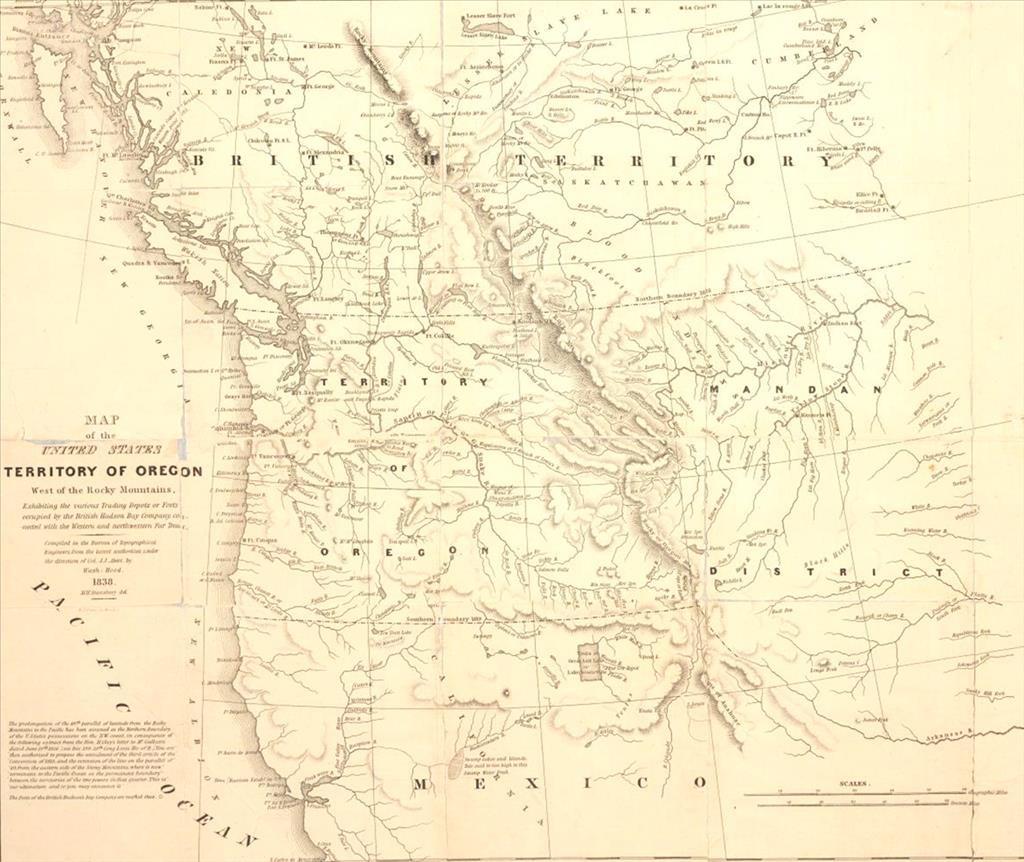
The Oregon Trail is an overland trail between Independence, Missouri, and Oregon City, near present-day Portland, Oregon, in the Willamette River valley. It was about 2,000-miles long and crossed through the States of Kansas, Nebraska, Colorado, Wyoming, Idaho, Oregon and Washington

It was one of the two main emigrant routes to the American West in the 19th century (the other being the southerly Santa Fe Trail from Independence to Santa Fe (now in New Mexico)).

It wasn’t until 1836 that the first wagons were used on the trek from Missouri to Oregon. A missionary party headed by Marcus and Narcissa Whitman set out to reach the Willamette Valley. Though the Whitmans were forced to abandon their wagons 200 miles short of Oregon, they proved that families could go west by wheeled travel.

In the spring of 1843, a wagon train of nearly 1,000 people organized at Independence, Missouri with plans to reach Oregon Country. Amidst an overwhelming chorus of naysayers who doubted their success, the so-called “Great Migration” made it safely to Oregon. (NPS)

Interest in the East for the Oregon country had begun to grow.  By 1846, thousands of emigrants who were drawn west by cheap land, patriotism or the promise of a better life found their way to Oregon Country.

With so many Americans settling the region, it became obvious to the British that Oregon was no longer theirs. They ceded Oregon Country to the United States that year.  (NPS)

Crucial to the success and well-being of travelers on the trail were the many forts and other settlements that sprang up along the route. (Britannica)   The forts were manned by troops of cavalry who were there to protect the emigrants traveling west and to also provide supplies for the wagon trains. (NPS)

Fort Laramie grew to become the largest and most important military post on the Northern Plains. It served emigrants as post office, resupply point and protection on the trail. Fort Laramie is now a NPS National Historic Site. (NPS)

As a result of the 1849 Gold Rush, the 1847 Mormon exodus to Utah and the thousands who moved west on the Oregon Trail starting in the 1840s, the need for a fast mail service beyond the Rocky Mountains became obvious.

The Pony Express, although it lasted only about 19-months (April 1860 and November 1861), generally followed the Oregon Trail and used some of the Forts as part of the horseback relay mail service. (NPS) There were approximately 190 relay stations located approximately 15 miles apart. (U of Nebraska)

Likewise, some of the forts served as telegraph stations and the forts protected the stations and helped to repair the telegraph lines. (The telegraph effectively eliminated the need for the Pony Express.)

The trail had several break-offs that were used by the Mormon pioneers, the California Gold Rush miners and many people who found what they were looking for or simply broke down along the way and decided to homestead the land they ended up on. (Post Register)

The Overland Trail and Stagecoach Line was an alternate wagon route off the Oregon Trail. Pioneers crossed this area as they headed westward in the late 1800s. (Laramie)

Possibly a half million traversed the Oregon Trail, covering an average of 15 to 20-miles per day; most completed their journeys in four to five months.  (Britannica)

Settlers who traveled the Oregon Trail spent roughly $800 to $1200 to be properly outfitted. Many of the pioneers raised their capital by selling their farms and possessions.

Along the way they found inflated prices for scarce commodities at trading posts and ferries. Once arriving in Oregon, there were scarce supplies available for purchase, requiring ability to work in exchange for goods and services (than cash for purchasing). (BLM)

Overwhelmingly, the journey was made by wagons drawn by teams of draft animals. Some people did not have wagons and rode horseback, while others went west with handcarts, animal carts, or even the occasional carriage.  (Britannica)

It is estimated that as many as 1 in 10 emigrants died on the trail – between 20,000 and 30,000 people (an average of ten graves per mile). The majority of deaths occurred because of diseases caused by poor sanitation. Cholera and typhoid fever were the biggest killers on the trail.

Another major cause of death was falling off a wagon and getting run over. This was not just the case for children; many adults also died from this type of accident.

Other deaths on the trail are recorded in dairies as: stampeding livestock, attack by emigrants on other emigrants, lightning, gunpowder explosion, drowning at river crossings and suicide. (BLM)

Most Native Americans tolerated wagon trains passing through their territories. Many pioneers would not have made it if it had not been for trading with the tribes along the trail.

There were conflicts between Native Americans and emigrants along the trail, but, when compared to the number of people traveling the Oregon Trail, deaths by Indians attacks were very rare. (BLM)

The completion of the first transcontinental railroad at Promontory, Utah, in 1869 marked the beginning of the end for the great overland migration routes to the West. (Britannica)

© 2024 Ho‘okuleana LLC

Filed Under: General, Place Names, Economy Tagged With: Hawaii, Oregon Trail, Wagon Ruts

April 21, 2024 by Peter T Young Leave a Comment

Lānai – Lāhainā Ferry

In ancient times, the windward coast of the island of Lānai was home to many native residents.  Maunalei Valley had the only perennial stream on the island and a system of loʻi kalo (taro pond field terraces) supplied taro to the surrounding community.

Sheltered coves, fronted by a barrier reef, provided the residents with access to important fisheries, and allowed for the development of loko iʻa (fishponds), in which various species of fish were cultivated, and available to native tenants, even when the ocean was too rough for the canoes to venture out to sea.  (Lānai Culture and Heritage Center)

The history of Lānai is rich and diverse, spanning first, some 800 years of native Hawaiian residency and subsistence practices (ca. 1000 – 1800 A.D.). Then following 1800, there was a decline in the native population as foreign influences began to grow.

In 1861, Walter Murray Gibson came to Hawaiʻi after joining the Mormon Church the year before; he was to serve as a missionary and envoy of the Mormon Church to the peoples of the Pacific.

The experience with the Church was relatively short-lived; in 1864, he was excommunicated for selling priesthood offices, defrauding the Hawaiian members and misusing his ecclesiastical authority (in part, he was using church funds to buy land in his name.)

By the 1870s, Gibson focused his interests at Koele, situated in a sheltered valley in the uplands of Kamoku Ahupuaʻa. As the ranch operation was developed, Koele was transformed from an area of traditional residency and sustainable agriculture to the ranch headquarters.  (Lānai Culture and Heritage Center)  In 1872, Gibson moved from Lānai to Lāhainā and then to Honolulu.

After Gibson’s death in 1888, the ranch was turned over to his daughter and son-in-law, Talula and Frederick Hayselden.  As early as 1896, the Gibson-Hayselden interests on Lānai, which held nearly all the land on the island in fee-simple or leasehold title, began developing a scheme to plant and grow sugar on Lānai.

They chose the ancient fishing community of Keōmuku for the base of operations.  However, before completing the construction of the mill and associated facilities, and prior to the first harvest being collected for processing, the Maunalei Sugar Company went bankrupt.

In the period between 1899 to the 1920s, Keōmuku served as the hub of residency and commerce. Several motor-driven boats were engaged in providing transportation of people and goods between Lānai and Lāhaina. (Lānai Culture and Heritage Center)

Navigating the rough seas and near shore reef waters took exceptional skill. With names like “Akamai” (Smart,) “Naheihei” (The Racer,) “Mikioi” (Skillful,) “Lokahi” (Unity) and “Manukiiwai” (Bird That Fetches Water,) the boats regularly made runs to Lāhainā from Halepalaoa.

The return trip from Lāhainā brought back the mail, various food supplies, along with poi, rice and flour, fresh water in bottles, and passengers – including family members and visitors to the island.

Kupuna, Venus Leinaala Gay Holt, born at Keomoku in 1905 recalled that: “No matter how rough, Noa Kaopuiki knew how to wait. He would keep the engine running and everything. He’d wait. He knew how to count the waves. And we would all hold right there, see everything. And all the sudden, he’d go! He was gone. Right through the channel, gone. And the big waves are coming right after that. Gone on his way to Lāhaina.”

“Our boats ran twice a week to Lāhainā. They always came back with a barrel of poi, bags of flour, or whatever, whatever, whatever. We had sort of a store room with all the things in it… The boat went over and we bought most of our supplies from Lāhainā.”

“We brought in large supplies, by cases. Case of corned beef, case of canned salmon… Every Wednesday and every Saturday, they bought fresh supplies, poi, a whole barrel of poi once a week. We always had rice, and we grew a lot of things down here. We grew a lot of vegetables. We grew sweet potatoes, even down at the beach house. Lots of sweet potatoes were grown for the pigs…” (Venus Leinaala Gay Holt, January 28, 2006; Lānai CHC)

© 2024 Hoʻokuleana LLC

Filed Under: Economy, Place Names Tagged With: Lanai Culture and Heritage Center, Maunalei, Halepalaoa, Hawaii, Lanai, Lahaina

April 16, 2024 by Peter T Young Leave a Comment

Līhuʻe

Līhuʻe, Kauai (literally translated as ‘cold chill’) dates from the late-1830s when Kaikioʻewa, governor of Kauai, moved his home from the traditional seat of government, Waimea, to the hilly lands overlooking Nawiliwili Bay on the southeastern side of Kauai in the ahupuaʻa of Kalapaki.

He named this area Līhuʻe in memory of his earlier home on Oʻahu. The name, Līhuʻe, was unknown on Kauai before then; the ancient name for this area was Kalaʻiamea, “calm reddish brown place.”  (Līhuʻe on Oʻahu is in the uplands on the Waianae side of Wahiawa; Kūkaniloko is situated in Līhuʻe.)  (Fornander)

In 1849, Henry A Peirce & Co, a partnership between Charles Reed Bishop, Judge William L Lee, and Henry A Pierce established a suar plantation (on the site Kaikioʻewa chose for it on the Nawiliwili stream (water power was used to drive the mill rollers.)) (In 1859, a new partnership was formed and the name was changed to the Līhuʻe Plantation Company.) (HSPA)

The Plantation had several innovations.  “(T)he first important (irrigation) ditch was dug at Līhuʻe, Kauai, in 1851 … other ditches on Maui soon followed.”  (Louisiana Planter)  In 1859, the first steam engine used to power a sugar mill in Hawaiʻi was installed at Līhuʻe.  (LOC)

In 1851, a frame courthouse was built on a site just above Kalapaki Bay and Nāwiliwili Harbor.  The Lihue Plantation Store was built in the 1860s on the grounds of the plantation manager’s residence and moved in 1876 to a hill across the mill valley (where the present County Executive Offices are situated.)  The store later served as the area’s mail distribution hub.

A cluster of homes and stores around it was the start of the town of Līhuʻe.  During most of the nineteenth century, Līhuʻe served as the center of island government.  Sugar planting to feed the plantation and mill changed the landscape.

“The country was undergoing the process of denudation. Non-resident landlords, large landholders, have in most cases leased out their lands by long leases to vandal-like tenants, who are making the most of their time and their bargain by cutting down the forests, and supplying the sugar mills, shipping, and even Honolulu with wood.”

“Sixteen years ago, where beautiful kukui groves gladdened the scene, is now a barren plain.”  (Pacific Commercial Advertiser, July 27, 1867)

Līhuʻe Plantation expanded in 1910 with the purchase of controlling interest in Makee Sugar Company. Expansion again occurred in 1916 when Līhuʻe Plantation and WF Sanborn purchased the 6,000 acre Princeville Plantation.

In 1922, American Factors, Ltd (AmFac,) successor company to H Hackfield & Co, acquired control of Līhuʻe Plantation Company.  The Līhuʻe Mill was one of the longest sugar mills in service in the Islands (1849-2000.)

The Fairview Hotel (initially opened by Charles W Spitz in 1890) was the first full-fledged hotel on Kauai providing rooms and a restaurant. William Hyde Rice’s oldest son William Henry Rice took over the operation in 1894 and eventually changed the name to Lihue Hotel; it grew over the years to 68-rooms.

In those days, an operation had to be self-sufficient and a farm behind the hotel raised cattle, pigs and chickens along with fruits and vegetable grown for the restaurant.   After Rice’s death in 1946, the family sold the hotel to Inter-Island Steam Navigation Company; the name was changed to Kauai Inn.  (Kauai Museum)

Following annexation (1898,) the Territorial government passed the County Act (1905,) establishing county governments.  Līhuʻe became the county seat of Kauai and the County Commissioners held monthly meetings in the 1851 courthouse.

In 1913, the present County Building was erected, the first structure in the territory built expressly to house a county government.  Its Chambers have served the Kauai County Council ever since.

That year, a new Līhuʻe Store replaced the old.  The County Building and Līhuʻe Store were the earliest buildings on Kauai constructed of concrete and presaged a new era in the development of Lihue.  With the completion of the County Building, the 1851 courthouse was razed and a school built on its site.

The school was interchangeably referred to as Līhuʻe High School and Kauai High School.  It was the fifth high school in the Territory of Hawaiʻi and the first high school on the island of Kauai.  Kauai High sits on a hill often referred to as “Ke Kuhiau” (meaning “high point” – it’s also the name of the school yearbook.)  (KHS)

The partially-rock-faced Albert Spencer Wilcox Memorial Library, the island’s first library, was dedicated on May 24, 1924 (Albert’s birthday – it was funded by Emma Mahelona Wilcox in memory of her husband.)  (A new library was built in Līhuʻe in 1969 – the Wilcox Building is now the Kauai Museum and home to the Kauai Historical Society.)

Down the hill, construction of the Nawiliwili breakwater began in 1920. This was the first step in creating Nawiliwili Harbor, not completed until 1930.  Air fields at Līhuʻe and Hanapepe were constructed and the first airplanes actually flew to Kauai in 1920. By 1929 Hawaiian Airlines established regular flight service. (Strazar)

Kaua‘ made history at this time when it sent the first woman in Hawai‘i to the Territorial House in 1924, Rosalie Keliʻinoi, and the first to the Territorial Senate in 1932, Elsie Wilcox. (Strazar)

During the Depression Era and 1930s, public improvement projects dominated the construction scene in Līhuʻe. Roads were paved and several significant buildings were built.

The area surrounding the County Building developed as the hub of government activities with the construction of the Territorial Office Building (County Building Annex) in 1930 and the County Courthouse in 1938.

Originally the County Courthouse was to be built in the park in front of the County Building; however, public outcry against that location resulted in the construction of Umi Street and the Courthouse on its present site.

Līhuʻe Theater was built in 1931.  The Līhuʻe Post Office (1938) was the first and only federally-constructed post office on the island of Kauai (it was expanded in the late-1970s.)

Daily flights led to airmail in 1934 complementing long distance telephone service begun in 1931. During the 1920s and 1930s a belt road connecting main towns was paved, as well. (Strazar)

© 2024 Hoʻokuleana LLC


Filed Under: Economy, Place Names Tagged With: Amfac, Albert Wilcox, Hawaii, Kauai, Lihue, Hackfeld, Lihue Plantation, Emma Kauikeolani Wilcox

April 10, 2024 by Peter T Young Leave a Comment

Jack London and Waipio

In 1906, Jack London announced he was planning a trip on a boat – the Snark – he was to build and do blue-water sailing on a round-the-world cruise.  (The Snark was named after one of Lewis Carroll’s nonsense poems.)

“‘Honolulu first,’ said London yesterday. ‘After that we are not very definite. Everybody’s in good health, the bourgeoise tradesmen have finally freed us, the boat is staunch, the weather fine. What more a man wants I don’t know.’”

“‘Meet me in Paris,’ called Mrs. Jack London back through the megaphone as the boat disappeared. ‘Isn’t it glorious? Good-by, everybody!” [April 23, 1907] Jack and his wife Charmian came to the Islands twice, 1907-09 & 1915-16.

Later, Charmian wrote of Jack London’s impression of the Islands, “Jack, with his unquestionable love of natural beauty,

was ever impressed with man’s lordly harnessing of the outlaw, Nature, leading her by the mouth to perform his work upon earth.”

“‘’Do you get the splendid romance of it?’ he would say. ‘Look what these engineers have done – reaching out their hands and gathering and diverting the storm wastage of streams over the edge of this valley thousands of feet here in the clouds. …”

“[O]ne day, riding in a drizzle, Jack and I happened upon the broad, steep trail of the 2500-foot eastern scarp, into Waipio, and mushed through its mud down into a sunnier level, meeting strings of ascending mules laden with garden produce.”

“An old chronicler referred to the condition of the ‘roads’ hereabout as ‘embarrassing.’ Our horses tried very fractiously to refuse the descent.”

“This was one of the prettiest little adventures we two ever had together, dropping into the sequestered vale that opened wondrously as we progressed to the lovely banks of a wooded river that wound to the sea, widening to meet the surf that thundered upon a two-mile shingle.”

“On the banks of the stream we could see wahines at their washing, and hear the ringing sweet voices of children at play-survivors of a once thick population, as evidenced by remains that are to be found of fish-ponds, taro-patches, and the like. Here the last Hawaiian tapa cloth was made.”

“That same chronicler says: ‘There was something about that valley so lovely, so undisturbed … it seemed to belong to another world, or to be a portion of this into which sorrow and death had never entered.’”

“At the head of this great break in the coast nestles the half-deserted, half-ruined village of Waipio, and behind it there wedges into the floor of the valley a tremendous rock bastion veiled in waterfalls to its mid-hidden summit.”

“A second river curved from beyond its feet, and joined the one that flowed into the sea. We rode on across reedy shallows to a pathway once sacred to the sorcerers, kahunas, the which no layman then dared to profane with his step.”

“Only approaching twilight held us back from the beach trail that leads to a clump of tall coconuts, marking the site of a onetime important temple of refuge in this section of Hawaii, Puuhonua, built as long ago as the thirteenth century by a Kauai king.”

“There is reason to believe that there were several lesser temples in the neighborhood. They do say that Kamehameha the Great was born here in Waipio.”

“One would like to think that first seeing the light of day in so superlatively grand and beautiful a vale might make for greatness!”

“That day, moving along the bases of the cloud-shadowed precipices, we planned happily how we should some day come here, restore one of the abandoned cottages and its garden, and live for a while without thought of time.”

“What a place for quietude and work!”

“For once Jack seemed to welcome the idea of such seclusion and repose. Little as he ever inclined toward folding his pinions for long, Hawaii stayed them more than any other land.”

“‘You can’t beat the Ranch in California – it’s a sweet land,’ he would stanchly defend, ‘but I’d like to spend a great deal of my time down here.’”

“We bemoaned the weather that prevented us from climbing the zig-zag stark above our heads into Waimanu.” (London, Our Hawaii)

© 2024 Ho‘okuleana LLC

Filed Under: Prominent People, General, Place Names Tagged With: Hawaii, Hamakua, Waipio, Jack London, Charmian London

April 9, 2024 by Peter T Young Leave a Comment

Kahuku Pali

Kahuku is the largest of the 1300 ahupuaʻa (traditional land divisions) in Hawaiʻi. Located in the vast Kaʻū district, the ahupuaʻa of Kahuku originally extended from the summit caldera of Mauna Loa to the sea. (NPS)

The oldest dated feature within Kahuku is from about 1400 AD, though older evidence has been found nearby near Ka Lae (South Point).

Widespread settlement in this dry, volcanic area came later than in most parts of Hawai’i. By the mid-1400s, Ka‘ū (and perhaps Kahuku) had intensively managed agricultural fields in mid-elevation land with adequate rain and soil. Food crops included sugar cane, ʻuala, and maiʻa (bananas). (NPS)

Kahuku pali has two Hawaiian names: Pali o Mamalu, for its mauka (inland) section, and Pali‘okūlani, for its makai (seaward) section.  It was formed by a geologic fault. Its average height is 400 ft, but its maximum height, which is equal to the amount of offset (movement) on the fault, is approximately 560 ft.

The origin of the Kahuku pali is still debated. One hypothesis is that the pali is a scissors fault, with zero offset above Highway 11 and increasing amounts of offset toward the south—similar to the way the two cutting surfaces of scissors get farther apart as you move from hinge to tip. On the Kahuku pali, the west side of the fault dropped down relative to the east side.

An alternate hypothesis is that the submarine portion of the pali is the headwall of a catastrophic landslide, with the west side falling away and leaving the mile-high scarp. Both hypotheses have pros and cons, and today, there is no definitive answer as to the origin of the pali. (USGS)

“In the lee of the great cliff (which was caused by a geologic fault) named Pali-o-Mamalu (Cliff-of-Protection) is Wai-o-‘Ahu-kini. The trade winds pass a thousand or more feet above it, which gives it a scorching desert climate in the daytime; but when the sun goes down it cools rapidly and the nights are cool.”

“Southerly cyclonic storms sweep in over the low shore, inundating the whole area. That is why there is, and has been, no permanent habitation here.” (Handy, Handy & Pukui)

“(T)he population settled in the two western ahupua‘a of Ka‘ū. Wai-o-‘Ahu-kini (Water of Ahukini) close by, with its spring, pond, and canoe haven, and the best fishing ground in all Hawaii …”

“… was awarded in the ancient land allotment to Pakini, then one of the most verdant of the plains areas of cultivation. Doubtless it was Pakini’s numerous population, which gave its ali‘i power, that was responsible for this award.”

“From the cliff above Wai-o-‘Ahu-kini and from the trail going down can be seen a stagnant pool close to the shore; this was evidently the ‘water’ of ‘Ahu-kini.” (Handy, Handy & Pukui)

Cooks’ journal entry for January 5, 1779; reported his ship had rounded the south point of the island … “On this point stands apritty large village, the inhabitants of which thronged off to the Ship with hogs and women … As we had now got a quantity of salt I purchased no hogs but what were fit, for salting, refuseing all that were under size …”

“… in general they being no other at first, but when they found we took none but the large ones, several went a shore and returned with some, however we could seldom get one about 50 or 60 Ib weight.”

“As to fruit and roots we did not want and it was well we did not for it was very little of either they brought with them, indeed the Country did not seem capable of producing many of either having been destroyed by a Volcano.” (Cook’s Journal)

“Some of the canoes that greeted Cook’s ship may have come not only from the South Point village, but also from those at Wai‘ahukini and Ka‘iliki‘i to the west and Keana and Kaalualu to the east.”  (Kelly)

“One of the earliest foreigners to visit Ka‘ū was Archibald Menzies, the surgeon and naturalist on Vancouver’s voyage. Menzies had been in the Hawaiian Islands previously as surgeon on the furtrader Prince of Wales under Captain Colnett in the years 1787 and 1788, but he had not kept a journal of that visit.”

“Vancouver’s ships were in the Islands three times – 1792, 1793, and 1794. “On the 1794 trip Menzies was able to get to the top of Hualālai and of Mauna Loa. His successful ascent of Mauna Loa was on a trail that leads up from Kapāpala.”

“The approach to this trail from Kona, where Vancouver’s ships were anchored, was by canoe to Ka‘iliki‘i, or Wai‘ahukini in Pi‘ikini, Kalli, and then overland on foot to Kapāpala.” (Kelly)

Menzies, on his way to be the first white man to reach the summit of Mauna Loa, climbed the pali … “we left our canoes at Pakini and set out early on the morning of the 10th [of February 1794] to prosecute the remainder of our journey by land.”

“We had not travelled far when we found we had to ascend an elevated steep rugged bank that took its rise at the south point of the island and running along the southern side of Pakini Bay continued its direction inland behind the village.”

“On gaining its summit, which was not an easy task, an extensive tract of the most luxuriant pasture we had yet seen amongst these islands rushed at once upon our sight, extending itself from the south point to a considerable distance inland.”

“It was cropped with fine soft grass reaching up to our knees, and naturally of a thick bottom that would afford excellent feeding for cattle, where herds of them might live at their ease, if it was not for scarcity of fresh water, which we experienced in all the low grounds we had yet visited….”

“Close by us was a fine plantation belonging to Kamehameha, called Kahuku, where our purveyor was particularly ordered to demand supplies for our journey …” (Menzies)

“In the afternoon we resumed our journey and soon after reached the upper plantations, when instead of ascending directly up the mountain as we expected, they led us across these plantations to the north-eastward at a distance of five or six miles from the shore by a narrow winding path which in some places was very rugged and seldom admitted more than one person at a time …”

“… so that we followed one another in a string, and occupied a considerable space in length from the number of our party and the crowds that followed us from village to village through curiosity and flocked to see us, from far and near.”

“This path we found to be the public road leading to the east end of the island, and at small eminences here and there, we met cleared spots for resting on, where the wearied travellers generally sit down to chew sugar cane and admire the surrounding prospect.” (Menzies)

© 2024 Ho‘okuleana LLC

Filed Under: Place Names, Prominent People, General Tagged With: Hawaii, Kahuku, Kau, Archibald Menzies, Kahuku Pali, Pali o Mamalu, Paliokulani

  • « Previous Page
  • 1
  • …
  • 34
  • 35
  • 36
  • 37
  • 38
  • …
  • 154
  • Next Page »

Images of Old Hawaiʻi

People, places, and events in Hawaiʻi’s past come alive through text and media in “Images of Old Hawaiʻi.” These posts are informal historic summaries presented for personal, non-commercial, and educational purposes.

Info@Hookuleana.com

Connect with Us

  • Email
  • Facebook
  • LinkedIn
  • Twitter
  • YouTube

Recent Posts

  • ‘Aim High to Reach the Heaven’
  • Presidents’ Day
  • Moku Manu
  • Valentine’s Day
  • Louis Henri Jean Charlot
  • Greek Artillery
  • Land Divisions

Categories

  • Place Names
  • Prominent People
  • Schools
  • Sailing, Shipping & Shipwrecks
  • Economy
  • Voyage of the Thaddeus
  • Mayflower Summaries
  • American Revolution
  • General
  • Ali'i / Chiefs / Governance
  • Buildings
  • Missionaries / Churches / Religious Buildings
  • Hawaiian Traditions
  • Military

Tags

Albatross Al Capone Ane Keohokalole Archibald Campbell Bernice Pauahi Bishop Charles Reed Bishop Downtown Honolulu Eruption Founder's Day George Patton Great Wall of Kuakini Green Sea Turtle Hawaii Hawaii Island Hermes Hilo Holoikauaua Honolulu Isaac Davis James Robinson Kamae Kamaeokalani Kameeiamoku Kamehameha Schools Lalani Village Lava Flow Lelia Byrd Liberty Ship Liliuokalani Mao Math Mauna Loa Midway Monk Seal Northwestern Hawaiian Islands Oahu Papahanaumokuakea Marine National Monument Pearl Pualani Mossman Quartette Thomas Jaggar Volcano Waikiki Wake Wisdom

Hoʻokuleana LLC

Hoʻokuleana LLC is a Planning and Consulting firm assisting property owners with Land Use Planning efforts, including Environmental Review, Entitlement Process, Permitting, Community Outreach, etc. We are uniquely positioned to assist you in a variety of needs.

Info@Hookuleana.com

Copyright © 2012-2024 Peter T Young, Hoʻokuleana LLC


Loading Comments...