Images of Old Hawaiʻi

  • Home
  • About
  • Categories
    • Ali’i / Chiefs / Governance
    • American Protestant Mission
    • Buildings
    • Collections
    • Economy
    • Missionaries / Churches / Religious Buildings
    • General
    • Hawaiian Traditions
    • Other Summaries
    • Mayflower Summaries
    • Mayflower Full Summaries
    • Military
    • Place Names
    • Prominent People
    • Schools
    • Sailing, Shipping & Shipwrecks
    • Voyage of the Thaddeus
  • Collections
  • Contact
  • Follow

January 8, 2025 by Peter T Young Leave a Comment

Before the Marine Base

O‘ahu used to be nearly twice as big as it is now.  (Thompson) The Island consists of two major shield volcanoes: Waiʻanae and Koʻolau; the eroded remnants of which are the Waiʻanae Range and the Koʻolau Range.

Koʻolau volcano started as a seamount above the Hawaiian hotspot around 4-million years ago. It broke sea level some time prior to 2.9-million years ago.

About 2-million years ago, much of the northeast flank of Koʻolau volcano was sheared off and material was swept onto the ocean floor (named the Nuʻuanu Avalanche) – one of the largest landslides on Earth.

The Pali is the remaining edge of the giant basin, or caldera, formed by the volcano. At its base are the towns of Kāne’ohe, Kailua and Waimānalo – beyond that, open ocean. The other half of the caldera, an area the size of Brooklyn, tore away and tumbled into the ocean.  (Sullivan)

Mōkapu Peninsula (where Marine Corps Base Hawai‘i is situated) is evidence of subsequent secondary volcanic eruptions that formed Ulupaʻu Crater (the large hill on the Kailua side of the peninsula,) Pu‘u Hawaiiloa (the central hill that originally had the base control tower, now has radar (‘the hill’,)) Pyramid Rock and the nearby Moku Manu (Bird Island.)

Coral reefs and marine terraces were formed at different elevations due to the changing sea levels over time.  There are some broad lowland areas in the lower reaches of deeply alluvial valleys. (Moberly)

Mōkapu Peninsula is part of two ahupua’a in the district of Ko‘olaupoko: He‘eia and Kāne‘ohe. He‘eia ahupua’a encompasses the western third of the peninsula (called the ‘iii of Mōkapu) and extended inland; Kāne‘ohe ahupua‘a is on the eastern two-thirds of the peninsula.

Hawaiians lived on Mōkapu Peninsula for at least 500 to 800 years before Western Contact. Farmers cultivated dryland crops like sweet potato for food, and gourds for household utensils.

They tended groves of hala (pandanus) trees for the lauhala (leaves) to weave into mats and baskets, and wauke plants for kapa (paperbark cloth). The highly prized wetland taro might have been grown in the marshy area at the center of the peninsula.

Mōkapu people fished in the protected waters of Kāne‘ohe Bay, in Kailua Bay, and in the deep ocean to the north; and took advantage of the rich shore resources.

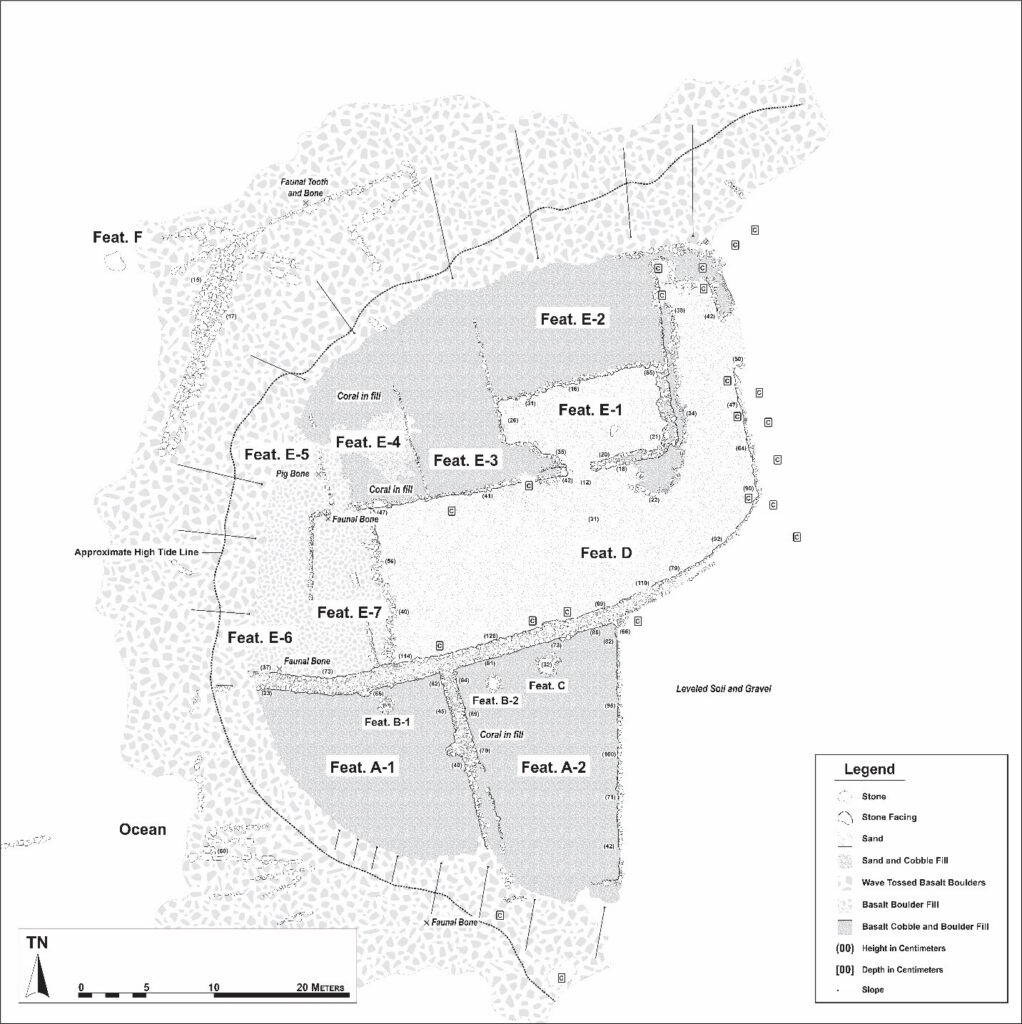
There were at least two small villages on the peninsula, as well as scattered houses along the coastline. With walls up to six feet wide, the massive fishponds of Mōkapu are an indication of political significance since only chiefs could command the labor to build such monuments. They were being used from as early as the 15th or 16th centuries.

British Captain James Cook made landfall in Hawai‘i in 1778, the first documented Western contact with the islands. He was followed in short order by European and American explorers and traders.

In the first decades after Western Contact, Honolulu was the focus of interactions between Hawaiians and foreigners. On remote Mōkapu Peninsula, separated from urban Honolulu by the high, sheer Pali, life continued in the cycle of subsistence farming.

Mōkapu, and Kāne‘ohe, in general, were far from the attentions of foreigners. It was not until the US Exploring Expedition of 1840-1841 that Kāne‘ohe Bay and its environs were documented in detail.

Under King Kamehameha III, the most important event in the reformation of the land system in Hawai‘i was the separation of the rights of the King, the Chiefs and the Konohiki (land agents) through the Great Mahele in 1848.

The King retained all of his private lands as his individual property; one third of the remaining land was to be for the Hawaiian Government; one third for the Chiefs and Konohiki; and one third to be set aside for the tenants, the actual cultivators of the soil.

Paki (father of Bernice Pauahi Bishop) received the ahupua‘a of He‘eia, including the ‘ili of Mōkapu. Kamehameha III kept the ‘ili of Kuwa‘ahohe in the center of the peninsula, as well as Halekou and Kaluapūhi ponds; Kalama, his wife, received most of the ahupua‘a of Kāne‘ohe including Nu‘upia Fishpond.

Following Paki’s death in 1855, the Sumner brothers, John and William, bought the ‘Ili of Mōkapu.  In 1885, John Sumner became sole owner when his brother died. In 1892, John left Mōkapu in a trust to his nephew, Robert Wyllie Davis (the son of Sumner’s younger sister Maria).

In the first half of the 20th century, truck farms and commercial plantings replaced the traditional subsistence gardens on almost all of the tillable land of the peninsula, including inside Ulupa‘u Crater.

Watermelon thrived in the hot and sunny, loamy soil of the peninsula – papaya, sweet potato, Irish potato, pumpkins, squash, and sweet corn were also grown.   The Japanese farming community was about where the MCBH runway is today .

One of the earliest commercial efforts was Albert van Clief and Addie Gear’s cotton plantation. “Strange as it may seem our cotton pickers are Hawaiian. … We have three Hawaiian women and one Hawaiian man and a Korean couple.” (Hawaiian Gazette, Dec 10. 1910)  But hard times for the Gears quickly followed.

Chinatown was the primary market for the Mōkapu farmers.  The Maui News of June 21, 1918, reported that Mōkapu farmer N. Ewasaki won second place for “Best ten-pound any white variety” of Irish potatoes at the annual Maui County.

As early as 1890, Joseph Paul Mendonça and his partner Christel Bolte had been leasing the former Kāne‘ohe Ahupua‘a lands of Queen Kalama. A journal entry on June 1, 1893, noted “We commenced today doing business under the name of Kāneʻohe Ranch”.

They started with the herd with imported Angus cattle, purchased from James I Dowsett, one of the founders of the ranching industry in Hawai‘i. Horses, sheep, and goats rounded out the livestock assets.

Then, Mendonça was ready for a change; the Ranch ledger entry for December 31, 1899 stated, “Joe Mendonça is ‘pau ke aloha’ with Kaneohe, he wants to sell out or do something, he does not exactly know what ….” (MCBH) By 1905, James B.Castle was a shareholder in the Ranch.

In 1917, Castle’s son, Harold KL Castle, purchased the ranch. Harold Castle and his family spent weekends at their beach home on the ocean side of the high Heleloa Dune.

Kāne‘ohe Ranch was the main cattle operation (on the eastern portion of the peninsula); Robert Davis and later Arthur H. Rice, Sr., had their own smaller herds in the former ‘ili of Mōkapu. Scattered wild lands were covered in kiawe, hau, and haole koa trees, and lantana and feral tomatoes were rampant.

In 1921, the Territory of Hawai‘i established a game farm on Mōkapu Peninsula. The farm contained about 350-acres, which included Halekou and Kaluapūhi fishponds.  As a part of the farm program, the Territory also initiated a reforestation program at Mōkapu in which about 5,000 trees had been planted by the end of 1930, and about 2,000 coconuts in 1932.

The tract of land that Mōkapu Game Farm was developed on was described in 1929 as “an arid waste, barren, silent, almost desolate” (Honolulu Star Bulletin Oct. 31, 1929). At the end of 1930, 185 acres of the land had to be fenced to protect it from “wandering stock” (Hawaii, Terr., Bd. Comm. Ag. & For. 1931:118) (Maly)

The Mōkapu Game Farm raised and released many types of game birds, including: Pheasants (the primary bird raised and released); California quail, Gambel’s quail, and Japanese quail; Chukars; Guinea fowl; Ducks; and others. The birds were raised and released to benefit hunters and to increase agricultural yield by preying on plantation pests.

Folks at the Game Farm apparently also raised Japanese oysters in the nearby mud flats by the old Wilson Pier, used by the Territorial Game Farm that was situated near the location of the present H-3 interchange. (George Davis; Maly)

In the 1920s, the peninsula was a private holding with no access to the general public, and there were few permanent residents. Wally Davis and the Date family lived at Davis Point in southwestern Mōkapu. Some Japanese farmers had homes on the peninsula, but many lived in Kailua or Kāne‘ohe and came to the peninsula only to work their fields.

Dr. George Straub and members of the Kawainui Shooting Club were periodic visitors to their places along the Kailua Bay frontage. The supervisor of the Territorial Game Farm had a residence at Halekou Fishpond.

The ‘ili of Mōkapu became the “Fisherman’s Paradise” with development of the Mōkapu Tract Subdivision – “A private sea fishery is an appurtenant to the land, in which lot owners are given the privilege of fishing for personal.”

Beach lots were offered for sale from $1,000 and up; and second tier lots with rights of way to the beach for $500 and up.  “Put on the market in 1932, Mōkapu has met with exceptional success.”  (Maly)

In 1934, a radio facility was built by Pan American Airways on the crest of He‘eia Dune, roughly between Pyramid Rock and the north end of the present Runway 4/22. It was used as a link for Pan Am trans-Pacific flights, that started in 1935.

In 1918, through Executive Order 2900, President Woodrow Wilson designated 322 acres in the central portion of Mōkapu Peninsula as the Army’s Kuwa‘ahohe Military Reservation. Deactivated at the end of World War I, the reservation was leased for ranching until 1939, when it was reactivated as Fort Kuwa‘aohe.

In December 1940, Fort Kuwa‘aohe was renamed Fort Hase, in honor of Major General William F Hase, who served as Chief of Staff of the Army’s Hawaiian Department from April 1934 to January 1935. It served as headquarters of the Harbor Defenses of Kāne‘ohe Bay.

On the western side of the peninsula, Naval Air Station (NAS) Kāne‘ohe was established in 1939; a base for squadrons of seaplanes to support the Pearl Harbor fleet was developed.

The work included dredge and fill operations that added 280 acres to the Kāne‘ohe Bay side of the peninsula, as well as filled low-lying areas for runway and hangar construction.

The great bulk of all reef material dredged in Kāne‘ohe Bay was removed in connection with the construction at Mōkapu of the Kāne‘ohe Naval Air Station (now Marine Corps Base Hawai‘i) between 1939 and 1945.

Dredging for the base began on September 27, 1939, and continued throughout World War II.  A bulkhead was constructed on the west side of Mōkapu Peninsula, and initial dredged material from the adjacent reef flat was used as fill behind it.

In November 1939, the patch reefs in the seaplane take-off area in the main Bay basin were dredged to 10-feet (later most were taken down to 30-feet.)

Other early dredging was just off the northwest tip of the peninsula, near the site of the “landing mat” (runway.)  It appears that a fairly reliable total of dredged material is 15,193,000 cubic yards.

(Do the Math … Let’s say the common dump truck load is 10 cubic yards … that’s a million and a half truckloads of dredge material.)  The runway was about half complete at the time of the Japanese attack on December 7, 1941. (Lots here is from Tomonari-Tuggle & Arakaki)

© 2025 Ho‘okuleana LLC

Filed Under: Hawaiian Traditions, Military, Place Names, Economy Tagged With: George Francis Straub, Kaneohe, Castle, Harold Castle, Straub, Heeia, Mendonca, James B Castle, Bolte, Paki, Christel Bolte, Kaneohe Ranch, Mokapu, Kalama, Hawaii, Joseph Paul Mendonça, Kaneohe Bay

January 6, 2025 by Peter T Young Leave a Comment

Maʻi Pākē

The common Hawaiian name for the disease was Maʻi Pākē, or Chinese sickness.

Its introduction to the Islands was but one of many new diseases; it was called maʻi pākē (Chinese sickness,) maʻi ali‘i (chiefly sickness) and eventually maʻi hoʻokaʻawale ʻohana (disease that separates family.) It is thought that it came to the islands in the early-1800s, but it did not attain levels of great concern until the 1850s and 1860s.  (Inglis)

One of the earliest descriptions of it in Hawaiʻi was written by the Reverend Charles Samuel Stewart, a missionary in the 2nd Company of American Protestant missionaries, who landed at Honolulu in 1823.

An entry in his journal dated May 21, 1823 notes “not to mention the frequent and hideous marks of scourge, which more clearly than any proclaims the curse, of a God of Purity, and which while it annually consigned hundreds of these people to the tomb, converts thousands while, living into walking sepulchres.”

“The inhabitants generally are subject to many disorders of the skin; the majority are more or less disfigured by eruptions and sores found many are as unsightly as lepers.”  (Schrodt)

The association of the disease with the Chinese people probably had to do either with the fact that an individual or individuals of that race were noted to have the disease or simply that the Chinese were familiar with it because they had often seen it in their own country.  (Greene)

The name “maʻi pākē” may, no doubt, have originated on the interrogation by a native of a Chinaman, “What is this disease?”  The Chinaman would probably answer, “I do not know the Hawaiian word, but there are plenty of people sick with the disease in my country.”

“It was recognized by the few Chinese, then on the islands, and this has given it the name of “Maʻi Pākē” here, and not because it has been introduced here by the Chinese.” (Hawaii Board of Health 1886)

From Eastern writings there is good evidence that India, East Asia and China are among its most ancient homes. The earliest reference appears to be rather universally accepted was written in the Chou Dynasty in 6th century B.C.

In the Chinese medical classic entitled Nei Ching there are four passages which may allude to an afflicted patient. If this classic was written by one Huang Ti, it may have been recognized in China over five thousand years ago.  (Schrodt)

Early incidences in the Islands were most often associated with Chinese immigrants to Hawai‘i and thus the name maʻi pākē. Some believed that it came with Chinese plantation workers, but many individuals and groups also arrived from other regions of the world where leprosy was endemic. It could have come from any number of sources such as the Azores, Africa, Malaysia or Scandinavia.  (Inglis)

Further statements from the Board of Health report refute that the disease was started by the Chinese, “if one Chinaman caused such an alarming spread of the disease thirty or forty years ago, there are now, comparatively speaking, so very few cases of leprosy among the seventeen or eighteen thousand Chinamen on these islands.”  (Hawaiʻi Board of Health, 1886)

“Again, if the disease had been introduced by the Chinese, and propagated by them … I should expect to find a much larger proportion of (them) affected with this loathsome malady, and yet we all know that the contrary is the fact.”

“It is much more likely that it came to these islands through the mixed crews of whale-ships, which had negroes, black and white Portuguese, and men of other races, coming from countries where leprosy was, and still is, prevalent.”  (Hawaiʻi Board of Health, 1886)

It rapidly spread on Oʻahu.  In response, the Legislative Assembly of the Hawaiian Islands passed “An Act to Prevent the Spread of Leprosy” in 1865, which King Kamehameha V approved. This law provided for setting apart land for an establishment for the isolation and seclusion of leprous persons who were thought capable of spreading the disease.

On June 10, 1865, a suitable location for incurable cases of leprosy came up for discussion.  he peninsula on the northern shore of Moloka’i seemed the most suitable spot for a leprosy settlement.

Its southern side was bounded by a pali – vertical mountain wall of cliffs 1,800 to 2,000 feet high, and its north, west and east sides by the sea and precipitous shores. Landings were possible in only two places, at Kalaupapa on the west side and at Kalawao on the east side of the peninsula, weather permitting.

The first shipment of lepers landed at Kalaupapa January 6, 1866, the beginning of segregation and banishment of lepers to the leper settlement.

Receiving and detention centers were established on Oʻahu.  Kalihi Hospital was the first hospital for leprosy patients in Hawaiʻi opening in 1865. Kapiʻolani Home opened in Kalihi Kai in 1891 adjacent to the Kalihi Hospital and Receiving Station; Kalihi Plague Camp (1900-1912) and Meyers Street, Kalihi Uka (1912-1938.)

Two notable people in Hawaiʻi associated with the treatment of patients with leprosy are Father (now Saint) Damien and Mother (now Saint) Marianne.)

Damien (born as Jozef de Veuster,) arrived in Hawaiʻi on March 9, 1864.  He continued his studies here and Bishop Maigret ordained Father Damien at the Cathedral of Our Lady of Peace, on May 21, 1864; in 1873, Maigret assigned him to Molokaʻi.  Damien spent the rest of his life in Hawaiʻi; he died April 15, 1889 (aged 49) at Kalaupapa.

In 1877, Sister Marianne was elected Mother General of the Franciscan congregation and given the title “Mother” as was the custom of the time. In 1883, she received a letter from Father Leonor Fouesnel, a missionary in Hawaiʻi, to come to Hawaiʻi to help “procure the salvation of souls and to promote the glory of God.”

Of the 50 religious communities in the US contacted, only Mother Marianne’s Order of Sisters agreed to come to Hawaiʻi to care for people with leprosy.  The Sisters arrived in Hawaii on November 8, 1883.

In the summer of 1886, the Sisters took care of Damien when he visited Honolulu during his bout with leprosy.  He asked the Sisters to take over for him when he died.  Mother Marianne led the first contingent of Sister-nurses to Kalaupapa, Molokaʻi, where more than a thousand people with leprosy had been exiled.

A third person in Hawaiʻi, Alice Ball, made notable contributions in the treatment of the disease. In the fall of 1914, she entered the College of Hawaiʻi (later called the University of Hawaiʻi) as a graduate student in chemistry.   The significant contribution Ball made to medicine was a successful injectable treatment for those suffering from Hansen’s disease.

Although not a full cure, Ball’s discovery was an extremely effective in relieving some of the symptoms of Hansen’s disease and was a significant victory in the fight against a disease that has plagued nations for thousands of years.

The discovery was coined, at least for the time being, the “Ball Method.”  During the four years between 1919 and 1923, no patients were sent to Kalaupapa – and, for the first time, some Kalaupapa patients were released.

Once known as leprosy, the disease was renamed after Dr. Gerharad Armauer Hansen, a Norwegian physician, when he discovered the causative microorganism in 1873, the same year that Damien volunteered to serve at Kalaupapa.

During the third quarter of the nineteenth century incidence of the disease occurred in more than 1% of the population in Hawai`i. In 1890 Kalawao’s patient population peaked at around 1,100.

By 1900, the number of new patients in the islands began a slow decline, a trend that continued until the 1940s when it was determined that the disease was not spreading in the general population.  (NPS)

About 8,000 people have been exiled there since 1865.  The predominant group of patients were Hawaiian and part-Hawaiian; in addition there were whites, Japanese, Chinese, Portuguese, Filipino and other racial groups that sent to Kalaupapa.  The law remained in effect until 1969, when admissions to Kalaupapa ended.

The image shows a view of Kalaupapa, Kalawao.

© 2024 Hoʻokuleana LLC

Filed Under: General, Missionaries / Churches / Religious Buildings, Place Names Tagged With: Saint Damien, Kalaupapa, Hansen's Disease, Kalawao, Saint Marianne, Mai Pake, Hawaii, Molokai

December 31, 2024 by Peter T Young Leave a Comment

ʻAlekoko Fishpond (Menehune Fishpond)

ʻAla ke kai o ka ʻanae.
Fragrant is the soup of a big mullet.
(A prosperous person attracts others. (ʻŌlelo Noʻeau))

‘Anae (ʻamaʻama – mullet) and awa (milk fish) were popular fish raised in Hawaiian walled fishponds.  The cultivation of fish took place in Hawaiian agricultural pondfields, as well as in specialized fresh and brackish water fishponds.

Ponds were built to catch and hold fish; the ponds grew algae that fed the fish.  A natural food chain can be expected to produce a ratio of 10:1 in terms of the conversion of one link by another (10,000-kg of algae make 1,000-kg of tiny crustaceans, which in turn make 100-kg of small fish.  (Kelly)

The Hawaiian walled fishpond stands as a technological achievement unmatched elsewhere in island Oceania.  Hawaiians built rock-walled enclosures to raise fish for their communities and families.  It is believed these were first built around the fifteenth century.  (Kelly)

These fishponds were symbols of chiefly status and power, and usually under the direct control of aliʻi or konohiki. The fish from these ponds often went to feed chiefly households. (Handy)

One significant fishpond on the southeast side of Kauaʻi is known as ʻAlekoko Fishpond (one of the rarest and most significant cultural and archaeological sites on Kauaʻi.)

Just outside Līhuʻe and Nāwiliwili Harbor on the Hulēʻia River, a Scenic Overlook is located just off of Hulemalu Road, about ½-mile from the entrance to the Nāwiliwili small boat harbor.

The fishpond is located in the Hulēʻia National Wildlife Refuge, 238-acres of river valley that is a habitat for thirty-one species of birds, including endangered Hawaiian birds: aeʻo (Hawaiian stilt,) ʻalae keʻokeʻo (Hawaiian coot,) ʻalae ʻula (Hawaiian moorhen,) nēnē (Hawaiian goose) and koloa maoli (Hawaiian duck.)

Although you can see the fishpond and the refuge from the road, the area is not open to the public. Small boats, kayaks, jet skis, windsurfers and water-skiers use the river.

ʻAlekoko Fishpond is located near the mouth of the Hulēʻia River, in the ahupuaʻa of Niumalu; it was formed by walling off a large bend in the river; the stone-faced, dirt wall is over 900-yards long.

The dirt wall is 5-feet above the water level, 4-feet wide on top and the dirt slants out on both sides. The facing wall begins with a single row of stones and then becomes double-thickness as it gets further out into the river and the current.

The stones also become larger until the double layer is 2-feet thick. The stone facing on the outside is five feet high in most places and is quite perpendicular. The stones are very carefully fitted together; the stone facing runs for about two-thirds of the total length of the wall. (NPS)

“That pond, of course, is monumental, monumental stone work.  To me this is the ultimate fishpond.  What makes it kind of special here on Kauaʻi is the way the stones are fitted.” (David Burney, paleoecologist; star-bulletin)

Ancient Hawaiians often used lava rock to build walls, but they typically shaped them to fit together instead of cutting them into blocks.  “Hawaiians didn’t typically cut rock to build something, (as they did at ʻAlekoko).” (Michael Graves, US archaeology professor; star-bulletin)

The pond did not just hold fish.  In the 1800s, two of the three gaps in the levee were filled in and the pond was used by rice farmers.

In the 1940s, after a tidal wave, the wall was repaired by the man who had the lease at the time. He put bags of cement in the weak spots and now longish “rocks” are visible where the bags deteriorated and the cement hardened.

According to legend, Chief ʻAlekoko asked the Menehune to build two ponds – one for him and one for his sister Hāhālua.  (Menehune, while small in size, were the mythical masters of stone work and engineering; they agreed to build the ponds – with one stipulation: neither should look out of their houses on the night of construction.)

Hāhālua, content with the idea of being able to eat fish from her own pond, did not look; however, her brother could not stand the temptation and he peered out.  Immediately, the Menehune stopped work and washed their bleeding hands in the water – hence the name of the pond, ʻAlekoko (bloody ripples.)

Built by the Menehune, it is also known as Menehune Fishpond.

“Today the lush vegetation on the wall and banks of the pond and the calm blue waters of the Hulēʻia River combine to make Menehune Fishpond an impressive sight, an ideal picture of Polynesia.”

“It is an important historical reminder of the past and a contemporary source of pride for the people of Kauaʻi.”  It was added to the National Register in 1973.  (NPS)  (Unfortunately, it has also been overgrown with invasive plants and silt has filled parts of the pond.)

© 2024 Hoʻokuleana LLC

Filed Under: Hawaiian Traditions, Place Names Tagged With: Nawiliwili, Fishpond, Huleia Wildlife Refuge, Huleia River, Alekoko Fishpond, Menehune, Hawaii, Kauai

December 30, 2024 by Peter T Young Leave a Comment

Volcanic Glass

Because “obsidian” is a generic term for dark-colored volcanic glass, people sometimes refer to the dense, glassy crust that forms on some Pāhoehoe flows here in Hawaiʻi as obsidian.

Most geologists and archeologists, however, prefer to make a distinction between the thin, glassy rind on an otherwise crystalline lava flow and the glass that erupts as thick flows or domes. We refer to the former as “volcanic glass,” reserving the term obsidian for the latter.

According to the International Association for Obsidian Studies, the sole source of obsidian in the state of Hawaiʻi is Pu`u Wa‘awa‘a, a broad, dome-shaped cone on the north flank of Hualālai Volcano.

The cone consists of layers of gray pumice, some containing blocks of black obsidian, that were deposited during explosive eruptions about 114,000 years ago. (USGS)

Obsidian is dense volcanic glass, usually rhyolitic (the fine-grained equivalent of granite) in composition and black in color. Glass, be it volcanic or manmade, cools quickly from a molten liquid without forming crystals, the building blocks of the minerals that make up most rocks.

In nature, erupting a glass flow requires an unusually viscous magma, one that has both a high silicon dioxide (silica) content and a very low water content. When viscosity is high and heat loss is rapid, crystallization is inhibited.

Crystals impart a regular structure to materials. Without this structure, glass fractures in conchoidal, or smoothly curved, shapes, leaving edges that are sharper than the finest steel blades.

Walking on an obsidian flow can be a nerve-wracking experience-wear gloves! Native Americans, of course, prized obsidian for arrowheads, and obsidian was traded hundreds of miles from its source.

Volcanic glass is rich in iron and magnesium, and tiny crystals of iron oxide give the glass its dark color. Different oxidation states of iron can tint the obsidian red, brown, or green.

Obsidian is commonly banded or streaked, because the high viscosity of molten obsidian prevents impurities or bubbles from easily mixing with the surrounding magma.

Obsidian is short-lived relative to most crystalline rocks. Most obsidian is younger than 20 million years, because any obsidian older than that has devitrified, or changed from glass to crystalline rock. Over eons, the silica molecules within the glass slowly rearrange into organized crystal structures.  (USGS)

Since the raw material is quite small, there is no tradition of formal tool manufacture as in other parts of the world where obsidian is a preferred resource for manufacturing flake blades and a range of bifaces (e.g., arrow and spear points).

Based on retouch, microscopic edge damage, step flake scars, and crushing, most researchers have assumed that small sharp flakes were used for light or fine cutting and scraping tasks.  Some have speculated that volcanic glass flakes may have been used for circumcision.  (Weisler in Liritzis and Stevenson)

Volcanic glass was used by Hawaiians to make cutting tools like knives for butchering birds and other animals as well as for doing fine wood work. (NPS)  They appear to have been used for short periods of time then discarded. (McCoy et al)

Volcanic glass was limited to a few small, informal tools types, typically scrapers or multi-purpose cutting tools. Basaltic volcanic glass, sometimes referred to as tachylite, forms by the rapid cooling of lava, and has few, if any, crystals and no corresponding internal crystal structure. Rarer in Hawai‘i is high silica volcanic glass from trachyte cones.  (Lundblad, et al)

Another form of volcanic glass are thin strands drawn out from molten lava that have long been called Pele’s hair, named for Pele, the Hawaiian goddess of volcanoes.

Scientists say Pele’s hair is “volcanic glass that has been stretched into thin strands by the physical pulling apart of molten material during eruptions. Most commonly it forms during fire fountain activity.”  (Batiza)

Missionary Titus Coan describes Pele’s Hair: “All at once the scene changes, the central portion begins to swell and rise into a grayish dome, until it bursts like a gigantic bubble, and out rushes a sea of crimson fusion …”

“… which pours down to the surrounding wall with an awful seething and roaring, striking this mural barrier with fury, and with such force that its sanguinary jets are thrown back like a repulsed charge upon a battle-field, or tossed into the air fifty to a hundred feet high, to fall upon the upper rim of the pit in a hail-storm of fire.”

“This makes the filamentous vitrification called ‘Pele’s hair.’”

“The sudden sundering of the fusion into thousands of particles, by the force that thus ejects the igneous masses upward, and their separation when in this fused state, spins out vitreous threads like spun glass.”

“These threads are light, and when taken up by brisk winds, are often kept floating and gyrating in the atmosphere, until they come into a calmer stratum of air …”

“… when they fall over the surrounding regions, sometimes in masses in quiet and sheltered places. They are sometimes carried a hundred miles, as is proved by their dropping on ships at sea.”

“This ‘hair’ takes the color of the lava of which it is formed. Some of it is a dark gray, some auburn, or it may be yellow, or red, or of a brick color.”  (Titus Coan)

A single strand, with a diameter of less than 0.5 mm (~0.02 inch), may be as long as 2 m (~6.5 feet). The strands are formed by the stretching or blowing-out of molten basaltic glass from lava, usually from lava fountains, lava cascades, and vigorous lava flows (for example, as pāhoehoe lava plunges over a small cliff and at the front of an ‘a’a flow.)

Pele’s hair is often carried high into the air during fountaining, and wind can blow the glass threads several tens of kilometers from a vent.  (USGS)

© 2024 Ho‘okuleana LLC

Filed Under: Place Names, Economy, General, Hawaiian Traditions Tagged With: Hawaii, Pele's Hair, Volcanic Glass, Obsidian

December 29, 2024 by Peter T Young Leave a Comment

The Big Fence on the Big Island

“Captain George Vancouver brought the first cattle to Hawaii from California in 1793-1794. They were landed and liberated at Kealakekua, South Kona on the Big Island. As with other introduced animals of the same period, a rigid “kapu” was placed on them in order to permit them to multiply.”

“This they did with a vengeance and within a comparatively short span of years they became quite common on all the islands, particularly on Hawaii where they found many hundreds of acres of good pasture lands.”

“Over a period of many years they were slaughtered by men employed for this purpose by the King, principally for their hides, which at one time formed one of the principal articles of export from Hawaii.”

“Experts were employed by the King to go into the mountains to shoot and rope these animals. Only a small amount of the meat was used, some of it being salted and sold to the whaling ships wintered in these water at that time.”

“Many of them were trapped in “pitfalls” similar to the one which David Douglass lost his life on the slopes of Mauna Kea in 1834.” (Bryan, “Wild Cattle in Hawaii” Paradise of the Pacific (1937))

“For the past twenty years the attention of our Government and of this Forestry Bureau has been called to the destruction of our Native forests on Government lands in particular. … It is become a serious problem with us.”

“Large areas of Public Forests are annually destroyed by fire, orginating [sic] in many instances by cattlemen setting fire to the ferns and underbrush to improve their pasture. …  If the cattle are not taken away soon it will be but a short time when this Native forest will be destroyed, and the water supply on the low land diminished.”

“‘[C]attle seem to be the principal enemy of the forests.’  [Sheep also damage the forest habitat]  .By way of countering this threat, [it was] recommended that large parts of the government forest lands …”

“… ‘should be fenced off at once, for the purpose of preserving the living and growing timber and promoting the younger growth of fern and underbrush.’” (Report of the Minister of Interior to the President of the Republic of Hawaii for the Biennium, Ending December 31, 1899; LRB, 1965)

Then came “The Big Fence on the Big Island” … The Territorial Division of Forestry intensified efforts to eradicate feral sheep from the Mauna Kea Forest Reserve in the 1930s after noticing a lack of natural regeneration and damage to māmane trees caused by sheep.

With the help of the Civilian Conservation Corps (CCC), territorial foresters built a 55-mile fence around Mauna Kea in 20 months. It was 4.5-foot tall galvanized stock wire stretched between large māmane posts. (DLNR)

“On the 29th of January, 1937, the longest fence in the Territory of Hawaii was completed by CCC boys. It is around the entire boundary of the Mauna Kea Forest Reserve – the second largest reserve in the Hawaiian Islands.”

“This project, which is part of the Territorial Division of Forestry’s conservation program, was done under the direction of Project Superintendent W.A. Hartman. …  Much credit is due … to the enrollees who worked under them, for the fine accomplishment.”

“Actual construction work was started in June of 1935. A total of twenty months was required to complete the work on the fence which has a total length, including necessary corrals, of fifty-five and one-half miles. Eighteen thousand five hundred and thirty-six man-days were expended on all work connection with this project.”

“A great deal of preliminary work was required before the actual construction of the fence began. First, it was necessary to build many miles of horse and truck trails and tractor roads.”

“In connection with the fence line alone nearly sixty miles of horse-trails were constructed. This trail was used to pack in the fence wire and other supplies. It was made permanent for future use in fence patrol and wild animal eradication work.”

“Most of the fence work was above the eight thousand foot contour. Camp locations had to be selected, shelters constructed, and water tanks installed. These camps were located as close to the fence lines as possible and placed at intervals around the mountain approximately four miles apart.”

“This made the maximum distance from camp to work about two miles each way. At each camp site it was necessary to construct a corral for the work animals. Practically all feed, and part of the water, for these animals, had to be transported to the camp site.”

“Nine line camps were used. Seven of them had to be constructed in advance. These camps were made on the same plan; one small building with watertanks alongside in which could be stored between six and eight thousand gallons of water. The building was used as a cook-house and store-room. The boys lived in tents.”

“During the winter months it becomes quite cold on Mauna Kea and it was found that seven blankets per boy was not too much cover.”

“Frequently the thermometer registered below freezing and at the Puu Loa Camp last February it was necessary to stop work for three days due to an exceptionally heavy fall of snow which covered the ground in that section and prevented work on the fence line.”

“The completion of this fence concludes one of the most important conservation projects attempted by the CCC in the Territory of Hawaii. It completely encloses and protects a reserve area containing approximately one hundred thousand acres. “

“The important Wailuku River – which furnishes the water-supply for the City of Hilo – as well as several other large streams that supply water to Hilo and Hamakua Districts, have their source within this area.”

“This reserve has, for many years, been overrun with wild sheep, there being an estimated population of about forty thousand. These animals do much damage and of recent years have effectively prevented any natural reproduction of the predominating tree growth – Mamani.”

“With this new fence completed it is now possible to conduct drives and reduce the number of these animals to a minimum. In a recent drive, held since the fence was completed, over three thousand wild sheep were captured and killed in a single day.”

“After these animals are exterminated we can expect considerable assistance from nature in our reforestation work. On a small scale this fact has already been demonstrated so we fell assured of ultimate success.”

“In some sections, where seed trees are lacking, it will be necessary to assist nature with reforestation; but where seed trees have been left we can expect to see a new generation of plants occur naturally.” (Bryan, “The Big Fence on the Big Island” Paradise of the Pacific  (1937)

The completed fence enabled territorial foresters on horseback to drive sheep and herd them into pens. In one drive near Kemole, they captured and killed over 3,000 sheep in a day.

Territorial foresters removed nearly 47,000 sheep and 2,200 other non-native browsing animals from Mauna Kea during the 1930s and 1940s. It is likely that the Palila would not be here today if not for these efforts due to the highly degraded condition of the forest at the time. (DLNR)

© 2024 Ho‘okuleana LLC

Filed Under: Economy, General, Place Names Tagged With: Mauna Kea, Humuula Sheep Station, Civilian Conservation Corps, Keanakolu, CCC, Palila, Fence, Mamane, Hawaii, Cattle

  • « Previous Page
  • 1
  • …
  • 21
  • 22
  • 23
  • 24
  • 25
  • …
  • 154
  • Next Page »

Images of Old Hawaiʻi

People, places, and events in Hawaiʻi’s past come alive through text and media in “Images of Old Hawaiʻi.” These posts are informal historic summaries presented for personal, non-commercial, and educational purposes.

Info@Hookuleana.com

Connect with Us

  • Email
  • Facebook
  • LinkedIn
  • Twitter
  • YouTube

Recent Posts

  • About 250 Years Ago … George Washington
  • 50-Star US Flag
  • About 250 Years Ago … Stars and Stripes, the US Flag (also US Army Birthday)
  • Kaname Yonamine
  • Moon Nights
  • Kamehameha Day
  • The Hawaiian Club

Categories

  • Schools
  • Sailing, Shipping & Shipwrecks
  • Economy
  • Voyage of the Thaddeus
  • Mayflower Summaries
  • American Revolution
  • General
  • Ali'i / Chiefs / Governance
  • Buildings
  • Missionaries / Churches / Religious Buildings
  • Hawaiian Traditions
  • Military
  • Place Names
  • Prominent People

Tags

Albatross Al Capone Ane Keohokalole Archibald Campbell Bernice Pauahi Bishop Charles Reed Bishop Downtown Honolulu Eruption Founder's Day George Patton Great Wall of Kuakini Green Sea Turtle Hawaii Hawaii Island Hermes Hilo Holoikauaua Honolulu Isaac Davis James Robinson Kamae Kamaeokalani Kameeiamoku Kamehameha Schools Lalani Village Lava Flow Lelia Byrd Liberty Ship Liliuokalani Mao Math Mauna Loa Midway Monk Seal Northwestern Hawaiian Islands Oahu Papahanaumokuakea Marine National Monument Pearl Pualani Mossman Quartette Thomas Jaggar Volcano Waikiki Wake Wisdom

Hoʻokuleana LLC

Hoʻokuleana LLC is a Planning and Consulting firm assisting property owners with Land Use Planning efforts, including Environmental Review, Entitlement Process, Permitting, Community Outreach, etc. We are uniquely positioned to assist you in a variety of needs.

Info@Hookuleana.com

Copyright © 2012-2024 Peter T Young, Hoʻokuleana LLC

Loading Comments...