Images of Old Hawaiʻi

  • Home
  • About
  • Categories
    • Ali’i / Chiefs / Governance
    • American Protestant Mission
    • Buildings
    • Collections
    • Economy
    • Missionaries / Churches / Religious Buildings
    • General
    • Hawaiian Traditions
    • Other Summaries
    • Mayflower Summaries
    • Mayflower Full Summaries
    • Military
    • Place Names
    • Prominent People
    • Schools
    • Sailing, Shipping & Shipwrecks
    • Voyage of the Thaddeus
  • Collections
  • Contact
  • Follow

September 3, 2022 by Peter T Young Leave a Comment

1849

In 1789, Congress created three Executive Departments: Foreign Affairs (later in the same year renamed State), Treasury, and War. It also provided for an Attorney General and a Postmaster General. Domestic matters were apportioned by Congress among these departments. (DOI)

In the decade of the 1840s the cry of Manifest Destiny expanded the vision of Americans to continental dimensions. In quick succession came the annexation of Texas in 1845, the resolution of the Oregon boundary dispute with Britain in 1846, and the Treaty of Guadalupe Hidalgo concluding the Mexican War in February 1848.

In three years the United States enlarged its domain by more than a million square miles, reaching nearly its present size between Canada and Mexico. Widely applauded, this remarkable national aggrandizement also prompted sectional controversy over the extension of slavery.  (NPS)

The idea of setting up a separate department to handle domestic matters was put forward on numerous occasions. It wasn’t until March 3, 1849, the last day of the 30th Congress, that a bill was passed to create the Department of the Interior to take charge of the Nation’s internal affairs.

Creation of the Home Department consolidated the General Land Office (Department of the Treasury), the Patent Office (Department of State), the Indian Affairs Office (War Department) and the military pension offices (War and Navy Departments).

Subsequently, Interior functions expand to include the census, regulation of territorial governments, exploration of the western wilderness, and management of the D.C. jail and water system. (DOI)

“Everything upon the face of God’s earth will go into the Home Department,” US Senator John O. Calhoun had prophesied.  Later, it became known as the Department of Interior.

As Interior took shape under its early leaders and in response to congressional mandates, it came more and more to deserve the appelation of “Great Miscellany” often given it.  Some suggested it was the Department of Everything Else. (NPS)

In the Islands …

French Invasion of Honolulu – 1849

On August 12, 1849, French admiral Louis Tromelin arrived in Honolulu Harbor on the corvette Gassendi with the frigate La Poursuivante.  Upon arrival, de Tromelin met with French Consul Dillon.

Dillon immediately initiated a systematic and irritating interference in the internal affairs of the Kingdom, arising largely out of personal hostility to RC Wyllie, minister of foreign affairs, picking flaws and making matters of extended diplomatic correspondence over circumstances of trifling importance.

This continued until the French Admiral Tromelin arrived, and after a conference with Dillon the celebrated “ten demands” were formulated and presented to the Hawaiian Government with the commanding request for immediate action.

Sensing disaster, King Kamehameha III issued orders: “Make no resistance if the French fire on the town, land under arms, or take possession of the Fort; but keep the flag flying ‘till the French take it down. … Strict orders to all native inhabitants to offer no insult to any French officer, soldier or sailor, or afford them any pretext whatever for acts of violence.”

The marines broke the coastal guns, threw kegs of powder into the harbor and destroyed all the other weapons they found (mainly muskets and ammunition).  They raided government buildings and general property in Honolulu, including destruction of furniture, calabashes and ornaments in the governor’s house.  After these raids, the invasion force withdrew to the fort.

On the 30th, the admiral issued a proclamation, declaring that by way of “reprisal” the fort had been dismantled, and the king’s yacht, “Kamehameha III,” confiscated (and then sailed to Tahiti,) but that private property would be restored. He also declared the treaty of 1846 to be annulled, and replaced by the Laplace Convention of 1839. This last act, however, was promptly disavowed by the French Government.

Alexander Liholiho and Lot Kamehameha travel abroad – 1849

Alexander Liholiho and Lot Kapuaiwa, grandsons of Kamehameha I through his daughter Kīnaʻu, later ruled Hawai’i as Kamehameha IV and V. While still teenagers, 9n 1849, they traveled to the United States and Europe accompanied by their guardian Dr. Gerritt Judd.

Alexander Liholiho celebrated his 16th birthday in Paris where he learned to fence and speak French. He and Lot met with French President Louis-Napoleon, with Prince Albert in London, and with President Zachary Taylor and Vice President Millard Fillmore in Washington, DC.

Treaty of Friendship, Commerce, and Navigation and Extradition with US – 1849

On December 20, 1849, the US and the Kingdom of Hawaii signed a Treaty of Friendship, Commerce, and Navigation and Extradition. The treaty, negotiated by US Secretary of State John M. Clayton and the Hawaiian special Commissioner to the Government of the United States James Jackson Jarves, was signed in Washington, D.C. (US State Department)

H Hackfeld & Co and BF Ehlers (Amfac and Liberty House) started – 1849

On September 26, 1849, sea captain Heinrich (Henry) Hackfeld arrived in Honolulu with his wife, Marie, her 16-year-old brother Johann Carl Pflueger and a nephew BF Ehlers.  Having purchased an assorted cargo at Hamburg, Germany, Hackfeld opened a general merchandise business (dry goods, crockery, hardware and stationery,) wholesale, as well as retail store on Queen Street.

In 1850 he moved to a larger location on Fort Street. This store was so popular, it became known as “Hale Kilika” – the House of Silk (because it sold the finest goods available.) As business grew, the nephew took over management of the store while Hackfeld traveled the world for merchandise. The company took BF Ehlers’ name in 1862.

By 1855, Hackfeld operated two stores, served as agent for two sugar plantations, and represented the governments of Russia, Sweden and Norway. (Later the firm or its principals also represented Austro-Hungary, Belgium and Germany.)  When Hackfeld left on a two-year business trip to Germany and Pflueger took charge in his absence.  (Greaney)

In 1881, Hackfeld and Paul Isenberg became partners.  Isenberg, who had arrived in Hawaiʻi in 1858, had extensive experience in the sugar industry, previously working under Judge Duncan McBryde and Rev. William Harrison Rice in Kōloa and Līhu‘e.

From that time on Mr. Isenberg was a factor in the development of the Hackfeld business, which became one of the largest in Hawaiʻi.  When the partnership was incorporated in 1897, a new building was erected at the corner of Fort and Queen Streets; it stood there for 70-years.

A few years later, with the advent of the US involvement in World War I, things changed significantly for the worst for the folks at H Hackfeld & Co. and BT Ehlers.

In 1918, using the terms of the Trading with the Enemy Act and its amendments, the US government seized H Hackfeld & Company and ordered the sale of German-owned shares.  (Jung)

The patriotic sounding “American Factors, Ltd,” the newly-formed Hawaiʻi-based corporation, whose largest shareholders included Alexander & Baldwin, C Brewer & Company, Castle & Cooke, HP Baldwin Ltd, Matson Navigation Company and Welch & Company, bought the H Hackfeld stock.  (Jung) 

At that same time, the BF Ehlers dry goods store also took the patriotic “Liberty House” name.  In 1937 a second store was opened in the Waikiki area. Eventually there would be seven stores on Oahu, and several more on the other islands.

Judd Trail – 1849 – 1859

At its May 23, 1849 meeting, the Privy Council of the Kingdom of Hawaiʻi (a private committee of the King’s closest advisors to give confidential advice on affairs of state) sought to “facilitate communication between Kailua, the seat of the local government, and Hilo, the principal port.”

They resolved “that GP Judd and Kinimaka proceed to Kailua, Hawaiʻi, to explore a route from that place to Hilo direct, and make a road, if practicable, by employing the prisoners on that island and if necessary taking the prisoners from this island (Oʻahu) to assist; the government to bear all expenses”. (Privy Council Minutes, Punawaiola)

(In 1828, Dr Gerrit Parmele Judd came with the Third Company of missionaries to Hawaiʻi. A medical missionary, Judd had originally come to the islands to serve as the missionary physician; by 1842, he left the mission and served in the Hawaiian government.)

In planning the road, the words of the Privy Council’s resolution were taken literally, and the route selected ran to the high saddle between Mauna Kea and Mauna Loa on a practically straight line between the terminal points.

What became known as the “Judd Road” (or “Judd Trail”) was constructed between 1849 and 1859; construction began at the government road in Kailua (what is now known as Aliʻi Drive) and traversed through a general corridor between Hualālai and Mauna Loa. (Remnants of perimeter walls can still be seen at Aliʻi Drive.)

When the road had been built about 12-miles from Kailua into the saddle between Hualālai and Mauna Loa, the project was abandoned – an 1859 pāhoehoe lava flow from the 11,000 foot-level of Mauna Loa crossed its path. Though incomplete (it never reached its final destination in Hilo,) people did use the Judd Road to get into Kona’s mauka countryside.

© 2022 Ho‘okuleana LLC

Filed Under: General, Ali'i / Chiefs / Governance, Buildings, Prominent People, Economy

September 1, 2022 by Peter T Young Leave a Comment

John Coffin Jones Jr

John Coffin Jones Jr was the only son of a prominent Boston businessman (in mercantile and shipping business) and politician. (John C Jones Sr served as speaker of the Massachusetts House of Representatives and was legislative colleague of John Quincy Adams (and one of the signors for Massachusetts of the Ratification of the US Constitution for that State.))

Young Jones was born in 1796 in Massachusetts and seems to have gone to sea at an early age.  He left to work in the sandalwood trade under Captain Dixey Wildes.   (Kelley)

Jones (also known in Hawaiian documents as John Aluli) was appointed US Agent for Commerce and Seamen on September 19, 1820. When he acknowledged his commission as Agent for Commerce and Seamen, he mentioned two previous voyages he had made to Canton and an extended visit to the Sandwich Islands.  (State Department)

He began to serve in October of 1820, at the port of Honolulu.   As Agent for Commerce and Seamen, Jones became the first official US representative in the Hawaiian Islands.  His role was to help distressed American citizens ashore, both seamen and civilians, serving without salary from the US government and required to report on commerce in Hawai‘i.

(The post of commercial agent was raised to Consul effective July 5, 1844, and held by Peter A. Brinsmade, who had already been appointed commercial agent on April 13, 1838.)

Jones was already agent for the prosperous Boston firm of Marshall and Wildes (one of four American mercantile houses doing business in Honolulu,) and by accepting the additional responsibility from his country, the firm and he might hope that through his reports to Washington the voice of commerce in the Pacific would be heard more clearly by the US Government.  (Hackler)

When Jones arrived in 1821 the sandalwood trade with China was still thriving. King Kamehameha I had monopolized, the cutting and exporting of sandalwood during his reign, but after his death in 1819, Kamehameha II was unable to enforce the conservation policies of his father, and unrestricted cutting of sandalwood soon threatened to deplete the hillsides of this rare wood.

But, while the wood lasted and the market held up in Canton, the American merchants in Honolulu competed fiercely with each other for the valuable cargoes, and pressed on the Hawaiians all sorts of goods which were to be paid for in sandalwood.  (Hackler)

He was considered an advocate for commercial interests in Hawaiʻi and immediately collided with the missionary group led by Rev. Hiram Bingham.  For the next couple of decades he contended for commercial advantages for the US. He set up his own trading firm in 1830 and made many voyages to California during the next ten years.  (Kelley)

“Since the discovery of the whale fishery on the coast of Japan, and the independence of the republics of the western coasts of North and South America, the commerce of the United States at the Sandwich islands has vastly increased.”

“Of such importance have these islands become to our ships which resort to the coast of Japan for the prosecution of the whale fishery, that, without another place could be found, possessing equal advantages of conveniences and situation, our fishery on Japan would be vastly contracted, or pursued under circumstances the most disadvantageous.”  (Jones, to Captain Wm B Finch, October 30, 1829)

As US Agent for Seamen, Jones had a burdensome responsibility.  Many seamen were put ashore because of illness, and they became the special concern of Jones. This was a responsibility and an expense.

In his first report to the Secretary of State on December 31, 1821, Jones complained of the commanders of American ships who were in the habit of discharging troublesome seamen at Honolulu and taking on Hawaiian hands.  (Hackler)

In addition, Jones reported to the Department that 30,000 piculs of sandalwood were sent to China in American ships that year, and estimated that the price for this wood in Canton should be about $300,000. The Hawaiian chiefs were becoming increasingly indebted to the American merchants in Honolulu and payment was slow in coming.

To add to his burden, in 1822-23 the crews of three wrecked American vessels were brought to the islands; in 1825 he explained his disbursements at Honolulu on behalf of seamen as being very heavy, as many men were put ashore without funds.  (Hackler)

“The number of hands generally comprising the Company of a whale ship will average Twenty Five; and owing to the want of discipline, the length and the ardourous duties of the voyage, these people generally become dissatisfied and are willing at any moment to join a rebellion or desert the first opportu(nity) that may offer;”

“- this has been fully exemplified in the whale ships that  have visited these islands, constant disertions have taken place and many serious mutinies both contributing to protract and frequently ruin the voyage.”  (Jones report to Henry Clay, Secretary of State, 1827)

He wrote that the only solution was the posting of a US naval vessel at Honolulu, at least during the periods between March and May, and October and December, when the whalers gathered at the port.  (Hackler)

The service of Jones as consular agent in Honolulu put him in the middle of a number of commercial and political causes. Both as government representative and private trader during a formative period, he was an energetic figure and is credited with leadership in opening trade between Hawaiʻi and Spanish California.

By 1829, Jones seemed to have fallen out of favor with the Hawaiian rulers. At that time the King and the principal chiefs addressed a protest to Captain Finch of the USS Vincennes, accusing Jones of maltreating a native and lying about royal morals.  (Hackler)

Jones’ several marriages caused additional concern. He married Hannah Jones Davis, widow of his partner, William Heath Davis Sr, in 1823.  His younger stepson, William Heath Davis, Jr, became a prominent California businessman.

Jones continued to live with Hannah but also lived with Lahilahi Marin, daughter of Don Francisco Marin, and had children by both. In 1838, he married Manuela Carrillo of Santa Barbara, California and deserted Hannah and Lahilahi.

In December, 1838, returning from one of his periodic business trips to California, he introduced Manuela as his wife. This apparently enraged Hannah Holmes Jones, who promptly petitioned the Hawaiian Government for a divorce on grounds of bigamy.

The charge was upheld by the King and led to his writing Jones on January 8, 1839, that “… I refuse any longer to know you as consul from the United States of America.”  (Kamehameha III; Hacker)

Jones left the Islands and settled in Santa Barbara in 1839 and continued as a merchant both in California and Massachusetts. He died on December 24, 1861, leaving his wife and six children.  (Kelley)

The image shows Honolulu Harbor in 1826 (with the Dolphin in the harbor. (Massey))

© 2022 Hoʻokuleana LLC

Filed Under: Economy, Prominent People Tagged With: William Heath Davis, Sandalwood, Hawaii, Honolulu Harbor, John Coffin Jones

August 31, 2022 by Peter T Young 1 Comment

Halekūlani Hotel

Historically, Waikīkī encompassed fishponds, taro lo‘i, coconut groves and a reef-protected beach that accommodated Hawaiian canoes.

Waikīkī shifted from agricultural to residential uses, with private residences for the Hawaiian royalty and the well-to-do.  Near the turn of the 20th-century, some of these homes were converted into small hotels and eventually into world class resorts.

Robert Lewers (whose firm Lewers & Cooke supplied much of the lumber for O‘ahu homes) built a two-story wooden frame bungalow with an open veranda overlooking a coconut grove in 1883.  Then, in 1907, Edwin Irwin leased the Lewers’ house and converted it into a small hotel called the Hau Tree.

Nearby, the J Atherton Gilman family bought 3-acres and built a two-story house from a man named Hall.  La Vancha Maria Chapin Gray rented the Gilman house in 1912 and converted it into a boarding house and named it Gray’s-by-the-Beach.  The sandy area fronting it was soon referred to as Gray’s Beach.

In 1917, Clifford and Juliet Kimball acquired the Hau Tree Inn near Gray’s Beach and, in the late 1920s, they decided to expand and bought the Gilman property, including Gray’s-by-the-Sea and an adjacent parcel belonging to Arthur Brown.

When their expansion project was completed, the Kimballs had acquired over five acres of prime Waikīkī beachfront for their resort, which they named Halekūlani, or “house befitting heaven.”

An early guest at the Halekūlani was Earl Derr Biggers, the author of a murder mystery called ‘The House Without a Key’ (1925.)  Biggers’ book title was based on his discovery that no one locked their doors there.  In memory of the author and his novel, the Halekūlani named its seaside bar and lanai “House Without a Key.”

The principal character in the story was Charlie Chan, the celebrated Chinese detective, patterned after a Honolulu detective named Chang Apana.

(Born Ah Ping Chang on December 26, 1871 in Waipiʻo, Oʻahu; he eventually became known as Chang Apana (the Hawaiianized version of the Chinese name Ah Ping.)  In 1898, Chang joined the Honolulu Police Department and the “shrewd and meticulous investigator” rose through the ranks to become detective in 1916.)

The beach in this area is a place of healing called Kawehewehe (the removal.)  The sick and the injured came to bathe in the kai, or waters of the sea.  It’s now a small pocket of sand nestled between the Halekūlani and the Sheraton Waikīkī.

Kawehewehe takes its meaning from the root word, wehe (which means to remove) (Pukui.)  Thus, as the name implies, Kawehewehe was a traditional place where people went to be cured of all types of illnesses – both physical and spiritual – by bathing in the healing waters of the ocean.

There was a Kawehewehe Pond; people with a physical ailment would come to the pond in search of healing.  A kahuna, or priest, would place a lei limu kala around their neck, and instruct them to submerge themselves in the healing waters of the pond.

When the lei came off and floated downstream, it was said that the afflicted ones were healed.  (This area is also typically known as Gary’s Beach.)

Gray’s Channel heading out from the beach was a natural channel through the reef off the Halekūlani Hotel.  It was enlarged by dredging in the early 1950s to allow catamarans to come ashore at Gray’s Beach.   Popular surf sites are just off-shore.

Eventually, the Norton Clapp family of Seattle bought Halekulani, by now consisting of a large Main Building and 37 one and two-story bungalows.

In 1981 the hotel was purchased by Mitsui Real Estate Development Co., Ltd. Today the 456-room Halekūlani Hotel is one of Waikīkī’s premier resorts.  (Lots of info here from Halekūlani and Clark.)

© 2022 Hoʻokuleana LLC

Filed Under: Buildings, Economy Tagged With: Hawaii, Waikiki, Oahu, Halekulani, Charlie Chan, Kawehewehe

August 30, 2022 by Peter T Young Leave a Comment

Honolulu Sugar Company

A little over 100-years after it started, its buildings were almost refurbished and saved from demolition … to serve as a headquarters and factory for Crazy Shirts Hawaiʻi.

For nearly 50 years the mill and refinery buildings were surrounded by thousands of acres of sugar cane fields with linkages by railroad to other mills and cane field sources.

It began as the Honolulu Sugar Company, but over the years it went by a lot of names – but to most folks it was known as the ʻAiea Sugar Mill.

Let’s look back.

September 1, 1888, Bishop Estate leased about 2,900-acres for a period of twenty years, until September 1, 1908 to James I Dowsett.

At about this same time, (1898,) the Hālawa Plantation Company was organized, with 4,000-acres from the coastal plain around Pearl Harbor up the hillsides to 650 feet.  A year later Hālawa Plantation Company was reorganized as Honolulu Plantation Company.  (NPS)

Dowsett died and on August 1, 1898, the administrator of his estate sub-let the land to the Honolulu Sugar Company (formed in San Francisco and headed by John Buck.)  That year, the Honolulu Sugar Company built a sugar mill in ‘Aiea.

Almost two months later, Honolulu Sugar Company assigned the lease to the Honolulu Plantation Company.  (US District Court)  Operations expanded; the plantation and mill prospered.

ʻAiea was named for a small shrub (Nothocestrum – used by ancient Hawaiians for thatching sticks (ʻaho) and fire-making) that once grew profusely there; it was plowed under to make way for sugar.  The town of ʻAiea was created because of, and grew up around, the mill.

Labor for the fledgling company was problematic; many workers had to be imported: “We have some 200 Contract Japanese Laborers now on the plantation and another hundred at the Quarantine Station in Honolulu which will swell our daily labor to about 500 men, there being nearly 300 Chinese, Japanese, Native and Portuguese free laborers now on the plantation.”  (Klieger)

The plantation expanded along the inshore and upland areas of Pearl Harbor – it extended from ʻAiea westward as far as Mānana and Waiawa Streams.  It included lands where the present Honolulu International Airport and Hickam Base are located.  (Cultural Surveys)

By 1901, Honolulu Plantation Company had started its own railroad. On the Hālawa property, the narrow-gauge rail line extended through the lower canefields (at what is now Honolulu International Airport,) crossed the OR&L at Puʻuloa Station (near the present Nimitz Gate at Pearl Harbor), skirted the southern edge of Makalapa Crater, wound its way past the fields at the confluence of Kamananui and Kamanaiki Streams, and climbed the grade up to the ʻAiea mill site.  (Klieger)

In December 1914, a newspaper article reported that “Generally, the first request of a visitor to Honolulu who wishes to see the sights and has but a few hours in which to do so is to be shown a sugar mill, and in nearly every instance the sugar mill of the Honolulu Plantation Company at Aiea is the one visited.”

“Malihinis receive their first impressions of sugar-making here, and they are always lasting, for the mill of this corporation is an up-to-date and model institution, incorporating all the latest devices and improvements in the manufacture of sugar, and in some instances putting into use innovations.”  (NPS)

By the early-1900s, all of the ʻEwa plains was transformed and planted in sugar; by the mid-1930s, Honolulu Plantation Company had more than 23,000-acres of land in and around ʻAiea.

In 1910 the Honolulu Plantation Company helped with the reforestation of ridges and uplands; about 125,000 trees were planted in the fall of 1910 and 1911.

In the 1930s the Honolulu Plantation Company employed about 2,500 people and refined more than 40,000 tons of sugar annually.

Pre- and post-World War II impacts and military needs affected not only the expansion, but also transformed the future of Honolulu Plantation.

The beginning of the end of ʻAiea as a plantation came in 1935 when the US government took 625-prime cane acres to build Hickam Field. With the advent of WWII, the company lost more of its best lands to military operations, roads and rapidly developing commercial and housing areas.  (NPS)

In 1942, the Army built a cupola or lookout tower on top of the refinery and manned it day and night for the next three years.

In 1944 and 1945, despite having lost nearly 50% of its lands to the Army and Navy, the company supplied the mid-Pacific area with 70,000-tons of white sugar – noted as “a remarkable wartime achievement.” Two years after the war, plantation operations were discontinued and houses sprouted in ʻAiea where sugar cane once grew.  (NPS)

Honolulu Plantation was forced out of business by rising labor costs, low sugar yields and military confiscation of half its canefields and went bankrupt in 1946; the plantation acreage was sold to Oʻahu Sugar Company and most of the mill equipment went to a Philippines firm.

Taking over the mill enabled C&H to refine raw sugar intended for the Hawaiʻi market in the Islands, instead of sending it to California for refining and shipping it back for use here.  By 1954, the ʻAiea mill’s refined sugar output, to Hawai’i retailers, manufacturers and pineapple canneries, reach 62,000 tons. (HHF)

Alexander & Baldwin Properties bought the site in 1993 and soon added a new liquid-sugar refinery in order to satisfy an increasing demand for soft-drink sweeteners. But granulated sugar production was becoming unprofitable.

A&B sought to scrap the site and develop an industrial park.  In steps Rick Ralston from Crazy Shirts to save the historic structure, restoring some to maintain the historic sugar flavor, as well as refurbish and reuse parts for the shirt production.

However, costs for clean-up mounted and forced abandonment of the restoration – Bank of Hawaiʻi took over the property.  The ʻAiea Mill was demolished in 1998.  The ʻAiea Sugar Mill property was bounded by Ulune Street, ʻAiea Heights Drive, Kulawea Street, Hakina Street, and ʻAiea Intermediate School.

© 2022 Hoʻokuleana LLC

honolulu_plantation_williams_1915
C. Brewer's Honolulu plantation mill (1898-1946) located at 'Aiea, O'ahu, ca. 1902
C. Brewer’s Honolulu plantation mill (1898-1946) located at ‘Aiea, O’ahu, ca. 1902
Aiea Mill-Sugar Plantation, Oahu, TH-Feb 26, 1940-Babcock
14-1-14-17 =aiea mill looking toward Pearl Harbor- Kamehameha Schools Archives
Aiea Halawa-Sugar cane fields and sugar mill at Aiea, Oahu, T.H. Alt. 800' Aug 4, 1933-Babcock
Possibly-Aiea_Sugar-aep-his276
Pearl Ridge Hill-Sugar cane fields at Aiea, Oahu, T.H. Altitude 800'-Aug 4, 1933-Babcock
Pearl Ridge Hill-Sugar cane fields at Aiea, Oahu, T.H. Altitude 800′-Aug 4, 1933-Babcock
Burning off a field of sugarcane, Aiea, Oahu, TH-Aug 1, 1932-Babcock
Aiea-Nothocestrum
Aiea-Nothocestrum
Aiea-Nothocestrum_breviflorum_(4740368749)
Honolulu_Sugar_Company-Reg2643

Filed Under: Economy Tagged With: Hawaii, Oahu, Pearl Harbor, Honolulu Sugar Company, Aiea Sugar Mill, Hickam, Joint-Base Pearl Harbor-Hickam, Aiea

August 29, 2022 by Peter T Young 1 Comment

Kaluaokau

Kaluaokau, an ʻili in Waikīkī, has been interpreted with several possible meanings.  Henry Kekahuna, a Hawaiian ethnologist, pronounced Kaluaokau as ka-lu‘a-o-ka‘u, which translates as “the grave of Ka‘u” (lu‘a means “heap, pile or grave.”)

The term Kaluaokau can also be divided as ka-lua-o-Kau, which literally translates as ka (the) lua (pit) o (of) Kau (a personal name), or “the pit of Kau.”  There are others.

Whatever the purpose of the prior naming and its meaning, this portion of Waikīkī (including Helumoa, Kaluaokau and adjacent ‘ili) was important in the lives of the Hawaiian Ali’i.

The ‘ili of Kaluaokau was eventually granted to William Lunalilo (the first democratically elected King, who defeated Kalākaua in 1873.)

The first structure on the property was a simple grass hut; Lunalilo later built and referred to his Waikīkī home as the “Marine Residence;” it consisted of a residence, a detached cottage and outbuildings, surrounded by a fence. The estate included a small section that extended makai to the sea and included several small outbuildings and a canoe shed.

Following Lunalilo’s death in 1874, his Kaluaokau home and land were bequeathed to Queen Emma, the widow of Kamehameha IV (Alexander Liholiho – who had died in 1863.)

Queen Emma had Papaʻenaʻena Heiau on the slopes of Diamond Head dismantled, and she used the rocks to build a fence to surround her Waikīkī estate.

Later litigation confirmed that the Queen Emma parcel included access to the water (ʻĀpuakēhau Stream) and the taro growing on the ‘Marine Residence” property.  Queen Emma is known to have resided occasionally on the Waikīkī property before her death.

Her will stated that her lands be put in trust with the proceeds to benefit the Queen’s Hospital in Honolulu, which Queen Emma, along with her husband, Kamehameha IV, had helped to found.

Records indicate Henry Macfarlane, an entrepreneur from New Zealand who had settled on O‘ahu owned and/or leased property within the Kaluaokau ʻili.

Reportedly, it was Macfarlane and his wife who planted the banyan tree currently growing in the center of the property. They lived on this property for a while, eventually raising six children, some of who became financiers for sugar plantations and for the early tourist industry in Waikīkī.

The site was also used by immigrant Japanese workers.  During the construction of hotels (Moana Hotel, Royal Hawaiian Hotel) in the early twentieth century (and later the Surfrider in 1952) by the Matson Navigation Company, cottages were built for housing the mostly Japanese immigrant workers and their families, and called “Japanese Camps.”  More buildings were built.

By the mid-1950s, there were more than fifty hotels and apartments from the Kālia area to the Diamond Head end of Kapiʻolani Park. The Waikīkī population by the mid-1950s was not limited to transient tourists; it included 11,000 permanent residents, living in 4,000 single dwellings and apartment buildings.

On January 16, 1955, entrepreneur Donn Beach (Don the Beachcomber) announced plans for a “Waikīkī Village” that was to be called “The International Market Place.”

The International Market Place first opened in 1957. Envisioned as a commercial center with the Dagger Bar and Bazaar Buildings, and featuring the arts, crafts, entertainment and foods of Hawaiʻi’s multicultural people, it may have been one of the earliest cultural tourist attractions in the Islands.

Designed originally to encompass 14-acres between the Waikīkī Theater and the Princess Kaʻiulani Hotel, extending from Kalākaua Avenue halfway to Kūhiō Avenue, the International Market Place was to be a “casual, tropical village with arts, crafts, entertainment, and foods of Hawai‘i’s truly diverse people … including Hawaiian, South Sea islander, Japanese, Chinese, Indian, and Filipino…” (Queen Emma Foundation)

By the late-1950s, a row of retail shops had been constructed along Kalākaua Avenue.  Other elements of the International Market Place included the Hawaiian Halau, Japanese Tea House and Esplanade buildings. The banyan tree, which still remains to this day, was also once home to Don’s tree house.

Matson sold all of its Waikīkī hotel properties to the Sheraton Company in 1959 and no longer required housing for its hotel staff. Additionally, properties were likely cleared in anticipation of the extensive development that occurred throughout Waikīkī in the 1960s and 1970s.

In 1964, Waikīkī’s entertainment hub was International Market Place; and it’s where the first Crazy Shirts shop was born (initially known as Ricky’s Crazy Shirts.) T-shirts with a message sold. Some were silly (“Suck ’em Up!”), some were logos (“Surfboards Hawaii”), and some were political (“Draft Beer Not Students”). (Crazy Shirts)

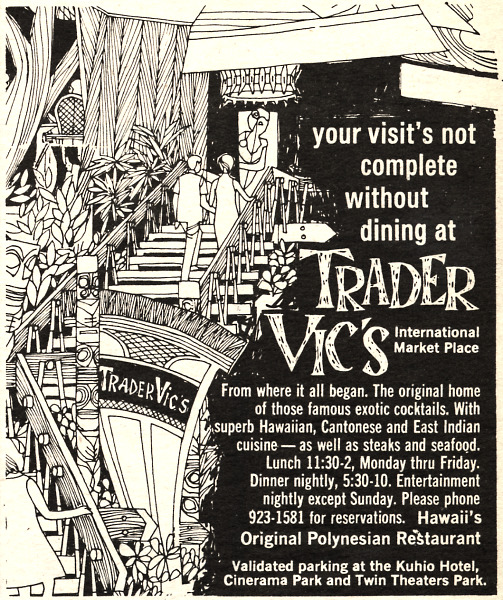
The famous Duke Kahanamoku’s (Duke’s,) where Don Ho gained fame, was once housed there. Don the Beachcomber, one of Waikīkī’s long-gone landmark restaurants, as well as Trader Vic’s also called it home.

Hawaiʻi radio icon, Hal Lewis (the self-named “J Akuhead Pupule,” best known to Island radio listeners as “Aku,”) once broadcast his popular morning talk show from the tree house in the Banyan tree.

However, over the last half-century, as the rest of Waikīkī evolved, the Market Place kept its 1960s look, as visitors wind through the carts and kiosks, hawking T-shirts, plastic hula skirts, volcano-shaped candles, and other tiki and tacky souvenirs.

Landowner Queen Emma Foundation changed that. Working with the Taubman Company, the International Market Place, Waikīkī Town Center and Miramar Hotel were demolished, and new structures took their place.

Aiming to restore “a sense of Hawaiianness,” the new International Market Place features low-rise structures, open-air shops and restaurants, paths, gardens, a storytelling hearth, a performance amphitheater and, yes, parking. And the banyan tree stays.

Today, as successor to The Queen’s Hospital, The Queen’s Medical Center is the largest private nonprofit hospital in Hawaiʻi, licensed to operate with 505 acute care beds and 28 sub-acute beds. As the leading medical referral center in the Pacific Basin, Queen’s has more than 3,500 employees and over 1,100 physicians on staff.

The royal mission and vision of The Queen’s Health Systems is directly supported through revenues generated by the lands bequeathed by Queen Emma when she passed away in 1885, including the International Market Place.

© 2022 Hoʻokuleana LLC

Filed Under: Prominent People, Economy, Place Names Tagged With: Kaluaokau, Hawaii, Don the Beachcomber, Waikiki, Oahu, Lunalilo, Kamehameha IV, Matson, Queen Emma, Duke Kahanamoku, Don Ho, Trader Vic's

  • « Previous Page
  • 1
  • …
  • 274
  • 275
  • 276
  • 277
  • 278
  • …
  • 680
  • Next Page »

Images of Old Hawaiʻi

People, places, and events in Hawaiʻi’s past come alive through text and media in “Images of Old Hawaiʻi.” These posts are informal historic summaries presented for personal, non-commercial, and educational purposes.

Info@Hookuleana.com

Connect with Us

  • Email
  • Facebook
  • LinkedIn
  • Twitter
  • YouTube

Recent Posts

  • Lāhainā Canal
  • Boondocks
  • About 250 Years Ago … Battle of Kings Mountain
  • Cow Laws
  • Palea and the Pinnace
  • Yick Lung
  • Early Days at Kamehameha Schools

Categories

  • Ali'i / Chiefs / Governance
  • Buildings
  • Missionaries / Churches / Religious Buildings
  • Hawaiian Traditions
  • Military
  • Place Names
  • Prominent People
  • Schools
  • Sailing, Shipping & Shipwrecks
  • Economy
  • Voyage of the Thaddeus
  • Mayflower Summaries
  • American Revolution
  • General

Tags

Albatross Al Capone Ane Keohokalole Archibald Campbell Bernice Pauahi Bishop Charles Reed Bishop Downtown Honolulu Eruption Founder's Day George Patton Great Wall of Kuakini Green Sea Turtle Hawaii Hawaii Island Hermes Hilo Holoikauaua Honolulu Isaac Davis James Robinson Kamae Kamaeokalani Kameeiamoku Kamehameha Schools Lalani Village Lava Flow Lelia Byrd Liberty Ship Liliuokalani Mao Math Mauna Loa Midway Monk Seal Northwestern Hawaiian Islands Oahu Papahanaumokuakea Marine National Monument Pearl Pualani Mossman Quartette Thomas Jaggar Volcano Waikiki Wake Wisdom

Hoʻokuleana LLC

Hoʻokuleana LLC is a Planning and Consulting firm assisting property owners with Land Use Planning efforts, including Environmental Review, Entitlement Process, Permitting, Community Outreach, etc. We are uniquely positioned to assist you in a variety of needs.

Info@Hookuleana.com

Copyright © 2012-2024 Peter T Young, Hoʻokuleana LLC

Loading Comments...