Images of Old Hawaiʻi

  • Home
  • About
  • Categories
    • Ali’i / Chiefs / Governance
    • American Protestant Mission
    • Buildings
    • Collections
    • Economy
    • Missionaries / Churches / Religious Buildings
    • General
    • Hawaiian Traditions
    • Other Summaries
    • Mayflower Summaries
    • Mayflower Full Summaries
    • Military
    • Place Names
    • Prominent People
    • Schools
    • Sailing, Shipping & Shipwrecks
    • Voyage of the Thaddeus
  • Collections
  • Contact
  • Follow

December 12, 2021 by Peter T Young Leave a Comment

Kaiakeakua

Royal Centers were where the aliʻi resided.

The Royal Centers were selected for their abundance of resources and recreation opportunities, with good surfing and canoe-landing sites being favored.

The Hawaiian court was mobile within the districts the aliʻi controlled. A Chief’s attendants might consist of as many as 700 to 1000-followers, made of kahuna and political advisors; servants which included craftsmen, guards, stewards; relatives and others.  (NPS)

Aliʻi often moved between several residences throughout the year.  There was no regular schedule for movement between Royal Centers.  In part, periodic moves served to ensure that district chiefs did not remain isolated, or unsupervised long enough to gather support for a revolt.  (NPS)

For centuries, Kaiakeakua (also spelled Kaiakekua) was a favored place for royalty.

“Perhaps … because it was a place celebrated for the constant appearance of fishes. Sometimes kule, fish that burrow in the sand … for there is sand (at) Kaiakekua …” (John Papa ʻIʻi)

“This sandy stretch, called Kaiakekua was a canoe landing, with some houses mauka of it. … Its fresh water came up from the pāhoehoe and mixed with the water of the sea.”

“It was a gathering place for those who went swimming and a place where the surf rolled in and dashed on land when it was rough. … just makai was a patch of sand facing north, where canoes landed”.  (John Papa ʻIʻi)

“There were chiefs and families of chiefs …(and) … The sands of Kaiakeakua were worn down like a dromedary’s (camel’s) back by the many feet of chiefs and chiefesses tramping over them, and … could be seen at night the sparkle of lights reflected in the sea like diamonds, from the homes of the chiefs…. The number of chiefs and lesser chiefs reached into the thousands”.  (Kamakau)

At about the same time of Christopher Columbus crossing the Atlantic to America (he was looking for an alternate trade route to the East Indies,) ʻUmi-a-Līloa (ʻUmi) moved his Royal Center there.

ʻUmi was famous for his battle with the gods. His wife Piʻikea, had supernatural grandmothers, who were Hapuʻu and Kalaihauola, and who desired to have a grandchild that they might take to Oʻahu to bring up, because the mother of Piʻikea, Laieloheloheikawai, belonged to Oahu.

Laieloheloheikawai sent the supernatural grandmothers to Hawaiʻi to obtain one of Piʻikea’s children. When they arrived in Hawaiʻi ʻUmi refused to permit a child to be taken.  ʻUmi offered to fight the deities at the sandy plains.

However, human beings battle with their hands, clubs and stones, but the gods without hands, and when the battle was fought the gods were victorious over the battle of men. The place is called Kaiakeakua – sea of the god – to this day.  (Fornander)

Lonoikamakahiki ca. 1640-1660 was tested at Kaiakeakua by Kanaloakuaʻana. “I want to be positive of your great skill, hence I have brought you here for that test and to satisfy myself that you are indeed a master.”

“There were about thirty spearmen to throw at the same time. After the men were ready and the spears thrown it was seen that Lonoikamakahiki was not hit by a single one of them.”  The test was continued from 30 spears to 80 spears, and Lonoikamakahiki was not hit.  (Fornander)

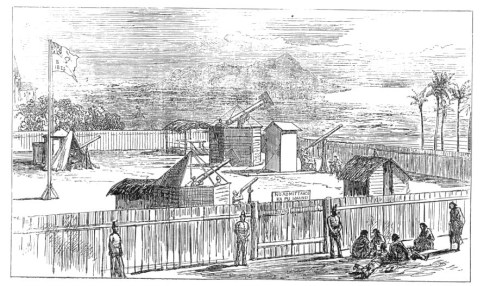
Some early writers called this place “Kayakakoua.” Joseph Paul Gaimard, zoologist on a French scientific expedition commanded by Louis de Freycinet during the years 1817-20, speaks of Kayakakoua.

“It is located on the beach and appears to consist of about four hundred houses, if you can apply this term to the smallest of huts which are not more than two or three feet high.”

“There are no streets and the habitations are scattered without any order.  In addition there are three buildings for storing powder and a large storeroom built of stone covered with lime.”

“The dock yards, storehouses and the principal nautical workshops of the king are also located there.  At each end of the town stands a morai (heiau) a simple elevation surrounded by a stake fence and filled with gigantic wooden idols.”

Oh, the name Kaiakeakua has gone out of use … today we simply call this place Kailua (in Kona on the Island of Hawaiʻi.)  The remnant of the once sandy beach of Kaiakeakua sits adjacent to the Kailua Pier – it’s where the Ironman Triathlon World Championship starts each year.

© 2021 Hoʻokuleana LLC


Filed Under: Place Names Tagged With: Kailua-Kona, Kaiakeakua, Hawaii, Hawaii Island, Kona, Royal Center, Kailua

March 29, 2020 by Peter T Young Leave a Comment

Kona Airport at Kailua

Interisland air travel was initiated in Hawaiʻi on November 11, 1929, by Stanley Kennedy, a WWI aviator who acquired two Sikorsky S-38 Amphibian aircraft and initiated direct service from Honolulu to Hilo (3 times a week) via Maʻalaea, Maui, and to Port Allen, Kauai (2 times a week). Later, service was added to Molokai.

For a number of years, Kailua-Kona was only serviced by seaplanes. Then (after clearing an area of rocks the week before,) on August 21, 1935, Alfred W Smith landed his single-seated monoplane about a mile north of Kailua, the first airplane ground landing ever made in Kona.

By the late-1930s, there was a public push to provide an airport at Kailua, Kona. An area parallel to the beach, previously used for small aircraft operations, and known as Kailua Airstrip, was determined to be the only suitable area in the vicinity. It was located about 1½-miles northwest of the Kona Inn.

“It is believed that the proposed airport would result in a great increase in tourist interest in the area and also in the development of vacation homes for residents of Honolulu,” stated a Department of Public Works report.

“The general opening up of the area by providing means for quicker transportation to Honolulu would tend to interest young people of Oahu in the possibility of establishing themselves in the Kona area (where land is relatively available) and thus help solve the land scarcity problem which is critical on Oahu.” (hawaii-gov)

“The shipment of Kona fruits and vegetables to Honolulu by air freight would be economically practicable both for sale in Honolulu and, during certain periods of the year, for trans-shipment to California.” (hawaii-gov)

In late-1940, applications were prepared and processed under the provisions of the 1940 National Airport Act. The next year funds were allotted, but construction never started. Finally, in 1944 the Post War Planning Division of the Territorial Public Works Department proposed proceeding with the airport when the war was over.

Surveys were made and plans prepared by the Department of Public Works, and in May 1948 bids were opened for construction of a runway 100-feet wide by 3,500-feet long, an aircraft parking mat and an access road connecting the main road through the village of Kailua.

Work was started June 10, 1948. Due to the multiple ‘Kailua’ names for various items, including airports (there was another private airport at Kailua, Oʻahu,) on February 7, 1949 the airport was named Kona Airport.

On July 10, 1949 between 3,000 and 4,000 people gathered at the new Kona Airport for the official opening and ceremonies. Acting Governor Oren E Long officially declared the airport open for commercial air transportation, and said he “hoped that in spite of the trade and prosperity that the district would inherit, Kona would remain noted for its hospitality and not become a Great White Way marred by neon signs and a Coney Island atmosphere.” (hawaii-gov)

Hawaiian Airlines President Stan Kennedy announced that additional weekend flights would be made by his airline on the Kona Coaster every Friday afternoon from Honolulu and returning every Sunday afternoon. “Kona will become, now more than ever, a must for the tourist as well as for local travel,” Kennedy said.

Hawaiian Airlines was the first commercial plane to arrive at the airport from Honolulu via Molokai at 11:30 am bringing a full load of passengers and the first direct air mail from Oahu. It took off at noon bound for Honolulu with passengers and air mail.

Over the next few years the facility was expanded and the runway lengthened. However, the location of the airport, with planes flying over Kailua-Kona and nearby residences, started to raise concerns – especially with the increasing number of flights and the need for further expansion with a longer runway to accommodate larger aircraft.

Less than 10-years after it opened, in 1957, there were discussions and planning for the relocation of the airport. Part of the plan was to sell the old airport site for the development of a tourist resort, in order to fund construction of a new airport to replace those facilities.

However, in the interim, in 1966, the runway was lengthened as a stop gap measure to accommodate the growing size of the interisland carriers’ planes.

On June 30, 1970, Kona Airport was closed and all operations were moved to the new Keāhole Airport with operations beginning at the new airport on July 1, 1970, with the new Queen Kaʻahumanu Highway built to that point.

For three summers, I worked for Aloha Airlines, starting at the “Old” Kona Airport – initially throwing bags, then as a ramp agent greeting and saying farewell to the planes as they landed/departed.

The summer of 1970, we moved the airline office furniture and supplies, slowing moving with our tugs and baggage carts piled high along the new Queen Kaʻahumanu Highway to the new Keāhole Airport (extension of Queen Kaʻahumanu Highway to Kawaihae was completed in 1975.)

After the old airport’s closure, its runway was used as a drag strip until the State and the County converted it to a recreational park around 1976. The runway is used as a parking area and access road for the former State park area.

While the State still owns the site, while I was at DLNR, the Board of Land and Natural Resources approved the set aside (assignment of management jurisdiction) of the former airport site to the County of Hawai‘i for park and recreational purposes.

In October 2010, the State completed the Kona International Airport at Keāhole Airport Master Plan which provides a long-range vision of the developments on airport property. Recently (March 2013,) an EIS preparation notice was filed for proposed airfield improvements and airport facilities related to that plan that are anticipated to be implemented within the next five to ten years.

Follow Peter T Young on Facebook 

Follow Peter T Young on Google+ 

Follow Peter T Young on LinkedIn  

Follow Peter T Young on Blogger

© 2020 Hoʻokuleana LLC

4 At Kona
36 ANCHORED_IN_K_KONA_C1936
37 scan0027
2012-11-11_00-01-16_864
Air lanes between the principal Hawaiian islands-1930s
Aloha_Airlines
Baggage claim, Kona Airport-(hawaii-gov)-1960s
Governor John Burns dedicates Keahole, Kona, Airport
Hawaiian_Air-Convair_640-(Machado)-1953-1973
Hawaiian_Air-Kona_Airport-child
US mail plane takes off from historic Kailua Bay, Island of Hawaii, landing place of pioneer American missionaries over 100 years ago.
Kona 1950
Kona Airport freight terminal-(hawaii-gov)-1966
Kona Airport-(hawaii-gov)-1950
Kona Airport-(Machado)-1950
Kona Airport-(Machado)-1956
Kona Airport, Kailua, Hawaii-(hawaii-gov)-1950
Kona Airport, Kailua, Hawaii-(hawaii-gov)-April 21, 1955
Kona Airport, Kailua, Hawaii-(hawaii-gov)-April 22, 1955
Kona Airport, Kailua, Hawaii-(hawaii-gov)-July 12, 1950
Kona Internationa Airport at Keahole-Master_Plan-layout
Kona plan
Kona_Airport-(Machado)-1950
Feb 1950 Landing strip for Kona Airport
Makaeo_Park-(Old_Airport_Park)-Master_Plan-2011
scan0005
scan0112
Seaplane

Filed Under: Economy, General, Place Names Tagged With: Aloha Airlines, Hawaii, Hawaii Island, Kona, Kailua-Kona, Hawaiian Airlines, DLNR, Keahole

October 21, 2019 by Peter T Young Leave a Comment

‘When shall we all meet again?’

On October 23, 1819, the Pioneer Company of missionaries from the American Board of Commissioners for Foreign Missions (ABCFM) from the northeast United States, set sail from Boston on the Thaddeus for Hawai‘i.

The Prudential Committee of the ABCFM in giving instructions to the pioneers of 1819 said: “Your mission is a mission of mercy, and your work is to be wholly a labor of love. …”

“Your views are not to be limited to a low, narrow scale, but you are to open your hearts wide, and set your marks high. You are to aim at nothing short of covering these islands with fruitful fields, and pleasant dwellings and schools and churches, and of Christian civilization.” (The Friend)

“Oct. 23, 1819. – This day by the good providence of God, I have embarked on board the brig Thaddeus (Blanchard master) for the Sandwich Islands to spread the gospel of Christ among the heathens.” (The term ‘heathen’ (without the knowledge of Jesus Christ and God) was a term in use at the time (200-years ago.))

“At 8 oclock took breakfast with the good Mr. Homer; at 11, gave the parting hand toward our dear friends on shore, & came on board accompanied by the Prudential Com. Mr. and Mrs. Dwight and some others.” (Samuel Whitney)

“That day week (the 23d), a great crowd of friends, acquaintances, and strangers, gathered on Long Wharf, for farewell religious exercises. The assembly united in singing the hymn, ‘Blest be the tie that binds.’”

“Dr. Worcester, in fervent prayer, commended the band to the God of missions; and Thomas Hopoo made a closing address. The two ordained brethren, assisted by an intimate friend, § then with perfect composure sang the lines, ‘When shall we all meet again?’” (Thompson)

“A fervent and appropriate prayer was offered by the Secretary of the Board, and the mission was affectionately commended to the grace of God, and immediately conveyed to the brig by a barge furnished for the purpose by a US Naval officer, they being still accompanied by the Secretary and Treasurer and a few other friends.”

“When these had given the parting hand and benediction, they descended into the boat and began to move off. The tender and benignant look of Dr. Worcester, as the boat left our vessel, turning his eyes upon the little band looking over the rail, as if he would say, my love be ever with you, will not soon be forgotten.” (Hiram Bingham)

“At 1 the sails were hoisted & we soon left sight of a multitude of friends who were lifting up holy hands in their behalf. This evening we came to anchor off Boston light.” (Samuel Whitney)

As they did at their ordination at Goshen and at the Park Street Church in Boston, receiving their instructions, Asa Thurston, tenor, and Hiram Bingham, base, sang Melton Mowbray (‘Head of the Church Triumphant’). (Bingham)

“When they had reached the wharf, the brig weighed anchor and set sail, and as we dropped down the stream, they waved their handkerchiefs, till out of sight. Though leaving my friends, home and country, as I supposed for ever, and trying as was the parting scene, I regarded that day as one of the happiest of my life.”

“But loosing from our beloved country, and not expecting ever to tread its shores or look upon its like again, with what intense interest did we gaze upon its fading landscapes, its receding hills and mountains, till the objects successively disappeared In the distance, or sank below the horizon.” (Hiram Bingham)

“The trying scene is now over, the parting hand given, the Farewell past. We shall no more behold the face of that dear, ever dear Mother whom we so ardently love, and who has shed so many tears on our account.”

“We shall not again in the flesh greet those beloved brethren & sisters and our dear friends with whom we have often had such sweet counsel and walked to the house of God in company.”

“Ye ever memorable and dear native town; must we say farewell to you? shall we never again walk your streets, no more visit those devoted sanctuaries, and there renew our covenant engagements with our God and commemorate the dying love of Jesus?”

“Dear Heathen seminary at Cornwall, you are doubly dear to our hearts. We have prayed for you, we shall pray for you still. May the great head of the church, ever preside over you.”

“We hope to hear from time to time of your abundant prosperity, and. we hope that in due time many of your children may come to the S. Islands and. help us. Farewell, dear youth, we shall never forget you.-”

“And. now America; for the last time we fix our eyes upon your dear shores. Your places which have known us will know us no more forever. We look upon you with hearts full of emotion as you recede from our view; we shed a tear or two, and cheerfully bid you a long, long farewell.” (Samuel & Nancy Ruggles, on board the Brig Thaddeus Oct. 23, 1819)

“While receding from my sight I could not but exclaim, farewell beloved country, and thrice beloved friends, I bid you all adieu! ‘Home, that dearest sweetest spot,’ where I have spent so many happy hours, the remembrance of which will ever afford me much pleasure; I cheerfully bid you adieu.”

“Yes, dear as is that humble mansion and those beloved friends whom I shall ever love with the strangest ties of an actual affection, I can willingly part with you all, if I may but bear a humble part in promoting the glory of God, and be used as an instrument in carrying the glad tidings of salvation to the perishing heathen.”

“As many and great as are the sacrifices which I have made, I do not regret my undertaking. The souls of the heathen appear precious, infinitely more so than all the world good. O that Christians profess more of a spirit of this interested benevolence.” (Mercy Whitney, Oct 24, 1819)

After 164-days at sea, on April 4, 1820, the Thaddeus arrived and anchored at Kailua-Kona on the Island of Hawaiʻi. Hawai‘i’s “Plymouth Rock” is about where the Kailua pier is today.

Above text is a summary – Click HERE for more information on the Departure of the Missionaries.

Follow Peter T Young on Facebook 

Follow Peter T Young on Google+ 

Follow Peter T Young on LinkedIn  

Follow Peter T Young on Blogger

© 2019 Hoʻokuleana LLC

1743_LongWharf_Boston_map_WilliamPrice
departure_of_the_second_company_from_the_american_board_of_commissioners_for_foreign_missions_to_hawaii
Independence 74
Independence 74
Brig_Thaddeus-Friend19341101

Filed Under: Missionaries / Churches / Religious Buildings Tagged With: Hawaii, American Board of Commissioners of Foreign Missions, Pioneer Company, Boston, Missionaries, Kailua-Kona, Thaddeus

May 29, 2019 by Peter T Young Leave a Comment

Ka Pā Nui o Kuakini

Captain George Vancouver gave a few cattle to Kamehameha I in 1793; Vancouver strongly encouraged Kamehameha to place a kapu on them to allow the herd to grow.

In the decades that followed, cattle flourished and turned into a dangerous nuisance. By 1846, 25,000 wild cattle roamed at will and an additional 10,000 semi‐domesticated cattle lived alongside humans.

John Adams Kuakini was an important adviser to Kamehameha I in the early stages of the Kingdom of Hawai‘i.

When the Kingdom’s central government moved to Lāhaina in 1820, Kuakini’s influence expanded on Hawaiʻi Island, with his appointment as the Royal Governor of Hawaiʻi Island, serving from 1820 until his death in 1844.

During his tenure, Kuakini built many of the historical sites that dominate Kailua today. The Great Wall of Kuakini, probably a major enhancement of an earlier wall, was one of these.

The Great Wall of Kuakini extends in a north-south direction for approximately 6 miles from Kailua to near Keauhou, and is generally 4 to 6-feet high and 4-feet wide.

Built between 1830 and 1840, the Great Wall of Kuakini separated the coastal lands from Kailua to Keauhou from the inland pasture lands.

The mortar-less lava-rock wall has had varying opinions regarding the purpose of its construction.

Speculation has ranged from military/defense to the confinement of grazing animals; however, most seem to agree it served as a cattle wall, keeping the troublesome cattle from wandering through the fields and houses of Kailua.

It is likely that the function of the wall changed over time, as the economic importance of cattle grew and the kinds and density of land use and settlement changed.

Kuakini was responsible for other changes and buildings in the Kona District during this era.

He gave land to Asa Thurston to build Moku‘aikaua Church.

He built Huliheʻe Palace in the American style out of native lava, coral lime mortar, koa and ‘ōhi‘a timbers. Completed in 1838, he used the palace to entertain visiting Americans and Europeans with great feasts.

Hulihe‘e Palace is now a museum run the Daughters of Hawaiʻi, including some of his artifacts.

He made official visits to all ships that arrived on the island, offering them tours of sites, such as the Kīlauea volcano.

He was born about 1789 with the name Kaluaikonahale. With the introduction of Christianity, Hawaiians were encouraged to take British or American names.

He chose the name John Adams after John Quincy Adams, the US president in office at the time. He adopted the name, as well as other customs of the US and Europe.

Kuakini was the youngest of four important siblings: sisters Queen Kaʻahumanu, Kamehameha’s favorite wife who later became the powerful Kuhina nui, Kalākua Kaheiheimālie and Namahana-o-Piʻia (also queens of Kamehameha) and brother George Cox Kahekili Keʻeaumoku.

He married Analeʻa (Ane or Annie) Keohokālole; they had no children. (She later married Caesar Kapaʻakea. That union produced several children (including the future King Kalākaua and Queen Liliʻuokalani.)

A highway is named “Kuakini Highway,” which runs from the Hawaii Belt Road through the town of Kailua-Kona, to the Old Kona Airport Recreation Area.

He is also the namesake of Kuakini Street in Honolulu, which is in turn the namesake of the Kuakini Medical Center on it.

Follow Peter T Young on Facebook 

Follow Peter T Young on Google+ 

Follow Peter T Young on LinkedIn  

Follow Peter T Young on Blogger

© 2019 Hoʻokuleana LLC

Great_Wall_of_Kuakini-WC
'John Adams' Kuakini, royal governor or the island of Hawai'i, circa 1823
‘John Adams’ Kuakini, royal governor or the island of Hawai’i, circa 1823
Great_Wall_of_Kuakini-vicinity_of_Lowes-Kailua-Kona-(GoogleEarth)
Great-Wall_of_Kuakini
'John Adams' Kuakini, royal governor or the island of Hawai'i, circa 1823
‘John Adams’ Kuakini, royal governor or the island of Hawai’i, circa 1823
Great-Wall_of_Kuakini
Kahului-Kuamoo-USGS_Quadrangle-1924-(note_alignment_of_Great_Wall_of_Kuakini)
Kailua_Town_and_Vicinity-Map-Kanakanui-Reg1676 (1892)-(note_Great_Wall_of_Kuakini)
Kailua_Town_and_Vicinity_Map-Kanakanui-Reg1676 (1892)-(note_Great_Wall_of_Kuakini)

Filed Under: General, Ali'i / Chiefs / Governance, Economy Tagged With: Kailua-Kona, Asa Thurston, Mokuaikaua, George Vancouver, King Kalakaua, Hawaii, Ane Keohokalole, Great Wall of Kuakini, Queen Liliuokalani, Kuakini, Hulihee Palace

May 4, 2019 by Peter T Young 1 Comment

Birth-Beach of the Boogie Board

Many may not realize that today’s Boogie Board was created in Kailua-Kona, at Wai‘aha, a place commonly referred to as “Honl’s” (after the name of the family that used to live there.)

Wai‘aha (“Gathering Water,”) a little strip of white sand beach, just on the outskirts of Kailua Village, is now a County Beach Park. It is a popular surf spot, especially with bodyboarders.

Tom Morey was staying in the house that once stood on the beach at Wai‘aha in July 1971 when he made the first “boogie board” prototype.

He first called the board “S.N.A.K.E.” (Side, Navel, Arm, Knee, Elbow – because all the body parts were involved in its use) – he trademarked the name Morey Boogie in 1973 and founded Morey Boogie in 1974. (He later called it a Boogie Board after his love of music.)

According to Tom Morey’s son, Sol Morey, “the first boogie board was created in 1971 in order to surf shallower breaks that couldn’t otherwise be enjoyed.”

“The surf at our Hawaii rental on the Kailua coast was where it began with the shaping and sealing of the foam to form the first boogie.”

Tom Morey was a traditional surfboard builder/shaper, but looked for inventions and innovation. In 1964, he created the first TRAF polypropylene fin (his term TRAF being FART spelled backward), innovating the first commercial interchangeable fin system. In 1965, the Skeg Works became Morey Surfboards.

In 1965, Karl Pope became his business partner and the name changed again — Morey-Pope Surfboards. They built, tested and marketed Pope’s Trisect, a three-piece surfboard that folded into a suitcase.

But he had different ideas in Kona; he used an electric carving knife and a household iron, whittled some scrap polyethylene foam into a small rectangular mat and covered it with newspaper and hit the swells in front of his home on the Big Island of Hawaii.

With it, the sport of bodyboarding started in 1971 in Hawaii. (Prior to 1971, bodyboards were made from wood or fiberglass and called paipo boards.)

According to Tom Morey, he took his last nine-foot piece of polyethylene foam (that he had planned for a conventional board) and “grabbed a knife and cut it in half.”

“There was no turning back at that point. I looked at the foam and then at the surf and began fooling around with a hot iron and an electric knife.”

“I found that I could shape the foam using the iron if I put a sheet of newspaper down on the foam first. Later that night, I drew a few curves on the foam with a red marking pen and went to bed.”

Morey rose early on July 9, 1971, and cut and ironed out his planned shape. He left his board as wide as possible and left the nose square so that it would have more structural strength and so he could hold on to it.

“I decided I’d shape the rails like those on a Hot Curl surfboard,” says Morey. “Those were the boards from the 20s and 30s; built before boards had skegs. I cut 45-degree Hot Curl rails into my board.”

“They looked great, but I still wasn’t sure how it would ride.” Morey grabbed his board, ran down to Honl’s and the sport of bodyboarding was born.

Wai‘aha is home to the annual Malama Wai‘aha (Honl’s) Roots Bodyboard contest. The contest (started in 2002) was formed to honor the birth-beach and the birthplace of modern bodyboarding (they held their 10th anniversary event on June 30.)

In 2006, the Hawai‘i County acquired the property fronting the beach and it is now part of the County beach park system. Parking for users is also mauka of Ali‘i Drive and was provided by a developer as a condition of a rezoning.

Morey Bodyboards became a division of Mattel Toys and then Wham-O. In 2005, Tom Morey earned a star on the Huntington Walk of Fame and was inducted into the Surfing Hall of Fame.

Follow Peter T Young on Facebook 

Follow Peter T Young on Google+ 

Follow Peter T Young on LinkedIn  

Follow Peter T Young on Blogger

© 2019 Hoʻokuleana LLC

Tom_Morey_and_initial_SNAKE-Boogie-Bodyboard
Tom_Morey-still_has_the_original-Boogie
Photo-Roots_Bodyboard_Contest
Waiaha_Beach
Waiaha_Beach
Sunset_at_Waiaha
Sunset_at_Waiaha
Morey-Cruiser-Bodyboard
Paipo_Board
Paipo_Board
Paipo_Board
Paipo_Board
Roots_Contest-Banner

Filed Under: Economy, General, Place Names Tagged With: Boogie Board, Bodyboard, Hawaii, Kailua-Kona, Waiaha

  • « Previous Page
  • 1
  • 2
  • 3
  • 4
  • 5
  • 6
  • 7
  • Next Page »

Images of Old Hawaiʻi

People, places, and events in Hawaiʻi’s past come alive through text and media in “Images of Old Hawaiʻi.” These posts are informal historic summaries presented for personal, non-commercial, and educational purposes.

Info@Hookuleana.com

Connect with Us

  • Email
  • Facebook
  • LinkedIn
  • Twitter
  • YouTube

Recent Posts

  • Insane Asylum
  • Sneyd-Kynnersley
  • Pele’s Hair
  • Waialua High and Intermediate School
  • Pulukai
  • Lydia Panioikawai Hunt French
  • Hawaiian Colonization

Categories

  • Economy
  • Voyage of the Thaddeus
  • Mayflower Summaries
  • American Revolution
  • General
  • Ali'i / Chiefs / Governance
  • Buildings
  • Missionaries / Churches / Religious Buildings
  • Hawaiian Traditions
  • Military
  • Place Names
  • Prominent People
  • Schools
  • Sailing, Shipping & Shipwrecks

Tags

Albatross Al Capone Ane Keohokalole Archibald Campbell Bernice Pauahi Bishop Charles Reed Bishop Downtown Honolulu Eruption Founder's Day George Patton Great Wall of Kuakini Green Sea Turtle Hawaii Hawaii Island Hermes Hilo Holoikauaua Honolulu Isaac Davis James Robinson Kamae Kamaeokalani Kameeiamoku Kamehameha Schools Lalani Village Lava Flow Lelia Byrd Liberty Ship Liliuokalani Mao Math Mauna Loa Midway Monk Seal Northwestern Hawaiian Islands Oahu Papahanaumokuakea Marine National Monument Pearl Pualani Mossman Quartette Thomas Jaggar Volcano Waikiki Wake Wisdom

Hoʻokuleana LLC

Hoʻokuleana LLC is a Planning and Consulting firm assisting property owners with Land Use Planning efforts, including Environmental Review, Entitlement Process, Permitting, Community Outreach, etc. We are uniquely positioned to assist you in a variety of needs.

Info@Hookuleana.com

Copyright © 2012-2024 Peter T Young, Hoʻokuleana LLC

Loading Comments...