Images of Old Hawaiʻi

  • Home
  • About
  • Categories
    • Ali’i / Chiefs / Governance
    • American Protestant Mission
    • Buildings
    • Collections
    • Economy
    • Missionaries / Churches / Religious Buildings
    • General
    • Hawaiian Traditions
    • Other Summaries
    • Mayflower Summaries
    • Mayflower Full Summaries
    • Military
    • Place Names
    • Prominent People
    • Schools
    • Sailing, Shipping & Shipwrecks
    • Voyage of the Thaddeus
  • Collections
  • Contact
  • Follow

May 26, 2022 by Peter T Young Leave a Comment

James Kahuhu

On October 23, 1819, the Pioneer Company of American Protestant missionaries from the northeast US set sail on the Thaddeus for the Sandwich Islands (now known as Hawai‘i.)  There were seven American couples sent by the ABCFM in this first company.

These included two Ordained Preachers, Hiram Bingham and his wife Sybil and Asa Thurston and his wife Lucy; two Teachers, Mr. Samuel Whitney and his wife Mercy and Samuel Ruggles and his wife Mary; a Doctor, Thomas Holman and his wife Lucia; a Printer, Elisha Loomis and his wife Maria; and a Farmer, Daniel Chamberlain, his wife and five children.

By the time the Pioneer Company arrived, Kamehameha I had died and the centuries-old kapu system had been abolished; through the actions of King Kamehameha II (Liholiho,) with encouragement by former Queens Kaʻahumanu and Keōpūolani (Liholiho’s mother,) the Hawaiian people had already dismantled their heiau and had rejected their religious beliefs.

One of the first things the missionaries did was begin to learn the Hawaiian language and create an alphabet for a written format of the language.   Their emphasis was on teaching and preaching.

The first mission station was at Kailua-Kona, where they first landed in the Islands, then the residence of the King (Liholiho, Kamehameha II;) Asa and Lucy Thurston manned the mission, there.

Liholiho was Asa Thurston’s first pupil. His orders were that “none should be taught to read except those of high rank, those to whom he gave special permission, and the wives and children of white men.”

James Kahuhu and John ʻlʻi were two of his favorite courtiers, whom he placed under Mr. Thurston’s instruction in order that he might judge whether the new learning was going to be of any value.  (Alexander, The Friend, December 1902)

In 1820, Missionary Lucy Thurston noted in her Journal, “The king (Liholiho, Kamehameha II) brought two young men to Mr. Thurston, and said: ‘Teach these, my favorites, (John Papa) Ii and (James) Kahuhu. It will be the same as teaching me. Through them I shall find out what learning is.’”

“To do his part to distinguish and make them respectable scholars, he dressed them in a civilized manner. They daily came forth from the king, entered the presence of their teacher, clad in white, while his majesty and court continued to sit in their girdles.”

“Although thus distinguished from their fellows, in all the beauty and strength of ripening manhood, with what humility they drank in instruction from the lips of their teacher, even as the dry earth drinks in water!”

“After an absence of some months, the king returned, and called at our dwelling to hear the two young men, his favorites, read. He was delighted with their improvement, and shook Mr. Thurston most cordially by the hand – pressed it between both his own – then kissed it.” (Lucy Thurston)

Kahuhu was among the earliest of those associated with the chiefs to learn both spoken and written words. Kahuhu then became a teacher to the chiefs.

In April or May 1821, the King and the chiefs gathered in Honolulu and selected teachers to assist Mr Bingham.  James Kahuhu, John ʻĪʻi, Haʻalilio, Prince Kauikeaouli were among those who learned English.  (Kamakau)

On October 7, 1829, it seems that Kauikeaouli (Kamehameha III) set up a legislative body and council of state when he prepared a definite and authoritative declaration to foreigners and each of them signed it.  (Frear – HHS)  Kahuhu was one of the participants.

King Kamehameha III issued a Proclamation “respecting the treatment of Foreigners within his Territories.”  It was prepared in the name of the King and the Chiefs in Council:  Kauikeaouli, the King; Gov. Boki; Kaʻahumanu; Gov. Adams Kuakini; Manuia; Kekūanāoʻa; Hinau; ʻAikanaka; Paki; Kīnaʻu; John ʻIʻi and James Kahuhu.

In part, he states, “The Laws of my Country prohibit murder, theft, adultery, fornication, retailing ardent spirits at houses for selling spirits, amusements on the Sabbath Day, gambling and betting on the Sabbath Day, and at all times.  If any man shall transgress any of these Laws, he is liable to the penalty, – the same for every Foreigner and for the People of these Islands: whoever shall violate these Laws shall be punished.”

It continues with, “This is our communication to you all, ye parents from the Countries whence originate the winds; have compassion on a Nation of little Children, very small and young, who are yet in mental darkness; and help us to do right and follow with us, that which will be for the best good of this our Country.”

The Hawaiʻi State Archives is the repository of significant historic documents for Hawaiʻi; reportedly, the oldest Hawaiian language document in its possession is a letter written by James Kahuhu.

Writing to Chief John Adams Kuakini, Kahuhu’s letter was partially in English and partially Hawaiian (at that time, Kuakini was learning both English and written Hawaiian.)

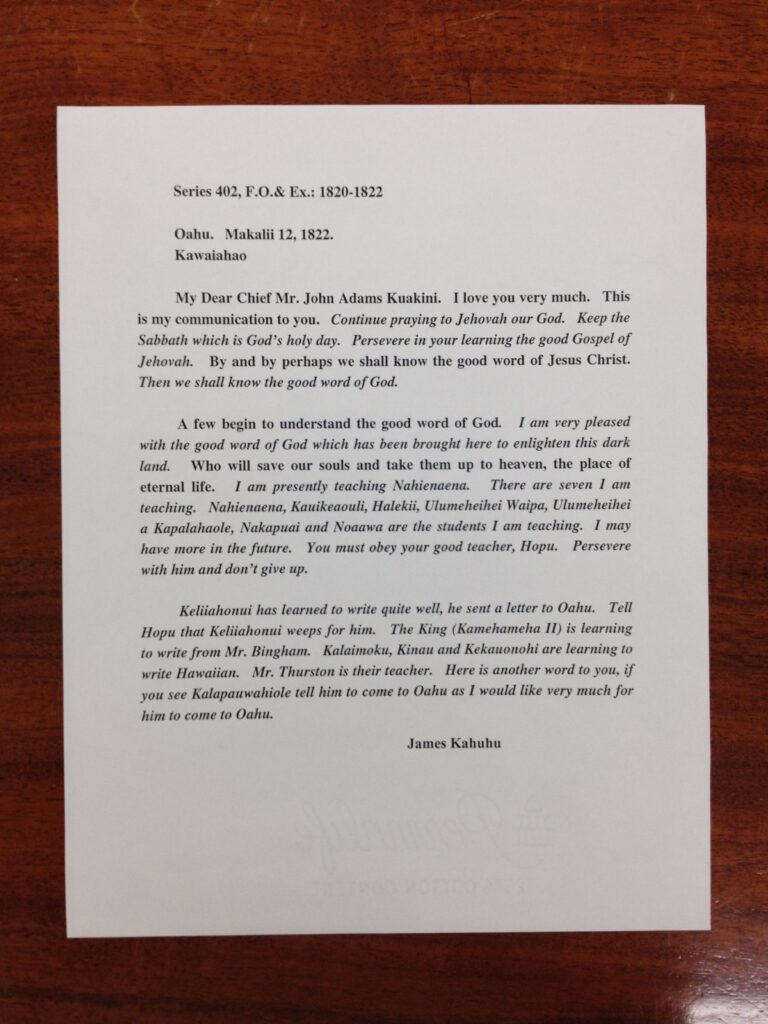
Below is a transcription of Kahuhu’s letter.  (HSA)

Oahu. Makaliʻi 12, 1822.
Kawaiahaʻo.
My Dear Chief Mr. John Adams Kuakini. I love you very much. This is my communication to you. Continue praying to Jehovah our God. Keep the Sabbath which is God’s holy day. Persevere in your learning the good Gospel of Jehovah. By and by perhaps we shall know the good word of Jesus Christ. Then we shall know the good word of God.

A few begin to understand the good word of God. I am very pleased with the good word of God which has been brought here to enlighten this dark land. Who will save our souls and take them up to heaven, the place of eternal life. I am presently teaching Nahiʻenaʻena. I am teaching seven of them. Nahienaena, Kauikeaouli, Halekiʻi, Ulumāheihei Waipa, Ulumāheihei a Kapalahaole, Nakapuai and Noaʻawa are the students I am teaching. I may have more in the future. You must obey your good teacher, Hopu. Persevere with him and don’t give up.

Keliʻiahonui has learned to write quite well, he sent a letter to Oahu. Tell Hopu that Keliʻiahonui misses him. The King is learning to write from Mr. Bingham. Kalanimōku, Kīnaʻu and Kekauōnohi are learning to write Hawaiian. Mr. Thurston is their teacher. Here is another word to you, if you see Kalapauwahiole tell him to come to Oahu as I would like very much for him to come to Oahu.
James Kahuhu

(Makaliʻi was the name of a month: December on Hawai‘i, April on Moloka’i, October on Oʻahu.  (Malo))

The image shows the first page of the Kahuhu letter to Kuakini (HSA.) 

© 2022 Hoʻokuleana LLC


Filed Under: Missionaries / Churches / Religious Buildings Tagged With: Liholiho, Kamehameha II, Kauikeaouli, Hawaii, Asa Thurston, Hawaii Island, Kaiakeakua, Kuakini, Kamehameha III, Hiram Bingham, American Board of Commissioners of Foreign Missions, ABCFM, Missionaries, Kailua-Kona

May 25, 2022 by Peter T Young Leave a Comment

Shingon Shu Hawaiʻi

Born, reborn and born again,
The beginnings of their births they do not know.
Dying, dying and dying once again,
The end of their deaths they do not know.
(Odaishisama)

The founder of the Shingon Buddhism sect in Japan, Kūkai (more commonly known as Kōbō Daishi or Odaishisama) lived between the years 774 to 835. In Japanese folklore, he has been given mystical powers, ability to create wells and springs for areas stricken by drought, abilities to heal the sick and raise the dead.

Born to an aristocratic family, Kūkai was well educated and charismatic, always able to gain the confidence of the people around him. While travelling to China, Kukai discovered Shingon esotericism and brought this back to Japan.

He convinced the Japanese Emperor to provide land for a temple complex on Mount Kōya, now the world headquarters of the Kōyasan Shingon sect of Japanese Buddhism.

Odaishisama’s Shingon Esoteric view of life is based on the idea of the how things originate with the Six Great-Elements of earth, water, fire, wind, space and consciousness (all of the Six Great-Elements are expressed in the single sanskrit letter “A;” the Shingon view of life lies in the realization that there is no beginning or end to the world of the Buddha.  (shingon-org)

Kūkai was a calligrapher; among the many achievements attributed to him is the invention of the kana, the syllabic Japanese script with which, in combination with Chinese characters (kanji,) the Japanese language is written today.

Having predicted his death the year before, Kūkai died on April 23, 835; it is believed that he remains in spirit.  He was given the name Kōbō Daishi after his death (Odaishisama) and is remembered as a saint, scholar, savior and spiritual healer.

The Issei (first generation) Japanese immigrants that came to Hawaiʻi immigrated to the Islands from 1885 to 1924.  Like the other ethnic immigrant groups, the Issei worked on sugar and pineapple plantations.  The term Issei came into common use and represented the idea of a new beginning and belonging.  When they came, they believed Odaishisama crossed the ocean with them.

On leaving Japan, the young Shingon followers received small portrait scrolls of Odaishisama from their elderly parents, who with tears in their eyes surely told them, “When you go to Hawaii there will be times of hardship and suffering, and also times when you will become sick. At those times, ask Odaishisama for help. Do not forget to say “Namu Daishi Henjo Kongo” (the mantra of Kōbō Daishi, “Homage to the Great Master, the Vajra of all-pervading spiritual radiance”) (NPS)

Shingon Shu Hawaiʻi (Hawai‘i Shingon Mission) was founded March 15, 1915 in Honolulu.  The first temple was built on the site in 1918, completed by Nakagawa Katsutaro, a master builder of Japanese-style temples. In 1929, Hego Fuchino renovated the temple along the lines of the Japanese Design Style.

The temple is a congregational Buddhist school, interested in studying and sharing the faith of Shingon esoteric Buddhism; the temple follows the original tenets established by Kobo Daishi who brought the teachings of esoteric Buddhism to Japan from China in 806 AD.  (ShingunShuHawaii)

The Hawaiʻi Shingon Mission (Shingon Shu Hawaiʻi) is one of seven missions remaining of this type of Japanese Design Style of architecture in Hawaiʻi. As the mother church for the Shingon sect in Hawaii, the Hawaiʻi Shingon Mission on Sheridan Street in Honolulu is one of the most elaborately decorated Buddhist temples in Hawaiʻi.

Although it was altered in 1978 and a major addition was built in 1992, the roof and its original carvings form the framework of its character and the interior furnishings brought from Japan maintain a major part of its significance. The most visible portion of the Hawaii Shingon Mission is its irimoya or steeply sloped-hipped gable roof with elaborate carvings adorning each gable end.

Termed “Japanese Design Style” by Lorraine Minatoishi Palumbo in her dissertation on Japanese temple architecture in Hawaiʻi, it is representative of a time period in Hawaiʻi when the Japanese, proud of their heritage, wanted the familiarity of home.

While this style lasted only 22 years before the Japanese took a decided lean towards a Western influence, the results of this strong connection to a style in Japan makes these buildings stand out in Hawaiʻi.

At the very top of the roof is a depiction of the tomoe, which suggests the yin-yang symbol of China, but represents the circle of life in Japan.

The karahafu-kohai or cusped gable entrance roof with a carving of the Hozo, a phoenix on top of the cusp and within the eyebrow, mark a well-defined entry. The phoenix is widely considered to represent the cycle of life, death, and rebirth. There is also a dragon, representing wisdom, good fortune and power, resting in the clouds.

Culturally, the social history of the Japanese is intertwined in the Buddhist philosophy (which originated in northern India by Prince Siddhartha Gautama, known as Buddha, in 528 BC.) (Lots of information here from NPS.)

© 2022 Hoʻokuleana LLC


Filed Under: Missionaries / Churches / Religious Buildings Tagged With: Shingon Shu Hawaii, Shingon Buddhism, Nakagawa Katsutaro, Hawaii, Japanese, Odaishisama, Hego Fuchino

May 24, 2022 by Peter T Young Leave a Comment

Chiefs in the 1820s

“The houses of the chiefs are generally large, for the kind of building, – from forty to sixty feet in length, twenty or twenty-five in breadth, and eighteen or twenty in height at the peak of the roof.”

“The sides and ends, as well as the roof, are of thatch, and the whole in one apartment. They are generally without windows, or any opening for light or air, except a wide door in the middle of a side or end.”

“In the back part of the house, the personal property and moveables, such as trunks, boxes, calabashes and dishes for water, food, &c. are deposited; while the mats for sitting, lounging, and sleeping are spread near the door.”

“Every chief has from thirty to fifty and an hundred personal attendants, friends and servants, attached to his establishment; who always live and move with him, and share in the provisions of his house.”

“All these, except the bosom friends, or punahele, have different offices and duties: – one is a pipe lighter, another a spittoon carrier, a third a kahile bearer, &c. Others with their families, prepare, cook, and serve the food, &c.”

“All the former, from the bosom friend, or punahele, to the pipe lighter, eat from the same dishes and calabashes with their master; and form, at their meals, a most uncouth and motley group.”

“In every respect indeed, as well as in that of eating, the household servants of the whole company of chiefs, from the king to the petty headman of a village, seem to enjoy a perpetual saturnalia.”

“The formation of this establishment takes place immediately on the birth of a chief, whether male or female. A kahu or nurse is appointed, who assumes all the care of the parent, and directs the affairs of the child, till he is old enough to exercise a will of his own.”

“Thus, often, very little intercourse takes place between the parents themselves, and the young chief; the former not unfrequently residing at a different district, or on a different island.”

“The present prince and princess, who are both children, have each separate houses, and a large train of attendants: and though their guardians of state reside near them, they are left very much to their own will, or to that of their kahus or nurses.”

“I have seen a young chief, apparently not three years old, walking the streets of Honoruru as naked as when born, (with the exception of a pair of green morocco shoes on his feet,) followed by ten or twelve stout men, and as many boys, carrying umbrellas, and kahiles, and spitboxes, and fans, and the various trappings of chieftainship.”

“The young noble was evidently under no controul but his own will, and enjoyed already the privileges of his birth, in choosing his own path, and doing whatever he pleased.”

“This portion of the inhabitants spend their lives principally in eating and drinking, lounging and sleeping; in the sports of the surf, and the various games of the country; at cards, which have long been introduced …”

“… in hearing the songs of the musicians, a kind of recitation accompanied by much action; and in witnessing the performances of the dancers.”

“They are not, however, wholly given to idleness and pleasure. It is customary for the male chiefs to superintend, in a degree, any work in which their own vassals, at the place where they are residing, are engaged, whether of agriculture or manufacture …”

“… and the female chiefs, also, overlook their women in their appropriate occupations, and not unfrequently assist them with their own hands.”

“A great change appears about to take place among the chiefs, in the general manner of employing time. The palapala and the pule, letters and religion, as presented by the Missionaries, are happily beginning deeply to interest their minds …”

“… and books and slates, I doubt not, will, as is the fact already, in individual cases, soon universally take the place of cards and games, and every amusement of dissipation.”

These general and desultory remarks will give you, my dear M-, some idea of the external character and state of the nobler part of the nation, for whose benefit H – and myself have sacrificed the innumerable enjoyments of home.”

“As to their qualities of heart and mind, they in general appear to be as mild and amiable in disposition, and as sprightly and active in intellect, as the inhabitants of our own country.”

“Ignorance, superstition, and sin, make all the difference we observe: and though that difference is at present fearful indeed, still we believe, that, with the removal of its causes, it will be entirely done away.”

“Notwithstanding the dreadful abominations daily taking place around us, drunkenness and adultery, gambling and theft, deceit, treachery, and death, all of which exist throughout the land to an almost incredible degree …”

“… such has already been the success attending the efforts at reformation, made in the very infancy of the Mission, that we are encouraged by every day’s observance, with fresh zeal to dedicate ourselves to the work of rescue and salvation.”

“No pagan nation on earth can be better prepared for the labour of the Christian Missionary; and no herald of the cross could desire a more privileged and delightful task …”

“… than to take this people by the outstretched and beckoning hand, and lead their bewildered feet into paths of light and life, of purity and peace …”

“… nor a greater happiness than to be the instrument of guiding, not only the generation now living, in the right way, but of rescuing from wretchedness and spiritual death, millions of the generations yet unborn, who are here to live, and here to die, before the angel ‘shall lift up his hand to heaven, and swear that there shall be time no longer!’” (The entire text, here, is from CS Stewart.)

© 2017 Hoʻokuleana LLC

Alphonse_Pellion,_Îles_Sandwich;_Maisons_de_Kraïmokou,_Premier_Ministre_du_Roi;_Fabrication_des_Étoffes_(c._1819)

Filed Under: Ali'i / Chiefs / Governance, Hawaiian Traditions Tagged With: Hawaii, Chiefs, Timeline, 1820s

May 22, 2022 by Peter T Young Leave a Comment

Kaluanui

Henry (Harry) Alexander Baldwin, eldest son of Henry Perrine Baldwin and grandson of missionary Dwight Baldwin, was born in Pāʻia, Maui on January 12, 1871.
 
Baldwin was educated in Honolulu at Punahou School. His parents later sent him to Phillips Academy in Andover, Massachusetts from which he graduated in 1889. In 1894, Baldwin obtained a degree at the Massachusetts Institute of Technology.
 
He returned to work for his father and uncle on the Haiku sugarcane plantation; from 1897 to 1904 he became manager.  In addition to extensive business interests (including Baldwin Bank, Haleakala Ranch Co, Maui Agricultural Co, Grove Ranch, Kahoʻolawe Ranch, Maui Telephone Co, and Maui Publishing Co,) Harry dabbled in politics.  He was elected to represent Maui in the territorial senate and served several terms.
 
Then, in 1922, following the death of Prince Jonah Kūhiō Kalanianaʻole (Hawaiʻi’s congressman,) Baldwin was elected to the sixty-seventh Congress to fill the vacancy and Kūhiō’s unexpired term (Baldwin declined to be a candidate for a subsequent term.)
 
He resumed his former business pursuits and later got back into politics, first as a State representative in 1933 and then member of the Hawaii senate 1934-1937, serving as president during the 1937 session.
 
Harry married Ethel Frances Smith (1879–1967), daughter of lawyer William Owen Smith in Honolulu — Harry’s younger brother Samuel later married Ethel’s sister Katherine Smith.  Harry and Ethel had one daughter, Frances Hobron (1904–1996,) who married J Walter Cameron (1895–1976.)
 
In 1917, Harry and Ethel Baldwin had a home designed (by a relative, architect CW Dickey) and built in 1917 – the property was known as “Kaluanui.”
 
Horses were Harry’s passion, and riding was his respite. He kept a private stable at Kaluanui; occasionally, racing some of his favorites at the Maui County Fair and joining his brothers on the polo field, beginning a Baldwin Family tradition that continues today.
 
Baldwin Beach Park is named after Harry A Baldwin.  The park was originally developed as a company recreation facility by Hawaiian Commercial and Sugar Company, but in 1963 it became a public beach park.  (Clark)
 
Back in 1850, Robert Wood and AH Spencer started East Maui Plantation at Kaluanui.  It was eventually bought by C Brewer & Co and closed in 1885. The land sold to Haiku Sugar Co.  It became part of the Maui Agriculture Co and later Maui Land & Pineapple Co (run by son-in-law J Walter Cameron and grandson Colin.)
 
In 1934, Ethel Baldwin, a community leader, founded the Hui Noʻeau Visual Arts Society.  She invited artists from around the world to stay at Kaluanui in exchange for art lessons that she and her friends attended.
 
When the family stopped using Kaluanui as a home in the 1950s, the estate became the property of Maui Land & Pineapple Company.
 
In 1976, Maui Land & Pine granted the Hui Noʻeau Visual Arts Society use of Kaluanui property for a school of the visual arts.  It has since under gone extensive historic restoration and repair.  In June 2005, the Hui purchased the 25-acre property from Maui Land & Pine.
 
The Hui Noʻeau Visual Arts Center is a non-profit organization that now owns the Kaluanui property and supports lifelong learning in the arts including public workshops and classes, lectures, exhibitions, art events, historical tours and educational outreach programs. The “Hui” has been a gathering place for some of the greatest artistic minds contributing to Maui arts and culture.
 
The art studios at Hui Noʻeau offer year-round access to fine art equipment and technical supervision for all who choose to participate. The exhibition program and galleries of Hui Noʻeau play an important role in Maui’s growing art community, showing work from on and off island artists.
 
The unique gallery shop features the work of Hui Noʻeau member artists and a wide variety of handcrafted items, books, jewelry, cards, posters and prints.
 
The organization offers classes in printmaking, pottery, woodcarving and other visual arts. Folks are welcome to visit the gallery, which exhibits topnotch local artists, and walk around the grounds, which include stables turned into art studios. The gift shop sells quality ceramics, glassware and original prints.
 
The Hui provides an array of programs that support lifelong learning in the visual arts including public workshops and classes, free lecture series, monthly exhibitions, art events, historical house tours and educational outreach programs with schools and community partner organizations.
 
Harry Baldwin died at Pāʻia, Maui County, Hawaii, October 8, 1946, Ethel Baldwin died September 20, 1967 they are buried in Makawao Cemetery, Makawao, Hawaiʻi.
                                                 
© 2022 Hoʻokuleana LLC

Filed Under: Economy, Buildings, Missionaries / Churches / Religious Buildings Tagged With: Hui Noeau, Harry Baldwin, Hawaii, Maui, Dwight Baldwin, Prince Kuhio, Kaluanui, Maui Land and Pineapple

May 21, 2022 by Peter T Young 1 Comment

Haraguchi Rice Mill

The Royal Hawaiian Agricultural Society was formed in 1850 to develop Hawaiʻi’s agricultural resources.  It was then that rice made its mark in the Hawaiʻi economy. The group purchased land in the Nuʻuanu Valley and rice seed from China and planted in a former taro patch.

At first the Society offered the rice seed to anyone in Hawaiʻi who wanted to plant it. King Kamehameha IV also offered land grants for cultivation of rice.  Because there were no proper milling facilities in Hawaiʻi, it didn’t take off as a viable crop right away.

Then, in 1860, imported rice seed from South Carolina proved very successful and yielded a fair amount of crop.  This, combined with the collapse of the taro industry in 1861-1862 (as the Hawaiian population declined, the demand for taro also declined,) added value to the numerous vacant taro patches and a boom in the rice industry.

In 1899, Hawaiʻi’s rice production had expanded so that it placed third in production of rice behind Louisiana and South Carolina.

The Agricultural Extension Service of the University of Hawaiʻi encouraged rice production, primarily in Hanalei.  As a result the acreage planted in rice on the island rose from 759 acres in 1933 to 1,058 in 1934.

For areas like Hanalei Valley, such efforts, coupled with the valley’s general remoteness and absence of competing demands for the land, allowed rice cultivation to continue as a regional activity.

The Hanalei Valley of Kauaʻi led all other single geographic units in the amount of acreage planted in rice. The valley was one of the first areas converted to this use and continued to produce well into the 1960s.

The Commercial Pacific Advertiser noted on October 3, 1861, “Everybody and his wife (including defunct government employees) are into rice – sugar is nowhere and cotton is no longer king. Taro patches are held at fabulous valuations, and among the thoughtful the query is being propounded, where is our taro to come from?”

When the Japanese immigrants arrived in Hawaiʻi, their tastes preferred a shorter grain rice than the Chinese long-grain variety. With the decline of the Chinese population and increase in the Japanese population, more of the Japanese rice was being imported from Japan.

As the Japanese left the plantations, they started their own farms and cultivated their own staple rice.

It was at Hanalei where some Chinese built a rice processing facility; it as later purchased by the Haraguchi family in 1924.  At one time, the Haraguchis cultivated about 75-acres in Hanalei Valley.

Fire destroyed the original wooden mill in March of 1930; a new mill consisted of a 3-foot thick concrete foundation with corrugated iron for its roof and siding.  Interior spaces included engine room, milling area, and storage area for both finished and unprocessed rice.

This main engine operated all the mill machinery by turning a main shaft that connected all the other machines by a pulley system.  The rice in a pit would be delivered up by cups on a belt located on a “triple chute” system. One chute served the belts going downward, another chute for the belts returning upwards and a third to suck the dust up which traveled to the blower.

The cups carried the rice over the wall onto another chute and into the strainer. This strainer would shake the rice and separate any rubbish or stones to prevent it from entering the husking machines.  From the strainer, the rice would proceed to the first husker that removed part of the husk.

About 80% of the husks would be removed by this husker. The husks would travel up the air ‘chute to the blower which blew the husks out the back of the mill into a ditch that carried the husks into the river.

The partly husked rice would exit the first husker and was taken up a chute by belted cups and dropped onto another chute into the second husker. The second husker would remove the rest of the husks and the grains would continue up another “triple chute” which would carry it up and over into the polishing machine.

The fine dust from the second husker was collected in a basket under the machine and also taken up the chute into the blower.  Cowhide was used to polish the rice which prevented the grains from cracking which ensured high quality rice.  The rice would exit the polisher and taken up another chute to the grader.

The grading machine constantly shook to move the rice to the three different grades of rice. The whole grain would bypass the grading holes and a trowel was used to push the rice onto a small trough into the rice bag which hung at the end of the funnel.  From there the bags were scaled, sewn by hand and then stacked.

Despite the competition from the California grown rice, the Japanese farmers continued to produce on a smaller scale than the Chinese farmers. By the early 1950s there were about 50 growers cultivating 170 acres of rice on Kauaʻi. Hanalei Valley held 90 acres, 48 acres in Wailua and the rest was split between Hanapepe and Waimea valleys.

In addition to the staple rice, “mochi rice,” used for traditional Japanese cake on New Year’s and other special occasions, was grown.

The mochi rice from Hanalei Valley was noted for its quality throughout the Islands. It was largely a luxury crop and most of it was consumed in the Islands; about 200-bags were shipped to the Mainland.

Some mochi rice was imported from the Mainland but local buyers preferred the local crop since it was said to produce a larger yield of mochi per pound.

In 1959, Hurricane Dot left the mill intact except for an air vent at the roof peak that was torn off and not replaced.  The mill ceased operating in 1960 when Kaua`i’s rice industry collapsed. Hurricane Iwa on November 23, 1982 toppled 85% of the building onto the machinery; then came Hurricane Iniki in 1992.

The Haraguchi Rice Mill was the last mill to operate in Hanalei Valley and the only remaining rice mill in the State of Hawaiʻi.  A nonprofit organization was formed to preserve and interpret the mill; the organization is guided by an unpaid Board of Directors (many of them are members of the Haraguchi family.)  The Haraguchi family now farms taro on the adjacent lands that once supported rice.

Today, the Hoʻopulapula Haraguchi Rice Mill is an agrarian museum located in the taro fields of Hanalei Valley.  The Rice Mill Kiosk is open to the public, Monday through Saturday, 11 am – 3 pm.  No Public access into the farm & Rice Mill unless through guided tours, available Wednesdays at 10 am (reservations are required.)  (Lots of information here from NPS.)

© 2022 Hoʻokuleana LLC

Filed Under: Economy, General Tagged With: Hawaii, Japanese, Kauai, Rice, Royal Hawaiian Agricultural Society, Haraguchi Rice Mill, Chinese, Hanalei

  • « Previous Page
  • 1
  • …
  • 245
  • 246
  • 247
  • 248
  • 249
  • …
  • 572
  • Next Page »

Images of Old Hawaiʻi

People, places, and events in Hawaiʻi’s past come alive through text and media in “Images of Old Hawaiʻi.” These posts are informal historic summaries presented for personal, non-commercial, and educational purposes.

Info@Hookuleana.com

Connect with Us

  • Email
  • Facebook
  • LinkedIn
  • Twitter
  • YouTube

Recent Posts

  • Herbert, William & Jack
  • Lake Waiau
  • Silva’s Stores
  • Jones Act
  • Lady in Waiting
  • ‘For Manly Men’
  • Hawaiian Common Law

Categories

  • Missionaries / Churches / Religious Buildings
  • Hawaiian Traditions
  • Military
  • Place Names
  • Prominent People
  • Schools
  • Sailing, Shipping & Shipwrecks
  • Economy
  • Voyage of the Thaddeus
  • Mayflower Summaries
  • American Revolution
  • General
  • Ali'i / Chiefs / Governance
  • Buildings

Tags

Albatross Al Capone Ane Keohokalole Archibald Campbell Bernice Pauahi Bishop Charles Reed Bishop Downtown Honolulu Eruption Founder's Day George Patton Great Wall of Kuakini Green Sea Turtle Hawaii Hawaii Island Hermes Hilo Holoikauaua Honolulu Isaac Davis James Robinson Kamae Kamaeokalani Kameeiamoku Kamehameha Schools Lalani Village Lava Flow Lelia Byrd Liberty Ship Liliuokalani Mao Math Mauna Loa Midway Monk Seal Northwestern Hawaiian Islands Oahu Papahanaumokuakea Marine National Monument Pearl Pualani Mossman Quartette Thomas Jaggar Volcano Waikiki Wake Wisdom

Hoʻokuleana LLC

Hoʻokuleana LLC is a Planning and Consulting firm assisting property owners with Land Use Planning efforts, including Environmental Review, Entitlement Process, Permitting, Community Outreach, etc. We are uniquely positioned to assist you in a variety of needs.

Info@Hookuleana.com

Copyright © 2012-2024 Peter T Young, Hoʻokuleana LLC

Loading Comments...