Images of Old Hawaiʻi

  • Home
  • About
  • Categories
    • Ali’i / Chiefs / Governance
    • American Protestant Mission
    • Buildings
    • Collections
    • Economy
    • Missionaries / Churches / Religious Buildings
    • General
    • Hawaiian Traditions
    • Other Summaries
    • Mayflower Summaries
    • Mayflower Full Summaries
    • Military
    • Place Names
    • Prominent People
    • Schools
    • Sailing, Shipping & Shipwrecks
    • Voyage of the Thaddeus
  • Collections
  • Contact
  • Follow

April 26, 2023 by Peter T Young 3 Comments

Kula Hospital

“Man vs. Tuberculosis, the strange, uncanny fight two thousand years of age, is, in Hawaii, in favor of Man. The tremendous exertion, the patience, the attention to incalculable minutae that this mere suggestion indicates is hard to realize unless one is in the fight, but success is on the banners of the Anti-Tuberculosis League of Hawaii at last.”  (Pacific Commercial Advertiser, December 20, 1913)

Tuberculosis attacks the lungs and organs; in the second decade of the twentieth century it was the leading cause of death in Hawaiʻi, with 400 to 500 annual deaths.  (Nordyke)  (Even today, Hawai’i ranks No. 1 with the highest rate of tuberculosis (TB) in the United States.  (HealthTrends))

The campaign against tuberculosis was inaugurated in Hawaii in 1909 as a result of the interest of James A Rath and others at Pālama Settlement in Honolulu.  Stimulated by the Anti-Tuberculosis League of Hawaiʻi, interest steadily grew – the Territorial Government took over the program in 1920.

A number of years ago – though not so very many – when the present Governor Pinkham was president of the Board of health of Hawaii, it was found necessary to survey the ravages of tuberculosis, a disease which to that time had received little attention. A commission was appointed. In an unofficial way it investigated and made a report. The report was alarming.  (MacKaye, Thrum’s Annual 1917)

Tuberculosis was a graver danger than was believed, although since then it has been shown that even that estimate was short of the mark. Mr. Pinkham referred the report to the various counties and urged them to do something to remedy the situation.”

“There was no answer from Honolulu until several years later, from Kauai not until the present day, and from Hawaii not at all, so far as county government went. (MacKaye, Thrum’s Annual 1917)

But the Maui county supervisors had more vision. There was land available on the slopes of mighty Haleakala and some money that could be spent. The territorial government lent a little bit more. A doctor was employed, a nurse secured.”

“The beginnings of the Kula Sanitarium were made at Waiakoa, on the side of the “House of the Sun,” an appropriate site, for medical science has yet to find a substitute for the sun and fair winds in its combat with consumption. (MacKaye, Thrum’s Annual 1917)

“The sanitarium is located at Keokea, Kula, Maui, at an elevation of some 3,000 feet, and is most singularly fortunate in being so situated that the regular trade winds coming between the Island of Lānaʻi and Molokini have a clear ocean sweep of thousands of miles, and reach this elevated area crisp and heavily laden with pure, unused oxygen.”

“It is free from dust, since it does not pass over one acre of cultivated land, and the view, which adds much to the cheer and content of the patients, is simply magnificent.” (McConkey, Report of the Maui County Farm and Sanitarium to the Board of Health, 1911)

The Kula Sanatorium began as a vision of Dr Wilbur Fiske Boggs McConkey, who was a practicing physician treating tuberculosis patients in the Keokea district. During his long drive across the rough roads of Kula in 1909, Dr. McConkey remarked on Kula’s suitable climate for tuberculosis patients and began his quest to start a tuberculosis facility.  (NPS)

This first attempt at a sanitarium was a modest endeavor, a little shack protected with canvas, alone in the midst of a rather desolate countryside.  (MacKaye, Thrum’s Annual 1917)

“Two tent houses were built, with canvas sides, wooden floors, and corrugated iron roofing.  A cook-house of rough one by twelve inch lumber was thrown together; this had no floor but had a corrugated iron roof and was luxuriously fitted with an open lean-to and a rough board table, which served as the sanitarium dining-room.”

“Canvas cots were used in the sleeping quarters; the lights were humble barn lanterns. The cook, a Korean, was a patient himself. Six patients from the plantations were accommodated, who took care of themselves.”  (Long)

The first patients were admitted into the then-named Maui County Farm and Sanitarium on September 14, 1910.   The June 1911 Official Patient Report reported 12-patients; over the years, the ethnicity of the patients reflected the Islands’ growing diversity, Americans, Australians, Hawaiians, Chinese, Japanese, Koreans, Filipinos, Porto Ricans, Portuguese and Norwegian.

“We do not encourage the admission of patients suffering from diseases or injuries of a non-tubercular nature, but owing, in the main, to the difficulty which is met with in arranging for the means of transportation of such patients down the mountain to a general hospital, as well as the emergency cases which have been present from time to time, we have found it necessary to admit and care for these in order to avoid what would have caused hardship and extra suffering.” (Report of the Maui County Farm and Sanitarium to the Board of Health, 1913)

“Early in its history Mr. V. Woodburn Herron, a man with some hospital training, took charge as steward, nurse and non-medical superintendent. The sanitarium was a county institution with Dr McConkey regularly constituted physician.”

“This regime lasted some months, when a change of administration brought Mr WE Foster up from Paia to act as superintendent. His wife, a trained nurse, accompanied him. Mr. Foster’s untimely demise – he was himself a victim of the disease – ended this arrangement, but not before he had lighted the way for future progress.”  (Long)

With public funds and by private subscription, the Sanitarium staff and its Board of Supervisors built and equipped a plant for the treatment of tuberculosis very favorably comparable to anything on the mainland.  A favorite method of fund-raising/facility building was the contribution of a cottage for an individual by the latter’s friends. After the patient has passed through the treatment the cottage became the property of the Sanitarium.  (Long)

In 1926, children were admitted into the Preventorium.  The overall facility was expanded into the Charles William Dickey-designed Kula Sanatorium (one of the largest designed by Dickey in his career,) with the first patients moving in on May 27, 1937.

The facility was designed to accommodate 166-patients in wards and 16-patients in private rooms and had facilities on the porches to accommodate 59-more patients in an emergency.  The primary consideration in treatment was rest, “rest to the body, mind, and lungs.”

The layout of the gardens at Kula Sanatorium was a combination of formal plantings and careful use of indigenous plantings. They were designed by the first registered landscape architect in Hawaii, Catherine Jones Thompson and her husband, Robert O Thompson.

In the 1950s when drugs were developed to control tuberculosis, Kula Sanatorium changed its focus to serving long-term care patients.  In 1960, psychiatric patients were admitted on an experimental basis.

In 1975, tuberculosis services were discontinued and on April 9, 1976, the complex was renamed Kula Hospital.  The Kula Hospital & Clinic is a five story Moderne style hospital (“traditionalism and modernism” popular from 1925 through the 1940s) that serves as a general hospital and clinic to residents within the Kula area.

The complex has acute care beds, 24-hour emergency room and outpatient clinic with lab and x-ray services.  Kula Hospital continues to provide long-term care for its residents.

© 2023 Hoʻokuleana LLC

Filed Under: Buildings, Place Names, Economy Tagged With: Hawaii, Maui, Kula, Tuberculosis, Kula Hospital

April 25, 2023 by Peter T Young Leave a Comment

“Let them take the Islands”

“I wish to inform you that your King has surrendered recently the Kingdom due to the incessant demand to the Commander of the British battleship.  We have tried all means of settling the controversy, but in vain.”

“And therefore, we were given the time to consider as to the matter of surrendering from the hours of the morning to four in the afternoon; that, if we fail to recognize and adhere to the demand, we would likely be killed.” (Kekāuluohi to Kuakini, February 27, 1843)

Let’s see how we got there.

April 25, 1825, Richard Charlton arrived in the Islands to serve as the first British consul. A former sea captain and trader, he was already familiar with the islands of the Pacific and had promoted them in England for their commercial potential (he worked for the East India Company in the Pacific as early as 1821.)

Charlton had been in London during Kamehameha II’s visit in 1824 and secured an introduction to the king and his entourage.  By the time he arrived in Hawai‘i in 1825, instructions had already arrived from Kamehameha II that Charlton was to be allowed to build a house, or houses, any place he wished and should be made comfortable.  This apparently was due to favors Charlton had done for the royal party.  (Hawaiʻi State Archives)

In 1840, Charlton made a claim for several parcels of land in Honolulu. To substantiate his claim, Charlton produced a 299-year lease for the land in question, granted by Kalanimōku.  There was no disagreement over the parcel, Wailele, on which Charlton lived, but the adjoining parcel he claimed, Pūlaholaho, had been occupied since 1826 by retainers and heirs of Kaʻahumanu.

In rejecting Charlton’s claim, Kamehameha III cited the fact that Kalanimōku did not have the authority to grant the lease.  At the time the lease was made, Kaʻahumanu was Kuhina Nui, and only she and the king could make such grants.  The land was Kaʻahumanu’s in the first place, and Kalanimōku certainly could not give it away.  (Hawaiʻi State Archives)  The dispute dragged on for years.

This, and other grievances purported by Charlton and the British community in Hawai‘i, led to the landing of George Paulet on February 11, 1843 “for the purpose of affording protection to British subjects, as likewise to support the position of Her Britannic Majesty’s representative here”.

That day, Paulet sent King Kamehameha III six demands, threatening war if they were not acceded to by 4 pm of the next day.

  1. Restoration of Charlton’s land and reparation for losses
  2. Acknowledgment of the right of Mr Simpson to serve as acting Consul
  3. Guarantee that no British subject shall be subjected to imprisonment, unless it is a felony under  English laws
  4. Written promise given by Kamehameha III for a new trial for Captain Jones
  5. Adoption of steps to resolve disputes between British subjects and Hawaiians
  6. Immediate settlement of grievances and complaints of British subjects against the Hawaiian government

Pressed by demands which became more and more impossible, the King said, “Let them take the islands.”  (Smith)  Before the deadline, the King acceded to the demands under protest, and appealed to the British Government for damages.

But a fresh series of demands having been made, and claims for, the king decided, by Dr Gerrit Judd’s advice, to forestall the intended seizure of the Islands by a provisional cession, pending an appeal to the justice of the home government.

On February 25, the King acceded to his demands and noted, “In consequence of the difficulties in which we find ourselves involved, and our opinion of the impossibility of complying with the demands in the manner in which they are made … “

“… we do hereby cede the group of islands known as the Hawaiian (or Sandwich) Islands, unto the Right Honorable Lord George Paulet … the said cession being made with the reservation that it is subject to any arrangement that may have been entered into by the Representatives appointed by us to treat with the Government of Her Britannic Majesty…”

Under the terms of the new government the King and his advisers continued to administer the affairs of the Hawaiian population.  For business dealing with foreigners, a commission was created, consisting of the King (or his representative,) Paulet and two officers from Paulet’s ship.  Judd served as the representative of the King.  (Daws)

Interesting, at the same time this was going on, three representative of the Hawaiian government were already on the continent and Europe to seek recognition of Hawaiʻi’s sovereignty by other countries.  The King and others were concerned that there may be takeovers by others.

Great Britain claimed Australia and Aotearoa (New Zealand,) the French Marquesas and Society Islands … the Hawaiian Islands’ strategic mid-Pacific position made it a likely next target. Invasion, overthrow and occupation seemed imminent.

In the face of this threat, Kamehameha III commissioned and dispatched three Ministers – an American, Briton and a trusted childhood friend; William Richards, Sir George Simpson and Timoteo Haʻalilio – to secure the recognition of the Hawaiian Kingdom’s independence and protection of public international law that accompanied recognition.  (Hawaiian Journal of Law & Politics)

In April 1842, Simpson left for England; in July, Haʻalilio and Richards departed for the US. By December 1842, the US had recognized the Hawaiian Kingdom; shortly thereafter they secured formal recognition from Great Britain and France.

On April 1, 1843, Lord Aberdeen, on behalf of Her Britannic Majesty Queen Victoria, assured the Hawaiian delegation that: “Her Majesty’s Government was willing and had determined to recognize the independence of the Sandwich Islands under their present sovereign.”

On November 28, 1843, the British and French Governments united in a joint declaration and entered into a formal agreement recognizing Hawaiian independence (Lord Aberdeen signed on behalf of Britain, French ambassador Louis Saint-Aulaire signed on behalf of France.)

The Declaration states:
“Her Majesty the Queen of the United Kingdom of Great Britain and Ireland, and His Majesty the King of the French, taking into consideration the existence in the Sandwich Islands of a government capable of providing for the regularity of its relations with foreign nations have thought it right to engage reciprocally to consider the Sandwich Islands as an independent State and never to take possession, either directly or under the title of protectorate, or under any other form, of any part of the territory of which they are composed.”

“The undersigned, Her Britannic Majesty’s principal secretary of state for foreign affairs, and the ambassador extraordinary of His Majesty the King of the French, at the court of London, being furnished with the necessary powers, hereby declare in consequence that their said majesties take reciprocally that engagement.” (Hawaiian Journal of Law & Politics)

Back in the Islands … after five months of British rule, Queen Victoria, on learning the injustice done, immediately sent Rear Admiral Richard Darton Thomas to the islands to restore sovereignty to its rightful rulers. On July 31, 1843 the Hawaiian flag was raised.  The ceremony was held in area known as Kulaokahuʻa; the site of the ceremony was turned into a park Thomas Square.

© 2023 Hoʻokuleana LLC

Filed Under: Ali'i / Chiefs / Governance, Prominent People Tagged With: Timothy Haalilio, William Richards, Thomas Square, Gerrit Judd, Hawaii, Admiral Thomas, Oahu, Sovereignty, Queen Victoria, Ka La Hoihoi Ea, Kamehameha III, Richard Charlton, Paulet

April 22, 2023 by Peter T Young Leave a Comment

Aliʻi and the Haole

Aliʻi made friends with many of the haole (white foreigners) who stopped at or ended up living in the Islands.  The Aliʻi appointed many to positions of leadership in the Kingdom.  Here is a summary on a handful of them.

Isaac Davis and John Young arrived in Hawai‘i at the same time (1790 – on different boats) and they served Kamehameha I as co-advisors.  Because of their knowledge of European warfare, they trained Kamehameha and his men in the use of muskets and cannons, and fought alongside Kamehameha in his many battles.

Davis became one of the highest chiefs under Kamehameha and the King appointed Davis Governor of Oʻahu during the early-1800s.  He was also one of Kamehameha’s closest friends.

An observer noted in 1798 that, “On leaving Davis the king embraced him and cried like a child. Davis said he always did when he left him, for he was always apprehensive that he might leave him, although he had promised him he would never do it without giving him previous notice.”

When Captain George Vancouver visited Hawai‘i Island in 1793, he observed that both Young and Davis “are in his (Kamehameha’s) most perfect confidence, attend him in all his excursions of business or pleasure, or expeditions of war or enterprise; and are in the habit of daily experiencing from him the greatest respect, and the highest degree of esteem and regard.”

Vancouver also had a warm reception from Kamehameha.  He noted in his Journal, “He (Kamehameha) instantly ascended the side of the ship, and taking hold of my hand, demanded, if we were sincerely his friends? To this I answered in the affirmative; he then said, that he understood we belonged to King George, and asked if he was likewise his friend? On receiving a satisfactory answer to this question, he declared that he was our firm good friend; and, according to the custom of the country, in testimony of the sincerity of our declarations we saluted by touching noses.”

In 1819, Young was one of the few present at the death of Kamehameha I. He then actively assisted Kamehameha II (Liholiho) in retaining his authority over the various factions that arose at his succession to the throne. Young was married twice; his hānai granddaughter was Queen Emma. Young was also present for the ending of the kapu system in 1819 and, a few months later, advised the new king to allow the first Protestant missionaries to settle in the Islands.

On October 23, 1819, the Pioneer Company of missionaries from the northeast United States set sail on the Thaddeus for Hawai‘i.  Over the course of a little over 40-years (1820-1863 – the “Missionary Period,”) about 180-men and women in twelve Companies served in Hawaiʻi to carry out the mission of the ABCFM in the Hawaiian Islands.

In 1820, missionary Lucy Thurston noted in her Journal, Liholiho’s desire to learn, “The king (Liholiho, Kamehameha II) brought two young men to Mr. Thurston, and said: “Teach these, my favorites, (John Papa) ʻĪʻi and (James) Kahuhu. It will be the same as teaching me. Through them I shall find out what learning is.”

On October 7, 1829, King Kamehameha III issued a Proclamation “respecting the treatment of Foreigners within his Territories.”  It was prepared in the name of the King and the Chiefs in Council:  Kauikeaouli, the King; Gov. Boki; Kaahumanu; Gov. Adams Kuakini; Manuia; Kekuanaoa; Hinau; Aikanaka; Paki; Kinaʻu; John Īʻi and James Kahuhu.

In part, he states, “The Laws of my Country prohibit murder, theft, adultery, fornication, retailing ardent spirits at houses for selling spirits, amusements on the Sabbath Day, gambling and betting on the Sabbath Day, and at all times.  If any man shall transgress any of these Laws, he is liable to the penalty, – the same for every Foreigner and for the People of these Islands: whoever shall violate these Laws shall be punished.”

It continues with, “This is our communication to you all, ye parents from the Countries whence originate the winds; have compassion on a Nation of little Children, very small and young, who are yet in mental darkness; and help us to do right and follow with us, that which will be for the best good of this our Country.”

In 1829, Kaʻahumanu wanted to give Hiram and Sybil Bingham a gift of land and consulted Hoapili. Hoapili suggested Kapunahou (although he had already given it to Liliha (his daughter.)) The decision was made over the objection from Liliha; however Hoapili confirmed the gift. It was considered to be a gift from Kaʻahumanu, Kuhina Nui or Queen Regent at that time.

King Kamehameha III founded the Chief’s Children’s School in 1839.  The school’s main goal was to groom the next generation of the highest ranking chief’s children of the realm and secure their positions for Hawaii’s Kingdom.  The King selected missionaries Amos Starr Cooke (1810–1871) and Juliette Montague Cooke (1812-1896) to teach the 16-royal children and run the school.

In a letter requesting the Cookes to teach and Judd to care for the children, King Kamehameha II wrote, “Greetings to you all, Teachers – Where are you, all you teachers? We ask Mr. Cooke to be teacher for our royal children. He is the teacher of our royal children and Dr. Judd is the one to take care of the royal children because we two hold Dr. Judd as necessary for the children and also in certain difficulties between us and you all.”

In this school, the Hawai‘i sovereigns who reigned over the Hawaiian people from 1855 were educated, including: Alexander Liholiho (King Kamehameha IV;) Emma Naʻea Rooke (Queen Emma;) Lot Kapuāiwa (King Kamehameha V;) William Lunalilo (King Lunalilo;) Bernice Pauahi (Princess Bernice Pauahi Bishop founder of Kamehameha Schools;) David Kalākaua (King Kalākaua) and Lydia Liliʻu Kamakaʻeha (Queen Liliʻuokalani.)

King Kamehameha III asked missionary William Richards (who had previously been asked to serve as Queen Keōpūolani’s religious teacher) to become an advisor to the King as instructor in law, political economy and the administration of affairs generally.

Richards gave classes to King Kamehameha III and his Chiefs on the Western ideas of rule of law and economics.  Richards became advisor in the drafting of the first written constitution of the Kingdom in 1840. In 1842 Richards became an envoy to Britain and the US to help negotiate treaties on behalf of Hawaiʻi.

King Kamehameha III initiated and implemented Hawaiʻi’s first constitution (1840) (one of five constitutions governing the Islands – and then, later, governance as part of the United States.)  Of his own free will he granted the Constitution of 1840, it introduced the innovation of representatives chosen by the people (rather than as previously solely selected by the Aliʻi.)  This gave the common people a share in the government’s actual political power for the first time.

Kamehameha III called for a highly-organized educational system; the Constitution of 1840 helped Hawaiʻi public schools become reorganized.  The King selected missionary Richard Armstrong to oversee the system.  Armstrong was later known as the “the father of American education in Hawaiʻi.”  The government-sponsored education system in Hawaiʻi is the longest running public school system west of the Mississippi River.

In May 1842, Kamehameha III asked Gerrit P Judd to accept an appointment as “translator and recorder for the government,” and as a member of the “treasury board,” with instructions to aid Oʻahu’s Governor Kekūanāoʻa in the transaction of business with foreigners.  In November, 1843, Judd was appointed secretary of state for foreign affairs, with the full responsibility of dealing with the foreign representatives.

Robert Crichton Wyllie came to the Islands in 1844 and first worked as acting British Consul. During this time he compiled in-depth reports on the conditions in the islands. Attracted by Wyllie’s devotion to the affairs of Hawaiʻi, on March 26, 1845, King Kamehameha III appointed him the Minister of Foreign Affairs.

The foundation of the Archives of Hawaiʻi today are based almost entirely upon the vast, voluminous collections of letters and documents prepared and stored away by Wyllie.  Wyllie served as Minister of Foreign Relations from 1845 until his death in 1865, serving under Kamehameha III, Kamehameha IV and Kamehameha V.

Over the decades, the Hawaiian Kings and Queen appointed white foreigners to Cabinet and Privy Council positions; Kingdom Finance Ministers; Kingdom Foreign Ministers; Kingdom Interior Ministers and Kingdom Attorneys General.  Several haole are buried at Mauna Ala, including: Young, Wyllie, Rooke (adopted father of Queen Emma) and Lee (Chief Justice of Supreme Court.)

A few of the royalty married white spouses; notably, Princess Bernice Pauahi married Charles R Bishop, Queen Liliʻuokalani married John Dominis and Princess Miriam Likelike (sister of King Kalākaua and Queen Liliuokalani) married Archibald Scott Cleghorn (their daughter is Princess Kaʻiulani.

© 2023 Hoʻokuleana LLC

Filed Under: Ali'i / Chiefs / Governance, Missionaries / Churches / Religious Buildings Tagged With: Robert Wyllie, Sybil Bingham, Rooke, Liholiho, Judd, Kauikeaouli, William Richards, Amos Cooke, John Young, Hawaii, Cleghorn, Isaac Davis, Haole, Liliuokalani, John Dominis, Hiram Bingham

April 21, 2023 by Peter T Young Leave a Comment

Ellery Chun’s Gift to Hawaiʻi

Ellery J Chun was born in Honolulu in 1909. He graduated from Punahou School in 1927, then went on to Yale University where he graduated in 1931 with a degree in Economics.

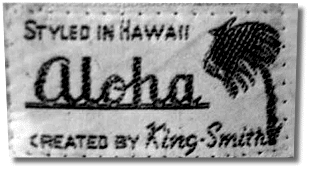
Returning to Honolulu, he was the owner of a Chinatown dry goods shop at 36 North King Street, that he renamed King-Smith Clothiers (the store was named after its location, near the intersection King and Smith Streets.)

With the great depression underway, he looked for ways to increase business; he got the idea to promote a local-style shirt.  Using leftover kimono material, he patterned a shirt after the plantation workers’ palaka shirt (short sleeved, un-tucked square bottom.)  They had a few dozen made and hung them in the window.

He called them “Aloha Shirts.”

“Since there was no pre-printed Hawaiian fabric around, I took patterned Japanese yukata cloth and had a few dozen short-sleeve, square-bottomed shirts made up for me. I put the shirts in the front window of the store with a sign that said Aloha Shirts.’ They were a novelty item at first, but I could see that they had great potential.”  (Chun, 1987 Interview, Star-Bulletin)

They started small, having a few dozen bright printed Hawaiian patterns with hula dancers, palm trees and pineapples.  His store became a mecca for a wide range of customers.

In 1936, Chun registered the “Aloha Shirt” trademark.
“It turned out well.”

That year, two firms, Branfleet (the original company was founded in 1936 as a partnership between the Frenchman George Brangier and a Californian, Nat Norfleet; later known as Kahala Sportswear) and the Kamehameha Garment Company, began to shift the focus of the garment industry to a larger and more export-oriented market.

Their products, factory-made sportswear, provided the direction and product line that continues to dominate large segments of the industry today.  (Chinen)

A shipping strike in 1936 forced the companies to explore the local island market which brought them renewed success. The years 1936-1939 were big growth years for the garment industry in general and each company typically came out with 15 or more new shirt designs each year.

Paradise of the Pacific published its first photograph of a man wearing an aloha shirt in 1938. Soon thereafter, movie stars took up the fad. By 1940, officials of the Territorial and City and County governments were allowing their employees to wear aloha shirts, at least in warm weather.  (Schmitt)

After World War II, a gradual change in aloha wear took place with the breakdown of rigid dress requirements for business attire. The business tie and jacket certainly were not comfortable in Hawaiʻi’s summer climate. In 1946, the Honolulu Chamber of commerce appropriated $1,000 to study aloha shirts and prepare suitable designs for clothing businessmen could wear. (Art of the Aloha Shirt)

In 1947, the Hawaiʻi Chamber of Commerce organized an annual event called Aloha Week, during which office workers were encouraged to shed their suits and wear Alohas to work. In the 1960s, the chamber invented Aloha Fridays, which led to casual Fridays.  (Washington Post)

By 1950, however, “screen printing” had emerged, led by companies like Alfred Shaheen and Von Hamm Textiles. This procedure permitted the printing of smaller yardages, expressly for local designers. More important, it permitted brighter and more shaded prints which, from 1947 on, received greater national and international exposure through yearly Aloha Week publicity events.  (Chinen)

Up to the middle to late-1950s was considered the Golden Age of aloha shirts.  Rayon with smooth finish and Hawaiian prints became the pinnacle of aloha shirts. Complicated eye popping patterns containing all aspects of Hawaiian culture and artifacts were included on the aloha shirts, often referred to as “chop suey” prints because of the mixture of content in the design.  (Art of the Aloha Shirt)

The modern era of aloha shirts is considered the 1960s and beyond. In 1962 the Hawaiian Fashion guild staged “Operation Liberation”, giving two aloha shirts to each man in the State House and Senate. The Senate passed a resolution urging the regular wearing of aloha attire from Lei Day, May 1st, and throughout the summer months.

Aloha Friday officially began in 1966, and by the end of the 1960s, the wearing of aloha shirts for business dress any day of the week was accepted.   (Art of the Aloha Shirt)

According to Alfred Shaheen, “It (Aloha dress) was really provincial in Hawaiʻi then; the old timers were into formality.  They weren’t far from missionaries; in fact, many were descendants of the missionaries so they were still pretty strict and puritanical about things. …  So it was a new breed, the younger guys who were ready for a new style.”  (Art of the Aloha Shirt)

With aloha dress accepted as every-day wear, Reyn Spooner shirts came on the scene in the early-1960s.  Reyn McCullough liked Pat Dorian’s original “reverse” print shirt and started to market it in his Ala Moana Center store.  It was a more conservative, “traditional” pullover reverse shirt with a button-down-collar and tails to tuck into slacks.  (Tim McCullough)

“Aloha attire is a pan-ethnic expression.  What it does is show varied influences coming to Hawai’i. Clothing shows us that all the ethnicities have an impact on what we wear.”  (Arthur, UH)

Ellery Chun eventually closed his store and became a bank vice president.  He died in 2000; that year, Governor Ben Cayetano proclaimed “The Year of the Aloha Shirt.”  (Lots of information here from Aloha Shirts of Hawaiʻi, The Art of the Aloha Shirt and Chinen.)

Chun’s legacy lives on.

© 2023 Hoʻokuleana LLC

Filed Under: Economy, General, Prominent People Tagged With: Hawaii, Reyn McCullough, Ellery Chun, Aloha Shirt

April 18, 2023 by Peter T Young Leave a Comment

What Had Long Been Feared

“What has long been feared by some, and considered a certain event by others, has happened. The Chinese quarter of Honolulu has been devastated by a fire, that, gaining headway in the dense aggregation of wooden buildings, was quickly beyond control and sweeping in all directions.” (Daily Bulletin – April 19, 1886)

It started on April 18, 1886.  A few minutes before 1 o’clock the fire started in a Chinese cook house on the corner of Hotel street and Smith’s lane. It started accidentally by the owner of the premises in lighting his fire for cooking.

“Although not a breath of wind stirred … quicker than can be told the fire was leaping from roof to roof, gliding along verandahs, entwining itself about pillars and posts, festooning doors and windows . … In the calm the smoke rose in a vast volume . . . . Both [Smith and Hotel] were soon lanes of fire.”  (Daily Bulletin – April 19, 1886)

After a seven-hour ordeal-about half of it in darkness-the walls of the last building to collapse fell in. It was exactly 11:20 and the place was the makai side of the King Street bridge leading across to the Palama district.

As the embers cooled, tempers flared.

Hawaiians of Chinatown, especially around the ʻEwa side of Maunakea Street, where they had been the greatest losers, were bitter.  They blamed it all on the Chinese.

By midnight a mob of perhaps 3,000 crowded around the King Street bridge and back to the Chinese theater. As Hawaiians itched for a fight, things could get nasty – fortunately, cooler heads prevailed and while skirmishes occurred, a full-on riot was avoided.

Honolulu’s Chinatown, then and now, is the approximate 36-acres on the ʻEwa side of Downtown Honolulu.  It developed into a Chinese dominated place, following the in-migration of Chinese to work on the sugar plantation, starting in 1852.

Between 1852 and 1876, 3,908 Chinese were imported as contract laborers, compared with only 148 Japanese and 223 South Sea Islanders. Around 1882, the Chinese in Hawaii formed nearly 49% of the total plantation working force, and for a time outnumbered Caucasians in the islands.

It had been noted, according to one observer in 1882, for the fact that the great majority of its business establishments “watchmakers’ and jewelers’ shops, shoe-shops, tailor shops, saddle and harness shops, furniture-shops, cabinet shops and bakeries, (were) all run by Chinamen with Chinese workmen.”

By 1884, the Chinese population in Honolulu reached 5,000, and the number of Chinese doing plantation work declined.   As a group they became very important in business in Hawaii, and 75% of them were concentrated in Chinatown where they built their clubhouses, herb shops, restaurants, temples and retail stores.

By 1886, there were 20,000 people living in the area between Nuʻuanu Stream, Nuʻuanu Avenue, Beretania Street and Honolulu Harbor.

Most of the structures were one- and two-story wooden shacks crammed with people, animal and pests. Chinatown had a poor water supply system and no sewage disposal.

Although the fire intensified anti-Chinese feeling, this group had long been under attack. During the 1880s, spurred by what was considered an alarming influx, the Hawaiian government had limited – and for a time halted – their coming.

The year before the fire, massive Japanese immigration started. It had been conceived and encouraged not only to man plantation fields, but also to provide a counterbalance to the Chinese.

The 1886 blaze destroyed eight blocks of Chinatown. While the government soon after established ordinances to widen the narrow streets and limit building construction to stone or brick, nothing was enforced. More ramshackle buildings went up, laying the groundwork for future disaster and disease.

The 1886 fire started at the corner of Hotel and Smith Streets.

They rebuilt.

In 1900, fire struck again.  However, in 1900, the Board of Health intentionally set “sanitary” fires to prevent further spread of the bubonic plague.  Those got out of control.

The 1900 fire caused the destruction of all premises bounded by Kukui Street, River Street, Queen Street (presently Ala Moana Boulevard) and Nuʻuanu Avenue.

Today, the majority of buildings in Chinatown date from 1901 with very few exceptions which escaped the January 20, 1900 fire.

© 2023 Hoʻokuleana LLC


Filed Under: General, Economy Tagged With: Hawaii, Oahu, Chinatown

  • « Previous Page
  • 1
  • …
  • 203
  • 204
  • 205
  • 206
  • 207
  • …
  • 572
  • Next Page »

Images of Old Hawaiʻi

People, places, and events in Hawaiʻi’s past come alive through text and media in “Images of Old Hawaiʻi.” These posts are informal historic summaries presented for personal, non-commercial, and educational purposes.

Info@Hookuleana.com

Connect with Us

  • Email
  • Facebook
  • LinkedIn
  • Twitter
  • YouTube

Recent Posts

  • ʻĪmaikalani
  • About 250 years Ago … Give Me Liberty, Or Give Me Death
  • Herbert, William & Jack
  • Lake Waiau
  • Silva’s Stores
  • Jones Act
  • Lady in Waiting

Categories

  • Ali'i / Chiefs / Governance
  • Buildings
  • Missionaries / Churches / Religious Buildings
  • Hawaiian Traditions
  • Military
  • Place Names
  • Prominent People
  • Schools
  • Sailing, Shipping & Shipwrecks
  • Economy
  • Voyage of the Thaddeus
  • Mayflower Summaries
  • American Revolution
  • General

Tags

Albatross Al Capone Ane Keohokalole Archibald Campbell Bernice Pauahi Bishop Charles Reed Bishop Downtown Honolulu Eruption Founder's Day George Patton Great Wall of Kuakini Green Sea Turtle Hawaii Hawaii Island Hermes Hilo Holoikauaua Honolulu Isaac Davis James Robinson Kamae Kamaeokalani Kameeiamoku Kamehameha Schools Lalani Village Lava Flow Lelia Byrd Liberty Ship Liliuokalani Mao Math Mauna Loa Midway Monk Seal Northwestern Hawaiian Islands Oahu Papahanaumokuakea Marine National Monument Pearl Pualani Mossman Quartette Thomas Jaggar Volcano Waikiki Wake Wisdom

Hoʻokuleana LLC

Hoʻokuleana LLC is a Planning and Consulting firm assisting property owners with Land Use Planning efforts, including Environmental Review, Entitlement Process, Permitting, Community Outreach, etc. We are uniquely positioned to assist you in a variety of needs.

Info@Hookuleana.com

Copyright © 2012-2024 Peter T Young, Hoʻokuleana LLC

Loading Comments...