Images of Old Hawaiʻi

  • Home
  • About
  • Categories
    • Ali’i / Chiefs / Governance
    • American Protestant Mission
    • Buildings
    • Collections
    • Economy
    • Missionaries / Churches / Religious Buildings
    • General
    • Hawaiian Traditions
    • Other Summaries
    • Mayflower Summaries
    • Mayflower Full Summaries
    • Military
    • Place Names
    • Prominent People
    • Schools
    • Sailing, Shipping & Shipwrecks
    • Voyage of the Thaddeus
  • Collections
  • Contact
  • Follow

September 29, 2023 by Peter T Young Leave a Comment

Maui No Ka Oi

Several have asked about historical information on Lahaina and West Maui. Here is a repeat of something I posted a while ago – its focus is on West Maui.

West Maui was considered a ‘window to the world’ because this area has seen the comings and goings of rival chiefs, kings, missionaries, whalers, government officials, the military, sugar and pineapple plantation owners, early labor immigrants, celebrities and travelers for centuries.

This ‘window’ is a metaphor. As a ‘window to the world,’ the stories of West Maui give a bigger perspective of the world, than we would otherwise have, and helps us to expand our view and broaden our understanding of the world.

History tells us much about a community – what it is and where it has come from. West Maui has a rich history dating back to the times of: Pre-contact Hawaiʻi; Hawaiian Monarchy; American Protestant Missionaries; Whaling industry; Sugar and Pineapple Plantations; and Evolution of the West Maui Community.

Each successive passage of an era has added to the cultural richness of the community. And through the tireless efforts of numerous organizations and individuals in the community, much has been done to preserve the historic character of West Maui town and to restore historic sites.

The island of Maui is divided into twelve moku; Kāʻanapali, Lāhainā, Wailuku, Hāmākuapoko, Hāmākualoa, Koʻolau, Hāna, Kīpahulu, Kaupō, Kahikinui, Honuaʻula and Kula. Two of these, Kāʻanapali and Lāhainā make up West Maui.

Probably there is no portion of our Valley Isle, around which gathers so much historic value as West Maui. It was the former capital and favorite residence of kings and chiefs.

After serving for centuries as Royal Center to ruling chiefs, West Maui was selected by Kamehameha III and his chiefs to be the seat of government; here the first Hawaiian constitution was drafted and the first legislature was convened.

Hawai‘i’s whaling era began in 1819 when two New England ships became the first whaling ships to arrive in the Hawaiian Islands. Over the next two decades, the Pacific whaling fleet nearly quadrupled in size and in the record year of 1846, 736-whaling ships arrived in Hawai’i.

Although Honolulu was originally the port most favored by the whalers, West Maui often surpassed it in the number of recorded visits, particularly from about 1840 to 1855.

Lāhainā Roads, also called the Lāhainā Roadstead is a channel between the islands of Maui and Lānai (and to a lesser extent, Molokai and Kahoʻolawe) making it a sheltered anchorage.

The central location of the Hawaiian Islands between the continent and Japan whaling grounds brought many whaling ships to the Islands. Whalers needed food and the islands supplied this need from its fertile lands.

Between the 1820s and the 1860s, the Lāhainā Roadstead was the principal anchorage of the American Pacific whaling fleet. One reason why so many whalers preferred West Maui to other ports was that by anchoring in a roadstead from half a mile to a mile from shore they could control their crews better than when in a harbor.

Another factor to affect the change, growth and social structure of West Maui was the arrival of the first missionaries in the islands during 1820.

The first missionaries to be established at Lāhainā, the Rev. CS Stewart and the Rev. William Richards, arrived in 1823. They came at the request of Queen Mother Keōpūolani, who moved to live in Lāhainā that year.

The great event of 1823 was the death of Keōpūolani at Lāhainā. Within an hour before “joining the Great Majority” she had been baptized as a Christian, an occurrence which proved a great stimulus to increasing the influence of the missionaries. King Kaumuali’i of Kauai, at his special request, was buried beside Keōpūolani in 1824. (NPS)

In 1831, classes at the new Mission Seminary at Lahainaluna (later known as Lahainaluna (Upper Lahaina)) began. The school was established by the American Board of Commissioners of Foreign Missions “to instruct young men of piety and promising talents” (training preachers and teachers.) It is the oldest high school west of the Mississippi River.

Per the requests of the chiefs, the American Protestant missionaries began teaching the makaʻāinana (commoners.) Literacy levels exploded.

From 1820 to 1832, in which Hawaiian literacy grew by 91 percent, the literacy rate on the US continent grew by only 6 percent and did not exceed the 90 percent level until 1902 – three hundred years after the first settlers landed in Jamestown – overall European literacy rates in 1850 had not been much above 50 percent.

Centuries ago, the early Polynesian settlers to Hawaiʻi brought sugar cane with them and demonstrated that it could be grown successfully.

It was not until 1823 that several members of the West Maui Mission Station began to process sugar from native sugarcanes for their tables. By the 1840s, efforts were underway in West Maui to develop a means for making sugar as a commodity.

Starting in the 1850s, when the Hawaiian Legislature passed “An Act for the Governance of Masters and Servants,” a section of which provided the legal basis for a contract-labor system, labor shortages were eased by bringing in contract workers from Asia, Europe and North America.

It is not likely anyone then foresaw the impact this would have on the cultural and social structure of the islands. The sugar industry is at the center of Hawaiʻi’s modern diversity of races and ethnic cultures. Of the nearly 385,000-workers that came, many thousands stayed to become a part of Hawai‘i’s unique ethnic mix. Hawai‘i continues to be one of the most culturally-diverse and racially-integrated places.

Pioneer Mill Company was one of the earliest plantations to use a steam tramway for transporting harvested cane from the fields to the mill. Cane from about 1000‐acres was flumed directly to the mill cane carrier with the rest coming to the mill by rail. (The Sugar Cane Train is a remnant of that system.)

In 1859, an oil well was discovered and developed in Titusville, Pennsylvania; within a few years this new type of oil replaced whale oil for lamps and many other uses – spelling the end of the whaling industry.

By 1862, the whaling industry was in a definite and permanent decline. The effect of West Maui was striking. Prosperity ended, prices fell, cattle and crops were a drag on the market, and ship chandleries and retail stores began to wither.

Historically Maui’s second largest industry, pineapple cultivation has also played a large role in forming Maui’s modern day landscape. The pineapple industry began on Maui in 1890 with Dwight D. Baldwin’s Haiku Fruit and Packing Company on the northeast side of the island.

West Maui’s roots in the historic pineapple industry began in 1912, when of Honolua Ranch manager, David Fleming began growing pineapple there; almost overnight the pineapple industry boomed.

The ranch was soon renamed Baldwin Packers; at one time they were the largest producer of private label pineapple and pineapple juice in the nation.

One of the first hotels in West Maui was the Pioneer Hotel – founded in 1901. George Freeland arrived in the Lāhainā roadstead on a ship that had just come from a long voyage through the south seas; he noted a need for a hotel.

It remained the only place for visitors to stay on Maui’s west side until the early-1960s. Tourism exploded; West Maui is a full-fledged tourist destination second only to Waikīkī.

Lāhainā’s Front Street, offering an incredible oceanfront setting, people of diverse cultures, architecture and incredible stories of Hawaiʻi’s past, was recognized as one of the American Planning Association’s 2011 “Great Streets in America.”

The following link is to a larger discussion on West Maui – it was prepared a few years ago, before the fires.

Click HERE to view/download for more information on West Maui’s place in the Islands and world.

To see and read about the many structures that were lost in the Lahaina fire, I encourage you to download an App developed by the Lahaina Restoration Foundation that was put together as a ‘Walking Tour’ through Lahaina (you will see images and information on the pre-fire structures):

https://lahainarestoration.org/lahaina-historic-trail/

The tragic fire in Lahaina destroyed many of the physical structures of the community. Some of the historic buildings may be rebuilt; something else will take the place of others.

But the fires did not take away the memory we share of this area. Do what you can to help those that have been impacted and share your memories of West Maui and Lahaina.  Maui No Ka Oi (Maui is the best).

© 2023 Hoʻokuleana LLC

Humpback_Whale-Maui-(Stan_Butler-NOAA)-WC
Olowalu-Petroglyphs
Olowalu-Petroglyphs
Bathing scene, Lahaina, Maui, watercolor, by James Gay Sawkins-1855
Port-of-Lahaina-Maui-1848
Whale-ships at Lahaina-(vintagehawaii)-1848
Edward_T._Perkins,_Rear_View_of_Lahaina,_1854
Whales from McGregor Point-(cphamrah)
Pioneer Mill
Pioneer Mill
McGregor_Point-Norwegian-Monument
Lahaina_from_offshore_in-1885
Lahaina_Boat_Landing
Lahaina,_West_Maui,_Sandwich_Islands2,_watercolor_and_pencil,_by_James_Gay_Sawkins-1855
Lahaina,_Maui,_c._1831
Lahaina, Front Street 1942
Lahaina Tunnel Dedication (1951)
Lahaina Roads
Lahaina Roads
Lahaina Harbor before harbor perimeter retaining wall built-ca 1940
Lahaina Courthouse-fronting beach-(now Lahaina Small Boat Harbor)
Banyan Tree located in courthouse square in the center of Lahaina
Baldwin Packers Cannery (kapalua)
1837 Map of the Islands; made by students at Lahainaluna School (Mission Houses)

Filed Under: Buildings, Economy, Missionaries / Churches / Religious Buildings, Hawaiian Traditions, Military, Place Names, Prominent People, Schools, Sailing, Shipping & Shipwrecks, General, Ali'i / Chiefs / Governance Tagged With: Hawaii, Maui, West Maui

May 21, 2023 by Peter T Young Leave a Comment

West Loch Tragedy

Despite its moniker, “Large Slow Target,” the ‘Landing Ship, Tank’ (LST) was an important naval vessel created during World War II to support amphibious operations by carrying significant quantities of vehicles, cargo and landing troops directly onto an unimproved shore.

An LST, 382-feet long and 50-feet wide, carried a crew of 8-10 officers and 115 enlisted men; in addition, there were berths for over 200-troops and a capacity to carry a 2,100-ton load of tanks, trucks, jeeps and weapon carriers and associated munitions and supplies.

1,051 LSTs were constructed and used in the war effort; they were used in the Atlantic and the Pacific.  Only 26 were lost in WWII due to enemy action.

However, in Hawaiʻi, a once secret and often-forgotten tragedy struck at Pearl Harbor, in 1944.

At the time, the Allied forces were preparing for two assaults – one was in the Atlantic (D-Day, June 6, 1944 – nearly 200,000-Allied troops on 7,000-ships and more than 3,000-aircraft headed toward Normandy, France.)

The other was in the Pacific (Saipan, June 15, 1944 – more than 300-landing vehicles put 8,000-Marines on the west coast of Saipan; eleven support ships covered the Marine landings.)

In preparation for the Saipan assault, in late-May, crews were loading ships at the US Pacific Fleet base at West Loch, Pearl Harbor.

(Pearl Harbor is divided into a series of lochs that fan out from Ford Island that sits in the center of harbor. West Loch was the staging area for the invasion fleets of the Pacific.)

29-LSTs, plus a variety of other amphibious vessels that would support the initial landings and follow-on operations, were tightly clustered while their hulls and decks were being filled with ammunition, supplies and other material.

That list of items included munitions of all calibers and types, propellants, aviation gasoline, vehicle fuel and a variety of other volatile cargoes.

Nested beam-to-beam at piers off of Hanaloa and Intrepid Points opposite Lualualei (now known as Naval Magazine Pearl Harbor) were six compact rows of LSTs and other craft moored at “Tare” piers jutting into the adjoining waters of West Loch and Walker Bay.

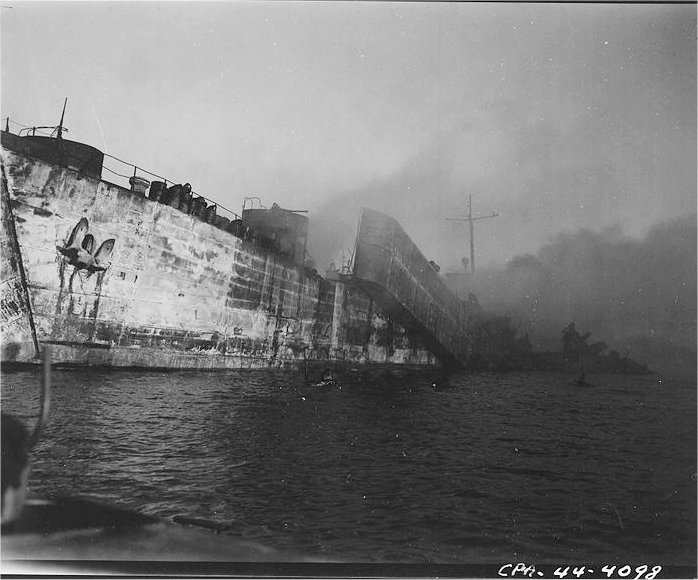
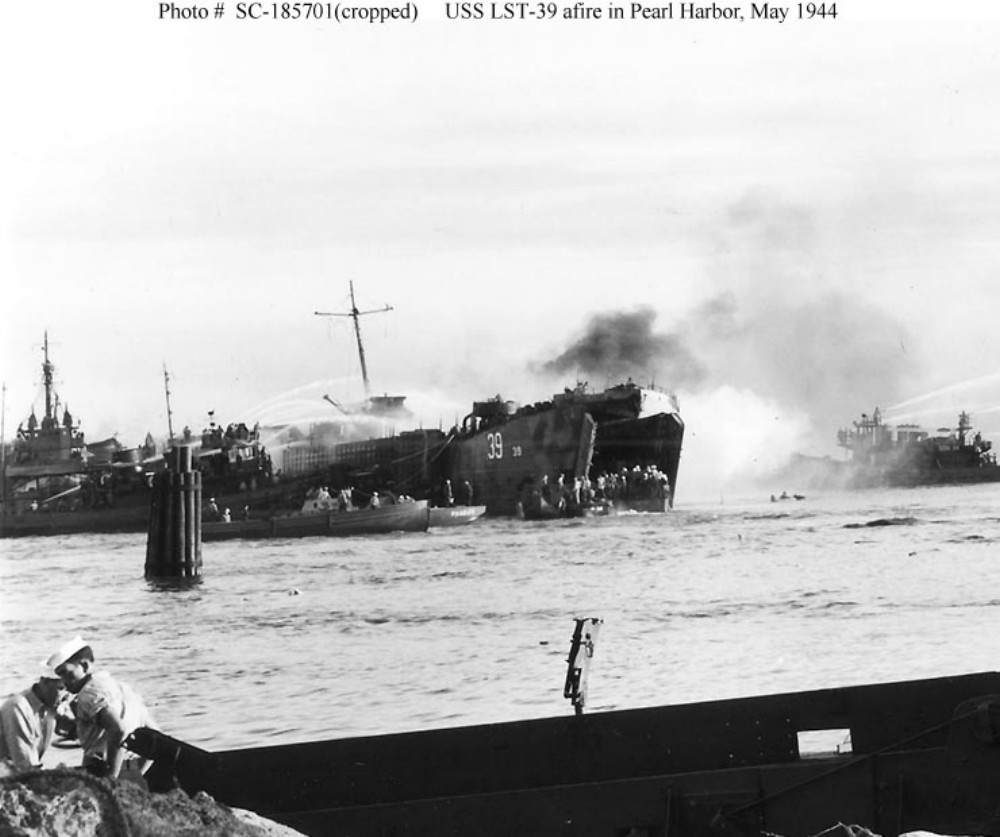
At 1508 (3:08 pm) May 21, 1944, Lualualei’s tranquility was shattered by a deafening explosion which thundered across most of Oʻahu.

Without warning, an enormous mushroom of orange black fire encapsulated LST-353 at Tare 8, obliterating it and most of the seven other ships from view as the giant fireball burst into the cloudless sky.  (Oliver)

The explosions continued, damaging more than 20 buildings shoreside at the West Loch facility. For 24-hours fires raged aboard the stricken ships.  (NPS)

Had the Japanese struck again – another sneak attack on Pearl Harbor? … No one knew.

Then the ground shook to a second blast. Earthquake?  Volcano?  Aerial bombs?  Alarms rang as another shattering blast of even greater magnitude jolted the air.  (Oliver)

Predictably, flaming gasoline and exploding ammunition soon began to take a frightful toll of the Soldiers, Sailors and Marines loading and manning the ships.

Fires and explosions drove back ships and craft engaged in firefighting efforts, each time those vessels re-entered the inferno to contain the fires and keep the disaster from spreading to the rest of the Fleet anchorage. (USNavalInstitute)

Several investigations sought to find the reason for such a disaster, but no conclusive evidence as how it occurred was decided upon.  Two major causes emerged as most likely: Either a fused mortar round was accidently dropped while unloading the LCT aboard LST-353, or the initial explosion was caused by gasoline vapors.  (Oliver)

The Navy put a “Top Secret” status on the tragedy.  Survivors and eyewitnesses to the calamity were warned under threat of prosecution not to make any mention of the disaster in letters or calls to family members. To the outside world the tragedy at West Loch simply never happened.  (Oliver)  (It was declassified in 1960.)

The total casualties were 392 dead; 163 sailors, the rest young Marines from the newly formed 2nd and 4th Marine Divisions, and 396 injured – eight ships were lost.

It was recommended that LSTs no longer be nested, so that disaster like that at West Loch could be avoided. Fleet Admiral Chester Nimitz disagreed. He felt that facilities were too limited at Pearl and that the nesting was necessary. “It is a calculated risk that must be accepted.”  (NPS)

Despite the losses, the Saipan invasion force put to sea as scheduled on June 5, 1944, just as the largest invasion armada ever to sail was crossing the English Channel en route to the Normandy beaches.

On June 15, 1944, during the Pacific Campaign of World War II (1939-45,) Admiral Turner was in charge of the assault on Saipan.  At 05:42, his orders came – “Land the landing force.” In position, about 1,250 yards from the line of departure, 34-LSTs moved into line. Two huge doors on the bow of each ship opened and dropped their ramps into the water. (BattleOfSaipan)

US Marines (having earlier trained at Camp Tarawa, Waimea, Hawaiʻi Island and Camp Maui, Ha‘ikū, Maui) stormed the beaches of the strategically significant Japanese island of Saipan, with a goal of gaining a crucial air base from which the US could launch its new long-range B-29 bombers directly at Japan’s home islands.

Facing fierce Japanese resistance, Americans poured from their landing crafts to establish a beachhead, battling Japanese soldiers inland and forcing the Japanese army to retreat north. Fighting became especially brutal and prolonged around Mount Tapotchau, Saipan’s highest peak, and Marines gave battle sites in the area names such as “Death Valley” and “Purple Heart Ridge.”  (history-com)

This was the first action of Operation Forager, the conquest of the Marianas, consisting of two Marine Divisions, a US Army Division, and the required force and support units from an amphibious armada of nearly 600-ships and craft.

When the US finally trapped the Japanese in the northern part of the island, Japanese soldiers launched a massive but futile banzai charge. On July 9, the US flag was raised in victory over Saipan.  (history-com)

© 2023 Hoʻokuleana LLC


Filed Under: Military Tagged With: Hawaii, Oahu, Pearl Harbor, LST, West Loch

February 8, 2023 by Peter T Young Leave a Comment

Currency Stamped with “HAWAII” during WWII

Like most people of his generation, my father saved stuff, especially “special” stamps, currency and coins – below is a $10 bill of his that he gave to me.
 
According to the Federal Reserve, with the start of World War II, the US started printing specialized military currency to provide economic stability for the US dollar in occupied countries.
 
In Hawaiʻi, the Treasury Department replaced all US currency with special issue notes as a precautionary measure in the event of a Japanese victory.
 
These notes were circulated only in Hawai‘i and their brown seals and serial numbers differentiated them from notes issued on the mainland.
 
Overprints of the word HAWAII were made; two small overprints to the sides of the obverse of the bill between the border and both the treasury seal and Federal Reserve Bank of San Francisco seal, and huge outlined HAWAII lettering dominating the reverse.
 
The hope was that, should there have been a Japanese invasion, the US Government could immediately declare any Hawai‘i-stamped notes worthless, due to their easy identification.
 
$1, $5, $10 and $20 San Francisco Reserve notes featured the seal and serial numbers that the Bureau of Engraving and Printing called the “Hawaiʻi Overprint” (from July 1942 until October 1944.)
 
Hawai‘i wasn’t the only place where special currency was distributed.  Similarly, special notes were issued for use by American troops during the invasion of North Africa in November 1942.
 
These notes were overprinted with distinctive yellow Treasury Seals to distinguish them from the regular Silver Certificates overprinted with blue seals.
 
Like the overprinted Hawai‘i notes, these distinctive certificates could be declared worthless if large amounts fell into enemy hands.
 
In addition to the Hawai‘i currency issued, the Bureau of Engraving and Printing produced or oversaw the private production of Allied military currency used in Italy, France, Austria, Germany and Japan during and after the war.
 
The Department of the Treasury redeems all genuine United States currency at face value only, and does not render opinions concerning the numismatic value of old or rare currencies.
 
However, numerous websites indicate premiums are being paid for these special bills.  (I am keeping mine as a reminder of my father.)
 
© 2023 Ho‘okuleana LLC

Filed Under: Military Tagged With: Hawaii, WWII, Currency

February 1, 2023 by Peter T Young Leave a Comment

Raising the United States Flag

A Command from Captain Wiltse to Lieutenant Commander Swinburne; USS Boston, Honolulu, Hawaiian Islands, February 1, 1893 …

“Sir: You will take possession of the Government building, and the American flag will be hoisted over it at 9 am. Very respectfully, GC Wiltse, Captain US Navy, Commanding USS Boston.”

The following is a summary of a report prepared by Lieut. Commander Swinburne in preparation and response to that order and the events that followed (as recorded in the Report of the Committee of Foreign Relations, United States Senate, 1894.)

In accordance with that order, the battalion of the Boston landed at Brewers Wharf, in the city of Honolulu, at 5 pm January 16.

The following summarizes the forces that landed: Company A, Artillery, 40 men; Company B, Infantry, 35 men; Company C, Infantry, 34 men; Company D, Marines, 30 men;  Color guard, 4 men; hospital corps, 1 apothecary, 4 stretchermen; signalmen, 2; music, 3. Total, 153 men, 11 officers.

Each man carried the regulation knapsack, with blanket and change of clothing, haversack with mess gear and ration of hard bread, and filled canteen. Those armed with Lee rifle wore the double webbing belt carrying 60 cartridges in the loops and 20 in magazines. The marines were fitted out with the same belts, but the loops only were filled.

The ammunition boxes of the Gatling gun contained four filled Accle’s Feeds and 1,380 extra rounds of .45 caliber in pasteboard boxes. The ammunition boxes of the 37 mm contained 64 cartridges, common shell. Reserve ammunition in 37 mm. caisson was as follows: After compartments, 112 37 mm. cartridges, common shell; forward compartment 1,600 caliber .45 cartridges in pasteboard boxes; top or center compartment, four filled Accle’s Feeds, and 800 .38 caliber revolver cartridges.

After the battalion was formed, they marched first to the United States consulate, where Lieut. Draper, with his company, was detached with orders to proceed to the legation and leave half his command in charge of the orderly sergeant, returning with the remainder to the United States consulate, himself, and remain there as a guard until further orders.

The remainder of the battalion then marched down King Street. In passing the palace the battalion, in column of companies, gave a marching salute, trumpeters sounding four ruffles in honor of the royal standard, which was flying there.

On arriving at the residence of Mr. JB Atherton, an American, the command was halted, and permission having been obtained, was marched into the grounds, arms stacked and ranks broken.  About 8 in the evening the battalion marched to Arion Hall and camped there.

During the night the men were kept ready for an instant’s call, but there were no disturbances of any kind.

At reveille the next morning, 17th, the camp routine was published and has been strictly carried out in all its details. Latrines were built in the yard and every sanitary precaution taken.

At 2:30 pm, a civilian, armed, reported that a policeman had been shot while attempting to stop a wagonload of ammunition which was being conveyed to the old armory where the civilian forces enrolled by the committee of safety were then assembling, and that a large crowd was collecting on Merchant Street.

The battalion was immediately assembled under arms in the yard in rear of the building to await developments. Until nearly 6 o’clock, the men leading the citizens’ movement had assumed charge of the Government building without opposition of any kind; the civilian companies under arms had marched in and established a line of sentries about the Government building.

The Boston’s battalion was kept in rear of the camp, at their company parades, with arms stacked. About 1 pm, they were notified that a Provisional Government, of which Mr. SB Dole was presiding officer, was in complete possession.  A letter from the United States minister recognized it as the de facto government of the Hawaiian Islands, and the battalion was to consider it as such.

During the night, again, officers and men were kept ready for a moment’s call, but the city was perfectly quiet.

During the day of the 18th the royal standard was hauled down over the palace, and the household troops disbanded, by order of the Provisional Government, except a small guard of honor, who accompanied the ex-Queen to her residence on Beretania street.

On January 19 new quarters were provided for the battalion at the unoccupied house on King street, the property of Mr. CR Bishop.  Having thoroughly policed the old camp, the battalion moved into the new quarters at 1:30 pm.  Daily routine followed.

In accordance with verbal orders given the evening of January 31, the battalion was paraded on the morning of February 1, at 8:30, in front of the quarters – ‘A’ Company as artillery with Gatling and 37 men; the rest as infantry in light marching order.

As the line was formed, a written order, dated February 1, was given; in obedience to those orders the battalion marched to the Government building, where we were received by the civilian troops, who presented arms as they entered. President Dole and all members of the ministry and advisory council were also present.

According to the order, Col. Sofer, Commander in Chief of the Provisional Government forces, at once turned over the custody of the building to Lieut. Commander Swinburne.

A proclamation from Minister Stevens establishing a protectorate over the Hawaiian Islands in the name of the United States, pending negotiations with the Hawaiian Commissioners at Washington, was read.

At 9 am, the United States ensign was hoisted over the building, the battalion and civilian forces presenting arms.  The Hawaiian flag, hoisted on the pole in the grounds, received the same salute.

The civilian forces of the Provisional Government were then withdrawn and the custody of the building turned over to Lieut. Draper with his company of 25 marines, which were withdrawn from the United States consulate for the purpose, the guard at the United States legation being continued but reduced to 5 men. The blue jacket companies of the battalion then returned to their quarters.

© 2023 Hoʻokuleana LLC

Filed Under: Ali'i / Chiefs / Governance, Military Tagged With: Wiltse, C Brewer, Atherton, Arion Hall, Camp Boston, Hawaii, Charles Reed Bishop, Arlington Hotel

January 17, 2023 by Peter T Young Leave a Comment

Overthrow

Some suggest the overthrow of the Hawai‘i constitutional monarchy was neither unexpected nor sudden.

Dissatisfaction with the rule of Kalākaua and Lili‘uokalani initially led to the ‘Bayonet Constitution,’ then, the overthrow. “(M)ounting dissatisfaction with government policies and private acts of officials led to the formation of the Hawaiian League, a group of Honolulu businessmen.” (Forbes)

Challenges with Kalākaua
• Polynesian Confederacy
• “(Gibson) discerned but little difficulty in the way of organizing such a political union, over which Kalākaua would be the logical emperor, and the Premier of an almost boundless empire of Polynesian archipelagoes.” (Daggett; Pacific Commercial Advertiser, February 6, 1900)

Opium License Bribery Case
• Initially the king, through his minister of foreign affairs, disclaimed any involvement. However, “To cap the climax of the opium matter, the Attorney General proceeds to acknowledge that the money was paid over by the Chinese … (H)e informed the gentlemen interested in getting the money back that he would never accomplish his object so long as he allowed the newspaper to speak of the affair.” (Hawaiian Gazette, May 17, 1887)

Extravagance/Debt
• Although Kalākaua had been elected and serving as King since 1874, upon returning from a trip around the world (1881), it was determined that Hawaiʻi’s King should also be properly crowned.
• “ʻIolani Palace, the new building of that name, had been completed the previous year (1882), and a large pavilion had been erected immediately in front of it for the celebration of the coronation. This was exclusively for the accommodation of the royal family; but there was adjacent thereto a sort of amphitheatre, capable of holding ten thousand persons, intended for the occupation of the people.” (Liliʻuokalani)

Bayonet Constitution (1887)
• In 1887, the struggle for control of Hawaiʻi was at its height with David Kalākaua on the throne. But some of the businessmen were distrustful of him. “So the mercantile element, as embodied in the Chamber of Commerce, the sugar planters, and the proprietors of the ‘missionary’ stores, formed a distinct political party, called the ‘down-town’ party, whose purpose was to minimize or entirely subvert other interests, and especially the prerogatives of the crown, which, based upon ancient custom and the authority of the island chiefs, were the sole guaranty of our nationality.” (Liliʻuokalani)

Concern with Lili‘uokalani’s Attempt to Rewrite the Constitution
• “When Lili‘uokalani became Queen, she took the following oath: ‘I solemnly swear in the presence of Almighty God, to maintain the Constitution of the Kingdom whole and inviolate, and to govern in conformity therewith.’” (UH Law School)
• “On January 14, 1893, Lili‘uokalani was prepared to ignore the constitutionally mandated approval-by-two-successive Legislatures process for amending the 1887 Constitution by announcing a new constitution in place of Kalākaua’s 1887 Constitution.” (UH Law School)
• “She did not do so because the Cabinet she appointed on January 13, 1893, refused her authorization request. The members of that Cabinet were Samuel Parker, William Henry Cornwell, Jr,, Arthur P. Peterson and John Colburn. Parker was a Native Hawaiian.” (UH Law School)

Some Native Hawaiian Dissatisfaction with the Acts of Kalākaua and Lili‘uokalani
• Robert W Wilcox – the man who figured so prominently & conspicuously in the revolution of 1889 (All quotes from Wilcox, Morgan Report)
o “Queen Lili‘uokalani brought these evils upon herself and the country both by her personal corruption, and that of her Government.”
o “I believe that if we can be annexed to the United States, the rights of all of our citizens, and especially those of the native Hawaiians, will be protected more carefully than they have ever been under the monarchy.”
o “They are naturally somewhat prejudiced against (the Provisional Government), as monarchy is the only form of Government with which they are familiar, but this feeling will quickly wear away as the Hawaiians are led to see that the Government is friendly to them and their interests. They already have confidence in the integrity and patriotism of President Dole.
o “I have repeatedly (advocated annexation to the United States) in public meetings held in this city. … but I am compelled to move cautiously or I shall lose my influence over them. I believe I am doing a good work by constantly conversing with them on the subject.”
o “I have told my countrymen that the monarchy is gone forever, and when they ask me what is the best thing to follow it I tell them annexation, and I firmly believe that in a very short time every Hawaiian will be in favor of that step.” (Robert W Wilcox – the man who figured so prominently & conspicuously in the revolution of 1889; Morgan Report)

Repeated Changes in Cabinet Ministers in the Kalākaua and Lili‘uokalani Reigns
• “Under every constitution prior to 1887 the ministers were appointed by the King and removed by him; but until Kalākaua’s reign it was a very rare thing that any King changed his ministry. They had a pretty long lease of political life.” (Judd; Blount Report)
• “It was a very rare political occurrence, and made a great sensation when a change was made.” (Judd; Blount Report) if

January 14, 1893 Lili‘uokalani’s Ministers Refused to Support Her Constitution – Threats of Bloodshed were Made Against Her Cabinet Ministers
• “The Queen retired to the blue room and summoned the ministers (Samuel Parker – Minister of Foreign Affairs; John F Colburn – Minister of Interior; William H Crowell – Minister of Finance; Arthur P Peterson – Attorney General) who repaired at once to the palace. The Queen was at a table, still dressed in the magnificent costume of the morning, and sparkling in a coronet of diamonds.”
• “She at once presented them with the draft of the new constitution, demanded their signatures, and declared her intention to promulgate the same at once.”
• “Attorney-general Peterson and Minister of Interior Colburn decidedly refused to do so, and Ministers Cornwell and Parker, though more hesitatingly, joined their colleagues in this refusal.”

The Provisional Government (and subsequent Republic, Territory & State) did not steal the land from the Hawaiian people – Crown Lands Remain in the Public Trust
• Crown and Government Lands, though under the control of changing sovereigns and governments (Kingdom to Provisional Government to Republic to Territory to State,) were in and continue to remain in the ‘public domain’ for the public good.
• US Court of Claims concluded, “The constitution of the Republic of Hawai‘i, as respects the crown lands, provided as follows: ‘That portion of the public domain heretofore known as crown land is hereby declared to have been heretofore, and now to be, the property of the Hawaiian Government …” (Lili‘uokalani v The United States, 1910)
• We now generally refer to the Crown and Government Lands as ‘ceded’ lands. Under the Admission Act, about 1.2-million acres are to “be held by (the) State as a public trust” to promote one or more of five purposes:
o support of the public schools and other public educational institutions
o betterment of the conditions of native Hawaiians (per the Hawaiian Homes Act, 1920)
o development of farm and home ownership on as widespread a basis as possible
o making of public improvements
o provision of lands for public use

The United States does not have to acquire property only through a Treaty of Annexation with a concurring vote by the US Senate.
• Annexation of Hawai‘i to the US was not a hostile takeover, it was something the Republic of Hawai‘i sought. “There was no ‘conquest’ by force in the annexation of the Hawaiian Islands nor ‘holding as conquered territory;’ they (Republic of Hawai‘i) came to the United States in the same way that Florida did, to wit, by voluntary cession”. (Territorial Supreme Court; Albany Law Journal)
• “There is no provision in the Constitution by which the national government is specifically authorized to acquire territory; and only by a great effort of the imagination can the substantive power to do so be found in the terms of any or all of the enumerated powers.” (Legal Issues Raised by Proposed Presidential Proclamation To Extend the Territorial Sea, October 4, 1988)

To read more on the overthrow Click HERE:

Here is the URL: https://imagesofoldhawaii.com/wp-content/uploads/Overthrow.pdf

One more correction to the many misconceptions … on January 17, 1893, the Hawai‘i constitutional monarchy was overthrown, not the Hawaiian race.

Commenters, please focus on the facts and if referring to the linked document. Please note the page and line number you are referring to (please include your source reference, as well).

© 2023 Hoʻokuleana LLC

Raising_of_American_flag_at_Iolani_Palace-1898

Filed Under: General, Economy, Ali'i / Chiefs / Governance, Military, Prominent People Tagged With: Hawaiian Citizenship, King Kalakaua, Constitutional Monarchy, Overthrow, Opium, Liliuokalani, Constitutional Government, Queen Liliuokalani, Extravgance, Kalakaua, Debt, Hawaiian Constitution, Polynesian Confederacy

  • « Previous Page
  • 1
  • …
  • 12
  • 13
  • 14
  • 15
  • 16
  • …
  • 44
  • Next Page »

Images of Old Hawaiʻi

People, places, and events in Hawaiʻi’s past come alive through text and media in “Images of Old Hawaiʻi.” These posts are informal historic summaries presented for personal, non-commercial, and educational purposes.

Info@Hookuleana.com

Connect with Us

  • Email
  • Facebook
  • LinkedIn
  • Twitter
  • YouTube

Recent Posts

  • ‘Kakela me Kuke’
  • Aliʻiolani Hale
  • Hotel Del Coronado
  • “This does not look like me”
  • ‘Aim High to Reach the Heaven’
  • Presidents’ Day
  • Moku Manu

Categories

  • Hawaiian Traditions
  • Military
  • Place Names
  • Prominent People
  • Schools
  • Sailing, Shipping & Shipwrecks
  • Economy
  • Voyage of the Thaddeus
  • Mayflower Summaries
  • American Revolution
  • General
  • Ali'i / Chiefs / Governance
  • Buildings
  • Missionaries / Churches / Religious Buildings

Tags

Albatross Al Capone Ane Keohokalole Archibald Campbell Bernice Pauahi Bishop Charles Reed Bishop Downtown Honolulu Eruption Founder's Day George Patton Great Wall of Kuakini Green Sea Turtle Hawaii Hawaii Island Hermes Hilo Holoikauaua Honolulu Isaac Davis James Robinson Kamae Kamaeokalani Kameeiamoku Kamehameha Schools Lalani Village Lava Flow Lelia Byrd Liberty Ship Liliuokalani Mao Math Mauna Loa Midway Monk Seal Northwestern Hawaiian Islands Oahu Papahanaumokuakea Marine National Monument Pearl Pualani Mossman Quartette Thomas Jaggar Volcano Waikiki Wake Wisdom

Hoʻokuleana LLC

Hoʻokuleana LLC is a Planning and Consulting firm assisting property owners with Land Use Planning efforts, including Environmental Review, Entitlement Process, Permitting, Community Outreach, etc. We are uniquely positioned to assist you in a variety of needs.

Info@Hookuleana.com

Copyright © 2012-2024 Peter T Young, Hoʻokuleana LLC


Loading Comments...