Images of Old Hawaiʻi

  • Home
  • About
  • Categories
    • Ali’i / Chiefs / Governance
    • American Protestant Mission
    • Buildings
    • Collections
    • Economy
    • Missionaries / Churches / Religious Buildings
    • General
    • Hawaiian Traditions
    • Other Summaries
    • Mayflower Summaries
    • Mayflower Full Summaries
    • Military
    • Place Names
    • Prominent People
    • Schools
    • Sailing, Shipping & Shipwrecks
    • Voyage of the Thaddeus
  • Collections
  • Contact
  • Follow

May 21, 2022 by Peter T Young 1 Comment

Haraguchi Rice Mill

The Royal Hawaiian Agricultural Society was formed in 1850 to develop Hawaiʻi’s agricultural resources.  It was then that rice made its mark in the Hawaiʻi economy. The group purchased land in the Nuʻuanu Valley and rice seed from China and planted in a former taro patch.

At first the Society offered the rice seed to anyone in Hawaiʻi who wanted to plant it. King Kamehameha IV also offered land grants for cultivation of rice.  Because there were no proper milling facilities in Hawaiʻi, it didn’t take off as a viable crop right away.

Then, in 1860, imported rice seed from South Carolina proved very successful and yielded a fair amount of crop.  This, combined with the collapse of the taro industry in 1861-1862 (as the Hawaiian population declined, the demand for taro also declined,) added value to the numerous vacant taro patches and a boom in the rice industry.

In 1899, Hawaiʻi’s rice production had expanded so that it placed third in production of rice behind Louisiana and South Carolina.

The Agricultural Extension Service of the University of Hawaiʻi encouraged rice production, primarily in Hanalei.  As a result the acreage planted in rice on the island rose from 759 acres in 1933 to 1,058 in 1934.

For areas like Hanalei Valley, such efforts, coupled with the valley’s general remoteness and absence of competing demands for the land, allowed rice cultivation to continue as a regional activity.

The Hanalei Valley of Kauaʻi led all other single geographic units in the amount of acreage planted in rice. The valley was one of the first areas converted to this use and continued to produce well into the 1960s.

The Commercial Pacific Advertiser noted on October 3, 1861, “Everybody and his wife (including defunct government employees) are into rice – sugar is nowhere and cotton is no longer king. Taro patches are held at fabulous valuations, and among the thoughtful the query is being propounded, where is our taro to come from?”

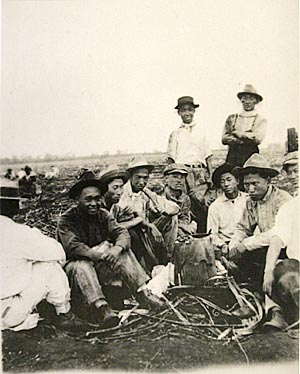
When the Japanese immigrants arrived in Hawaiʻi, their tastes preferred a shorter grain rice than the Chinese long-grain variety. With the decline of the Chinese population and increase in the Japanese population, more of the Japanese rice was being imported from Japan.

As the Japanese left the plantations, they started their own farms and cultivated their own staple rice.

It was at Hanalei where some Chinese built a rice processing facility; it as later purchased by the Haraguchi family in 1924.  At one time, the Haraguchis cultivated about 75-acres in Hanalei Valley.

Fire destroyed the original wooden mill in March of 1930; a new mill consisted of a 3-foot thick concrete foundation with corrugated iron for its roof and siding.  Interior spaces included engine room, milling area, and storage area for both finished and unprocessed rice.

This main engine operated all the mill machinery by turning a main shaft that connected all the other machines by a pulley system.  The rice in a pit would be delivered up by cups on a belt located on a “triple chute” system. One chute served the belts going downward, another chute for the belts returning upwards and a third to suck the dust up which traveled to the blower.

The cups carried the rice over the wall onto another chute and into the strainer. This strainer would shake the rice and separate any rubbish or stones to prevent it from entering the husking machines.  From the strainer, the rice would proceed to the first husker that removed part of the husk.

About 80% of the husks would be removed by this husker. The husks would travel up the air ‘chute to the blower which blew the husks out the back of the mill into a ditch that carried the husks into the river.

The partly husked rice would exit the first husker and was taken up a chute by belted cups and dropped onto another chute into the second husker. The second husker would remove the rest of the husks and the grains would continue up another “triple chute” which would carry it up and over into the polishing machine.

The fine dust from the second husker was collected in a basket under the machine and also taken up the chute into the blower.  Cowhide was used to polish the rice which prevented the grains from cracking which ensured high quality rice.  The rice would exit the polisher and taken up another chute to the grader.

The grading machine constantly shook to move the rice to the three different grades of rice. The whole grain would bypass the grading holes and a trowel was used to push the rice onto a small trough into the rice bag which hung at the end of the funnel.  From there the bags were scaled, sewn by hand and then stacked.

Despite the competition from the California grown rice, the Japanese farmers continued to produce on a smaller scale than the Chinese farmers. By the early 1950s there were about 50 growers cultivating 170 acres of rice on Kauaʻi. Hanalei Valley held 90 acres, 48 acres in Wailua and the rest was split between Hanapepe and Waimea valleys.

In addition to the staple rice, “mochi rice,” used for traditional Japanese cake on New Year’s and other special occasions, was grown.

The mochi rice from Hanalei Valley was noted for its quality throughout the Islands. It was largely a luxury crop and most of it was consumed in the Islands; about 200-bags were shipped to the Mainland.

Some mochi rice was imported from the Mainland but local buyers preferred the local crop since it was said to produce a larger yield of mochi per pound.

In 1959, Hurricane Dot left the mill intact except for an air vent at the roof peak that was torn off and not replaced.  The mill ceased operating in 1960 when Kaua`i’s rice industry collapsed. Hurricane Iwa on November 23, 1982 toppled 85% of the building onto the machinery; then came Hurricane Iniki in 1992.

The Haraguchi Rice Mill was the last mill to operate in Hanalei Valley and the only remaining rice mill in the State of Hawaiʻi.  A nonprofit organization was formed to preserve and interpret the mill; the organization is guided by an unpaid Board of Directors (many of them are members of the Haraguchi family.)  The Haraguchi family now farms taro on the adjacent lands that once supported rice.

Today, the Hoʻopulapula Haraguchi Rice Mill is an agrarian museum located in the taro fields of Hanalei Valley.  The Rice Mill Kiosk is open to the public, Monday through Saturday, 11 am – 3 pm.  No Public access into the farm & Rice Mill unless through guided tours, available Wednesdays at 10 am (reservations are required.)  (Lots of information here from NPS.)

© 2022 Hoʻokuleana LLC

Filed Under: Economy, General Tagged With: Japanese, Kauai, Rice, Royal Hawaiian Agricultural Society, Haraguchi Rice Mill, Chinese, Hanalei, Hawaii

May 17, 2022 by Peter T Young Leave a Comment

Lord Byron’s 1825 Trip to Pearl River

In 1824, Liholiho (King Kamehameha II), his wife, Kamāmalu, and a group of retainers and foreign advisors, traveled from Hawai‘i to England. Liholiho and his wife died in England and in May of 1825, their bodies were returned to Hawai‘i by Lord Byron.

While in the islands, James Macrae, a botanist, traveling with the Lord, traveled to various locations in the company of native guides, where he took observations and collected biological samples.

One of Macrae’s journeys along with Lord Byron and party took him to Pu‘uloa, the Pearl River, where he described the scene and scenery. (Maly)

“May 17. Joined Lord Byron’s party, with Mantle carrying my traps. We did not embark until noon. After two hours sailing along the coast, we entered the mouth of the Pearl River, which divides itself into several branches, forming two islands.”

“One which is smaller than the other is called Rabbit island [Moku‘ume‘ume], from a person, the name of Marine [Marin], a Spaniard, residing at Hanarura, having put rabbits on it some years ago. The rabbits have since increased in numbers.”

“It became so calm, that his Lordship, Mr. C., and the Bloxoms left us in the launch, and rowed in the small boat in tow, and soon disappeared from sight.”

“We waited in suspense, hour after hour, not knowing the several branches of the river, nor where we were to spend the night.”

“The boat party pulling into one branch of the river, the other in which I was tacking about from bank to bank till the boaters hauled their boat ashore and we cast anchor.”

“Both parties were opposite each other on Rabbit Island, but ignorant of the fact, till on walking about the island, the parties met.”

“One hut was noticed, and those on the island made for it, but the launch having the ladies and some others on board, got up anchor and sailed round to the hut, where with the help of canoes, they all landed.”

“The ladies were somewhat discontented, but after a good dinner partaken sitting on mats spread on the grass, harmony was restored.”

“At dusk we embarked to cross to a larger hut. Landed at 8 p.m. At ten o’clock two old men entered our hut to play the hura dance on a couple of bottle shaped gourds. They took a sitting posture, beating time on the gourd’s with the palms of their hands, accompanied by a song made up about the late king.”

“About 11, we all retired to rest, lying down beside each other on mats, some with pumpkins or what else they could get for a pillow. The ladies got themselves screened off in a corner with a flag without any other accommodation.”

“Pearl River is about seven miles west of Hanarura, and is improperly called a river, being rather inlets from the sea, branching off in different directions. There are three chief branches, named by the surveyors, the East, Middle and West Lochs.”

“The entrance to Pearl River is very narrow and shallow, and in its present state it is fit for very small vessels to enter, but over the bar there is deep water, and in the channel leading to the lochs there are from 7 to 20 fathoms. The lochs themselves are rather shallow.”

“The coast from Hanarura to the west of Pearl River possesses no variety of plants beyond two or three species, such as Argemones (kala, beach poppy), Portulacas (‘ihi, yellow purslane), and a few other little annuals, intermixed with the common long grass so plentiful everywhere on the coast round the island.”

“The oysters that are found in Pearl River are small and insipid and of no value or consequence.”

“May 18. Got up at 4 a.m., after a restless night, having been tormented with fleas. Departed with my man Mantle, leaving the rest yet asleep. But after travelling about three miles, the path which we had first struck terminated, and the grass became longer and more difficult to travel over.”

“At last, after another three miles, we got so entangled with creeping plants running a little above the ground beneath the grass, that Mantle, who was stockingless, shed tears, complaining of his ankles, and refused to go on.”

“Being yet five miles from the woods, and not having sufficient provisions for two days, we were forced to return to the town by a path leading through taro ponds, some distance inland from the coast.”

“On the path we had left near the Pearl River, we saw several thickly inhabited huts, situated on the side of a ravine stocked with bananas, taro and healthy breadfruit trees just forming their fruit. Here we met with an old Englishman, who told us there was on the opposite side of the ravine a large river coming out under the ground.”

“We went to the place and found that what he had told us was correct, and stood admiring the subterranean stream of fine, cool water. Its source was rapid, forming a cascade nearly 20 feet in height, having ferns and mosses on its sides.”

“In the grounds of the natives, I saw plenty of the awa plant (piper) mentioned in the history of these islands, as being destructive to the health of the natives when used to excess, owing to its intoxicating qualities. I obtained several specimens of it in flower.”

“The old man informed me that he had been on the island over sixteen years, and that the grounds we were then upon, belonged to Boki, and had been in his charge for ten years.”

“Upon Boki going to England with the king, another chief had turned him away, and taken all his little ground from him, so that he had been forced to live on the charity of the natives.”

“The neighbourhood of the Pearl River is very extensive, rising backwards with a gentle slope towards the woods, but is without cultivation, except round the outskirts to about half a mile from the water.”

“The country is divided into separate farms or allotments belonging to the chiefs, and enclosed with walls from four to six feet high, made of a mixture of mud and stone.”

“The poorer natives live on these farms, also a few ragged foreigners who have a hut with a small spot of ground given them, for which they must work for the chiefs a certain number of days besides paying an annual rent in dogs, hogs, goats, poultry and tapa cloths, which they have to carry to whatever spot their master is then living on the island.”

“On the least neglect to perform these demands, they are turned away and deprived of whatever stock, etc., they may possess. Such is the present despotic or absolute law in the Sandwich Islands.”

“This is corroborated by all foreigners met with at different times, who, on our arrival, hoped that Lord Byron would render them their little property more secure in future. Unfortunately they must wait till the British Consul helps them, as we have no authority to interfere with the laws of the country.”

“On our way home we noticed that the country on the side towards the woods still remained uncultivated, also towards the sea coast, except the lower ends of the small valleys which are cultivated with the taro in ponds, which much resemble peat mosses that had been worked and afterwards allowed to get full of stagnant water.”

“There is no convenient road to travel anywhere on the island. We met with another subterranean river at the side of one of the hollows, larger than the other, but of no great fall after its appearance from underground.”

“By 4 pm we gained the summit of a high hill, thickly covered with tufts of long grass. It lies within three miles of Hanarura. There is a burying ground of the natives at the top, which was formerly where the chiefs of high rank had a morai.”

“At the bottom towards the sea, there is a circular salt pond, nearly two miles in circumference, surrounded by low conical hills. In places on the sides of a valley leading to the pond from the interior, are several huts of the natives with taro ponds and a large grove of coco-nut trees, apparently very old from their height and mossy appearance.”

“We reached town about six o’clock having travelled twenty miles since morning without much success, being too near the coast to meet with a variety of plants. We learnt, however, a good deal about the present mode of life of the natives, and the manner in which they continue to cultivate their grounds, differing but little, if any, from the descriptions given Capt. Cook and others.” (Macrae)

© 2022 Hoʻokuleana LLC

Honolulu-South_Shore-Pearl_Harbor-to-Diamond_Head-Kotzebue-1817-portion-for_GoogleEarth-600
Pearl_Lochs_and_Puuloa_Entrance-Map-1873
Puuloa-map
Puuloa-map
Pearl_Harbor,_Hawaii-2009
Puʻuloa_in_the_1880s
Ewa_ahupuaa

Filed Under: General, Ali'i / Chiefs / Governance, Place Names Tagged With: Puuloa, Pearl River, Lord Byron, Hawaii, Pearl Harbor, Ewa

May 15, 2022 by Peter T Young 1 Comment

Hālawa Shaft

The Hawaiian Islands are made up of one or more shield volcanoes that are composed primarily of extremely permeable, thin basaltic lava flows (within the flows are a few ash beds.)  Ordinarily, basalts are among the most permeable rocks on earth.

When rain falls on the Islands, it does one of three things: (1) wets the land surface, shallow infiltration saturates the uppermost soil layer and replaces soil moisture used by plants and then is absorbed by the vegetation and/or evaporates (evapotranspiration;) (2) runs off, eroding the land, forming valleys and gouges in the mountain slopes (and also creates some spectacular periodic waterfalls;) or (3) percolates into the ground (slowly sinks into the ground and becomes groundwater.)

The latter contributes to the groundwater recharge of the area (in the Koʻolau, it takes about 9-months for the rain, now groundwater, to seep down through cracks and permeable materials in the mountain.) Other recharge components include cloud drip (moisture condenses on the trees and leaves as clouds/fog drift through) and irrigation of an area helps add to the recharge.

Rainfall percolating through the ground may accumulate in three principal types of groundwater bodies: (1) high-level bodies perched on relatively impervious soil, ash or lava layers; (2) high-level bodies impounded within compartments formed by impermeable dikes that have intruded the lava flows; and (3) basal water bodies floating on and displacing salt water.

The principal source of fresh ground water in the Hawaiian Islands is the roughly lens-shaped basal water body floating on and displacing denser sea water.  (It varies by area, sometimes there is high-level confined water.)  Recharge of the basal water body results directly from percolating rain water or by underground leakage from perched-water bodies and bodies impounded by dikes.

The Ghyben-Herzberg principle applies to this basal water that suggests the top of fresh water above sea level should be balanced by a thickness of fresh water below sea level about 40 times as great.  That generally means, for every foot of fresh water above sea level, there is 40-feet of fresh water below it.)

Water resources were becoming a challenge in the growing Honolulu community. “From the outset it was the Board’s major problem to supply the City of Honolulu with water from sources within its own boundaries as long as that remained possible.”

“The Board’s long range plan, however, contemplated the eventual necessity of going outside the boundaries of the District of Honolulu for additional artesian water but it had been thought that the time when this would have to be done was far in the future. However, when the emergency arose it was possible to advance this phase of the program by deferring the infiltration projects.”

“Bond moneys that would have been applied to infiltration were transferred to a new project through which additional artesian water will be brought into the city from a 284-foot inclined shaft and electrically-operated underground pumping station in North Hālawa Valley.”

“War has delayed the completion of the North Hālawa project and has greatly increased its cost. Army and Navy authorities have given us splendid cooperation on this project, and, although we cannot be certain how soon all the materials and equipment required for completion of the installation will reach us, progress on its construction has been satisfactory, and it should be completed within the year 1943.”  (Report of the Board of Water Supply, Ohrt’s Report, January 28, 1943)

North Hālawa Valley overlies the Pearl Harbor aquifer, an important source of potable water for the island of Oʻahu. Freshwater in the Pearl Harbor aquifer is part of a large, lens-shaped body of ground water that is thickest in the central part of Oahu and thins toward the coastline.

This lens of freshwater, known as the ‘basal lens,’ floats on saltwater that penetrates from the ocean into the basalt flows of which the island is composed.  (Izuka, USGS)

In some early installations, vertical wells were drilled in the tunnels to develop additional water.  Hālawa was different; it is referred to as a skimming tunnel.  It’s commonly called the Hālawa Shaft.

Skimming tunnels consist essentially of a vertical or inclined shaft constructed from the ground surface down to about the water table and one or more horizontal, or nearly horizontal, tunnels constructed laterally at, or just below, the water level to collect water.  (Peterson)

The fundamental advantage of the skimming tunnels over conventional wells is their capability to produce large quantities of fresh water from lenses so thin that drilled wells would recover only brackish water.

For this reason, skimming tunnels are especially useful in some of the dry leeward coastal areas of Hawaiʻi, as well as on many small oceanic islands with extremely thin fresh-water lenses.

Owing primarily to economic considerations and also to the greater flexibility of modern deep-well pumping stations, no new major skimming tunnels have been constructed in Hawaiʻi since the early 1950s. (Peterson)

The Hālawa Shaft facility is at an elevation of 165 feet above sea level; it’s one of five main shafts operated by the Honolulu Board of Water Supply. (The other main shafts include Wai’alae, Kalihi, Makaha and Pearl City.)

Approximately 15-million gallons of pure water is pumped every day from the Hālawa shaft by three pumping units which have a capacity of 18 to 20-million gallons per day.

The water pool is a ‘hole’ at the top of a 919-foot long water development tunnel below. The Hālawa Shaft was put in operation on August 22, 1944.  (Papacostas)

The completion of the Hālawa Shaft made possible the importation of water from the Pearl Harbor area to Honolulu permitting a reduction in draft from the Honolulu aquifer.

This change in draft has raised the water levels in Honolulu to the extent that this aquifer now appears to be functioning well within the limits of its safe yield. (Ground Water Development, 1958)

While I was at DLNR, I had the opportunity to have a private tour of the Hālawa Shaft.  The lack of a key to unlock a gate on the stairs leading down the shaft caused quite an embarrassment to the Water staff.

Rather than turn back, we climbed over the gate and were able to view the shaft and water pool.  

© 2022 Hoʻokuleana LLC


Filed Under: Economy, General Tagged With: Halawa, Water Supply, Halawa Shaft, Hawaii, Oahu

May 11, 2022 by Peter T Young Leave a Comment

KGU

What is thought to have been the earliest broadcast of music and speech in the Territory occurred around October 1920 when Marion Mulrony and TC Hall transmitted nearly an hour of talk and records from the Electric Shop in downtown Honolulu to the Pacific Heights home of their only known listeners, Tong Phong and his family. (Schmitt)

Mulrony came to the Islands after a stint in Australia where he initially was the wireless operator on the RMS Makura. In April 1910, Mulrony claimed a record transmission from the RMS Makura of 2,080 miles to North Vancouver. He was later general Manager of Maritime Wireless.

On the continent, Westinghouse, one of the leading radio manufacturers, had an idea for selling more radios: It would offer programming. Radio began as a one-to-one method of communication, so this was a novel idea.

Dr Frank Conrad was a Pittsburgh area ham operator. He frequently played records over the airwaves for the benefit of his friends. This was just the sort of thing Westinghouse had in mind, and it asked Conrad to help set up a regularly transmitting station in Pittsburgh.

On November 2, 1920, station KDKA made the nation’s first commercial broadcast (a term coined by Conrad himself). They chose that date because it was election day, and the power of radio was proven when people could hear the results of the Harding-Cox presidential race before they read about it in the newspaper. (PBS)

Then, “Hello, hello” was blurted out over KGU at 10:57 am, May 11, 1922 – it was the first commercial radio broadcast in the Islands. (Territorial Airwaves)

The first scheduled program on KGU was a concert aired from 7:30 to 9:00 that evening. It began with a violin solo by Kathleen Parlow, Ave Maria, and closed with selections by Johnny Noble’s jazz orchestra. (Schmitt)

Mulrony had obtained the first license to construct a commercial radio station in the Hawaiian Islands. He was the first to broadcast over KGU. KDYX was the second, getting on the Hawaiian airwaves at 11:12 am with “Aloha.” (Territorial Airwaves)

Back then, radio stations were owned by the newspapers. KGU was owned by the Advertising Publishing Company and its transmitter was located in the Honolulu Advertiser newspaper building; the Star-Bulletin’ radio went by the KDYX call letters. (KDYX later became known as KGMB.)

KGU and KGMB were the only commercial broadcast stations on O‘ahu until after World War II. Within a few months of the war’s end, KHON, KPOA and KULA came on the air using surplus military radio equipment. (Sigall)

Call letters were originally created so telegraph operators could send messages to ships and other parties without having to spell out the entire name of the recipient with every communication. With the advent of radio, they became an easy way to carve out a station’s identity.

The international assignment of call letters was codified in 1912 at the London International Radiotelegraphic Conference. German channels would begin with A or D (for Deutschland) or use KAA to KCZ. British stations would start with a B or M, while French channels would use the letter F.

The United States received the letters KDA to KZZ, as well as N (used for Navy and Coast Guard stations), and W. In 1929, it received the rest of the K combinations, which had originally been allocated to Germany. (New York Times)

When the US began licensing radio stations in late 1912, from the start the policy has been that stations in the west normally got K calls, while W calls were issued to stations in the east. (Initially ship stations were the reverse, with W assignments in the west, and K in the east.)

The original K/W boundary ran north from the Texas-New Mexico border, so at first stations along the Gulf of Mexico and northward were assigned W calls. It was only in late January, 1923 that the K/W boundary was shifted east to the current boundary of the Mississippi River.

With this change, Ks were assigned to most new stations west of the Mississippi, however, existing W stations located west of the Mississippi were allowed to keep their now non-standard calls.

© 2022 Ho‘okuleana LLC

Filed Under: Economy, General, Prominent People Tagged With: Radio, Marion Mulrony, KGU, KDYX, Honolulu Advertiser, Star Bulletin

May 10, 2022 by Peter T Young Leave a Comment

Maui, 1819

“We left Owhyhee on the 15th of August, at four in the morning, with a very light breeze, which, however, freshened up during the morning. We coasted along Taourae, a barren island, flat, and moderately elevated, on which was not the slightest appearance of vegetation.”

“The soil is reddish and furrowed at intervals. The island is desert and uninhabited; some breakers extend beyond its western point. On doubling this, we discovered the small rock of Morikini, from whose summit rises a lofty column of smoke, which would have induced us to suspect there was a volcano under it; the pilots on board, assured us, however; that this was not the case.”

“That part of the North-East coast of Mowhee which we were able to distinguish, appeared to me to be extremely barren; high mountains, separated by a neck of low land, divide it in two parts.”

“The Western coast is bold, and the volcanic rocks which rise above it are cut into sharp angles, forming deep ravines and frightful declivities.”

“When the clouds, which are driven by contrary winds rising from these caverns, and disputing their possession, float over the verdant summits of these mournful heights, the reflection of the light, and the lively tints bestowed on them by the sun, in contrast with the dark and stormy points of the horizon, form a landscape at once harmonious and terrific.”

“Some elevated springs, fed no doubt by the humidity contained in the surrounding vapours, give a degree of animation to these pointed rocks, which might almost be taken for the realm of the dead. The base of this mountain, which somewhat resembles our Canigou, is dry and barren, without the smallest trace of that verdure which crowns its summit.”

“As soon, however, as the South-West part of the island had been coasted for a little time, and we approached the North, a vigorous vegetation began to show itself, together with banana and other trees, which give life to the scene, and awaken pleasing sensations in the mind of the navigator.”

“From the perpendicular of the most lofty summit of the great mountain, to the North-West point of the island, and even beyond that, the country is quite delightful …”

“… so that it was with extreme pleasure we beheld the anchor drop in the harbour of Lahaina, that we might enjoy the prospect, which appeared the more brilliant, from the other objects that surround this part of Mowhee, as well as the isles which enclose its bay, being barren and repulsive.”

“A chain of breakers extends the whole length of the coast. The anchor is however cast at one or two cables’ length distance, without incurring the least danger, although sudden gusts of wind arise here frequently, and blow with great violence.”

“The group of islands which surrounds this bay will not permit the sea to run very high; and the bottom being very good, tends to banish every apprehension.”

“The observatory has been fixed on a small stone elevation, close to a house built of masonry, belonging to the King; richly tufted shrubs and beautiful cocoa-nut trees create an agreeable freshness.”

“While the astronomers are observing the heavens, let us range through the country; we shall certainly not find so much majesty there; but the variety and beauty of the scene will repay us with interest.”

“The environs of Lahaina are like a garden. It would be difficult to find a soil more fertile, or a people who could turn it to greater advantage; little path-ways sufficiently raised, and kept in excellent condition, serve as communications between the different estates.”

“These are frequently divided by trenches, through which a fresh and limpid stream flows tranquilly, giving life to the plantations, the sole riches of the country.”

“Hollow squares, of the depth of two, three, and sometimes four feet, nourish various sorts of vegetables and plants; amongst which we distinguish the Caribee-cabbage, named here taro; double rows of banana, bread-fruit, cocoa-nut, palma-christi, and the paper-mulberry trees intercept the rays of the sun, and allow you to walk at mid-day.”

“Every cabin has its enclosure, and every enclosure is well taken care of; it seems to suffice for the wants of the family.”

“Here, the father turns the ground with his long staff of red or sandal wood; there, the son clears the soil of weeds, and prepares the dinner; farther off the mother is seated at the door of her hut, and weaves the stuff with which she clothes herself, whilst her youthful daughter, unincumbered with drapery, is seated by her side, and tempts you by her unsophisticated caresses.”

“The space cultivated by the natives of Lahaina is about three leagues in length, and one in its greatest breadth. Beyond this, all is dry and barren; every thing recals the image of desolation.”

“Nevertheless, the soil and its resources are the same; whence therefore this apparently culpable neglect? It is a natural consequence of the mode of reasoning adopted by these people; they have all that is necessary at hand, what advantage would there be in seeking superfluities from afar? … Superfluities are thrown away on these people.”

“Twenty acres of land will not produce them a better dinner than their square of taro.”

“It is so rare to see ships put in here, that the hope of their arrival, and the ennui of disappointed expectation, would more than counterbalance all the advantages which they might procure by bartering.”

“Let us, therefore, leave these good people to their early habits and natural inclinations; why teach them desires and wants? If repose, comfort, tranquillity and pleasure constitute happiness, they are happy; what do they want more?”

“Would you propose to give them in exchange for these, interest, the love of glory, avarice, jealousy, and all the passions of which they are now ignorant, and which prevail in our wiser Europe? They will laugh at you, and, leaving you to your prejudices, return gaily to their own lowly huts.”

“I have here remarked the same customs, and the same tastes, the same gaiety and benevolence, as at Owhyhee. Are the natives of Woahoo equally happy?”

“During one of my late excursions, hearing loud cries proceeding from a small enclosure that I had just passed, several of my companions hastened with me to the spot, where we saw a young female seated on the ground, surrounded by about fifteen women, who were rubbing her with great violence, breaking forth at the same time into loud cries …”

“… approaching, with an air of sympathy, we inquired the cause of this general sorrow; their tears ceased, and they told us they were endeavouring to cure a sick person, whom these cries would restore to health: upon which, the lamentations recommenced with more ardour than ever.”

“With us, such a process would soon put an end to a patient; but here the louder the groans, the more efficacious the remedy. The most remarkable peculiarity in these scenes of desolation is, that when the parties are weary of crying, they become silent; then chat and laugh, and begin to roar in a moment after; such was the case in this instance.”

“These macerations, and some indigenous roots, are the only remedies in use here: surgery has not made greater progress than medicine; and I do not think the Bordeaux doctor will extend their progress greatly.”

“The tears shed for the restoration of this young sufferer, and for the death of Tammeamah, are the only ones I have seen flow in the Sandwich Islands. Have our own tears generally, or frequently, a source equally noble and innocent?”

All is from ‘Narrative of a Voyage Round the World’ by Jacques Arago (March 6, 1790 – November 27, 1855), a French writer, artist and explorer who joined Louis de Freycinet on his 1817 voyage around the world aboard the ship Uranie.

© 2022 Hoʻokuleana LLC

Maui_Nui-SP_Kalama-1838-Maui

Filed Under: General, Place Names Tagged With: Maui, Jacques Arago, Timeline, 1819

  • « Previous Page
  • 1
  • …
  • 101
  • 102
  • 103
  • 104
  • 105
  • …
  • 270
  • Next Page »

Images of Old Hawaiʻi

People, places, and events in Hawaiʻi’s past come alive through text and media in “Images of Old Hawaiʻi.” These posts are informal historic summaries presented for personal, non-commercial, and educational purposes.

Info@Hookuleana.com

Connect with Us

  • Email
  • Facebook
  • LinkedIn
  • Twitter
  • YouTube

Recent Posts

  • May The Forest Be With You
  • Spanish Galleons
  • Oklahoma
  • May Day
  • US Marine Hospital
  • By Horse, Car & Plane
  • John Rollin Desha

Categories

  • Hawaiian Traditions
  • Military
  • Place Names
  • Prominent People
  • Schools
  • Sailing, Shipping & Shipwrecks
  • Economy
  • Voyage of the Thaddeus
  • Mayflower Summaries
  • American Revolution
  • General
  • Ali'i / Chiefs / Governance
  • Buildings
  • Missionaries / Churches / Religious Buildings

Tags

Albatross Al Capone Ane Keohokalole Archibald Campbell Bernice Pauahi Bishop Charles Reed Bishop Downtown Honolulu Eruption Founder's Day George Patton Great Wall of Kuakini Green Sea Turtle Hawaii Hawaii Island Hermes Hilo Holoikauaua Honolulu Isaac Davis James Robinson Kamae Kamaeokalani Kameeiamoku Kamehameha Schools Lalani Village Lava Flow Lelia Byrd Liberty Ship Liliuokalani Mao Math Mauna Loa Midway Monk Seal Northwestern Hawaiian Islands Oahu Papahanaumokuakea Marine National Monument Pearl Pualani Mossman Quartette Thomas Jaggar Volcano Waikiki Wake Wisdom

Hoʻokuleana LLC

Hoʻokuleana LLC is a Planning and Consulting firm assisting property owners with Land Use Planning efforts, including Environmental Review, Entitlement Process, Permitting, Community Outreach, etc. We are uniquely positioned to assist you in a variety of needs.

Info@Hookuleana.com

Copyright © 2012-2024 Peter T Young, Hoʻokuleana LLC


Loading Comments...