Images of Old Hawaiʻi

  • Home
  • About
  • Categories
    • Ali’i / Chiefs / Governance
    • American Protestant Mission
    • Buildings
    • Collections
    • Economy
    • Missionaries / Churches / Religious Buildings
    • General
    • Hawaiian Traditions
    • Other Summaries
    • Mayflower Summaries
    • Mayflower Full Summaries
    • Military
    • Place Names
    • Prominent People
    • Schools
    • Sailing, Shipping & Shipwrecks
    • Voyage of the Thaddeus
  • Collections
  • Contact
  • Follow

October 13, 2016 by Peter T Young 2 Comments

Red Vest

At daybreak, on November 24, 1816, the ship Rurick faced the coast of Hawai‘i. Captain von Kotzebue had previously been advised of a strong anti-Russian feeling ‘in the air’, as a result of the awkwardly aggressive maneuvers of the Russian (Georg Anton Schäffer) against Kamehameha’s political primacy. (Charlot)

In 1815, Schäffer had been sent to Hawai‘i to retrieve cargo and the sailors’ possessions of the Russian ship ‘Bering’ that were confiscated by Kaua‘i’s ruler, Kaumuali‘i. Schäffer arrived in Honolulu and Kamehameha granted him permission to build a storehouse near Honolulu Harbor; instead, they built a fort.

“(Q)uarrels ensued between the Russians and the natives, in which the latter (by the account of the narrator,) appeared in a very advantageous position …”

“… the ships, on leaving the Sandwich Islands, threatened to return soon with a strong reinforcement, mentioning particularly a man-of-war, that would likewise oppose the inhabitants.” (Voyage of Discovery, Otto von Kotzebue)

So, now, the Russians were back in Hawai‘i – “the king (Kamehameha) had actually expected a hostile man-of-war, and had already given orders to line the whole coast with soldiers; who, to the number of 400, armed with muskets, stood already prepared.” (Otto von Kotzebue)

“On the shore, countess people were under arms. The old king, in front of whose house we landed, was sitting upon a raised terrace, surrounded by his wives, and dressed in his native costume, the red malo and the black tapa, the wide beautiful folded cape .… Tammeamea (Kamehameha) received us frigidly.” (De Chamisso; Charlot)

However, peace prevailed, “The king sent me word that he regretted that he could not come to me onboard, since the jealousy of his people would not permit it; that he, himself had a better opinion of us, after his naja had acquainted him with the object of our voyage …”

“… and, as a token of his friendly sentiments, he, invited me to his camp, where he promised to treat me with a pig, baked on the ground.” (Otto von Kotzebue)

Louis Choris, the official artist on the Rurick, “asked Tammeamea permission to do his portrait; this project seemed to please him very much, but he asked me to leave him alone an instant, so he could dress.”

“Imagine my surprise on seeing this monarch display himself in the costume of a sailor; he wore blue trousers, a red waistcoat, a clean white shirt and a necktie of yellow silk. I begged him to change his dress; he refused absolutely and insisted on being painted as he was.” (Charlot)

“Mr. Choris succeeded admirably well in taking his likeness, although Tammeamea, to make it more difficult, would not set still for a moment, but was making grimaces all the time. At five o’clock in the afternoon we took leave of the king.”

“An attendant not having yet arrived, I promised to wait for him near the land. A well-made quiet horse, which he had obtained from an American ship, he kept as a curiosity, and suffered it to run about free. A number of little boys near the shore had hardened the sand by stamping on it, and drew on it, with ability, the Rurick under sail.” (Otto von Kotzebue)

Initially, Choris “had side by side with the king’s picture the drawing of a woman of the middle class.” Added Adelbert de Chamisso, the botanist of the expedition, “Mr Young, to whom this page was shown, expressed his doubts of the propriety of such a combination.”

“He advised our friend (Choris) either to separate the two pictures or not to show them at all. Therefore the page was cut in two before the King was shown to other Hawaiians.” (Charlot)

From Hawaii, the Rurick went to Oahu for provisioning and repairs, anchoring at Honolulu. An event of its stay was the visit aboard of Kamehameha’s vice-regent for the island, Kalanimoku, and his retinue. (Charlot)

“They immediately recognized Tammeamea’s portrait, and when it became known that we had Tammeamea on paper, we daily received a crowd of visitors who wished to see him.” (Otto von Kotzebue)

Kamehameha obviously preferred western dress, whereas Choris wished to present him in the traditional kapa attire; however, knowing that the western world would be the audience for the artist’s depiction, Kamehameha presented himself as a civilized ruler in western wear.  (Mission Houses)

His drawings of the king were so admired in Hawaii that some soon found their way abroad. One had apparently reached Manila long before the artist himself did two years later; and when Choris finally arrived there aboard the Rurick in December of 1818, he found his portrait being copied en masse.

von Chamisso wrote in Manila that “American merchants had already gained possession of (Choris’s) picture and had had many copies made for commerce in the Chinese painting factories.” (Boston Athenaeum)

Follow Peter T Young on Facebook 

Follow Peter T Young on Google+ 

Follow Peter T Young on LinkedIn  

Follow Peter T Young on Blogger

© 2016 Hoʻokuleana LLC

'King_Kamehameha_I_in_a_Red_Vest'_c._1820
‘King_Kamehameha_I_in_a_Red_Vest’_c._1820

Filed Under: Ali'i / Chiefs / Governance, Hawaiian Traditions, Economy, General Tagged With: Hawaii, Kamehameha, Western

October 12, 2016 by Peter T Young Leave a Comment

Waiting Isles

“The isles shall wait for His law.”
(Isaiah 42:4)

By that “Law” for which in the vision of the prophet the isles were to wait must be understood the revelation of love and mercy set forth to the world in the incarnation, sufferings, death, and exaltation of the Divine Redeemer …

… carried on in its progress towards completion, and rendered effectual to the individual soul, by the Holy Spirit in the Church. It implies at once the inward spiritual agency described by our Lord as a “kingdom within us,” …

… and what must ever be its outward expression and embodiment,–the kingdom of Christ visible here on earth, His Mystical Body, the blessed company of all faithful people, His Holy Catholic Church.

The whole history of that far-distant group of islands with which we are concerned is an exemplification of the prediction, “The isles shall wait for His law.”

Two men, John Young and Isaac Davies, the former a Liverpool shipwright, fell into the hands of the chief of Hawaii–one who had an intense wish to raise his people to the level of those strangers who, he saw, were so far beyond himself in the power which superior knowledge always gives.

They took up their permanent abode with him, and became his chief advisers. Dissatisfaction ere long sprung up in the mind of Kamehameha,–for that was the name of the chieftain,–with the then existing religious system …

… and when Vancouver, after repeated visits to the islands during several years, finally took leave of them in 1794, he begged the captain to procure teachers from England to instruct his people in the faith of Christ.

That unhappily was not a missionary age. It was a time of unreality and spiritual deadness in the Church of England: “the love of many had waxed cold;” and it is not therefore to be wondered at, though sadly to be regretted, that such an opportunity was lost.

Had it been seized, how different from the actual one might have been the religious history of the various achipelagoes of the Pacific!

After the death of Kamehameha, still in a state of heathenism and unbaptized we find his successor Rihoriho issued an edict abolishing idolatry and the old religion. This met with some opposition; a battle was fought, but victory proved on the side of the reforming party.

And it was when the way had been thus remarkably prepared that some Congregationalist Missionaries visited them from the United States of America.

They were not permitted to land till the king had assured himself by consultation with Mr. Young that they would speak of the same God and Saviour as the English missionaries, whom they had been in vain expecting for the quarter of a century, which had then elapsed since the petition made to Vancouver.

Christianity under this form made rapid progress among the people. Rihoriho and his queen came over to England in the year 1823, and, it will be remembered, died in London. The accounts of his visit mention how the royal party attended the services of Westminster Abbey, with which they were much pleased.

May we not regard the series of applications which have reached our Church from these islands during seventy years or more, as a significant commentary on the prophet’s words, “The isles shall wait for Thy law?”

And now in more recent times, when the group has assumed an importance it had not before, when the developement of its productions with various forms of trade has collected in Honolulu a foreign population …

… when a system of national education has brought the Hawaiian into a comparatively advanced state of civilization, when, too, Christianity, in the form of Congregationalism or the Roman Church, has become nominally the religion of the islands, the cry for help has again reached our shores, and this time has not boon heard in vain.

The circumstances of the origin of the mission are too well known to need any detail of them on the present occasion. Nor need I remind you of several features in the work itself not without interest to the Church generally:

… how that we have here the first instance of our Reformed Church being invited by an independent sovereign to plant itself in his dominions; how, too, by the formation of this new diocese the only link is supplied which was wanting to make the girdle of her influence encircle the globe.

It is, however, rather on the nature and objects of the work to be done, than on its general aspects I ought now to dwell.

All who visit the islands bear testimony to the sad want of moral purity among them, no doubt in part due to the licentiousness of European and American sailors and others.

In touching accents the King lately complained to his Legislature, “Our acts are vain unless we can stay the wasting hand that is destroying our people. I feel a heavy responsibility in this matter” …

… accordingly he has encouraged by all the means in his power the institution of boarding schools for the education of native girls, taking them from home at an early age and raising them by the training of the ladies to a higher appreciation of their dignity as women.

The Sisters of the Sacred Heart have opened such schools in connexion with the Roman Church, and defective will be our machinery if no similar provision is made by us for furthering the same object.

As an English Mission, it is hoped, we may render valuable aid to the cause of primary education in the islands. It is in contemplation to give a more industrial and practical character to the system pursued in the State Schools, and gradually to bring about a displacement of the Hawaiian for the English tongue throughout the native population.

How inadequate the old language is as a vehicle of thought or moral training appears from the fact that there are no words in it whereby to express hope, gratitude, or chastity. …

The King says, “The importance of substituting English for Hawaiian schools I have already earnestly recommended and in again bringing the subject under your attention, I would touch upon a matter which I think of equal importance, and that is the raising the standard of elementary education in the Common Schools.

This latter object may be secured by the institution of Normal Schools, as recommended by the President but combined with the teaching of the English as a general thing throughout the kingdom, it must place the object beyond a peradventure.”

The foreigners centred there for the purposes of trade and agriculture, chiefly English and Americans, containing many professedly members of our Reformed Church or others who are willing to unite with her … will have to be tended and fed with Christ’s holy Word and Sacraments.

In the national jealousies, too, which usually prevail in a centre of resort such as this–one owing its independence to the forbearance and protection of its more powerful neighbours,–we have reason for care and circumspection.

The interest felt by the present very intelligent, high-principled, and even accomplished King in the realization of an English episcopate, the clinging on the part of the islanders from the first to England as the country to supply them with a religion they could trust …

… the co-operation of the English and many of the American residents in preparing for the reception of the mission, the baptism of the Prince of Hawaii, our own beloved Queen standing, by proxy, as the sponsor, with which ceremony the Church will, so to speak, be inaugurated–these are all hopeful signs.

When, too, I consider the warm sympathy and support extended to the Mission by my countrymen and fellow-churchmen during the months that have elapsed since my consecration,–shown by their liberal contributions no less than in the hearty prayers they have ever been ready to offer for its success …

… there is indeed reason “to be of good cheer and take courage.” For those loving tokens of interest and sympathy how can I ever be grateful enough?

And now, on the eve of departure with those brethren who have thrown in their lot with me, and are devoting themselves to this arduous enterprise, I have to ask you, on their behalf as well as my own, a continuance of your Christian sympathy and your prayers.

Surely religion is not all psalm-singing and gloom. While the heavy of heart and the unforgiven are welcome to groan and lament that over their souls no gladness and light have arisen …

… yet we would like to see merriment and rejoicing, in those whose spirits are so attuned, exhibit themselves especially on those great Christian occasions so eminently calculated to invite the mind to joy, thanksgiving, and gladness, such as Christmas Day, Easter Sunday, and Ascension Day.

We notice that this land is said to have been converted to Christianity … We would like to see Borne of the old-world secular festivals introduced, such as “May Day” for instance, to be celebrated with national sports, jubilee, and bonfires through every village and hamlet in the country. Were this properly taken in hand, it could not fail of the best results.

As it now is, the nation, as such, has no festival either religious or social, but gropes in the ashes of the past for some stray ember of a half-forgotten “mele,” which it chaunts with fear and trembling, lest its sound may provoke the ban of the preacher or the rebuke of religious martinet.

“Such were our reflections on seeing the bonfire on Monday last, and we turned away in sadness.” (This post includes portions of ‘A Sermon Preached at the Farewell Service of the (Anglican) Mission to the Sandwich Islands, in Westminster Abbey, July 23, 1862’ by the Right Rev. the Bishop of Honolulu.)

King Kamehameha IV and Queen Emma were responsible for bringing the Anglican Church to Hawai‘i. This invitation culminated in the consecration of Thomas Nettleship Staley at Lambeth Palace on December 15, 1861 as Bishop of the Missionary Diocese of Honolulu. The first services of the church were held in Honolulu on October 12, 1862, upon their arrival.

Initially the church was called the Hawaiian Reformed Catholic Church but the name would change in 1870 to the Anglican Church in Hawai‘i. In 1902 it came under the Episcopal Church of the US.

This summary is from portions of a Sermon preached at the farewell service of the Mission to the Sandwich Islands in Westminster Abby, by Thomas Nettleship Staley, July 23, 1862. (The image shows St Andrew’s Pro Cathedral, called the English Church (built in 1866,) which was the temporary cathedral until St Andrews Cathedral was finished (1886.))

Follow Peter T Young on Facebook 

Follow Peter T Young on Google+ 

Follow Peter T Young on LinkedIn  

Follow Peter T Young on Blogger

© 2016 Hoʻokuleana LLC

St._Andrew's_Pro-Cathedral-called the English Church-was the temporary cathedral until the actual cathedral could be finished
St._Andrew’s_Pro-Cathedral-called the English Church-was the temporary cathedral until the actual cathedral could be finished

Filed Under: Ali'i / Chiefs / Governance, Missionaries / Churches / Religious Buildings Tagged With: Anglican Church, Hawaiian Reformed Catholic Church, Thomas Nettleship Staley, Hawaii, Episcopal, St. Andrews Cathedral

October 11, 2016 by Peter T Young Leave a Comment

William Ansel Kinney

William Ansel Kinney was born October 16, 1860 in Honolulu. His parents were born in Canada, lived a while in Calais, Maine, then moved to Hawai‘i.

William first attended the Royal School at Honolulu, afterwards at O‘ahu College (Punahou – (1874–1877.)) During his boyhood, when out of school, he has been a clerk in a law office. He graduated from Michigan University Law School in 1883. (Michigan University)

He returned to the Islands; his first law partner was Arthur P Peterson. Then, in 1887 he became partners with William Owen Smith and Lorrin A. Thurston. (Kuykendall) From 1887-1888, he was a member of the House of Representatives, representing Hawai‘i Island.

Kinney was part of the team that drafted the 1887 Constitution of the Kingdom of Hawai‘i (‘Bayonet Constitution.’) Other reforms to the government included replacement of the Kings cabinet. (Forbes)

He moved to Salt Lake City, Utah, about 1890 and practiced law there. “After several visits to the states about 1891 (his mother) came to live for a time at Salt Lake with her second son William A Kinney, then and for several years after a well-known attorney of this city. (Salt Lake Herald, April 9, 1897)

Following the overthrow of the Hawai‘i constitutional monarchy, “William A. Kinney, now a lawyer in Salt Lake City, but a former resident of the Sandwich Islands and one of the leading participants in the revolution of 1887…”

“… met the members of the committee (seeking Hawai‘i annexation to the US) at Ogden for the purpose of renewing old acquaintance, and was induced to accompany the body to Washington in an unofficial capacity as legal adviser.” (NY Times, February 4, 1893)

Kinney moved back to the Islands in 1893 and on August 16, 1893 he married Alice Vaughan McBryde in Honolulu. McBryde was the daughter of Judge Duncan McBryde, who laid the foundation for what later was to become McBryde Sugar Company. Not a planter himself (but encouraged by Kinney and Dillingham,) McBryde hired a few men to obtain seed, plow the land and haul cane.

The original plantation lands extended from Kōloa to the Hanapepe River giving the newly formed McBryde Sugar Company access to a port. At first, the ʻEleʻele sugar mill was used to grind the cane, but within a couple of year, the Directors knew that another mill would have to be built.

As fortune would have it, McBryde bought the large Cuban type mill originally destined for Molokai’s American Sugar Company, whose plans for a plantation had to be abandoned. (HSPA)

Following Queen Lili‘uokalani’s arrest in 1895, “Mr William A. Kinney … Without military experience, he was commissioned a captain, and afterward charged with the duty of Judge Advocate in attacking me, and those of my people who sought liberty from the foreign oppressor.” (Lili‘uokalani)

While critical of Kinney related to the trials in 1895, in 1909, Lili‘uokalani retained Kinney and others in her claim to Crown Lands.

“Mr Kinney was judge advocate for the United States in the trial of Queen Lili‘uokalani and as he says ‘I tried her, prosecuted her, and convicted her, and I am now her attorney. Of course there was never anything personal in the matter.’” (Hawaiian Gazette, July 26, 1910)

Queen Lili‘uokalani made a claim to Crown Lands as her personal property. Noting, “Her cause of action is predicated upon an alleged ‘vested equitable life interest’ to certain lands described in the petition, known as ‘crown lands,’ of which interest she was divested by the defendants.”

However, the US Court of Claims noted, “It may not be unworthy of remark that it is very unusual, even in cases of conquest, for the conqueror to do more than to displace the sovereign and assume dominion over the country.”

The Court concluded, “The crown lands were the resourceful methods of income to sustain, in part at least, the dignity of the office to which they were inseparably attached. When the office ceased to exist they became as other lands of the Sovereignty and passed to the defendants as part and parcel of the public domain.”

The Court further noted, “The constitution of the Republic of Hawai‘i, as respects the crown lands, provided as follows: ‘That portion of the public domain heretofore known as crown land is hereby declared to have been heretofore, and now to be, the property of the Hawaiian Government …” (Lili‘uokalani v The United States, 1910)

Later, Kinney joined forces with Prince Kūhiō in fighting Governor Frear (and the Big 5’s hold on the Islands,) noting, “Simply that the plantations, finding Gov. Frear under fire on their account, have been trying to fix things up …”

“… for they do not propose to lose control of the governorship and the local Territorial government; and when they do, however justly, a determined cry will be raised by them for commission government.”

“(I)nsistent retention of medieval ideas on land and labor, is merely an illustration of the recognized principle that things are apt to move along the lines of least resistance.”

“When the plantations of Hawaii have either got to do the right thing in regard to homesteading or go to the wall, they will come to time, and they should be forced to that position, not by way of retaliation nor in a spirit of hostility but because it is right and just to Hawaii and to the mainland that this be done.” (Kinney, Testimony before US House of Representatives, 1912)

The matter related to appointment of the next Territorial Governor of Hawai‘i. Kinney wanted someone without ties to the Plantations.

Lucius Pinkham, from the mainland, but had prior Island business interests and noted by Kūhiō that the Hawaiians “are very fond of Pinkham and … believe he is their best friend,” got the appointment.

Kinney left the Islands shortly thereafter and lived in California, continuing with his legal profession; he died sometime after 1930 in California.

Follow Peter T Young on Facebook 

Follow Peter T Young on Google+ 

Follow Peter T Young on LinkedIn  

Follow Peter T Young on Blogger

© 2016 Hoʻokuleana LLC

William Ansel Kinney-(PP-51-9-001)-1895-400
William_Ansel_Kinney-WC-1883
Hawaiian_Military_Commission-Alexander George Morison Robertson, William Ansel Kinney, and Alfred Wellington Carter-(PP-51-9-001)-1895
Neumann addressing Military Court-PP-53-6-003-00001
Trial_of_1895_Counter-Revolution_in_Hawaii-Kinney at far right
Political cartoon depicting Kinney on the shoulder of a governor going after sugarcane plantation interests-1912

Filed Under: Economy, General, Ali'i / Chiefs / Governance, Prominent People Tagged With: Queen Liliuokalani, Counter-Revolution, Crown Lands, William Ansel Kinney, Hawaii, Liliuokalani

October 4, 2016 by Peter T Young Leave a Comment

DOJ Opinion of October 4, 1988

“There is no provision in the Constitution by which the national government is specifically authorized to acquire territory; and only by a great effort of the imagination can the substantive power to do so be found in the terms of any or all of the enumerated powers.” (George Sutherland, Constitutional Power and World Affairs (1919))

“The United States has acquired territory through cession, purchase, conquest, annexation, treaty, and discovery and occupation. These methods are permissible under international law and have been approved by the Supreme Court.”

“The executive and the legislature have performed different roles in the acquisition of territory by each of these means. Unfortunately, the historical practice does not supply a precise explanation of where the Constitution places the power to acquire territory for the United States.” (Legal Issues Raised by Proposed Presidential Proclamation To Extend the Territorial Sea, October 4, 1988)

“Territory is acquired by discovery and occupation where no other recognized nation asserts sovereignty over such territory. In contrast, when territory is acquired by treaty, purchase, cession, or conquest, it is acquired from another nation.” (Footnote, Legal Issues Raised by Proposed Presidential Proclamation To Extend the Territorial Sea, October 4, 1988)

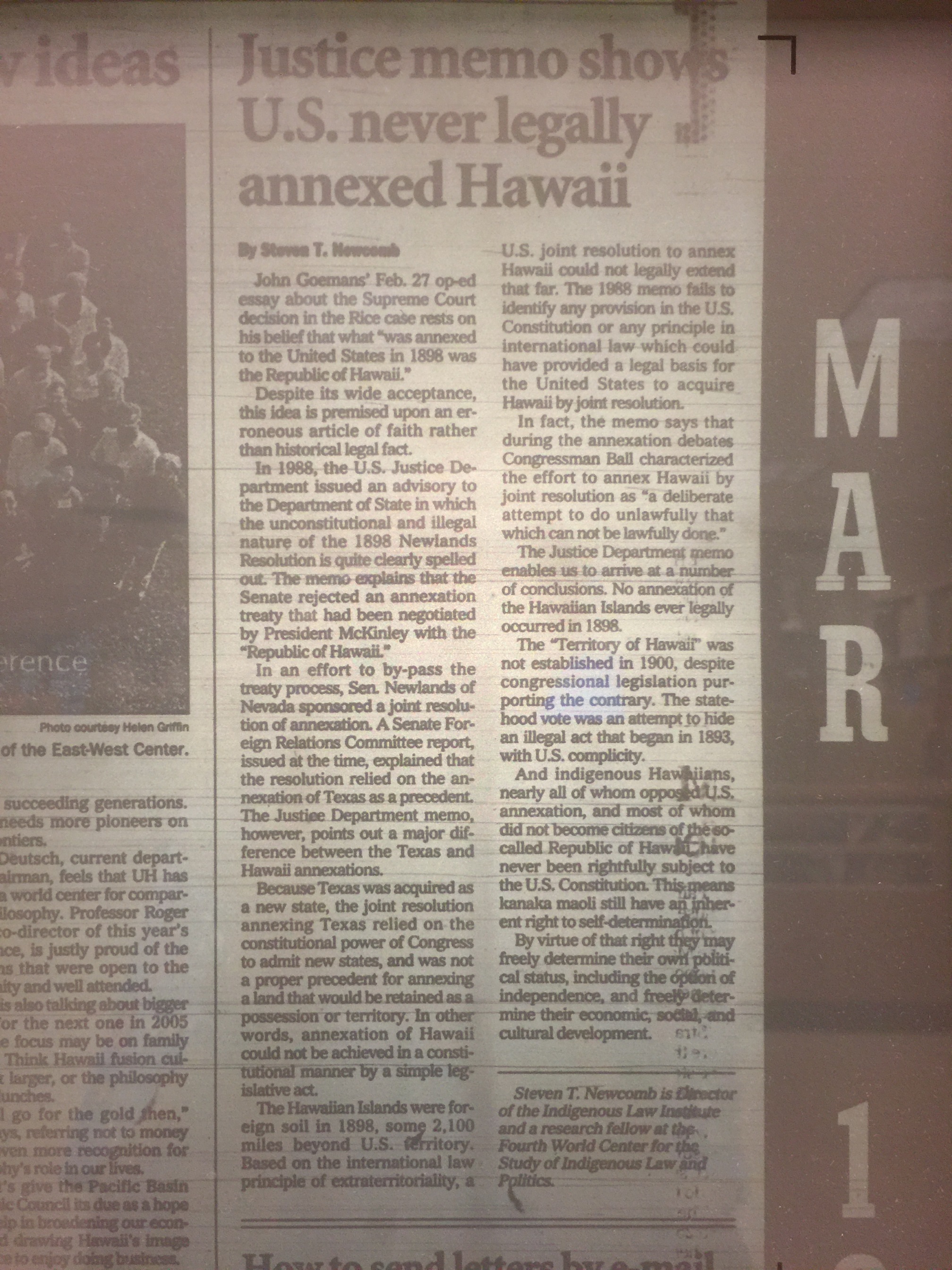
Some suggest that Hawai‘i was never annexed to the United States and, as proof, refer to the October 4, 1988 Office of Legal Counsel of the Department of Justice Opinion and a subsequent (March 12, 2000) Op-Ed by Steven Newcomb in the Advertiser to support their conclusion.

Some even go as far as adding a quote – “US never legally annexed Hawai‘i” – inferring that the Office of Legal Counsel Opinion notes same. (That was the heading on Newcomb’s Op-Ed and apparently his opinion, not the Department of Justice’s.)

In fact, the Office of Legal Counsel Opinion makes the definitive statement, “The United States also annexed Hawai‘i by joint resolution in 1898. Joint Res. 55, 30 Stat. 750 (1898). Again, the Senate had already rejected an annexation treaty, this one negotiated by President McKinley with Hawaii.”

“And again, Congress then considered a measure to annex the land by joint resolution. Indeed, Congress acted in explicit reliance on the procedure followed for the acquisition of Texas.”

Before we get far ahead of ourselves, we should first look at the noted Office of Legal Counsel Opinion and its purpose. While some would have you believe it was an opinion addressing Hawai‘i annexation, in fact, that Opinion was prepared to address “Legal Issues Raised by Proposed Presidential Proclamation To Extend the Territorial Sea”.

The Opinion clearly notes on its first page, under Introduction and Summary, that “This responds to the requests, made by your Office (State Department) and an inter-agency working group, for analysis of the constitutional and statutory questions raised by a proposed presidential proclamation to extend the territorial sea of the United States from its present breadth of three miles to twelve miles.”

The Opinion was not about Hawai‘i, nor its annexation – in fact, of the 26-pages of the Opinion (not counting appendices,) only 2-pages referenced the process of annexation of Hawai‘i. And Hawai‘i and its annexation to the US are not even mentioned in the Opinion’s Conclusion.

It does note, however, “(t)he constitutionality of the annexation of Hawai‘i, by a simple legislative act, was strenuously contested at the time both in Congress and by the press. The right to annex by treaty was not denied, but it was denied that this might be done by a simple legislative act.”

“Notwithstanding these constitutional objections, Congress approved the joint resolution and President McKinley signed the measure in 1898. Nevertheless, whether this action demonstrates the constitutional power of Congress to acquire territory is certainly questionable.”

“The stated justification for the joint resolution – the previous acquisition of Texas – simply ignores the reliance the 1845 Congress placed on its power to admit new states. It is therefore unclear which constitutional power Congress exercised when it acquired Hawaii by joint resolution.”

“Accordingly, it is doubtful that the acquisition of Hawai‘i can serve as an appropriate precedent for a congressional assertion of sovereignty over an extended territorial sea.” (Legal Issues Raised by Proposed Presidential Proclamation To Extend the Territorial Sea, October 4, 1988)

Annexation of Hawai‘i to the US was not a hostile takeover, it was something the Republic of Hawai‘i sought. “There was no ‘conquest’ by force in the annexation of the Hawaiian Islands nor ‘holding as conquered territory;’ they (Republic of Hawai‘i) came to the United States in the same way that Florida did, to wit, by voluntary cession”. (Territorial Supreme Court; Albany Law Journal)

“Whether the Republic is a government de facto or dejure it is entitled to American sympathy, and when it has been recognized, successively, by the United States and all other powers, first, as a government de facto and then as a rightful government, republican in form, and is in a successful career of constitutional authority, our national obligations and all our better sentiments compel us to admit its full power and authority to dispose of any question that concerns its sovereign will and the welfare of its people.”

“If it is true, as some rashly venture to assert, that the United States minister at Hawai‘i and the commander of the warship Boston, in violation of our international duty, assisted a band of revolutionists to depose the queen and to usurp the government of the islands …”

“… it is also true that President Harrison recognized that de facto and provisional government as having the rightful sovereignty in Hawaii, in so far that it could conclude a treaty of annexation with the United States, and such a treaty was duly signed and sent to the Senate.”

“Then President Cleveland, when he came into power, sent Mr Blount as his special commissioner and accredited him to President Dole as the representative of the sovereignty of Hawaii. If he, or those in the Senate who still suffer from the pangs and compunctions of conscience which he is supposed to have felt when he recognized President Dole had then renounced the actions of Minister Stevens and Captain Wiltse …”

“… and if Mr Cleveland had sent a minister to Lili‘uokalani as the rightful sovereign, they would have fully established the sincerity of their objections and would have shown ‘the courage of their convictions.’”

“But, instead of observing that logical course, they sent Mr Willis as minister to Hawai‘i and accredited him to President Dole as the chief executive of Hawai‘i.”

“Then the provisional government grew into the constitutional Republic of Hawai‘i, and we have fully recognized that as the rightful and permanent government of Hawai‘i, and have kept our minister and consul-general at Honolulu and our war ships in that bay to protect them and the Republic….” (Fifty-Fifth Congress, Second Session, Committee on Foreign Relations, March 16, 1898)

“Now, after the lapse of five years, it is urged that the Republic is a usurping government; that it is a fraud contrived for the personal advantage of its promoters, and that Lili‘uokalani is still the rightful queen of Hawai‘i….”

“No nation in the world has refused recognition of the Republic of Hawai‘i as the rightful Government, and none of them question its soverign [sic] right to deal with any question that concerns the people of Hawai‘i.” (Fifty-Fifth Congress, Second Session, Committee on Foreign Relations, March 16, 1898)

“This act also establishes the fact that a treaty with a foreign State which declares the consent of such State to be annexed to the United States, although it is rejected by the Senate of the United States, is a sufficient expression and authentication of the consent of such foreign State to authorize Congress to enact a law providing for annexation …”

“… which, when complied with, is effectual without further legislation to merge the sovereignty of such independent State into a new and different relation to the United States and toward its own people.” (Fifty-Fifth Congress, Second Session, Committee on Foreign Relations, March 16, 1898)

“Recognized by the powers of the earth, sending and receiving envoys, enforcing respect for the law, and maintaining peace within its island borders, Hawaii sends to the United States, not a commission representing a successful revolution, but the accredited plenipotentiary of a constituted and firmly established sovereign State.”

“… the Republic of Hawai‘i approaches the United States as an equal, and points for its authority to that provision of article 32 of the constitution promulgated July 24, 1894, whereby …”

“The President (of the Republic of Hawai‘i,) with the approval of the cabinet, is hereby expressly authorized and empowered to make a treaty of political or commercial union between the Republic of Hawai‘i and the United States of America, subject to the ratification of the Senate.” (The Hawaiian resolution for ratification of the annexation treaty was unanimously adopted by the Senate of the Republic of Hawai‘i on September 9, 1897.) (US Secretary of State Sherman, June 15, 1897)

And, as noted in the purported document that is inferred to suggest “US never legally annexed Hawai‘i” – inferring that the Opinion notes same – it does not; that document states, “The United States also annexed Hawai‘i by joint resolution in 1898.” (Legal Issues Raised by Proposed Presidential Proclamation To Extend the Territorial Sea, October 4, 1988)

Click Here to read the DOJ Opinion for yourself.

Click Here to read Newcomb’s Op-Ed.

Follow Peter T Young on Facebook 

Follow Peter T Young on Google+ 

Follow Peter T Young on LinkedIn  

Follow Peter T Young on Blogger

© 2016 Hoʻokuleana LLC

annexation_of_hawaii-pp-35-8-002-00001

Filed Under: Ali'i / Chiefs / Governance Tagged With: Hawaii, Annexation, Sovereignty

October 2, 2016 by Peter T Young Leave a Comment

The King’s Cape

“Centuries ago, when the rest of the world went to battle in iron clothing, the great seven-foot warriors of Hawaii donned gay war capes, fashioned of thousands of colorful feathers.”

“The principal colors used were red and yellow. The more yellow, the higher the rank of the wearer. … The first kings maintained a corps of trained ‘birdmen’ who lived in the forests and hunted these creatures.”

“They learned to imitate the call of the male and thus lure the birds close to their hiding place where they previously ‘doctored’ a flower particularly delectable to the bird they wished to catch.”

“Then they waited until the bird thrust his bill into the flower … Then the birdmen carefully removed the desired feathers and released the bird.” (Oakland Tribune, July 21, 1929)

Hawaiian featherwork consists of leis (or strings of feathers worn in the hair or around the neck,) kāhili (plumes of feathers used as royal insignia,) ahuʻula (cloaks or capes,) mahiole (helmets,) images of the god Kūkaʻilimoku (war god of Kamehameha,) or mat-like objects and other temple objects.) (Brigham)

The ‘ahuʻula (cloak or cape) was durable and comparatively small in bulk. Olonā (a fiber) was universally the basis of the Hawaiian feather capes. The Hawaiian had not looms, so a fiber net was formed as the foundation of the cape.

It was a common custom to net bands of a width from 8 to 12 inches and this was cut and joined. Regular and irregular pieces were put together to form the cape. (Brigham)

Hawaiian feather capes and cloaks were constructed by tying bundles of small feathers, usually 6-10 per bundle, to a foundation of netting. The ‘ahu‘ula of Kamehameha consists of approximately 450,000 feathers. (Bishop Museum)

To fasten feathers to this net much finer thread, often single fibers, was used and the feather was bound by 2 or 3 turns of the thread on the shaft of the feather. On the reverse, the feather did not show.

As in medieval Europe the vanquished knight was despoiled of his armor by the victor, so the chief who killed or captured his enemy took as spoils his feather cloak, helmet or lei. Generous Hawaiian chiefs often gave ‘ahuʻula as token of their friendship. (Brigham)

During the British warship Calypso’s three-and-a-half-month stay in Hawai‘i beginning on Oct. 2, 1858, its surgeon, WH Sloggett, was presented with a royal feather shoulder cape by King Kamehameha IV in gratitude for medical service he’d rendered the seriously ill King. (Soboleski)

“Sir Arthur Sloggett, surgeon-general of the British Expeditionary Forces during the World War, has presented, through a nephew who resides in the islands, the cape of Kamehameha IV, given to Sloggett’s great grandfather by the monarch.” (Oakland Tribune, July 21, 1929)

On occasion, the ship would carry King Kamehameha IV and his retinue to Hawai‘i Island. Taking advantage of the presence of the surgeon, the King requested an examination by Sloggett.

Sloggett declined to accept a fee. He felt he already was paid by the Navy so he didn’t need to be paid by the King for doing his job. (Faye)

However, as a gift Kamehameha IV delivered to the Calypso on its departure an ‘ahuʻula (red and yellow feather cape.) He hung it at his home in England. The King also gave him a small portrait of Queen Emma. (Faye, KauaiGold)

The Sloggett cape measures 15.5 inches in depth, 33 inches across at its widest width, and is made of the yellow and black feathers of the ‘o‘o (a now extinct black bird with one yellow feather indigenous to Hawai‘i), with yellow used as the background and black as ornamentation.

‘I‘iwi (a scarlet honeycreeper also indigenous to Hawai‘i) feathers also appear as ornamentation, while a network of olona fiber, intricately knotted, forms the foundation. The cape’s outside surface gleams like satin and its texture is as smooth as velvet.

Dr. Sloggett took the cape home to England, where he framed and hung it upon a wall in his house. Then in 1926, his son, Sir Arthur Sloggett, removed it from the drawing-room wall of his home in England and gave it to his nephew, Grove Farm Plantation director Henry Digby Sloggett, who returned it to Hawai‘i.

Henry Digby Sloggett passed the cape on to his son, Richard Henry Sloggett Sr, and for a time it was on loan to Honolulu’s Bishop Museum. The Sloggett cape can now be seen in the Kaua‘i Museum. (Soboleski) (Lots of information here is from Chris Faye and Kauai Museum. The image shows the Kamehameha IV ahuʻula given to Sloggett. (Faye – Kauai Museum))

Follow Peter T Young on Facebook 

Follow Peter T Young on Google+ 

Follow Peter T Young on LinkedIn  

Follow Peter T Young on Blogger

© 2016 Hoʻokuleana LLC

kamehameha-iv-cape-given-to-sloggett-christinefaye-tgi

Filed Under: Hawaiian Traditions, Ali'i / Chiefs / Governance Tagged With: Hawaii, Kamehameha IV, Alii, Ahuula, Sloggett

  • « Previous Page
  • 1
  • …
  • 122
  • 123
  • 124
  • 125
  • 126
  • …
  • 144
  • Next Page »

Images of Old Hawaiʻi

People, places, and events in Hawaiʻi’s past come alive through text and media in “Images of Old Hawaiʻi.” These posts are informal historic summaries presented for personal, non-commercial, and educational purposes.

Info@Hookuleana.com

Connect with Us

  • Email
  • Facebook
  • LinkedIn
  • Twitter
  • YouTube

Recent Posts

  • Canec
  • Flying the American Flag
  • April Fool
  • Beauty Hole
  • Junior … Intermediate … Middle
  • Ossipoff Meets Mid-19th Century
  • Waikapū

Categories

  • Economy
  • Voyage of the Thaddeus
  • Mayflower Summaries
  • American Revolution
  • General
  • Ali'i / Chiefs / Governance
  • Buildings
  • Missionaries / Churches / Religious Buildings
  • Hawaiian Traditions
  • Military
  • Place Names
  • Prominent People
  • Schools
  • Sailing, Shipping & Shipwrecks

Tags

Albatross Al Capone Ane Keohokalole Archibald Campbell Bernice Pauahi Bishop Charles Reed Bishop Downtown Honolulu Eruption Founder's Day George Patton Great Wall of Kuakini Green Sea Turtle Hawaii Hawaii Island Hermes Hilo Holoikauaua Honolulu Isaac Davis James Robinson Kamae Kamaeokalani Kameeiamoku Kamehameha Schools Lalani Village Lava Flow Lelia Byrd Liberty Ship Liliuokalani Mao Math Mauna Loa Midway Monk Seal Northwestern Hawaiian Islands Oahu Papahanaumokuakea Marine National Monument Pearl Pualani Mossman Quartette Thomas Jaggar Volcano Waikiki Wake Wisdom

Hoʻokuleana LLC

Hoʻokuleana LLC is a Planning and Consulting firm assisting property owners with Land Use Planning efforts, including Environmental Review, Entitlement Process, Permitting, Community Outreach, etc. We are uniquely positioned to assist you in a variety of needs.

Info@Hookuleana.com

Copyright © 2012-2024 Peter T Young, Hoʻokuleana LLC


Loading Comments...