Images of Old Hawaiʻi

  • Home
  • About
  • Categories
    • Ali’i / Chiefs / Governance
    • American Protestant Mission
    • Buildings
    • Collections
    • Economy
    • Missionaries / Churches / Religious Buildings
    • General
    • Hawaiian Traditions
    • Other Summaries
    • Mayflower Summaries
    • Mayflower Full Summaries
    • Military
    • Place Names
    • Prominent People
    • Schools
    • Sailing, Shipping & Shipwrecks
    • Voyage of the Thaddeus
  • Collections
  • Contact
  • Follow

December 22, 2022 by Peter T Young Leave a Comment

Early Colonial Towns

For centuries, the feudal structure of northern Europe had been based on well-demarcated villages with open-field agricultural land held in common.

The era of enclosure, in which common land was divided into private holdings and the peasantry scattered across the landscape, was beginning to revolutionize the English countryside, shattering old forms of rural life that had previously bound people closely to both the land and the social patterns that land supported.

When the early settlers first sailed for North America, they left England at just the moment when two ancient forms of geographic organization — the manorial town and the parish — were disintegrating.

The first colonists brought with them premodern templates of village organization, and infused them with 17th-century ideas about theocratic utopianism and municipal incorporation, leading to a geographic order in the form of nucleated settlements —  they were clustered around a central point, both physically compact and socio-politically bound together. (National Humanities Center)

The physical environment also reinforced their ideological bias for clustered communities: New England was poorly suited for large-scale agriculture, with few opportunities for the mass natural-resource exploitation that had motivated earlier waves of European imperialism in the New World.

In addition, the colonists were well aware of the threat of raids from native confederations and fortified themselves against the Wampanoags, Narragansetts, and Pequots.

For all these reasons, the New England town developed early on as a distinct kind of socio-spatial unit: a political, religious and social community laid out as a single cell: physically compact and institutionally bound together. (Places Journal)

In 1700 Jamestown was 93 years old, Charleston 37 years old, and Philadelphia only 19 years old. There were two Jerseys but only one Carolina, and Georgia wouldn’t be settled until 33 years later.

From 260,000 settlers in 1700, the colonial population grew eight times to 2,150,000 in 1770. (In comparison, the French colonial population grew from 15,000 to 90,000 in 1775, i.e., just 4% of the English total.) In fact, the English colonial population doubled almost every 25 years in the 1700s.  (National Humanities Center)

Early Colonial town laws governed not only proper moral behavior, but also decisions about land use, the siting of houses, and the allocation of common resources.  Many early settlements were forts surrounded by walls for protection from the natives as well as other colonial powers like France and Spain.

 Layout of Towns

The layout of towns or villages differed. Towns typically started on a river – they needed a water source, it was also used to turn the mill.  Many were on the coast where the harbor was an important place of trade and business.

Early land records used the phrase “common lands” to signify both ungranted, undeveloped land and shared land that was used for pasture or agriculture.  In addition, the term was used to describe open spaces, although public gathering areas were also called greens.

The early central town commons were used for burying grounds and grazing land, in some cases with a pen or “close” for enclosing animals brought in from pasture (also to gather cattle in the event of Indian attack.  (National Gallery of Art)

Meetinghouse

One of the first buildings built in many early colonial American towns was the meetinghouse.

The meetinghouse served both as the church and as the meeting place for the citizens to discuss issues and make plans. Everyone in the town was responsible for helping to build and maintain the meetinghouse.

Larger cities would often have a courthouse where the local judge would oversee disputes and punish crimes. After hearing the evidence and testimony, the judge would quickly make his ruling and any punishments could be carried out immediately.

Church

The church was often the center of the town. Everyone in the town was expected, sometimes by law, to attend church on Sunday. Churches in Colonial America were generally fairly simple buildings.

Houses

The houses built by the first English settlers in America were small single room homes. Many of these homes were “wattle and daub” homes. They had wooden frames which were filled in with sticks. The holes were then filled in with a sticky “daub” made from clay, mud, and grass.

The roof was usually a thatched roof made from dried local grasses. The floors were often dirt floors and the windows were covered with paper.

Inside the single room home was a fireplace used for cooking and to keep the house warm during the winter.

The early settlers didn’t have a lot of furniture. They may have had a bench to sit on, a small table, and some chests where they stored items such as clothes. The typical bed was a straw mattress on the floor.

Governor’s House

Each colony had a special house where the governor lived. This was usually the largest home in the town. The governor’s home was where town leaders often met to discuss issues and make new laws.

Gaol

The gaol was the town jail. The word “gaol” is pronounced just like “jail.” People were held in the gaol while they awaited their trials or punishment. Prisoners might include criminals, debtors, and runaway slaves.

Magazine

The magazine was a building designed to hold the town’s weapons including muskets, swords, pikes, and gunpowder. The magazine was often a stone or brick building to help make it fireproof as it stored the town’s gunpowder.

Tavern

Most larger towns had a number of taverns. Taverns were places to get a cooked meal and a drink. They were also important meeting places. Men would go to the tavern after work to discuss business and politics. A lot of plans for the American Revolution were made by patriots in taverns across the colonies.

Market Square

At the center of the town was often a large open square where people could meet and trade goods. Farmers could set up booths to sell produce and small merchants could peddle their goods. Major outdoor events took place at the market square including holiday celebrations and athletic contests.

Coffeehouse

The coffeehouse was sort of an elite form of the tavern. Only gentlemen were allowed inside the coffeehouse where they would drink mostly non-alcoholic beverages such as coffee, tea, and chocolate. It was a place where wealthy and educated men made business deals and discussed intellectual topics.

Shops

Colonial towns had plenty of shops to buy all sorts of items such as shoes, tools, food, candles, clothing, paper, and furniture. Most shops specialized in one area like the wigmaker who made custom wigs or the apothecary who made medicines. (Technological Solutions)

Plymouth Grew Beyond its Bounds

When an early Colonial town became too large to maintain its spatial and social integrity, it would undergo a split, breaking up into separate towns, each with their own full set of religious and political institutions.  (Places Journal)

When the Pilgrims arrived at Cape Cod on November 19, 1620 they did not find a suitable place to place their community until December 19.

They chose a site with a protected harbor and high grounds, suitable for defense, and christened their plantation New Plymouth.

Click the following link to a general summary about early Colonial Towns:

Click to access Colonial-Towns.pdf

© 2022 Hoʻokuleana LLC

Filed Under: American Revolution Tagged With: America250, Green, Meeting House, American Revolution, Colonial Town, Common

December 21, 2022 by Peter T Young Leave a Comment

Poʻo Kanaka

Traditional translations of poʻo kanaka suggest it means “human head;” however, in this case, it has a regional translation and is used to describe a flower, the pansy (folks thought the flower looked like a man’s head.)

It was also the name given to a man’s home.

He is said to have been the first to introduce the pansy flower in Hawaiʻi and he planted pansies around his house.  (Kimura)

Puapoʻo-kanaka (“The flower-that-looks-like-a-man”) eventually became the favorite of Waimea cowboys, who wore entire leis of pansies strung round their flopping vaquero hats.  (Korn)

The house stood within a level clearing at a spot called Puʻukapu, along the trail leading to the more upland forested area up Mauna Kea known as Manaiole, what we call Mānā, today.

The house, built in the 1830s, was made of rubble-and-mortar construction.  Rocks were formed into walls and plastered over with putty lime mortar (the lime obtained from ground coral.)  Rubble ruins remain of the house site, today.

The home was described as an Irish stone cottage.

It’s not clear what the man’s real name was – some suggest it was initially William Wallace.  An Irishman, he came to Hawaiʻi aboard a whaling ship that landed at Kawaihae (about 1834.)  He left the ship and went up the hill to Waimea, where he settled – there, he took the name Jack Purdy.  (Kimura)

Some suggest Purdy, along with fellow Waimea resident John Palmer Parker, can be considered the first cowboys in Hawaiʻi.  They started out as bullock hunters, selling their salt beef, hides and tallow.

In the early-1830s, trade in sandalwood slowed down as island forests became depleted.  At about the same time, whaling ships hunting in the north Pacific began wintering in Hawaiian waters.

Ships provisioning in Hawaiʻi ports provided a market for salt beef, in addition to hides and tallow.  With the economic push of providing provisions to the whaling fleets, ranching became a commercial enterprise that grew in the islands.

Parker took a more business-like approach and took advantage of the opportunities of the day and established the Parker Ranch in the fledgling livestock industry.  Purdy was a rowdy, living the rugged life, typical of his peers in the early American West.  (Bergin)

A real or tall tale of his exploits (written in 1857) tells how Jack Purdy, mighty bullock hunter and expert guide, together with his employer and hunting companion, Mr. Julius Brenchley, succeeded without firearms – in fact not even equipped with their usual lassos – in capturing a ferocious wild bull and in killing the beast when he failed to extricate himself from a mudhole; and then celebrated their victory with a deserved steak dinner fresh off the carcass.  (Korn)

In 1832, Purdy married into Hawaiian royal lineage when he took Keawe-maʻu-hili (daughter to Kewae-a-heulu and Kaʻakau) as his bride.  Several of his children from that and his second marriage were respected cowboys.   (Bergin)

His grandson, Ikua Purdy, made headlines and national fame, when he won the World’s Steer Roping Championship in Cheyenne, Wyoming – roping, throwing and tying the steer in 56 seconds (on a borrowed horse.)  Ikua had worked at Parker Ranch, he later moved to Maui to ʻUlupalakua Ranch (he died there in 1945.)

Jack Purdy (William Wallace Jack Harry Hale Purdy) died on June 22, 1886, at the age of 86; he is buried near his home, Poʻo Kanaka.

© 2022 Hoʻokuleana LLC

Filed Under: Ali'i / Chiefs / Governance, Hawaiian Traditions Tagged With: South Kohala, John Parker, Ulupalakua, Poo Kanaka, Jack Purdy, Hawaii, Waimea, Parker Ranch, Kohala

December 20, 2022 by Peter T Young Leave a Comment

Three Volcano Pioneers of the Mid-19th Century Hawaii

“Keep and publish careful records, invite the whole world of science to co-operate, and interest the business man.” (Jaggar)

The efficiency of an institution which is essentially educational and not commercial, productive of ideas rather than dollars, must be measured by its effect on productive men of learning in stimulating them to production; that is, to new discovery, experiment investigation and publication.

The founding of the Volcano Observatory and the formation of the group of subscribers here called the “Research Association,” were themselves evolved productions of the inspiring work of early investigators, as well as of the natural intellectual stimulus created in man by the unexplained Kilauea lake of boiling nebulous flux.

Three names stand out above all others as recorders of the work of the Fire Goddess in Hawaii in the middle decades of the nineteenth century : Titus Coan, James Dwight Dana, and William Lowthian Green.

Coan the missionary, earnest seeker after truth, for more than a third of the century watched every detail of the evolution of the volcanoes, pondered their meaning, and moreover made truthful record in scores of letters which were promptly published.

This genius for recording is rare among men, and is an all-important requirement in science; many men are good observers, but millions of valuable observations are forever lost, because of a lack of appreciation of the value of a jotting down – day, hour, minute, event, stages, appearances.

All science is no more than a categoric jotting-down, and the grouping of facts into new categories, until some of these reach the dignity of “theory.”

Coan without apparatus or endowment was an institution, a first Hawaiian volcano observatory, and in actual output he was a better observer and recorder than some institutions which have been elaborately equipped.

Professor Dana of Yale, foremost American geologist, was with the Wilkes Expedition at Kilauea in 1840, revisited Hawaii later, and wrote in 1891 a book, “Characteristics of Volcanoes,” which stands preeminent among volcano memoirs.

It was inspired by Kilauea and Mauna Loa, but is broad and sane, and presents a most painstaking and thoughtful summary of the progress of Hawaiian volcanic events, and their bearing on geology. Dana published in New Haven Coan’s letters, and it was doubtless Dana who stimulated much of Coan’s recording.

Green, the man of business, in his leisure moments student of volcanic life and of the inspiring heights and depths of the globe, conceived: to scale, with its film of waters and its blanket of gas, wrote a remarkable book in two volumes, “Vestiges of the Molten Globe.”

His second volume deals especially with the volcanoes, which he visited many times, and of it Professor Daly of Harvard writes: “It is certainly a pity that the second part of Green’s work is not more generally known. The book is almost as remarkable a contribution to the philosophy of vulcanism as Part 1, ‘On the Tetrahedral Theory of the Earth,’ is important in cosmogonic philosophy.”

Green’s work foreshadowed theoretic conceptions which modem thought has fixed more firmly, and his interest, as a business man, in the affairs of pure science was forerunner of the wider interest of many business men (and intelligent women) of Hawaii who now make up the Hawaiian Volcano Research Association.

These three men, Coan and Green resident here, Dana from an eastern university, typify the reason for the creation of an Hawaiian Volcano Observatory, and their portraits should forever hang in honored place upon its walls.

Coan, the systematic observer, showed the value of record and system; Green, the merchant, fascinated by the spell of Pele and inspired by the problems of position of this mid-Pacific pinnacle, Hawaii, rising 37,000 feet above the ocean deep, adopted volcanology for avocation, and left monumental work to inspire specialist and layman alike.

While Dana the scholar, coming from a distant seat of learning, hospitably entertained in the islands by Coan, Green, Bishop, Brigham, Alexander and a host of kind friends, rewarded their kindness by making famous to the whole world the achievements of his Hawaiian scientific colleagues.

Dana added new volcano lore and illustrated what production may come from scientific hospitality. (All here is copied from Special Bulleting of Hawaiian Volcano Observatory, 1913, as stated by Thomas Jaggar.)

© 2022 Ho‘okuleana LLC

Filed Under: General, Missionaries / Churches / Religious Buildings, Place Names, Prominent People Tagged With: Hawaii, Volcano, Titus Coan, James Dana, William Green

December 19, 2022 by Peter T Young Leave a Comment

Amusements

The following is a portion of a letter from William Richards to Charles Wilkes, commander of the United States Exploring Expedition, dated March 15, 1841 in Lahaina.  The letter responds to questions raised by Wilkes.  It comes from editors Marshall Sahlins and Dorothy Barrere.

Richards arrived in Honolulu in April 1823 in the second company of American missionaries and was stationed soon thereafter in Lahaina, home of many of the chiefs. He remained in Lahaina throughout most of his missionary career.

His knowledge of Hawaiian is known to have been excellent—he is responsible for many translations of biblical and other works into Hawaiian—and as the letter to Wilkes documents, he was friend to the famous Hoapili and other chiefs.

In 1838, Richards left the mission to become political counselor to the Monarchy. In 1842 with T. Ha‘alilio he undertook a mission to America and Europe to negotiate recognition of Hawaii’s independence. Richards was commissioned Minister of Public Instruction in 1846. He died in Honolulu in November 1847. All of the following is from that letter:

Their amusements were pretty numerous, and many of them of an athletic kind, though not requiring the severest trials of strength.

A favorite amusement of the chiefs was sliding down hill on a long narrow slead, upon which they prostratrated themselves, and then having the slead ballanced on the edge of a very steep hill they started it with the foot and were precipitated down the hill with immense velocity often to a distance of half or even a whole mile.

Thus they went from the top of Diamond Hill far out upon the plane of Honolulu, and at other places to a much greater distance.

Rolling a smooth round stone was another favorite amusement and one which tended to strengthen the arms more than any other with which I have been acquainted.

On ground where the descent was scarcely perceptable I have seen the stone rolled a hundred and thirty rods.

Throwing the spear and various other exercises with it was also an amusement as well as a military exercise. With this weapon they were very expert.

Playing on the surf board has always been and continues to be a very favorite amusement. As you have doubtless seen this, I need not describe the process.

The dance was an amusement which was practiced perhaps to a greater extent than any other. There was a great variety of dances. Some of them consisted mainly in the recital of songs accompanied with much action as was calculated to give them force. Other seemed to consist mainly in action.

Sometimes a single girl was the actress, again, a large number united. Their motions were anything but graceful. Their motions were regulated by music, which consisted of a kind of drumming on various hollow vessels, as calabashes, tubs, and a kind of drum made by drawing a piece of shark skin over a short piece of a hollow log. . . .

Every variety of song was rehearsed and acted on these occasions, from the most sentimental to the most lascivious, and the action always echoed to the sense.

Sometimes a single voice rehearsed the song—sometimes a number chanted in unison.

The first summer I spent in Lahaina scarcely a night passed in which I did not hear the noise of these assemblies, and they were uniformly scenes of lewdness and vice.

But the most numerous class of all their amusements was their games of chance.

Of these they were specially fond. These games were peculiar to themselves. The one most practiced by the chiefs was that of placing several bunches of kapas in a row, and then one man took a stone and hid it under one of the tapas. His antagonist guessed the place of the stone, and the one who was oftenest right won the game.

They never played at games of chance without a wager, nor indeed at any game of skill. The wager seemed to constitute the charm of most of their amusements. It was an accompanyment of their down hill slides – their play in the surf – their plays with the spear their rolling the stone – their flying the kite &c. . . .

They gambled away their property of every kind – their clothes – their food – the crops upon their land – the lands themselves – their wives – their husbands – their daughters, and even the very bones of their arms and legs.

At present cards is a common amusement and it is accompanied with its usual evils.

© 2022 Ho‘okuleana LLC

Filed Under: Hawaiian Traditions, Prominent People, Ali'i / Chiefs / Governance, Missionaries / Churches / Religious Buildings Tagged With: Hula, Surfing, Maika, Ulu Maika, William Richards, Charles Wilkes, Mele, Gambling, Amusements

December 18, 2022 by Peter T Young Leave a Comment

Hiwauli (Sarai) and ‘Ī‘ī

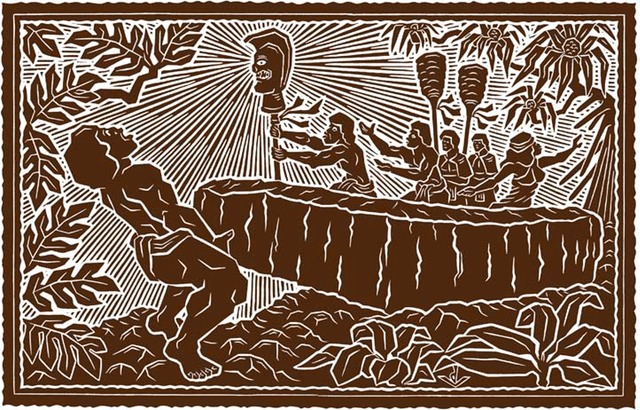
“Formerly, capital punishments were usually inflicted secretly in the night. The kings and some of the chiefs had a particular class of servants, called ‘ilamuku’, or executioners, to whom the business of punishing capitally was usually entrusted.”

“This class of men was much feared by the people, for there were no public trials, nor public sentence pronounced, and there fore whenever the executioner was seen abroad, there was general consternation, especially among those who were conscious of having committed offences, or incurred the displeasure of the king.”

“They usually went in the night and attacked their victims with clubs or stones, without giving him any warning. If the executioner were discovered by the friends of the criminal they neither dared to give him warning, nor resist the executioner, lest they should incur the displeasure of the king.”

“After the introduction of edged tools, and especially axes into the country, beheading secretly in the night became a rather common form of execution. The last instance of this took place in the year 1822”. (Richards to Wilkes)

In early 1822, Liholiho (Kamehameha II) had five official wives but took other women to his bed. When the court stopped in Hilo, Liholiho met Sarai Hiwauli, who became his “ano wahine” [a kind of formal partner].

She also slept with Ha‘alo‘u, a member of Liholiho’s entourage, and when the court returned to O‘ahu, Ha‘alo‘u brought her with him.

At some point, Liholiho discovered that Ha‘alo‘u had also slept with one or more of his ali‘i wahine. (Marin claims that it was Pauahi.)

While at Pu‘uloa, Liholiho ordered Koli‘i and Kahalai‘a to kill Ha‘alo‘u. On October 16, 1822, they killed him while he was sleeping next to Sarai. (Marie Alohalani Brown)

“It was in the reign of Kamehameha II and was for the same crime as the above. The king sent an ilamuku in the night, who found the criminal fast a sleep, his wife lying by his side.”

“The executioner gently pulled the woman’s head one side, and then with a broad axe instantly severed the head of her husband from his body.”  (Richards to Wilkes)

This victim was Ha‘alo‘u (whose wife was Sarai Hiwauli).

Sarai Hiwauli was born in Kahalu‘u, Ko‘olaupoko (O‘ahu); she was taken to Hilo, Hawai‘i to be raised, along with her parents and her kupuna.

Because the chiefs of the time knew the kupuna of her father, she was not seen as some stranger, and so she lived amongst them; but those who did not know, they questioned here her living with and dining with the ali‘i.

She was enrolled into the school of John Honoli‘i by Chiefess Kamāmalu to learn the alphabet, because she enrolled all her people with Honoli‘i to learn the alphabet.

After Ha‘alo‘u’s death, Sarai lived without a husband for maybe a month, then John Papa ‘Ī‘ī took her as a wife. The two of them were not separated from the time they were married. (Hae Hawaii, 10/1/1856, p. 156)

John Papa ʻĪʻī began his service in the royal court when he served as an attendant to Liholiho, Kamehameha II. ʻĪʻī later became a trusted advisor and chief in the court of Kauikeaouli, Kamehameha III.

When Kamehameha III formed the Chiefs’ Children’s School in 1839 under the direction of Amos and Juliette Cooke, John Papa ‘Ī‘ī joined the school on May 14, 1840 and served as kahu, or vice-principal, while his wife Sarai helped care for the students.

“John Ii and his estimable wife, Sarai, are attached to the institution, and exercise an important and useful guardianship over these royal and noble pupils. The parents of the pupils are highly satisfied with the management and success of the school.” (Bingham)

Sarai [or Sarah] died at Nawiliwili, Kauai, August 29, 1856; she was travelling with the Ali‘i who were circuiting the land, and she got paralysis (possibly a stroke/ heart attack) and died. (Hoku Loa o Hawaii, 9/11/1856) She is buried in Kawaiahaʻo Cemetery. They had no children.

Sarai Hiwauli was a loving, benevolent, and respectable woman. She was highly regarded by all for her righteousness and her piety.

She will be mourned from Hawaii to Niihau by her fellow church members and mostly her people. “Blessed are the dead who die in the Lord.” (Hoku Loa o Hawaii, 9/11/1856)

‘Ī‘ī then married Maleka Kaapa of Hilo on August 1st, 1861. She died “of consumption” (the common name for tuberculosis in that era) September 12, 1861, aged 19 years.

‘Ī‘ī’s third wife was Maraea Kamaunauikea Kapuahi; they married on January 1, 1862. Honolulu. By her he had Irene Kahalelaukoa, who married C. Brown and then Carl Holloway.

He was raised under the kapu system and his life ended with him in service of the Christian ministry.

Upon the arrival of the missionaries in Hawai‘i in 1820, John ʻĪʻī was among the first Hawaiians to study reading and writing with the missionaries, studying under the Reverend Hiram Bingham.

As time passed, John ʻĪʻī divided his time between the ruling Kamehamehas and the missionaries, particularly Reverend Bingham. John soon became an assistant to Bingham and a teacher at the latter’s school.

Mary A. Richards in her “Chiefs’ Children’s School” says, “Through the perspective of a century, John ʻĪʻī stands as one of the most remarkable Hawaiians of his time.”

The Reverend Richard Armstrong had this to say about him, “John ʻĪʻī, a man of high intelligence, sterling integrity and great moral worth.”

ʻĪʻī received training at Lahainaluna Seminary, where the Rev. Sheldon Dibble and others encouraged Native Hawaiians to record their history.

With rare insight into the workings of the monarchy as well as the common people, ʻĪʻī did just that, contributing regularly to the Hawaiian language publication Ka Nupepa Ku‘oko‘a from 1866

He lived in an old-fashioned cottage about where the Judiciary building now stands in downtown Honolulu.  His home was named “Mililani,” which means exalted or lifted heavenward.  At nearly seventy years of age, after a life devoted to the furtherance and development of Christianity in Hawai‘i and the development of a democratic form of government, he died there on May 2, 1870.

© 2022 Ho‘okuleana LLC

Filed Under: Ali'i / Chiefs / Governance, Missionaries / Churches / Religious Buildings, Prominent People Tagged With: Chief's Children's School, John Papa Ii, Sarai Hiwauli, Sarai

  • « Previous Page
  • 1
  • …
  • 204
  • 205
  • 206
  • 207
  • 208
  • …
  • 658
  • Next Page »

Images of Old Hawaiʻi

People, places, and events in Hawaiʻi’s past come alive through text and media in “Images of Old Hawaiʻi.” These posts are informal historic summaries presented for personal, non-commercial, and educational purposes.

Info@Hookuleana.com

Connect with Us

  • Email
  • Facebook
  • LinkedIn
  • Twitter
  • YouTube

Recent Posts

  • Martin Luther King at the Hawai‘i Legislature
  • Gilberts and Marshalls
  • It Wasn’t ‘Bloodless’
  • Universal Remedy
  • Aiʻenui
  • Victoria Kamāmalu
  • Ginaca

Categories

  • Military
  • Place Names
  • Prominent People
  • Schools
  • Sailing, Shipping & Shipwrecks
  • Economy
  • Voyage of the Thaddeus
  • Mayflower Summaries
  • American Revolution
  • General
  • Ali'i / Chiefs / Governance
  • Buildings
  • Missionaries / Churches / Religious Buildings
  • Hawaiian Traditions

Tags

Albatross Al Capone Ane Keohokalole Archibald Campbell Bernice Pauahi Bishop Charles Reed Bishop Downtown Honolulu Eruption Founder's Day George Patton Great Wall of Kuakini Green Sea Turtle Hawaii Hawaii Island Hermes Hilo Holoikauaua Honolulu Isaac Davis James Robinson Kamae Kamaeokalani Kameeiamoku Kamehameha Schools Lalani Village Lava Flow Lelia Byrd Liberty Ship Liliuokalani Mao Math Mauna Loa Midway Monk Seal Northwestern Hawaiian Islands Oahu Papahanaumokuakea Marine National Monument Pearl Pualani Mossman Quartette Thomas Jaggar Volcano Waikiki Wake Wisdom

Hoʻokuleana LLC

Hoʻokuleana LLC is a Planning and Consulting firm assisting property owners with Land Use Planning efforts, including Environmental Review, Entitlement Process, Permitting, Community Outreach, etc. We are uniquely positioned to assist you in a variety of needs.

Info@Hookuleana.com

Copyright © 2012-2024 Peter T Young, Hoʻokuleana LLC


Loading Comments...