Images of Old Hawaiʻi

  • Home
  • About
  • Categories
    • Ali’i / Chiefs / Governance
    • American Protestant Mission
    • Buildings
    • Collections
    • Economy
    • Missionaries / Churches / Religious Buildings
    • General
    • Hawaiian Traditions
    • Other Summaries
    • Mayflower Summaries
    • Mayflower Full Summaries
    • Military
    • Place Names
    • Prominent People
    • Schools
    • Sailing, Shipping & Shipwrecks
    • Voyage of the Thaddeus
  • Collections
  • Contact
  • Follow

December 9, 2023 by Peter T Young Leave a Comment

‘Sorrow Without Hope’

Amongst the islands of the Hawaiian group is one named Lānaʻi. Beautiful, fertile and productive, its people are orderly and self-governing, but subject to the crown of Hawaiʻi, and loyal subjects of the Kamehameha. Among the natives of this island linger many traditions of the past, both curious and poetical. (Halcombe, 1867)

There’s a small island between Hulopo’e and Mānele off the southern coast.  There is a tradition of how this place, and particularly the little island, came to be called Pu‘upehe, that was first recorded in 1867 by Walter M. Gibson, then owner of large portions of Lānaʻi, who reportedly learned the account from the chief, Pi‘ianai‘a, who was on Lānaʻi with Kamehameha I.

Gibson published the account under the title of “The Tomb of Puʻupehe, A Legend of Lānaʻi,” in the island newspaper, the Hawaiian Gazette of March 3, 1867.

Observed from the overhanging bluff that overlooks Puʻupehe, upon the summit of this block or elevated islet, would be noticed a small platform formed by a low stone wall. This is said to be the last resting-place of a Hawaiian girl whose body was buried there by her lover Makakēhau, a warrior of Lānaʻi.

Puʻupehe was the daughter of Uaua, a petty chief, one of the dependents of the king of Maui, and she was won by young Makakēhau as the joint prize of love and war. These two are described in the Kanikau, or Lamentation, of Puʻupehe, as mutually captive, the one to the other.

The maiden was a sweet flower of Hawaiian beauty. Her glossy brown, spotless body “shone like the clear sun rising out of Haleakala.” Her flowing, curly hair, bound by a wreath of lehua blossoms, streamed forth as she ran “like the surf crests scudding before the wind.” And the starry eyes of the beautiful daughter of Uaua blinded the young warrior, so that he was called Makakēhau, or Misty Eyes.

He feared that the beauty of his dear captive would cause her to be coveted by the chiefs of the land. His soul yearned to keep her all to himself. He said: “Let us go to the clear waters of Kalulu. There we will fish together for the kala and the aku, and there I will spear the turtle. I will hide you, my beloved, forever in the cave of Malauea.”

“Or, we will dwell together in the great ravine of Palawai, where we will eat the young of the uwau birds, and we will bake them in ki leaf with the sweet pala fern root. The ohelo berries of the mountains will refresh my love. We will drink of the cool waters of Maunalei. I will thatch a hut in the thicket of Kaohai for our resting-place, and we shall love on till the stars die.”

Makakēhau left his love one day in the cave of Malauea while he went to the mountain spring to fill the water-gourds with sweet water. This cavern yawns at the base of the overhanging bluff that overtops the rock of Puʻupehe. The sea surges far within, but there is an inner space which the expert swimmer can reach, and where Puʻupehe had often rested and baked the honu or sea turtle, for her absent lover.

This was the season for the kona, the terrific storm that comes up from the equator and hurls the ocean in increased volume upon the southern shores of the Hawaiian Islands. Makakēhau beheld from the rock springs of Pulou the vanguard of a great kona,—scuds of rain and thick mist, rushing with a howling wind, across the valley of Palawai.

He knew the storm would fill the cave with the sea and kill his love. He flung aside his calabashes of water and ran down the steep, then across the great valley and beyond its rim he rushed, through the bufferings of the storm, with an agonized heart, down the hill slope to the shore.

The sea was up indeed. The yeasty foam of mad surging waves whitened the shore. The thundering buffet of the charging billows chorused with the howl of the tempest. Ah! where should Misty Eyes find his love in this blinding storm? A rushing mountain of sea filled the mouth of Malauea, and the pent-up air hurled back the invading torrent with bubbling roar, blowing forth great streams of spray.

This was a war of matter, a battle of the elements to thrill with pleasure the hearts of strong men. But with one’s love in the seething gulf of the whirlpool, what would be to him the sublime cataract? What, to see amid the boiling foam the upturned face, and the dear, tender body of one’s own and only poor dear love, all mangled? You might agonize on the brink; but Makakēhau sprang into the dreadful pool and snatched his murdered bride from the jaws of an ocean grave.

The next day, fishermen heard the lamentation of Makakēhau, and the women of the valley came down and wailed over Puʻupehe. They wrapped her in bright new kapa. They placed upon her garlands of the fragrant na-u (gardenia). They prepared her for burial, and were about to place her in the burial ground of Manele, but Makakēhau  prayed that he might be left alone one night more with his lost love. And he was left as he desired.

The next day no corpse nor weeping lover were to be found, till after some search Makakēhau  was seen at work piling up stones on the top of the lone sea tower.

The wondering people of Lānaʻi looked on from the neighboring bluff, and some sailed around the base of the columnar rock in their canoes, still wondering, because they could see no way for him to ascend, for every face of the rock is perpendicular or overhanging. The old belief was, that some akua, kanekoa, or keawe-mauhili (deities), came at the cry of Makakēhau and helped him with the dead girl to the top.

When Makakēhau had finished his labors of placing his lost love in her grave and placed the last stone upon it, he stretched out his arms and wailed for Puʻupehe, thus:

“Where are you O Puʻupehe?
Are you in the cave of Malauea?
Shall I bring you sweet water,
The water of the mountain?
Shall I bring the uwau,
The pala, and the ohelo?
Are you baking the honu
And the red sweet hala?
Shall I pound the kalo of Maui?
Shall we dip in the gourd together?
The bird and the fish are bitter,
And the mountain water is sour.
I shall drink it no more;
I shall drink with ʻAipuhi,
The great shark of Manele.”

Ceasing his sad wail, Makakēhau leaped from the rock into the boiling surge at its base, where his body was crushed in the breakers. The people who beheld the sad scene secured the mangled corpse and buried it with respect in the kupapau of Mānele. (This piece is from the story printed in the Hawaiian Gazette in 1867; Halcombe noted – The Tomb of Puʻupehe – Sorrow Without Hope.)

© 2023 Hoʻokuleana LLC

Filed Under: Place Names Tagged With: Hawaii, Lanai, Walter Murray Gibson, Manele, Puupehe, Hulopoe

December 8, 2023 by Peter T Young Leave a Comment

Building Breakwaters

In 1899, Herbert, William, Jack and Edgar Young were at Catalina Island; the year before they started taking fishing parties out daily and conducting excursions to the coral gardens.

Then the Hawaiian Islands attracted their attention, and, as William put it, they “went with high hopes and the spirit of a pioneer toward strange lands and all the beauty of sky and sea in the blue Pacific.” (Herb and William were headed to Hawai‘i.)  “On January 9, 1900, we sailed out of Golden Gate toward the Great adventure …”

“For years we had heard tales of Hawaii; now at last we were to see it for ourselves. Every passing hour, every wave curling under our bows brought us so much nearer, and the eyes of youth, straining ahead of the ship, seemed almost to glimpse a palm-fringed shore where life was gay and living carefree.”

“At last, on January 19, after a fine voyage, we sighted Honolulu. The green shores. the white beach and coral formations, the boats of the Kanakas, the town rising at the harbor edge to be lost in the verdure of the tropical plants …”

“… the great forest of masts and spars in the harbor, the clear water and brilliant coloring of everything within eyeshot made a picture that the years could not dim. Here at last was the land of my dreams, the real El Dorado, the place which one may leave, but to which he will always return, the enchanting isles where there is no good-bye, but only Aloha.”

“We dropped anchor at quarantine and stood on deck, silently, in wonder at the natural beauty of the island. Would our dreams come true here?”

Most associate Young Brothers as an inter-island barge company.  But, in their early years in the Islands, Young Brothers did a lot of things.  Young Brothers was given a contract to help with the original dredging of Pearl Harbor. They engaged to tow mud scows out to sea and dump them.

They also got involved in the construction of a couple substantial breakwaters that continue to protect some significant bays.

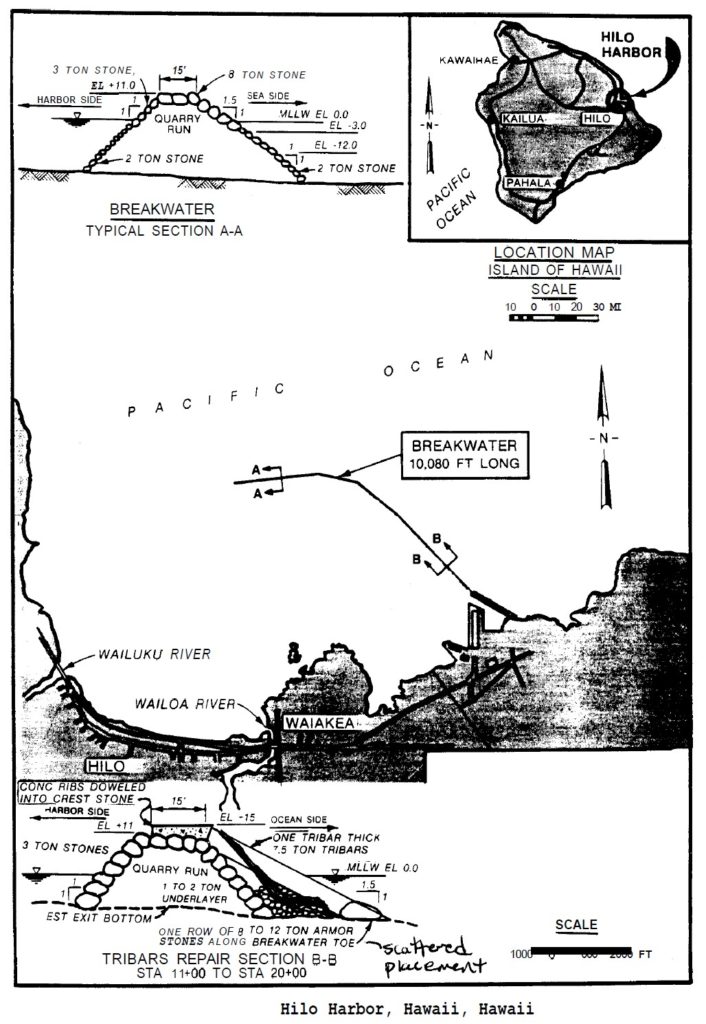
In the late 19th century, the growing sugar industry in East Hawai’i demanded a better and more protected port, and a breakwater was constructed on Blonde Reef in Hilo Bay to shield ships from rough waters as they entered Hilo Harbor.

 In 1911, Young Brothers contracted with the Lord Young Construction Co. to tow barges to build the breakwater at Hilo harbor on the Big Island.

They bought the tug Mikiala and went to work towing barges of huge rocks from the Hamakua coast and dumping them to build the long breakwater which protects the harbor today. Building it took many long months.

Jack Young was in charge of the work at Hilo and spent the better part of a year skippering the Brothers (the name of their tug) as it towed a scow loaded with rock to be dumped on the breakwater extension.

Dangerous conditions that developed during the Hilo breakwater construction were somewhat inevitable, given the unpredictable ocean swells and enormous load carried by the rock scow.

A news article appearing in the Pacific Commercial Advertiser on December 25, 1911, provides some insights into the job of building the breakwater as the Young Brothers’ crew experienced it:

“The sea had been rough for several days, and finally made it impossible to work. On Monday, the … scow was taken out in tow of the Hukihuki, having on board about 125 tons of rock, which it was to dump on the bottom ….”

“Here the substructure, which has been laid by Lord & Young, forms a kind of artificial reef over which the waves break in stormy weather. On the day in question, the breakers were thundering in at a great rate, and great combers were continually sweeping the deck of the scow.”

“Nevertheless, the Hukihuki bucked through the swirling water, and she had just brought the scow over the substructure, though not in the exact place where the load was to be dumped, when trouble began.”

“The heavy scow was let down, in the trough between two big waves, to such a depth that one of her edges struck the rock of the substructure with such a force that the timbers were splintered and broken, and the water began to pour in through the leak.”

“All thought of depositing the load had to be abandoned, and the Hukihuki maneuvered the disabled craft out of the breakers. The scow was sinking so rapidly that it was impossible to save the load, and good Kapoho rock was jettisoned.”

“By good seamanship the scow was towed to safety, where she is being repaired.”

Contrary to urban legend, the Hilo breakwater was built to dissipate general wave energy and reduce wave action in the protected bay, providing calm water within the bay and protection for mooring and operating in the bay; it was not built as a tsunami protection barrier for Hilo.

It was while they were engaged in building the Hilo breakwater that Captain Jack Young met and fell in love with Alloe Louise Marr. She had come to Hilo from Oakland, California, in 1909 with her father, Joseph Thomas Marr, to visit his cousin, Jack Guard.

John Alexander (Jack) Young and Alloe Louise Marr were married in a double wedding ceremony with her cousin, Stephanie Guard and John Fraser on September 20, 1911 at Hilo.  They returned to Honolulu to live.  The couples remained friends and co-workers in shipping.

In 1922, Young Bros. Ltd. contracted the towing to build the breakwater at Nawiliwili harbor hauling by barge the 6-ton rocks from the quarry on the coast of Maui to build the base of the breakwater.

The waterfront community was shocked when Captain Jack Young died of a heart attack at his home on October 23, 1946.  Alloe Louise Young was afflicted with a brain tumor in 1945 and died October 9, 1947 at her home on McKinley Street.

I am the youngest brother of the youngest brother of the youngest brother of Young Brothers.  Jack and Alloe Young are my grandparents.

We never met them, and they never knew they had grandchildren from their son Kenny; they both had died before they knew my mother was pregnant with my older brother. (Lots of information here is from Young Brothers: 100 Years of Service and a Young family background and genealogy.)

© 2023 Ho‘okuleana LLC

Filed Under: General, Place Names, Sailing, Shipping & Shipwrecks, Economy Tagged With: Breakwater, Nawiliwili Bay, Hawaii, Hilo, Young Brothers, Nawiliwili, Hilo Bay, Hilo Breakwater

December 7, 2023 by Peter T Young 4 Comments

Postcards, Sails, Sheets, Lights, Ads, Fires and Radio Signals

The attack on the US military installation at Pearl Harbor and other parts of Oʻahu by Japan’s Imperial military was one of the most successful surprise attacks in military history.

But an often-overlooked component of the successful attack is that the Japanese Empire had contracted with Bernard Otto Julius Kuehn, a German Nazi, to spy on the American military operations at Pearl Harbor from 1935 (an early ‘sleeper agent’ in espionage.)

The family had been contracted as agents of the Japanese government with the assistance of the Nazi Propaganda Minister Joseph Goebbels. The arrangement was promoted and negotiated by Goebbels as a byproduct of his relationship with Kuehn’s attractive 17-year old daughter, Susie Ruth.  (Washington Times)

The execution of the plan was reminiscent of “one, if by land, and two, if by sea,” the phrase coined by American poet, Henry Wadsworth Longfellow in his poem, Paul Revere’s Ride.

It references the secret signal during Revere’s ride from Boston to Concord on the verge of American Revolutionary War alerting patriots about the route the British troops would take to Concord (two lanterns were shown, the British rowed over to Cambridge.)

The Kuehns arrived in Hawaiʻi in 1935; they started their spying then.  They blended in, and waited.

No one seriously suspected that Caucasians would carry on espionage for the Empire of Japan, so Kuehn, his wife Friedel, their daughter and son, Hans Joachim, were virtually inconspicuous as a white family on the windward side.

Kuehn had houses in Hawaiʻi, lots of money, but no real job. Investigations by the Bureau and the Army, though, never turned up definite proof of spying.  (FBI)

However, every member of the family contributed towards collecting and documenting military activities at Pearl Harbor from 1935 right up to the day the bombs fell from Japanese aircraft.

Paid for his services, in three years he banked more than $70,000; one payment was $14,000 in $100 bills. They had houses in Lanikai and Kailua; these later served as the means of their intricate, yet simple, signaling system.  (Pearl Harbor Board)

The Kuehn family took various means to gather information.

Kuehn would scout the ships at Pearl Harbor.  Daughter Susie Ruth set up a beauty parlor and used it to gather gossip and random information from wives and girlfriends of the military men stationed at Pearl Harbor.  Mother Friedel kept track of all the notes.

Ten-year-old Hans was dressed in a sailor suit and with his father would walk down near the docks.  Many of the sailors thought the little guy was quite cute and some gave him unofficial “tours” of their ships.

Coached by his father, he would ask specific questions and observe everything he saw. Later he would be systematically debriefed by his parents.

The Kuehn family was not working alone; they worked with other Japanese spies attached to the Japanese consulate.

If the Consulate wanted to contact Kuehn, they would send a postcard signed “Jimmie” to his Post Office Box 1476 in Honolulu.  (Pearl Harbor Board)

On December 2, days before the attack, he provided specific – and highly accurate – details on the fleet in writing. That same day, he gave the consulate the set of signals that could be picked up by nearby Japanese submarines.  (FBI)

The set of signals contained eight combinations, each signal represented a number and each number represented the status of the naval fleet at Pearl Harbor.

No. 1 – battle fleet prepared to leave
No. 2 – scouting force prepared to leave
No. 3 – battle fleet left 1 to 3 days ago
No. 4 – scouting fleet left 1 to 3 days ago
No. 5 – air craft carriers left 1 to 3 days ago
No. 6 – battle fleet left 4 to 6 days ago
No. 7 – scout force left 4 to 6 days ago
No. 8 – aircraft carriers left 4 to 6 days ago

Signals were given that represented these respective code numbers.  Part of how they did this was to shine lights out windows and hang sheets on the laundry line.  These were done from their homes in Lanikai and Kailua (using lights in a dormer window.)

One light shining from the window between 7 and 8 pm meant No. 1; one light from 8 to 9 pm meant No. 2 and so forth for Nos. 3 and 4.  Two lights shining from the window from 7 to 8 meant No. 5, etc.  Hanging sheets on the laundry line carried the similar code.

An alternative display of the code used different patterns in the sail of Kuehn’s boat off Lanikai; a sail with/without a star and numbers at different hours represented corresponding references back to the code.

They also arranged the signal through KGMB Want Ads – different advertised items represented different numbers (ie Chinese rug, chicken farm, beauty parlor operator wanted, etc.)

Two other signaling means included garbage fires on a friend’s property on the side of Haleakala on Maui between certain times, representing different code numbers.  Signals were also sent via shortwave radio.  (Pearl Harbor Board)

Following the fateful attack of December 7, 1941, Honolulu Special Agent in Charge Robert Shivers immediately began coordinating homeland security in Hawaiʻi and tasked local police with guarding the Japanese consulate. They found its officials trying to burn reams of paper. These documents – once decoded – included a set of signals for US fleet movements.  (FBI)

All fingers pointed at Kuehn. He had the dormer window, the sailboat and big bank accounts. Kuehn was arrested the next day and confessed, though he denied ever sending coded signals. (FBI)

On February 21, 1942, just 76 days after the tragic attack on Pearl Harbor, a military court in Honolulu found Bernard Otto Julius Kuehn guilty of spying and sentenced to be shot “by musketry” in Honolulu.  His sentence was later commuted to 50 years of hard labor.

He served time in Leavenworth Penitentiary from December 1, 1942 to June 6, 1946 (when his sentence was commuted in order to deport him.)  On December 3, 1948, he was deported to Buenos Aires, Argentina.  (FBI)

Kuehn was one of 91-people convicted of spying against the United States from 1938 to 1945.  (FBI)

© 2023 Hoʻokuleana LLC

20040901-08 PRG SPY HOUSE There are two houses at 557 Kainalu in Kailua that are built very close to each other. This is the two story A fame house that is on the right side of the property. During the late 1930's it served as a den for a German spy who provided intelligence for the Japanese military leading up to the bombing of Pearl Harbor. The present owner, John Piper (225-3555) bought the houses in 1999. PHOTO BY DENNIS ODA. SEPT. 1, 2004. Nikon D2H Focal Length: 13mm White Balance: Direct sunlight Color Mode: Mode I (sRGB) 2004/09/01 12:35:19.1 Exposure Mode: Shutter Priority AF Mode: AF-C Hue Adjustment: 0¡ JPEG (8-bit) Fine Metering Mode: Multi-Pattern Tone Comp.: Auto Sharpening: Auto Image Size: Large (2464 x 1632) 1/250 sec - f/15 Flash Sync Mode: Not Attached Noise Reduction: OFF Exposure Comp.: 0 EV Lens: 12-24mm f/4 G Sensitivity: ISO 200 Image Comment: [#End of Shooting Data Section]
20040901-08 PRG SPY HOUSE There are two houses at 557 Kainalu in Kailua that are built very close to each other. This is the two story A fame house that is on the right side of the property. During the late 1930’s it served as a den for a German spy who provided intelligence for the Japanese military leading up to the bombing of Pearl Harbor. The present owner, John Piper (225-3555) bought the houses in 1999. PHOTO BY DENNIS ODA. SEPT. 1, 2004. Nikon D2H Focal Length: 13mm White Balance: Direct sunlight Color Mode: Mode I (sRGB) 2004/09/01 12:35:19.1 Exposure Mode: Shutter Priority AF Mode: AF-C Hue Adjustment: 0¡ JPEG (8-bit) Fine Metering Mode: Multi-Pattern Tone Comp.: Auto Sharpening: Auto Image Size: Large (2464 x 1632) 1/250 sec – f/15 Flash Sync Mode: Not Attached Noise Reduction: OFF Exposure Comp.: 0 EV Lens: 12-24mm f/4 G Sensitivity: ISO 200 Image Comment: [#End of Shooting Data Section]
Bernard_Julius_Otto_Kuehns_mug_shot_superimposed_over_USS_SHAW_exploding_-_1941
Bernard_Kuehn_mugshot_1941
Bernard_Kuehn-Friedel_Kuehn-(Gettysburg_Times)

Filed Under: Military Tagged With: Kailua, Lanikai, Hawaii, Oahu, Pearl Harbor, WWII, Bernard Otto Julius Kuehn

December 6, 2023 by Peter T Young Leave a Comment

Invisible Ink

George Washington received a letter from John Jay, written November 19, 1778, “This will be delivered by my Brother, who will communicate & explain to your Excellency a mode of Correspondence, which may be of use, provided proper agents can be obtained.”

“I have experienced its Efficacy by a three Years Trial. We shall remain absolutely silent on the Subject. I have the Honor to be with the highest Esteem & Respect Your Excellencys most obedient Servant.  John Jay”

John Jay was a Founder, delegate from New York to the First and Second Continental Congress (and served as President of the assembly from December 10, 1778 to September 28, 1779), served as the second Secretary of Foreign Affairs until the office was changed to ‘Secretary of State,’ wrote several of the Federalist Papers, signer of the Treaty of Paris, Second Governor of New York and First Chief Justice of the United States.

James Jay, the brother of John Jay (referred to in John Jay’s letter above), was a physician practicing in England at the time, created a chemical solution out of tannic acid to be used as an invisible ink, and supplied quantities of the stain to the colonists.

George Washington himself instructed his agents in the use of what was referred to as the ‘sympathetic stain,’ noting that the ink “will not only render … communications less exposed to detection, but relieve the fears of such persons as may be entrusted in its conveyance.”

Washington suggested that reports could be written in the invisible ink “on the blank leaves of a pamphlet … a common pocket book, or on the blank leaves at each end of registers, almanacks, or any publication or book of small value.”

James Jay studied and practiced medicine in Great Britain from the 1750s until the outbreak of the Revolutionary War.  He developed his invisible ink in 1775 and used it throughout the war in correspondence with his brother.  He never disclosed the recipe, and although he exported small quantities to America for use in the Culper spy ring, it always remained in short supply.

A correspondent would write a letter using the ink on white paper, and the recipient would apply a reagent in order to read it. George Washington used the code word “medicine” to refer to the ‘sympathetic stain’ in his future correspondence with James Jay.

Espionage was an important part of the American Revolution; George Washington sought spies and suggested various forms of communication, including the use of invisible ink in correspondence relating such.

Acquiring intelligence about troop movements, supplies, and battle plans was General Washington’s highest priority. Because such field reports could not be overtly communicated to him, placing his agents at great risk, Washington used an 18th-century form of invisible ink known as “sympathetic stain.” (History Channel) (Mount Vernon)

Spying and Forms of Communicating

Ciphers and secret codes were used to ensure that the contents of a letter could not be understood if correspondence was captured. In ciphers, letters were used to represent and replace other letters to mask the true message of the missive.

The letter’s recipient utilized a key – which referenced corresponding pages and letters from a well-known book, such as Entick’s Dictionary – to decode the document’s true message. Some spy groups even created their own pocket guide to serve as a cipher’s key.

Similarly, some letters were written in intricate secret codes where numbers and special characters replaced letters.

One form of secret writing used by both the British and American armies was invisible ink. During the Revolutionary War invisible ink usually consisted of a mixture of ferrous sulfate and water.

The true contents of letters were also hidden through the use of mask letters. These documents were intended to be viewed by a recipient who would place a shaped template over the full letter. The true message of the letter would then appear within the boundaries of the “mask.” The letter and the “mask” were usually delivered by separate couriers to ensure that the trick would go undetected.

British spies placed rolled up letters and small notes into a variety of holsters to hide potentially sensitive information. The hollowed out quills of large feathers that were used as writing utensils, for example, could hide a tightly rolled up letter.

Other materials were used to hide messages, ranging from buttons on a textile to hollowed out small, silver balls.

One particularly unlucky British spy named Daniel Taylor was caught in New Windsor, New York with a message sent from Henry Clinton to John Burgoyne hidden inside one of these small silver balls.

In haste, the spy swallowed the silver ball to avoid detection. However, Patriot soldiers forced the spy to drink a purgative and vomit up the ball. Momentarily undeterred, Taylor grabbed the ball and swallowed it again. Under the threat of being hanged and having the ball cut out of his stomach, Taylor relented. However, Taylor would eventually meet the cruel fate of the gallows, executed on October 16, 1777.

Black Chamber Operations

The Americans operated Black Chambers (secret offices where sensitive letters were opened and deciphered by public officials)  in the Highlands and General Philip Schuyler ran one in upstate New York.

The stamp in the seal would be duplicated, the letter was opened and if needed transcribed, and the letter resealed using the duplicate seal. The French started a Black Chamber operation in 1590. The British operated a black Chamber in the British post office since at least 1732 and since 1765 all diplomatic mail was read.

Washington had set up both New York Black chambers, the one in the highlands and General Schuyler’s operation.

Click the following link to a general summary about Invisible Ink:

Click to access Invisible-Ink.pdf

© 2023 Hoʻokuleana LLC

Filed Under: American Revolution Tagged With: America250, American Revolution, American Revolutionary War, Invisible Ink, Espionage

December 5, 2023 by Peter T Young Leave a Comment

Ka‘ahumanu’s Evolution Toward Christianity

On December 5, 1825, eight Hawaiians were received at Kawaiahaʻo Church. This was the beginning of formal admission into the Church (except, of course, Keōpūolani, who was baptized on her deathbed in Lāhainā in September, 1823.)

Ka‘ahumanu was born about the year 1768, near Hāna, Maui.  Her siblings include Governor John Adams Kuakini of Hawaiʻi Island, Queen Kalākua Kaheiheimālie (another wife of Kamehameha I) and Governor George Cox Keʻeaumoku II of Maui.

By birth, Kaʻahumanu ranked high among the Hawaiians. Her father was Keʻeaumoku, a distinguished warrior and counselor of Kamehameha the Great.   Her mother Namahana was a former wife of the king of Maui, and the daughter of Kekaulike (a great king of that island.)

Kaʻahumanu was one of the most powerful people in the Islands at the time of the arrival of the missionaries. There were those who were higher by birth, and there were those who were higher by title, but there was probably none who held greater influence.

Generally ambivalent through 1824, it is generally accepted that Kamehameha’s widowed Queen, from 1825 until her death in 1832, was one of the staunchest friends of the missionaries and one of the foremost supporters of their cause.

The Mission Journal noted (in 1820,) “Just at evening, Kaahumanu came into the presence of the king, and they at length listened to our propositions.  After many inquiries, respecting our design, and the number of arts which we could teach, they seemed to be satisfied that our intentions were good, and that we might be of service to them….”

“When we had finished our propositions and made all the statements, which we thought proper to make at this time, we left the king and his advisors, that they might have a general consultation among themselves.”

The following day, the missionaries were told they may settle in the islands for a probationary period of 1-year.

Soon after the first anniversary of their landing at Honolulu on April 19, 1821, Kaʻahumanu, Kalanimōku and Kalākua visited the mission and gave them supplies; this visit became important because during it Kaʻahumanu made her first request for prayer and showed her first interest in the teachings of the missionaries.

From that point on, Kaʻahumanu comes into more constant contact with the mission.

She was described to have a kindly and generous disposition and usually had as pleasant relations with foreigners who respected her royal rights. She was cautious and slow in deciding – more business-like in her decision-making – but once her mind was made up, she never wavered.

In 1822, she had a change of attitude toward education. Her brother, Keʻeaumoku (Governor Cox,) proposed that they should together follow the missionaries, encourage schools and allow all their people to be taught.  Hesitant, at first, she later went along, and on August 6, 1822, she started to learn to read.

On February 11, 1824, Kaʻahumanu made one of her first public speeches on religious questions, giving “plain, serious, close and faithful advice.”

At a meeting of the chiefs and school teachers, Kaʻahumanu and Kalanimōku declared their determination to “adhere to the instructions of the missionaries, to attend to learning, observe the Sabbath, Worship God, and obey his law, and have all their people instructed.”

She had requested baptism for Keōpūolani and Keʻeaumoku when they were dying, but she waited until April, 1824, before requesting the same for herself.

On December 5, 1825, Kaʻahumanu, six other chiefs, and one commoner were baptized and received holy communion.  The widowed queen took the Christian name of Elizabeth, which she added to her official signature.

Of her baptism, Kamakau said: “Kaahumanu was the first fruit of the Kawaiahaʻo church … for she was the first to accept the word of God, and she was the one who led her chiefly relations as the first disciples of God’s church.”

In December, 1827, laws against murder, stealing and adultery were adopted by the chiefs and proclaimed by Kaʻahumanu, who addressed the people, “demanding their attention to the laws of the land … and to others which were to be taught and explained more fully to the people, before their establishment.”  The ceremonies, planned by Kaʻahumanu, included hymns and prayers.

Then, in mid-1832, Kaʻahumanu became ill and was taken to her house in Mānoa, where a bed of maile and leaves of ginger was prepared.   “Her strength failed daily.  She was gentle as a lamb, and treated her attendants with great tenderness.  She would say to her waiting women, ‘Do sit down; you are very tired; I make you weary.’”

“Most of the missionaries visited her in those trying hours.” Her thoughts were continually on the future of her islands, and she was delighted a short time before her death when the first copy of the New Testament was hurried through the press, bound with her name embossed on the cover, and brought to her.

Hiram Bingham’s account of her last hours is, in part, as follows: “On the third instant, Sabbath night, about midnight, Dr. Judd sent down to me to say he thought her dying.  I hastened to Manoa and remained there until the fifth …”

“About the last words she used of a religious character were two lines of a hymn designed to express the feelings of a self-condemned penitent coining and submitting to Christ: ‘Here, here am I, O Jesus, oh – Grant me a gracious smile.’

“A little after this she called me to her and as I took her hand, she asked.  ‘Is this Bingham?’ I replied. ‘It is I’—She looked upon me & added ‘I am going now’ I replied: ’Ehele pu Jesu me oe, Ehele pomaikai aku.’ ‘May Jesus go with you, go in peace.’   She said no more.  Her last conflict was then soon over, – in 10 or 15 minutes she ceased to breathe.”

Her death took place at ten minutes past 3 o’clock on the morning of June 5, 1832, “after an illness of about 3 weeks in which she exhibited her unabated attachment to the Christian teachers and reliance on Christ, her Saviour.”

She was buried at Pohukaina at ʻIolani Place and later transferred to Mauna ‘Ala, the Royal Mausoleum in Nuʻuanu Valley.

The inspiration and information in this summary is from a three-part series in The Friend titled, ‘Kaahumanu – a Study’ in 1925 by Gwenfread E Allen.   It focused on Kaʻahumanu’s interests and activities related to the American Protestant missionaries who first came to Hawaiʻi in 1820.

© 2023 Hoʻokuleana LLC


Filed Under: Ali'i / Chiefs / Governance, Missionaries / Churches / Religious Buildings Tagged With: Hawaii, Hiram Bingham, Kawaiahao Church, Kaahumanu, Queen Kaahumanu

  • « Previous Page
  • 1
  • …
  • 158
  • 159
  • 160
  • 161
  • 162
  • …
  • 663
  • Next Page »

Images of Old Hawaiʻi

People, places, and events in Hawaiʻi’s past come alive through text and media in “Images of Old Hawaiʻi.” These posts are informal historic summaries presented for personal, non-commercial, and educational purposes.

Info@Hookuleana.com

Connect with Us

  • Email
  • Facebook
  • LinkedIn
  • Twitter
  • YouTube

Recent Posts

  • The Alii, the Missionaries and Hawaii
  • Canec
  • Flying the American Flag
  • April Fool
  • Beauty Hole
  • Junior … Intermediate … Middle
  • Ossipoff Meets Mid-19th Century

Categories

  • General
  • Ali'i / Chiefs / Governance
  • Buildings
  • Missionaries / Churches / Religious Buildings
  • Hawaiian Traditions
  • Military
  • Place Names
  • Prominent People
  • Schools
  • Sailing, Shipping & Shipwrecks
  • Economy
  • Voyage of the Thaddeus
  • Mayflower Summaries
  • American Revolution

Tags

Albatross Al Capone Ane Keohokalole Archibald Campbell Bernice Pauahi Bishop Charles Reed Bishop Downtown Honolulu Eruption Founder's Day George Patton Great Wall of Kuakini Green Sea Turtle Hawaii Hawaii Island Hermes Hilo Holoikauaua Honolulu Isaac Davis James Robinson Kamae Kamaeokalani Kameeiamoku Kamehameha Schools Lalani Village Lava Flow Lelia Byrd Liberty Ship Liliuokalani Mao Math Mauna Loa Midway Monk Seal Northwestern Hawaiian Islands Oahu Papahanaumokuakea Marine National Monument Pearl Pualani Mossman Quartette Thomas Jaggar Volcano Waikiki Wake Wisdom

Hoʻokuleana LLC

Hoʻokuleana LLC is a Planning and Consulting firm assisting property owners with Land Use Planning efforts, including Environmental Review, Entitlement Process, Permitting, Community Outreach, etc. We are uniquely positioned to assist you in a variety of needs.

Info@Hookuleana.com

Copyright © 2012-2024 Peter T Young, Hoʻokuleana LLC


Loading Comments...