Images of Old Hawaiʻi

  • Home
  • About
  • Categories
    • Ali’i / Chiefs / Governance
    • American Protestant Mission
    • Buildings
    • Collections
    • Economy
    • Missionaries / Churches / Religious Buildings
    • General
    • Hawaiian Traditions
    • Other Summaries
    • Mayflower Summaries
    • Mayflower Full Summaries
    • Military
    • Place Names
    • Prominent People
    • Schools
    • Sailing, Shipping & Shipwrecks
    • Voyage of the Thaddeus
  • Collections
  • Contact
  • Follow

March 31, 2026 by Peter T Young 1 Comment

Beauty Hole

Laniloa Point (or Lāʻie Point) is a protrusion of rock separating Lāʻie Beach to the south from Laniloa Beach to the north. Laniloa, literally means “tall, majesty.”

In ancient times this point was a moʻo (lizard-like creature,) standing upright; Lua Laniloa was a hole that was the home of the moʻo, who “menaced all travelers pausing to refresh themselves beside his pool.”

The moʻo were slain by the demi-hero Kana and his brother Nīheu. When the brothers killed the monsters, they chopped them up into the five islands off shore of Mālaekahana and Lāʻie.

The moʻo hole has been confused with a pool known as the “Beauty Hole,” which formed in the 1930s during construction of Kamehameha Highway when excavation led to the collapse of a sinkhole. (Cultural Surveys)

“The mere mention of the Beauty Hole brings tears to the eyes of those who remember it fondly. It might not have looked like much to the passerby … but to people like Phyllis Kuamoʻo, ‘it was our Natatorium.’”

“Indeed, the chance to jump into the refreshing water was a reward that had to be earned … making it all the more cherished. Phyllis remembers going directly from Lāʻie Elementary School in the afternoons to the taro patch, where she and her siblings would get hot and muddy pulling taro. It was only after she pulled her share that her dad might offer the chance to jump in the swimming hole.”

“Vatau Galeai Neria also holds happy memories of the Beauty Hole. Coming from Sāmoa in 1952, she never learned to swim. That is, until her friends encouraged her to try out the Beauty Hole, which she did by boldly jumping in the first time.”

“Thankfully, there was a ‘learner’s section,’ where you could doggie paddle from rock to rock and never stray into the center.”

“Of course there were always the dare devils. Using a hand made diving board, some adventurous young swimmers would dive down to where the water was dark and deep, fill a glass soda bottle with water that was noticeably colder, and offer proof to friends waiting on the surface of how close to the bottom they’d been.”

“Young people and families from Lāʻie would flock to the swimming hole where, inevitably, musicians would set themselves up on a nearby mound for an impromptu concert, and many would feel blissfully connected and carefree.” (Hoʻomua)

“The pond was not much more than twelve or fifteen feet in diameter. And of course, when you’re used to it, you don’t become frightened. But I learned to swim there by having someone throw me in, and that’s the way many of us swim.”

“They’d throw us in the pond and it was supposedly bottomless, but you could swim around the edges.” (Adam Forsythe, BYUH Oral Histories)

“The beauty hole … was an indentation, the origins of which are somewhat obscure, but people do remember it back as far as present memory can go. The accounts have been that it was possibly uncovered as a result of digging off the end of Lāʻie point during road construction.”

“(T)hat’s where our swimming hole was and this is where Hawaiian boys and girls – myself – learn how to swim. I’ve been living here seventy-two and I never noticed any drowning in here.”

“And this beauty hole here has produced two boys they was raised in Laie and they called themselves Kelii brothers and they were once-upon-a-time champion swimmers in 1925, ’26, ’27, ’29; they were champion swimmers. It was from the Beauty Hole they learned it from here.”

“Close to the road you cannot touch there; it’s very deep, but close to the wall, you can. It is only about twenty feet deep and this is the pool where I used to make a lot of money like diving for nickels twenty-five cents. Oh, yes especially on Sunday.”

“This one Sunday I didn’t go to priesthood meeting but I made a lot of money … When you throw the money you don’t jump on the money you jump on the side because when you jump on the money you just find bubbles coming up.”

“So that’s how I beat the other boys. So they named me Five-Cents, so today I’m still Five-Cents. Well I’m glad I’m Five-Cents because if you raised me up twenty-five cents, then the government tax me more.”

“We had three little diving boards … that’s where we learned how to dive on that high tower.” (Thomas Au (‘Uncle Five-Cents,’) BYUH)

Some say Beauty Hole got its name because a beautiful old woman with long grey hair would come to swim during each full moon, and then sit on a rock under the moonlight and comb her hair.

She had apparently found solace in that spot after losing her daughter. Whether or not the story is true is irrelevant, because for all those who long ago got to swim there, it was unquestionably a place of beauty. (Hoʻomua)

Located across from where Foodland is now, the Beauty Hole eventually got covered over in the 1960s and built on.

© 2026 Hoʻokuleana LLC

Filed Under: General, Place Names Tagged With: Hawaii, Laie, Bottomless Pit

June 25, 2024 by Peter T Young Leave a Comment

Lāʻie

During ancient times, various land divisions were used to divide and identify areas of control.  Islands were divided into moku (districts;) moku were divided into ahupuaʻa.  A common feature in each ahupuaʻa was water, typically in the form of a stream or spring.

The Island of Oʻahu has six Moku (districts:) Kona, Koʻolaupoko, Koʻolauloa, Waialua, Waiʻanae and ʻEwa.  The Moku of Koʻolauloa extends from Kalaeokaʻoiʻo (ʻOiʻo Point) in Kualoa to Waimea Bay.

Situated on the koʻolau (windward) side of the island, much of Koʻolauloa had ample rainfall, rich forests, streams, sheltered valleys, broad flat lands, reef protected shores, and rich estuarine environments to support nearshore fisheries.

The area that we refer to today as Lāʻie in Koʻolauloa (short for “lau ʻie; ʻie vine leaf; Pukui – referring to the red-spiked climbing pandanus tree) is made up of two ahupuaʻa, Lāʻiewai (wet Lāʻie) and Lāʻiemaloʻo (dry Lāʻie.)

Hawaiian mythology notes the ʻie vine is sacred to the god Kāne, the procreator, and the goddess of hula, Laka. The area of Lāʻie, prior to Western contact, provided rich resources with its many lo‘i kalo (taro terraces) and ke kai (the ocean ) filled with marine life. In historical times, it also provided sanctuary as a puʻuhonua, a sacred place where fugitives could seek safety from their pursuers. (Benham)

Early descriptions of of this area of Oʻahu were noted by Captain Clerke in 1779, who, following the death of Captain Cook, had succeeded command of the Resolution:
“Run round the Noern (northern) Extreme of the Isle (Oʻahu) which terminates in a low Point rather projecting (Kahuku Point;) off it lay a ledge of rocks extending a full Mile into the Sea … the country in this neighborhood is exceeding fine and fertile; here is a large Village, in the midst of it run up a large-Pyramid doubtlessly part of a Morai (heiau.)”

Lieutenant King also noted the north side of Oʻahu: “We…sailed along its NE & NW sides but saw nothing of the Soern (Southern) part. What we did see of this Island was by far the most beautiful country of any in the Group … Nothing could exceed the verdure of the hills, nor the Variety which the face of the Country display’d.”

“… the Valleys look’d exceedingly pleasant, near the N Point (Kahuku Point) we were charmd with the narrow border full of Villages, & the Moderate hills that rose behind them … the low land extended far back, & was highly cultivated. Where we Anchord was a charming Landscape (Waimea Bay.)”

With its favorable climate and environment, the Lāʻie area was traditionally divided into a number of smaller sections, each with a sizeable permanent population engaged in intensive cultivation of the relatively flat, low-lying lands between the hills and the coastline.

The area just mauka of the present day Mormon Temple was formerly the largest single wet taro location in the ahupuaʻa.   As evidence of kalo cultivation in the area, just south of Lāʻie, towards Hauʻula, extensive systems of stone terraces for wet taro cultivation (loʻi) were widely distributed, from prehistory into historical times.

After the conquest of Oʻahu in 1795 by Kamehameha I, Lāʻie was given to his half-brother, Kalaʻimamahū who eventually passed it on to his daughter, Kekāuluohi, who in turn passed it to her son with Charles Kanaʻina, Lunalilo.  The entire ahupuaʻa remained under the control of Lunalilo until the Great Māhele.

In March 1865, Brigham Young (President of The Church of Jesus Christ of Latter-day Saints from 1847 until his death in 1877,) in a letter to King Kamehameha V, requested permission to locate an agricultural colony in Lāʻie. The king granted his request.

Mormon missionaries purchased 6,000-acres of the ahupuaʻa of Lāʻiewai to Lāʻiemaloʻo for the Mormon Church.  One thousand acres were arable the remaining land was used for woodland and pasture for 500-head of cattle, 500-sheep, 200-goats and 25-horses.

By 1866, 125 Hawaiian members were living on property and helping with the planting and picking of a substantial cotton crop the land was considered to have a good potential for growing sugarcane.

At the time in the Islands, sugar production was growing in scale; in addition to farming for food for the mission, the Lāʻie land was considered to have a good potential for growing sugar cane.  In 1867, the first sugar cane was planted; in 1868 a mule-powered mill was installed.

Sugar played a central role in providing early members of the Church of Jesus Chris of Later-day Saints (Mormons) on the Lāʻie Plantation with income and financial sustainability.

In less than two years the little colony had grown to seven families from Utah, a Scotsman and 300-Polynesians.  By 1871, a store, dairy and several frame houses had been built there was also a school that nearly 100 boys and girls attended regularly.  During 1883, a substantial new meeting house was built and dedicated the King Kalākaua attended the dedication

In 1890, Kahuku Plantation Company and Oʻahu Railway and Land Company (OR&L) worked together to establish a railroad connecting the sugar industry facilities between Kahuku to the north and Kahana to the south – passing through Lāʻie.  (This served as a common freight carrier until 1931.)

By 1895 the old sugar mill had stood idle almost six years.  The cane was being processed by the Kahuku mill at a much cheaper price than the Lāʻie plantation could produce it.

By the turn of the century many changes had taken place in Lāʻie.  The old mission home was gone, although a new one was in its place; the old sugar mill was no longer functioning; the cane crop was being processed at the Kahuku mill; 450-acres were planted in cane; the homes of the Polynesians had been removed from the sugarcane fields; 250 acres of rice was being cultivated by Chinese families.  (Berge)

The Mormon Temple in Lāʻie – started in 1915 and dedicated on Thanksgiving Day 1919 – was the first such temple to be built outside of continental North America.  The over 47,000-square-foot temple’s exterior is concrete made of crushed lava rock from the area and tooled to a white cream finish.  It attracted more islanders from throughout the South Pacific.

When the Mormon missionaries bought Lāʻie, they hoped to create a gathering place where Native Hawaiian converts could settle, grow strong in their faith, and learn Western-styled industry.  (Compton)

Today, the Temple, Brigham Young University – Hawaiʻi, Polynesian Cultural Center and a variety of other Mormon facilities and followers dominate the Lāʻie landscape.

© 2024 Hoʻokuleana LLC

Filed Under: Missionaries / Churches / Religious Buildings, Place Names Tagged With: Hawaii, Oahu, Church of Jesus Christ of Latter-day Saints, BYU-Hawaii, Laie, Mormon, Polynesian Cultural Center, Koolauloa, Kahuku

October 18, 2023 by Peter T Young Leave a Comment

The Mormon Mission

New England Congregationalists first brought Protestant Christianity to the Islands in 1820.  Roman Catholic missionaries came to Hawaiʻi in 1827.  Quakers came in 1835; Methodists came in 1855 and members of the Church of England arrived in 1862.

As early as 1844, missionaries from The Church of Jesus Christ of Latter-day Saints (popularly called the Mormons or LDS Church) were working among the Polynesians in Tahiti and surrounding islands.

“The Mormons are said to have commenced their mission in 1850. Their converts are scattered over all the islands.   They number about nine per cent of all those who in the census returns have reported their religious affiliations.  This mission owns a small sugar plantation at Laie, on the island of Oʻahu.”  (The Friend, December 1902)

The Church traces its beginnings to Joseph Smith, Jr.  On April 6, 1830 in Western New York, Smith and five others incorporated The Church of Jesus Christ of Latter-day Saints in Fayette, New York.

In the summer of 1850, in California, elder Charles C Rich called together more elders to establish a mission in the Sandwich Islands.  They arrived December 12, 1850.  Later, more came.

The first gathering place for Mormon missionaries was established in the Palawai Basin on the island of Lānaʻi, in 1854.  By 1855, the church claimed about 4,650 Hawaiian converts with more than 50 organized congregations scattered through several villages in the Islands.

In 1855, a Hawaiian edition of the Book of Mormon was printed through the help of George Q. Cannon, William Farrer and a native Hawaiian named Jonatana H. Napela.  (Mormonism Research Ministry)

In March 1865, Brigham Young (President of The Church of Jesus Christ of Latter-day Saints from 1847 until his death in 1877,) in a letter to King Kamehameha V, requested permission to locate an agricultural colony in Lāʻie. The king granted his request.

That year, Mormon missionaries (Francis Asbury Hammond and George Nebeker) purchased 6,000-acres of the ahupuaʻa of Laiewai to Laiemaloʻo (in Koʻolauloa) from Mr. Thomas T Dougherty for the Mormon Church.

One thousand acres were arable the remaining land was used for woodland and pasture for 500-head of cattle, 500-sheep, 200-goats and 25-horses (which were all included in the price ($14,000.))

At the time, sugar production was growing in scale; in addition to farming for food for the mission, the Lāʻie land was considered to have a good potential for growing sugar cane.

In 1867, the first sugar cane was planted; in 1868 a mule-powered mill was installed.  This provided income and financial sustainability.  A new mill was built in 1881 and production increased.  Sugar provided the positive economic impact and gave financial support to the Mormon Church in Hawaiʻi.

The sugar produced at the mill had to be transferred by oxen teams to a landing where it was placed on a small boat carried through the surf and loaded on a steamship for transport to JT Waterhouse Company, agent of the plantation, in Honolulu.

Part of the area of the plantation now serves as the location for the Hawaiʻi Temple, the campus of Brigham Young University-Hawaii and one of the most popular locations in Hawaiʻi for visitors, the Polynesian Culture Center.

On October 16, 1875, the Mormon Church organized Brigham Young Academy at Provo, Utah. It eventually became Brigham Young University.  On September 26, 1955, the Mormons started the two-year “Church College of Hawaiʻi” (CCH) in Lāʻie in war surplus buildings with 153 students and 20 faculty/administrators.

In 1889, several Hawaiian members of the Mormon faith were interested in being closer to the temples and headquarters of the Church in Utah and left Hawaiʻi and established the Iosepa Colony in Tooele County’s Skull Valley.

“Iosepa,” meaning Joseph in Hawaiian and named for the Mormon prophet Joseph Smith and for Joseph F Smith, who went to the Hawaiian Islands as a missionary in 1854.

Former Queen Liliʻuokalani was baptized a member of the LDS Church on July 7, 1906.

The LDS Temple in Lāʻie – started in 1915 and dedicated on Thanksgiving Day 1919 – was the first such temple to be built outside of continental North America.

The 47,224-square-foot temple’s exterior is concrete made of crushed lava rock from the area and tooled to a white cream finish.  It attracted more islanders from throughout the South Pacific.

Utah’s Iosepa Colony lasted as a community until 1917, at which time the residents returned to Hawaiʻi where the Hawaiian Mormon Temple was under construction.

By the 1920s, LDS Church missionaries had carried their Christian teachings to all the major island groups of Polynesia, by living among the people and speaking their languages.

In 1960, CCH students performed in “The Polynesian Panorama” at the Kaiser Dome in Waikīkī (this program was the forerunner to the performances at Polynesian Cultural Center.)

Then in 1963, the Polynesian Cultural Center opened in Lāʻie.  On April 13, 1974, Church College of Hawaiʻi was renamed Brigham Young University-Hawaiʻi Campus.

There are now about 75,000-Mormons living in Hawaiʻi, or about 5 percent of the overall population.  There are 143 congregations, two temples and 26-Family Centers.

Worldwide Church membership today is over 17-million; 88,000-Mormon missionaries are currently serving in 350 missions.

© 2023 Hoʻokuleana LLC

Filed Under: Missionaries / Churches / Religious Buildings Tagged With: Church of Jesus Christ of Latter-day Saints, BYU-Hawaii, Laie, Mormon, Polynesian Cultural Center, Lanai, Iosepa, Hawaii, Oahu

October 11, 2023 by Peter T Young Leave a Comment

Polynesian Cultural Center

“The Mormons are said to have commenced their mission in 1850. Their converts are scattered over all the islands.   They number about nine per cent of all those who in the census returns have reported their religious affiliations.  This mission owns a small sugar plantation at Laie, on the island of Oʻahu.”  (The Friend, December 1902)

The Mormon mission purchased approximately 6,000-acres of land in Lāʻie in 1865; at the time, sugar production was growing in scale; in addition to farming for food for the mission, the Lāʻie land was considered to have a good potential for growing sugar cane.

In 1867, the first sugar cane was planted and was later expanded with the Lāʻie Plantation.  Sugar provided the positive economic impact and gave financial support to the Mormon Church in Hawaiʻi.  However, in the 1920s, the plantation had financial problems and the Church later leased sugar lands to Kahuku Plantation Company.

As the Lāʻie sugar industry declined, tourism to Hawaiʻi was growing,

Looking for new sources of revenue to the Church and its members, they looked to exploit the tourism market through the ‘hukilau’ at Lāʻie Bay (visitors pulling (huki) an arced net with leaves (lau) from the beach -to pull [a] rope with ti leaves [and a net attached.])

Each hukilau attracted several hundred tourists from Honolulu.  After the tourists helped pull the nets and the fish to shore, the residents of Lāʻie entertained them with songs, dances, activities, storytelling and feasting.  (Webb)

Then, in 1955, the Mormons started the “Church College of Hawaiʻi” (CCH) in Lāʻie (in 1974, the school changed its name to Brigham Young University-Hawaiʻi Campus (BYU-Hawaiʻi.)  Church officials looked for ways to provide jobs for the growing student population.

The success of the hukilau and the diversity and number of Polynesian students at the College led to expanded entertainment, including free tram rides to the nearby temple grounds.

In 1959 students and faculty at the Church College of Hawaiʻi organized the “Polynesian Institute” (later renamed “Polynesian Panorama”) and took the show on the road.  CCH students performed first at the International Market Place, then put on larger performances in the Kaiser Hawaiian Dome in Waikīkī.

Two years of shuttling Church College students back and forth to Waikiki for performances convinced decision-makers that a spirited, tourist-oriented Polynesian revue with a student cast was definitely marketable. And although some argued that La’ie was too far from Honolulu, others insisted that the success of the hukilau demonstrated that they could draw audiences large enough to make the venture profitable.  (Webb)

The Polynesian Cultural Center (PCC) was born.

Over 100 “labor missionaries” volunteered to help build the Polynesian Cultural Center’s original 39 structures on a 12-acre site that had previously been planted in taro. Skilled artisans and original materials from the South Pacific were imported to ensure the authenticity of the village houses.

When it opened on October 12, 1963, the PCC adopted some of the successes of the hukilau. The general pattern of cultural activities, a sumptuous meal and a culminating performance of songs and dances became the basic PCC program. Many of those who performed at the hukilau became part of the Center’s original cast.  (Webb)

Since opening, million of visitors have been introduced to the Polynesian people, their arts and customs, and tens of thousands of BYU-Hawaiʻi students have helped finance their educational objectives while working as the friendly guides, performers and other PCC employees serving people from all over the world.

Each of the major Polynesian cultures has its own section, centered on a traditional village. Hourly performances and cultural learning experiences take place in these villages. Villages include:  Hawaii, Samoa, Aotearoa (present-day New Zealand,) Fiji, Tahiti, Tonga and the Marquesas Islands.

In addition to the villages, the PCC has a special exhibit dedicated to Rapa Nui (Easter Island or Isla de Pascua) and a tribute to the 1850s LDS mission.

Over the years, the program and PCC footprint expanded.  An amphitheater built in 1975 now seats almost 2,800 guests.  A 1,000-seat restaurant opened in 1979, and IMAX films, shopping plaza and other features were added.

Now, there are things to do and shows to see, day and night (with Kamaʻaina rates).

© 2023 Hoʻokuleana LLC


Filed Under: Economy, Missionaries / Churches / Religious Buildings Tagged With: BYU-Hawaii, Laie, Mormon, Polynesian Cultural Center, Hukilau, Hawaii, Oahu, Church of Jesus Christ of Latter-day Saints

March 21, 2023 by Peter T Young 2 Comments

Shaka

“Shaka” is not a Hawaiian word (it’s not clear when or how it came into use) – but it is believed it started as a Hawaiian hand gesture and has grown to universal acceptance.

It has many meanings

Originally it means to “hang loose”, or to chill and be laid back. It can be used as a positive reinforcement. If somebody did something good, cool, or righteous, you can give them a shaka as a sign of approval or praise. It can also be used as a welcome/goodbye sign.

Most people would give the shaka as a sign of howzit, wassup or hello, use it as a way of saying goodbye, and even use it as a thank you.  (UrbanDictionary)

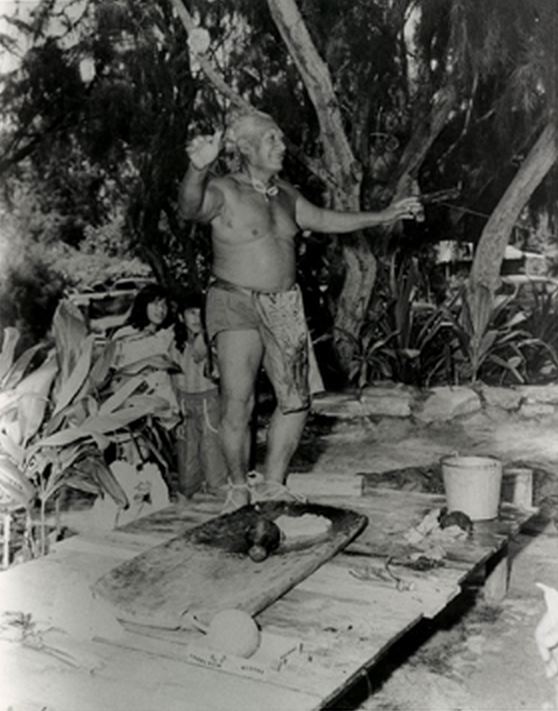
Most point to Hamana Kalili (June 18, 1882 – December 17, 1958) as its originator.

In 1985, 550 people signed a petition giving credit to Hamana Kalili, a big man on Lāʻie beach and in the Mormon Church during the 1920s and 1930s. Kalili was a folk hero — fisherman, tug of war champion and hukilau organizer of the community.  (Krauss)

Beatrice Ayer Patton (Mrs. George S Patton – Patton was stationed on Oʻahu during the mid-1920s) described Kalili as “a magnificent example of the pure Hawaiian. A man in his sixties, with white hair and a deeply carven face, he had the body and reactions of a teenager.”

“He lived and fished on the windward side of the island. … We went to several luaus … they were the real thing”.  (Patton-Totten)

When fellow Mormons in Lāʻie planned a hukilau to raise funds to replace their chapel that had burned down, they turned to Kalili, a renowned fisherman, for help; Kalili supplied the nets for fishing.  He also portrayed King Kamehameha during the entertainment portion of the hukilau.

To make a simple Shaka: make a fist (not a tight fist;) extend both your pinky and your thumb and lightly shake your hand.  (The Shaka sign resembles the American Sign Language letter for Y.)  There are multiple variations on the finger extension, speed of shake, etc.

Kalili’s Shaka didn’t start this way.

Prior to 1937, Hamana Kalili had lost his second, third and fourth fingers of one hand in an accident. 

Kalili’s grandnephew Vonn Logan explained that Kalili’s job was to feed sugar cane into the rollers at the sugar mill, which would squeeze out the juice. He lost his fingers when his hand got caught in the rollers.  (Star-Bulletin)

“..he had lost three fingers on his hand.  So, you know since we were making fun of him, but we would wave to him … (gestures waving with three middle fingers folded down) And we folded our fingers on our hand to show what his hand look like.”

“And we would wave to him, and he would wave back at us.  And we would laugh, because he would wave back to us without his fingers. … he was always like a father to us in the community.”  (Roland Maʻiola “Ahi” Logan; Kepa Maly)

“One of his jobs was to keep all the kids off the train.  All the kids would try to jump the train to ride from town to town. So they started signaling each other. Since (Kalili) lost his fingers, the perfect signal was what we have now as the ‘shaka sign.’ That’s how you signaled the way was clear.”  (Logan; Star-Bulletin)

In the late 60s. we put a lot of effort, and was able to convince Mayor Fasi and other people about the ‘shaka’ sign.  And Mayor Fasi took it upon himself to declare that Hamana Kalili was the originator.  And we were all in the Mayor Fasi’s office to take credit for my granduncle.”  (Logan; Maly)

A local car salesman, David “Lippy” Espinda, picked up on the Shaka sign and used it and his pidgin language in his TV commercials.   He emceed his own show, “Lippy’s Lanai Theater.”

Much sought after as a benefit auctioneer and banquet speaker, he appeared in “Hawaii Five-O” and “Brady Bunch” segments and had minor parts in some movies.

“Shaka, Brah,” was his trademark and he popularized the “Shaka” sign.  (Star-Bulletin)

Politicians used the “Shaka,” as well.  Frank Fasi used it while campaigning for Mayor of Honolulu in the mid-seventies.

In a 1999 Star-Bulletin interview, Fasi credited the late Bill Pacheco with using the sign and saying “shaka brother.”  “I think he meant shake it up, buddy. How’s it going? Aloha. Have a good day. All those good meanings. It just meant a world of goodness”.

© 2023 Hoʻokuleana LLC

Filed Under: Prominent People, General, Hawaiian Traditions Tagged With: Hawaii, Oahu, Laie, Shaka, Lippy Espinda, Hamana Kalili

  • 1
  • 2
  • Next Page »

Images of Old Hawaiʻi

People, places, and events in Hawaiʻi’s past come alive through text and media in “Images of Old Hawaiʻi.” These posts are informal historic summaries presented for personal, non-commercial, and educational purposes.

Info@Hookuleana.com

Connect with Us

  • Email
  • Facebook
  • LinkedIn
  • Twitter
  • YouTube

Recent Posts

  • Beauty Hole
  • Junior … Intermediate … Middle
  • Ossipoff Meets Mid-19th Century
  • Waikapū
  • Four Horsemen
  • Prince Jonah Kūhiō Kalanianaʻole Piʻikoi
  • Tutasi

Categories

  • Sailing, Shipping & Shipwrecks
  • Economy
  • Voyage of the Thaddeus
  • Mayflower Summaries
  • American Revolution
  • General
  • Ali'i / Chiefs / Governance
  • Buildings
  • Missionaries / Churches / Religious Buildings
  • Hawaiian Traditions
  • Military
  • Place Names
  • Prominent People
  • Schools

Tags

Albatross Al Capone Ane Keohokalole Archibald Campbell Bernice Pauahi Bishop Charles Reed Bishop Downtown Honolulu Eruption Founder's Day George Patton Great Wall of Kuakini Green Sea Turtle Hawaii Hawaii Island Hermes Hilo Holoikauaua Honolulu Isaac Davis James Robinson Kamae Kamaeokalani Kameeiamoku Kamehameha Schools Lalani Village Lava Flow Lelia Byrd Liberty Ship Liliuokalani Mao Math Mauna Loa Midway Monk Seal Northwestern Hawaiian Islands Oahu Papahanaumokuakea Marine National Monument Pearl Pualani Mossman Quartette Thomas Jaggar Volcano Waikiki Wake Wisdom

Hoʻokuleana LLC

Hoʻokuleana LLC is a Planning and Consulting firm assisting property owners with Land Use Planning efforts, including Environmental Review, Entitlement Process, Permitting, Community Outreach, etc. We are uniquely positioned to assist you in a variety of needs.

Info@Hookuleana.com

Copyright © 2012-2024 Peter T Young, Hoʻokuleana LLC


Loading Comments...