Images of Old Hawaiʻi

  • Home
  • About
  • Categories
    • Ali’i / Chiefs / Governance
    • American Protestant Mission
    • Buildings
    • Collections
    • Economy
    • Missionaries / Churches / Religious Buildings
    • General
    • Hawaiian Traditions
    • Other Summaries
    • Mayflower Summaries
    • Mayflower Full Summaries
    • Military
    • Place Names
    • Prominent People
    • Schools
    • Sailing, Shipping & Shipwrecks
    • Voyage of the Thaddeus
  • Collections
  • Contact
  • Follow

June 23, 2019 by Peter T Young Leave a Comment

The New “Big 5”

This story was inspired by a luncheon talk former OHA Trustee, Peter Apo gave to the Hawaiʻi Economic Association I attended. Although he hinted at the “Big 5” reference, he purposefully referenced it differently.

Since the early/mid-1800s, until relatively recently, five major companies emerged and dominated the state’s economic framework. Their common trait: they were founded in agriculture – sugar and pineapple.

They became known as the Big 5: Amfac – starting as Hackfeld & Company (1849;) Alexander & Baldwin (1870;) Theo H. Davies (1845;) Castle & Cooke (1851) and C. Brewer (1826.)

The luncheon talk suggested a new group of five is making a difference in Hawaiʻi’s economic scene.

The new “Big 5:” Kamehameha Schools, Queen Emma Foundation/Queens Health Systems, Department of Hawaiian Home Lands, Office of Hawaiian Affairs and Queen Liliʻuokalani Trust.

Their common trait: they are entities formed from or for native Hawaiians.

Kamehameha Schools (KS)

The largest, Kamehameha Schools (KS) was founded under the terms of the 1884 will of Bernice Pauahi Bishop and is supported by the land assets she provided to support the schools.

The Princess noted in her will that a trust is “to erect and maintain in the Hawaiian Islands two schools, each for boarding and day scholars, one for boys and one for girls, to be known as, and called the Kamehameha Schools.”

She further stated, “I desire my trustees to provide first and chiefly a good education in the common English branches, and also instruction in morals and in such useful knowledge as may tend to make good and industrious men and women”.

Through the legacy of its founder, KS is endowed with 365,000-acres of land statewide, ninety-eight percent of which is in agriculture and conservation.

KS has about 1,000 agricultural tenants who farm a variety of crops including coffee, papaya, pineapple, macadamia nuts, lettuce, asparagus, sweet potatoes, taro, watercress, avocado, bananas, tomatoes, cattle, aquaculture, and more.

Kamehameha Schools has net assets of nearly $7-billion and annual operating revenue of $1.34-billion.

Queen Emma Foundation/Queens Health Systems

The Queen’s Hospital, now called The Queen’s Medical Center, was founded in 1859 by Queen Emma and King Kamehameha IV.

Queen Emma Land Company was established to support the Queen’s Medical Center and its affiliates and accomplishes this by managing and enhancing income-generating potential of the lands left to the Queen’s Hospital by Queen Emma in 1885 and additional properties owned by the Queen’s Health Systems.

Today, the Queen’s Health Systems is Hawaiʻi’s oldest health care-related family of companies, ranking 13th in size among Hawaiʻi’s corporations and employing approximately 3,700 employees with net revenues of roughly $516-million.

Department of Hawaiian Home Lands (DHHL)

Written in 1920 and passed in 1921 by the US Congress, the “Hawaiian Homes Commission Act” established a structure and framework for the establishment of the Department of Hawaiian Home Lands (DHHL) to enable native Hawaiians to return to their lands in order to fully support self-sufficiency for native Hawaiians and the self-determination of native Hawaiians.

The principal purposes of the Act: establishing a permanent land base for the benefit and use of native Hawaiians; placing native Hawaiians on the lands; preventing alienation of the fee title to the lands set aside so that these lands will always be held in trust for continued use by native Hawaiians in perpetuity …

… providing adequate amounts of water and supporting infrastructure, so that homestead lands will always be usable and accessible; and providing financial support and technical assistance to native Hawaiian beneficiaries.

When considering development and use of its lands, DHHL asserts its land use authority over Hawaiian Home Lands through its General Plan and Island Plans and is exempt from State and County land classification requirements.

DHHL has net assets of approximately $717-million and annual operating revenue of over $12-million, plus on-going capital improvement/development expenditures.

Office of Hawaiian Affairs (OHA)

Amendments to the State Constitution in 1978 established the Office of Hawaiian Affairs (OHA.) Those amendments also established a board of trustees for the Office of Hawaiian Affairs.

The Office of Hawaiian Affairs is a semi-autonomous state agency created “to address the needs of the aboriginal class of people of Hawaii.”

Duties of the Board of Trustees include, “hold title to all the real and personal property now or hereafter set aside or conveyed to it which shall be held in trust … (as well as) manage and administer the proceeds from the sale or other disposition of the lands, natural resources, minerals and income derived from whatever sources for native Hawaiians and Hawaiians”.

Recently, it was announced that the State and OHA settled disagreements on past ceded land payments. The State is giving about 25 acres of land to OHA, worth $200 million.

This is added to its existing inventory of Wao Kele O Puna (25,800+ acres,) Waimea Valley (1,800-acres) and other smaller properties.

The Office of Hawaiian Affairs has net assets of over $650-million and operating revenue of over $40-million.

The Liliʻuokalani Trust (QLT)

In 1909, Queen Liliʻuokalani executed a Deed of Trust that established the legal and financial foundation of an institution dedicated to the welfare of orphaned and destitute children of Hawaiʻi.

Her Deed of Trust states that “all the property of the Trust Estate, both principal and income … shall be used by the Trustees for the benefit of orphan and other destitute children in the Hawaiian Islands, the preference given to Hawaiian children of pure or part-aboriginal blood.”

The trust owns approximately 6,200-acres of Hawaiʻi real estate, the vast majority of which is located on the Island of Hawaiʻi. 92% is agriculture/conservation land, with the remaining land zoned for residential, commercial and industrial use.

The trust owns approximately 16-acres of Waikīkī real estate and another 8-acres of commercial and residential real estate on other parts of Oʻahu. It has operating revenues of approximately $40-million.

In addition to these land holdings, the Legislature created the Kahoʻolawe Island Reserve Commission (KIRC) to manage the Kahoʻolawe Island Reserve while it is held in trust for a future Native Hawaiian sovereign entity.

While most of the prior “Big 5” have slowly faded away and no longer influence Hawaiʻi’s economy as in the past, these other five have a growing presence and influence in Hawaiʻi’s future.

Follow Peter T Young on Facebook 

Follow Peter T Young on Google+ 

Follow Peter T Young on LinkedIn  

Follow Peter T Young on Blogger

© 2019 Hoʻokuleana LLC

Hawaiian-Big_5-Statewide
New_Big_5-Kauai_County
New_Big_5-Oahu
Hawaiian-Big_5-Downtown-Kakaako
Hawaiian-Big_5-Waikiki
New_Big_5-Maui_County
New_Big_5-Hawaii_Island

Filed Under: General, Economy Tagged With: Big 5, Queen Emma, Queen's Medical Center, Kahoolawe, OHA, Hawaii, Office of Hawaiian Affairs, Bernice Pauahi Bishop, QLT, Kamehameha Schools, KSBE, Queen Liliuokalani, DHHL, Department of Hawaiian Home Lands

May 16, 2017 by Peter T Young Leave a Comment

Timeline Tuesday … 1980s

Today’s ‘Timeline Tuesday’ takes us through the 1980s – bombing halted at Kaho‘olawe, Alexander Young Building demolished, enactment of State Water Code and over 1,000 ancient human remains discovered on land being developed by the Ritz-Carlton on Maui. We look at what was happening in Hawai‘i during this time period and what else was happening around the rest of the world.

A Comparative Timeline illustrates the events with images and short phrases. This helps us to get a better context on what was happening in Hawai‘i versus the rest of the world. I prepared these a few years ago for a planning project. (Ultimately, they never got used for the project, but I thought they might be on interest to others.)

Follow Peter T Young on Facebook 

Follow Peter T Young on Google+ 

Follow Peter T Young on LinkedIn  

Follow Peter T Young on Blogger

© 2017 Hoʻokuleana LLC

Timeline-1980s

Filed Under: Economy, General, Buildings, Place Names Tagged With: Ron Rewald, Honokahua, Commission on Water Resource Management, Timeline Tuesday, Timeline, Population, Great Aloha Run, Hawaii, Kilauea, Kahoolawe

November 24, 2015 by Peter T Young 1 Comment

Kahoʻolawe

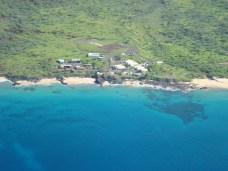
Kaho‘olawe is the smallest of the eight Main Hawaiian Islands, 11-miles long and 7-miles wide (approximately 28,800-acres,) rising to a height of 1,477-feet. It is seven miles southwest of Maui.

Archaeological evidence suggests human habitation began as early as 1000 AD; it is known as a navigational and religious center, as well as the site of an adze quarry. Subsistence farmers and fishers formerly populated Kaho‘olawe.

Interestingly, the entire island of Kaho‘olawe is part of an ahupua‘a from the Maui district of Honua‘ula. The island is divided into ʻili (smaller land units within ahupua‘a.)

Kekāuluohi “made Kahoʻolawe and Lānaʻi penal settlements for law breakers to punish them for such crimes as rebellion, theft, divorce, breaking marriage vows, murder and prostitution.” (Kamakau)

The first prisoners exiled to Kahoʻolawe were a Hawaiian man convicted of theft, and a woman accused of prostitution, both of whom were sent to the island on June 13, 1826. (Reeve; KIRC)

“The village is a collection of eight huts, and an unfinished adobe church. The chief has three large canoes for his use. In passing over the island, the walking had been found very tedious; for they sunk ankle-deep at each step.”

“The whole south part is covered with a light soil, composed of decomposed lava; and is destitute of vegetation, except a few stunted shrubs.”

“On the northern side of the island, there is a better soil, of a reddish colour, which is in places susceptible of cultivation. Many tracks of wild hogs were seen, but only one of the animals was met with.”

“The only article produced on the island is the sweet-potato, and but a small quantity of these. All the inhabitants are convicts, and receive their food from Maui: their number at present is about fifteen.”

“Besides this little cluster of convicts’ huts, there are one or two houses on the north end, inhabited by old women. Some of the convicts are allowed to visit the other islands, but not to remain.” (Wilkes, 1845)

The “Act of Grace” of Kamehameha III, in commemoration of the restoration of the flag by Admiral Thomas July 31, 1843, let “all prisoners of every description” committed for offenses during the period of cession “from Hawaiʻi to Niʻihau be immediately discharged,” royal clemency was apparently extended to include prisoners of earlier conviction. (Thrum)

Located in the “rain shadow” of Maui’s Haleakala, rainfall has been in short supply on Kaho‘olawe. Historically, a “cloud bridge” connected the island to the slopes of Haleakalā. The Naulu winds brought the Naulu rains that are associated with Kaho‘olawe (a heavy mist and shower of fine rain that would cover the island.)

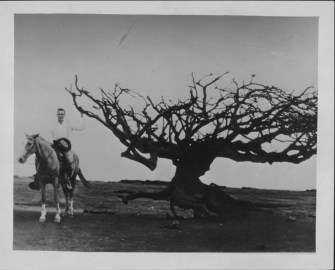
In 1858 the first lease of Kahoʻolawe was sold at public auction. Plans were made to turn the Island into a sheep ranch. From then until World War II, Kahoʻolawe was effectively used as a livestock ranch.

A constant theme from 1858 on was elimination of wild animals that were destroying the vegetation. At first wild dogs, hogs, and goats were the predators. By the end of the 19th century, grazing of cattle, goats and sheep were the destroyers. (King; KIRC)

“The Island of Kahoolawe consists of one government land, at present under an expiring lease held by Mr Eben P Low, that runs out on January 1, 1913. This lease was formerly held by Mr. CC Conradt, now of Pukoʻo, Molokai, and was transferred by him to Mr Low a few years since.”

“Prior to that time the island had passed through many hands. It has been used continuously for many years for the grazing of cattle, and especially of sheep.” (Hawaiian Forester, 1910)

“A great part of the time it has been badly overstocked, a condition which has resulted in the destruction of the original cover of vegetation, followed by erosion and the loss of large quantities of valuable soil, much of which has literally been blown away to sea by the strong trade wind.”

“As the result of long years of overstocking, Kahoolawe has become locally a name practically synonymous with desolation and waste. The object of declaring the island a forest reserve is to put it in a position where, upon the expiration of the existing lease, effective steps could be taken toward its reclamation.” (Hawaiian Forester, 1910)

The Island was a forest reserve from August 25, 1910 to April 20, 1918. But, it was determined, “(I)t would be a foolish waste of money to attempt to reforest the bare top of the island; that for the good of the island the remaining sheep and goats should be exterminated or entirely removed”. (Hawaiian Forester, 1918)

“(T)here is a vast area of pili grass valuable for fattening cattle for the market and tons of algaroba beans on the island going to waste annually; that under a carefully prepared lease of the island with due restrictions and limitations good use could be made of these and at the same time the goats could be required to be exterminated.” (Hawaiian Forester, 1918)

While ranching restarted with a lease to Kahoʻolawe Ranch, it was a later use that further impacted the Island. Military practice bombing of the island is reported to have begun as early as 1920. (Lewis; american-edu)

Then, in May 1941, Kahoʻolawe Ranch signed a sublease for a portion of the island with the US Navy for $1 per year to 1952, when the Ranch’s lease expired. Seven months later, following the attack on Pearl Harbor and initiation of martial law, the military took over the whole island and ranching operations ended. (PKO)

Bombing of the island continued to 1990. Then, in 1992, the State of Hawai‘i designated Kahoʻolawe as a natural and cultural reserve, “to be used exclusively for the preservation and practice of all rights customarily and traditionally exercised by Native Hawaiians for cultural, spiritual, and subsistence purposes.” (KIRC)

In 1993, Congress voted to end military use of the Island and authorized $400-million for ordnance removal. In 2004, The Navy ended the Kahoʻolawe UXO Clearance Project.

At its completion, approximately 75% of the island was surface cleared of unexploded ordnance (UXO). Of this area, 10% of the island, or 2,647 acres, was additionally cleared to the depth of four feet. Twenty-five percent, or 6,692 acres, was not cleared and unescorted access to these areas remains unsafe. (KIRC)

With the help of hard work by volunteers and Kahoolawe Island Reserve Commission (KIRC) staff, the island is healing and recovering. Kahoʻolawe is being planted with native species that include trees, shrubs, vines, grasses and herbs.

Every year, the planting season begins with a ceremony that consists of appropriate protocols, chants, and hoʻokupu given at a series of rain koʻa shrines that were built in 1997.

The shrines link ʻUlupalakua on Maui to Luamakika, located at the summit of Kahoʻolawe, seeking to call back the cloud bridge and the rains that come with it.

I was fortunate to have served on the Kahoʻolawe Island Reserve Commission (KIRC) for 4½-years and had the opportunity to visit and stay overnight on Kaho‘olawe; the experiences were memorable and rewarding.

Follow Peter T Young on Facebook 

Follow Peter T Young on Google+ 

Follow Peter T Young on LinkedIn  

Follow Peter T Young on Blogger

© 2015 Hoʻokuleana LLC

Kahoolawe-USGS-(LOC)-1926
aerial-kahoolawe
aerial-kahoolawe
Cloud Bridge - Kahoolawe to Maui
Cloud Bridge – Kahoolawe to Maui
Cloud Bridge - Maui to Kahoolawe
Cloud Bridge – Maui to Kahoolawe
Kahoolawe-PP-46-10-03400001
Kahoolawe-PP-46-10-038
Kahoolawe-PP-46-10-034
Kahoolawe-PP-46-10-033
Kahoolawe-PP-46-10-032
Kahoolawe-PP-46-10-017
Kahoolawe-PP-46-10-015
Kahoolawe-PP-46-10-041
Kahoolawe South-hellers
Kahoolawe_South-hellers
Kahoolawe-planting-hellers
KIRC Place names
KIRC Place names

Filed Under: Military, Place Names, Economy, Ali'i / Chiefs / Governance Tagged With: Hawaii, Kahoolawe

  • « Previous Page
  • 1
  • 2

Images of Old Hawaiʻi

People, places, and events in Hawaiʻi’s past come alive through text and media in “Images of Old Hawaiʻi.” These posts are informal historic summaries presented for personal, non-commercial, and educational purposes.

Info@Hookuleana.com

Connect with Us

  • Email
  • Facebook
  • LinkedIn
  • Twitter
  • YouTube

Recent Posts

  • 250 Years Ago … Comparing American & Hawaiian ‘Declarations’ … and War
  • Waikiki Beach
  • Cats and Dogs
  • “Ka ʻaina a Kane-huna-moku”
  • Experiment Stations
  • 250 Years Ago … Plot to Kill George Washington
  • Tydings-McDuffie

Categories

  • Buildings
  • Missionaries / Churches / Religious Buildings
  • Hawaiian Traditions
  • Military
  • Place Names
  • Prominent People
  • Schools
  • Sailing, Shipping & Shipwrecks
  • Economy
  • Voyage of the Thaddeus
  • Mayflower Summaries
  • American Revolution
  • General
  • Ali'i / Chiefs / Governance

Tags

Albatross Al Capone Ane Keohokalole Archibald Campbell Bernice Pauahi Bishop Charles Reed Bishop Downtown Honolulu Eruption Founder's Day George Patton Great Wall of Kuakini Green Sea Turtle Hawaii Hawaii Island Hermes Hilo Holoikauaua Honolulu Isaac Davis James Robinson Kamae Kamaeokalani Kameeiamoku Kamehameha Schools Lalani Village Lava Flow Lelia Byrd Liberty Ship Liliuokalani Mao Math Mauna Loa Midway Monk Seal Northwestern Hawaiian Islands Oahu Papahanaumokuakea Marine National Monument Pearl Pualani Mossman Quartette Thomas Jaggar Volcano Waikiki Wake Wisdom

Hoʻokuleana LLC

Hoʻokuleana LLC is a Planning and Consulting firm assisting property owners with Land Use Planning efforts, including Environmental Review, Entitlement Process, Permitting, Community Outreach, etc. We are uniquely positioned to assist you in a variety of needs.

Info@Hookuleana.com

Copyright © 2012-2024 Peter T Young, Hoʻokuleana LLC

Loading Comments...